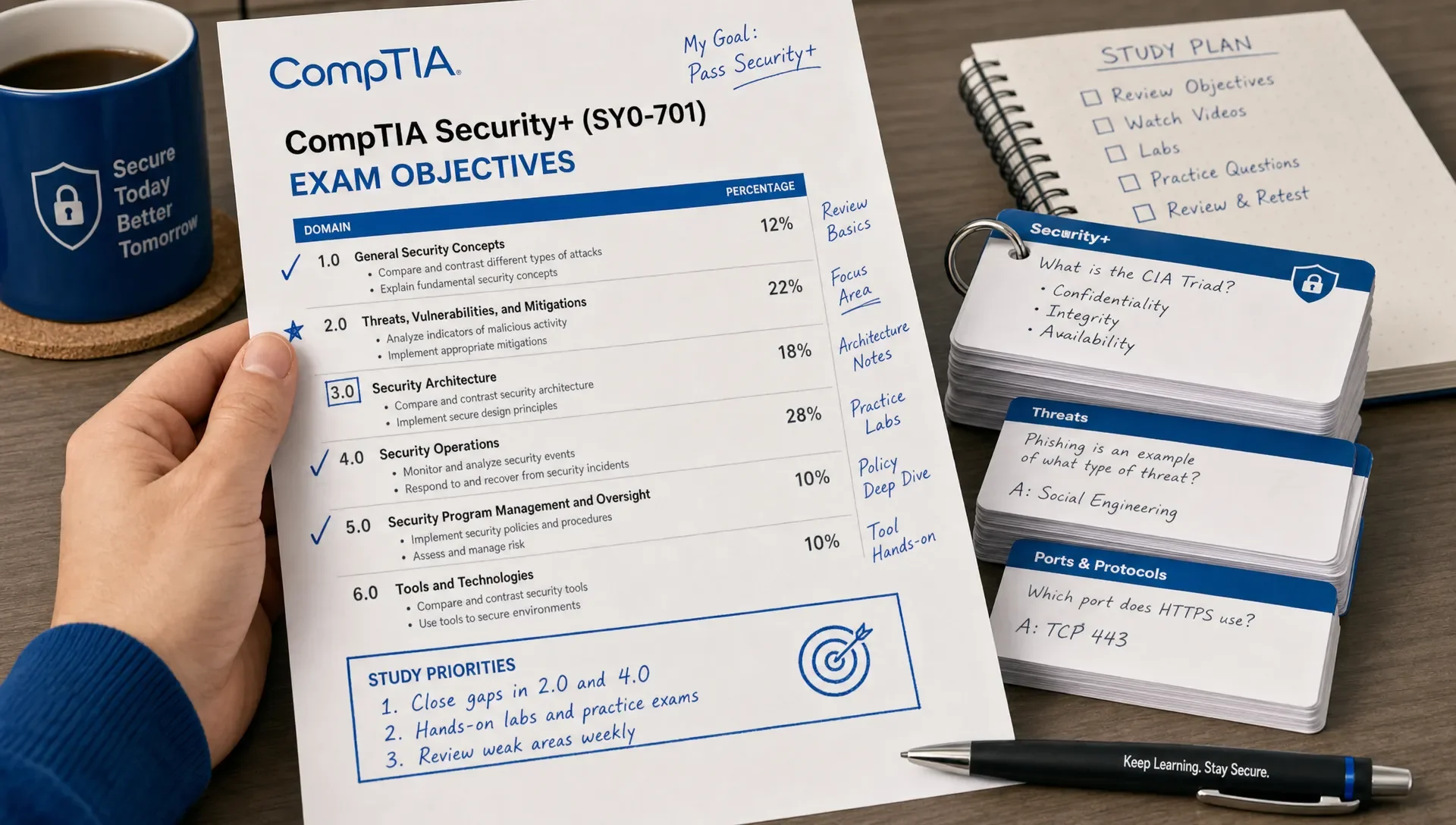
CompTIA Certification Exam Prep by Career Goal
CompTIA Certification Exam Prep by Career Goal
You should choose a CompTIA certification exam based on the job you want next, not because it looks popular on a forum or sounds easier than another option. Start with the role, then build your preparation around the tasks that role requires: troubleshooting, networking, security operations, cloud infrastructure, or advanced risk management.
Use this guide to choose a practical path, focus your study time, and avoid wasting weeks on material that doesn't support your career goal. If you still need the basic process for registration, scheduling, and exam-day setup, MindMesh Academy's guide on how to get a CompTIA certification is a useful companion.
CompTIA certification exam prep starts with the job you want
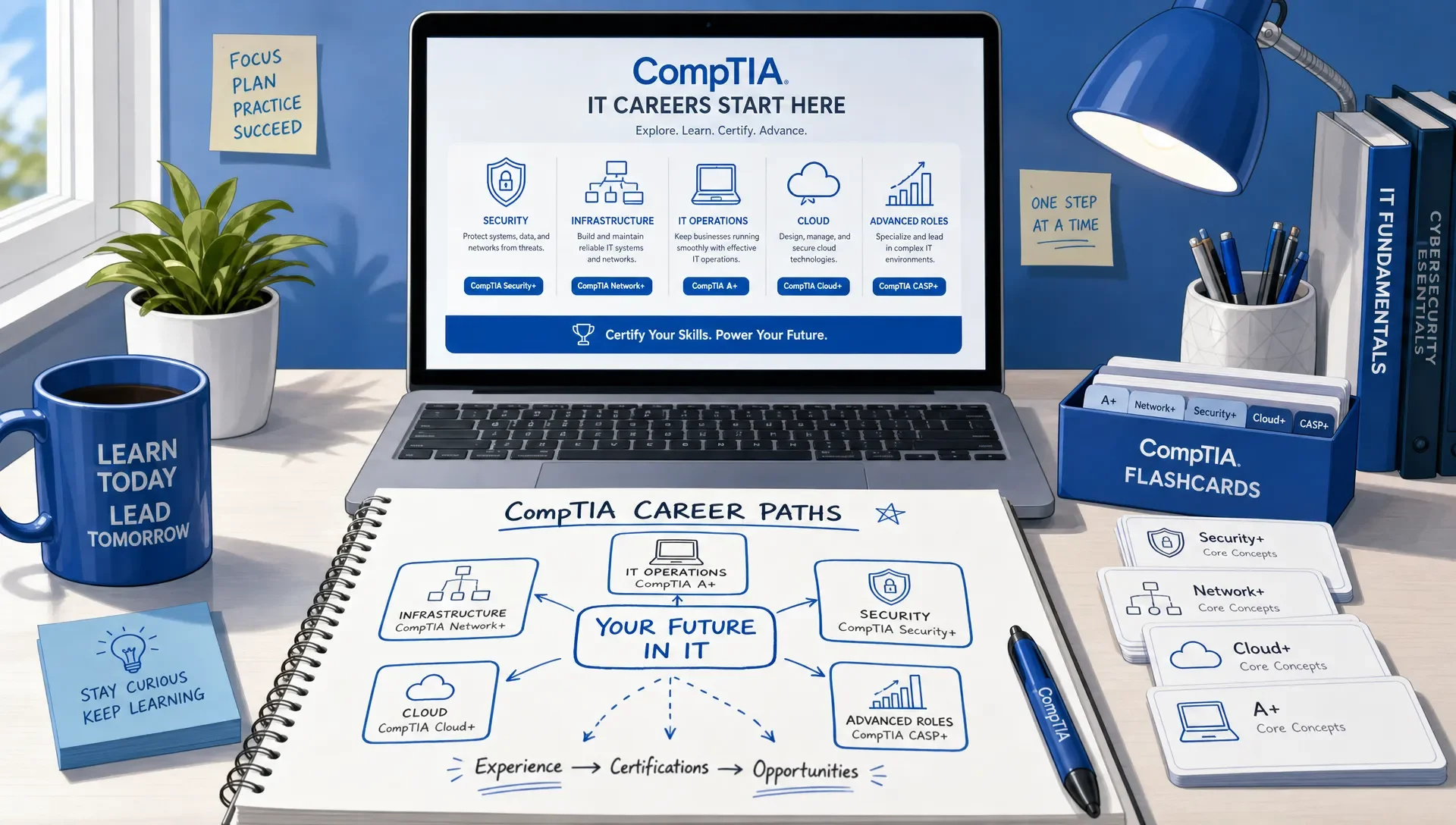
CompTIA certifications are vendor-neutral. This means they test skills and concepts that apply across many tools and environments. That makes them useful for learners who want to enter IT, validate a broad foundation, or move toward a specialty without locking themselves into one product ecosystem.
The mistake is treating the path as a fixed ladder for everyone. A future help desk technician doesn't need the same first 90 days of study as someone already working in IT who wants to move into security analysis. CompTIA's official certification pages group credentials across infrastructure, cybersecurity, data, and professional skills, which is a helpful way to think about career direction before choosing an exam.
| Career goal | Best starting point | Likely next step | What your prep should emphasize |
|---|---|---|---|
| Break into IT support | Tech+ or A+ | Network+ | Devices, operating systems, troubleshooting and customer-facing support |
| Move into networking | Network+ | Security+ or vendor networking | IP addressing, routing, switching, wireless and network operations |
| Start cybersecurity | Security+ | CySA+ or PenTest+ | Threats, controls, identity, risk and incident response |
| Work in systems or cloud | A+, Network+ or Cloud+ | Server+, Linux+ or cloud vendor certs | Compute, storage, virtualization, cloud models and infrastructure support |
| Advance in security | CySA+, PenTest+ or SecurityX | Role-specific leadership or architecture credentials | Governance, detection, architecture, testing and enterprise risk |
If a CompTIA certification exam doesn't connect to your target role, your motivation will drop because the material feels random. When every domain maps to a job task, practice questions become diagnostic instead of just stressful.
Best CompTIA path for help desk and IT support roles
For a first IT job, the usual decision is whether to begin with Tech+ or A+. Tech+ fits complete beginners who need confidence with basic IT concepts before committing to a technical support path. A+ aligns more directly with entry-level support work because it covers hardware, operating systems, networking basics, security, and operational procedures.
The official CompTIA A+ certification page describes it as a credential for core skills needed for modern IT support roles. That matters because help desk work is rarely one narrow topic. You might troubleshoot a laptop in the morning, reset access in the afternoon, and document a recurring printer issue before the end of the day.
What to prioritize for IT support prep
For this goal, your CompTIA certification exam preparation should focus on recognition plus troubleshooting. You need to identify components, settings, and symptoms quickly, then choose the next best step without overcomplicating the problem.
Spend extra time on:
- Hardware components and device troubleshooting
- Windows, macOS, Linux, mobile, and common support workflows
- Basic TCP/IP, Wi-Fi, and network connectivity checks
- Account security, malware symptoms, and safe operational habits
- Ticket documentation, change control, and professional communication
If A+ is your target, use exam objectives as the outline instead of studying random chapters. MindMesh Academy's CompTIA A+ certification study guide by exam domain can help you organize the two-core structure into smaller study blocks.
Best CompTIA path for networking and infrastructure roles
Network+ is usually the right anchor for learners who want NOC, junior network administrator, field technician, or infrastructure support roles. It gives you the vocabulary and troubleshooting patterns needed to understand why systems can talk to each other, why they sometimes can't, and how to isolate the fault.
The official CompTIA Network+ certification focuses on networking concepts, implementation, operations, security, and troubleshooting. For career planning, that blend is important. Networking jobs aren't only about memorizing port numbers. You need to reason through symptoms across cabling, switching, routing, DNS, DHCP, wireless, and security controls.
What to practice for networking roles
The right CompTIA certification exam for a networking goal should push you to explain what happens between endpoints. If you can't describe how a device gets an IP address, resolves a hostname, and reaches a remote service, you have a skill gap that practice questions alone won't fix.
A useful preparation cycle looks like this:
- Draw small network diagrams by hand and label the traffic path
- Drill subnetting until you can explain the method, not just the answer
- Review ports in context, such as which service uses them and why
- Practice troubleshooting from Layer 1 upward
- Use performance-based questions to test configuration and diagnosis skills
For a deeper Network+ plan, MindMesh Academy's CompTIA Network Plus guide breaks down the exam's role in career growth and the skills that deserve the most attention.
Best CompTIA path for cybersecurity roles
Security+ is the common starting point for cybersecurity because it builds a broad foundation across threats, architecture, identity, operations, risk, and governance. It also helps IT support and networking learners understand why certain controls exist, not just how to configure them.
The official CompTIA Security+ certification page positions it around baseline cybersecurity skills. That makes it especially relevant if you want to move toward SOC analyst, junior security analyst, systems administrator with security responsibilities, or compliance-adjacent IT work.
How to choose between Security+, CySA+, and PenTest+
For a security path, CompTIA certification exam preparation should match whether you want to defend systems, test systems, or build toward higher-level security responsibilities.
Security+ is the baseline.
CySA+ leans toward detection, analysis, and response.
PenTest+ leans toward authorized offensive testing and reporting.
| Security career direction | Strong exam focus | Prep should include |
|---|---|---|
| SOC analyst | Security+ then CySA+ | Logs, alerts, incident response, vulnerability management and threat behavior |
| Security-minded sysadmin | Security+ | Hardening, identity, secure protocols, access control and operational procedures |
| Penetration testing path | Security+ then PenTest+ | Scoping, reconnaissance, exploitation concepts, tools and reporting |
| Senior security path | CySA+, PenTest+ or SecurityX | Architecture, risk, governance, enterprise controls and leadership-level decisions |
If Security+ is your current target, a realistic practice workflow matters. MindMesh Academy's CompTIA Security+ practice exam includes practice questions and explanations so you can identify weak domains before the real exam.
Best CompTIA path for cloud, systems, and hybrid infrastructure
Cloud roles are rarely only about cloud. Employers often expect you to understand networking, identity, compute, storage, operating systems, and security before you touch a production cloud environment. That's why A+, Network+, Security+, Linux+, Server+, and Cloud+ can all make sense depending on your background.
If you're starting from zero, build a foundation first. A+ and Network+ make cloud concepts easier because virtual networks, load balancing, identity permissions, and storage services depend on infrastructure basics. If you're already supporting servers or networks, Cloud+ may be a more direct fit because it validates broader cloud operations and architecture concepts.
How to avoid skipping prerequisites
A CompTIA certification exam in the cloud or systems track will feel much harder if you don't understand the underlying services. For example, learning cloud security groups is easier when you already understand ports, protocols, and network segmentation. Learning virtual machines is easier when you understand CPU, memory, storage, and operating system installation.
Use this simple decision rule: if a term appears in the objective list and you can only define it from memory, you're not done. You should be able to use it in a scenario, recognize a misconfiguration, and explain the business impact of fixing it.
How to build a weekly study plan by career goal
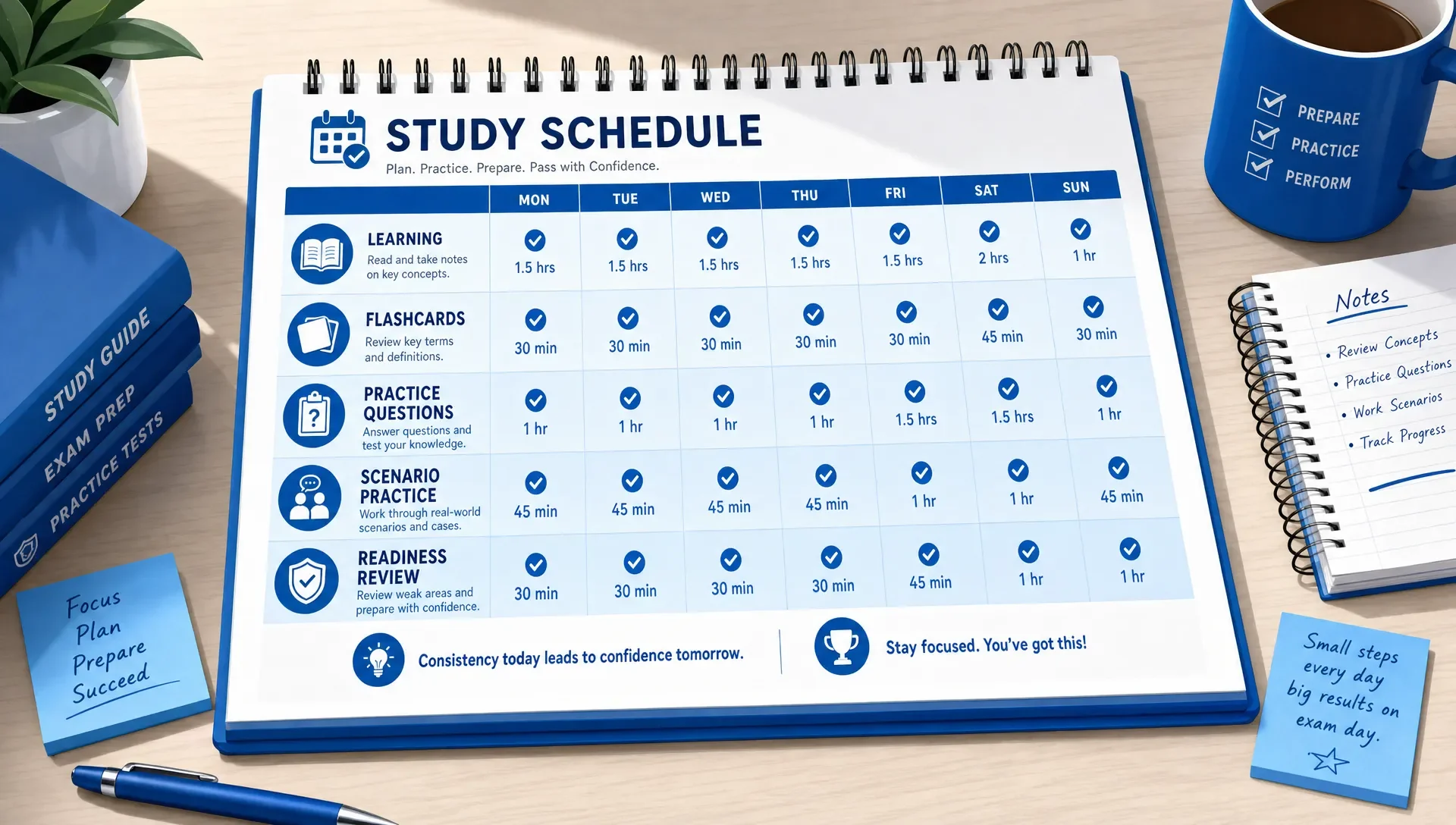
A weekly CompTIA certification exam plan should combine learning, retrieval, and targeted repair. Reading alone feels productive, but it doesn't reliably expose what you can't recall under pressure. The Institute of Education Sciences practice guide on organizing instruction and study to improve student learning recommends techniques such as spaced study and quizzing because they strengthen retention and retrieval.
The exact number of hours depends on your background, but the structure should stay consistent. You need enough new learning to cover the objectives, enough review to prevent forgetting, and enough scenario practice to prepare for performance-based questions.
| Weekly availability | Best structure | Who it fits |
|---|---|---|
| 4 to 5 hours | Three short study sessions plus one review session | Busy learners maintaining momentum |
| 6 to 8 hours | Two concept sessions, two practice sessions and one review block | Most learners preparing alongside work or school |
| 10 or more hours | Domain study, labs or simulations, practice exams and error review | Learners with a near exam date or prior experience |
MindMesh Academy supports this kind of workflow with study guides by exam objectives, practice questions and explanations, spaced-repetition flashcards, adaptive weakness-based practice, and readiness tracking. That combination is helpful because your plan should change as your weak topics become visible.
How to know you're ready for a CompTIA certification exam
Readiness is not the same as finishing a course. You're ready when you can handle unfamiliar scenarios, explain why wrong answers are wrong, and perform consistently across domains instead of relying on one strong area to carry your score.
Before scheduling, check these signals:
- You can explain each exam domain in plain language without reading notes
- Your practice misses are concentrated in a few fixable topics, not spread everywhere
- You review every missed question and write the reason for the miss
- You can answer scenario questions without hunting for keywords only
- You have practiced performance-based question formats, not only multiple choice
- You know the official exam objectives and haven't skipped low-interest domains
Practice scores can help, but don't let a single number make the decision for you. Look at consistency, topic coverage, and the quality of your explanations. If you guessed correctly on several questions, treat those as misses during review.
What to do if your career goal changes mid-prep
Career goals change often, especially once you learn what different IT roles actually do. That doesn't mean your study time was wasted. A learner who starts with A+ and becomes interested in networking has still built useful troubleshooting knowledge. A Security+ learner who realizes they prefer cloud operations has still gained essential security context.
The key is to pivot cleanly instead of stacking too many exams at once. Finish the certification if you're close and it still supports your resume, or pause it if the next exam is clearly a better match for your target role. Don't study A+, Network+, Security+, and Cloud+ at the same time unless you already have strong experience and a very specific reason.
If you're still comparing entry-level options, MindMesh Academy's free CompTIA study guide can help you review the major paths before committing to a schedule.
Common mistakes in CompTIA exam prep by career goal
The most common preparation mistake is choosing the hardest-sounding credential instead of the most relevant one. Advanced certifications can be valuable, but they don't replace missing fundamentals. If you want cybersecurity but can't explain basic networking, Security+ will be slower, and CySA+ will be frustrating.
Another mistake is using practice exams as the main learning method too early. Practice questions are excellent for diagnosis and reinforcement, but they work best after you've built a foundation. If every question feels unfamiliar, go back to objectives, study the domain, and then return to practice.
A third mistake is ignoring performance-based questions until the final week. These items require applied thinking, so start early with scenario work. For support roles, simulate troubleshooting. For networking, read diagrams and trace traffic. For security, interpret alerts, policies, and control choices.
Frequently asked questions
Which CompTIA certification exam should I take first? If you're new to IT, start with Tech+ if you need basic computer and IT fluency, or A+ if you're ready to prepare for help desk and technical support roles. If you already have IT experience, Network+ or Security+ may be a better starting point depending on your career goal.
Is A+ required before Network+ or Security+? A+ is not always required, but it can be useful if you lack hands-on support experience. If you already understand hardware, operating systems, and basic troubleshooting, you may be able to start with Network+ or Security+.
Is Security+ enough to get a cybersecurity job? Security+ can help you qualify for entry-level security conversations, but most cybersecurity roles also value networking knowledge, operating system skills, and hands-on troubleshooting ability. Treat Security+ as a strong baseline, not the entire career plan.
How long should I study for a CompTIA exam? It depends on your background and weekly availability. A beginner may need several months for A+ or Network+, while someone with job experience may move faster. Use domain readiness and practice review quality instead of a fixed calendar.
Should I take multiple CompTIA exams back to back? Back-to-back exams can work if the topics overlap and you have a clear goal, such as A+ followed by Network+. Avoid stacking unrelated exams at the same time because it can weaken retention and make your study plan harder to manage.
How do I use practice exams without memorizing answers? Review the explanation for every question, including the ones you answered correctly by guessing. Track the objective behind each miss, write the reason you missed it, and practice similar scenarios until you can explain the concept without seeing the same question again.
Build your CompTIA prep around the role, not the rumor
The best certification path is the one that moves you closer to the work you actually want to do. Help desk, networking, cybersecurity, cloud, and advanced security roles all require different emphasis, even when the exams overlap.
Ready to focus your study and build confidence for your next IT certification? MindMesh Academy offers structured study guides, practice questions with explanations, and readiness tracking to help you prepare for exams like the CompTIA Network+. Put your knowledge to the test and prepare for your CompTIA Network+ exam with our comprehensive tools.

Written by
Alvin Varughese
Founder, MindMesh Academy
Alvin Varughese is the founder of MindMesh Academy and an enterprise architecture leader. An electrical engineer by training, he moved from factory automation in South Africa to cloud architecture at GE Appliances and Humana (Fortune 50), and holds 20 professional certifications including AWS Solutions Architect Professional, Azure DevOps Engineer Expert, and Microsoft Agentic AI Business Solutions Architect. He built MindMesh Academy after interviewing too many highly certified candidates who couldn't answer basic questions: the goal is prep that makes you better at the job, not just able to pass the exam.