CompTIA Network Plus Guide: 2026 Exam & Career
CompTIA Network+ Guide: Advancing Your IT Career in 2026
You have served as the silent fixer during IT emergencies. You handled the dead switch port, identified the unplugged cable disguised as a hardware failure, and resolved "down internet" with a three-second DNS adjustment. These tasks prove you are already performing network diagnostics, even if your official job title suggests otherwise. However, looking toward specialized roles often feels like staring at a steep climb.
Many IT professionals follow a similar trajectory. They begin at the help desk, transition to desktop support, and eventually reach basic system administration. At this stage, the career path frequently diverges. One route stays generalist, while the other focuses on vital infrastructure, cybersecurity, or cloud computing. This specialized direction requires more than troubleshooting skills; it demands a verified grasp of networking. You need a solid technical foundation that moves beyond temporary fixes to support long-term professional growth.
Your Gateway to a Modern Networking Career
One of my students worked in internal IT at a midsize company. He was excellent at hardware swaps and laptop imaging, but he hit a wall whenever a task involved VLANs or routing tables. A senior administrator always had to step in. He was an asset for daily user support, but the company did not trust him with the core infrastructure yet.
The CompTIA Network+ (N10-009) certification fixes this specific gap. It provides a logical framework for the bits of networking knowledge most people pick up through trial and error. More importantly, it proves to a manager that you understand networking as an integrated system rather than a list of isolated terms.
 Navigating the crossroads of an IT career path. CompTIA Network+ can be a decisive step towards specialization.
If you are weighing your options, explore various career paths by certification. Comparing these routes helps you decide if networking, cloud, or security fits your long-term goals.
Networking remains a vital skill because businesses run on interconnected systems. Local offices still require reliable switches, full wireless coverage, and functional routing. At the same time, IT teams now manage cloud services and hybrid environments that fail without stable networking fundamentals.
CompTIA built this as a vendor-neutral credential. It does not focus on one hardware manufacturer like Cisco or Juniper. It is not tied to one cloud provider like AWS or Azure. Instead, you study the universal principles that govern every network. This flexibility is a major advantage when you work in environments using a mix of different technologies.
Tip: If you feel like you aren't advanced enough for networking, you are likely the target candidate. This exam turns scattered practical skills into a reliable, professional foundation.
What Is CompTIA Network+ and Who Is It For?
CompTIA Network+ validates the technical skills required to troubleshoot, configure, and manage wired and wireless networks. It serves as a bridge between general IT support roles and specialized infrastructure or security positions. While the material covers essential concepts, the exam is challenging and requires a clear understanding of how data moves across physical and virtual environments.
Why vendor-neutrality matters
Vendor-neutral training functions similarly to learning the universal rules of driving. You must understand traffic laws, road signs, braking distances, and traffic flow before you choose a specific vehicle. Once you grasp these mechanics, you can operate a Ford, a Tesla, or a heavy truck with minimal adjustment because the core principles of the road do not change.
Information technology operates on the same logic. Most organizations do not rely on a single manufacturer. A typical office might use Cisco routers, Aruba switches, FortiGate firewalls, and AWS cloud instances. Network+ provides the knowledge to manage all these components by focusing on the protocols that connect them rather than the commands specific to one brand. This is a primary reason employers value the certification. A professional with this training can logically approach several critical areas:
- Traffic flow: Tracking the path of data across OSI layers, through various network hardware, and between services like DHCP, DNS, and NTP.
- Connectivity: Managing the mechanics of wired and wireless connections, along with the roles routers, switches, and firewalls play in communication.
- Issue isolation: Applying systematic troubleshooting methodologies to find specific failure points instead of relying on trial-and-error.
Who should seriously consider it
This certification serves as a professional asset for several specific groups:
- Support Professionals: Help desk technicians encounter network-related symptoms daily. This certification allows you to understand the root causes behind these issues, which improves your ability to resolve tickets without immediate escalation.
- Junior System Administrators: Many server and application errors are actually network problems. Stronger networking knowledge helps you manage administrative tasks and resolve complex problems more efficiently.
- Career Changers: Those seeking a role with more technical depth than entry-level support will find that Network+ provides a clear path into infrastructure management.
- Security Aspirants: You cannot protect a network you do not understand. This knowledge provides the basis for understanding how different systems interact and how to build secure architectures.
CompTIA recommends that candidates have the CompTIA A+ certification and 9 to 12 months of hands-on experience as a junior network administrator or support technician. The certification also aligns with NICE and DoD 8140 roles, including System Administrator and Technical Support Specialist, according to the official certification overview: https://www.comptia.org/en-us/blog/what-is-comptia-network-certification/
What the payoff can look like
The career value associated with this certification is measurable. According to U.S. Bureau of Labor Statistics data cited by CompTIA, network administrators earn an average of $86,340 annually (verify current regional rates on the BLS website). Network support specialists earn $67,510 (check current job market data for your area), and network system analysts earn $92,740 annually (verify latest salary statistics). While these figures vary by location and experience level, they indicate that networking skills are tied to well-compensated roles that remain in high demand. Source: https://www.comptia.org/en-us/blog/what-is-comptia-network-certification/
Why it still matters in modern IT
Network+ remains relevant because connectivity is the core of all modern business operations. Most companies now use hybrid environments that combine on-premise hardware with cloud services like AWS, Azure, or Google Cloud. These organizations also manage a dispersed remote workforce that relies on secure remote access.
CompTIA ensures the exam covers current cloud concepts like Network Function Virtualization (NFV), Virtual Private Clouds (VPC), and SaaS/IaaS/PaaS models. It also includes security principles such as zero-trust architecture and SASE/SSE (Secure Access Service Edge/Security Service Edge). The curriculum addresses practical topics like NAT (Network Address Translation), which remains vital because the 4.29 billion addresses available in IPv4 cannot support the projected 20 billion connected devices worldwide. This broad coverage is why students should not view Network+ as an outdated credential. It is a necessary tool for managing the dynamic and secure network environments IT professionals handle today. Source: https://www.comptia.org/en-us/blog/what-is-comptia-network-certification/
Decoding the Network+ N10-009 Exam Blueprint
The current version of the certification is N10-009. This update to the curriculum includes more focus on modern network architecture, physical infrastructure installation, and zero-trust security. To evaluate your skills, the exam uses a mix of multiple-choice questions, drag-and-drop activities, and performance-based questions: https://www.comptia.org/en-us/blog/comptia-network-industry-standard-for-tech-professionals/
To pass and earn your certification, you must reach a score of 720 on a scale that ranges from 100 to 900. CompTIA provides a detailed breakdown of these requirements in their official overview: https://www.comptia.org/en-us/blog/what-is-comptia-network-certification/
The five domains and their practical weighting
The official exam objectives are divided into five specific domains. While CompTIA does not provide the exact percentage weights for every single category, the available figures help you prioritize your study efforts. You should treat every domain as essential because the topics overlap; you cannot understand network security without first understanding how basic networking concepts function.
| Exam Domain | Percentage Weight |
|---|---|
| Networking Concepts | 23% |
| Network Implementations | Qualitatively important domain |
| Network Operations | Qualitatively important domain |
| Network Security | Qualitatively important domain |
| Network Troubleshooting | Qualitatively important domain |
CompTIA confirms that Networking Concepts represents 23% of the overall exam weight: https://www.comptia.org/en-us/blog/comptia-network-industry-standard-for-tech-professionals/
Even without a full percentage list, the domain titles show a focus on applied knowledge. This exam is not just a test of your ability to memorize definitions. It requires you to explain core concepts, perform configurations, monitor network health, apply security measures, and fix technical errors.
What each domain feels like in practice
Framing these domains through practical tasks helps you organize your study schedule:
- Networking Concepts: This foundational domain covers the OSI model, IP addressing for both IPv4 and IPv6, and the mechanics of subnetting. You will study routing principles, network topologies like star or mesh, and common ports and protocols such as DNS, DHCP, and the differences between TCP and UDP. These are the skills used to design a small office network or set up a basic VPC in a cloud environment like AWS.
- Network Implementations: This area focuses on the physical and logical steps of building a network. You will examine cabling standards like Cat6 or fiber optics, wireless standards such as 802.11ax, and the role of hardware like switches, routers, and firewalls. A typical task in this domain involves choosing the right cable for a specific distance or configuring a wireless access point to support a high density of users.
- Network Operations: This domain covers the daily management of an existing network. You will learn to use monitoring tools, maintain network documentation, and establish performance baselines. You must be able to read system logs and follow formal change management procedures. You might find yourself monitoring the performance of an Azure instance or checking firewall logs to find why a specific application is running slowly.
- Network Security: This section deals with protecting the network and its data. You will study how to harden devices, recognize attacks like DDoS or phishing, and set up access control lists (ACLs). It also covers VPNs and the implementation of zero-trust security. These tasks are what you perform to protect a remote workforce that needs to access sensitive company resources from public Wi-Fi.
- Network Troubleshooting: This is the most practical part of the exam. You must identify technical symptoms, use tools like ping, tracert, or nslookup, and apply a logical process to find the root cause of a failure. You will face scenarios where you must fix a connectivity issue or restore service after a hardware failure.
Students often spend too much time on the "Networking Concepts" domain because it feels easier to study terms. However, the exam requires you to use those concepts to solve problems. You will be asked to choose the right solution for a specific situation rather than just identifying a definition.
The PBQ problem most students discover too late
The most significant change in N10-009 is the format of the questions themselves. CompTIA has increased the use of performance-based questions (PBQs), which has created a gap for students who use low-quality study materials. Many free guides do not provide the hands-on practice needed for these interactive scenarios: https://www.comptia.org/en-us/blog/the-new-network-n10-009-exam-your-questions-answered/
PBQs test your ability to apply skills in a simulated environment. While a standard question might ask you to define a VLAN, a PBQ will place you in a simulated switch interface and ask you to assign the correct ports to a specific VLAN. You might have to plan a troubleshooting path or select the right hardware to complete a network map.
Key Takeaway: If you only use videos and flashcards to prepare, you may know the material but still struggle during the exam. Hands-on practice is essential to passing the performance-based sections.
How to read the blueprint like an instructor
When training students, I categorize the exam blueprint into three levels of mastery:
- Know it Cold: These are the essential foundations. You must understand the OSI model, IP addressing, subnetting, and routing behavior perfectly. You should be able to explain how a DNS query works or identify a private IP address range immediately.
- Recognize it in Context: This includes security concepts, cloud terms like SaaS or IaaS, and disaster recovery metrics like RTO (Recovery Time Objective) and MTBF (Mean Time Between Failures). You might not configure these every day, but you must know what they are and how they affect the network.
- Do Something With It: This is the level required for PBQs. You must be able to look at a list of symptoms, use diagnostic tools, identify the most likely cause of a problem, and perform a simulated fix. This requires you to combine your foundational knowledge with practical problem-solving skills.
The reason many capable learners struggle is not a lack of effort. It is usually a result of focusing too much on theory and failing to practice the tasks in the third category. Use a lab environment to practice these skills before your exam date.
High-Value Topics You Must Master for the Exam
Many candidates find the N10-009 exam difficult because they attempt to memorize facts without grasping the logic behind the technology. Rote memorization fails quickly when you encounter performance-based questions involving routing, subnetting, or network segmentation. These areas require a functional understanding of how data moves across a wire and through different logical boundaries.
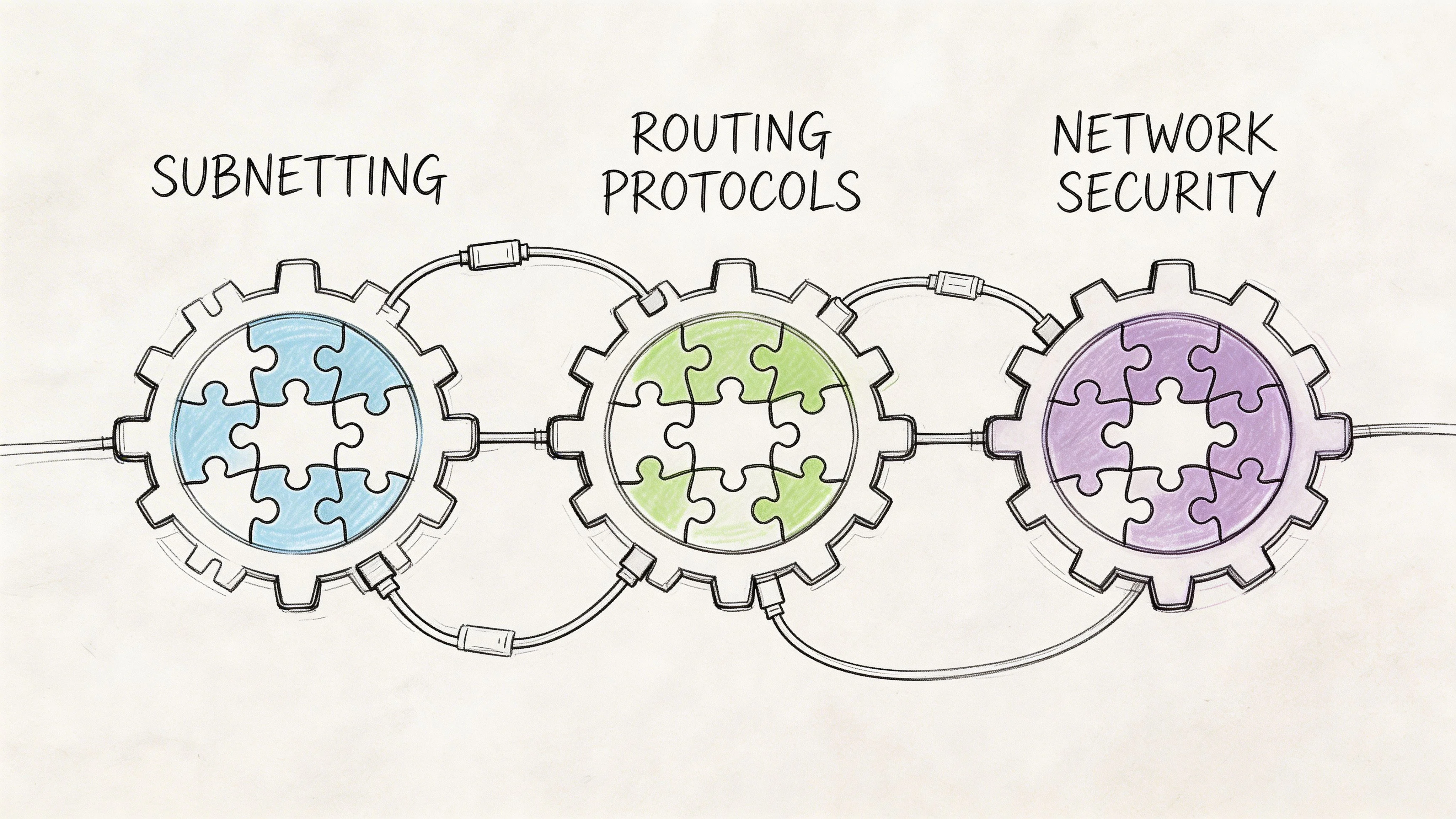 Understanding the interconnectedness of subnets, routing protocols, and network security is key to Network+ success.
Dynamic routing without the fog
Routing remains a difficult subject for many because of the sheer volume of acronyms and the appearance of complex routing tables. You can simplify this by focusing on the core mission: a router determines the most efficient path for a packet to reach its destination.
- Static routing occurs when an administrator manually enters every route into the routing table. This method works well for small, isolated networks with only one way in or out. However, static routes are rigid. In a modern office with multiple connections or cloud links, static routing fails to scale. If a link goes down, a static route stays in the table, directing traffic into a dead end. This leads to manual reconfiguration and downtime.
- Dynamic routing protocols allow routers to communicate with one another to build and update their own routing tables. They detect changes in the network and shift traffic automatically. For the current Network+ exam, you must understand OSPF (Open Shortest Path First). CompTIA identifies OSPF as a link-state protocol that uses Dijkstra’s algorithm to map the entire network and find the shortest path to any given node. It is significantly faster and more efficient than older methods.
- RIP (Routing Information Protocol) represents the opposite end of the spectrum. It is a distance-vector protocol that simply counts how many routers (hops) are between the source and destination. RIP has a hard limit of 15 hops. If a destination is 16 routers away, RIP considers it unreachable. It is also prone to loops and slow convergence: https://www.comptia.org/en-us/certifications/network/
To visualize these differences, use this comparison:
- RIP is like a driver who only knows the next turn. Every few minutes, they stop to shout their entire map to every other driver on the road. This creates unnecessary noise and uses up valuable bandwidth, especially if nothing has changed on the streets.
- OSPF is like a high-speed GPS system. It maintains a full map of the city and only updates other drivers when a road closes or a new path opens. This efficiency makes it the standard for most internal corporate networks.
When preparing for the exam, look beyond the definitions. Ask why a network lead would choose OSPF over RIP. Consider the impact of routing on a cloud-based VPC or a multi-site branch office.
Subnetting as organizing rooms in a building
Subnetting is often treated like a math test, but it is actually a design tool used to fix performance and security problems. If you view it as a way to organize a messy space, the math becomes secondary to the purpose.
Imagine a massive warehouse where 500 people are trying to work in one room. The noise would be deafening. If one person yells for a stapler, all 500 people hear it and stop working for a second. This is exactly what happens in a flat network with too many devices. Broadcast traffic hits every machine, wasting CPU cycles and slowing down the network. Subnetting breaks that warehouse into smaller, private offices.
Effective subnetting provides three main advantages:
- Control and Security: You can isolate the Finance department from the Guest Wi-Fi. By putting different groups into different subnets, you can use firewalls and access control lists to decide exactly who can talk to whom. This prevents a compromised guest laptop from accessing sensitive payroll servers.
- Performance: Routers do not pass broadcast traffic. By subnetting, you keep "noise" contained within a small group of devices. This prevents a single malfunctioning NIC from flooding the entire corporate network with junk traffic.
- Troubleshooting: If a user in the "Sales" subnet cannot reach the internet, you can immediately focus your investigation on that specific segment of the network. You don't have to hunt through the settings of every device in the building.
The exam will test your ability to define these boundaries. You might be asked to calculate how many hosts a /26 mask can support or which subnet mask is appropriate for a branch office with 50 employees. Focus on the CIDR notation and how it dictates the size of your "room."
VLANs and why segmentation matters
A VLAN (Virtual Local Area Network) allows you to separate devices logically even if they are plugged into the same physical equipment. In the past, if you wanted two separate networks, you needed two separate physical switches. VLANs changed this by allowing one switch to act like several independent units.
This is a standard requirement for modern offices. Think about the physical network closet in a building. The Accounting team, the Marketing team, and the public lobby Wi-Fi all run through the same cables. Using VLANs, a technician can configure the switch so that the lobby Wi-Fi traffic is tagged and isolated from the internal office traffic. This ensures that a visitor cannot see your internal file servers, even though they are using the same hardware.
VLANs are also vital for performance. For example, VoIP phones are usually placed on their own VLAN. This allows the network to prioritize voice traffic (Quality of Service) over standard web browsing, ensuring that phone calls don't drop or stutter when someone else downloads a large file.
In a Performance-Based Question (PBQ), you might see a scenario where a computer can ping its neighbor but cannot reach a server in another room. This often points to a VLAN mismatch or a trunk port that hasn't been configured to allow specific VLAN tags (802.1Q).
This video demonstrates how these virtual segments work in a real-world environment:
The OSI model without blind memorization
The OSI (Open Systems Interconnection) model is often taught as a list to be memorized for a quiz. However, for the Network+ exam, it is a diagnostic checklist. If you cannot use the model to find a fault, you haven't mastered it yet.
Instead of just remembering the names of the seven layers, focus on the specific hardware and data types at each level.
- Layer 1 (Physical): This involves the copper, fiber, and radio waves. If a link light is off or a cable is pinched, the problem is here. It is the foundation for everything else.
- Layer 2 (Data Link): This is where switches live. It uses MAC addresses to move frames. If a switch port is disabled or a MAC filter is blocking a device, you are dealing with a Layer 2 issue.
- Layer 3 (Network): This is the home of the IP address and the router. If you can ping a local device but cannot reach a website, the problem is likely a routing or IP configuration error at this layer.
- Layer 4 (Transport): This layer manages the connection between two hosts using TCP or UDP. If a firewall is blocking a specific port, such as port 443 for HTTPS, the traffic will fail here even if the lower layers are working perfectly.
- Layers 5, 6, and 7: These top layers handle the application data, encryption, and the session itself. If the network is fine but the website returns a "Database Connection Error," the issue is at the Application layer.
Tip: Use the OSI model to decide where to start your search. If you suspect a bad cable, start at Layer 1 and work up. If you can ping a server but can't log in, start at Layer 7 and work down. This systematic approach is the mark of a professional technician.
The N10-009 exam rewards candidates who can see how these pieces fit together. Routing finds the path, subnetting defines the boundaries, VLANs provide logical isolation, and the OSI model gives you a map to fix it all when it breaks. When you stop viewing these as separate chapters and start seeing them as a single system, you will be prepared for the exam.
Your Actionable Study Plan and Practice Strategy
The most frequent error candidates for the N10-009 exam make is preparing for a test that only requires multiple-choice knowledge. In reality, a large portion of the current exam is a practical assessment.
CompTIA has acknowledged this difficulty in its official communications. Performance-based questions (PBQs) often catch students off guard because many free materials do not provide enough simulation of actual technical environments: https://www.comptia.org/en-us/blog/the-new-network-n10-009-exam-your-questions-answered/
Because of this, you must construct your study plan around practical application from the very first day. You cannot rely on memorization alone to pass a test that asks you to configure a router or troubleshoot a live connection.
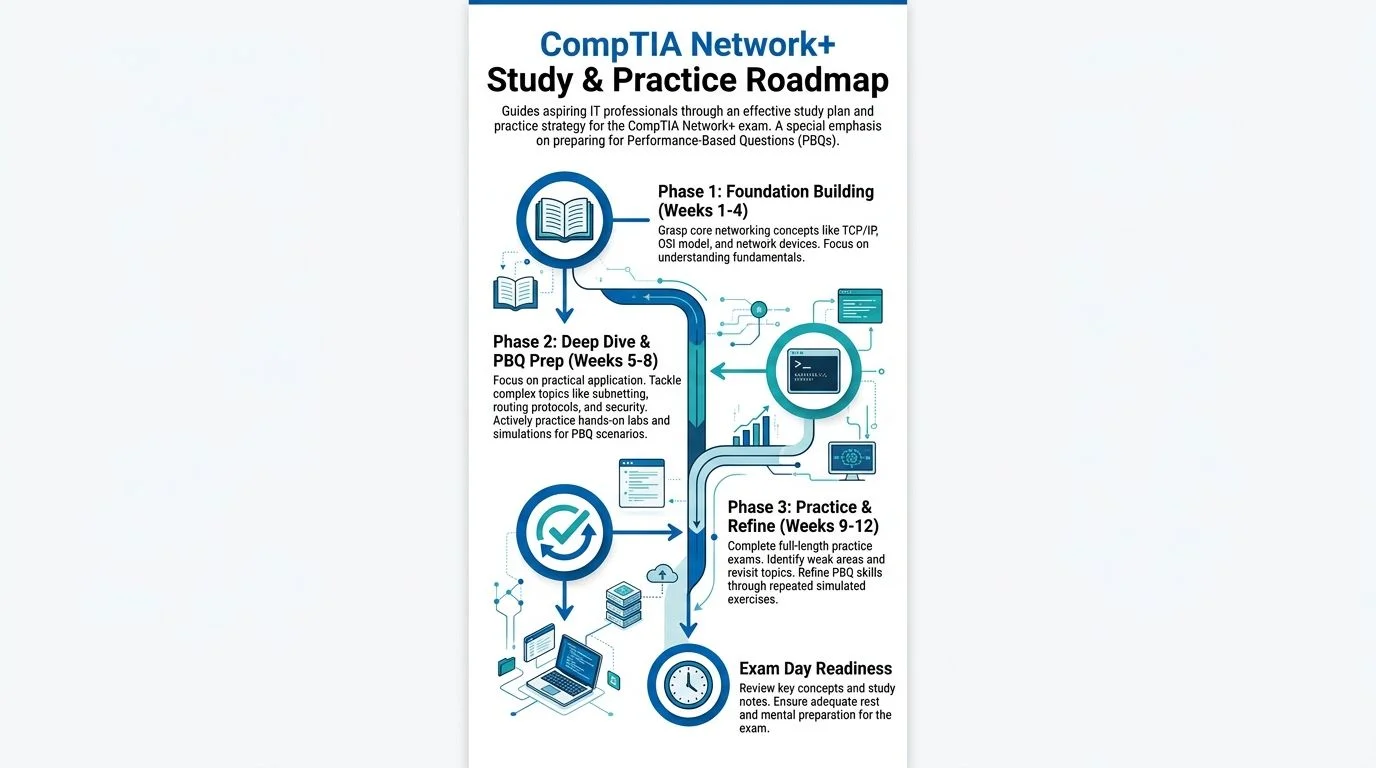 A structured study plan is essential for mastering the CompTIA Network+ exam.
Phase 1: Weeks 1-4 – Build the Foundation
The opening phase focuses on understanding technical concepts rather than speed. Your primary goal during these four weeks is to become fluent in the language of networking.
You must be able to explain the specific function of a network switch. You need to understand why DNS is critical for web browsing and how DHCP automates the assignment of IP addresses. You should also understand how a subnet mask determines the size of a network and how the OSI model helps you isolate faults when a connection fails. Use simple, plain English for these explanations to ensure you truly grasp the underlying mechanics.
Combine different types of learning resources to get a well-rounded view of the material:
- Official Exam Objectives: Treat these as your master checklist. Every bullet point represents a potential topic you might face on test day.
- Video Instruction: These are useful for seeing diagrams in motion and visualizing how data packets move through a topology.
- A Detailed Study Guide: These books offer the depth that videos often miss. They allow for a slower pace and make it easier to take notes on complex topics.
- Simple Labs or Simulations: Even basic exposure to network hardware or software simulators helps. Tools like Packet Tracer or GNS3 allow you to see theoretical ideas in a practical setting. You can also explore virtual networking components in cloud environments like AWS or Azure.
Students often ask how to study without simply reading the same pages over and over. A guide on how to study effectively for exams can help you improve your review sessions. Using active recall and spaced repetition is vital for technical certifications. Merely recognizing a term is not the same as knowing how to use it in a professional context.
What to do each week
Stay focused on clear, intentional activities during this first month:
- Master Core Concepts: Focus your attention on TCP/IP and the OSI model. Study common protocols like HTTP, FTP, and SSH. Learn about physical hardware such as different cable types and wireless standards like 802.11ax.
- Develop Personal Explanations: If you cannot explain a concept to someone who does not work in IT, you likely do not understand it well enough. Speaking your notes out loud is a strong way to test your knowledge.
- Create Comparisons: You need to clearly distinguish between similar technologies. Know the difference between a router and a switch. Understand how DHCP differs from DNS. Be able to explain when you would use a VLAN instead of a physical subnet.
Do not start taking full-length mock exams yet. At this stage, they usually just highlight what you have not learned yet, which can be discouraging. Focus on the building blocks first.
Phase 2: Weeks 5-8 – Move into Applied Practice
Many students do not give this phase the time it requires. Performance-based questions (PBQs) punish those who have only learned through passive methods. If your preparation has only involved watching videos, this phase will likely be difficult. Do not avoid that difficulty. The frustration you feel during labs is actually your brain closing the gap between theory and skill.
Focus topics for this middle phase
Direct your energy toward the technical areas that typically cause the most trouble for candidates:
- Subnetting: You must go beyond memorizing math formulas. Practice looking at a list of requirements and designing a logical subnet layout. You might need to allocate IP ranges for several departments while minimizing wasted addresses.
- Routing Behavior: Study how dynamic routing protocols like OSPF function. Learn why they are used instead of static routes in larger networks. Practice reading and interpreting routing tables so you can predict where a packet will go.
- Network Segmentation: Focus on VLANs and trunking. You must understand why separating traffic is a requirement for both security and network efficiency. Consider how these segments work across multiple physical switches.
- Operations and Security: Learn how to read network logs and monitoring metrics. Practice applying access control lists (ACLs) to firewalls or routers. You should be able to spot common configuration errors that leave a network open to attack.
- Troubleshooting: Use a logical system for every scenario. Identify the symptom first. Use the OSI model to narrow down the possible causes. Test the most likely solution and document your results. Use tools like
ping,ipconfig,traceroute, andnslookupuntil the commands are second nature.
Start using scenario-based practice questions now. A quality CompTIA Network+ practice exam needs to provide more than just simple definitions. You need to see drag-and-drop questions and simulations that force you to make decisions based on a set of constraints.
MindMesh Academy provides a structured way to handle this phase. They offer adaptive learning paths and progress tracking that helps you see exactly where your knowledge is weak. This prevents you from wasting time on topics you already know and allows you to put your effort where it will actually improve your score.
Instructor Note: When you get a practice question wrong, do not just look at the right answer and move on. You must analyze why you chose the wrong one. This helps you find patterns in your thinking that might lead to mistakes on the actual exam.
How to review mistakes the right way
Reviewing mistakes incorrectly looks like this: "I missed that one, but I'll remember the answer next time."
A better way to review follows a four-step process:
- Identify the Clue: What specific detail in the question did I overlook?
- Pinpoint the Concept: What was this question actually testing? Was it routing metrics, subnet masks, or firewall logic?
- Check for Practicality: If this were a simulation instead of a multiple-choice question, would I still know what to do?
- Rephrase the Solution: Can I explain why the correct answer is right without looking at the textbook?
This level of detail in your review turns a missed question into a permanent part of your technical knowledge.
Phase 3: Weeks 9-12 – Simulate Exam Conditions
The final month is about measuring your readiness and building stamina. You want to refine your timing and improve your judgment when you are under pressure. Your goal is not to be perfect, but to be consistent across every domain of the exam. You want to be confident enough that you do not lose focus if a hard PBQ appears right at the start of your test.
What this phase should include
- Full-Length Practice Exams: Take these in one sitting. This builds the mental endurance you need for a 90-minute exam. Mimic the testing environment by removing distractions and using a timer.
- PBQ Drills: Spend extra time on these simulations. Practice reading the task, identifying which domain it belongs to, and performing the configuration steps in the right order.
- Weak-Area Loops: Revisit the specific topics where you still struggle. Use flashcards for terms you keep forgetting. Go back to your study guide for one last read of the most difficult chapters.
- Condensed Notes: Write out a summary of the most important facts in your own words. The act of writing these down helps cement the information. This summary also serves as a quick reference for your final study sessions.
Most students find that their understanding of networking feels much deeper in week ten than it did in week four. This happens because of consistent repetition and practical application.
How to handle PBQs on exam day
PBQs are different because they do not give you a list of answers to choose from. They require you to solve a problem actively. When one of these questions appears, follow this strategy:
- Read the Task First: Do not click on anything until you understand the goal. Know exactly what the question expects you to accomplish.
- Identify the Domain: Is this a routing problem? Is it about security? Knowing the category helps you access the right mental information.
- Filter Out Distractors: These questions often include extra information that has nothing to do with the solution. Ignore the data that does not help you finish the specific task.
- Start with the Fundamentals: Think about how a working network should behave in this situation. Then look for the one thing that is preventing that behavior.
- Keep Moving: If a simulation is taking too long, do what you can and then flag it for review. Move on to the rest of the questions. You do not want to run out of time for the multiple-choice section because you got stuck on one simulation.
A practical weekly rhythm
Consistency is more important than long, occasional study sessions. If you follow a regular cycle, you will retain more information.
| Day | Focus |
|---|---|
| Day 1 | Learn a new topic using your study guide or a video course |
| Day 2 | Review your notes and explain the concepts out loud to yourself |
| Day 3 | Answer practice questions specifically about the new topic |
| Day 4 | Complete a short lab or a troubleshooting scenario |
| Day 5 | Review both the new material and older topics you studied previously |
| Day 6 | Spend time on a troubleshooting drill or a PBQ simulation |
| Day 7 | Rest and perform a very light review of key terms |
This schedule works because it mixes learning, active recall, and hands-on practice while giving your brain time to recover.
What not to do
Avoid these common habits that often lead to poor exam results:
- Avoid Selective Studying: Many people focus on security because it is interesting but ignore subnetting because it is difficult. You must be competent in every domain to pass.
- Don't Wait on PBQs: Leaving simulations until the last week of study is a mistake. You should be doing hands-on work throughout your entire preparation period.
- Don't Mistake Familiarity for Mastery: Just because you recognize a term when a video instructor says it does not mean you can use that technology in a simulation.
- Avoid Late-Night Cramming: Complex topics like routing protocols require time to sink in. Short, daily study sessions are much more effective than one massive session the night before the test.
If you focus on the applied aspects of the exam early, the process becomes much more manageable. Most people who fail CompTIA Network+ are not lacking intelligence; they simply used study methods that did not match the practical nature of the test. If you train for the specific types of questions you will face, you can enter the testing center with confidence.
Launching Your Career After Passing the Exam
Earning the CompTIA Network+ certification changes your professional options. It confirms to hiring managers that you have a functional understanding of network operations and troubleshooting. This certification serves as a clear signal that you can handle the technical demands of a modern IT environment.
Roles that align well after Network+
Job titles vary by organization, but the Network+ certification supports several key positions:
- Network Administrator: Managing and maintaining local and wide area networks to ensure consistent uptime.
- Junior Network Engineer: Supporting the design, installation, and configuration of network hardware and software.
- Network Support Specialist: Troubleshooting connectivity issues and providing technical support for network-related hardware.
- System Administrator: Maintaining server health and infrastructure, often focusing on how systems communicate.
- IT Support Specialist: Handling tiered support tickets with a specific focus on resolving complex network problems.
These roles typically align with the salary ranges for network administrators and analysts discussed earlier in this guide. While your specific job title might differ depending on the company, the core responsibilities involve using the skills validated by the current exam.
What comes after Network+
For many IT professionals, Network+ is a launchpad for a long-term career. CompTIA describes Network+ as preparation for advanced certifications such as the Cisco CCNA or CompTIA Security+. This progression makes sense. Once you master addressing, routing, switching, and network services, you have the background to study vendor-specific systems from Cisco or Juniper. You are also prepared to move into the field of cybersecurity.
If you are planning your next professional move, this overview of computer networking certifications shows where Network+ fits within the certification field.
How to use the certification in practice
Do not simply list the certification on your resume and wait for recruiters. You must actively apply your new knowledge:
- Rewrite Your Experience Bullets: Revise your work history to include specific tasks like "troubleshooting network connectivity," "configuring switch ports," or "documenting network changes." Use the terminology found in the current exam objectives to describe the work you already perform.
- Talk in Scenarios During Interviews: When an interviewer asks about your skills, provide specific examples. Explain how you isolate a connectivity fault or the steps you take to secure a network segment. Connecting your knowledge to actual problems shows you can think critically.
- Keep Building a Small Lab Habit: Practice your technical skills regularly. Set up a DHCP server, configure static routes between virtual routers, or create a VLAN in a virtual environment. This keeps your knowledge fresh and builds the muscle memory required for daily operations.
Career Advice: Employers hire people who can solve problems, not just people who pass exams. Network+ is most effective when you can explain how its principles help you resolve actual IT challenges.
Think in career layers
Visualize your professional development as a series of layers:
- Network+ provides the broad, vendor-neutral foundation required to understand how infrastructure functions.
- Security+ builds on this base for those specializing in network defense, focusing on threats and vulnerabilities.
- CCNA or other vendor-specific certifications allow you to master the implementation of hardware from specific manufacturers.
This sequence works because each layer builds on the previous one. Your understanding of networking fundamentals remains useful whether you move into cloud architecture, security operations, or systems administration.
Conclusion: Your Next Step to Network Mastery
CompTIA Network+ is a practical certification for IT professionals moving from general knowledge to demonstrable networking capability. It teaches the core concepts employers expect, but the current N10-009 exam requires you to apply those concepts under pressure in realistic scenarios. This focus on practical application changes how you should prepare. While videos, notes, and flashcards remain useful, you cannot rely on them alone to pass. Successful candidates combine repeated theory review with hands-on troubleshooting methodologies and performance-based question (PBQ) simulations.
If you want a career in networking, infrastructure management, or cybersecurity, this credential serves as a strong starting point. It also prepares you for the CompTIA Security+ certification. The networking foundation you build now will make advanced security topics much easier to understand later on.
Start your preparation by reviewing the official exam objectives and building a study schedule that covers all learning phases. Practice in the same format you will see on exam day to build your confidence. This deliberate approach might not be flashy, but it produces consistent results for those who put in the effort.
If you want a structured way to prepare for your certification, MindMesh Academy provides thorough study resources like the CompTIA Network+ Study Guide and Network+ Practice Exams. These materials help you track progress and practice with intent, ensuring you are ready for current exam requirements.

Written by
Alvin Varughese
Founder, MindMesh Academy
Alvin Varughese is the founder of MindMesh Academy and an enterprise architecture leader. An electrical engineer by training, he moved from factory automation in South Africa to cloud architecture at GE Appliances and Humana (Fortune 50), and holds 20 professional certifications including AWS Solutions Architect Professional, Azure DevOps Engineer Expert, and Microsoft Agentic AI Business Solutions Architect. He built MindMesh Academy after interviewing too many highly certified candidates who couldn't answer basic questions: the goal is prep that makes you better at the job, not just able to pass the exam.