
What is Self-Directed Learning? Master IT Certifications Faster
What is Self-Directed Learning? Master IT Certifications Faster
What does self-directed learning actually mean? Self-directed learning is more than solitary study. This approach requires you to take control of your education, which is a vital skill for IT professionals. You decide exactly how you learn.
Instead of following a fixed classroom schedule, you diagnose your own learning needs and set ambitious goals. You find the most effective resources and choose optimal strategies to understand difficult technical concepts. By taking full ownership of the entire process, you move beyond being a passive student. You become an active manager of your professional growth.
What Is Self-Directed Learning Really?
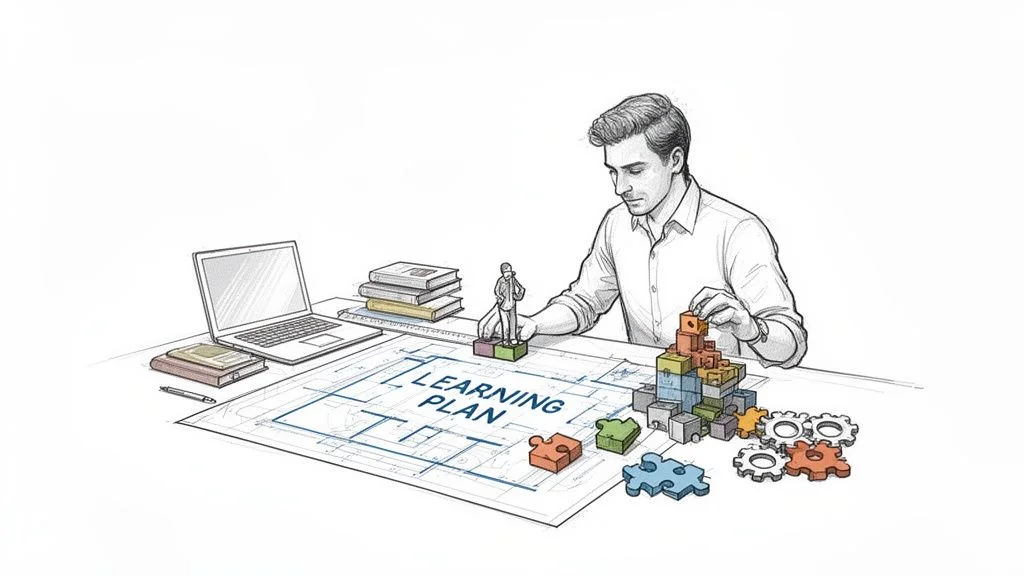 An illustration of self-directed learning, where an individual builds their learning plan with blocks, symbolizing active construction and ownership of their educational path.
Traditional education often functions like a guided bus tour. The route is set in advance, the stops follow a strict schedule, and your role involves observing from your assigned seat. You are a passenger following a fixed itinerary created by an instructor or an institution. While this provides a clear path, it lacks the flexibility to stop and explore specific areas of interest or skip sections you already understand.
Self-directed learning gives you the keys to your own vehicle. You identify the destination—perhaps earning an AWS Certified Solutions Architect - Associate or an Azure certification—and consult the map. However, you are the one selecting the most efficient route. You decide how fast to drive and when to pull over for an in-depth study of a specific topic. This is not a state of uncontrolled chaos. Rather, it is the process of building a custom, efficient, and engaging framework that fits your specific schedule and professional goals.
For IT professionals preparing for difficult exams like the CompTIA Security+ (SY0-701), the Azure Administrator Associate (AZ-104), or the PMP certification, this method changes the way you approach study sessions. Instead of clicking through a generic video course in chronological order, you manage your own skill development. If networking protocols are a personal weak point, you might spend four extra days on the OSI model. If you already understand cloud storage from your daily job, you might skip those basics and find advanced labs on serverless architecture or identity management. This process involves more than basic studying; you are engineering your personal expertise to meet industry standards.
The Mindset Of An Educational Architect
Self-directed learning requires a proactive mindset. It is a fundamental shift from waiting for instructions to taking charge of your own professional growth. In this model, you are more than a student. You act as the project manager, the person designing the curriculum, and the quality assurance lead for your own education. You no longer wait for a teacher to tell you what is important; you look at the exam objectives and decide where to focus your energy.
This shift is now a requirement for staying relevant in the technology sector. A recent survey showed that 46% of professionals worldwide spend 1 to 4 hours every month on self-paced study. This indicates a clear move toward taking personal responsibility for career growth. In a field where technical skills can become outdated in a few years, being proactive is a necessity for long-term career survival.
This method connects directly to the idea of staying current in your field through consistent effort. If you want to make this a permanent part of your routine, see our guide on what is continuous learning for more details on building these habits.
Understanding The Core Pillars
How do you turn the idea of "studying alone" into a functional system for passing IT exams? It starts with four pillars that provide structure to your efforts. These components turn a vague goal into a specific, actionable plan. Learning these pillars is a vital part of understanding What Is Self Directed Learning and How to Master It.
The following table outlines these pillars and how they apply to your certification goals.
The Four Pillars Of Self-Directed Learning
| Pillar | Description | Example in IT Certification |
|---|---|---|
| Autonomy | Taking full ownership and initiative for your learning. You decide what, when, and how you learn based on your schedule. | Choosing to spend extra time on AWS Lambda modules because serverless computing is a high priority for your current project, even if it is a small part of the official exam guide. |
| Goal-Setting | Defining clear, measurable objectives to provide direction and a way to track your success over time. | Setting a SMART goal: "Achieve an 85% or higher score on three consecutive CompTIA Network+ (N10-009) practice exams by the last day of the month." |
| Resource Management | Identifying and using the best tools available, such as official documentation, hands-on labs, and community forums. | Combining official Microsoft Azure study guides with custom labs in a personal sandbox environment while asking questions in developer communities or seeking advice from senior engineers. |
| Self-Evaluation | Regularly checking your progress against your goals and changing your study tactics when something is not working. | Analyzing practice test results for a PMP exam to find weak areas in 'Process Groups,' then moving study time from 'Planning' to 'Execution' and reviewing specific PMBOK chapters. |
Internalizing these four pillars is what separates aimless reading from a targeted, effective plan. This structured approach consistently produces better results when facing the high-stakes requirements of modern IT certifications.
Reflection Prompt: Consider your last significant learning effort. Which of these pillars did you rely on the most? Which one could you use to improve your next IT certification goal?
Frameworks That Make Self-Directed Learning Work
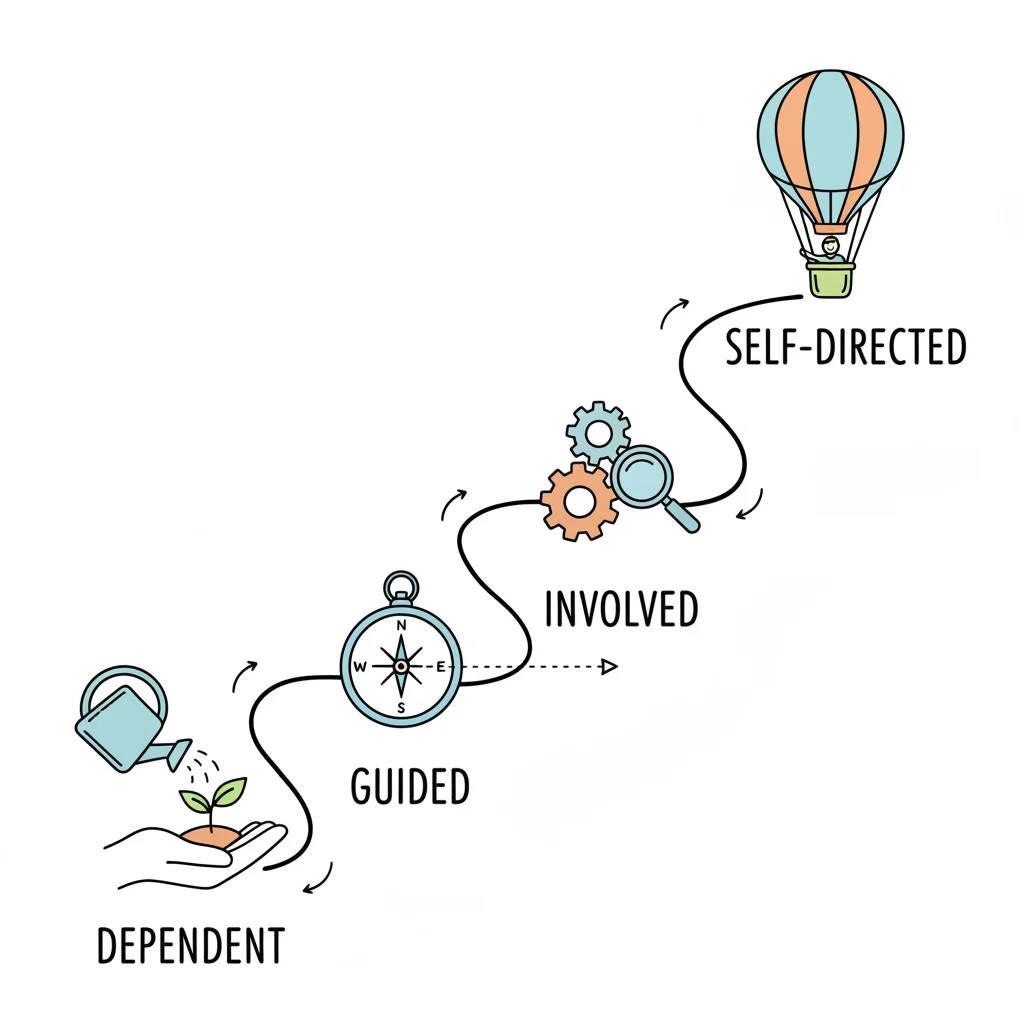 A visual representation of Grow's Four Stages of Self-Direction, illustrating the progression from dependent to fully self-directed learning.
Directing your own education sounds like a great idea, but a structured plan makes the effort effective. Self-directed learning is not about wandering through resources and hoping you learn something. It requires moving forward with a plan and a clear sense of purpose. Educational researchers have created systems to help you move from a beginner who needs hand-holding to a professional who controls their own development.
View these models as different methods to organize your study time and prepare for difficult exams. While each has its own focus, they all aim to prepare you for a career of continuous improvement. The following two systems change the idea of self-direction into a practical list of steps you can use to meet your IT certification goals.
The Foundation: Knowles' Principles of Adult Learning
Malcolm Knowles, a pioneer in educational research, observed that adults do not learn like children. His principles of adult learning, known as Andragogy, serve as a base for modern self-directed study. Knowles found that adult learners rely on internal motivation and use their existing professional experience to process new information. They do not want to be passive recipients of facts; they want to be active participants in the process.
Adults usually want to know the specific reason they are studying a topic. They need to see a direct connection to their current job or future career goals. This concept is useful for IT professionals. If you study for an Azure certification, you are not only memorizing definitions of virtual networks. You are likely looking for ways to fix the actual network latency problems you see at work every day. You might be figuring out how to build a resilient cloud setup for a new client. This immediate application changes the process from a memory exercise into practical problem-solving. It makes the information stick because you have a place to put it in your mind.
Your Guide: Grow’s Four Stages of Self-Direction
Gerald Grow expanded on these ideas by creating the Staged Self-Directed Learning (SSDL) model. This framework offers a practical way to track your progress through four distinct levels of autonomy. It works well as a diagnostic tool for IT professionals. You can use it to see where you stand right now and determine what you need to do to take more control of your certification prep.
“The SSDL model is based on the idea that learners need different levels of direction at different times. The goal is not just to be self-directed, but to become a better learner by matching teaching styles and learning strategies to the learner’s stage of readiness.”
This model acts like a system for tracking your progress. It shows you how to move from needing a teacher for every step to being the person who decides what to learn next.
Stage 1: The Dependent Learner At this point, you act as an apprentice. You need an expert to show you a specific, structured path to follow. You likely feel overwhelmed by the amount of information available and need someone to filter it for you.
- What it looks like: You rely on an instructor or a pre-made course to tell you what to study and when to do it. You rarely look at materials outside of the provided list.
- IT Certification Example: Following a rigid, step-by-step CompTIA A+ (220-1201/220-1202) video course (verify current codes on the vendor site). You watch every video in order and complete every lab exactly as shown without trying anything different. A person starting an ITIL Foundation course often begins here to ensure they cover the official syllabus without missing any definitions.
Stage 2: The Interested Learner You are starting to understand the basics and find your footing. You are more engaged and ask better questions during lessons. You do well with guided practice and lessons that allow for interaction with others.
- What it looks like: You still need a teacher to give you directions, but you start asking why things work a certain way. You begin to see how different technical concepts connect across different modules.
- IT Certification Example: Taking part in instructor-led labs for a Cisco CCNA. You aren't just clicking buttons in a simulator. You ask specific questions in forums or during live sessions to understand subnetting or how routing protocols behave in a real business environment. You might ask how OSPF areas impact performance in a multi-site network, moving beyond the basic configuration steps provided in the lab manual.
Stage 3: The Involved Learner You have built up enough skill and confidence to work more independently. You see yourself as a peer to the instructor in some areas. You can collaborate with others and find your own additional study materials to clear up confusion.
- What it looks like: You do well in group settings and can set your own goals without much help. You take the initiative to look at resources that aren't in the main textbook because you know what you need to learn.
- IT Certification Example: Once you finish a main AWS Certified Solutions Architect course, you decide to build your own small project. You might create a serverless API using S3, Lambda, and API Gateway to test what you learned. You spend time experimenting and fixing your own errors instead of just following a guide. Instead of relying on a single textbook, you might search for white papers or join a community server to discuss architecture patterns.
Stage 4: The Self-Directed Learner This is the final objective. You manage every part of your education. You set your own goals, carefully select your own resources, and check your own progress with a high degree of accuracy.
- What it looks like: You define your own objectives for what you want to learn. You find the best materials yourself and know when you have mastered a topic without needing a test to tell you.
- IT Certification Example: You create a custom study plan for the PMP exam. You combine the official PMBOK guides with high-level workshops, study groups, and practice tests. You look at your practice test scores to change your focus and improve your understanding of project management logic. You identify a need in your skillset, find the documentation, and build a lab to master it without waiting for a formal course to be released.
Recognizing your current stage helps you understand the process of self-directed learning. It lets you judge your current skills honestly. By doing this, you can build the habits you need to take control of your study time and find success in your IT career.
Why Self-Directed Learning Is Your Superpower for IT Certifications
In the fast-moving tech sector, standing still is the same as falling behind. For any IT professional, certifications act as more than just profile decorations. They provide actual proof of current skills and often dictate your salary ceiling. The constant challenge remains: how do you study for these difficult exams while holding down a forty-hour work week and managing a family? This is where self-directed learning stops being a trend and becomes your most useful strategy.
This is a system upgrade. You move from being a passive student in a generic course to a lead technician for your own career. You set the schedule and move directly toward your specific certification goals. This change in mindset alters the way you approach new material. It turns the stressful wall of exam preparation into a series of clear steps that produce better results.
The Flexibility to Learn on Your Terms
Time is the biggest barrier for most people working in tech. Traditional training forces you into rigid schedules that rarely match a real-world workload. Taking control of your own education gives you total power over when and where you study. You can finally weave study sessions into your daily routine instead of forcing your life to bend around a classroom schedule.
Maybe you review network protocols on the train during your morning commute. You might spend an hour at midnight working in a cloud security lab. Or perhaps you set aside a focused Saturday morning to get hands-on with Kubernetes deployments or database replication. This level of autonomy keeps your preparation consistent, even when your work week gets messy.
This adaptability is the key to success. It moves learning from a stressor to a sustainable part of your professional life, helping you make progress without hitting a wall.
Laser-Focus on Your Knowledge Gaps
If you are studying for an Azure Administrator certification, you might have managed virtual machines for years. That part of the exam will be easy. However, identity and access management (IAM) might be something you rarely touch. A standard course makes you sit through hours of VM basics before you ever see the IAM material you actually need.
A self-directed approach flips this. You start with a skills audit to find out what you really need to work on. Once you find the holes in your knowledge, you can hit them with a targeted strike. You put your time where it matters most. This builds a stronger foundation for the exam and ensures you aren't wasting hours on things you already know.
- Diagnostic Power: Use practice tests as tools to find weaknesses. Do not just look at the final percentage score. Analyze the data to see exactly which domains or question types are giving you trouble.
- Targeted Reinforcement: When you find a gap, look for a specific resource to fix it. This might be a technical whitepaper on AWS Key Management Service (KMS), a lab for SQL Server migration, or a video on ITIL processes.
- Efficient Progression: By fixing your weak points first, you turn them into strengths. This speeds up your total study time and builds confidence before you go to the testing center.
The Rise of Supporting Learning Ecosystems
You are not doing this alone. The global eLearning market is growing fast. It is currently valued at $203.81 billion and is on track to reach $279.30 billion by 2029 (verify current market data on research sites). Mobile learning is a major part of this growth. Data shows that workers who use their phones for training see a 43% increase in productivity. This expansion has created a massive library of high-quality resources for independent students. You can find more details in these latest eLearning statistics.
Modern platforms are built for people who study on their own. They are more than just lists of videos; they are environments built to support your professional growth. Many now include adaptive learning paths that change based on how you answer questions. They also use spaced repetition to help you remember facts for the long term. These tools help you build a custom plan that makes passing difficult IT certifications much more likely.
Actionable Strategies for Your Next Certification Exam
Understanding the theory of self-directed learning is one thing. Effectively applying it to pass your next IT certification exam is another matter. This section moves beyond abstract concepts to focus on practical techniques that will improve your performance on exam day.
The primary goal is to shift from passive habits to active learning. Passive studying involves re-reading notes or watching video lectures on repeat. Active learning requires your brain to solve problems and process material deeply. This approach builds the mental connections needed to recall facts under the pressure of a timed exam. We will now look at specific strategies you can use immediately.
Build Your Personalized Learning Blueprint
Before you open a study guide or start a video course, you need a plan. A self-directed learner does not move through a curriculum without a clear path; they act as the architect of their own education. Your first step is to create a personalized learning blueprint.
This plan is more than a checklist. It is a strategic map that identifies what you will study, the resources you will use, and the method for tracking your progress. Creating this document ensures you remain focused throughout the process.
- Define Your Destination: State your goal clearly. For example, you might aim to "Pass the AWS Solutions Architect - Associate exam in 12 weeks with a minimum score of 80% (verify passing requirements on the official AWS site)." Or you might plan to earn the ITIL 4 Foundation certification by the end of the next quarter.
- Audit Your Starting Point: Use official exam objectives from vendors like CompTIA, Microsoft, or AWS to assess your current skills. Take a diagnostic practice test early to find an honest baseline of what you already know. This step is essential for identifying specific knowledge gaps so you do not waste time on topics you have already mastered.
- Map Your Route: Divide the full exam scope into smaller, weekly goals. Week 1 might involve mastering IAM concepts and applying them in an AWS lab. Week 2 could focus on designing and configuring a basic Azure Virtual Network (VNet) and subnets. Breaking the material down makes a large certification feel manageable.
- Gather Your Tools: Select a limited number of high-quality resources. This might include one primary video course, official vendor documentation, hands-on lab environments, and a reliable practice exam engine. Limiting your sources prevents the information overload that often stops progress for IT professionals.
This planning phase is your first act of self-direction. It provides a clear trajectory and makes every study session more efficient. By knowing exactly what you need to achieve each day, you reduce the friction of getting started.
Master Concepts with The Feynman Technique
Many students study a topic and feel confident, only to fail when they try to explain it. This happens because there is a difference between recognizing information and truly understanding it. The Feynman Technique is a simple mental model used to bridge this gap. It is particularly helpful for grasping difficult IT concepts like networking protocols or cloud architecture.
The process involves four steps to ensure you have mastered a technical subject:
- Choose a Concept: Pick a specific topic that you find challenging. This could be the DNS resolution process, Docker container networking, Agile Scrum ceremonies, or the OAuth 2.0 authentication flow.
- Teach It to a Novice: Explain the concept in plain language. Imagine you are talking to someone with no technical background. You can write your explanation down or speak it aloud to a "rubber duck" on your desk. For example, if you are explaining DNS, you might describe it as a phone book for the internet that translates names into numbers.
- Identify Gaps: Pay attention to where you struggle. If you rely on technical jargon to hide a lack of clarity, or if you cannot explain how two parts of a system interact, you have found a weakness. This is your signal to go back to your study materials and review that specific area.
- Simplify and Refine: Redo your explanation. Use analogies that relate the technical concept to everyday life. Continue this process until you can describe the topic clearly and simply without looking at your notes.
This method forces you to break down complex systems into their basic parts. You will stop memorizing definitions and start understanding how systems function and interact. When you can explain a concept simply, you truly own that knowledge.
Reflection Prompt: Choose a concept you recently learned for an IT certification. Try to explain it aloud using the Feynman Technique right now. At what point did the explanation become difficult? That point is exactly what you need to study next.
Lock in Knowledge with Spaced Repetition
Cramming for an exam is the biggest obstacle to long-term memory. Human brains naturally lose information over time, a process often called the forgetting curve. Spaced Repetition is a learning method that fights this decline by having you review facts at specific intervals.
Instead of looking at a topic once and moving on, you revisit it just as you are about to forget it. This timing tells your brain that the information is important and needs to be stored. This process moves facts from short-term memory into long-term storage.
Many modern learning platforms, such as those at MindMesh Academy, use this principle. They track your answers on practice questions and show you difficult topics more frequently. This removes the guesswork from your schedule. You can find more details on these adult learning strategies in our detailed guide. These methods ensure that the knowledge you gain for an exam stays with you throughout your career.
The principles of effective learning are often the same across different subjects. Achieving small wins and building consistent habits works for technology and other fields. For instance, you can find similar patterns in strategies for multiple language study. Both learning a new language and mastering a new IT skill require a disciplined approach to how you review information.
Traditional Study Methods vs. Self-Directed Learning Techniques
The following table compares traditional study habits with active, self-directed techniques. This comparison shows why a modern approach is more effective for passing IT certification exams and retaining what you learn.
| Study Method | Traditional Approach | Self-Directed Approach | Effectiveness for Retention |
|---|---|---|---|
| Reviewing Material | Rereading textbook chapters or watching video modules multiple times. This leads to recognition but not mastery. | Using Spaced Repetition tools like Anki or built-in platform features to review topics at optimized intervals. | High |
| Understanding Concepts | Memorizing definitions and terms from lists without understanding how they apply to real-world scenarios. | Using the Feynman Technique to explain concepts like subnetting or cloud security in simple terms. | High |
| Practice | Taking the same practice test repeatedly until the score goes up, often by memorizing the answers. | Using practice tests as a diagnostic tool to find weaknesses in specific areas like AWS services or project management. | Medium (if not analyzed) |
| Note-Taking | Highlighting large parts of a book or typing exactly what a teacher says during a lecture. | Summarizing ideas in your own words, creating mind maps, or writing Q&A prompts for active recall during study. | High |
As the table shows, self-directed methods are designed to work with how the brain functions. By being intentional with your study time, you improve your understanding and increase your chances of passing the exam. These techniques turn a passive student into an active learner who is prepared for the challenges of the IT industry.
How to Measure Your Learning Progress
When you are steering your own education, you face a major challenge: how do you prove to yourself that you are actually learning? The simple feeling of "I think I get this" is not good enough when you are paying for an exam and your career growth is on the line. You need objective ways to track your progress. You need to know that your hours of study are moving you closer to that IT certification.
You have to change your role. You are the student, but you are also the person auditing the student. This means looking at your performance as a set of data points. You need to use these numbers to make smart choices about where to spend your time. If you have a limited amount of study time each day, you cannot afford to waste it on things you already know. You have to find the gaps in your knowledge and fill them with focused effort. This requires a shift from passive reading to active performance analysis. Let's look at the specific ways you can track this information.
Monitoring Your Learning Plan
Your learning plan should be a living tool that you use every day. It is not something you write once and then put in a drawer. It is the primary way you see if you are on schedule. The easiest metric to track is your weekly goal. Are you finishing the chapters or labs you said you would? If you find yourself falling behind on complex security concepts for a CompTIA CySA+ exam, that is a clear signal.
Staying on track builds momentum. It also warns you when things are going wrong. If a specific topic takes you three times longer than you expected, you need to adjust. You might need to change your study materials or find a different explanation from a new source. Constant, honest reviews of your progress are the only way to stay on your path. If you wait until the week before the exam to realize you are behind, it is too late to fix the problem. Use your calendar as a mirror to reflect your actual progress versus your planned goals.
Using Practice Exams as Diagnostic Tools
Practice exams are the best tool you have for generating data about your skills. Their main job is not to give you a score you can brag about. Their job is to find exactly where you are likely to fail on the real exam. Treat every practice test as a way to find your weaknesses with high precision. Instead of just looking at the total score, you need to look at the patterns in your mistakes.
- Domain-Specific Scores: Most practice exams break your results down by category. If you get a 95% in "Compute Services" for an AWS exam, but only 60% in "Database Services," you know exactly what to do next. You do not need to read about compute anymore. You need to spend your next four study sessions on databases. This data helps you ignore the stuff you know so you can fix the stuff you do not know yet.
- Question Type Analysis: Look at why you missed a question. Was it because you did not know the fact, or was it because of how the question was asked? Some exams, like those from Microsoft or the PMP, use long scenarios. If you are missing these but getting the short factual questions right, you need to practice your reading and analysis skills. You need to learn how to find the specific technical requirements hidden in the text.
- Time Management: Most IT exams are timed. Track how long it takes you to answer. If you are finishing the mock exam with only minutes left, you are in danger of failing the real thing. This often means you are hesitating because you are not confident in the material. Or, you might be getting stuck on specific types of calculations or diagrams. Tracking your time per section helps you see where you are slow so you can get faster.
Treat each practice test like a detailed diagnostic report. This approach turns your study time into a series of small, high-impact fixes. You stop guessing and start knowing. You can find more about how to do this in our guide on how to measure training effectiveness.
Applying Concepts in Mini-Projects
The best way to know if you understand a concept is to try to use it. Can you take what you read in a book and use it to configure a server or a cloud network? Small, hands-on projects are the true test of your skills. They bridge the gap between knowing a definition and having a skill you can use at work.
If you are studying for an AWS certification, don't just watch videos. Open a free-tier account and build a website. Use S3 for your files, Lambda for your code, and API Gateway for your entry point. Then, try to set up IAM roles to make sure only the right people can access it. For an Azure certification, try building a network with multiple Virtual Machines and an Azure SQL Database. Then, try to block all traffic except for what is absolutely necessary by configuring Network Security Groups. This forces you to understand how traffic flows between tiers. For project management exams like the PMP or PRINCE2, try creating a project charter, a detailed risk register, and a communication plan for a hypothetical IT rollout.
Successfully finishing a mini-project is proof that you have moved past memorization. You have achieved actual competency. When you build something, you find the small details that books often skip. If you can build it, you truly understand it.
This is active learning. It gives you a type of confidence that you cannot get from a multiple-choice question. It proves you are ready for the real world, not just the exam room. If you can build a working environment from scratch, you can pass with confidence.
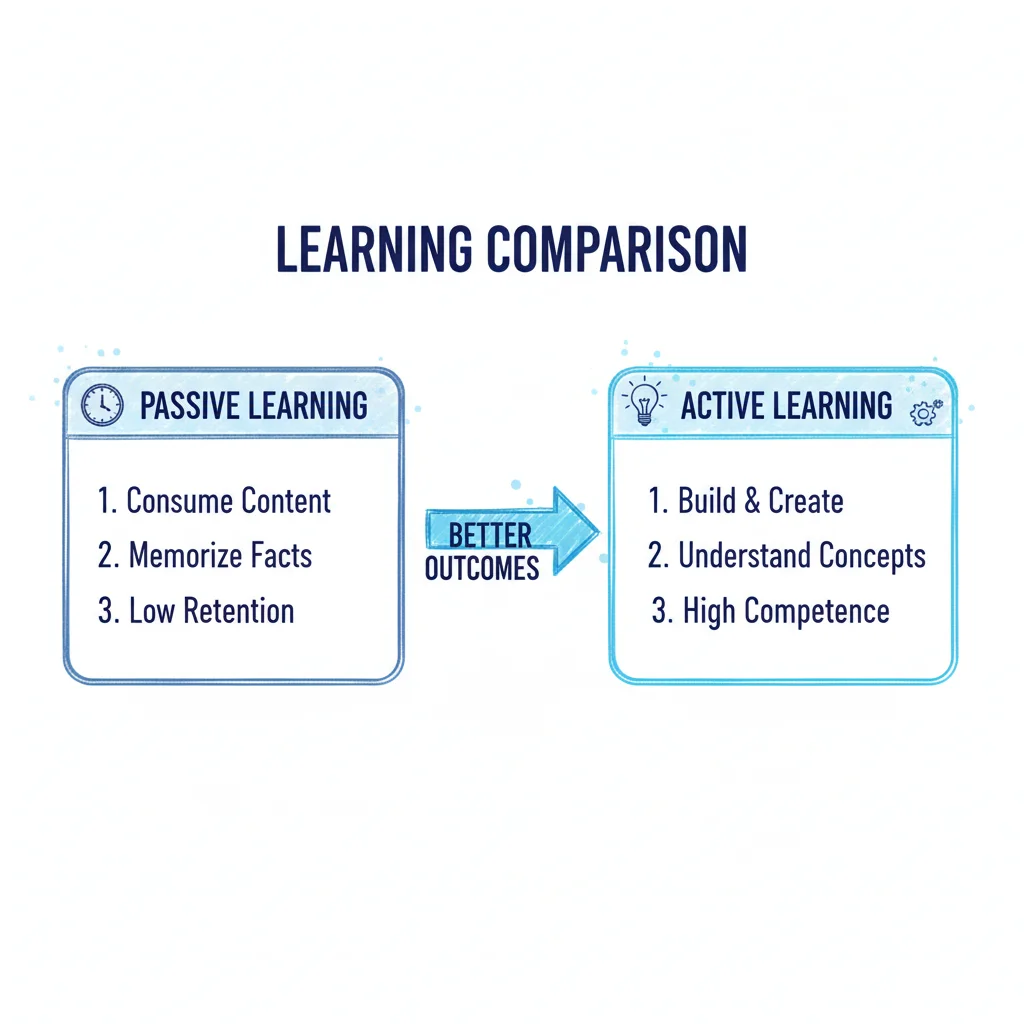 A visual comparison showing the difference in results between passive study methods and active, self-directed techniques like spaced repetition and the Feynman technique.
This image shows how methods like spaced repetition and explaining concepts to others are built for long-term learning. These techniques help you store information in your long-term memory. This is the opposite of cramming, where you forget everything two days after the test.
Visualizing Your Growth with Dashboards
Many modern learning platforms now have dashboards that turn your activity into charts and graphs. These tools take your performance data and show you how you are improving across different topics over time. There is no better way to stay motivated than seeing a line graph of your scores going up every week. It is the hard proof that your plan is working. When you see your scores in a difficult domain move from 40% to 85% over the course of a month, you know you are making real progress. These dashboards help you visualize your growth and keep you focused on the finish line. They take the guesswork out of your preparation.
Common Mistakes to Avoid in Self-Directed Learning
Directing your own education is a practical strategy, but it is not without specific difficulties. The process of studying for difficult IT certifications without a classroom often involves traps that can slow your momentum and make you doubt your progress. If you identify these specific hurdles before you start, you can prepare yourself to handle them more effectively.
Recognizing common challenges allows you to establish study habits that are more durable. You should plan for potential distractions and obstacles before you start your first lesson. This preparation helps you stay on track and ensures that you can move through your chosen certification material with a clear objective. It turns potential obstacles into opportunities to refine how you acquire new technical skills.
The Procrastination Pitfall
Procrastination is the most frequent obstacle for anyone managing their own study schedule. When you do not have a teacher checking your attendance or setting weekly deadlines, it is very easy to tell yourself that you will start the work later. The flexibility of self-paced learning is a major benefit, but it becomes a weakness if you lack the discipline to follow a routine.
The most effective way to fight the urge to delay is to create a formal structure for your time. Time-blocking is an essential method for anyone trying to master technical skills while balancing a full-time job. You should not simply aim to study at some point during the week. Instead, use your calendar to set firm appointments with yourself. For example, you could schedule "7:00 PM to 8:30 PM every Tuesday and Thursday for AWS Networking Labs" or "Saturday from 9:00 AM to 12:00 PM for PMP Practice Questions." By putting these times on your calendar, you change a vague idea into a specific commitment. You are much less likely to skip a session if it is treated as a fixed part of your daily routine, similar to a client meeting or a project deadline.
Information Overload and Analysis Paralysis
The internet provides an enormous amount of data, which frequently leads to a state of being overwhelmed. Many students find themselves with 50 browser tabs open while they search for the single best explanation of a concept like BGP routing or Kubernetes orchestration. You might spend hours reading reviews of different courses on Reddit or watching introductory videos on YouTube from five different instructors. This leads to analysis paralysis. You end up spending all your available study time looking for the perfect resource instead of actually learning from the materials you already have.
To solve this, you must choose your study materials before you begin the first chapter. Do not allow your search for resources to continue once you have started your study plan. Limit yourself to a small, high-quality collection of core tools. A good set usually includes one primary video course, one official study guide from the vendor—such as those provided for AWS, Microsoft, or CompTIA—and one trusted practice exam simulator. By narrowing your focus, you remove the distraction of endless options and create a direct path through the curriculum.
The Challenge of Staying Focused
Staying focused is a constant battle for IT professionals. Even if you have a solid plan, work demands often get in the way. A recent study identified a problem known as 'learning debt.' This happens when the immediate needs of your job push your professional development to the bottom of your priority list. The report found that multitasking during training sessions grew to 70% recently, rising from 58% just the year before. This illustrates how difficult it is to achieve the concentration needed for technical subjects when you are constantly interrupted by Slack messages or emails. For those using a platform like MindMesh Academy, these statistics show why a disciplined approach is necessary. You can find more details in the full learning and development report.
To succeed, you have to protect your study time from all outside distractions. This means your phone should be in a different room or turned off entirely. You should close every browser tab and application that is not related to the lesson. You might also want to use a software tool to block social media sites during your study blocks. Treat your scheduled learning time with the same level of importance as a meeting with a high-level executive. No interruptions should be allowed during these sessions if you want to make real progress.
Reflection Prompt: Which of these common mistakes do you find yourself most susceptible to? What single change can you implement today to mitigate it?
Inaccurate Self-Assessment
This is a dangerous trap because it is hard to detect until it is too late. You might read through a chapter or watch a detailed video and feel like you have a strong grasp of the material. However, when you sit down for a practice test, the results might show that you only understood the surface of the topic. This is the difference between recognition and recall. Relying on passive study methods, like just reading or highlighting text, often leads to a false sense of security.
You must build honest feedback loops into your schedule to see what you truly know.
- Take Practice Exams Constantly: Do not wait until the week before your test to use practice exams. Use them every two weeks as a diagnostic tool. This provides a clear view of your current knowledge and helps you find the specific topics where you still have gaps. If you consistently miss questions on subnetting or IAM policies, you know exactly where to focus your next study session.
- Use the Feynman Technique: Try to explain a technical concept in simple language as if you were talking to someone who has no IT experience. If you find yourself using too much jargon to cover up gaps in your explanation, or if you get confused halfway through, it means you have not mastered that topic yet. This method forces you to confront the limits of your understanding.
- Get Your Hands Dirty in Labs: You cannot fake your way through technical configurations. Whether you are setting up a secure network, deploying an application in a cloud environment like AWS or Azure, or fixing a database problem, the lab environment provides the truth. Practical application shows exactly what you can do and what you still need to practice. This hands-on experience is a requirement to pass with confidence on most modern IT certifications. You should spend at least as much time in a lab environment as you do reading the textbook.
Got Questions? We’ve Got Answers.
We have covered many aspects of self-directed learning, but a few recurring questions always come up when IT professionals start exploring this method. Let's address those questions directly to clarify how this approach works in practice.
Is Self-Directed Learning Just Another Term for Self-Paced Learning?
This is a common question, and while the two concepts are related, they serve different functions. Consider the difference this way: self-paced learning allows you to control the speed of your progress. It is like driving a car on a highway that someone else built. You follow a fixed route at your own pace. You might finish a training course in a weekend or take a month to get through it, but the content and the order of the lessons remain exactly the same.
self-directed learning puts you in control of the entire trip. You are not only picking the speed; you are choosing the destination. You decide which certification to pursue based on your specific career goals. You plan the route by building a custom study plan. You also choose every stop along the way, including which labs to run, which books to read, and which review methods to use. You decide what to learn, why it matters, and how to master it. This approach makes the educational process your own from start to finish.
How Do You Stay Motivated When You’re the One in Charge?
Staying motivated is often the hardest part when you are working alone. Without a teacher or an authority figure checking your progress, you must build your own system that includes clear goals and regular feedback loops. This keeps you focused and moving forward.
- Go for Small, Achievable Wins: Do not look at a massive certification as one single task. Break the work into small targets that you can hit every day or every week. Completing these small tasks creates a sense of accomplishment. For example, "Finish the practice questions for AWS S3 storage classes tonight" is more manageable than a broad goal like "Study for the AWS Certified Cloud Practitioner (CLF-C02)." (Verify current exam codes and pricing on the vendor site).
- Make Your Progress Visually Manifest: Use a simple tracker, a digital dashboard, or a whiteboard in your office to mark what you have finished. When you see a long list of completed tasks, it provides a mental boost. Seeing how much you have already done makes it harder to quit when the material gets difficult or technical.
- Find Your Community: You can learn independently without working in total isolation. Join online forums, such as those hosted by MindMesh Academy, or find a study group of peers working on similar IT certifications. Having people to talk to about technical problems or shared difficulties provides a level of accountability that is hard to create alone.
You should also keep your primary goal in sight. Write down why you want this certification. Maybe you want a higher salary, a promotion, or the ability to master a new skill. Tape that reason to your computer monitor. This reminder acts as fuel during the days when your energy is low.
Is This Approach a Good Idea for a Complete Beginner?
Yes, self-directed learning works well for beginners, though the process looks different at the start. If you are new to cloud computing or network fundamentals, you will need to use structured, foundational courses to build a base level of knowledge. At this stage, you do not yet know the details enough to build a custom curriculum from scratch.
For a beginner, the focus is on owning the process. This means you take charge of your schedule and your study habits. Instead of just watching videos, you actively test your knowledge. You might use practice exams early on to see which topics you do not understand yet. As you gain more knowledge and feel more confident, you can start to branch out. You will begin choosing different resources and taking more control over how you spend your study time.
Ready to move past memorization and start truly understanding the material for your next IT certification? MindMesh Academy provides the support, curated content, and tools you need to succeed as a self-directed learner. Look at our evidence-based courses and take control of your career path today. Visit us at Explore IT Certification Practice Exams.

Written by
Alvin Varughese
Founder, MindMesh Academy
Alvin Varughese is the founder of MindMesh Academy and an enterprise architecture leader. An electrical engineer by training, he moved from factory automation in South Africa to cloud architecture at GE Appliances and Humana (Fortune 50), and holds 20 professional certifications including AWS Solutions Architect Professional, Azure DevOps Engineer Expert, and Microsoft Agentic AI Business Solutions Architect. He built MindMesh Academy after interviewing too many highly certified candidates who couldn't answer basic questions: the goal is prep that makes you better at the job, not just able to pass the exam.