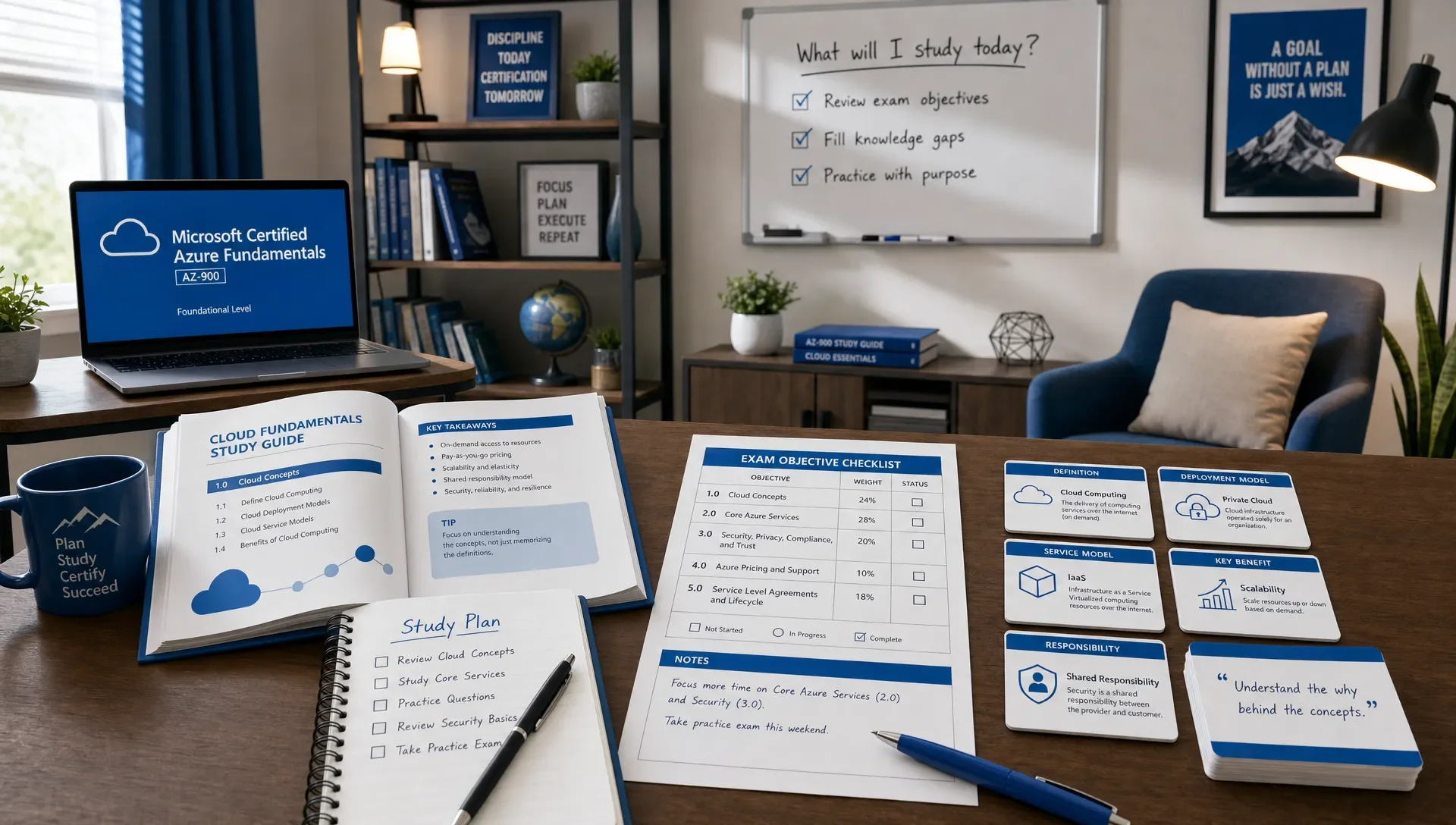
Test Help for When You Don't Know What to Study Next
How to Choose Your Next Study Topic for Certification Exams
Feeling stuck on what to study next? Rereading everything from the beginning is often the wrong approach. Instead, you need clear guidance that transforms confusion into a short, evidence-based next step. Focus on identifying your weakest objective, choosing the right practice format, and reviewing only what will improve your score.
Start by looking at three signals you already have: what you missed, what you guessed, and what you haven't touched recently. Even if you track these signals for just one study session, your next topic usually becomes obvious. The goal isn't to feel busy. It's to make each study block answer a specific question: what do I need to be able to do on exam day that I can't do yet?
Why Picking Your Next Study Topic Feels Hard
Many learners get stuck because their study materials are organized differently than the actual exam. A textbook chapter, a video playlist, or a flashcard deck might all cover the same general concept. However, exam blueprints are usually organized by specific objectives, domains, or skills. If your notes say 'networking basics' but the exam asks for detailed knowledge of VPC routing, subnets, and security controls, it's tough to decide what to study next.
Official exam pages are your best map here. AWS publishes certification exam information for roles like AWS Certified Cloud Practitioner, and Microsoft provides a detailed AZ-900 study guide that breaks the exam into measured skills. These objective lists help you stop treating all topics as equally important.
Another reason for feeling stuck is false confidence. Recognizing a term while reading notes feels like knowing it, but exams demand recall, application, and judgment under pressure. If you can recognize a term but can't explain when to use it, that topic isn't truly ready.
A third factor is emotional urgency. The topic you dislike most might feel like the one you absolutely must study, even if your practice results show a different weakness. Good prioritization protects you from studying based on discomfort alone.
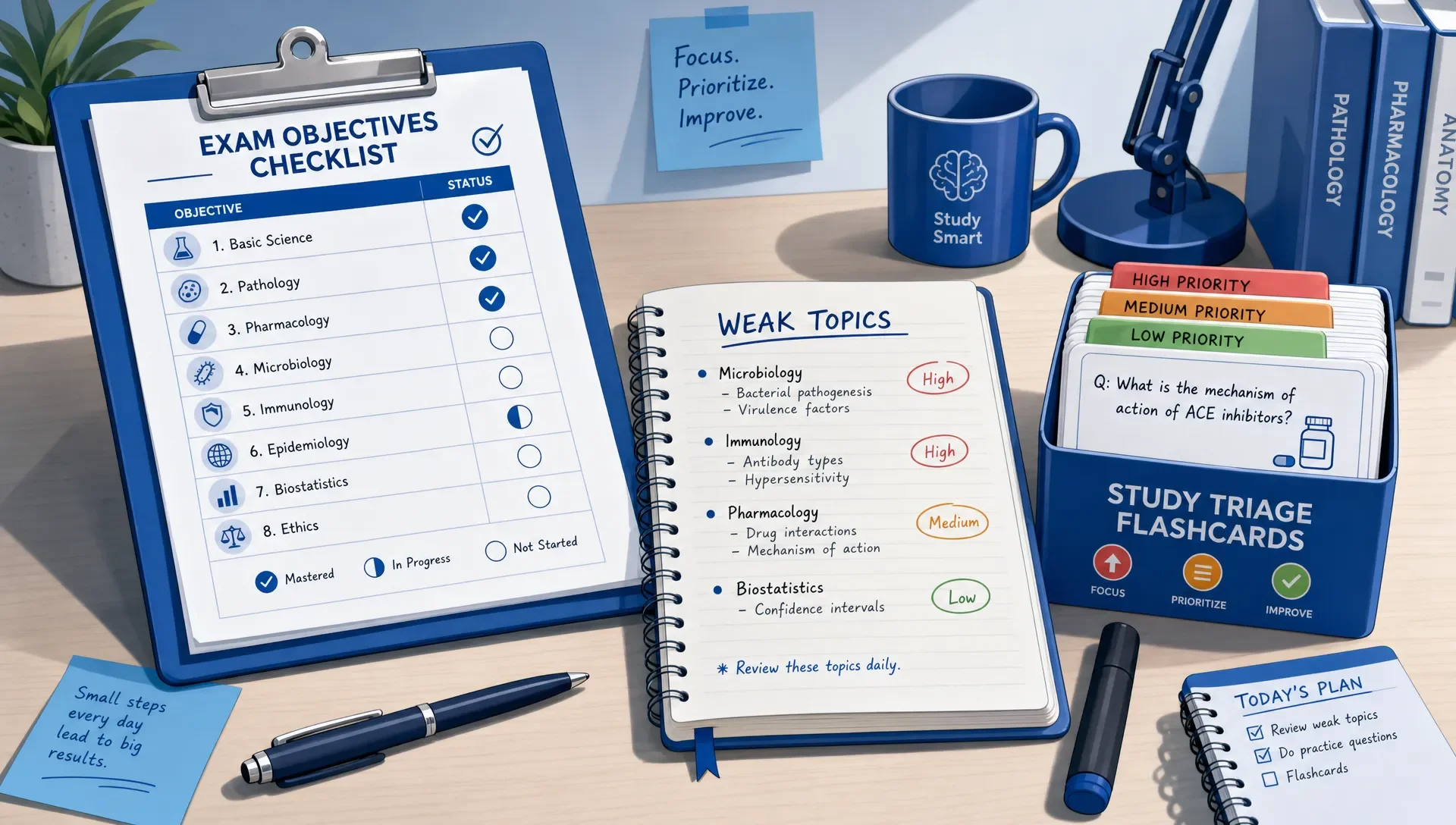
Your Study Starts With a Fast Triage
A useful study triage takes only 10 to 15 minutes. You don't need a perfect dashboard or a full diagnostic exam every time. You just need enough information to decide on your next study block.
Use your latest practice questions, missed flashcards, and an objective checklist. Mark each objective as strong, shaky, or unknown.
- Strong means you can answer scenario questions and explain your reasoning.
- Shaky means you recognize the idea but miss edge cases.
- Unknown means you can't define the terms or choose an answer without guessing.
| Signal from your study session | What it probably means | What to study next |
|---|---|---|
| You missed basic definition questions | The vocabulary isn't stable | Review the objective, then use flashcards |
| You missed scenario questions | You know terms but not their application | Compare use cases and decision rules |
| You guessed correctly | The score is hiding risk | Re-answer without choices and explain why |
| You ran out of time | Your process is too slow | Practice question reading and answer elimination |
| You keep missing one domain | The weakness is concentrated | Study that domain before adding new topics |
This is where guidance becomes practical: don't ask what you feel like studying. Ask which signal is strongest. If the strongest signal is repeated misses in one objective, that objective wins. If the strongest signal is slow timing across multiple domains, study question strategy instead of just content.
Build a Study Decision Grid
A decision grid prevents you from restarting your entire plan whenever you feel unsure. It should be simple enough to update after every practice session. Four columns are usually enough: objective, last score, confidence, and next action.
The confidence column is crucial because scores can be misleading. If you scored 80 percent on a topic but guessed on half the questions, that topic isn't solid. If you scored 60 percent but can explain every miss after review, you might be close to ready. Pairing score and confidence offers a clearer view than either metric alone.
| Objective or topic | Latest result | Confidence | Next action |
|---|---|---|---|
| Cloud shared responsibility | 5 of 6 correct | High | Maintain with spaced review |
| Identity and access management | 3 of 6 correct | Medium | Review use cases, then retest |
| Network security groups | 2 of 6 correct | Low | Study the objective from scratch |
| Cost management tools | 4 of 6 correct | Low | Explain each tool without notes |
When your grid shows a low score and low confidence, study the content. When it shows a high score and low confidence, review your reasoning. When it shows a low score and high confidence, inspect the question wording because you might be missing clues rather than concepts.
For deeper self-checking, use questions that force explanation instead of just recognition. MindMesh Academy's article on study questions that reveal what you actually know is a good companion when your practice scores look fine but your confidence is low.
The best support at this stage is a repeatable rule: update the grid, choose the weakest high-value objective, then run a focused practice set before moving on.
What to Study Next Based on Practice Results
Your next topic depends on the type of mistake, not just the fact that you were wrong. Two learners can miss the same question for entirely different reasons. One might not know a definition. The other might know the definition but miss a qualifier like 'least privilege,' 'most cost-effective,' or 'high availability.'
If you missed a question because you didn't know a term, go back to your study guide and build flashcards. Don't do ten more questions on the same topic yet; you'll only practice guessing. Learn the core vocabulary first, then return to questions after a short delay.
If you missed a question because two answers looked correct, study their comparison points. Certification exams often test the boundary between similar services, controls, processes, or commands. For cloud exams, this might mean knowing when to use one storage tier over another. For security exams, it might mean distinguishing between prevention, detection, and response controls.
If you missed a question because you ignored a clue, practice reading the question stem before the answers. Underline the required outcome, constraint, and environment. In project management exams, a clue like 'the issue has already occurred' changes the answer from risk planning to issue response.
This focused approach prevents wasted review because it connects each wrong answer to a specific fix. A definition miss needs memory work. A scenario miss needs application practice. A clue miss needs question technique.
| Mistake type | Your review question | Best next study action |
|---|---|---|
| Content gap | What term or rule didn't I know? | Read the objective and make recall cards |
| Application gap | What situation changes the best answer? | Compare scenarios and explain tradeoffs |
| Question-reading gap | What clue did I skip? | Practice stems without looking at answers |
| Timing gap | Where did I slow down? | Use shorter timed sets |
| Confidence gap | Why did I guess? | Re-answer and justify each option |
Use Practice Questions Without Memorizing Patterns
Practice questions are powerful, but only when they make you retrieve and reason. The Karpicke and Roediger paper in Science found that retrieval practice improved long-term retention more than additional studying in their experiments. Dunlosky and colleagues also rated practice testing and distributed practice as high-utility learning techniques in their review of study methods.
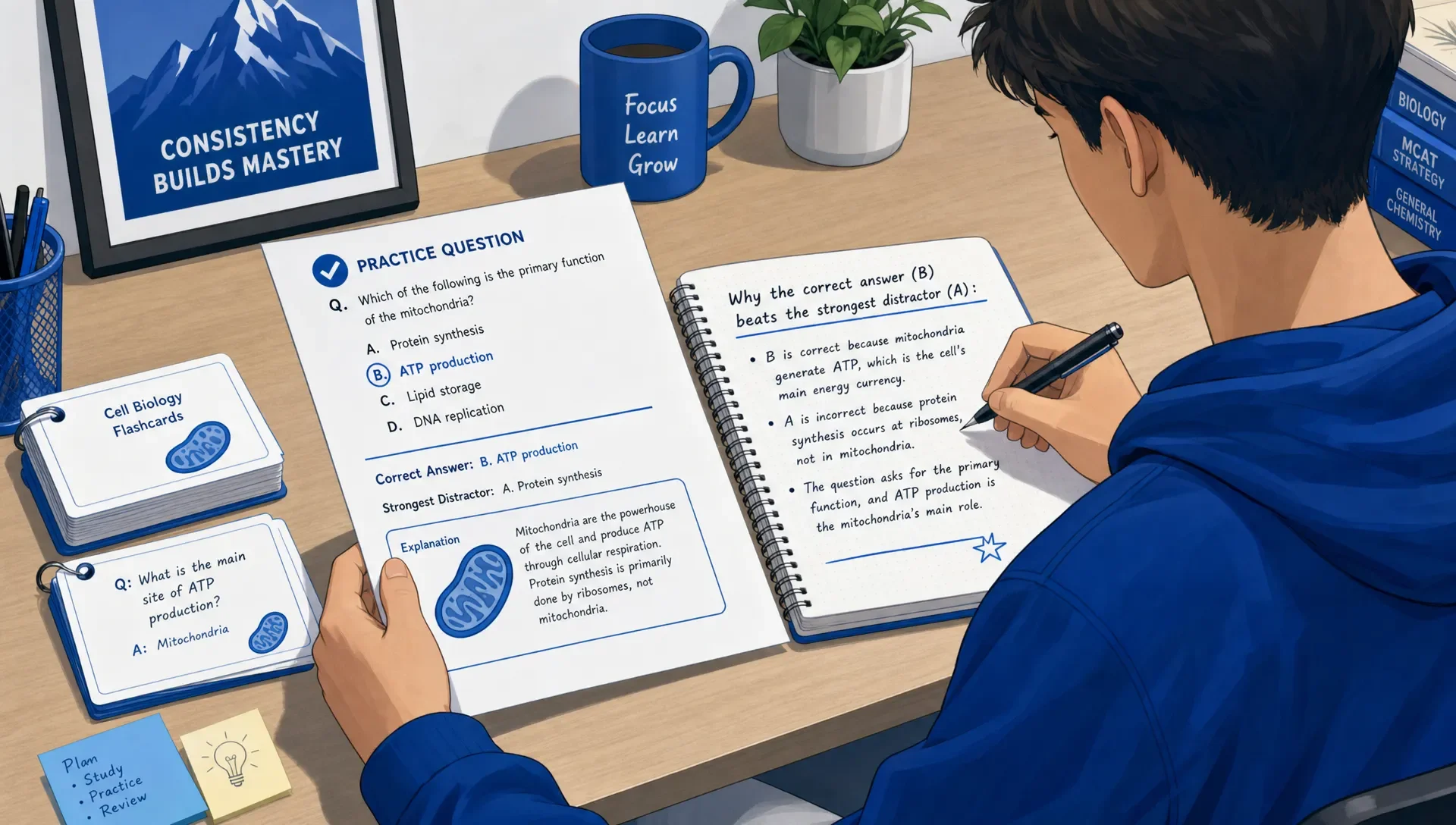
This doesn't mean you should hammer the same question bank until the answers look familiar. Familiarity can inflate your score without truly improving your readiness. After each question, write a one-sentence explanation for why the correct answer is best and why the strongest distractor is wrong. If you can't explain both, the question still holds value.
If you notice you're recognizing answer patterns, delay the retake and switch formats. Use flashcards, a short objective review, or scenario prompts before returning to the question bank. MindMesh Academy's guide to test prep methods that actually stick explains how active recall, spaced repetition, and mixed practice work together.
A 30-Minute Plan for Days You Don't Know What to Study
Some days you won't have the energy to design a full study session. Use a fixed 30-minute plan so you can start without negotiating with yourself.
| Time | What to do | Output |
|---|---|---|
| 0 to 5 minutes | Open your objective grid and choose one shaky topic | One target objective |
| 5 to 12 minutes | Review the study guide section or notes | Three key rules or facts |
| 12 to 20 minutes | Use flashcards or closed-book recall | A list of what you couldn't recall |
| 20 to 27 minutes | Answer 5 to 8 focused practice questions | Misses mapped to mistake types |
| 27 to 30 minutes | Decide the next action | Study, retest, or move on |
This plan works because it separates learning from testing. You start with a small content review, then you retrieve information, then you apply it. If you only read, you might feel productive without knowing if anything improved. If you only answer questions, you might keep repeating the same knowledge gap.
Use this version of focused study when your schedule is tight, your exam feels broad, or your motivation is low. The point isn't to finish an entire domain. The point is to reduce uncertainty enough to make your next session easier.
For busy learners preparing after work, the plan can shrink to 15 minutes: five minutes of recall, seven minutes of questions, and three minutes of review. The structure matters more than the length.
When to Stop Reviewing and Take a Practice Test
A full practice test isn't the best first move when you feel lost. If your objective grid shows many unknown topics, a full test might only tell you what you already know: you aren't ready yet. Use focused practice first.
Take a longer practice test when you've covered most objectives, your weak areas are specific, and you need to test pacing, endurance, and mixed-domain decision-making. If you're unsure where it belongs in your plan, MindMesh Academy's article on when to take a practice test in your study plan breaks down the timing.
Targeted assistance can also come from exam-specific practice. If you're preparing for a cloud fundamentals exam, an AWS Certified Cloud Practitioner practice exam can show whether your gaps are in billing, security, architecture, or core services. If you're studying security concepts, a CompTIA Security+ practice exam can help you separate knowledge gaps from scenario-reading problems.
Example Next Steps for Common Certification Goals
Different certifications call for different next steps when you're stuck. The same triage method applies, but the study action changes based on the exam style.
| Certification situation | Likely problem | Smart next step |
|---|---|---|
| You're new to cloud fundamentals | Too many unfamiliar service names | Study one objective at a time and use recall cards |
| You're close on a security exam | Similar controls blur together | Build comparison notes and do scenario sets |
| You're preparing for networking | Commands and concepts don't connect | Draw the path of traffic and explain each step |
| You're studying project management | Process choices feel subjective | Identify the project situation before choosing an answer |
| You're reviewing governance or IT service management | Terms sound similar | Create examples for each process or practice |
For Azure beginners, the AZ-900 Microsoft Azure Fundamentals study guide can help you work by measured skills instead of jumping between random topics. For learners preparing for project management, a PMP practice exam is more useful after you've practiced reading scenarios and identifying the project context.
The right help isn't always more content. Sometimes it's a better map. Sometimes it's a smaller practice set. Sometimes it's one flashcard deck repeated over several days until the basics stop slipping.
Frequently Asked Questions
How do I know what to study next for a certification exam? Start with your latest practice results and map every miss to an exam objective. Prioritize topics where you have both a low score and low confidence, then choose one focused study action before adding new material.
Should I reread my notes when I don't know what to study? Reread only after you identify the weak objective. General rereading feels safe, but it often avoids the real gap. Use recall, practice questions, and explanations to test whether the review worked.
How many practice questions should I do before changing topics? For focused review, 5 to 10 good questions can be enough to expose the next action. If the misses are all from the same concept, stop and study that concept before doing more questions.
What if my practice scores are good but I still feel unprepared? Check whether you can explain why each correct answer is right and why the closest wrong answer is wrong. If you can't, your score may reflect recognition rather than exam-ready understanding.
Can this method improve my study plan if my exam is close? Yes, but it should narrow your focus. When time is short, prioritize repeated misses, high-weight objectives, scenario questions, and topics you can't explain without notes.
Turn Uncertainty Into Your Next Study Move
You don't need to restart your study plan every time you feel unsure. You need a short feedback loop: choose an objective, test recall, answer a few focused questions, review the explanation, and record the next action.
MindMesh Academy is built around that loop, offering objective-based study guides, practice questions with explanations, spaced-repetition flashcards, and adaptive weakness-based practice. If your biggest problem is deciding what to study next, you can try an AZ-900 practice exam to gauge your readiness and let your results point to your next move.

Written by
Alvin Varughese
Founder, MindMesh Academy
Alvin Varughese is the founder of MindMesh Academy and an enterprise architecture leader. An electrical engineer by training, he moved from factory automation in South Africa to cloud architecture at GE Appliances and Humana (Fortune 50), and holds 20 professional certifications including AWS Solutions Architect Professional, Azure DevOps Engineer Expert, and Microsoft Agentic AI Business Solutions Architect. He built MindMesh Academy after interviewing too many highly certified candidates who couldn't answer basic questions: the goal is prep that makes you better at the job, not just able to pass the exam.