Test Prep Methods That Actually Stick
Test Prep Methods That Actually Stick
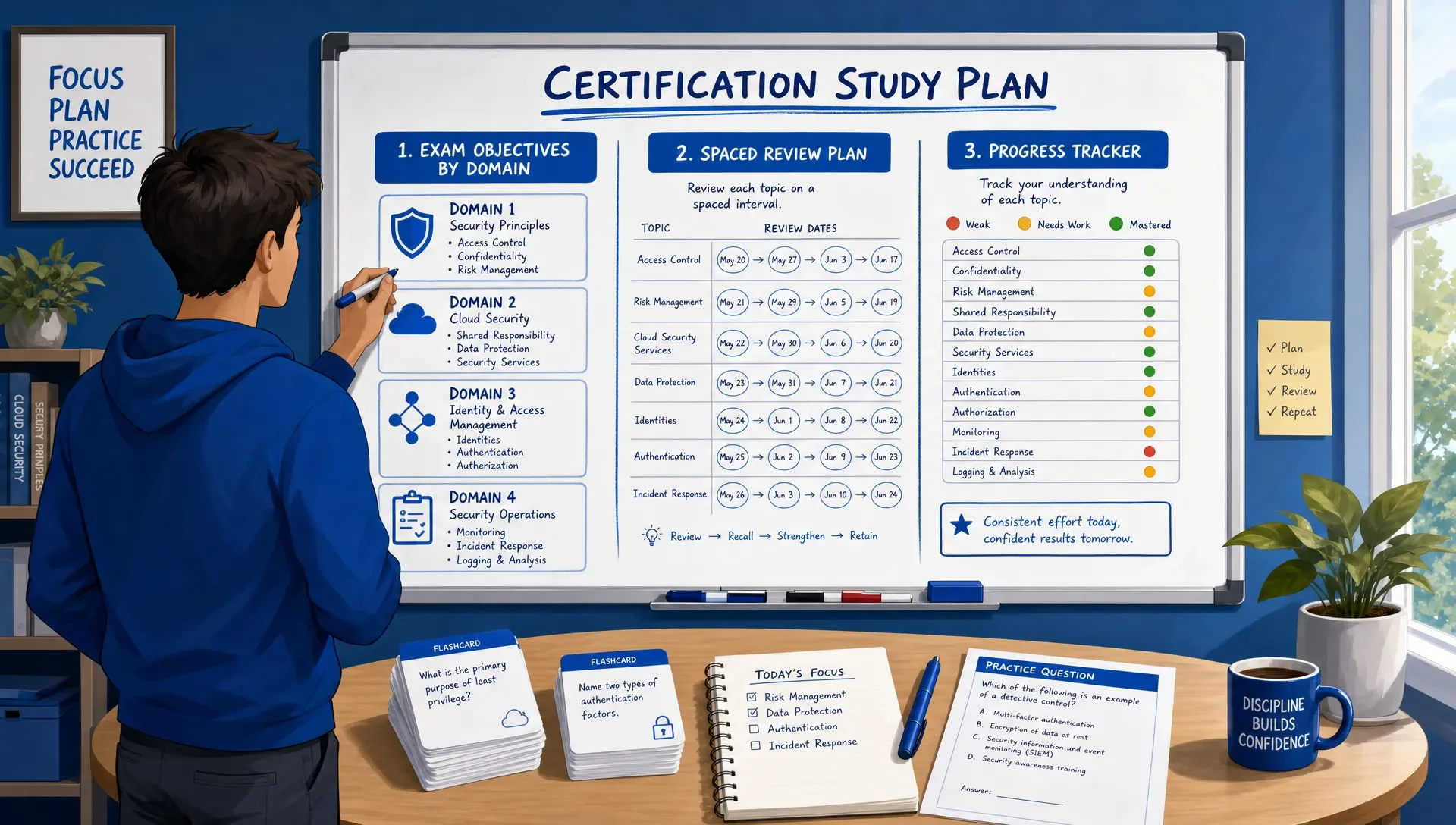
If you want test prep methods that actually stick, build every study session around one loop: learn a small objective, retrieve it from memory, check the explanation, schedule a spaced review, and test it again in a mixed set. If your session only involves rereading notes, highlighting, or watching another lesson, you may feel productive without building exam-ready recall.
A practical certification prep session should produce evidence. By the end, you should know which objective improved, which question type still slows you down, and which weak area needs the next review. That matters whether you're preparing for AWS, Azure, CompTIA, Cisco, PMI, ITIL, or another certification.
Start Test Prep With Exam Objectives
Good test prep starts with the exam blueprint, not with a random chapter order. Certification exams are built around objectives, domains, and task statements. If you study without that map, you can spend too much time on comfortable topics and miss the areas that actually drive exam difficulty.
Treat each objective as a promise you need to keep: you can define it, recognize it in a scenario, choose the best answer under time pressure, and explain why the other answers are weaker. That last part is where sticky learning happens. Recognition is easy. Explanation exposes whether you really understand the topic.
For example, if you're preparing for a cloud fundamentals exam, don't just read about shared responsibility. Ask yourself what the cloud provider manages, what the customer manages, and how that changes across IaaS, PaaS, and SaaS. If you're working through AWS foundations, an AWS Certified Cloud Practitioner practice exam can help you connect those objectives to exam-style questions.
| Weak test prep input | Sticky test prep output |
|---|---|
| Read a chapter | Explain the objective without notes |
| Watch a lesson | Answer closed-book recall prompts |
| Highlight definitions | Build flashcards from missed ideas |
| Take a quiz | Review each miss by objective and cause |
| Study what feels easy | Schedule review for weak and aging topics |
This approach also keeps you honest. If you can't explain a topic simply, you haven't finished studying it yet.
Use Active Recall Before You Feel Ready
Active recall means you try to produce the answer before looking it up. It feels harder than rereading because it is harder. That's the point. The effort is what trains retrieval.
A major review in Psychological Science in the Public Interest rated practice testing and distributed practice as high-utility learning techniques. In plain English, students remember more when they repeatedly pull information from memory and spread review over time instead of cramming.
Use active recall early, even when you feel underprepared. Waiting until you feel ready usually means you've delayed the most useful part of test prep. After reading a short section, close your notes and answer one of these prompts:
- What problem does this service, process, protocol, or framework solve?
- When would I use it instead of a similar option?
- What are two ways an exam question could try to confuse me?
- What keywords in a scenario would point toward this answer?
- What would make this answer wrong?
If you miss the answer, don't punish yourself. You just found the next card, note, or mini-drill. Misses are not failure data. They're targeting data.
Space Your Study Sessions So Review Happens Before Forgetting
Cramming can help you recognize material tomorrow, but certification exams reward flexible recall. You need to remember concepts after days or weeks, and you need to use them in scenarios that don't look like your notes.
The Institute of Education Sciences practice guide on organizing instruction and study recommends spacing learning over time rather than concentrating all study into one block. For test prep, that means you should review a topic multiple times with gaps between attempts.
A simple spacing rhythm works well:
| When to review | What to do | Goal |
|---|---|---|
| Same day | Recall key ideas without notes | Catch confusion immediately |
| 1 to 2 days later | Answer flashcards or a small quiz | Strengthen retrieval |
| 4 to 7 days later | Mix with related topics | Prevent shallow memorization |
| 10 to 14 days later | Use timed scenario questions | Build exam transfer |
| Final week | Review only weak and high-risk topics | Avoid wasting time on mastered areas |
Spaced repetition flashcards are useful because they make review timing easier. The key is not the flashcard itself. The key is that the card makes you recall before you see the answer, then returns at the right time based on how well you know it.
Turn Practice Tests Into a Feedback Loop
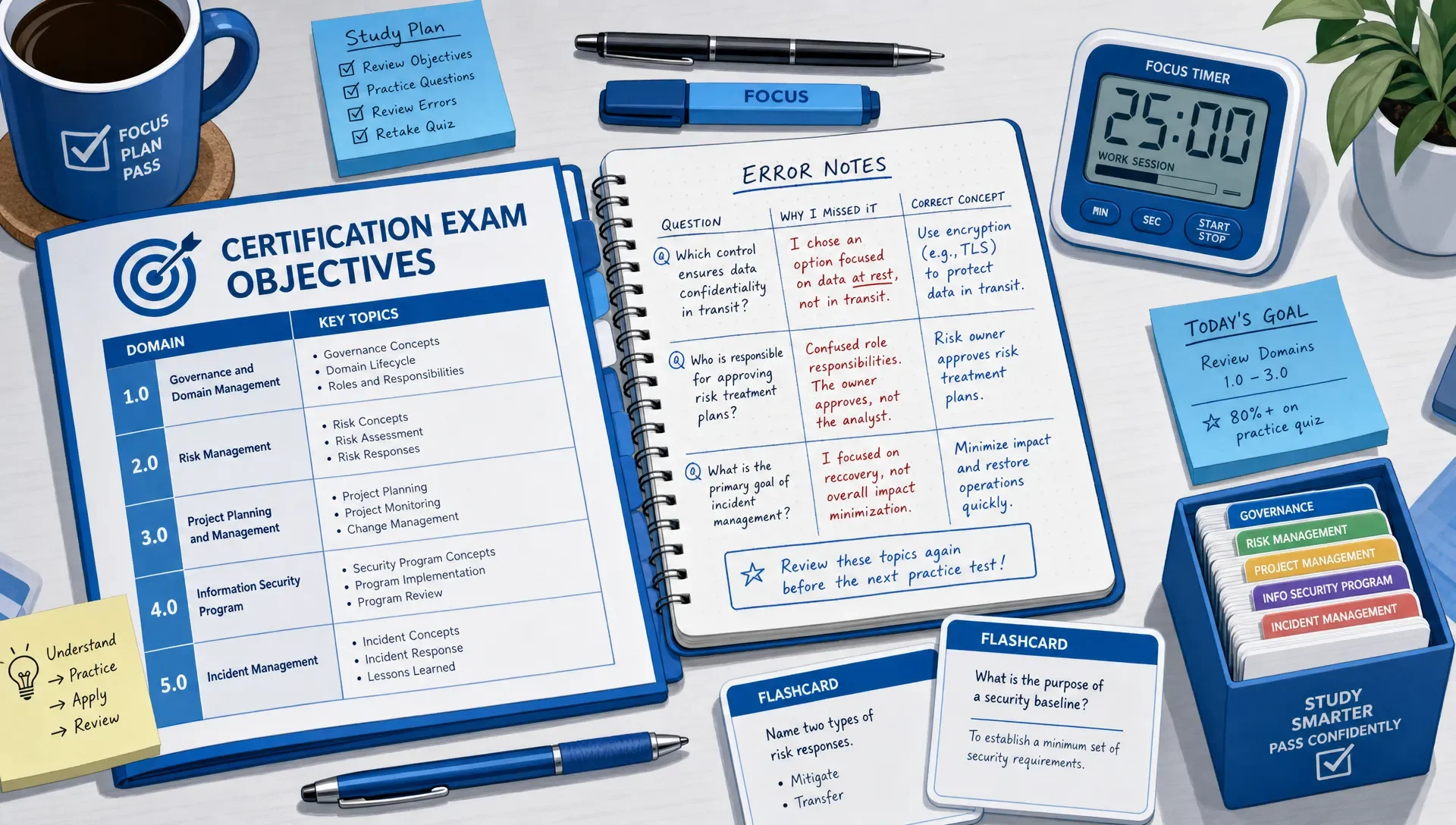
A practice test is not just a score. It's a diagnostic tool. If you only check the percentage and move on, you waste the most valuable part of the attempt.
Before reading explanations, mark each missed or guessed question with a cause. You want to know whether the issue was knowledge, reading, timing, or decision-making. That classification tells you what to do next.
| Practice test result | Likely cause | Best next action |
|---|---|---|
| Missed a definition | Knowledge gap | Relearn the objective and make recall cards |
| Chose a close distractor | Comparison gap | Study how two similar options differ |
| Changed a right answer | Confidence gap | Record why the first choice was stronger |
| Ran out of time | Pacing gap | Use short timed sets before full exams |
| Guessed correctly | Hidden risk | Review it like a miss |
| Missed only one domain repeatedly | Objective imbalance | Drill that domain before taking another full test |
This diagnostic mindset matters in real technical work, too. Teams don't fix complex systems well by guessing; they need visibility first. The AI automation and NetSuite consulting approach from DataOngoing is a good example of reducing black-box troubleshooting before remediation. Your test prep needs the same discipline: diagnose the weak link before you drill.
For certification exams, review explanations slowly. A good explanation should help you answer three questions: why the correct option is best, why each distractor is wrong, and what clue in the scenario mattered most. If you want a deeper walkthrough, use this guide on how to review an exam practice test the right way.
Mix Similar Topics So You Can Recognize the Right Answer
Studying one topic at a time feels clean, but exams often test whether you can choose between similar options. That's why mixed practice is so important.
If you're studying networking, don't drill only subnetting for an hour and then only routing protocols the next day. Mix small sets where the question could require subnetting, routing, DNS, NAT, firewall rules, or troubleshooting logic. If you're studying security, mix identity, encryption, risk management, incident response, and architecture decisions.
This helps because real exam questions rarely announce the topic in the first sentence. They give you a scenario and expect you to recognize the concept. Mixed practice trains that recognition.
A useful pattern is to study in two phases. First, isolate a topic until you understand it. Then, mix it with neighboring topics so you can tell them apart. Isolation builds the foundation. Mixing builds exam judgment.
For scenario-heavy exams, such as Security+, a CompTIA Security+ practice exam can help you practice that judgment under realistic constraints.
Explain Answers in Plain English Before Memorizing Terms
Many learners memorize terms too early. Definitions matter, but certification questions often ask you to apply a term, not recite it. If your explanation only works when you use official wording, you may not understand the idea yet.
Try this sequence:
- Explain the concept in plain English.
- Give a real or realistic example.
- Add the official term or exam phrase.
- Compare it with a similar concept.
- Answer a scenario question that uses it.
For example, don't stop at memorizing that high availability reduces downtime. Explain what fails, what keeps running, what redundancy exists, and how the design differs from disaster recovery. Then add the exam language.
This method works especially well for performance-based question formats and scenario questions because it forces you to understand relationships. You aren't just remembering a phrase. You're building a model you can use when the wording changes.
Practice Under Exam Constraints Without Burning Out
You need timed practice, but not every session should be a full mock exam. Full exams are useful, especially near the end of your prep, but they take time and energy. If you take them too often, you may collect scores without improving.
Use shorter timed sets during the middle of your study plan. A 10-question set can reveal pacing issues, sloppy reading, and weak objectives without draining the entire evening. After the set, review every miss and every guess. Then schedule targeted practice for the next session.
A balanced week might include concept review, flashcards, targeted quizzes, one mixed timed set, and one longer practice session. The goal is not to suffer through as many questions as possible. The goal is to convert each question into better decision-making.
| Session type | Best use | When to use it |
|---|---|---|
| Flashcards | Fast recall and spaced repetition | Most study days |
| Objective quiz | Fix a specific weak area | After learning a topic |
| Mixed timed set | Improve recognition and pacing | Middle and late prep |
| Full practice exam | Test endurance and readiness | Final stage of prep |
| Error review | Turn mistakes into study targets | After every quiz or exam |
Build a Weekly Test Prep Plan That Sticks
A sticky test prep plan should be repeatable. It doesn't need to be complicated, but it must include learning, retrieval, spacing, mixed practice, and review.
Here's a simple weekly structure you can adapt:
| Day | Main focus | Output you should produce |
|---|---|---|
| Monday | Learn one objective group | Notes rewritten as recall prompts |
| Tuesday | Active recall and flashcards | Cards rated by confidence |
| Wednesday | Targeted practice | Error log updated by objective |
| Thursday | Spaced review | Older weak topics refreshed |
| Friday | Mixed timed set | Timing and confidence tracked |
| Saturday | Deeper review | Explanations written for misses |
| Sunday | Light maintenance or rest | Plan adjusted for next week |
If you use MindMesh Academy, this kind of workflow fits naturally with study guides by exam objectives, practice questions with explanations, flashcards with spaced repetition, adaptive weakness-based practice, progress tracking by topic, and mastery and readiness tracking.
The most important part is the adjustment loop. Your plan should change based on performance. If your error log shows that identity and access questions keep causing misses, the next week should not be more general studying. It should include targeted identity and access review, recall cards, and mixed practice that forces comparison.
Know When You Are Ready to Schedule the Exam
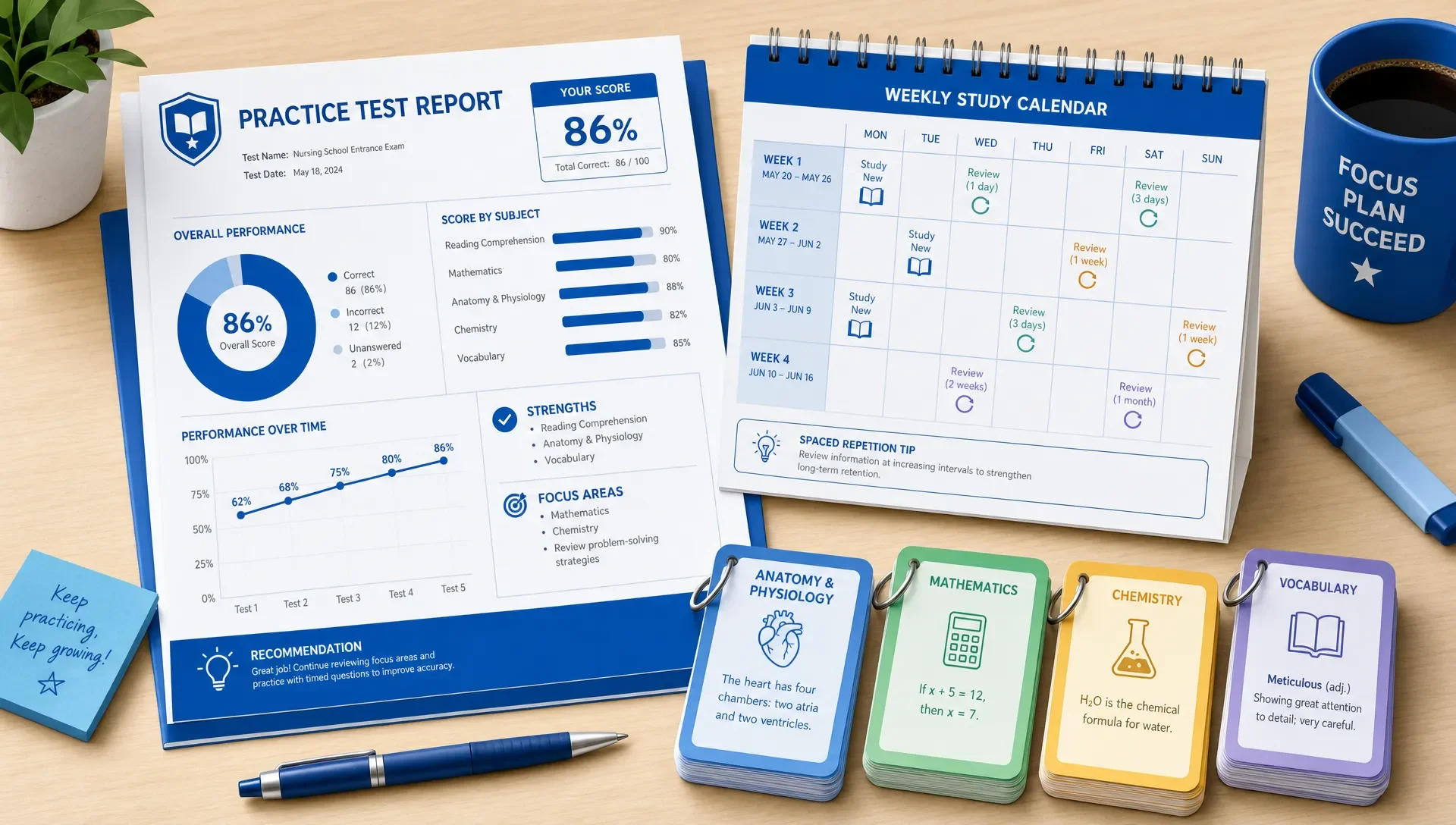
You don't need perfection before scheduling an exam, but you do need consistent evidence. A single good score can be a fluke, especially if you recognized questions from previous attempts. Look for patterns across different practice sets.
Good readiness signals include stable performance across domains, fewer lucky guesses, better pacing, and the ability to explain wrong answers without reading the explanation first. You should also feel some discomfort. A real exam will include unfamiliar wording, so your goal is not to make every question feel familiar. Your goal is to reason through unfamiliar questions using solid concepts.
| Readiness signal | What it tells you |
|---|---|
| You can explain core objectives without notes | Recall is becoming stable |
| Scores are consistent across mixed sets | You're not relying on topic order |
| Guesses are decreasing | Confidence and knowledge are improving |
| Timing is controlled | You can think under pressure |
| Weak domains are improving | Your review process is working |
| You can reject distractors clearly | You understand the decision logic |
If one domain is still far behind, don't ignore it. Certification exams often use weak domains to create doubt in stronger ones. A learner who knows cloud billing well but struggles with identity may overthink security scenarios. A learner who knows project management terms but struggles with change control may lose points on situational questions.
Common Test Prep Habits That Do Not Stick
Some study habits feel useful because they're familiar, not because they work. You don't need to eliminate every passive activity, but passive review should support active work, not replace it.
| Habit that feels productive | Why it usually fails | Better replacement |
|---|---|---|
| Rereading the same notes | Builds recognition more than recall | Close notes and answer prompts |
| Watching long lessons back to back | Creates fluency without proof | Pause every section for retrieval |
| Retaking the same quiz immediately | Inflates the score through memory | Review errors, wait, then retest |
| Ignoring correct guesses | Hides weak knowledge | Mark guessed answers for review |
| Studying only favorite domains | Leaves exam blueprint gaps | Track progress by objective |
| Reviewing explanations too quickly | Misses distractor logic | Write why each wrong option is wrong |
The fix is simple, but it takes discipline. Every study activity should answer one question: what can I do now that I couldn't do before? If you can't answer that, the session needs a clearer output.
Frequently Asked Questions About Test Prep Methods
How often should I take practice tests during test prep? Use short quizzes throughout your prep and save full-length practice exams for later stages. Early on, targeted quizzes help you fix weak objectives. Near the end, full practice exams help you test timing, endurance, and readiness.
Is rereading notes ever useful for certification exams? Yes, but only as a support activity. Reread briefly when you need to clarify a concept, then close the notes and retrieve the idea from memory. If rereading doesn't lead to recall or practice, it probably won't stick.
How long should a study session be? Most learners do better with focused sessions that have a specific output. A 45-minute session with recall, practice, and review often beats two hours of passive reading. The best length is the one that lets you stay active and review mistakes carefully.
What should I do when I keep missing the same topic? Stop taking broad quizzes for a moment. Relearn that objective, explain it in plain English, compare it with similar topics, create flashcards, and then test it in a small mixed set a day or two later.
How do I know if my test prep is actually sticking? Look for delayed recall. If you can answer questions on a topic several days after studying it, explain why distractors are wrong, and apply the idea in a new scenario, the learning is sticking.
Make Your Test Prep Stick With a Connected Workflow
Sticky test prep is not about studying harder every day. It's about making each session produce better recall, better judgment, and better evidence of readiness.
Use the loop: objectives, active recall, spaced review, mixed practice, timed testing, and error analysis. If you keep that loop connected, you won't have to guess what to study next. Your performance will show you.
MindMesh Academy supports this connected workflow. You'll find structured study materials, practice questions with detailed explanations, and spaced repetition flashcards to build your recall. To start building a strong foundation for your cloud career, explore our AWS Certified Cloud Practitioner study guide today.

Written by
Alvin Varughese
Founder, MindMesh Academy
Alvin Varughese is the founder of MindMesh Academy and an enterprise architecture leader. An electrical engineer by training, he moved from factory automation in South Africa to cloud architecture at GE Appliances and Humana (Fortune 50), and holds 20 professional certifications including AWS Solutions Architect Professional, Azure DevOps Engineer Expert, and Microsoft Agentic AI Business Solutions Architect. He built MindMesh Academy after interviewing too many highly certified candidates who couldn't answer basic questions: the goal is prep that makes you better at the job, not just able to pass the exam.