
Study Questions That Reveal What You Actually Know
Study Questions That Reveal What You Actually Know
Good study questions ask you to prove what you know before you see the answer. If a question feels familiar only because you've seen the wording before, it's testing recognition, not understanding. The fix is simple: use questions that force you to recall information, require a decision, and make you explain why other answers are wrong.
Use this rule during every study session: answer closed-book first, rate your confidence, explain your reasoning, then check the explanation. When you're preparing for AWS, Azure, CompTIA, Cisco, PMI, or another certification, that process shows whether you're actually ready or just comfortable with repeated material.
What Makes Study Questions Reveal Real Knowledge
The best study questions create a small amount of productive struggle. They don't just ask you to repeat a definition. They ask you to apply an idea, compare it with a similar concept, or choose the best action under specific constraints.
This matters because certification exams rarely reward surface memory alone. A cloud question might ask you to choose the most cost-effective managed service. A security question could ask for the best control after a specific incident. A project management question might ask what the project manager should do next, not what a term means.
Retrieval practice is one of the strongest reasons this works. In a well-known study by Karpicke and Roediger published in Science, learners who practiced retrieving information improved long-term retention compared with learners who spent more time restudying. The practical takeaway for exam prep: don't reread first. Try to answer first.
Strong study questions usually have these traits:
- They require you to produce an answer before seeing options.
- They connect directly to an exam objective or job task.
- They include plausible distractors that reveal a misconception.
- They make you explain why your answer is better than the alternatives.
- They lead to a specific next review action when you miss them.
If your questions don't do at least two of those things, they may still be useful for warm-up, but they won't tell you much about your readiness for the actual exam.
Study Question Types That Test Understanding
Different question formats reveal different kinds of knowledge. If you only use multiple-choice questions, you'll miss gaps in recall, explanation, and scenario reasoning. A balanced set gives you a clearer picture.
| Study question type | What it reveals | Example prompt |
|---|---|---|
| Blank-page recall | Whether you can retrieve the concept without clues | List the main steps in troubleshooting a DNS issue. |
| Explain-it-back | Whether you understand the idea clearly | Explain the difference between authentication and authorization. |
| Scenario decision | Whether you can apply knowledge under constraints | A workload needs high availability across two zones. What design choice fits best? |
| Compare and contrast | Whether you can separate similar concepts | When would you use a security group instead of a network ACL? |
| Error diagnosis | Whether you can spot why something failed | A user can ping an IP address but not a hostname. What is the likely problem? |
| Distractor defense | Whether your correct answer is stable | Why are the other three answer choices wrong? |
The most revealing format is often the one you least want to do. If you avoid blank-page recall, you may be relying too much on answer choices. If you dislike explaining your reasoning, you might be memorizing outcomes without understanding causes.
For a deeper look at using question banks without falling into memorization mode, MindMesh Academy's guide to question bank tactics that build real understanding pairs well with this approach.
How To Turn Basic Study Questions Into Diagnostic Questions
A basic question checks whether you remember a fact. A diagnostic question shows what kind of mistake you're likely to make on the exam. The difference is usually in the follow-up.
Basic question: What is least privilege?
Diagnostic version: A junior admin needs temporary access to restart one production service. Which access model best supports least privilege, and what risk would a permanent admin role create?
The second version does more work. It checks the definition, the use case, the security reasoning, and the risk trade-off. If you miss it, you can tell whether the gap is vocabulary, policy design, or scenario interpretation.
Use these upgrades when a question feels too easy:
- Add a constraint: Include cost, time, security, compliance, availability, or operational limits.
- Add a similar wrong option: Put a close concept next to the right one so you have to distinguish them.
- Ask for the next best step: Certification exams often test sequence, not just knowledge.
- Ask why not: Force yourself to explain why each distractor fails.
- Change the environment: Move the same concept from a definition question into a cloud, network, project, or service scenario.
This is also how you avoid the false confidence that comes from repeating the same item until you remember its position. If you can answer a reworded scenario correctly, your knowledge is more durable.
How To Use Study Questions For Certification Exam Prep
For certification preparation, study questions should start with the exam objectives. Don't build your question set from random topics or whatever feels interesting that day. Your goal is to test the same skills the exam says it will test.
Start with one objective, then create several question styles around it. For example, if you're studying cloud shared responsibility, don't stop at the definition. Ask who patches the host operating system, who configures identity permissions, what changes when you move from IaaS to SaaS, and how a distractor might confuse provider responsibility with customer responsibility.
If you're preparing for an entry-level cloud exam, an AWS Certified Cloud Practitioner practice exam can help you test whether your understanding holds up across services, billing, security, and architecture basics. If you're working on cybersecurity foundations, CompTIA Security+ practice questions are useful for checking whether you can apply controls, identify threats, and reason through scenarios.
The key is not just the number of questions you answer. It's whether each question produces evidence. After a session, you should know which objective is strong, which one is shaky, and what you'll review next.
A Simple Review Workflow For Every Study Question
The review process matters as much as the question itself. Many learners rush through explanations after seeing whether they got the item right. That's a missed opportunity. A correct answer with weak reasoning is still a warning sign.
Use this workflow for each meaningful question:
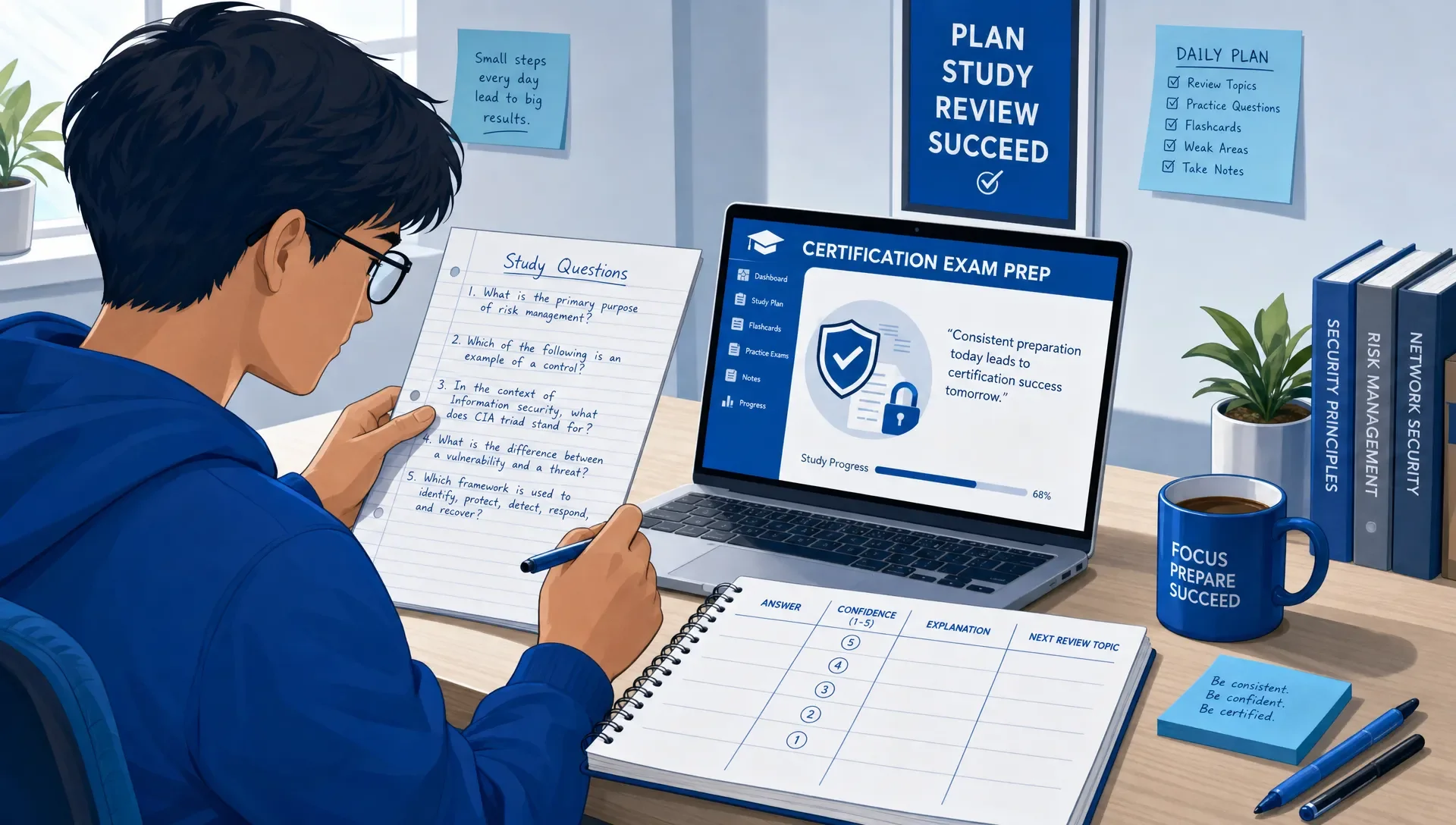
- Answer before checking anything: Don't look up notes, hints, or explanations until you've committed.
- Rate confidence from 1 to 3: Use 1 for guessing, 2 for partial confidence, and 3 for solid reasoning.
- Write the reason in one sentence: If you can't explain it, you don't own it yet.
- Review the explanation and objective: Identify the exact concept that made the answer correct.
- Create one follow-up question: Turn the mistake into another retrieval opportunity for tomorrow or later in the week.
This workflow separates lucky guesses from real mastery. A high score with many low-confidence answers means you need more practice. A lower score with clear explanations may be easier to fix because you can see the pattern.
The practice examination habits that improve recall article expands on this same principle: practice exams are most valuable when you treat them as retrieval training, not just score reports.
Study Questions By Topic Area
Good study questions look different depending on the certification area. A networking question should make you trace traffic. A cloud question should make you choose a service or architecture. A project management question should make you decide what action fits the process and context.
| Topic area | Weak question | Better study question |
|---|---|---|
| Cloud | What is scalability? | A web app has unpredictable traffic spikes. Which design choice improves scalability without overprovisioning? |
| Networking | What port does HTTPS use? | A firewall allows HTTPS, but users still can't reach a site by name. What should you check next? |
| Security | What is MFA? | A phishing attack captured a user's password. Which control reduces the chance of account takeover? |
| Project management | What is a stakeholder? | A stakeholder requests a scope change mid-sprint. What should the project manager do next? |
| IT service management | What is an incident? | A business-critical service is down for multiple users. Which process should be triggered first? |
Notice the pattern: the better question puts the concept inside a decision. That's what makes it reveal understanding. It doesn't just ask whether you recognize a term. It asks whether you can use the term correctly when the situation changes.
How To Know If Your Study Questions Are Working
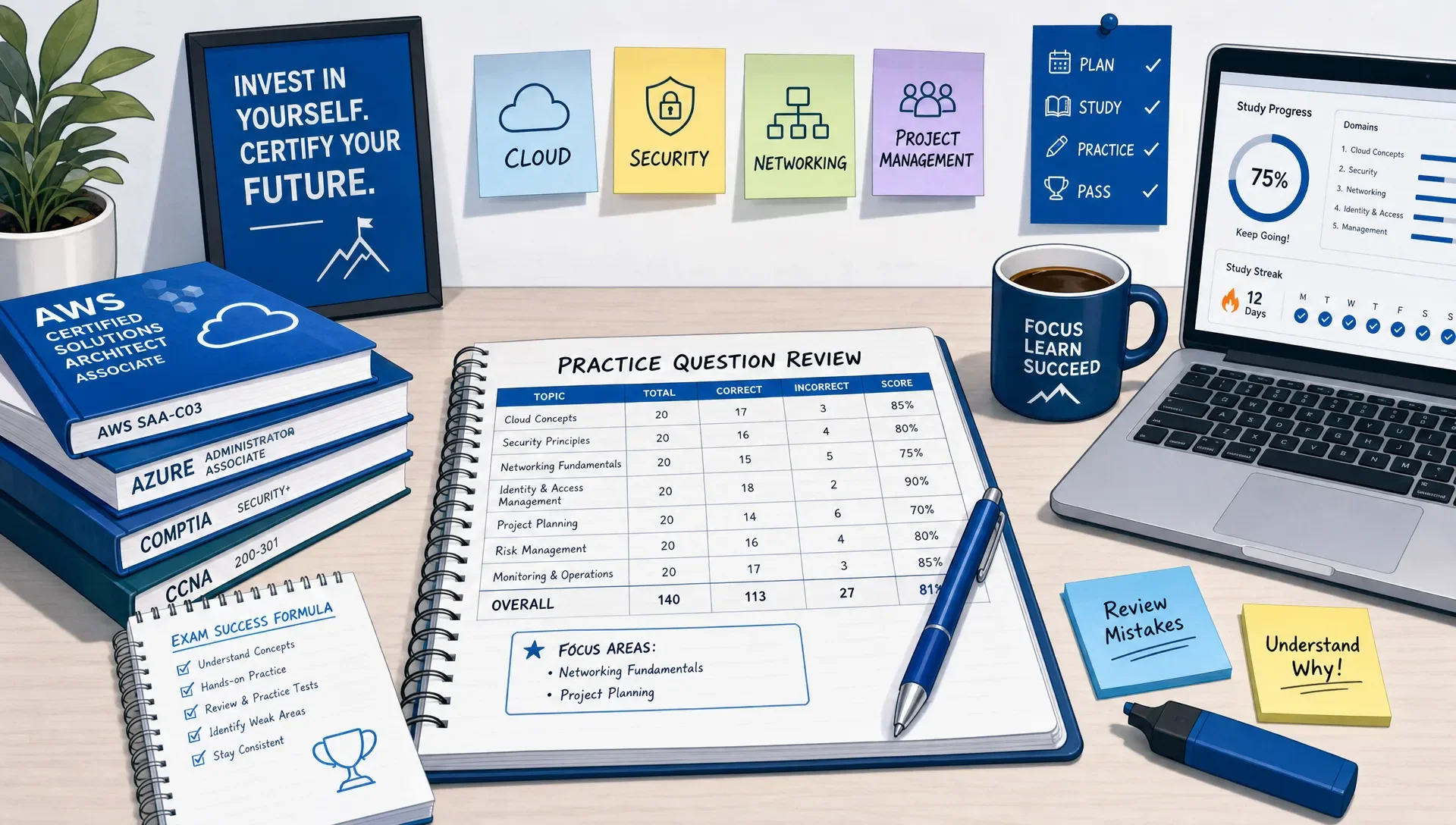
Study questions are working when your mistakes become more specific. Early in prep, you might write, "I don't understand networking." After better questioning, that becomes, "I confuse DNS resolution with transport connectivity," or "I choose encryption controls when the scenario asks for access control."
That's progress. Specific mistakes are fixable.
Track these signals during your weekly review:
| Signal | What it means | What to do next |
|---|---|---|
| Correct with high confidence | The concept is probably stable | Space it out and review later. |
| Correct with low confidence | You may have guessed well | Re-test with a reworded scenario. |
| Incorrect with high confidence | You have a misconception | Read the explanation carefully and make a contrast question. |
| Incorrect with low confidence | The topic is underdeveloped | Return to the study guide and rebuild the concept. |
| Slow but correct | You understand it, but retrieval is not fluent | Add short timed practice later. |
MindMesh Academy is built around this kind of connected study workflow.
Common Mistakes When Writing Or Choosing Study Questions
The biggest mistake is using questions that are too close to your notes. If the wording matches what you just read, you're often recognizing sentence structure instead of retrieving the idea.
Another mistake is reviewing only wrong answers. Correct answers deserve review when your confidence was low or your reasoning was incomplete. A guessed correct answer can hide a weak topic until exam day.
Also, watch out for overusing single-topic blocks. If you answer 30 questions on the same concept, the context itself gives you clues. Mixed practice is harder, but it better reflects real testing conditions. The Institute of Education Sciences practice guide on organizing instruction and study to improve student learning recommends approaches such as spaced practice and interleaving related skills because they support stronger long-term learning.
If you're unsure whether your practice habits are helping or hurting, review the common practice quiz mistakes that hurt your final score before your next full-length session.
Frequently Asked Questions About Study Questions
How many study questions should I do per day? It depends on your exam date and current readiness, but quality matters more than volume. Ten well-reviewed questions with written reasoning can be more valuable than 50 rushed questions you barely analyze.
Are multiple-choice study questions enough for certification exams? They help, but they shouldn't be your only format. Add blank-page recall, explain-it-back prompts, and scenario questions so you can test memory, reasoning, and application.
Should I repeat study questions I got wrong? Yes, but don't repeat them immediately until you simply remember the answer. Review the explanation, rebuild the concept, then answer a reworded version later through spaced repetition.
What should I write down after missing a question? Write the exam objective, the reason your answer was wrong, the clue you missed, and one follow-up question. This turns a wrong answer into a targeted study task.
How do I know if I'm memorizing questions instead of learning? Reword the scenario, remove the answer choices, or ask yourself why each distractor is wrong. If your performance drops sharply, you were relying on recognition.
Do study questions help with performance-based questions? Yes, if you make them task-based. Ask what you would configure, troubleshoot, sequence, or verify, not just which definition is correct.
Build Study Sessions That Show Real Readiness
The right study questions make your preparation honest. They show the difference between familiar material, partial understanding, and knowledge you can use under exam pressure.
If you want a more structured way to approach your preparation, MindMesh Academy offers detailed exam objective study guides, practice questions with explanations, and readiness tracking tools. Start by exploring our comprehensive AWS Certified Cloud Practitioner Study Guide to build a strong foundation for your exam.

Written by
Alvin Varughese
Founder, MindMesh Academy
Alvin Varughese is the founder of MindMesh Academy and an enterprise architecture leader. An electrical engineer by training, he moved from factory automation in South Africa to cloud architecture at GE Appliances and Humana (Fortune 50), and holds 20 professional certifications including AWS Solutions Architect Professional, Azure DevOps Engineer Expert, and Microsoft Agentic AI Business Solutions Architect. He built MindMesh Academy after interviewing too many highly certified candidates who couldn't answer basic questions: the goal is prep that makes you better at the job, not just able to pass the exam.