When to Take a Practice Test in Your Study Plan
When to Take a Practice Test in Your Study Plan
The best time to take a practice test is before your study plan feels finished, but after you've seen enough of the exam objectives to make the score meaningful. Use an early diagnostic test to find gaps, short topic tests after each major section, mixed tests during review, and full-length timed tests only when you're close enough to use the result as a readiness signal.
If you wait until the final week to take a practice test for the first time, you're using it like a verdict. That's stressful and usually too late to fix weak areas. Taking a full-length test on day one with no context can be discouraging without being useful. The goal is to match the test to your study phase so every score tells you what to do next.
Why Practice Tests Belong Throughout Your Study Plan
A practice test is more than just a score check. It forces retrieval, meaning you have to pull information from memory instead of simply recognizing it on a page. Roediger and Karpicke's retrieval practice research found that taking memory tests after studying improved later retention compared with repeated studying alone. For certification prep, this matters because exam questions rarely ask you to recite a definition. Instead, they ask you to choose between close options under time pressure.
The Institute of Education Sciences also recommends spacing learning over time and using quizzes to support retention in its practice guide on organizing instruction and study. This supports a simple study-planning rule: don't save all practice until the end. Space it out, review your misses, and retest weak objectives after time has passed.
For IT, cloud, security, and project management exams, practice tests also help you map your knowledge to the official exam structure. Vendors publish objectives and skills measured pages, such as the AWS Certified Cloud Practitioner exam page and Microsoft's AZ-900 skills outline. Your practice-test schedule should follow those objectives, not just the chapters in a book or the order of videos in a course.
When to Take Your First Practice Test
Take your first practice test after a quick orientation through the exam objectives, not after weeks of passive studying. At this point, you don't need to know everything. You simply need enough vocabulary to understand what the questions are asking.
For most certification plans, this means taking a diagnostic test after you've skimmed the exam blueprint, read a high-level overview of each domain, and learned the basic terms. This might happen after a few study sessions for a fundamentals exam or after a longer orientation for an advanced certification.
The first test should be low stakes. It can be shorter than the real exam, untimed or lightly timed, and focused on broad coverage. You're not trying to prove you're ready. You're trying to answer three questions:
- Which objectives are already familiar?
- Which ones are weak?
- Which ones are completely new?
A good diagnostic score often feels messy. That's fine. The danger isn't a low score. The danger is ignoring what the score says and continuing with the same plan anyway.
How to Schedule Practice Tests by Study Phase
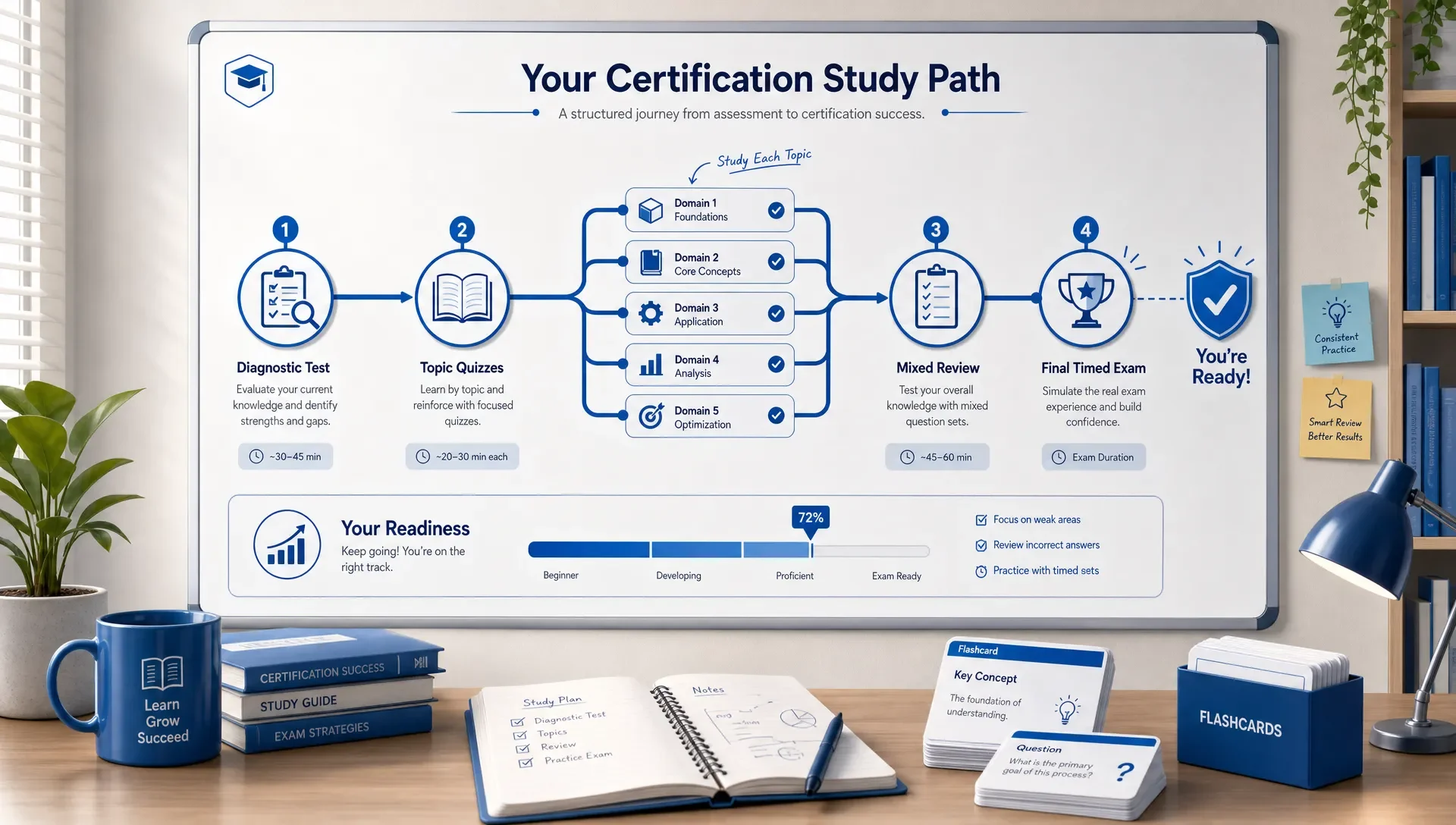
Your study plan should include different checkpoints. A single final mock exam can't do all the work. Use this table as a practical starting point and adjust it based on exam difficulty, your background, and your deadline.
| Study phase | When to test | Best test type | What to do with the result |
|---|---|---|---|
| Orientation | After reviewing the exam objectives and basic terms | Short diagnostic test | Identify weak domains and plan study time |
| Core learning | After each major objective or domain | Topic-focused quiz | Fix misunderstandings before moving on |
| Midpoint review | After covering about half the objectives | Mixed practice test | Check whether older topics are sticking |
| Final review | After covering all objectives at least once | Timed section test or full-length test | Measure timing, stamina, and readiness gaps |
| Last check | A few days before the real exam | Short confidence check | Confirm stability, not cram new content |
The most important row is the middle one. Many learners study Domain 1, do fine on a quiz, then forget it while studying Domain 4. Mixed practice catches that. It brings older material back into the rotation before it decays.
Which Practice Test Format to Use at Each Stage
Not every practice test should feel like the real exam. Early in your plan, shorter tests give clearer feedback because they isolate specific objectives. Later, full simulations become more useful because they reveal timing problems, fatigue, and question-switching issues.
| Practice format | Best time to use it | Why it helps |
|---|---|---|
| Diagnostic quiz | Beginning of the plan | Shows where to spend study time first |
| Objective-based quiz | After studying one domain | Confirms whether you understood that section |
| Mixed quiz | Weekly or during midpoint review | Tests retention across older and newer topics |
| Timed section test | Final review phase | Builds pacing without the load of a full exam |
| Full-length practice exam | Near the end of the plan | Tests readiness, stamina, and decision-making under pressure |
If you're preparing for a cloud fundamentals exam, for example, an objective-based workflow helps you avoid random practice. A learner working toward AWS Cloud Practitioner might use the AWS Certified Cloud Practitioner practice exam after covering the main knowledge areas, then review weak objectives before attempting another timed set.
If you're still building the foundation, use the study guide first and test in smaller sections. For Azure learners, an objective-based resource like the AZ-900 Microsoft Azure Fundamentals study guide can help you organize the learning phase before you rely on larger practice exams.
When a Full-Length Timed Practice Exam Makes Sense
A full-length timed exam is most useful after you've covered all exam objectives at least once and completed some mixed review. Before that point, it often measures exposure more than readiness. You might miss questions simply because you haven't studied the topic yet, which is obvious but not very actionable.
Use a full-length timed test when you need to validate three things:
- Can you handle the full range of objectives in one sitting?
- Can you keep a steady pace without rushing the last section?
- Can you make decisions when two answer choices both sound plausible?
A full-length test is also useful if you tend to overthink. Short quizzes don't always reveal that habit because the topic is fresh and narrow. A longer mixed test forces you to decide, move on, and manage uncertainty.
Don't take multiple full-length tests back to back without review. That usually creates score noise, not improvement. The learning happens between attempts, when you diagnose mistakes, revisit objectives, and practice the weak areas.
When You Should Not Take a Practice Test
There are times when another practice test is the wrong move. If you've just finished a full exam and haven't reviewed it, don't start a new one. You're likely to repeat the same mistakes. Review first, then retest.
Don't take a full-length test when you're exhausted just to check a box. Fatigue can be part of exam prep, but a score from a poor testing state may lead you to overreact. If your plan says full exam tonight but you're mentally done, use a short review session or flashcards instead.
Avoid taking your first real practice test the night before the exam. At that point, the result can create panic without leaving enough time for targeted repair. The final day is better for light review, formula checks, command memorization if relevant, and confidence-building questions.
Also avoid using practice tests as a substitute for learning. If every study session is just question after question, you may start recognizing patterns without understanding the concept. That can fail quickly when the real exam changes the wording or asks you to apply the same idea in a new scenario.
How Often Should You Take Practice Tests
For most certification learners, short practice sessions should happen more often than full practice exams. You might use topic quizzes several times per week, mixed practice quizzes once or twice per week, and full-length tests only in the final stretch. The exact schedule depends on your exam date and baseline knowledge.
A useful rhythm is study, quiz, review, repair, and retest. The retest shouldn't happen immediately every time. If you retest too soon, you may remember the question rather than the concept. Give yourself enough spacing so the second attempt measures learning, not short-term recognition.
If your scores are flat, taking more tests may not be the answer. Look at the cause. Are you missing the same objective repeatedly? Are you misreading scenario details? Are you running out of time? Are you choosing answers based on familiar words instead of requirements? Each problem needs a different fix.
How to Act on Your Practice Test Results
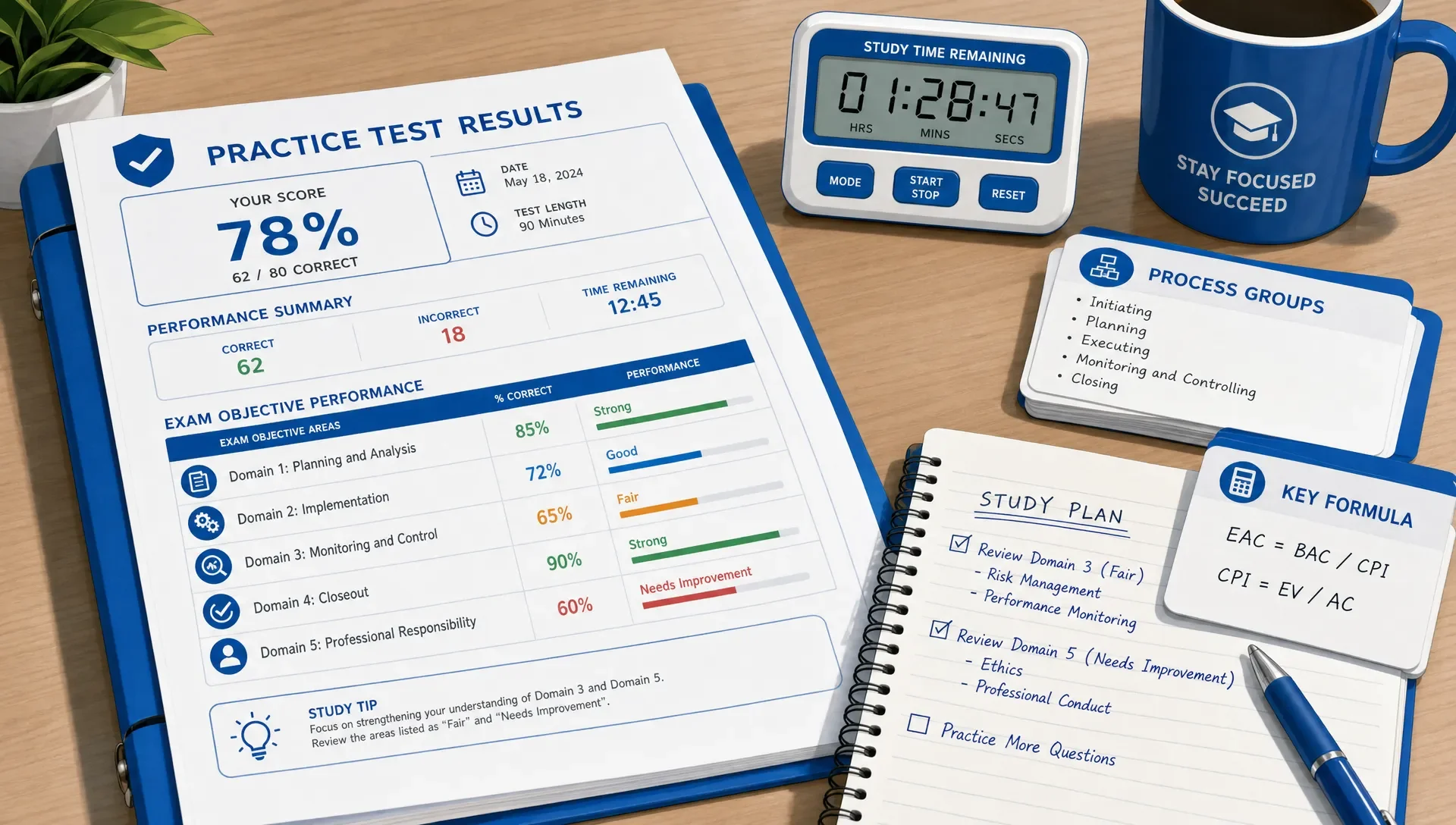
Your score is the least detailed part of the result. The real value is in the pattern of misses. After each test, sort your mistakes before reading too deeply into explanations. This keeps you from saying, "I knew that," and moving on too quickly.
A simple review should separate content gaps from reasoning problems. Content gaps mean you didn't know the service, term, process, or rule. Reasoning problems mean you knew the material but missed the clue, chose too quickly, or didn't compare the options carefully.
Use this table to decide what to do after a practice test.
| Result pattern | Likely issue | Best next step |
|---|---|---|
| Low score across many domains | Not enough foundation yet | Return to objective-based study and shorter quizzes |
| Strong topic scores but weak mixed scores | Retention or transfer problem | Add spaced mixed review and flashcards |
| Good accuracy but poor timing | Pacing problem | Use timed section tests and decision rules |
| Same objective missed repeatedly | Persistent knowledge gap | Relearn that objective and practice similar questions |
| Misses caused by wording | Question analysis problem | Slow down on qualifiers, constraints, and scenario clues |
For a deeper process, use a structured review method after every serious attempt. MindMesh Academy's guide on how to review an exam practice test the right way walks through score, timing, confidence, and error causes so your next study session is based on evidence rather than mood.
How to Know You're Ready to Schedule the Exam
A practice test should help you decide whether to schedule, reschedule, or keep studying. Don't base that decision on one high score. Look for consistency across multiple attempts and question sets.
You're getting close when your scores are stable, your weak domains are shrinking, and you can explain why the wrong answers are wrong. That last point matters. If you only know why the correct answer is correct, you're not fully ready for tricky exam wording.
You should also feel in control of timing. That doesn't mean every question feels easy. It means you can mark a hard question, move on, and return without letting one item ruin the next ten. For many certification exams, that test-taking discipline is as important as memorizing facts.
Readiness also depends on the source quality of your questions. Good practice questions should align with exam objectives, include explanations, and test application rather than pure recall. If you're scoring well only because you've memorized a small bank of questions, treat that as a warning sign.
Sample Practice Test Timing for a Four-Week Study Plan
A four-week plan needs fast feedback, but it still shouldn't be one long stream of random tests. Here's a practical structure.
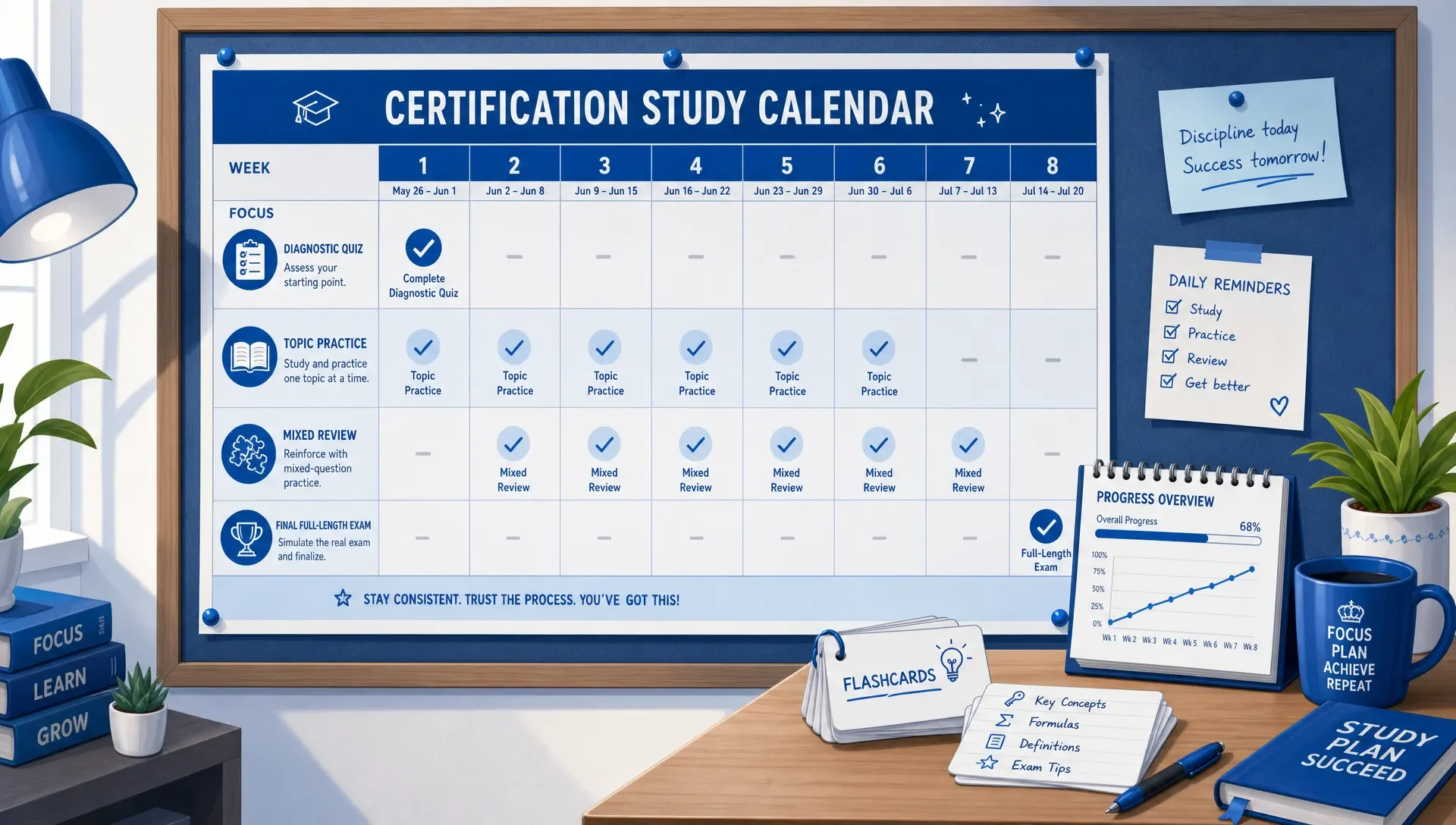
In week one, review the exam objectives, learn the basic vocabulary, and take a short diagnostic. Use the result to rank domains by weakness. In week two, study the highest-weight or weakest objectives and take topic quizzes after each block. In week three, shift into mixed practice so older topics stay active. In week four, take one full-length timed test early enough that you can review it, repair weak areas, and do a smaller confidence check before exam day.
If your plan is eight to twelve weeks, stretch the same pattern. Add more spaced review, more objective-level checkpoints, and fewer panic-driven full-length timed exams. More time should mean better spacing, not more procrastination.
Frequently Asked Questions
Should I take a practice test before I start studying? Yes, but keep it a short diagnostic. Review the exam objectives and basic terms first. Taking a full-length test before understanding the exam structure often yields a low, unhelpful score.
How many practice tests should I take before a certification exam? Focus on many short quizzes and fewer full-length tests. Frequent objective-based and mixed practice usually offers more value than redoing full exams without careful review.
Is it bad to take a full practice test too early? It's not inherently bad, but it's inefficient. If you haven't covered the objectives, the score will simply confirm you still need to study. Use a diagnostic test early, and save full simulations for your final review.
Should every practice test be timed? No. Untimed early quizzes let you focus on reasoning and explanations. Introduce timing later to build pacing, stamina, and exam-day decision-making.
What score should I reach before taking the real exam? Aim for consistent scores above your target, strong performance across all objectives, and the ability to explain why both correct and incorrect options are valid. Avoid relying on a single high score or a memorized question set.
What should I do after a bad practice test score? Review your misses by objective and error type, then study your weakest areas before retesting. A low score is valuable if it guides your next study session.
Build a Practice-Test Schedule That Shows Your Next Step
A strong study plan doesn't ask, "Did I take enough tests?" It asks, "Did each test tell me what to study next?" Use diagnostics early, topic quizzes during learning, mixed practice for retention, and full-length timed exams only when you're ready to measure exam behavior.
MindMesh Academy helps you connect your learning to actionable insights. We offer study guides aligned to exam objectives, practice questions with detailed explanations, and adaptive tools that pinpoint your weak areas. If your current study plan feels uncertain, let your practice test results guide your next steps. Start preparing for your AZ-900 exam with MindMesh Academy's practice tests and build confidence for exam day.

Written by
Alvin Varughese
Founder, MindMesh Academy
Alvin Varughese is the founder of MindMesh Academy and an enterprise architecture leader. An electrical engineer by training, he moved from factory automation in South Africa to cloud architecture at GE Appliances and Humana (Fortune 50), and holds 20 professional certifications including AWS Solutions Architect Professional, Azure DevOps Engineer Expert, and Microsoft Agentic AI Business Solutions Architect. He built MindMesh Academy after interviewing too many highly certified candidates who couldn't answer basic questions: the goal is prep that makes you better at the job, not just able to pass the exam.