Practice Examination Habits That Improve Recall
Practice Examination Habits That Improve Recall
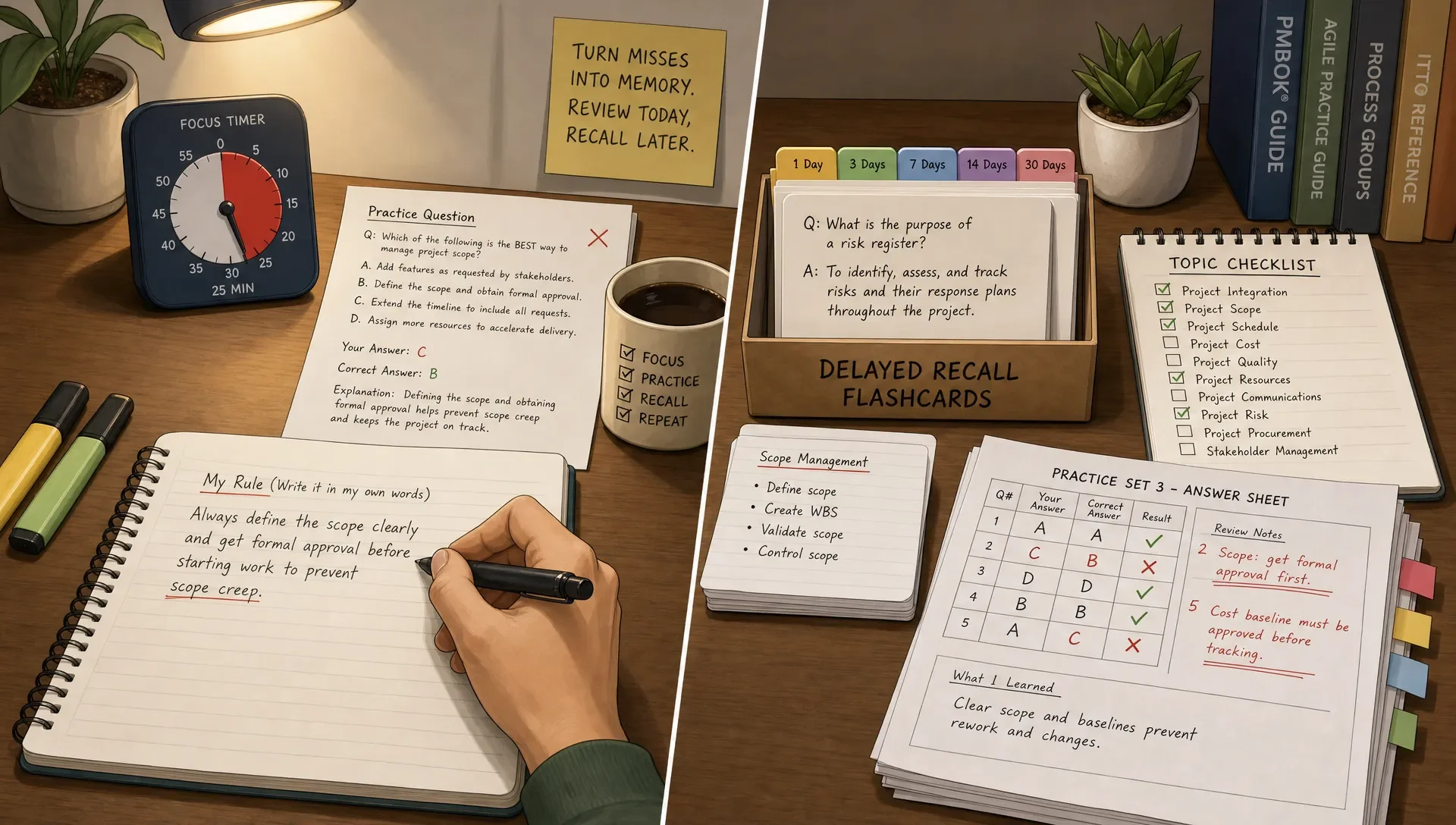
A practice examination improves recall only when you use it as retrieval training, not as a scoreboard. The most effective habit is simple: answer closed book, commit to a choice, review the explanation, identify the rule you missed, then retest that rule after a delay.
If you're preparing for an IT, cloud, cybersecurity, or project management certification, build your practice around this loop. Scores matter, but your real goal is to make the right information easier to pull from memory under pressure. If you want a quick refresher on the role of simulated exams, MindMesh Academy's guide to what a practice exam is and how it helps is a useful companion to the habits below.
Use Closed-Book Practice Before You Review Notes
The recall benefit starts before you know whether you're right. When you force your brain to retrieve an answer without notes, you're strengthening access to the information, even when the attempt feels difficult.
That isn't just study folklore. In a well-known experiment, Roediger and Karpicke found that taking memory tests improved long-term retention more than simply restudying the material, even when students initially felt less confident after testing. You can read the original paper in Psychological Science.
For certification prep, that means you shouldn't open a study guide every time a question looks unfamiliar. First, make yourself retrieve. Choose the best answer, mark your confidence, and write a short reason before you check the explanation.
| Practice habit | What it prevents | What to do instead |
|---|---|---|
| Answer before reviewing | Passive recognition | Commit to an answer without notes |
| Mark confidence | False certainty | Label each answer as high, medium, or low confidence |
| Explain your choice | Lucky guessing | Write one sentence explaining why you chose it |
| Review after the attempt | Shallow reading | Compare your reasoning with the explanation |
A low-confidence correct answer still needs attention. On the real exam, the same concept may appear in a different scenario, with different wording, and you won't want to rely on luck.
Review Explanations Until You Can Rebuild the Rule
Many learners review practice questions too quickly. They see the correct answer, nod, and move on. That gives you recognition, not recall.
A better review habit is to rebuild the rule behind the answer. For every missed or low-confidence question, write a short correction in your own words. Don't copy the explanation. Reduce it to the principle you'll need next time.
For example, if you miss an AWS shared responsibility question, the useful takeaway isn't just that option C was correct. The takeaway might be: AWS secures the infrastructure, while the customer is responsible for configuration, identity access, and data choices in the cloud. That sentence is reusable across many future questions.
Use this three-part review format:
- Why the correct answer is right: State the principle, not just the option letter.
- Why your answer was tempting: Name the misconception that pulled you away.
- What clue you missed: Identify the phrase, requirement, or constraint in the question stem.
This is where structured content matters. If you're studying from a guide organized by exam objectives, it's easier to connect each miss to the exact domain you need to reinforce. For broader learning mechanics, the MindMesh article on the neuroscience of learning explains why active recall, spacing, and elaboration work better than rereading alone.
Retake Missed Questions on a Delay, Not Immediately
Immediate retakes can feel productive, but they often test short-term recognition. You remember the answer because you just saw it. That doesn't prove you'll recall the concept days later during a timed exam.
Spacing your retakes is more reliable. Cepeda and colleagues found that spacing study sessions improves later retention, and their research showed that the best gap depends on how far away the final test is. The original study is available in Psychological Science.
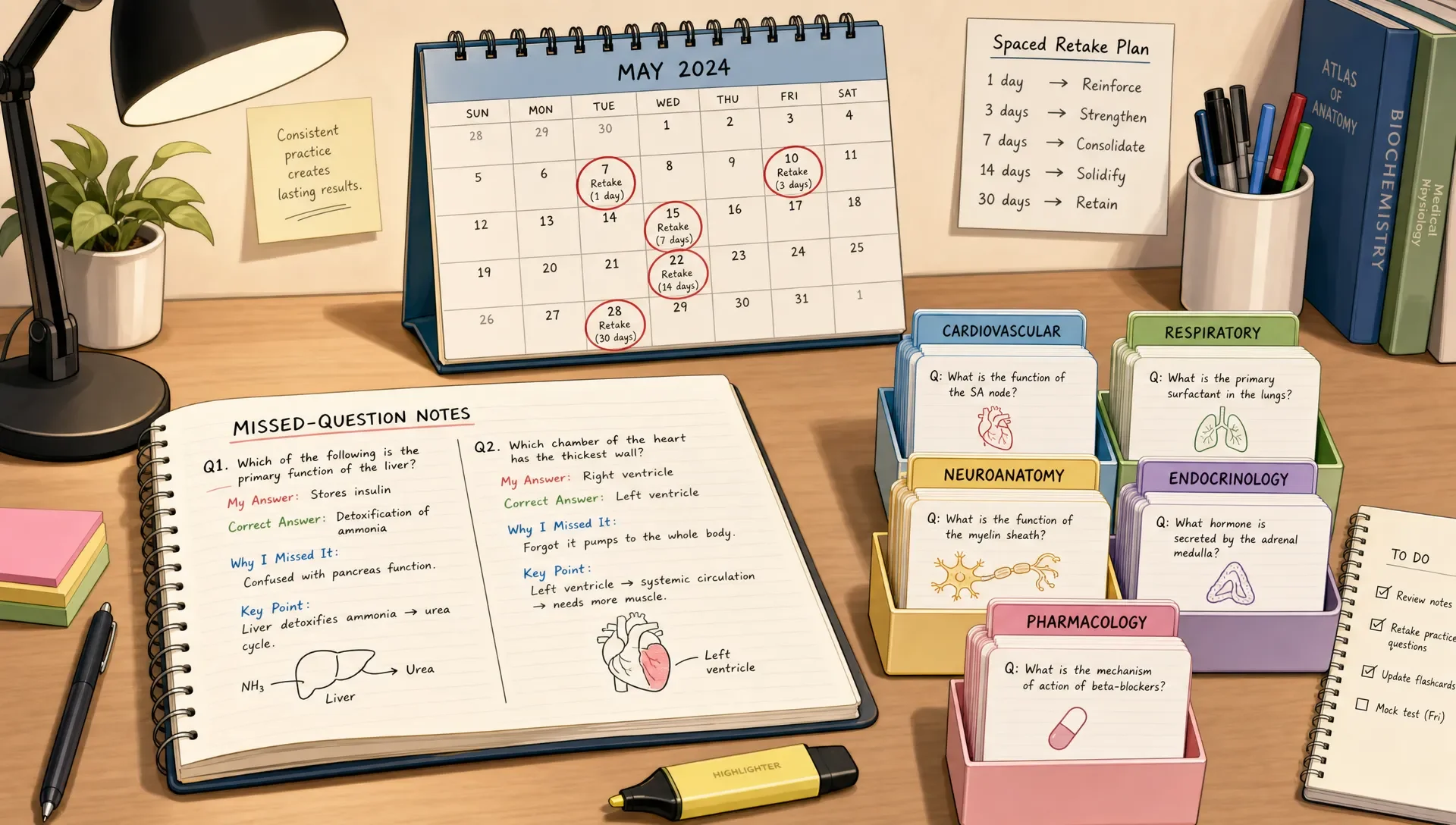
For certification prep, you don't need a complicated formula. Use a simple delayed retake schedule that turns every missed question into a follow-up retrieval event.
| When you miss a question | What to do | Purpose |
|---|---|---|
| Same day | Review the explanation and write the rule | Fix the misconception |
| Next day | Answer a similar question or flashcard | Test short-term recall |
| Three to four days later | Retake the concept in a mixed set | Check transfer across wording |
| One week later | Include it in a timed practice block | Confirm readiness under pressure |
This habit also keeps you from wasting full practice exams. Instead of retaking the same entire exam until you memorize the sequence, recycle weak concepts across spaced sessions.
Mix Topics So Recall Transfers to Real Exam Questions
Blocked practice, such as studying only networking for two hours or only identity services all evening, can help when you're first learning a topic. But exams rarely stay in one neat category. A question may combine security, networking, cost, and operations in the same scenario.
Once you've reviewed a topic, start mixing it with others. This habit is especially useful for cloud and security certifications, where the correct answer often depends on context rather than a memorized definition.
A practical pattern looks like this: study one weak objective, answer 10 targeted questions, review thoroughly, then take a 20-question mixed set that includes that objective alongside older topics. The mixed set tells you whether you can retrieve the concept when the question doesn't announce the category.
If you're preparing for foundational cloud concepts, a structured AWS Certified Cloud Practitioner practice exam can help you move from isolated facts to scenario-based recall. The key is to avoid treating every question as a standalone trivia item. Ask, what exam objective is this testing, and what decision rule does it expect me to apply?
| Practice mode | Best use | Recall risk if overused |
|---|---|---|
| Targeted topic set | Learning a weak domain | You may recognize the topic too easily |
| Mixed question set | Building exam-like recall | Can feel frustrating before basics are stable |
| Full timed practice examination | Testing stamina and readiness | Review can become shallow if the set is too large |
| Flashcard review | Reinforcing rules and definitions | May not test scenario judgment by itself |
The strongest study plans use all four modes. The mistake is relying on only one.
Treat Timing as a Recall Constraint, Not Just a Speed Drill
Timed practice isn't only about moving faster. Time pressure changes recall. It exposes whether you can recognize the tested concept quickly, filter irrelevant details, and commit without second-guessing every answer.
Start timing your practice once you understand the basics. If you time yourself too early, you'll rush through confusion and reinforce bad habits. If you wait too long, you may know the material but struggle to perform under exam conditions.
A good timing habit is to separate pacing problems from knowledge problems. After a timed set, mark each missed question with one of these causes:
- I didn't know the concept: Return to the study guide and rebuild the rule.
- I knew it but misread the scenario: Practice slowing down on keywords and constraints.
- I narrowed it to two and guessed wrong: Compare both options and define the decision boundary.
- I ran out of time: Use shorter timed sets until pacing becomes consistent.
For exams with performance-based or scenario-heavy items, this distinction matters. A learner preparing with a CompTIA Security+ practice exam should not review a simulation-style miss the same way they review a vocabulary miss. One may require process practice, while the other may require memorization and spacing.
Use Error Categories That Tell You What To Study Next
A raw score tells you how you did. Error categories tell you what to do next.
After each practice examination, don't just record 72 percent or 84 percent. Break the score into patterns. Did you miss the same domain repeatedly? Did you get definitions right but scenarios wrong? Did you lose points because you changed correct answers?
| Error category | What it usually means | Best next study move |
|---|---|---|
| Concept gap | You don't know the underlying rule | Review the objective and create flashcards |
| Misread question | You missed a constraint such as most secure or least costly | Slow down and underline decision words |
| Distractor confusion | Two choices looked equally correct | Write the difference between the options |
| Scenario transfer issue | You knew the fact but couldn't apply it | Practice mixed scenario questions |
| Time pressure error | You rushed or stalled | Use short timed sets and review pacing |
This is where readiness tracking becomes valuable. MindMesh Academy is built around study guides by exam objectives, practice questions with explanations, flashcards with spaced repetition, adaptive weakness-based practice, and mastery tracking, so your review can focus on the areas that actually need work.
Build a Weekly Practice Examination Routine
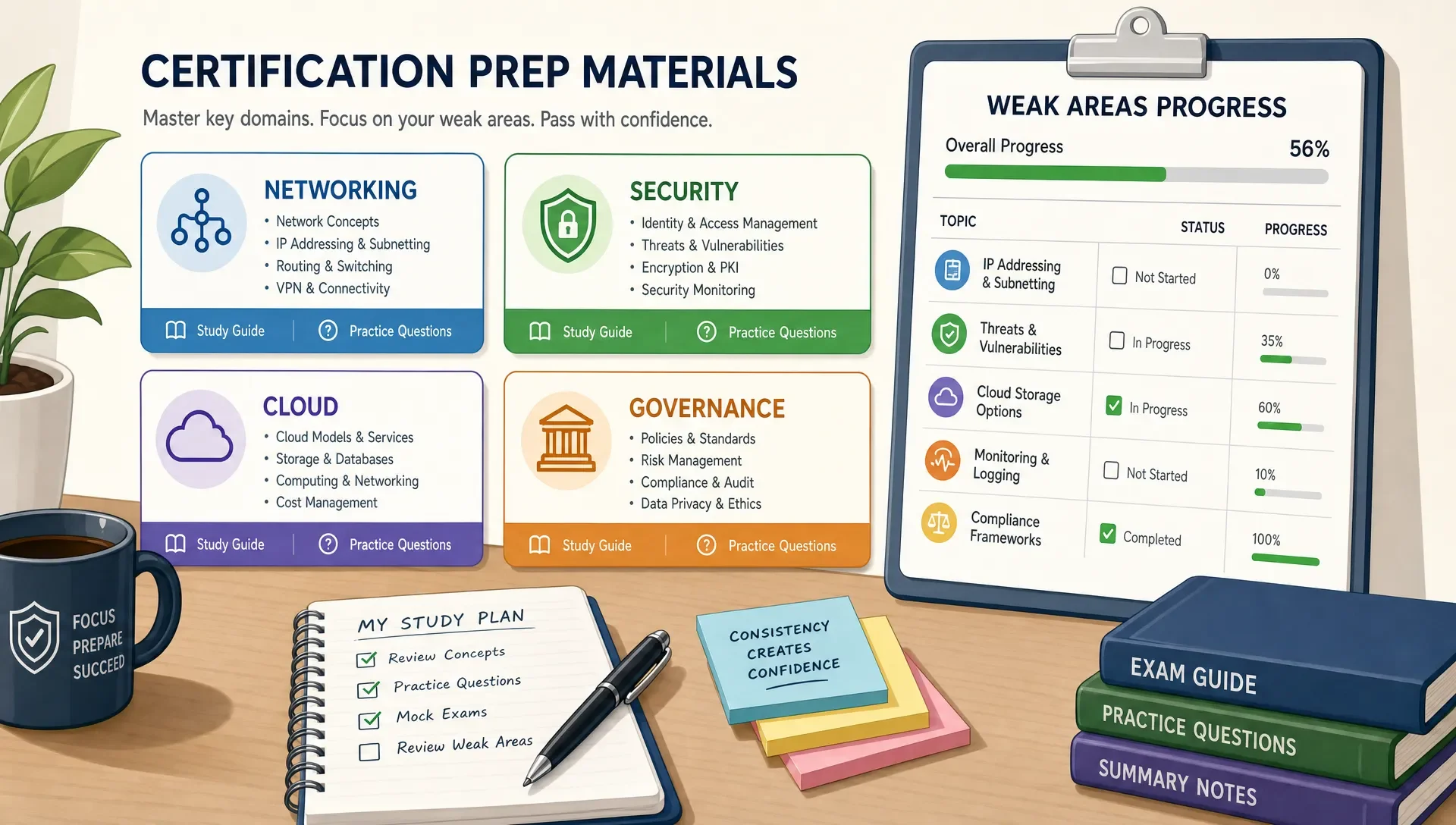
You don't need to take a full practice examination every day. In fact, doing that often leads to fatigue and shallow review. A better weekly routine balances retrieval, review, spacing, and readiness checks.
Use full practice exams sparingly, and use shorter blocks more often. Your goal is to create repeated recall events without burning through your best exam simulations too early.
| Day | Practice habit | Session goal |
|---|---|---|
| Monday | 15 to 25 targeted questions | Diagnose one weak objective |
| Tuesday | Flashcards and explanation review | Reinforce rules from missed questions |
| Wednesday | 20 to 30 mixed timed questions | Test recall across topics |
| Thursday | Delayed retake of missed concepts | Check retention after spacing |
| Friday | Scenario-based practice | Improve application and decision-making |
| Weekend | Full or half practice examination | Measure readiness and stamina |
Adjust the volume to your exam date and schedule. If you only have 30 minutes, do fewer questions and review them deeply. Ten well-reviewed questions can improve recall more than 50 questions you barely analyze.
Know When a Practice Examination Score Is Actually Useful
A practice examination score is useful when it reflects recall under realistic conditions. It becomes less useful when you've seen the same questions too many times, paused the timer repeatedly, or reviewed notes while answering.
Look for stable performance, not one lucky high score. If you can score well across mixed sets, explain missed questions clearly, and maintain pacing, you're getting closer to readiness. If your score drops whenever questions are reworded, you need more transfer practice.
Your review notes should also become shorter over time. Early in prep, you may write long explanations because every miss feels new. Later, your notes should focus on edge cases, traps, and decision boundaries. That shift is a sign that your recall is becoming more organized.
Frequently Asked Questions
How often should I take a practice examination? Most learners do better with frequent short practice blocks and occasional full exams. Use short sets several times per week, then schedule full practice examinations when you need to test stamina, pacing, and readiness.
Should I retake the same practice examination? Yes, but not immediately and not too often. Retake missed concepts after a delay, and mix them with new questions so you're testing recall rather than memorizing the answer order.
Is it better to review right after a practice exam or the next day? Do an initial review right away while your reasoning is fresh, then retest the missed concepts later. Immediate review fixes the misconception, while delayed retrieval checks whether you can recall it again.
What score means I'm ready for the real certification exam? A single score isn't enough. Look for consistent performance across multiple mixed sets, strong pacing, fewer repeated mistakes, and the ability to explain why correct answers are right and distractors are wrong.
Do flashcards help after practice examinations? Yes, if you create them from missed rules and confusing distinctions. Flashcards work best for definitions, decision rules, formulas, ports, commands, and service limits, but scenario questions are still needed for application.
How long should I spend reviewing missed questions? Spend enough time to identify the rule, the misconception, and the clue you missed. For many learners, review takes as long as the practice set itself, especially early in preparation.
Turn Practice Examinations Into Recall Training
The best practice examination habit is not taking more tests. It's creating a repeatable recall system: closed-book attempts, explanation-based review, delayed retakes, mixed topics, timed sets, and error categories that guide your next move.
Ready to build these habits into your study routine? MindMesh Academy helps you create a repeatable recall system with structured study guides, detailed practice questions, and adaptive readiness tracking. Discover how our tools can strengthen your memory and prepare you for your next certification exam on our certifications page.

Written by
Alvin Varughese
Founder, MindMesh Academy
Alvin Varughese is the founder of MindMesh Academy and an enterprise architecture leader. An electrical engineer by training, he moved from factory automation in South Africa to cloud architecture at GE Appliances and Humana (Fortune 50), and holds 20 professional certifications including AWS Solutions Architect Professional, Azure DevOps Engineer Expert, and Microsoft Agentic AI Business Solutions Architect. He built MindMesh Academy after interviewing too many highly certified candidates who couldn't answer basic questions: the goal is prep that makes you better at the job, not just able to pass the exam.