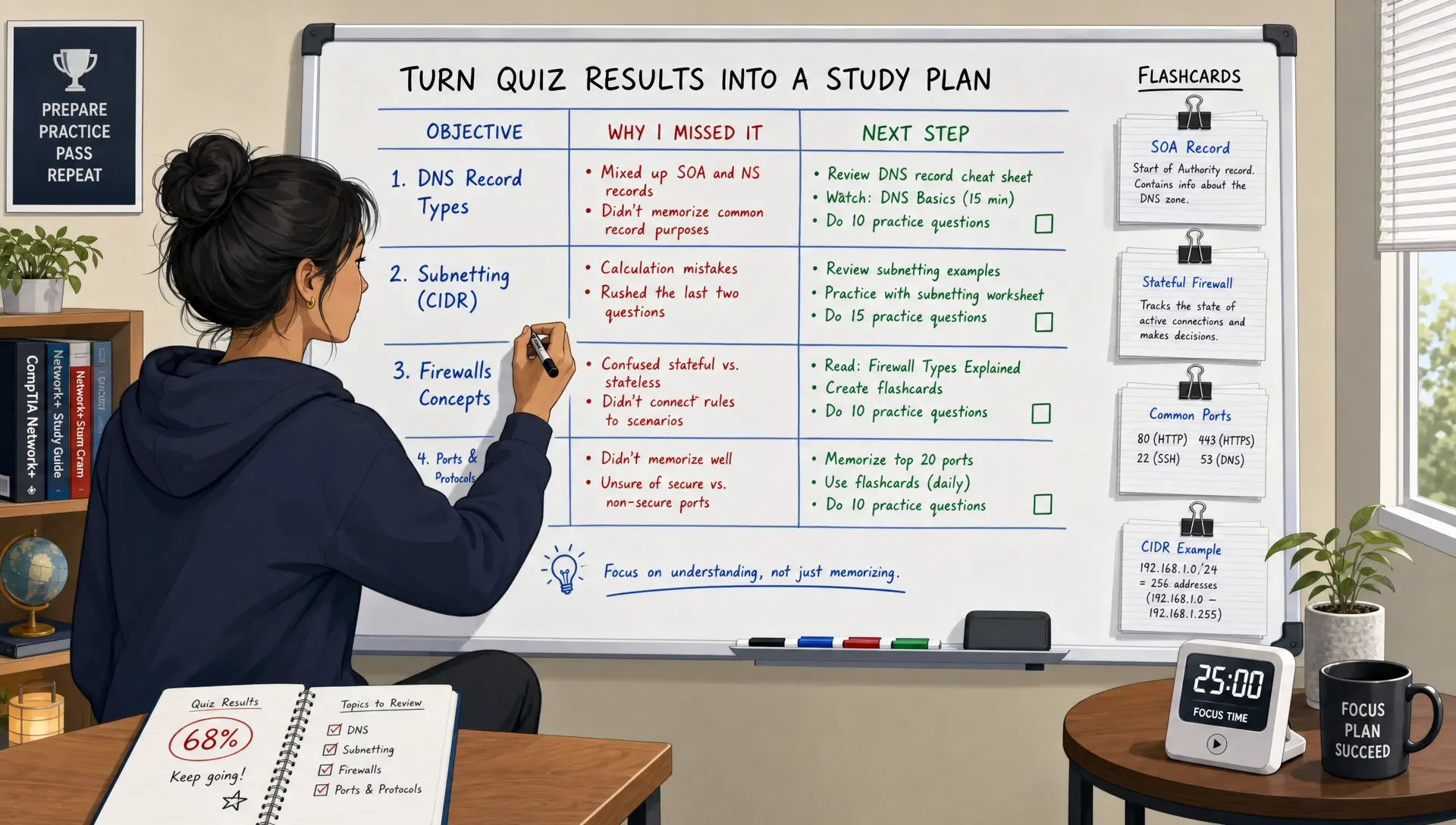
Practice Quiz Mistakes That Hurt Your Final Score
Practice Quiz Mistakes That Hurt Your Final Score
A practice quiz can improve your final score, but only if you use it as feedback, not just a scoreboard. The biggest mistake is simple: taking quiz after quiz, glancing at the percentage, then moving on without changing how you study.
If you're preparing for an IT, cloud, security, networking, or project management certification, your next quiz should answer three questions: What objective did I miss? Why did I choose the wrong option? What will I do differently before the next timed attempt? If your practice quiz routine doesn't produce those answers, it's probably giving you false confidence.
What Your Practice Quiz Score Actually Tells You
A quiz score isn't the same thing as exam readiness. It tells you how you performed on a specific set of questions under specific conditions. That matters, but it's incomplete.
A 78 percent on a short quiz might be strong if the questions were unfamiliar, timed, and mapped evenly to exam objectives. The same 78 percent might be weak if you just reviewed the answers yesterday, the quiz covered only your favorite topic, or you took it untimed with notes open.
Use your score as a signal, then look for the pattern behind it.
| Practice quiz signal | What it may mean | What to do next |
|---|---|---|
| High score, slow pace | You know the material but may lose points under exam timing | Add short timed sets and track minutes per question |
| Low score in one domain | You have an objective-level gap | Revisit that domain in a study guide, then quiz only that area |
| Repeated wrong answers on similar scenarios | You may know definitions but not application | Review explanations and practice scenario questions |
| Improved score on the same quiz | Could be real progress or answer memorization | Wait before retaking and use fresh questions |
| Many changed answers from right to wrong | You may be second-guessing under pressure | Practice decision rules and flag only truly uncertain items |
This is why readiness tracking matters. A strong prep workflow connects quiz performance to topics, explanations, flashcards, and follow-up practice, so you're not guessing what to study next.
Mistake 1: Taking a Practice Quiz Before Checking the Exam Objectives
Many learners start with random questions because it feels productive. The problem is that certification exams are built from objectives, not from whatever questions are easiest to find.
Official exam guides define the content areas you're expected to know. For example, Microsoft publishes measured skills for AZ-900 in its official AZ-900 study guide. Cloud, security, networking, and project management exams all work the same general way: the blueprint is your map.
Before you take a quiz, ask whether it maps to the exam objectives. If it doesn't, you can still learn something, but you can't trust the score as a readiness indicator.
A better approach is to quiz by domain first. If you're studying Azure fundamentals, work through objectives in sequence with an AZ-900 study guide, then use practice questions to test whether the concepts stuck. For cloud foundations, security, and networking, the same principle applies: learn by objective, quiz by objective, then mix domains later.
Mistake 2: Reviewing Only the Questions You Got Wrong
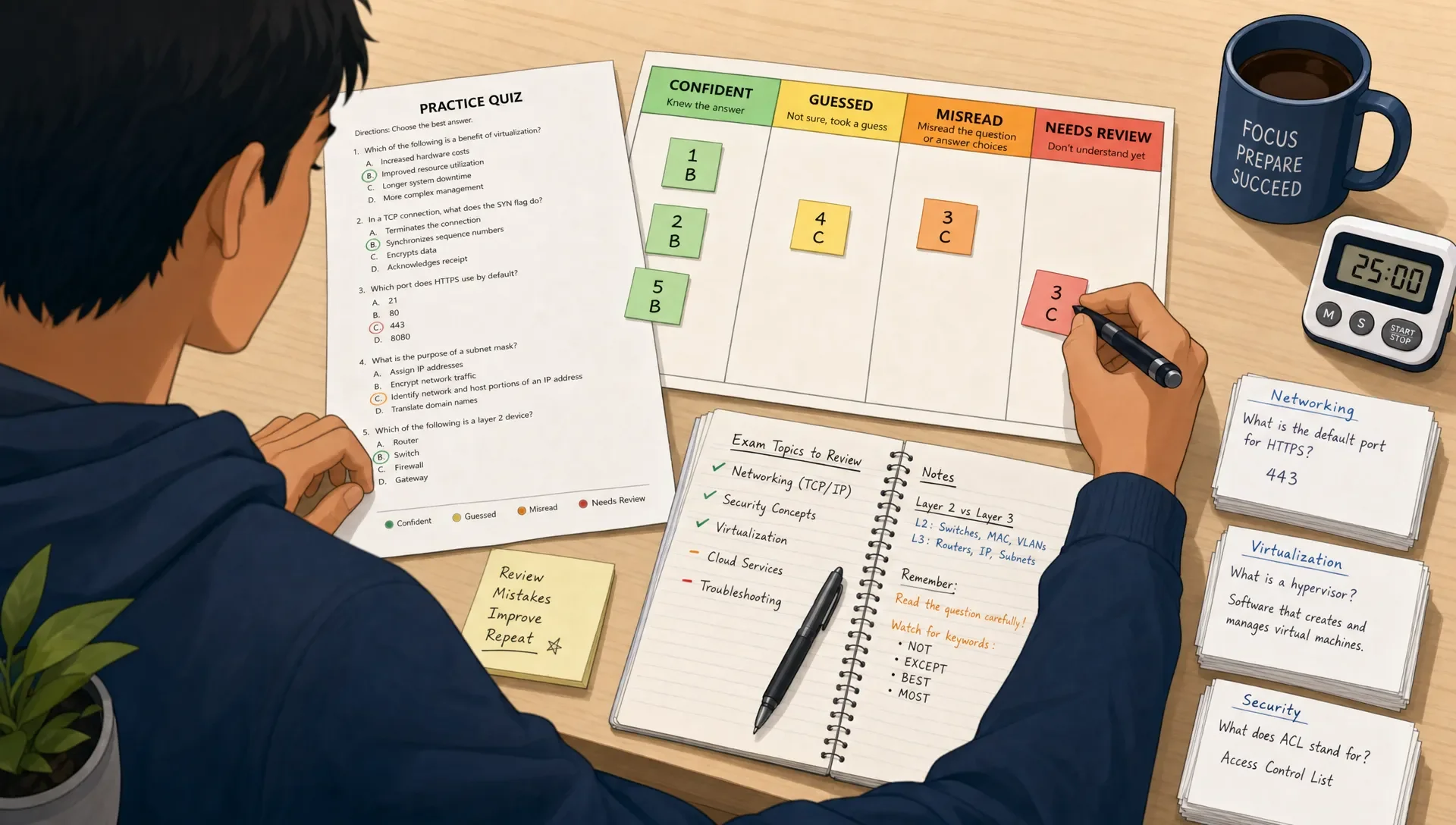
Wrong answers deserve attention, but correct answers can hide serious risk. If you guessed correctly, eliminated options by luck, or recognized wording from an earlier attempt, the score overstates your readiness.
After each quiz, sort every question into one of these categories.
| Result | What happened | Score risk |
|---|---|---|
| Correct and confident | You understood the concept and reasoning | Low risk |
| Correct but guessed | You got the point, but not the knowledge | High risk |
| Correct from memory | You remembered the question, not the concept | Medium to high risk |
| Wrong from knowledge gap | You didn't know the topic | High risk |
| Wrong from misreading | You knew the topic but missed a keyword | Medium risk |
| Wrong from timing pressure | You rushed or overthought | Medium risk |
The most dangerous category is correct but guessed. It feels like progress, but it won't protect you when the real exam changes the wording, scenario, or answer order.
When you review, write a one-sentence reason for the correct answer. Then write a one-sentence reason each tempting wrong answer is wrong. This turns answer review into retrieval practice instead of passive reading.
Mistake 3: Memorizing Quiz Answers Instead of Rebuilding Recall
Retaking the same quiz too quickly can make your score jump without improving your exam performance. Your brain recognizes the question pattern, remembers that option C was right, and rewards you with a higher percentage. That isn't the same as understanding.
Retrieval practice works when you actively pull information from memory. In a well-known study by Karpicke and Roediger, published in Science, repeated retrieval improved long-term retention more than repeated studying alone (primary source). The takeaway for certification prep is practical: don't just reread the explanation, force yourself to answer the underlying question again later without seeing the options.
For example, if you miss a cloud security question about shared responsibility, don't only memorize the correct option. Ask yourself: What is the provider responsible for? What is the customer responsible for? How would that change in IaaS, PaaS, and SaaS?
Flashcards help here when they're spaced over time. The Institute of Education Sciences practice guide on learning recommends spacing study sessions and using questions to promote retrieval, rather than relying on massed review in one sitting (IES practice guide).
Mistake 4: Taking Only Full-Length Exams Too Early
Full-length practice exams are useful, but they're expensive in time and energy. If you take them before you've built enough knowledge, you spend hours confirming that you're not ready.
Shorter quiz sets are better early in your prep because they give faster feedback. A 10 to 20 question practice quiz can isolate one topic, expose a misconception, and send you back to targeted study. Once your domain scores stabilize, full-length exams become more valuable because you're testing stamina, timing, and mixed-topic decision-making.
If you want a more focused way to use short timed sets, MindMesh's guide to a fast practice test strategy explains how micro-tests can support certification prep without burning an entire study session.
The key is sequencing. Start narrow, then widen.
| Prep stage | Best quiz format | Main goal |
|---|---|---|
| First pass through content | Untimed objective quiz | Find knowledge gaps |
| Mid-prep | Short timed quiz | Build recall and pacing |
| Late prep | Mixed-domain timed quiz | Practice switching between topics |
| Final readiness check | Full-length practice exam | Test stamina and exam strategy |
Mistake 5: Ignoring Time Pressure Until the End
Some learners study untimed for weeks, then discover late that they can't answer fast enough. Others do the opposite: they time everything from day one and never slow down enough to understand why they missed questions.
You need both modes.
Untimed quizzes are for learning. They let you read carefully, reason through distractors, and build the habit of explaining your answer. Timed quizzes are for execution. They teach you how long to spend on a question, when to flag, and when to move on.
A practical rule is to separate the session into two phases. During the quiz, act like it's the real exam: no notes, no pausing, no checking. During review, slow down completely. The review phase is where most of the score improvement happens.
If you're preparing for AWS, use a structured AWS Certified Cloud Practitioner practice exam after you've built familiarity with the core services and exam domains. If you're preparing for security, a CompTIA Security+ practice exam can help you test how well you apply concepts under pressure, especially when scenarios include multiple plausible answers.
Mistake 6: Letting the Answer Explanation Do All the Work
An explanation is not the finish line. It's the starting point for repair.
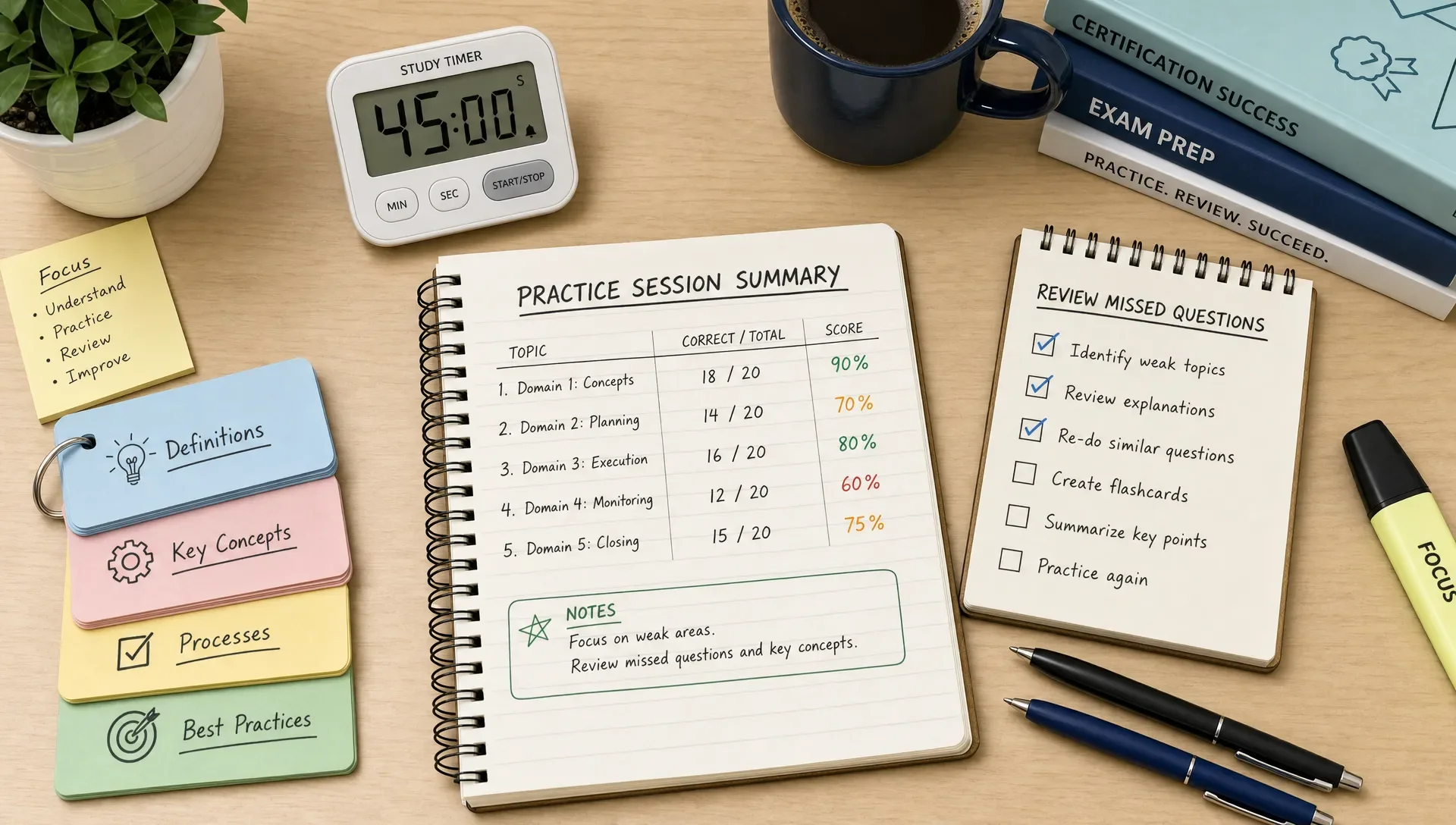
When you read an explanation, your goal is not to nod and move on. Your goal is to convert it into something you'll remember under pressure. That usually means making the explanation shorter, more personal, and more testable.
Try this review pattern after every missed or guessed question:
- Name the objective or topic the question tested.
- Write the rule, command, service, process, or concept in your own words.
- Identify the clue in the question that should have led you to the answer.
- Explain why the strongest distractor is wrong.
- Create a flashcard or schedule a follow-up quiz for that topic.
This takes longer than scanning the answer key, but it prevents repeated mistakes. If you keep missing the same topic after two review cycles, don't take another mixed quiz yet. Go back to the study material, rebuild the concept, then quiz that objective again.
Mistake 7: Practicing Only Definition Questions
Definition questions are useful for fundamentals, but many certification exams expect application. You may need to choose the best service for a scenario, troubleshoot a configuration, compare two security controls, interpret a process step, or decide what to do next.
If your practice quiz mostly asks direct recall questions, your score may look better than your real readiness. The final exam may ask the same concept through a scenario with extra details, constraints, and distractors.
Look for practice that includes explanations and performance-based question formats where relevant. For example, networking and security exams often require applied thinking, not just vocabulary. Project management and IT service management exams also test judgment, sequence, and role-based decision-making.
A strong quiz mix includes recall, concept application, scenario judgment, and review of weak objectives. The balance changes as you improve. Early on, definitions help you build vocabulary. Later, scenario questions reveal whether you can use that vocabulary correctly.
How to Fix Your Practice Quiz Routine Before Exam Day
You don't need a complicated system. You need a consistent loop that turns every quiz into a decision about what to study next.
Use this routine for your next five practice sessions.
| Step | What to do | Why it protects your final score |
|---|---|---|
| Choose one objective or a mixed set intentionally | Don't take random quizzes without a purpose | Keeps practice aligned to the exam blueprint |
| Take the quiz under the right condition | Use untimed mode for learning and timed mode for pacing | Prevents false confidence |
| Review all guessed and missed answers | Include correct guesses in your review | Finds hidden weaknesses |
| Tag the cause of each miss | Knowledge gap, misread, timing, or scenario confusion | Shows what to fix first |
| Study the weak objective | Use a guide, notes, or flashcards before another quiz | Rebuilds understanding |
| Retest after a delay | Use fresh questions when possible | Confirms retention instead of recognition |
MindMesh Academy is built around this connected workflow: study guides by exam objective, practice questions with explanations, spaced-repetition flashcards, adaptive weakness-based practice, and readiness tracking. That matters because the best quiz routine doesn't just ask whether you were right. It helps you understand what to do next.
Frequently Asked Questions
How many practice quiz questions should I take per study session? For most certification prep sessions, 10 to 30 focused questions is enough if you review them deeply. Longer sets are useful later, but early practice should prioritize feedback and repair over volume.
Is a high practice quiz score enough to know I'm ready? Not by itself. A high score is more meaningful when the questions are unfamiliar, timed, mapped to objectives, and reviewed carefully. If you retook the same quiz several times, the score may reflect memorization.
Should I review questions I answered correctly? Yes, especially if you guessed or felt unsure. Correct guesses are hidden weaknesses. If you can't explain why the right answer is right and why the distractors are wrong, review the topic.
How often should I retake the same practice quiz? Avoid immediate retakes unless your goal is to review. For readiness, wait long enough that you're testing recall, not recognition. When possible, use fresh questions on the same objective.
Are timed quizzes better than untimed quizzes? Both are useful. Untimed quizzes help you learn and reason through explanations. Timed quizzes help you build pacing, reduce hesitation, and practice exam-day decision-making.
What should I do if my scores stop improving? Stop taking random mixed quizzes for a few sessions. Break your results down by objective, review explanations, rebuild weak topics, use flashcards for recall, then return to timed practice.
Turn Your Next Practice Quiz Into a Better Score
Your final score improves when every quiz changes your next study decision. Don't just chase higher percentages. Track why you missed questions, review guessed answers, practice weak objectives, and retest after enough time has passed to prove retention.
Ready to build a better study routine and approach your certification exam with confidence? Explore the objective-based study guides, practice questions with explanations, and readiness tracking tools on MindMesh Academy.

Written by
Alvin Varughese
Founder, MindMesh Academy
Alvin Varughese is the founder of MindMesh Academy and an enterprise architecture leader. An electrical engineer by training, he moved from factory automation in South Africa to cloud architecture at GE Appliances and Humana (Fortune 50), and holds 20 professional certifications including AWS Solutions Architect Professional, Azure DevOps Engineer Expert, and Microsoft Agentic AI Business Solutions Architect. He built MindMesh Academy after interviewing too many highly certified candidates who couldn't answer basic questions: the goal is prep that makes you better at the job, not just able to pass the exam.