Question Bank Tactics That Build Real Understanding
Question Bank Tactics That Build Real Understanding
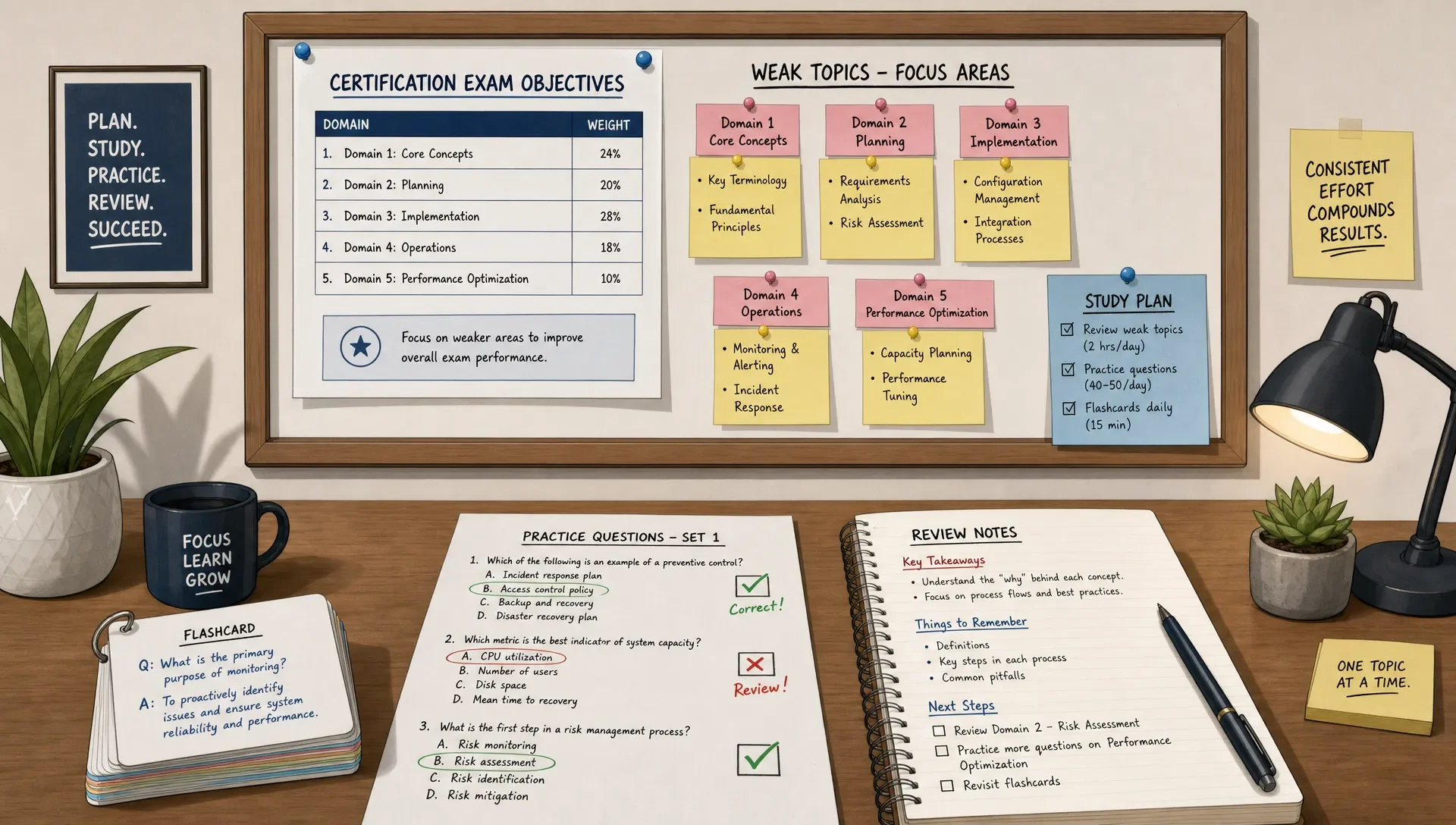
A question bank works best when you treat it as a diagnostic tool, not just a list of answers to memorize. Here's a simple, practical move: answer a small set of questions, inspect every explanation, identify the underlying objective, then turn a missed question into a study action before you tackle more questions.
Use this rule in your next session: if you spend 20 minutes answering questions, dedicate at least 30 minutes to reviewing them. That review time builds real understanding. Scores matter, but only after you've built the habit of explaining why the right answer is correct, why the distractors are wrong, and how the concept would appear in a new scenario.
How to Use a Question Bank Without Memorizing Answers
Memorizing questions might feel productive because your score rises quickly after you've seen the same questions a few times. The problem is that certification exams rarely reward recognition alone. AWS, Azure, CompTIA, Cisco, PMI, and similar exams test whether you can apply a concept under specific constraints, such as cost, security, availability, scope, or business impact.
A better question bank routine has three key parts: the first attempt, explanation review, and a transfer check. Your first attempt shows what you can do without help. The explanation review clarifies the concept. The transfer check proves you can apply it somewhere else.
This transfer check doesn't need to be long. After each question, ask yourself one of these:
- What fact or rule did this question test?
- What clue in the question stem mattered most?
- What clue was irrelevant or distracting?
- How would the answer change if one constraint changed?
- Which exam objective does this map to?
If you can't answer those questions, don't move on just because you guessed correctly. A lucky correct answer still signals a learning gap. Mark it for review, write a one-sentence takeaway, and revisit the concept later with flashcards or a study guide.
This is also why a smaller set of well-reviewed questions beats a huge set of rushed questions. A question bank should help you uncover your reasoning, not just your recognition speed.
Start With the Exam Objectives Before You Answer Questions
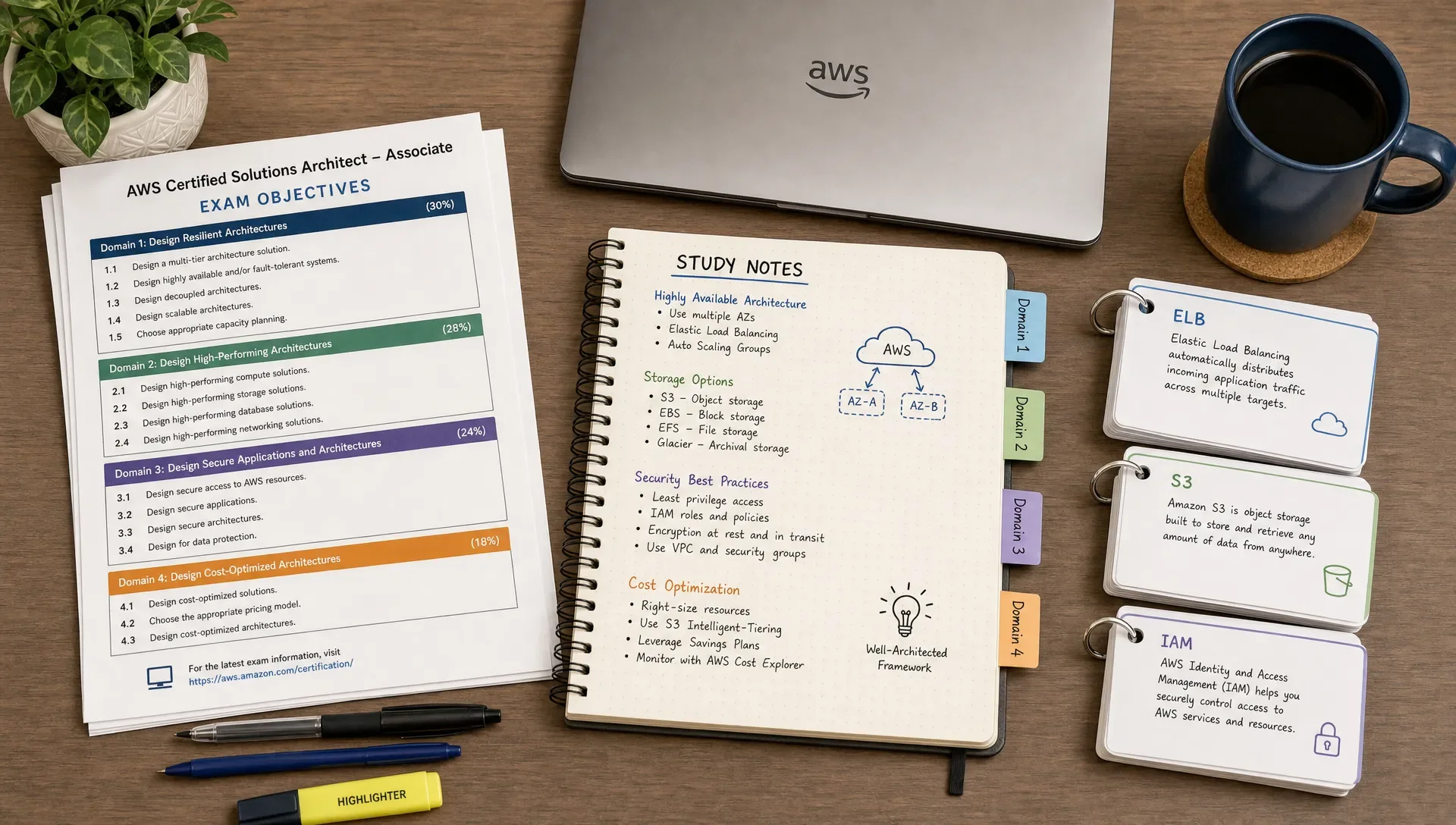
Before opening a question bank, pull up the official exam objectives or skills outline. Certification vendors publish these documents for a reason: they tell you what the exam can test. For example, AWS provides official certification pages for exams like AWS Certified Cloud Practitioner, and Microsoft publishes skills measured pages such as the AZ-900 study guide.
Your goal is to connect every practice question back to an objective. When you do that, your question bank becomes a map of your readiness instead of a random quiz feed.
For instance, if you're studying cloud fundamentals, don't label a missed question as "storage question." Label it with the exact domain and subskill, such as identity, pricing, shared responsibility, governance, networking, or monitoring. That level of detail helps you see patterns faster.
If you want a structured starting point, a certification-specific guide like the AZ-900 Microsoft Azure Fundamentals study guide can help you organize concepts before you test yourself.
| Question bank habit | What it builds | What to avoid |
|---|---|---|
| Tagging each miss to an exam objective | Topic-level clarity | Reviewing questions by score only |
| Writing a one-sentence explanation | Conceptual recall | Copying the full explanation word for word |
| Comparing the right answer to distractors | Better elimination skills | Reading only the correct answer |
| Changing one condition in the scenario | Transfer to new questions | Memorizing the original wording |
| Retesting after a delay | Durable memory | Retaking the same set immediately |
This objective-based approach also makes your study sessions easier to plan. Instead of thinking, "I need to do 100 more questions," you can think, "I need 20 targeted questions on identity, then a review of the concepts I miss."
Choose the Right Question Bank Mode for Each Study Phase
Not every practice session should feel like the real exam. Early in your preparation, slow practice is better than speed. Later, timed practice matters because you need to manage pacing, fatigue, and decision-making under pressure.
Think in phases. Your question bank strategy should change as your knowledge improves.
| Study phase | Best question bank mode | Session size | Main goal |
|---|---|---|---|
| First exposure | Untimed, objective-focused | 5 to 15 questions | Learn how concepts are tested |
| Skill building | Targeted weak-area practice | 10 to 25 questions | Close specific gaps |
| Integration | Mixed-topic practice | 20 to 40 questions | Recognize which concept applies |
| Exam readiness | Timed full or partial practice | Exam-like blocks | Build pacing and stamina |
| Final review | Missed and flagged questions | Small sets | Confirm weak areas are improving |
The mistake is using exam mode too early. If you're still learning the material, a low score on a timed test can tell you what you already know: you're not ready yet. It doesn't always tell you what to fix.
Start with tutor-style review, where explanations are part of the learning process. Then move into targeted practice by objective. After that, use mixed practice to prevent your brain from relying on topic labels. Finally, use timed sets when you have enough knowledge for timing to be meaningful.
For cloud learners, a focused resource like an AWS Certified Cloud Practitioner practice exam is most useful when you pair each result with topic review, not when you simply repeat the same set until the score looks good.
Turn Missed Questions Into a Repeatable Learning Loop
A missed question is not a failure. It's a work order. It tells you exactly where to spend your next study block.
Use a simple loop: diagnose, repair, retrieve, and retest. Diagnose why you missed it. Repair the concept with a short study session. Retrieve the idea from memory without looking. Retest later with a similar, but not identical, question.
The key is to identify the type of miss. A wrong answer caused by a weak concept needs a different fix than a wrong answer caused by rushing.
| Type of miss | What it usually means | Best fix |
|---|---|---|
| Concept gap | You didn't know the underlying rule, service, command, or process | Revisit the study guide section, then create a flashcard |
| Misread stem | You missed a constraint such as "least cost," "most secure," or "first step" | Slow down and underline decision words during practice |
| Distractor trap | You recognized a familiar term but didn't test whether it fit | Explain why each wrong option is wrong |
| Overgeneralization | You applied a rule in a situation where an exception mattered | Write the boundary condition for that rule |
| Time pressure | You knew the concept but rushed or second-guessed | Practice small timed sets and review pacing decisions |
This loop works especially well for security, networking, and project management exams, where similar-sounding options often test judgment. For example, a Security+ scenario may include several controls that sound reasonable, but only one control fits the risk, constraint, or incident stage. A CompTIA Security+ practice exam becomes much more useful when you track why each wrong option tempted you.
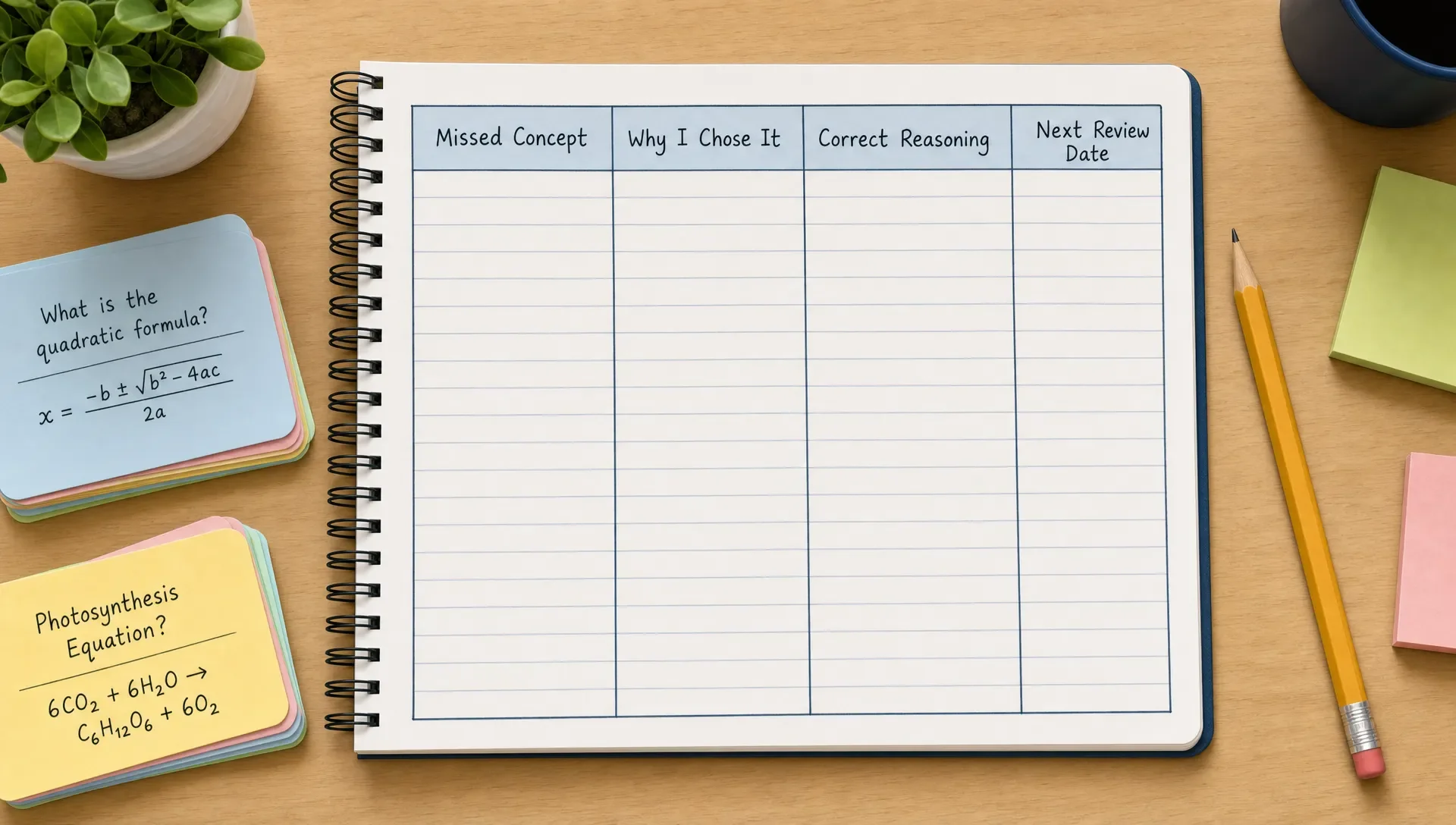
Don't let your review notes become long transcripts. Keep them brief and reusable. Good notes sound like this: "Security groups are stateful, network ACLs are stateless." Or: "For incident response questions, identify the phase before choosing the action." Those short takeaways convert easily into flashcards.
Review Explanations Like an Instructor, Not a Spectator
Most learners read explanations too passively. They see the correct answer, nod, and move on. That feels efficient, but it skips the mental work that helps you handle new questions.
A stronger explanation review has four passes. First, restate the question in your own words. Second, justify the correct answer without looking at the explanation. Third, reject each distractor with a specific reason. Fourth, write the rule or decision pattern that the question tested.
This matters because certification questions often hide the real decision inside extra detail. If you only remember the answer letter, you're not learning the decision pattern. If you can explain the pattern, you can handle a new question.
For example, suppose a cloud question asks for a highly available architecture across multiple facilities. The answer may involve multiple Availability Zones, but the deeper lesson is about fault isolation and redundancy. If you write only "use multiple AZs," you might miss the broader concept. If you write "use isolated locations to reduce single points of failure," you're closer to real understanding.
If you're building your own practice sets for a team or study group, MindMesh's article on how to make practice tests covers how to align questions to a blueprint and calibrate difficulty.
Use Spaced Repetition After Question Bank Review
The best time to create a flashcard is right after a meaningful miss. You already know the concept matters because it affected your performance. Now you need to make sure you can retrieve it later.
Research supports this approach. In a well-known study on retrieval practice, Roediger and Karpicke found that repeated testing improved long-term retention compared with repeated studying. A major review by Dunlosky and colleagues also rated practice testing and distributed practice as high-utility learning techniques.
For certification preparation, that means you shouldn't just reread explanations. You should turn important misses into prompts that force recall.
Poor flashcard: "What is IAM?"
Better flashcard: "A user needs temporary access to an AWS resource without long-term credentials. What identity concept should you consider and why?"
The better card tests application, not vocabulary. You can still use definition cards for new terms, but scenario cards are stronger once you understand the basics.
A practical spaced repetition rhythm looks like this:
- Same day: review the missed concept and create a card.
- Next day: retrieve the concept without notes.
- Three to four days later: answer a related question.
- One week later: mix it into a broader practice set.
- Final review: retest only if the topic still feels weak.
MindMesh Academy includes flashcards with spaced repetition, so this workflow can connect your question bank review to memory practice instead of leaving your notes scattered.
Mix Topics So You Learn When to Use Each Concept
Targeted practice is great for repairing weak areas, but it has a limitation: when you know the topic in advance, you get a hint. If you open a set labeled "networking," your brain already knows which toolbox to use.
Real exams don't give you that hint. They present a scenario, and you decide what domain applies. That is why mixed-topic practice matters.
After you've repaired a weak area, mix it with nearby topics. For AWS, pair identity with networking and logging. For Azure fundamentals, pair governance with cost management and security. For Security+, pair risk management with architecture, operations, and incident response.
The point isn't to make practice harder for no reason. The point is to train selection. Many exam questions are not asking, "Do you know this term?" They are asking, "Can you choose the right concept for this situation?"
A good weekly rhythm is to use targeted sets early in the week and mixed sets later in the week. Keep the same review standard for both. If a mixed question exposes a weak topic, send it back into targeted practice.
Track Readiness by Topic, Not Just Overall Score
An 82 percent score can hide a serious problem. You might be strong in three domains and dangerously weak in one. If that weak domain carries enough exam weight, or if it appears in scenario-heavy questions, your overall average can give you false confidence.
Track readiness by topic. At minimum, record the objective, number of questions attempted, accuracy, confidence, and review status. Confidence is important because a correct answer with low confidence is not the same as a correct answer with clear reasoning.
You don't need a complicated spreadsheet. You need a consistent decision rule. For example, mark a topic as ready only when you can meet all three conditions: you score well on fresh questions, you can explain the reasoning, and you can still answer correctly after a delay.
MindMesh Academy is built around this connected workflow with study guides by exam objectives, practice questions and explanations, adaptive weakness-based practice, progress tracking by topic, and mastery and readiness tracking. Used correctly, those features help you decide what to study next instead of guessing.
Avoid These Question Bank Mistakes
A question bank can hurt your preparation if you use it as a shortcut. Watch for these habits:
- Repeating the same questions until you recognize the answers.
- Reviewing only wrong answers and ignoring lucky guesses.
- Skipping explanations because the score looked good.
- Taking full exams too often without targeted remediation.
- Measuring progress only by total question count.
- Using questions before you understand the exam objectives.
The fix is not to stop using questions. The fix is to slow down your review and make each question earn its place in your study plan.
A strong question bank session should produce three outputs: a score, a list of weak objectives, and a set of next actions. If you finish a session with only a score, you haven't finished the session.
Frequently Asked Questions
How many question bank questions should I do per day? It depends on your stage of study, but quality matters more than volume. Early on, 10 to 25 well-reviewed questions can be more useful than 75 rushed questions. Increase volume when your explanations are accurate and your topic gaps are shrinking.
Should I review questions I got right? Yes. Review every correct answer that involved a guess, low confidence, or slow reasoning. Correct answers can hide weak understanding, especially when you recognized wording from a previous attempt.
When should I start using timed practice exams? Use timed exams after you've built a foundation and repaired the most obvious weak areas. If you start timed practice too early, the result may reflect missing knowledge more than exam readiness.
Is it bad to repeat the same question bank? Repeating questions is useful only if enough time has passed and you're testing reasoning, not memory of the question stem. If you remember the answer immediately, explain the concept and move on to fresh or mixed questions.
How do I know if a question bank is helping me understand the material? It should improve your ability to explain concepts, reject distractors, and answer new questions on the same objective. If your score rises only on repeated items, you're likely memorizing.
Should I use flashcards with practice questions? Yes. Turn missed questions and shaky correct answers into flashcards, especially when the issue is a rule, comparison, process step, or scenario pattern. Spaced repetition helps you revisit those concepts before they fade.
Build a Question Bank Workflow That Shows What You Really Know
The best question bank tactics are not complicated. Align questions to objectives, answer before reviewing, explain every option, turn misses into flashcards, retest after a delay, and track readiness by topic. Do that consistently, and your score becomes more than a number. It becomes evidence that you understand the material.
If you want one place to connect study guides, practice questions, flashcards, adaptive weakness-based practice, and readiness tracking across certification paths, MindMesh Academy helps you solidify your understanding. Put your knowledge to the test with an AZ-900 practice exam and apply these tactics to find gaps, fix them, and prove they're closed before exam day.

Written by
Alvin Varughese
Founder, MindMesh Academy
Alvin Varughese is the founder of MindMesh Academy and an enterprise architecture leader. An electrical engineer by training, he moved from factory automation in South Africa to cloud architecture at GE Appliances and Humana (Fortune 50), and holds 20 professional certifications including AWS Solutions Architect Professional, Azure DevOps Engineer Expert, and Microsoft Agentic AI Business Solutions Architect. He built MindMesh Academy after interviewing too many highly certified candidates who couldn't answer basic questions: the goal is prep that makes you better at the job, not just able to pass the exam.