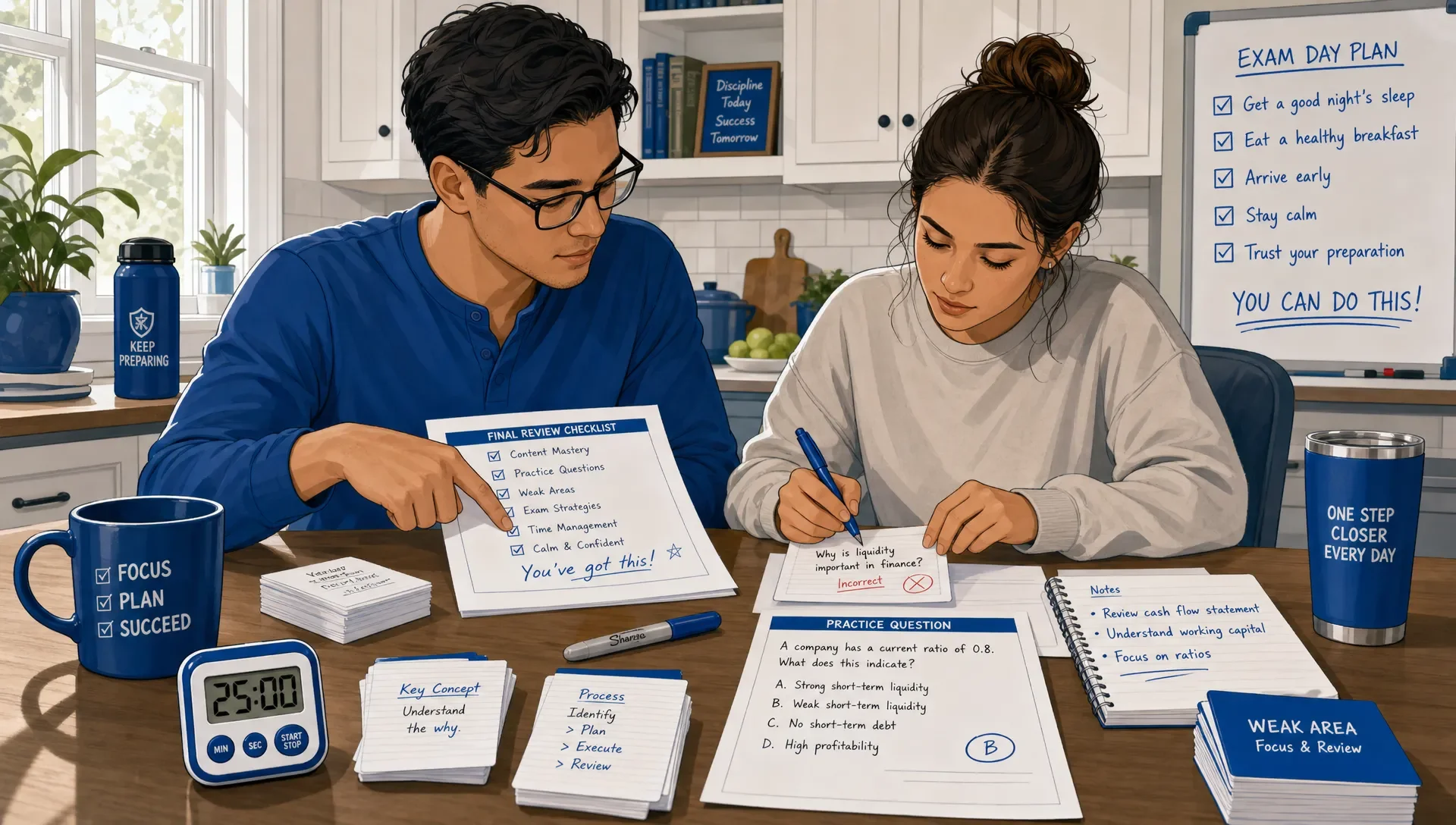
Study Guide for Test Day: Build a Better Final Review
Build a Better Final Review: Your Test Day Study Guide
A strong study guide for test day acts as a final-review tool, not a collection of everything you've ever studied. Its purpose is to help you confirm what you know, expose those last few weak spots, and make the final 24 to 72 hours feel controlled, not frantic.
Start with three key actions: narrow your review to the official exam objectives, transform weak topics into recall prompts, and rehearse the conditions you'll face on exam day. If your final review doesn't help you answer questions faster, explain concepts from memory, or make better choices under time pressure, it's probably just making you busier.
What to Include in a Test Day Study Guide
A final review guide should be short enough to use and specific enough to trust. For most certification exams, this means you don't need a 60-page notebook. Instead, you need a decision tool that tells you what to review, how to test that knowledge, and when to stop.
A practical final guide typically includes these components:
| Final review element | What it should contain | Why it matters |
|---|---|---|
| Exam objective | The official topic or subtopic | Keeps your review aligned to the real exam scope |
| Recall prompt | A question you can answer without notes | Forces memory retrieval instead of just recognition |
| Key rule or process | One concise explanation, command, or sequence | Helps you rebuild the concept quickly |
| Common trap | A confusing exception, similar term, or distractor | Reduces avoidable mistakes |
| Practice evidence | A recent question result or confidence score | Shows whether the topic is actually ready |
| Final action | Review, quiz, skip, or ask for clarification | Prevents random, last-minute studying |
Your study guide for test day should answer one question for every topic: "Can I use this knowledge under exam conditions?" If the answer is no, add a recall prompt or a short practice set. If the answer is yes, stop rewriting notes and move on.
Start with Official Exam Objectives, Not Your Notes
Official exam objectives provide the clearest boundary for final review because they define precisely what the exam can test. Your notes may be helpful, but they're often uneven. They reflect what you focused on, not always what the exam weights most heavily.
For vendor certifications, use the current exam guide or skills outline as your definitive source. AWS publishes exam guides for its certifications, Microsoft lists measured skills on Microsoft Learn, and CompTIA provides exam objectives for each exam. You don't need to memorize every word in those documents, but your final review should map directly back to them.
Turn objectives into recall prompts
A weak final review prompt sounds like, "Review networking." A useful prompt, by contrast, sounds like, "Explain when a private subnet needs a NAT gateway" or "Choose the best authentication method for this scenario." That small change makes all the difference between rereading and active retrieval.
If you're already using condensed one-page references, pair them with prompts instead of rereading them silently. MindMesh Academy's article on turning exam topics into quick study sheets is a useful companion if your notes are still too long for the last few days.
Mark each objective with a simple status
Don't label topics as "done" just because you watched a lesson or read a chapter. Use evidence from recall, practice questions, and timed review. A study guide for test day works best when each topic has one of three statuses: ready, shaky, or urgent.
- Ready means you can answer scenario questions correctly and explain why the wrong answers are incorrect.
- Shaky means you recognize the topic but still hesitate or miss details.
- Urgent means the objective appears on the exam outline, and you don't have a working explanation yet.
Choose Your Final Review Priorities
The last stretch before an exam is not the time to treat every topic equally. Giving equal time feels fair, but it often wastes energy on material you already know. Prioritize topics that combine high exam relevance with low confidence.
A good rule is to start with "shaky" topics before moving to "urgent" ones. Shaky topics often improve quickly because the foundation is already there. Urgent topics may need more instruction, so you'll need to decide whether a focused overview is enough or if the topic is too broad to address at the last minute.
Use practice question review to find the cause
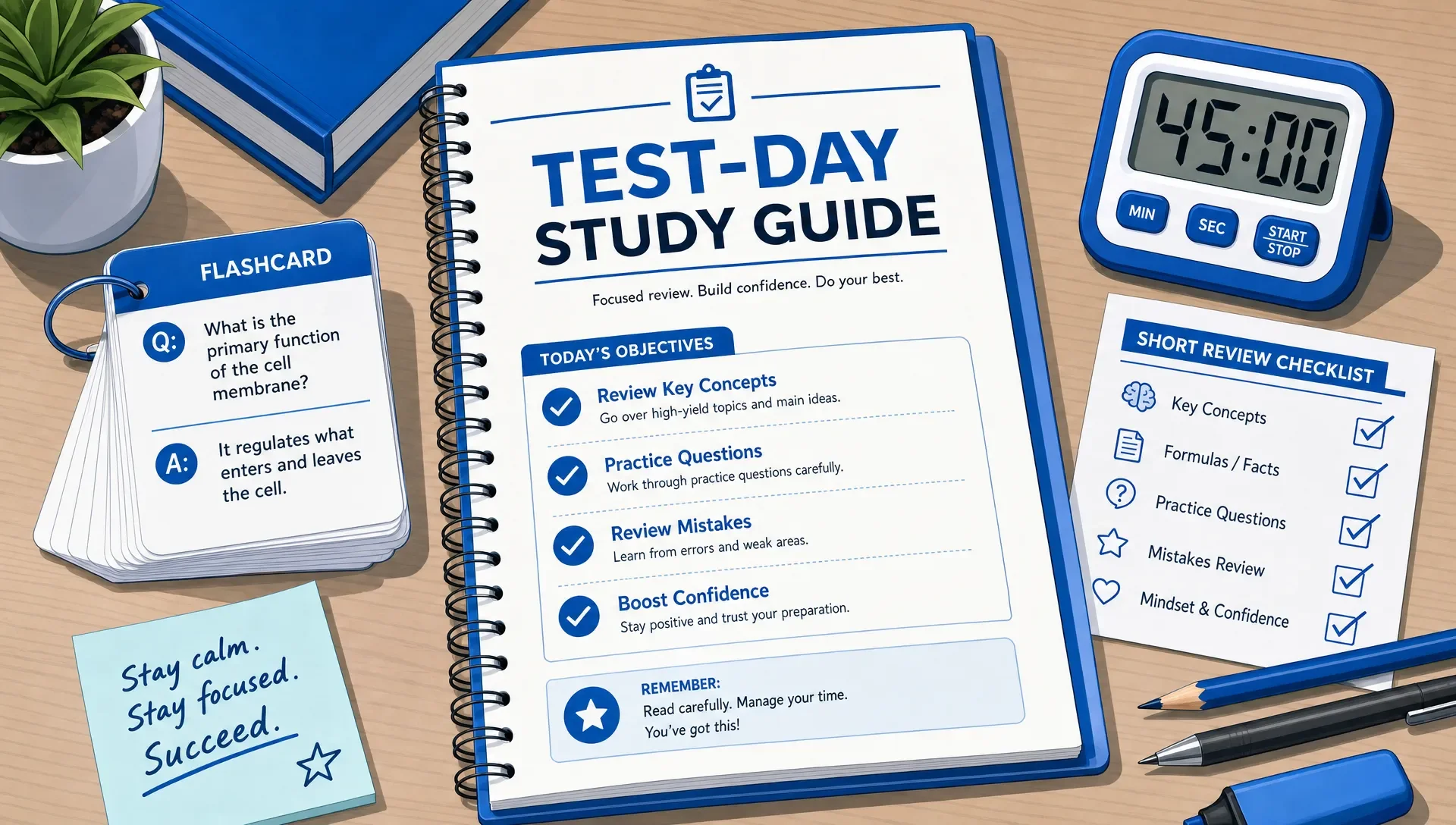
A wrong answer doesn't always mean you don't understand the core concept. Sometimes you misread a qualifier, confused two similar services, rushed a calculation, or failed to eliminate a distractor. Your final review should capture the cause of the mistake, not just the result.
When you review practice questions, write a short tag next to each missed item. Use tags like concept gap, misread, memory lapse, bad elimination, or time pressure. If you need a deeper process, the MindMesh guide on reviewing every practice exam answer better walks through how to learn from both correct and incorrect choices.
Decide what you'll stop reviewing
Final review requires subtraction. If a topic has been consistently correct across multiple practice sessions and you can explain it without notes, don't keep giving it prime study time. Add it to a light maintenance list and revisit it briefly through flashcards or mixed questions.
This is where many learners get stuck. They continue reviewing comfortable topics because it feels productive. A study guide for test day should make avoidance visible by showing which weak objectives still need attention.
Use Active Recall Instead of Rereading
Rereading feels smooth because the material looks familiar. But familiarity is not the same as exam readiness. Certification exams ask you to choose, apply, troubleshoot, and sometimes perform a task, so your final review must make you retrieve knowledge before you see the answer.
A large review by John Dunlosky and colleagues in Psychological Science in the Public Interest rated practice testing and distributed practice as highly effective learning techniques. In a separate paper in Science, Jeffrey Karpicke and Henry Roediger found that retrieval practice improved long-term retention more than repeated studying in their experiments.
This research aligns with what experienced instructors see every week: students usually don't struggle because they never saw the material. They struggle because they didn't practice pulling the right idea from memory under pressure.
Run a 25-minute final review block
Use short blocks to keep your review active. Pick one weak objective, hide your notes, and answer two or three prompts out loud or in writing. Then complete a small set of related questions and review explanations immediately.
A useful block might look like this:
| Time | Activity | Output |
|---|---|---|
| 5 minutes | Recall the concept without notes | A rough explanation or diagram |
| 10 minutes | Answer targeted questions | Correctness, timing, and confidence notes |
| 5 minutes | Review explanations | One corrected rule or trap |
| 5 minutes | Update your guide | Topic status and next action |
Use your study guide for test day as the record of these blocks. If you need stronger methods than rereading, the MindMesh Academy article on study methods for exams that beat rereading gives you more active alternatives.
Practice Under Test-Day Conditions
Final review should include at least a few timed question sets. You don't need to take a full-length practice exam every day, but you do need to know whether timing changes your decisions. Many learners answer well when relaxed but miss easier questions once the clock is visible.
Use mixed questions, not only topic-specific drills. Topic drills are useful for repair, but mixed sets force you to identify what kind of problem you're facing before you solve it. That's closer to the real exam experience.
If you're preparing for AWS fundamentals, a timed session using the AWS Certified Cloud Practitioner practice exam can help you test broad service knowledge and decision-making. If you're working on Microsoft fundamentals, pairing objective review with the AZ-900 Microsoft Azure Fundamentals study guide can keep your final review aligned by topic.
Include performance-based question practice when relevant
Some exams include performance-based or scenario-heavy question formats. These questions penalize passive familiarity because they require you to interpret the task, choose a sequence, or work through a realistic configuration-style problem.
Don't leave these formats until the night before. Add one or two to your review when you're mentally fresh. A study guide for test day should remind you of the steps you use for these items: read the task, identify constraints, eliminate impossible options, and check that your final answer satisfies the scenario.
Build a Test-Day Timing Checklist
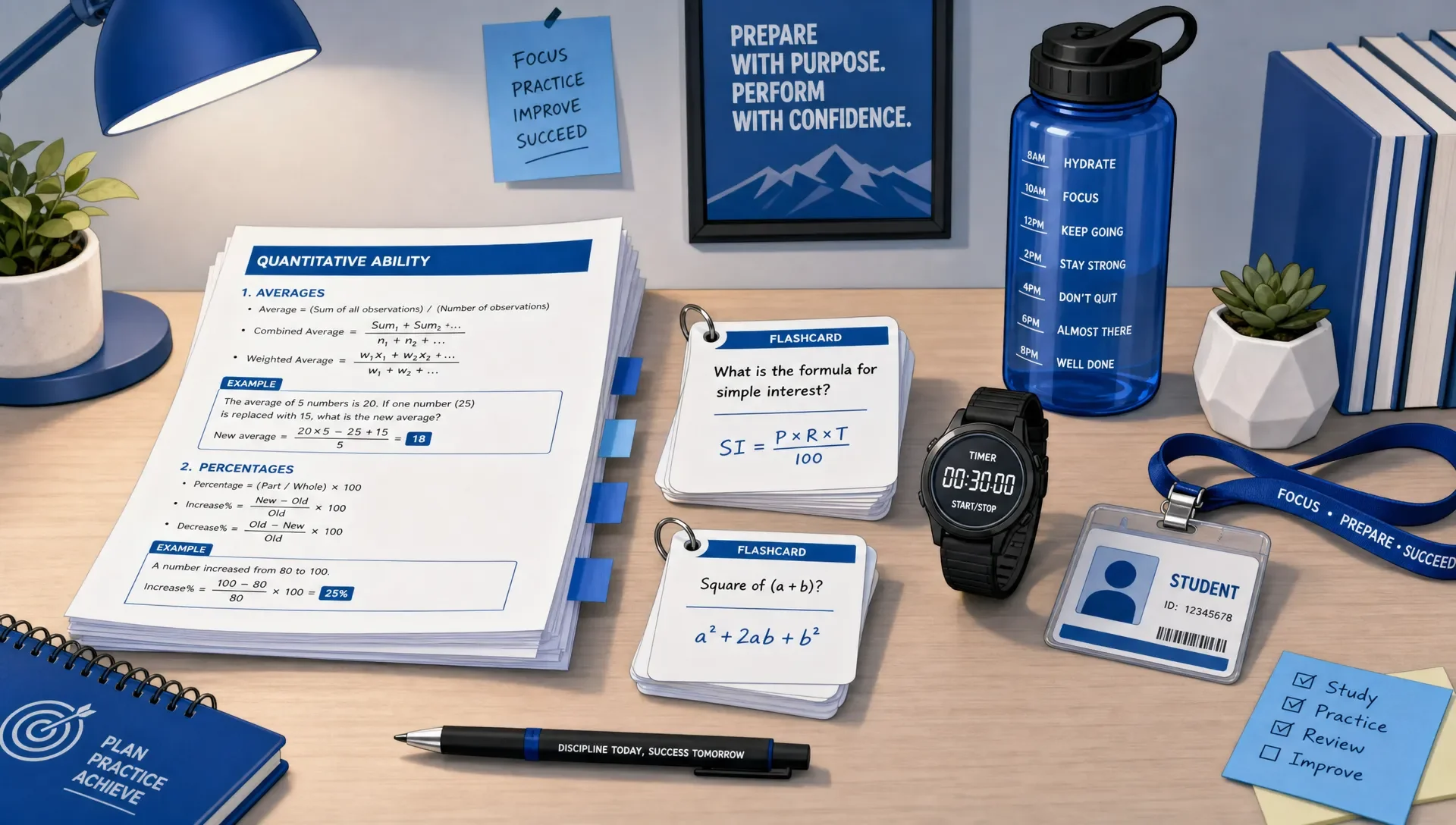
The best final review also protects your energy. Tired learners misread questions, second-guess correct answers, and waste time on low-value cramming. A timing checklist helps you decide what belongs in each final window.
| Time before exam | What to do | What to avoid |
|---|---|---|
| 7 days | Take a timed mixed practice set and update weak objectives | Restarting the entire course |
| 3 days | Review shaky topics, flashcards, and missed-question patterns | Adding too many new resources |
| 24 hours | Light recall, logistics check, and sleep plan | Full-night cramming |
| Exam morning | Brief formula, rule, or acronym review | Learning brand-new material |
| Final 10 minutes | Breathe, confirm instructions, and settle your pace | Comparing scores with other people |
Your study guide for test day should get shorter as the exam approaches. By the final morning, it should fit into a 10 to 15 minute review, not a stressful marathon.
Prepare your exam logistics early
Check the exam appointment time, identification rules, testing environment, and allowed materials well before the final day. If you're testing online, review the vendor's system check instructions in advance. If you're going to a testing center, confirm travel time and parking.
This isn't busywork. Logistics mistakes drain attention before the exam even starts. Your final review should leave you with fewer decisions, not more.
What to Leave Out of the Final Review
A clean final review is selective. If your guide includes everything, it doesn't help you make choices. The goal is to improve readiness, not to prove how much effort you've put in.
Leave these items out of your final review unless you have a clear reason to include them:
- Long textbook sections you've already summarized
- Unverified notes copied from random forums
- Question dumps or memorized answer lists
- New tools, new courses, or new systems in the final 24 hours
- Practice exams taken without reviewing explanations
- Comfort topics that are already consistently correct
A study guide for test day should also exclude panic-driven additions. If a topic suddenly worries you, check the official objective, answer a few recall prompts, and decide whether it truly deserves time. Don't let anxiety rewrite your entire plan.
How MindMesh Academy Supports Final Review
MindMesh Academy is built around connected certification prep, rather than isolated study tasks. You can study by exam objectives, answer practice questions with explanations, use flashcards with spaced repetition, and track progress by topic.
This structure is especially useful near the end because final review depends on solid evidence. Our mastery and readiness tracking features help you see where you're truly prepared and where weakness-based practice still makes sense. For certifications that include applied formats, performance-based question practice can also help you rehearse more than just definition recall.
Use MindMesh Academy as the working version of your study guide for test day: objectives show the scope, practice questions test application, flashcards protect memory, and progress tracking keeps your final review focused.
Frequently Asked Questions
How long should my final review guide be? Keep it short enough to use in one sitting. For many certification exams, that means a few pages of objectives, recall prompts, traps, and weak-topic notes rather than a full notebook.
Should I take a full practice exam the day before the test? Usually, a lighter review is better the day before. If you do take a long practice exam, leave enough time and energy to review explanations, because an unreviewed score doesn't teach much.
What should I study on the morning of the exam? Review only high-value reminders: formulas, command patterns, acronyms, process steps, or traps you already identified. Don't introduce brand-new topics unless they're small and clearly listed in the exam objectives.
How do I know when to stop reviewing a topic? Stop when you can explain the idea without notes, answer mixed practice questions correctly, and identify why the wrong answers are wrong. At that point, move the topic to light maintenance.
Can a study guide for test day help with exam anxiety? Yes, if it reduces decisions. A clear final guide shows what to review, what to skip, and what to do next, which makes the last few days feel more manageable.
Build Your Final Review with Less Guesswork
Your final review should be focused, active, and tied to exam evidence. Don't spend the last stretch polishing notes you'll never use. Instead, build a short guide around objectives, recall prompts, practice-question causes, and a realistic timing plan.
If you're ready to create an effective final review plan, explore the MindMesh Academy AWS Certified Cloud Practitioner study guide to build a strong foundation for your exam.

Written by
Alvin Varughese
Founder, MindMesh Academy
Alvin Varughese is the founder of MindMesh Academy and an enterprise architecture leader. An electrical engineer by training, he moved from factory automation in South Africa to cloud architecture at GE Appliances and Humana (Fortune 50), and holds 20 professional certifications including AWS Solutions Architect Professional, Azure DevOps Engineer Expert, and Microsoft Agentic AI Business Solutions Architect. He built MindMesh Academy after interviewing too many highly certified candidates who couldn't answer basic questions: the goal is prep that makes you better at the job, not just able to pass the exam.