Study Methods for Exams That Beat Rereading
Study Methods for Exams That Beat Rereading
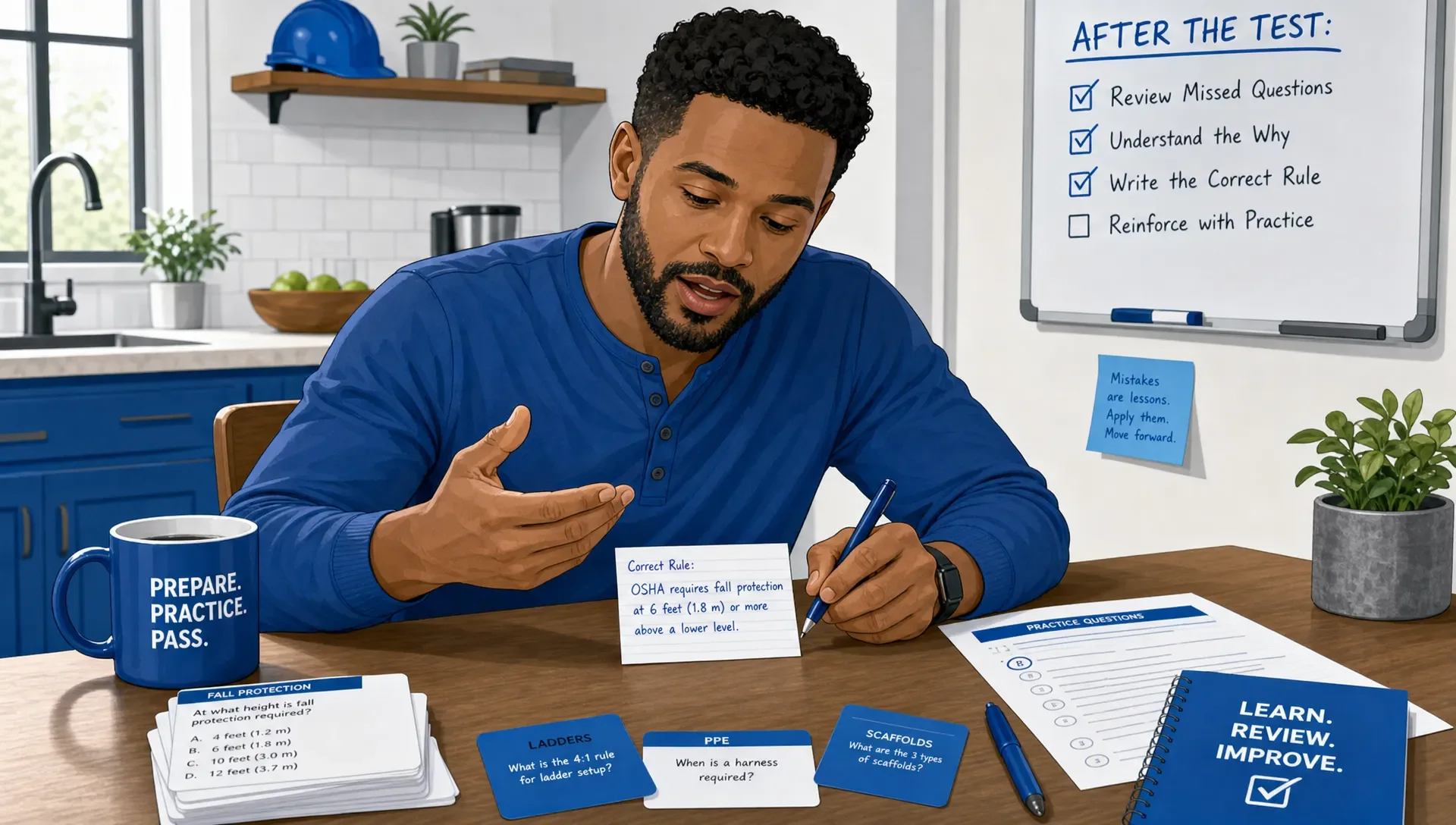
If your exam preparation relies on rereading, it's time for a change. Adopt a simple rule: read once to understand, then dedicate most of your study session to proving you can recall and apply the material without looking. This means using closed-book questions, flashcards, short explanations in your own words, and practice tests reviewed by exam objective.
The best study methods do more than just make the material feel familiar. They train the precise skills you'll need on test day: retrieving facts under pressure, choosing between similar answers, applying rules to scenarios, and identifying your weak topics before the exam does.
Why rereading feels productive but doesn't prove exam readiness
Rereading feels comfortable because it gives you quick recognition. You see a cloud service name, a security control, or a project management term and think, "I know this." The problem is that recognition is weaker than recall. Most certification exams don't ask if a paragraph looks familiar. They ask you to select the best answer from plausible options, interpret a scenario, or solve a task with limited context.
A well-known review by Dunlosky and colleagues in Psychological Science in the Public Interest rated rereading as a low-utility learning technique when compared with practice testing and distributed practice. This doesn't mean reading has no value. You need it for initial exposure, definitions, and context. The issue arises when rereading becomes your primary study method after that first pass.
Rereading also hides knowledge gaps. You might follow a worked example with the answer right in front of you, then fail to rebuild the same reasoning from memory later. You could highlight every line in a networking chapter, then freeze when a question asks which routing behavior fits a specific subnetting scenario. That gap between familiarity and usable knowledge is often where exam failures happen.
For IT, cloud, and project management certifications, the solution isn't to reread more. It's to change the goal of each study session. Instead of asking, "Did I cover this chapter?", ask, "Can I answer questions from this objective without notes, explain why the correct option wins, and say why each distractor is wrong?"
Study methods that replace rereading
The most effective alternatives to rereading share a common trait: they make you do the mental work before you see the answer. This effort might feel slower initially, but it provides much better evidence of what you truly know.
| If you usually... | Replace it with... | What it trains | Quick example |
|---|---|---|---|
| Reread the same page until it feels clear | Active recall | Pulling knowledge from memory | Close the guide and list the steps in a process. |
| Review all topics in one long session | Spaced repetition | Remembering after time has passed | Revisit missed flashcards tomorrow, then again later in the week. |
| Read explanations before answering | Practice questions first | Exam-like decision-making | Answer, rate your confidence, then read the explanation. |
| Study one topic until it feels solid | Interleaving | Choosing the right method or concept | Mix IAM, networking, and storage questions in one set. |
| Copy notes from the guide | Self-explanation | Connecting ideas and spotting gaps | Explain why one service fits a scenario better than another. |
If you're preparing for a certification with broad objectives, don't try to invent the structure yourself. Start with the official exam outline, then use objective-aligned material. For example, Azure beginners can work through an AZ-900 Microsoft Azure Fundamentals study guide and convert each objective into questions they can answer without notes.
How to turn one chapter into a high-retention study session
A strong study session doesn't need to be complicated. The mistake is spending the entire block consuming content. A better session has three phases: understand, retrieve, and repair.
Start by reading one small section with a specific target. Don't read an entire domain unless you have hours and high focus. Pick one exam objective or a cluster of related ideas. For instance, you might study shared responsibility in cloud security, Azure identity basics, or risk responses in project management.
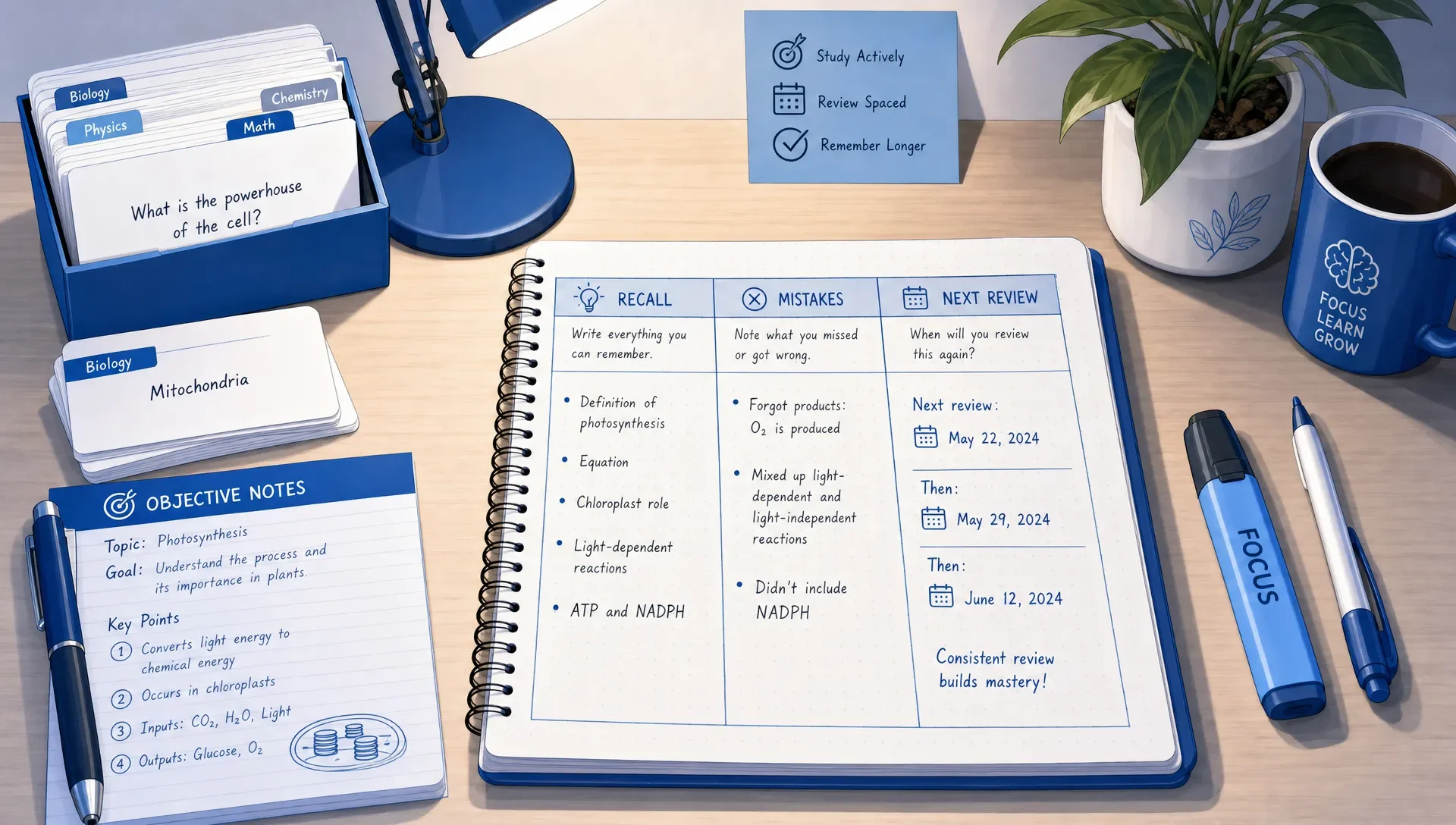
After the first pass, close the material and write down what you remember. This can be messy. Use a blank page, a notes app, or flashcards. The value comes from trying to rebuild the concept before the guide helps you. If you can't explain it, you've found the exact place to review.
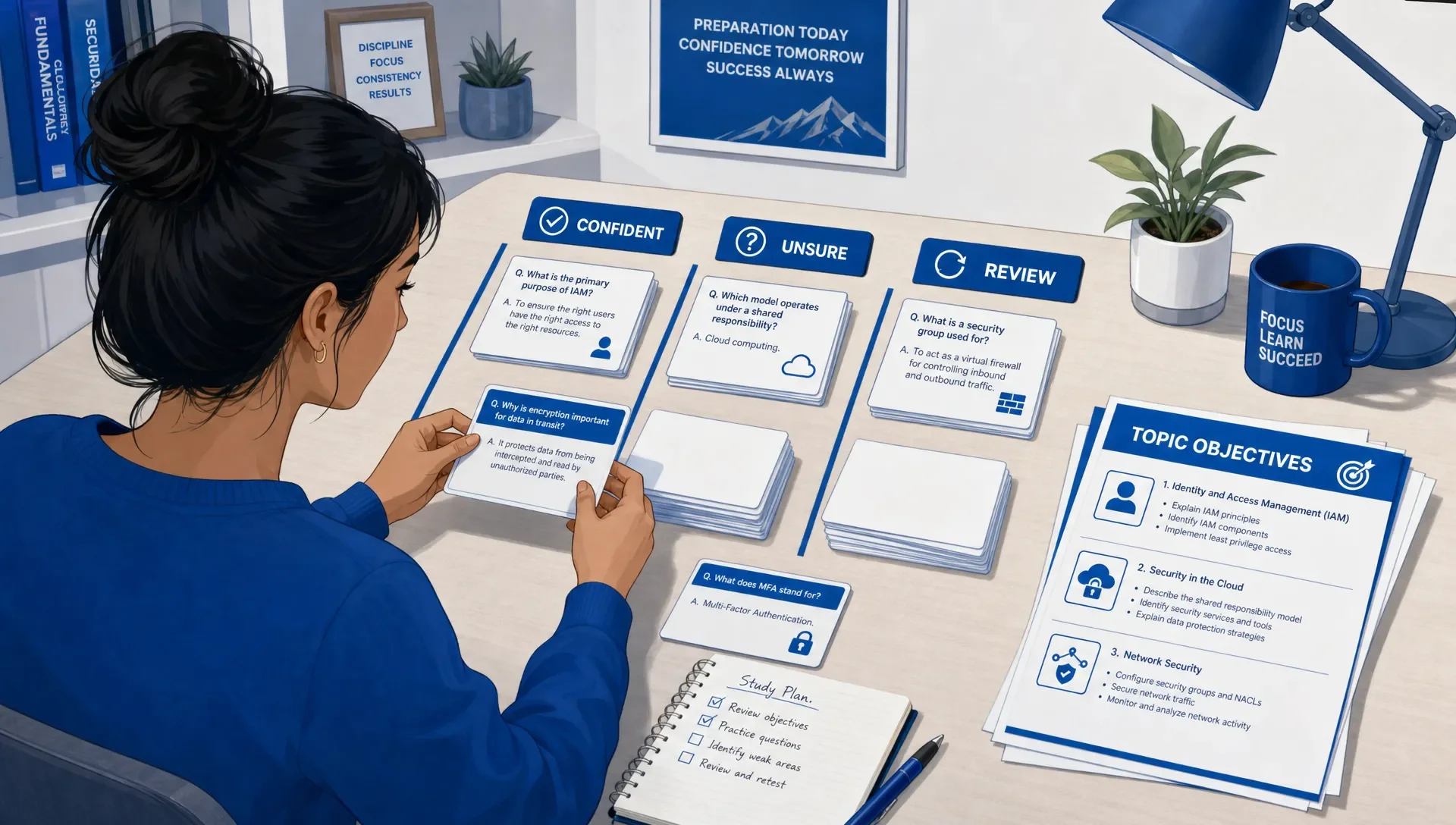
Then, answer questions. Keep them closed-book. Mark every answer with a confidence level before checking the explanation. A confident wrong answer is more urgent than a guessed wrong answer because it means your mental model is misleading you.
Finish by repairing only the weak points. Don't reread the whole chapter just because you missed two questions. Go back to the specific paragraph, diagram, or objective that explains the mistake. Then, create a recall prompt for later, such as, "When should you use a security group instead of a network ACL?" or "What makes a risk response a transfer rather than a mitigation?"
How to use practice questions without memorizing answers
Practice questions aren't just for generating scores. Used correctly, they're retrieval training. In a classic experiment, Karpicke and Roediger found that repeated retrieval improved long-term retention more than repeated studying. For exam preparation, this means the act of trying to answer matters, even before you get it right.
The wrong way to use practice questions is to burn through huge sets, glance at the score, and move on. That teaches you to recognize question wording. It doesn't reliably teach the underlying objective.
A better approach is slower:
- Answer the question before looking anything up.
- Rate your confidence as high, medium, or low.
- Read the full explanation, including why the wrong answers are wrong.
- Tag the missed objective or topic.
- Create one follow-up prompt that forces recall later.
If you're preparing for cloud fundamentals, an AWS Certified Cloud Practitioner practice exam can help you test whether you can apply concepts across billing, security, architecture, and core services instead of just recognizing terms from a guide. If you're studying cybersecurity, a CompTIA Security+ practice exam gives you a way to pressure-test controls, threats, identity topics, and scenario-based reasoning.
The review matters as much as the attempt. A missed question can stem from several causes: you forgot a fact, misunderstood the concept, missed a keyword, rushed the scenario, or confused two similar options. If you want a detailed review workflow, MindMesh Academy's guide on how to review an exam practice test the right way breaks that process down by score, timing, confidence, and error causes.
How to schedule spaced review before the exam
Cramming can increase short-term familiarity, but spaced review is much better for knowledge you need to retain long-term. A review by Cepeda and colleagues in Psychological Bulletin found that distributing study across time improves later recall compared with massing study into a single session.
For exam preparation, spacing doesn't mean waiting weeks between reviews. It means you revisit a topic after enough time has passed that recall takes effort. If the answer is still too easy, the gap can grow. If you miss it, shorten the gap and repair the concept.
| When you first learn a topic | What to do next | Purpose |
|---|---|---|
| Same day | Answer 3 to 5 closed-book questions/prompts | Check immediate understanding |
| Next day | Review only missed or low-confidence items | Prevent early forgetting |
| 3 to 4 days later | Mix the topic into a broader question set | Practice choosing between concepts |
| 1 week later | Use flashcards or objective-based recall | Confirm durable memory |
| Final week | Focus on weak objectives and timed sets | Build exam readiness |
Flashcards work best when they're short and specific. A weak flashcard asks, "What is encryption?" A stronger flashcard asks, "What problem does encryption at rest solve, and what does it not solve?" That prompt forces you to recall boundaries, which is often what certification questions test.
MindMesh Academy's flashcards use spaced repetition, and its adaptive weakness-based practice is built around the idea that your study time should target your gaps. This matters when you have limited evenings and can't afford to give equal time to topics you already know.
How to study scenario-based and performance-based questions
Scenario questions punish shallow rereading because they rarely ask for a direct definition. They give you constraints, then ask for the best choice. In cloud exams, that might mean balancing cost, availability, and operational overhead. In security exams, it could involve choosing the most appropriate control after an incident. In project management exams, it might mean identifying the next action, not just the correct concept.
To study these questions, slow down during review and identify the decision rule. Ask yourself what changed the answer. Was it the word fastest, least privilege, most cost-effective, highly available, or first? Those words often separate a good answer from the best answer.
For performance-based question formats, definitions aren't enough. You need to practice the workflow. That might mean reading a configuration scenario, ordering steps, matching controls to risks, or interpreting a small technical output. Rereading the documentation can support this, but only after you've tried the task and found the point of confusion.
A 60-minute study block that beats rereading
When you're tired after work, a specific study block helps you avoid sliding back into passive review. Use the same pattern across subjects so the habit becomes automatic.
| Time | Task | What to avoid |
|---|---|---|
| 0 to 10 minutes | Review yesterday's missed flashcards or prompts | Starting with new reading before checking retention |
| 10 to 25 minutes | Read or watch one small objective-based lesson | Trying to cover an entire domain at once |
| 25 to 40 minutes | Close the material and write or explain key points | Copying notes word for word |
| 40 to 55 minutes | Answer practice questions related to the objective | Checking explanations before committing to an answer |
| 55 to 60 minutes | Tag mistakes and schedule the next review | Ending with only a score and no repair plan |
This works because it separates exposure from proof. You still learn new material, but the session doesn't end until you've tested it. Over several weeks, that creates a record of weak objectives, improving topics, and areas that need more practice.
Common mistakes when switching away from rereading
You check the answer too soon
Active recall feels uncomfortable because it exposes uncertainty. Many learners escape that feeling by checking the answer after a few seconds. Give yourself time to think. Even a wrong attempt is useful because it reveals your current mental model.
You only practice the topics you enjoy
People naturally return to topics that feel good. Certification exams don't care which domain you prefer. If your practice history shows repeated weakness in networking, governance, access control, or stakeholder management, that topic deserves scheduled attention until your recall improves.
You treat wrong answers as failures
A wrong answer during study is feedback. The real failure is missing the same objective repeatedly without changing your approach. After each miss, write the reason in plain language: "I confused authentication with authorization," "I ignored the cost constraint," or "I answered what the service can do instead of what the question asked."
You make flashcards that are too broad
Broad flashcards create vague recall. Keep prompts small enough to answer clearly. Instead of one card for all project risk responses, create separate prompts that ask you to distinguish avoid, mitigate, transfer, and accept in realistic situations.
You take full practice exams too early
Full-length exams are useful, but they're expensive in time and attention. Early in your plan, shorter objective-based sets often teach more. Save full timed exams for readiness checks after you've covered the main objectives and built some recall strength.
How to know you're ready without rereading the whole course
Readiness isn't the same as finishing content. You're closer to exam-ready when you can answer mixed questions without clues, explain your reasoning, and recover from mistakes quickly.
Look for several signals simultaneously. Your scores should improve across mixed sets, not just repeated questions. Your timing should feel controlled. Your wrong answers should cluster in fewer objectives. Your explanations should become more precise. If you can explain why the wrong options fail, you're moving beyond memorization.
This is where readiness tracking helps. MindMesh Academy connects study guides, practice questions, flashcards, progress tracking by topic, and mastery signals so you can see whether you're actually improving. That's far more useful than rereading a finished chapter and hoping it sticks.
Frequently Asked Questions
Is rereading ever useful for exam prep? Yes. Rereading is useful for first exposure, clarifying a confusing explanation, or repairing a specific mistake. It becomes a problem when it replaces recall, practice questions, and spaced review.
What should I do if active recall feels too hard? Start smaller. After reading one short section, close it and recall only three key ideas. Then check the guide, fix gaps, and try again. Difficulty isn't a sign that the method is failing. It often means you're finally training retrieval.
Are flashcards better than practice questions? They serve different jobs. Flashcards are great for definitions, distinctions, commands, formulas, and short decision rules. Practice questions are better for scenario interpretation, distractor analysis, and exam timing.
How many times should I review a topic before the exam? Review it until you can recall it after time has passed and apply it in mixed questions. Strong topics need fewer reviews. Missed, low-confidence, or high-weight objectives need more frequent review.
Should I take notes while studying? Yes, but don't let note-taking become copying. The best notes are short, written after recall, and focused on mistakes, decision rules, and confusing distinctions.
What is the fastest way to stop relying on rereading? Add one closed-book step to every session. Before you reread anything, write what you remember or answer a few questions. Then use the material only to repair what you missed.
Build a study routine that proves what you know
Rereading feels safe, but exams reward recall, judgment, and application. A better routine is simple: learn a small objective, retrieve it without notes, test it with questions, review the explanation, and schedule spaced follow-up.
If you want that workflow in one place, MindMesh Academy helps you move past passive study. Our platform provides objective-based study guides, practice questions with detailed explanations, and adaptive weakness-based practice. Get started today and see your progress for yourself by checking out our AZ-900 Microsoft Azure Fundamentals practice exam.

Written by
Alvin Varughese
Founder, MindMesh Academy
Alvin Varughese is the founder of MindMesh Academy and an enterprise architecture leader. An electrical engineer by training, he moved from factory automation in South Africa to cloud architecture at GE Appliances and Humana (Fortune 50), and holds 20 professional certifications including AWS Solutions Architect Professional, Azure DevOps Engineer Expert, and Microsoft Agentic AI Business Solutions Architect. He built MindMesh Academy after interviewing too many highly certified candidates who couldn't answer basic questions: the goal is prep that makes you better at the job, not just able to pass the exam.