Practice Exam Questions: Review Every Answer Better
Review Every Answer: How to Improve with Practice Exam Questions
Passing certification exams like those from AWS, CompTIA, Cisco, Microsoft, or PMI means more than just answering practice questions. It means learning from every single one. Your practice exam score tells you where you stand, but a thoughtful review shows you what to fix before your real test.
After each set of practice questions, resist the urge to jump into another batch. First, closely inspect every answer: the ones you missed, the ones you guessed correctly, and even the ones you got right for solid reasons. This is how you pinpoint weak concepts, identify poor reading habits, recognize timing issues, and spot distractors that still look tempting.
Why You Should Review Every Practice Exam Question
Many people preparing for certifications only review the answers they got wrong, skipping over the correct ones. This feels efficient, but it leaves two problems unaddressed. First, a correct answer might have come from a lucky guess. Second, you might know a definition but fail to see how the concept applies in a scenario-based question.
Slowing down for review has a strong educational basis. Researchers like Dunlosky et al. highlight practice testing and distributed practice as highly effective learning methods. Practice questions aren't just for measurement. When you retrieve information, check the feedback, and revisit weak areas later, you're actively training your memory and judgment.
For certification exams, answer review becomes even more critical because many questions test application, not just recall. Vendors like AWS and CompTIA publish exam objectives or guides that describe what candidates are expected to do, not just what they should recognize. For instance, the AWS Certified Cloud Practitioner exam page breaks down the exam into domains and task statements. Similarly, CompTIA's Security+ certification page provides exam objectives that organize security knowledge by topic.
Your review should connect each question back to these objectives. If you miss three identity and access questions, the solution isn't to do more random questions. Instead, rebuild your understanding of that specific objective, then retest yourself on it.
What to Capture Before Reading the Explanation
The most effective review happens before you look at the official explanation. Once you see the correct answer, your brain will often try to rationalize your original choice, making it seem better than it was. Capture your initial reasoning first, then compare it to the explanation.
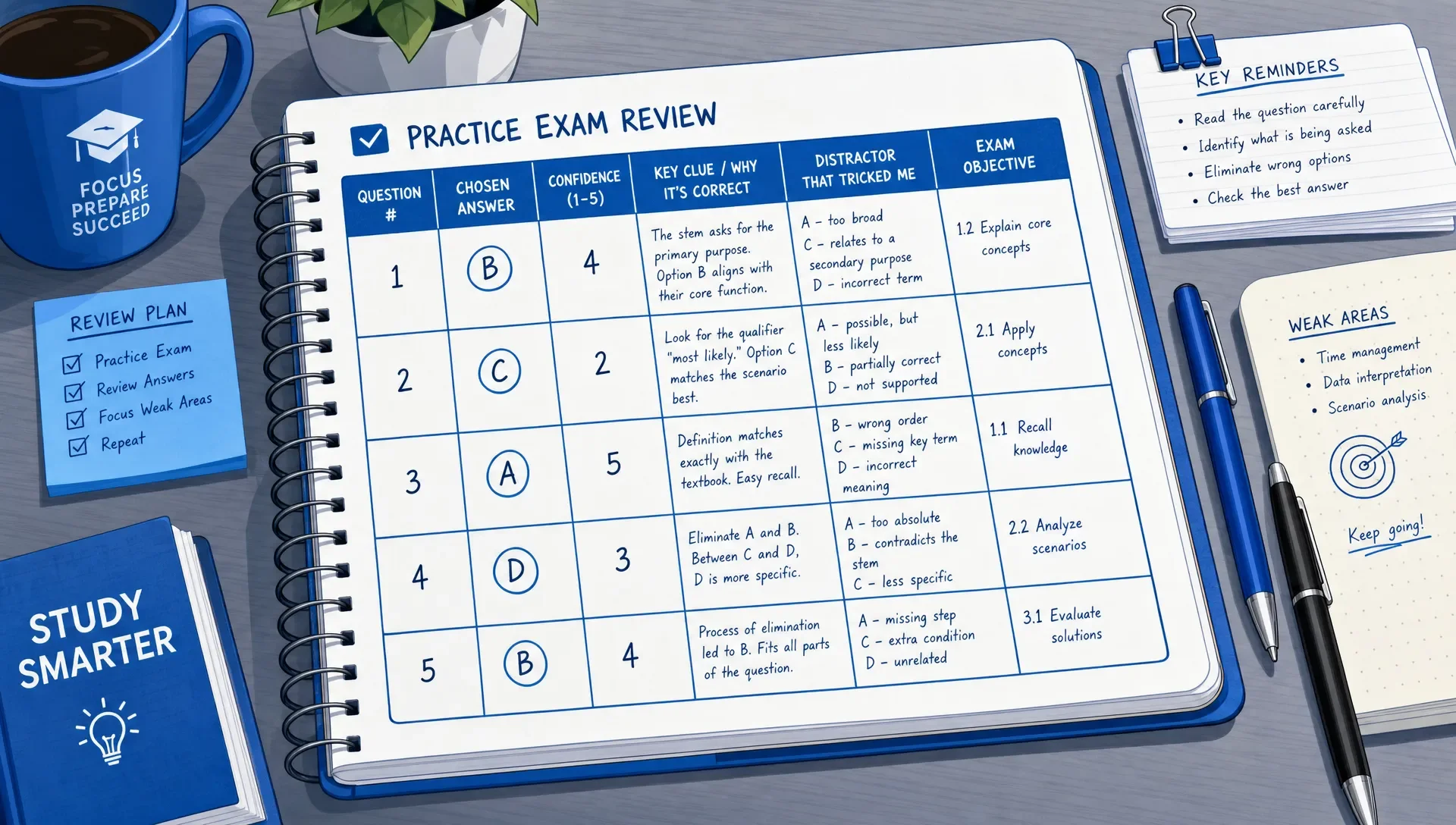
Use a simple answer log. It doesn't need to be complex. A spreadsheet, a notebook, or a notes field within your practice platform can work, as long as you consistently track the same information.
| Field to capture | What to write | Why it improves review |
|---|---|---|
| Chosen answer | The option you selected | Shows your actual decision, not your corrected memory |
| Confidence | High, medium, or low | Separates true understanding from lucky correct answers |
| Main clue | The phrase or condition you used | Reveals if you found the key signal in the question |
| Rejected option | The strongest distractor you avoided or nearly chose | Helps you understand why wrong answers seemed plausible |
| Time spent | Fast, normal, or slow | Flags questions where timing affected accuracy |
| Exam objective | The domain, task, or topic | Turns review into targeted study instead of vague rework |
This log is especially helpful when questions include explanations. If you're preparing for security topics, for example, working through a CompTIA Security+ practice exam provides questions and explanations you can map back to specific objectives during your review.
How to Review Correct Answers Without Wasting Time
Not all correct answers deserve equal review time. Sort them into three categories: solid, unstable, and lucky. This prevents you from spending too much time on concepts you already know while ignoring a correct answer that was just a guess.
A solid correct answer is one you chose quickly, with high confidence, and a clear reason. For these, quickly scan the explanation to confirm your logic. If your reasoning matches, move on.
An unstable correct answer is one you got right with hesitation. Maybe you narrowed it down to two options and picked the better one. Or you recognized a term but weren't sure why the other option was wrong. These answers warrant review because a slightly different phrasing of the same concept could lead to a wrong answer on the actual exam.
A lucky correct answer is one you can't explain why you chose. Treat it like a wrong answer. Write down the rule you didn't know, identify the clue you missed, and add it to your next study session.
| Correct answer type | How it feels during the test | Best review action |
|---|---|---|
| Solid | You knew why the answer was right and why the others were wrong | Confirm the explanation, then move on |
| Unstable | You hesitated between two options or used partial knowledge | Review the explanation and write down the decision rule |
| Lucky | You guessed or recognized a familiar phrase | Treat it as a miss and relearn the topic |
A good question review isn't finished when you know the right letter. It's finished when you can explain why the chosen answer is the best under the specific conditions given in the question.
How to Review Wrong Practice Exam Answers So They Improve Your Next Score
Wrong answers are only useful if you diagnose their cause. Simply writing "wrong because I didn't know it" is usually too vague. You need to identify whether the mistake came from a knowledge gap, misreading the question, timing pressure, or a decision-making flaw.
For each wrong answer, write four short statements: "I chose this because...," "the correct answer is better because...," "the clue I missed was...," and "next time I will...." This transforms the explanation into a rule you can apply later.
| Mistake type | What it looks like | What to do next |
|---|---|---|
| Knowledge gap | You didn't recognize the concept or command | Return to the study guide section for that objective |
| Misread stem | You missed words like best, first, most likely, or least | Slow down on the final sentence and underline the specific request |
| Distractor trap | You chose a true statement that didn't answer the scenario | Compare each option to the question, not just to your memory |
| Rule exception | You knew the general rule but missed a condition that changes it | Write an if-then rule and test similar scenarios |
| Timing pressure | You rushed and skipped a key detail | Practice shorter timed sets before another full exam |
| Overconfidence | You answered fast and were wrong | Add a final clue check before submitting similar questions |
This is also where you should separate content problems from exam technique problems. If you consistently miss questions on IAM, subnetting, incident response, or project stakeholders, that's a content signal. If you miss questions across many topics because you ignore qualifiers like "always" or "never," that indicates a reading strategy issue.
For a deeper process on reviewing full timed exams, check out MindMesh Academy's guide on how to review an exam practice test the right way. For individual questions, keep your focus tighter: decision, clue, distractor, objective, and next action.
How to Turn Answer Explanations Into Better Notes
Lengthy notes often feel productive, but concise review notes are usually more effective. After a practice question, don't rewrite entire textbook chapters. Convert the explanation into a rule you can apply.
Good review notes often use one of these formats:
- Because statement: "The answer is correct because the scenario requires encryption at rest, not network segmentation."
- If-then rule: "If the question asks for the least administrative effort, prefer the managed service when it satisfies the requirement."
- Distractor warning: "This option is true generally, but it doesn't address the specific incident described in the question."
- Objective link: "Review access control models under the identity and access management objective."
These notes become the raw material for flashcards, quick reviews, and targeted practice. The Institute of Education Sciences practice guide on organizing instruction and study recommends techniques such as spacing learning over time, using quizzes, and asking learners to explain material. This lines up well with a review process where you revisit missed rules instead of simply cramming them once.
MindMesh Academy supports this workflow through study guides organized by exam objectives, practice questions with explanations, and flashcards designed for spaced repetition. The goal is to connect your review directly to your next study action, ensuring your mistakes don't stay hidden in an old score report.
How to Schedule Practice Exam Question Review During the Week
The best review schedule depends on how close you are to your exam date, but the general pattern is straightforward: review immediately, revisit soon, and retest later. Don't wait a week to inspect a practice set. By then, you likely won't remember why a particular option seemed attractive.
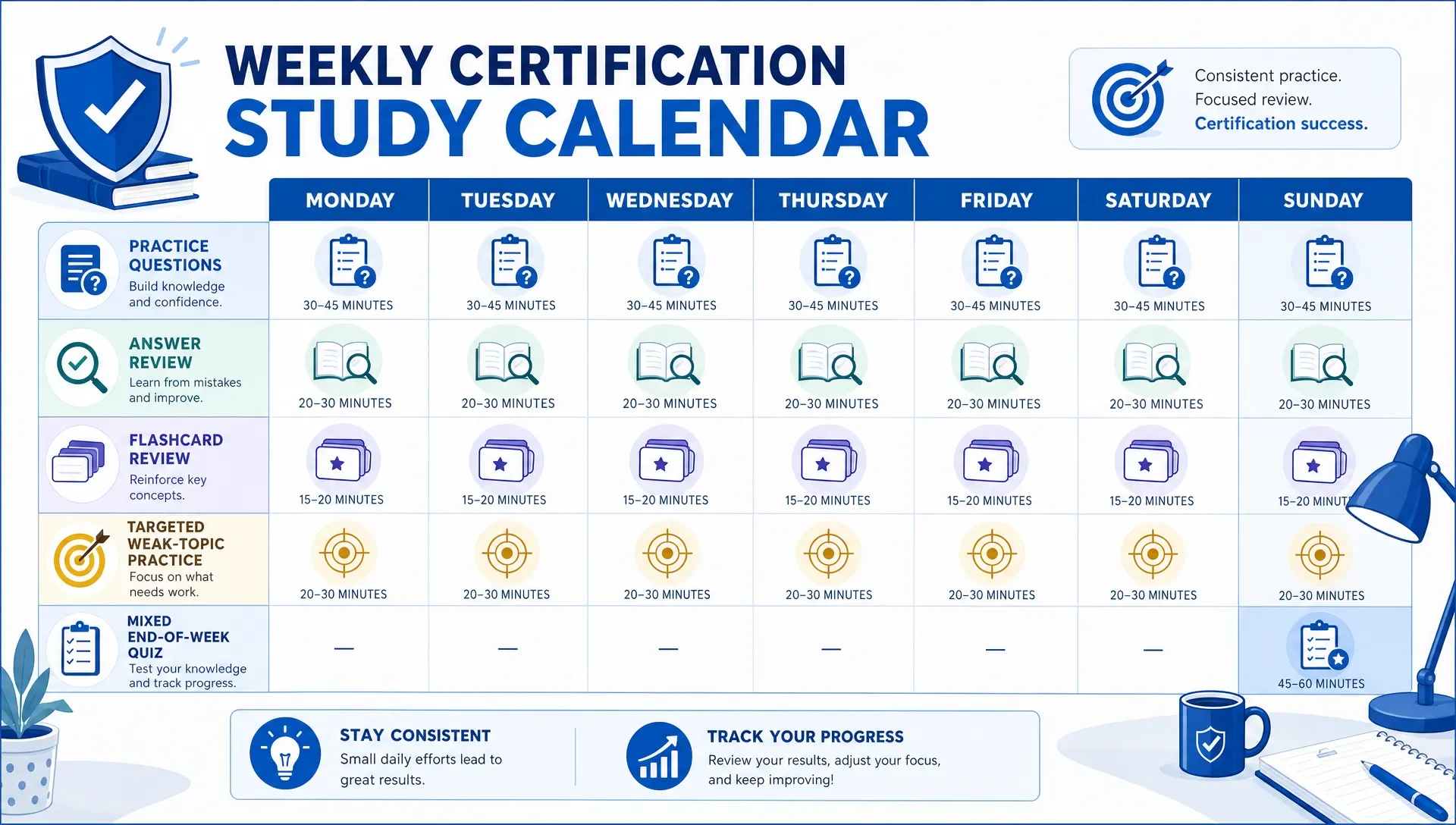
A practical weekly schedule might look like this:
| When | What to do | Time needed |
|---|---|---|
| Right after a question set | Log confidence, clue, and mistake type before reading explanations | 15 to 30 minutes |
| Later the same day | Read explanations and write short decision rules | 20 to 40 minutes |
| Next day | Review flashcards or notes from missed and unstable answers | 10 to 20 minutes |
| Two to three days later | Do a targeted set on the same objectives | 20 to 45 minutes |
| End of week | Take a mixed set to check whether the weakness still appears | 30 to 60 minutes |
This schedule helps avoid two common problems. You won't overreact to a single missed question, and you won't ignore a consistent pattern of mistakes across several questions. If the same objective remains weak after review and retesting, return to your main study guide before doing more random practice.
When to Move From Question Review to Full Practice Exams
Question-level review is ideal while you're still building your knowledge foundation. Full practice exams are better for testing stamina, pacing, and readiness across multiple domains. If you attempt full exams too early, you might spend hours generating score reports without truly fixing the underlying causes of your performance.
Move toward full practice exams when you can explain most correct answers, your missed questions cluster in a few identifiable objectives, and your timing is consistent on shorter sets. At this point, a timed, full-length attempt provides more accurate readiness data.
For cloud fundamentals, the AWS Certified Cloud Practitioner practice exam can help you connect timed practice with explanations and topic-level progress. The same review principles apply across all certification paths: don't just ask whether you passed the practice exam. Ask which answer decisions are repeatable under pressure.
Performance-based question formats require extra attention. Review the specific task steps you took, not just the final result. If you configured the wrong control, selected an incorrect command, or solved the steps in an inefficient order, capture that in your answer log. For task-based items, process errors are often more significant than just the final option chosen.
Common Practice Exam Question Review Mistakes
The biggest review mistake is reading explanations passively. If you read an explanation, nod, and move on, you might recognize the answer next time without truly understanding it. This leads to answer memorization, not genuine exam readiness.
Another mistake is reviewing solely based on your score. A 78 percent could mean you're almost ready, or it could mean you guessed your way through several high-value objectives. A 62 percent can be discouraging, but if most misses stem from only two topics, the fix might be straightforward.
Watch for these habits during your review:
- You look at the correct answer before writing down why you chose yours.
- You mark a topic as mastered after only one correct answer.
- You retake the same questions too soon and simply remember the letter.
- You write notes that are too long to effectively review later.
- You ignore timing because the question seemed conceptually familiar.
Replace those habits with a systematic review loop: decide, explain, compare, diagnose, retest. This loop is simple enough to repeat and specific enough to change your next score.
Frequently Asked Questions
Should I review practice exam questions I got right? Yes. Review correct answers quickly, but don't skip them entirely. A correct answer chosen with low confidence still represents a weakness, as you might miss a similar question under pressure.
How long should I spend reviewing practice exam questions? A good rule is to spend about as much time reviewing as you spent answering, especially early in your preparation. Later, when more of your answers are solid, your review time should naturally decrease.
Should I read the explanation immediately after each question? If you're currently learning a topic, immediate feedback can be helpful. If you're simulating exam conditions, answer the full set first, capture your confidence and reasoning, then read explanations after submitting.
What should I do if I keep missing the same objective? Stop doing random questions for a moment. Return to the relevant study guide section, create a few short rule-based notes or flashcards, then do targeted practice specifically on that objective.
Is it bad to retake the same practice exam questions? Retakes can help if enough time has passed and you focus on reasoning rather than recall. If you remember the answer letter or wording, the retake might inflate your score without truly proving readiness.
How do I know when answer review is working? You should see fewer repeated mistake types, higher confidence on your correct answers, and faster recognition of key clues within questions. Your score matters, but consistent understanding across objectives matters more.
Build a Better Answer Review Loop
Practice exam questions should do more than just produce a percentage. Each answer should tell you what you truly understand, what you guessed, what distracted you, and what to study next.
At MindMesh Academy, we design our learning experience around this connected workflow. You'll find objective-based study guides, practice questions with detailed explanations, and tools for tracking your mastery across different certification paths. Use these resources to turn every answer into a decision you can explain, repeat, and trust on exam day. Explore our full range of certification offerings at https://www.mindmeshacademy.com/certifications.

Written by
Alvin Varughese
Founder, MindMesh Academy
Alvin Varughese is the founder of MindMesh Academy and an enterprise architecture leader. An electrical engineer by training, he moved from factory automation in South Africa to cloud architecture at GE Appliances and Humana (Fortune 50), and holds 20 professional certifications including AWS Solutions Architect Professional, Azure DevOps Engineer Expert, and Microsoft Agentic AI Business Solutions Architect. He built MindMesh Academy after interviewing too many highly certified candidates who couldn't answer basic questions: the goal is prep that makes you better at the job, not just able to pass the exam.