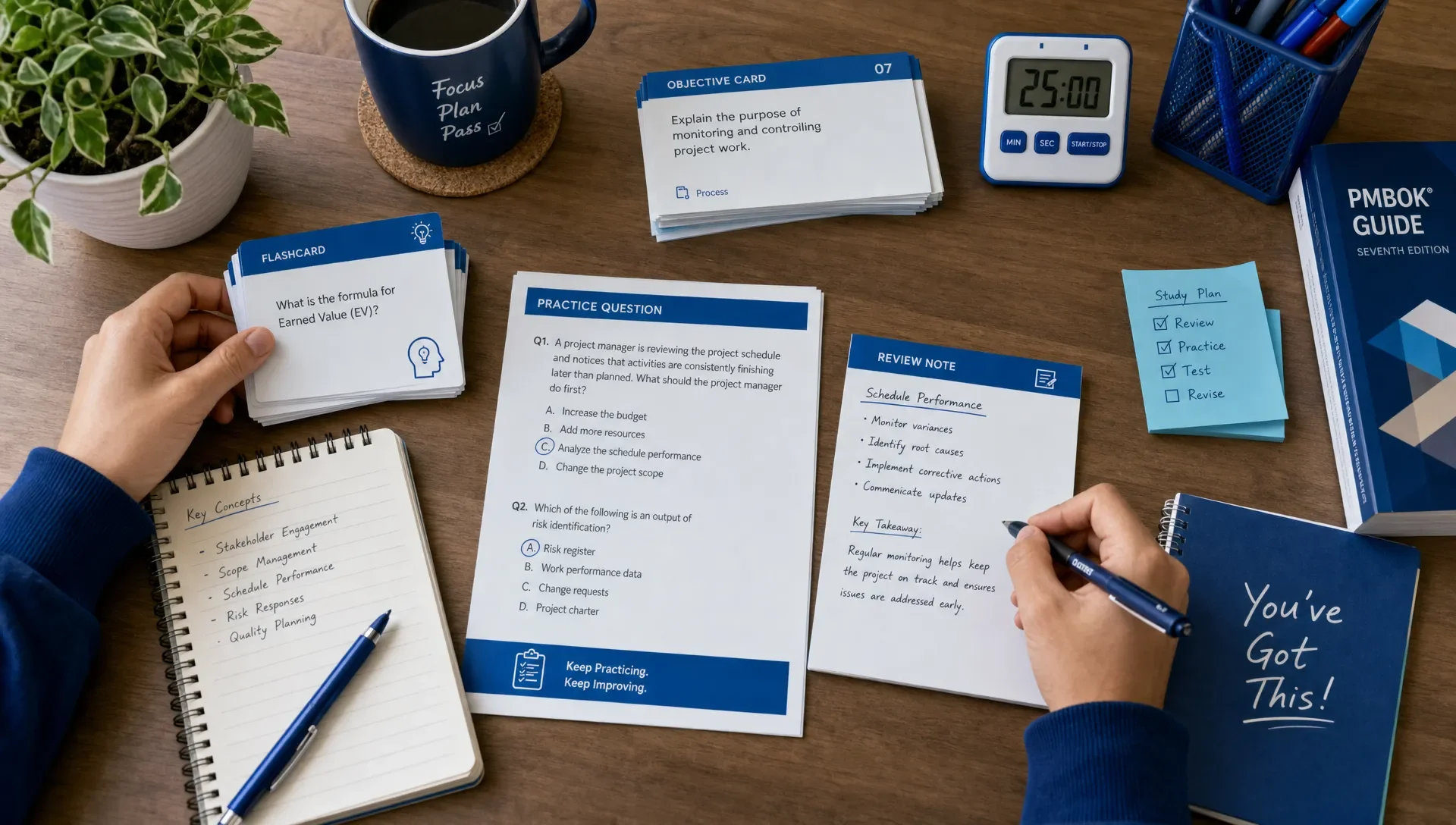
Study for a Certification Exam With a Weekly Loop
Study for a Certification Exam With a Weekly Loop
When you study for a certification exam, the weekly loop is simple: choose the exam objectives for the week, learn the smallest useful chunk, test yourself, review every miss, then reset next week based on evidence. Don't start with a huge calendar you won't follow. Start with a seven-day rhythm you can repeat.
This approach works because certification prep isn't just about covering content. You need to prove you can recall concepts, apply them in scenarios, and spot traps under exam pressure. A weekly loop gives you that proof before test day, whether you're preparing for AWS, Azure, CompTIA, Cisco, PMI, or another certification path.
What a Weekly Certification Study Loop Looks Like
A weekly loop turns exam prep into a repeatable operating system. You don't wake up each day wondering what to do. Each day has a job, and each week ends with a better plan than the one you started with.
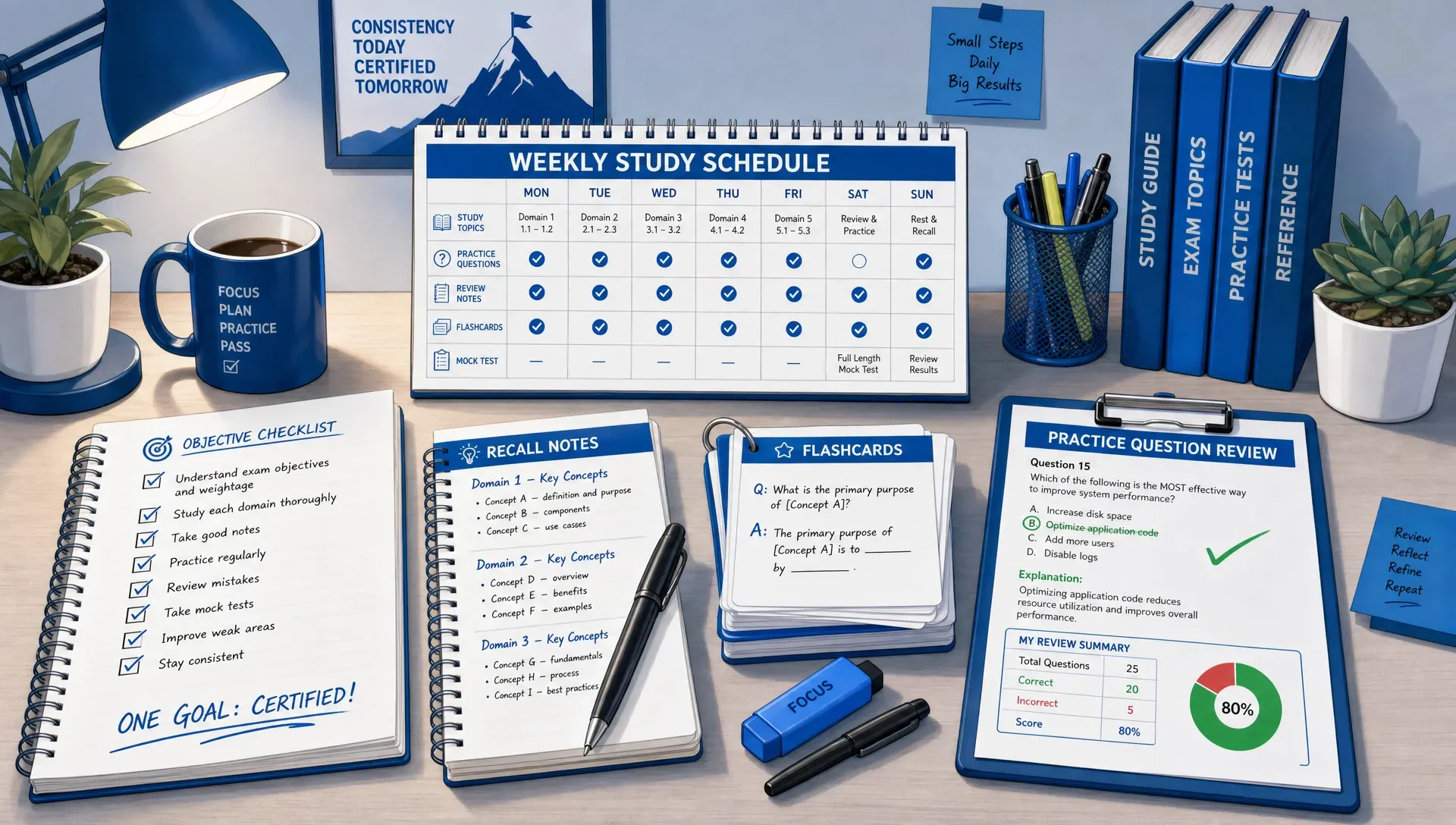
Here is a practical default loop you can adjust around work, school, or family commitments.
| Day | Main focus | What you should produce |
|---|---|---|
| Monday | Pick objectives and preview | A short list of objectives for the week |
| Tuesday | Learn and summarize | Notes in your own words, not copied definitions |
| Wednesday | Active recall | Closed-book explanations and flashcards |
| Thursday | Practice questions | Missed-question review notes |
| Friday | Weakness repair | Reworked explanations and targeted study |
| Saturday | Timed practice or scenario work | Score, timing notes, and confidence rating |
| Sunday | Reset and plan | Next week's objective list based on evidence |
You don't have to follow these exact days. If you work weekends, shift the loop. If your exam is close, compress the cycle into three or four days. The important part is the sequence: objectives, learning, recall, practice, review, and reset.
Start Each Week With the Official Exam Objectives
Certification exams are built around exam objectives, not around whatever your favorite resource happens to teach first. Start every week by choosing a small set of objectives from the official blueprint, then define what it would mean to prove mastery.
For example, AWS publishes exam pages and guides through AWS Certification, and Microsoft lists skills measured for certifications through Microsoft Learn credentials. These vendor pages should shape your weekly plan because they tell you what the exam is allowed to test.
A good weekly objective list is narrow enough that you can finish it and test it. Instead of writing study cloud security, write something like explain shared responsibility, identify IAM policy effects, and choose encryption options for common storage scenarios. That gives you clear targets.
If you're preparing for Azure fundamentals, an objective-organized resource like the AZ-900 Microsoft Azure Fundamentals study guide can help you keep the week tied to the exam structure rather than random topic hopping.
| Weak weekly target | Strong weekly target |
|---|---|
| Study networking | Explain subnets, routing basics, and private versus public access |
| Review security | Compare authentication, authorization, and least privilege choices |
| Do practice questions | Complete 30 questions on two objectives and review every miss |
| Read the guide | Summarize three objectives from memory and make flashcards |
The stronger targets are easier to test. If you can't test it, you can't manage it.
Use Active Recall Before You Reread a Topic
Rereading feels productive because the material looks familiar. Familiarity isn't the same as retrieval. You need to practice pulling the answer out of memory before the exam forces you to do it.
The Institute of Education Sciences practice guide Organizing Instruction and Study to Improve Student Learning recommends techniques such as asking deep explanatory questions, spacing learning over time, and using tests to promote learning. For certification prep, that means you should test your memory before you feel fully ready. This is where active recall comes in.
Use this active recall sequence after each study block:
- Close your notes and write the concept in your own words.
- Explain when you would use it and when you wouldn't.
- Create one example scenario that could appear on the exam.
- Compare your answer to the study guide or official documentation.
- Turn every gap into a flashcard or a practice target.
If this feels slower than rereading, that's normal. You're doing the hard part during practice instead of saving it for exam day. For more ways to replace passive review, MindMesh also covers study methods for exams that beat rereading.
Use Practice Questions in the Middle of the Week
Many learners save practice questions for the weekend. That's too late if your goal is to repair weak spots during the same week. Put your first question set in the middle of the loop so the results can change what you study next.
Midweek questions should be targeted, not random. If Tuesday was identity and access management, Thursday should test identity and access management. Mixed practice becomes more useful after you've covered several domains.
| Practice mode | Best time to use it | What it tells you |
|---|---|---|
| Objective-specific questions | Middle of the week | Whether the concept landed |
| Mixed-domain questions | End of the week | Whether you can switch between topics |
| Timed sets | Weekend or final review phase | Whether pacing affects accuracy |
| Scenario questions | After basic recall | Whether you can apply the rule in context |
The value comes from the explanation review, not just the score. A 70 percent score with careful review can move you forward. An 85 percent score with skipped explanations can leave hidden gaps.
If you're studying for Security+, using a targeted CompTIA Security+ practice exam can help you connect questions back to objectives and review the reasoning behind each answer.
Review Missed Questions Until You Can Explain the Rule
A missed question is not a failure. It's a diagnostic result. The mistake becomes useful only when you identify why you missed it and what rule you should apply next time.
Don't write notes like got it wrong or remember encryption. Those notes won't help you later. Write the decision rule you failed to apply.
| Review prompt | What to write |
|---|---|
| What was the question really testing? | Name the objective or concept behind the wording |
| Which clue mattered most? | Identify the phrase that should have changed your answer |
| Why was your answer wrong? | Explain the mistaken assumption or missing fact |
| What is the rule for next time? | Write a short if-this-then-that decision rule |
| How will you retest it? | Add a flashcard, question set, or scenario practice task |
For example, if you miss a cloud storage question because you choose the cheapest option but ignore access frequency, your review note should mention the rule: choose storage class based on access pattern, retrieval needs, and cost tradeoff, not price alone.
This type of review builds transfer. You aren't memorizing one question. You're extracting the rule that helps you answer a new one.
Put Flashcards and Spaced Repetition on the Calendar
Flashcards work best when they're short, testable, and scheduled. Don't make cards that ask you to recite a whole textbook paragraph. Ask one clear question, then answer it without looking.
For certification exams, strong flashcards usually test definitions, comparisons, command effects, service limits, formulas, process steps, and decision rules. Weak flashcards ask vague questions like explain networking or know risk management.
Spaced repetition matters because exam prep stretches across weeks. You need old material to keep resurfacing while you learn new objectives. MindMesh Academy includes flashcards with spaced repetition, which helps you keep earlier topics active instead of relearning them right before the exam.
A simple daily target is enough for most learners: ten to fifteen minutes of flashcards before you open new material. If your cards pile up, don't start by adding more. First, clean up weak cards, split overloaded cards, and delete anything that doesn't map to an objective.
Add Performance-Based or Scenario Practice Before the Weekend
Many certification exams don't only ask what a term means. They ask what you would do in a situation. That shift matters for cloud, networking, security, and project management exams because the correct answer often depends on constraints.
Scenario practice should start after basic recall, not before. If you can't define a concept, you won't apply it well. Once you can explain the basics, build short scenarios that force a decision.
For IT exams, that might mean choosing a secure network design, interpreting a log snippet, matching a cloud service to a requirement, or troubleshooting a failed connection. For project management exams, it might mean choosing the next action based on stakeholder conflict, risk changes, or delivery constraints.
Performance-based questions also deserve a place in the weekly loop. Treat them as a different skill from multiple-choice recall. You may know the concept but still lose time because the interface, sequence, or task format feels unfamiliar.
Track Readiness With Evidence Instead of Confidence
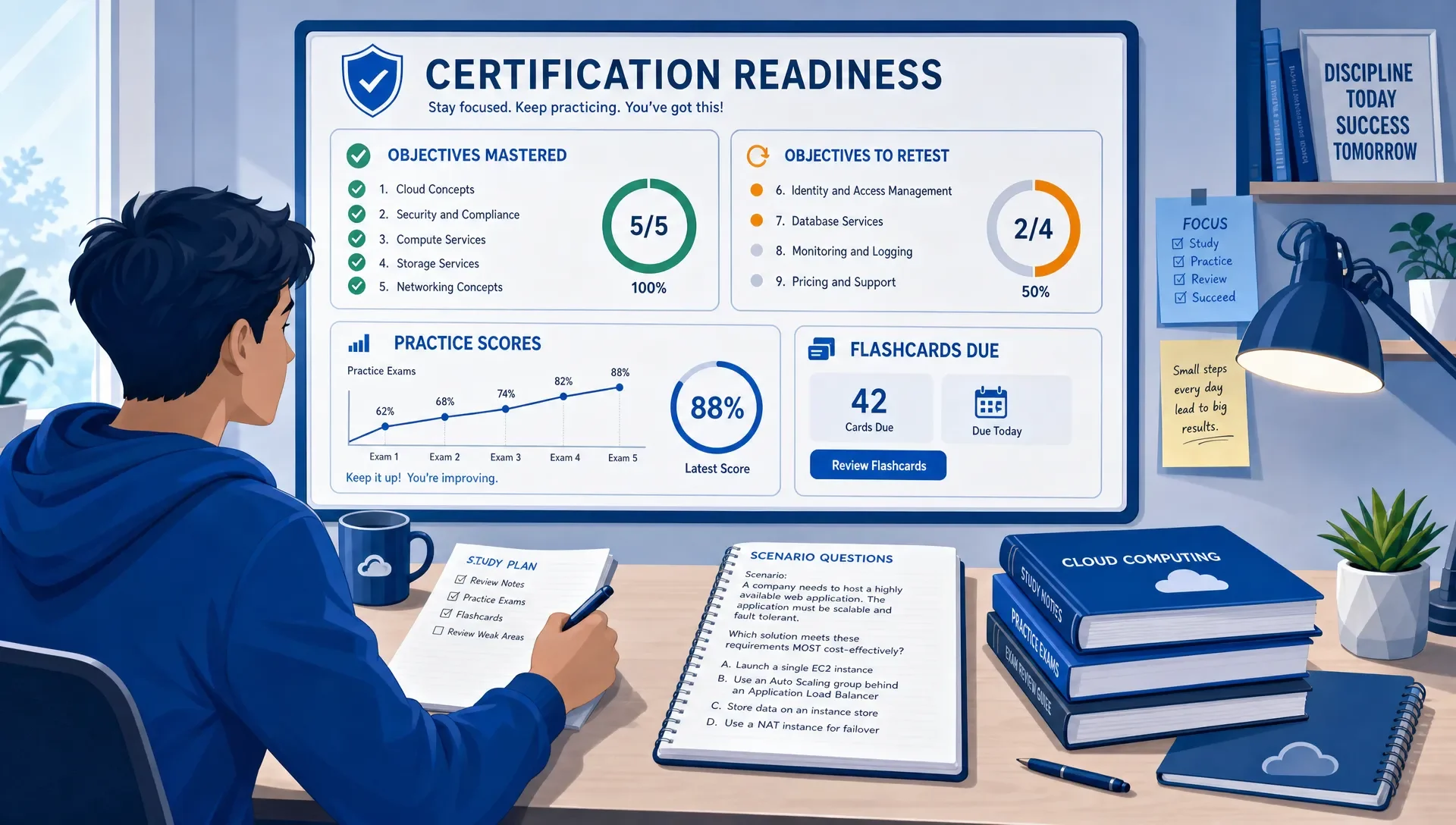
Confidence can mislead you. You may feel ready because you recognize terms, or you may feel unready because practice feels hard. Use evidence instead.
A readiness signal should connect to exam behavior: Can you answer objective-level questions cold? Can you explain missed answers? Can you finish a timed set without rushing? Can you handle scenarios that combine topics?
| Readiness signal | Not ready yet | Stronger evidence of readiness |
|---|---|---|
| Objective coverage | You watched or read the topic | You can explain and answer questions on it |
| Practice accuracy | Scores swing wildly by topic | Scores are stable across covered domains |
| Missed-question review | You read the explanation | You can restate the rule and retest correctly |
| Timing | You often run out of time | You finish with enough time to review flagged items |
| Scenario handling | You guess when requirements change | You identify constraints and eliminate bad options |
MindMesh Academy's connected study workflow supports this kind of evidence-based prep with study guides by exam objectives, practice questions and explanations, adaptive weakness-based practice, progress tracking by topic and mastery, and readiness tracking.
If you want a broader framework for organizing resources, review cycles, and practice data, this guide on how to build an exam prep system that actually works goes deeper into the full study system.
How Many Study Hours Do You Need Per Week
There isn't one correct weekly study total. The right number depends on the exam level, your background, and how soon you test. What matters more is consistency across the loop.
Use these planning ranges as a starting point, then adjust based on your practice results.
| Exam situation | Weekly study range | Best loop adjustment |
|---|---|---|
| Entry-level or fundamentals exam with some background | 4 to 6 hours | Keep sessions short and test recall often |
| Associate-level technical exam | 6 to 8 hours | Add scenario practice and weekly timed sets |
| Advanced exam or weak background | 8 to 12 hours | Split objectives into smaller chunks and review more often |
| Exam date within two weeks | 8 or more focused hours if available | Prioritize weak objectives and practice review over new resources |
A five-hour week can work if every hour has a job. A twelve-hour week can fail if most of it goes into passive videos, messy notes, and unreviewed questions.
Weekly Loop Example for Busy People Preparing After Work
If you're studying after work, protect your energy. You don't need long sessions every night. You need a repeatable pattern that survives tired days.
A realistic after-work loop might use 35 to 45 minutes on weeknights and a longer session on Saturday. Monday is objective selection. Tuesday is study and summary. Wednesday is flashcards and active recall. Thursday is practice questions. Friday is light review. Saturday is timed practice and missed-question repair. Sunday is optional reset if life allows it.
The key is to avoid making every session equal. Some nights should be lighter by design. If you try to force deep scenario practice after an exhausting day, you'll either skip it or do it poorly. Save harder tasks for the time blocks when you have the most attention.
For more scheduling tactics, especially if your prep happens around work and family obligations, see these practical ideas for study help for busy people preparing after work.
Common Weekly Study Loop Problems and Fixes
A weekly loop should reduce friction, not create another system to maintain. If it starts feeling heavy, simplify the loop before you abandon it.
| Problem | Likely cause | Fix for next week |
|---|---|---|
| You keep changing resources | No objective list | Pick objectives first, then choose only the resources needed for them |
| You study but can't answer questions | Too much passive review | Add closed-book recall before practice questions |
| Scores don't improve | Weak review process | Rewrite missed questions into decision rules and retest |
| Flashcards feel overwhelming | Cards are too broad | Split large cards into single-question cards |
| You run out of time every week | Plan is too ambitious | Cut the objective list in half and finish the loop fully |
| You forget older topics | No spacing | Review old flashcards daily before new study |
The fix is usually smaller than people think. You don't need a new plan every time a week goes badly. You need a cleaner next loop.
Frequently Asked Questions
How do I study for a certification exam if I only have weekends? Use the same loop but compress it. Spend the first block choosing objectives and learning, the second block doing active recall, the third block on practice questions, and the final block reviewing misses and planning the next weekend.
Should I take a full practice exam every week? Not at the beginning. Early in prep, objective-specific question sets usually teach you more. Add full timed practice when you've covered enough domains for the score to mean something.
What should I do when I miss the same topic repeatedly? Stop rereading the whole chapter. Write the decision rule, make two or three flashcards, answer a small targeted question set, and explain the concept out loud without notes.
How do flashcards fit into a weekly certification study loop? Use flashcards daily for spaced review, not as a last-minute cram tool. They work best for facts, comparisons, process steps, and rules you need to recall quickly.
How do I know when I'm ready to schedule the exam? Look for stable evidence: strong scores across covered objectives, fewer repeated misses, good timing on practice sets, and the ability to explain why wrong answers are wrong.
Build a Weekly Loop You Can Actually Repeat
The best study plan is the one you can run again next week. Keep the loop simple: pick objectives, learn actively, test yourself, review misses, space your flashcards, and reset based on results.
A consistent weekly study loop can make all the difference in your certification prep. If you're ready to put this approach into action, MindMesh Academy provides structured study guides and practice questions with explanations to support your journey. You can build a strong foundation and refine your knowledge for exams like Azure Fundamentals. Start your prep with our AZ-900 Microsoft Azure Fundamentals practice exam and see how well you're retaining those crucial concepts.

Written by
Alvin Varughese
Founder, MindMesh Academy
Alvin Varughese is the founder of MindMesh Academy and an enterprise architecture leader. An electrical engineer by training, he moved from factory automation in South Africa to cloud architecture at GE Appliances and Humana (Fortune 50), and holds 20 professional certifications including AWS Solutions Architect Professional, Azure DevOps Engineer Expert, and Microsoft Agentic AI Business Solutions Architect. He built MindMesh Academy after interviewing too many highly certified candidates who couldn't answer basic questions: the goal is prep that makes you better at the job, not just able to pass the exam.