How to Build an Exam Prep System That Actually Works
Build an Exam Prep System That Actually Works
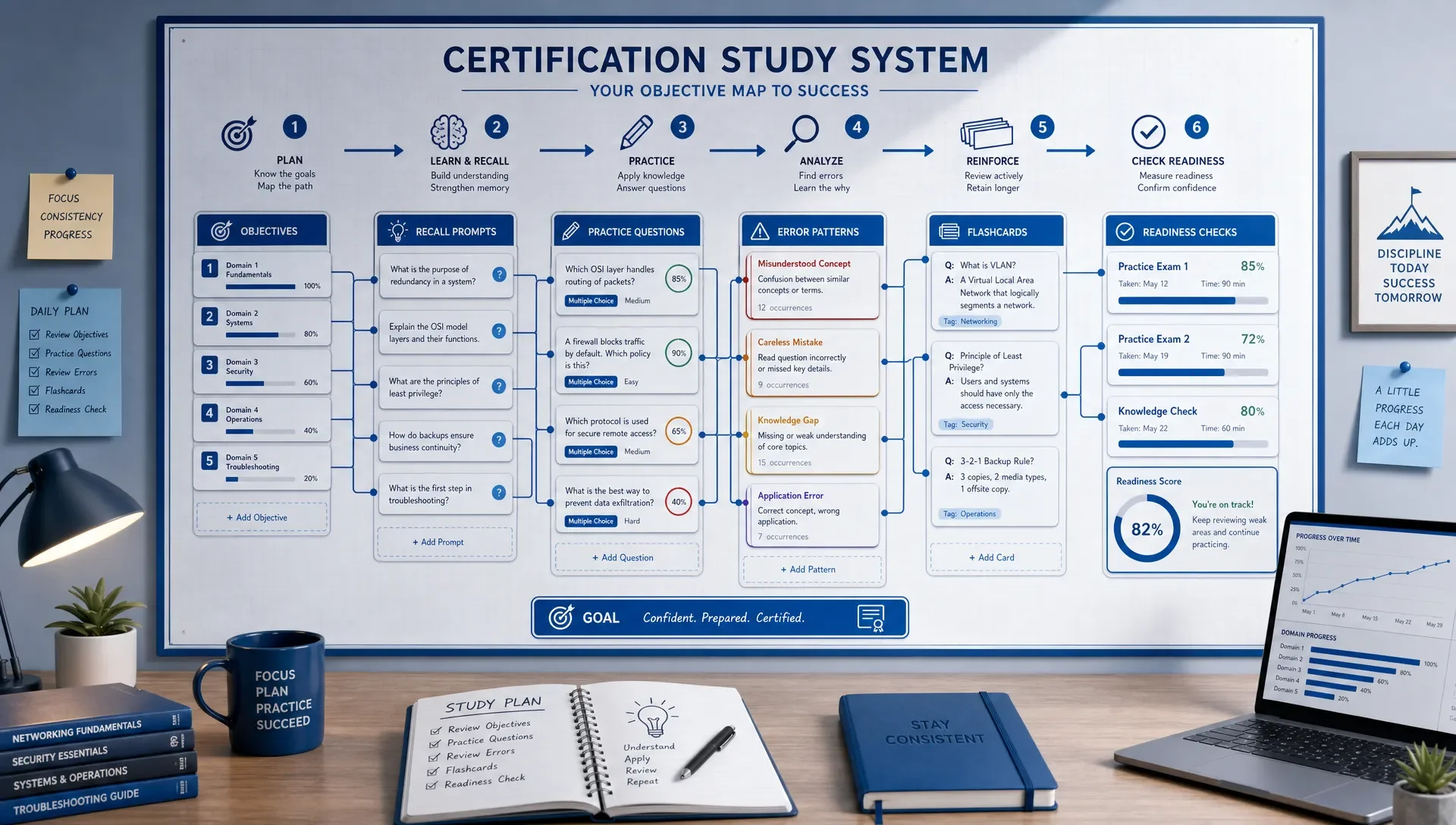
An effective exam prep system does four things: it maps the exam's content, forces retrieval practice before you feel ready, helps you fix weak areas fast, and tracks your readiness with real data instead of just guessing. If your current study method involves only watching lessons, rereading notes, and then cramming practice tests at the end, you're missing the crucial feedback loop that turns study time into higher scores.
This article outlines a clear structure: start with official exam objectives, break them into weekly goals, study each topic using closed-book recall, answer exam-style questions, review every mistake by objective, then revisit weak topics with spaced flashcards and mixed practice. That's the core system. We'll show you how to build it without overcomplicating your schedule.
Start With the Official Exam Objectives
Good exam preparation begins with the official blueprint, not just a book, course, or long playlist. Certification exams are developed from specific objectives, domains, task statements, and weighting. These documents clearly state what the test creator expects you to know.
For instance, Microsoft provides official skill outlines for exams like AZ-900 on Microsoft Learn. AWS maintains certification pages and exam guides through AWS Certification, and CompTIA posts exam objective information on its Security+ certification page. Your first step is to use these official sources to define your study scope.
Create a straightforward objective map with four columns:
| Column | What to write | Why it matters |
|---|---|---|
| Objective | The official topic or skill statement | Keeps your study plan aligned to the exam |
| What I must know | Terms, concepts, limits, models, commands, or services | Transforms vague topics into learnable items |
| What I must do | Scenario tasks, calculations, troubleshooting, or configuration choices | Prepares you for applied questions |
| Evidence of readiness | Practice results, flashcard accuracy, or explanation quality | Prevents false confidence |
Don't rewrite the entire exam guide. Instead, translate each objective into verifiable proof of understanding. If an objective requires you to understand cloud pricing, your proof might involve explaining cost drivers, choosing the right pricing model in a scenario, and recognizing how specific services impact billing.
If you want a more structured process for this initial step, MindMesh has a separate guide on how to turn official exam objectives into a study guide. Use that approach once, and your daily study decisions will become much clearer.
Build a Weekly Exam Prep Loop
A study system works best when every week follows the same learning cycle. While the topics change, the process remains consistent. This consistency is vital because it saves you energy from deciding how to study each night.
A strong weekly loop includes five parts:
- Learn the topic from an objective-aligned source.
- Recall it from memory without notes.
- Answer practice questions tied to that topic.
- Review misses and weak guesses immediately.
- Revisit the same material later through spaced repetition.
This isn't just a matter of productivity. The U.S. Department of Education's What Works Clearinghouse practice guide on organizing instruction and study to improve student learning recommends spacing out learning and using quizzes to boost retention. In a certification context, this means you shouldn't save practice questions until the very end. Questions are a key part of the learning process itself.
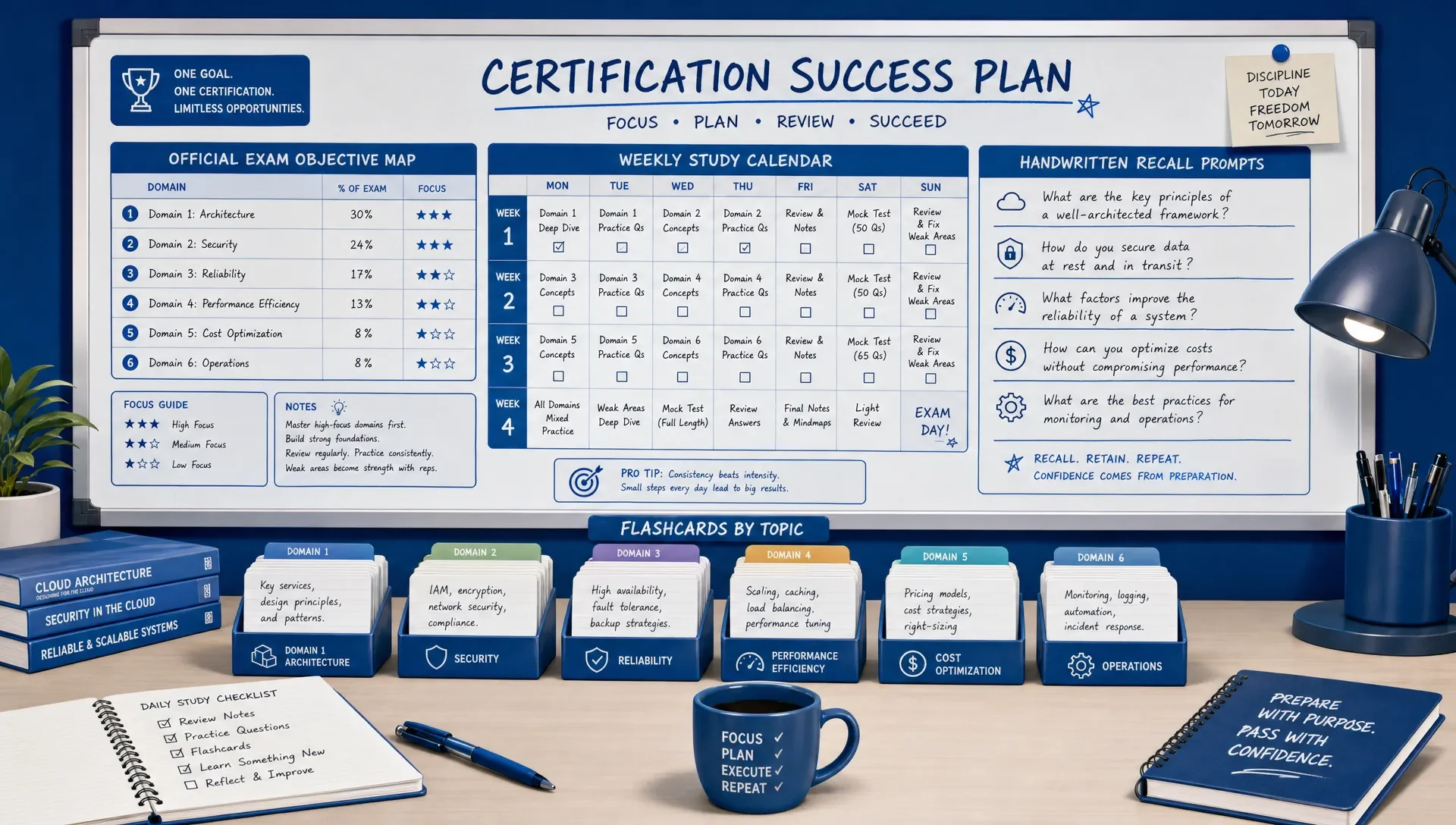
Here's a practical weekly structure for someone studying 6 to 8 hours per week:
| Day | Main task | Output |
|---|---|---|
| Monday | Study one objective group | Short notes and 5 to 10 recall prompts |
| Tuesday | Closed-book recall and flashcards | Updated flashcards for weak facts |
| Wednesday | Topic practice questions | Error log mapped to objectives |
| Thursday | Repair weak areas | Rewritten explanations and targeted review |
| Friday | Mixed practice from old and new topics | Timing and confidence notes |
| Weekend | Mini review or longer practice set | Readiness snapshot by domain |
If you have less time, keep the same sequence and reduce the volume. If you have more time, add more practice and review, not just more passive reading.
Turn Practice Questions Into a Feedback System
Practice questions aren't there to make you feel good. They exist to reveal the gap between recognition and recall. A learner who says, "I knew that," after reading an explanation often didn't truly know it well enough before seeing the answer.
To make practice effective, answer first, then review. Mark each question with three signals before you read the explanation:
| Signal | What it tells you | What to do next |
|---|---|---|
| Correct and confident | You likely understand the objective | Revisit later through mixed practice |
| Correct but guessed | You recognized clues but lack full control | Review the explanation and create a recall prompt |
| Incorrect | You have a knowledge, reasoning, or reading gap | Log the cause and repair the objective |
| Too slow | You may know it but can't retrieve it efficiently | Practice similar scenarios under light timing |
The most important step is identifying the cause of the mistake. Was it an unfamiliar term? A scenario detail you overlooked? A tempting distractor? A rule you only half-remembered? Each cause requires a different fix.
A classic peer-reviewed study by Roediger and Karpicke on test-enhanced learning found that taking tests after learning improved long-term retention more than additional study alone. For exam prep, the lesson is clear: don't treat testing as just a final assessment. Treat it as retrieval training.
MindMesh Academy practice questions include explanations, which helps you turn misses into specific study actions instead of just a raw score. If you're preparing for an entry-level cloud certification, an AWS Certified Cloud Practitioner practice exam can give you objective-aligned retrieval practice. For security learners, a CompTIA Security+ practice exam can help you test applied knowledge across domains.
For a more robust review process, use a repeatable practice test review process so every attempt generates better notes, stronger flashcards, and clearer next steps.
Use Flashcards for Recall, Not Recognition
Flashcards are powerful tools, but only if they compel you to retrieve information actively. A weak card might ask, "What is high availability?" allowing your brain to respond vaguely. A stronger card would ask, "In a cloud architecture scenario, what design choices improve high availability, and what tradeoff might each create?"
Good cards are short, specific, and directly tied to your mistakes or objectives. You don't need a card for every sentence in your notes. You need cards for facts, distinctions, procedural steps, and decision rules that you must retrieve quickly.
Consider these card types:
| Card type | Example prompt | Best for |
|---|---|---|
| Definition | What does least privilege mean? | Core vocabulary |
| Distinction | When would you choose option A instead of option B? | Similar services or concepts |
| Scenario | A user reports X under condition Y. What should you check first? | Troubleshooting and applied exams |
| Process | What are the steps to complete this task? | Procedures and configurations |
| Mistake card | Why was answer C wrong in this question? | Preventing repeat errors |
Spaced repetition keeps older topics fresh while you learn new ones. MindMesh Academy includes flashcards with spaced repetition, which helps you revisit concepts before they fade, preventing the need to cram them all again in the final week.
Track Readiness Before You Schedule the Exam
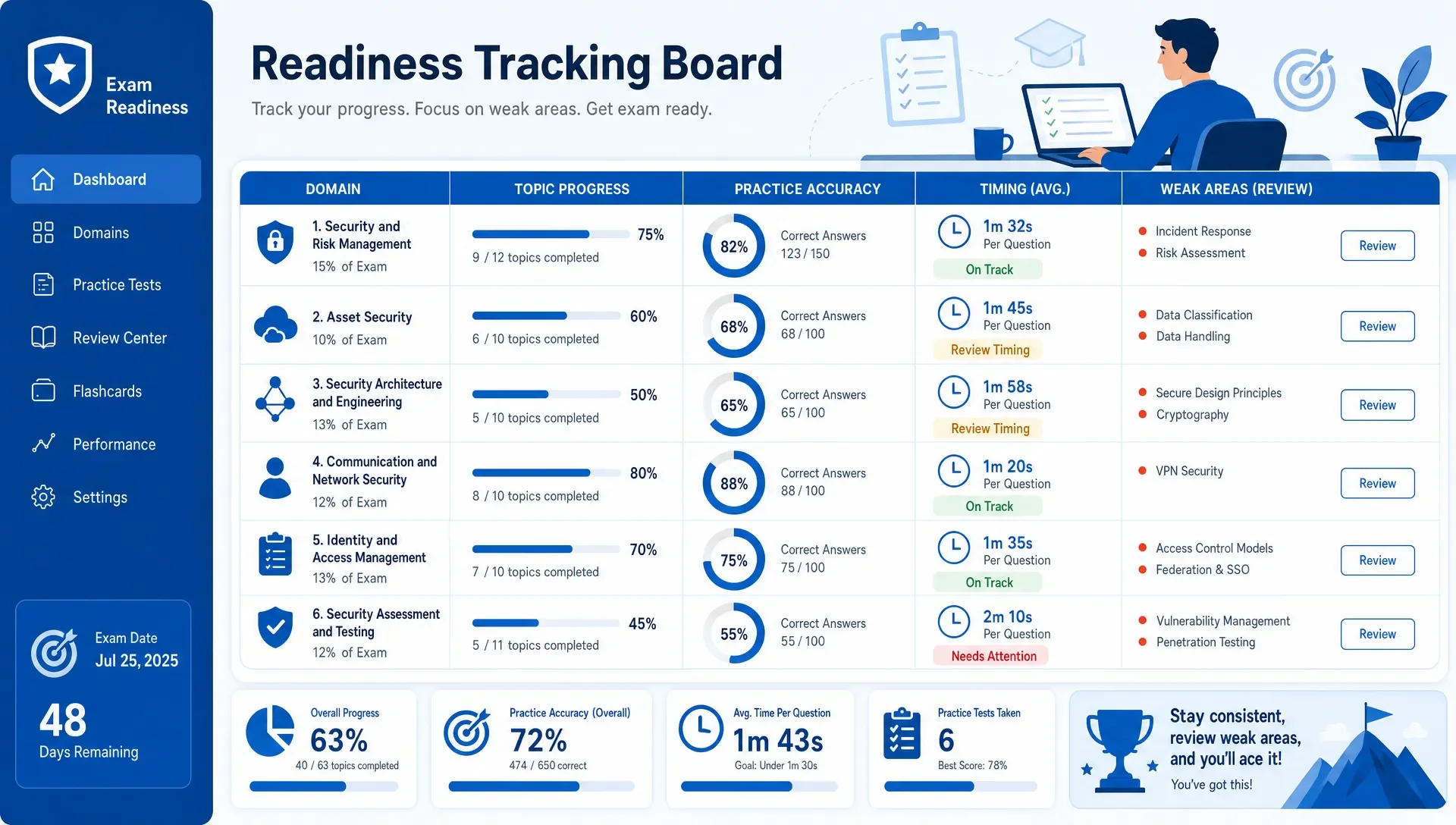
A single practice test score isn't enough to decide if you're truly ready. Scores can be misleading due to memorized questions, lucky guesses, or uneven topic coverage. A more accurate readiness check combines your score with consistency, timing, confidence, and objective coverage.
Use a readiness dashboard like this:
| Readiness signal | Ready enough | Needs more work |
|---|---|---|
| Objective coverage | You have studied and practiced every domain | One or more domains are mostly untouched |
| Practice accuracy | Scores are consistently near or above your target range | Scores swing widely between attempts |
| Confidence accuracy | Most confident answers are correct | You often feel sure and still miss |
| Timing | You finish with review time | You rush or leave items blank |
| Error pattern | Misses are scattered and explainable | The same objectives keep failing |
| Explanation quality | You can explain why right and wrong answers differ | You rely on answer memory or wording clues |
The best indicator isn't perfection; it's stability. You want to see weak areas shrinking, explanations becoming sharper, and mixed practice feeling less like starting over each time.
This is where readiness tracking becomes vital. MindMesh Academy tracks your mastery and readiness by topic, allowing your study plan to focus on what still needs work rather than what already feels comfortable. If you're starting with Microsoft fundamentals, an AZ-900 Microsoft Azure Fundamentals study guide can help you organize your learning by objectives before moving into heavier practice.
Example Exam Prep System for a Four-Week Timeline
Not every certification can be completed in four weeks, especially advanced exams like CISSP, PMP, or CCNA if you're new to the field. However, a four-week model is useful for illustrating how to sequence your work. You can stretch the same pattern over 8, 10, or 12 weeks for larger exams.
Week 1: Build the map and start core topics
Use the official objectives to create your topic map. Study the first major domain and create recall prompts as you go. At the end of each session, close your notes and write down what you remember. Then, check your accuracy.
Your goal in week 1 isn't speed. It's about building a solid foundation and proving you can explain the basics without staring at the source material.
Week 2: Add practice and error logging
Start topic-level practice. Don't wait until you've finished every domain. Begin with small sets, review them thoroughly, and classify your mistakes. Convert repeated errors into flashcards or concise explanation notes.
By the end of week 2, you should know which objectives are easy, which are shaky, and which you haven't touched yet.
Week 3: Mix topics and increase difficulty
This is often where many learners feel uncomfortable, which is a good sign. Mixed practice forces you to select the correct concept without knowing which chapter it's from. Add scenario questions, relevant performance-based formats, and timed sets.
Keep correcting your errors. If one objective consistently causes problems, don't take three more full practice tests hoping it will magically fix itself. Go back to the concept, rebuild your understanding, then test it again.
Week 4: Validate readiness and reduce noise
Use longer practice sets, review your timing, and focus on final weak areas. Avoid introducing a large new resource unless your objective map reveals a genuine gap. The final week is for retrieval, correction, and calibrating your confidence.
If your scores are stable and your explanations are strong, schedule or confirm your exam date. If your weak areas are concentrated in major domains, extend your study plan instead of rushing a poor attempt.
Common Exam Prep System Problems and Fixes
Most failed study plans aren't due to a lack of effort. They often fail because the system provides poor feedback. Here are common problems I observe when coaching certification candidates:
| Problem | What it looks like | Fix |
|---|---|---|
| Too much passive study | Hours of videos and notes, low recall | Add closed-book recall every session |
| Practice too late | First real test happens near exam week | Start small practice sets in week 1 |
| No error log | Same mistakes repeat | Track each miss by objective and cause |
| Flashcard overload | Hundreds of cards, low completion | Keep cards tied to objectives and misses |
| Fake readiness | High score on repeated questions | Use mixed sets and explain answers aloud |
| Weak timing | Knowledge exists but retrieval is slow | Practice under timed conditions gradually |
The solution is rarely to study everything again. The fix is to make your study loop more diagnostic. Ask yourself: What objective did I miss? Why did I miss it? What specific proof will show that I've repaired this weakness?
What to Put in Your Exam Prep System
Your system doesn't need to be elaborate; it just needs to be complete. Whether you use a notebook, a spreadsheet, or a dedicated platform, ensure these components are in place:
| System piece | Minimum requirement |
|---|---|
| Objective map | Every official domain and topic is visible |
| Study schedule | Weekly targets and review sessions are planned |
| Practice workflow | Questions are reviewed for reasoning, not just score |
| Error log | Misses are mapped to objectives and causes |
| Flashcards | Weak facts and decision rules are reviewed over time |
| Readiness tracker | Topic mastery and exam readiness are visible |
If one piece is missing, that's likely where your preparation will falter. For example, learners without an error log often feel they're practicing enough, but they don't know whether that practice is addressing their original weaknesses. Learners without a readiness tracker often over-study familiar topics simply because they feel productive.
A connected workflow prevents these issues. You learn an objective, practice it, review any misses, create a flashcard, revisit it later, and update your readiness. That's the complete loop.
Frequently Asked Questions
How long should an exam prep system run before a certification exam? It depends on the exam's difficulty and your existing background. For an entry-level exam, a few focused weeks may be sufficient if you already know the basics. For advanced certifications, plan a longer schedule and maintain the same weekly loop.
Should I take a full practice exam before studying? A short diagnostic test can help you understand the scope, but don't let a low early score discourage you. Use it to identify key domains, then move into objective-based study and smaller practice sets.
How many practice questions should I do per day? Quality is more important than sheer volume. Ten deeply reviewed questions can teach you more than fifty rushed ones. Increase volume as your foundation improves, but always review mistakes before tackling more questions.
Are flashcards enough for exam prep? No. Flashcards are excellent for recall, definitions, distinctions, and decision rules. However, you still need scenario practice, objective review, timing work, and the ability to explain concepts to prepare for applied exam questions.
How do I know if I'm ready for the real exam? Look for consistent practice performance, strong explanations for both correct and incorrect answers, good timing, and fewer repeated mistakes by objective. If your results depend on encountering familiar questions, you're not fully prepared yet.
What should I do in the final week before the exam? Focus on mixed practice, spaced review, timing drills, and addressing known weak areas. Avoid completely overhauling your study plan or adding a large new resource unless you've identified a clear, critical objective gap.
Build Your Certification Prep Workflow With MindMesh Academy
If you want to bring structure to your exam preparation, building your study loop in one place makes a huge difference. MindMesh Academy offers structured study guides aligned with exam objectives, practice questions with detailed explanations, and readiness tracking by topic across many certification paths.
Choose your certification, map out the objectives, and start working the system. Our goal is to help you understand exactly what you're learning, where your gaps are, and when you're well-prepared for your exam. Start building a strong foundation for your Project Management Professional certification by exploring our PMP practice exam.

Written by
Alvin Varughese
Founder, MindMesh Academy
Alvin Varughese is the founder of MindMesh Academy and an enterprise architecture leader. An electrical engineer by training, he moved from factory automation in South Africa to cloud architecture at GE Appliances and Humana (Fortune 50), and holds 20 professional certifications including AWS Solutions Architect Professional, Azure DevOps Engineer Expert, and Microsoft Agentic AI Business Solutions Architect. He built MindMesh Academy after interviewing too many highly certified candidates who couldn't answer basic questions: the goal is prep that makes you better at the job, not just able to pass the exam.