
Study Help for Busy People Preparing After Work
Study Help for Busy People Preparing After Work
After work, your best study strategy isn't a bigger planner. It's a focused plan that tells you exactly what to do, even when your energy is low. Start with 45 to 75 minutes of focused work, rotate between learning, recall, and review, and stop judging your progress by how long you sat at your desk.
If you're preparing for an IT, cloud, cybersecurity, or project management certification after a long day, use this rule tonight: one topic, one active task, one quick check. Read one exam objective, answer practice questions on that objective, then write down what you missed. This approach beats three tired hours of rereading notes.
Why Study After Work Needs a Different Approach
Studying after work isn't the same as studying on a free Saturday. You're dealing with decision fatigue, unfinished tasks, family responsibilities, commute stress, and a limited attention window. A study plan that assumes you can consistently study deeply for two hours every night will often fail by Wednesday.
The goal isn't to remove all friction. It's to make the next study action clear enough that you can begin even when you don't feel sharp. This means your weeknight sessions should be short, specific, and active.
Busy learners often make one of two common mistakes. Some rely on passive study methods because they feel easier after work, such as highlighting, watching video lessons, or simply rereading a study guide. Others try to cover too much in one night, then skip the next three nights because they're drained. Both patterns lead to the same problem: inconsistent retrieval of information.
A better after-work plan protects consistency. You should know which exam objective you're studying, which practice set you'll use, and what counts as "done" before you even sit down. If scheduling is a challenge, MindMesh Academy offers a guide on time management strategies for students that can help you build a weekly routine around your work and personal commitments.
How Many Study Hours You Need Per Week
There's no universal number of study hours that fits every exam or every learner. Your existing background matters. A network administrator preparing for CCNA starts in a different place than someone seeing subnetting for the first time. Similarly, a project manager with years of delivery experience will approach PMP certification differently than someone changing careers.
Still, busy people need a planning range. For most certification prep, the useful target isn't daily perfection. It's a repeatable weekly total you can sustain without sacrificing sleep.
| Exam situation | Weekly target | Best after-work pattern | Best weekend use |
|---|---|---|---|
| Fundamentals or entry-level exam | 4-6 focused hours | 3 short weeknight sessions | 1 longer review block |
| Broad associate-level or IT core exam | 6-9 focused hours | 4 short weeknight sessions | 1 practice and review block |
| Advanced, professional, or high-stakes exam | 8-12 focused hours | 4-5 short weeknight sessions | 1-2 deeper scenario blocks |
| Final two weeks before exam day | 7-12 focused hours | Short daily recall and review | Timed practice plus error review |
Treat these as starting points, not rigid rules. If your practice scores are improving and you can explain your missed questions, your plan is working. If you're putting in hours but repeating the same mistakes, you don't primarily need more time; you need better feedback.
The Best After-Work Study Sessions to Rotate
After work, instead of asking "What should I study?" ask "What type of study session do I have the energy for?" A complete certification plan needs three types of sessions: learning new material, retrieving information, and repairing weaknesses.
A significant review in Psychological Science in the Public Interest highlighted that practice testing and distributed practice are highly effective across many learning conditions. In simpler terms, you remember more when you repeatedly recall information from memory over time, rather than trying to cram it all at once.
Use this rotation to keep your study plan balanced:
| Session type | Best length after work | What you do | What success looks like |
|---|---|---|---|
| Learn | 25-45 minutes | Study one exam objective, concept, or procedure | You can summarize it without notes |
| Retrieve | 20-40 minutes | Answer practice questions or flashcards without looking first | You know what you truly remember |
| Repair | 20-45 minutes | Review missed questions, rewrite weak notes, retry problems | You can explain why the right answer is right |
This mix is important because certification exams rarely reward recognition alone. You need to identify what a question is asking, eliminate traps, apply the correct concept, and choose the best answer under time pressure.
For example, if you're preparing for cloud fundamentals, a short evening block with an AWS Certified Cloud Practitioner practice exam can quickly show whether you understand services, billing, security, and architecture concepts well enough to apply them. If you're preparing for cybersecurity, targeted drills with a CompTIA Security+ practice exam can reveal weak areas like threats, architecture, operations, or governance before they become exam-day surprises.
A Weeknight Study Routine You Can Use Tonight
A good routine should be simple enough to follow on a normal workday. You don't need a perfect environment; you need a repeatable sequence that gets you into active learning quickly.
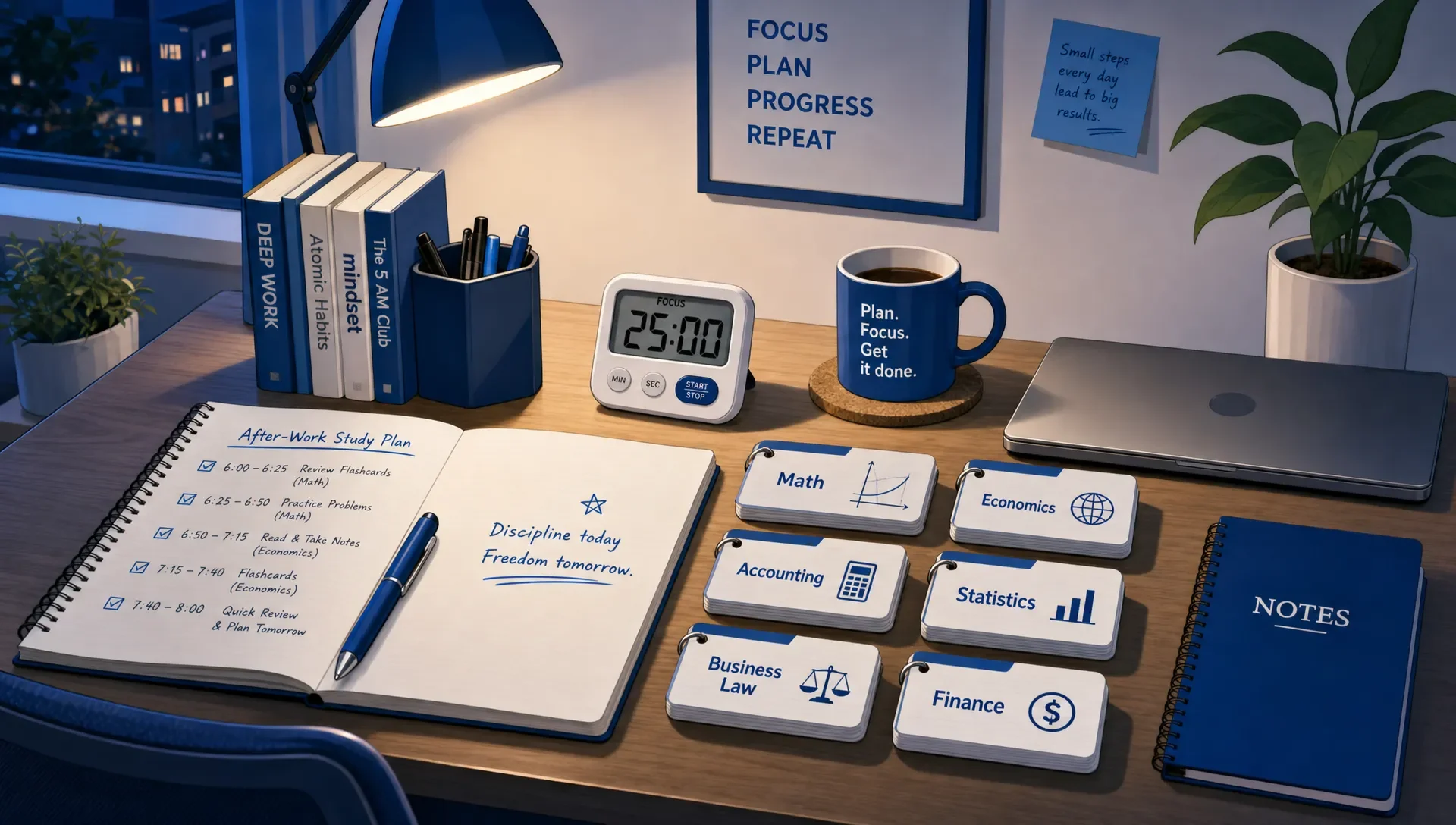
Try this 60-minute after-work study block:
- 5 minutes: Clear your desk, open only the resources you need, and choose one exam objective.
- 10 minutes: Review flashcards or notes from previously identified weak areas.
- 25 minutes: Study one small concept or answer a focused practice set.
- 15 minutes: Review explanations and write down why you missed each question.
- 5 minutes: Choose tomorrow's objective before you stop.
The final five minutes are more critical than they might seem. When you decide tomorrow's task before ending today's session, you eliminate the "startup problem." You won't waste your first 20 minutes tomorrow deciding whether to study identity and access, networking, risk management, service operations, or project scope.
If 60 minutes is too much on certain nights, shrink the plan instead of skipping it entirely. A 20-minute session can still be useful if it includes active recall. Ten flashcards, five practice questions, or a review of one missed question is better than breaking the chain completely.
On heavy workdays, your "win condition" might be simple: show up, retrieve something, and leave a clear trail for the next session. That still counts as progress.
What to Study When You Are Tired
Your energy level should guide your task selection. Busy learners often waste their best focus on easy review and save difficult application questions for late at night. Try to reverse that pattern when you can.
Use high-energy time for tasks that require deep reasoning. Use low-energy time for tasks that keep your memory system active without demanding complex problem-solving.
| Your energy level | Best study task | Avoid this task |
|---|---|---|
| High | New concepts, labs, scenarios, performance-based questions | Passive rereading only |
| Medium | Practice questions, objective review, explanation review | Jumping across too many topics |
| Low | Flashcards, error log cleanup, light recall, planning tomorrow | Starting a brand-new dense topic |
This is also where spaced repetition proves its value. Flashcards aren't just for definitions. They can help you remember ports, command syntax, formulas, process groups (like those in ITIL or PMP), cloud service purposes (AWS, Azure), security controls, and decision rules. The key is to answer first, then check. Looking at the answer and thinking, "I knew that," is not the same as actively retrieving the information.
If you're too tired to learn a new topic, don't force it. Instead, review yesterday's missed questions and write one sentence for each: What clue did I miss? What concept did I confuse? What rule would help me answer this next time?
That small repair habit compounds. Over time, your error log becomes a personalized study guide built from your actual weaknesses.
How to Use Practice Questions After Work
Practice questions aren't just for generating scores. They are diagnostic tools. If you only take a quiz, look at the percentage, and move on, you're missing out on the most useful part of the session.
After work, keep practice sets small enough that you still have energy to review them thoroughly. For most weeknights, 10 to 20 questions is plenty. The review should take at least as long as the answering process.
For each missed question, identify the cause:
- You didn't know the core concept.
- You knew the concept but missed a keyword or detail in the question.
- You confused two similar options.
- You rushed and ignored key parts of the scenario.
- You understood the answer only after reading the explanation.
That last one is common. It feels like learning, but it often means the knowledge wasn't truly retrievable yet. Make sure to put that concept back into flashcards or a short practice set later in the week.
Save full-length timed tests for specific checkpoints in your study plan. Taking one too early can discourage you and waste a high-value assessment. Taking one too late leaves no time to fix identified weaknesses. If you're unsure where to place full practice exams, consider a guide on when to take a practice test in your study plan to time them more strategically.
How to Build a Study Calendar Around Your Job
Start with your exam date only if it's already scheduled. If it's not scheduled, begin by assessing your weekly availability and build from there. A calendar that ignores your real life isn't a plan; it's wishful thinking.
Use exam objectives as the backbone of your calendar. Most major certification vendors publish objective domains, which clearly outline what the exam is permitted to test. The Institute of Education Sciences also recommends spacing learning over time in its practice guide on organizing instruction and study, a principle that aligns well with certification preparation because objectives can be revisited in cycles.
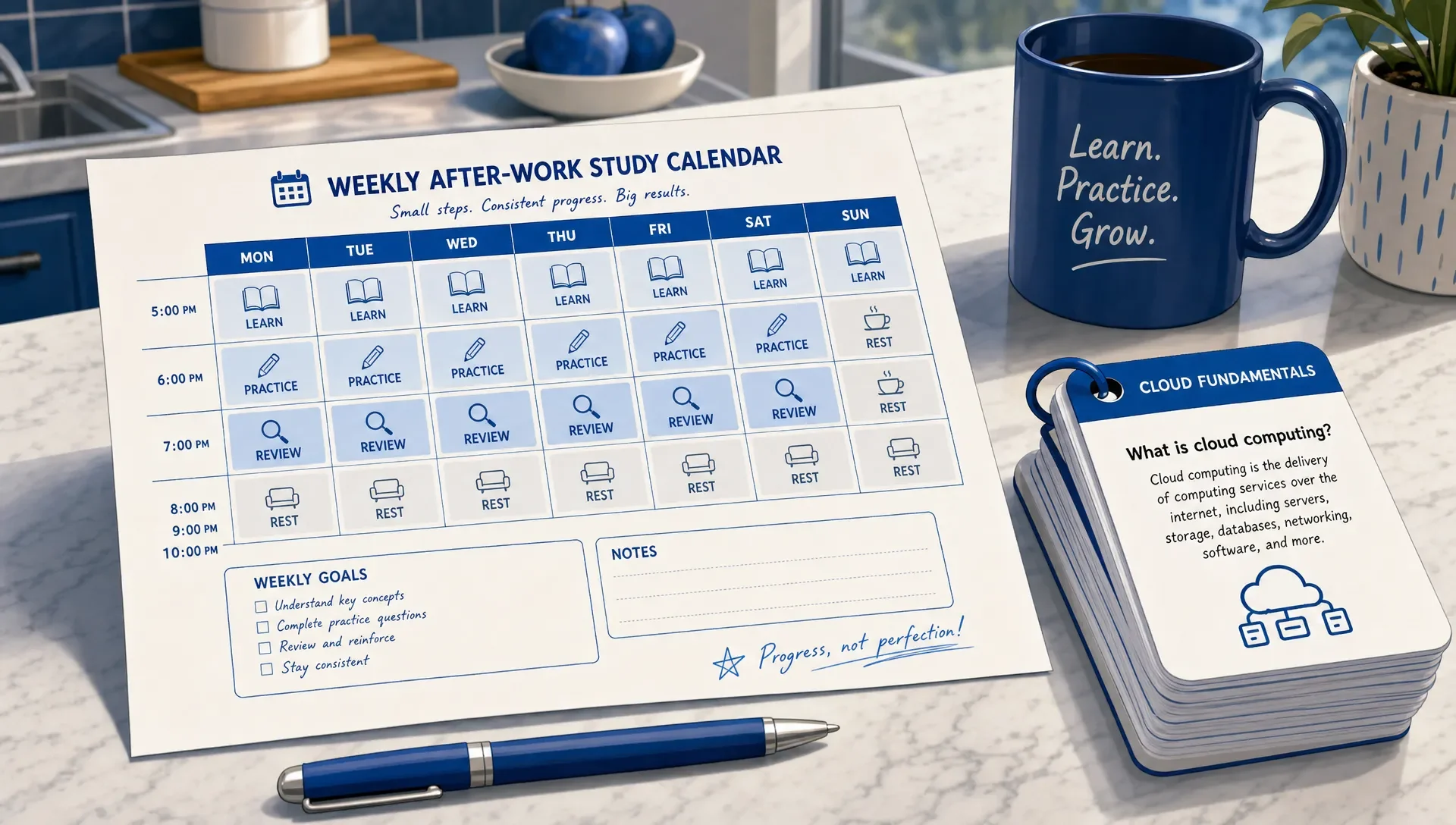
A simple calendar could look like this:
| Day | Session focus | Example task |
|---|---|---|
| Monday | Learn | Study one objective and summarize it |
| Tuesday | Retrieve | Answer focused questions on Monday's topic |
| Wednesday | Repair | Review misses and make flashcards |
| Thursday | Learn | Start the next objective |
| Friday | Light review | Flashcards or short error log review |
| Saturday | Deep practice | Longer mixed set or scenario practice |
| Sunday | Reset | Plan next week and rest |
Notice that rest is an integral part of the plan. If you schedule seven study nights but only complete three, you'll feel behind, even if three was the realistic number all along. A better plan includes buffer time so one late meeting doesn't derail your entire week.
For harder exams, use study cycles instead of linear coverage. Study a domain, test your knowledge, repair any weaknesses, then revisit it later. Don't wait until you've covered every objective to start retrieval practice. You need feedback early enough to adjust how you study.
Study Tools That Make Short Sessions Count
Busy learners need tools that reduce setup time and clearly show their weaknesses. A pile of disconnected notes, random PDFs, and unreviewed quizzes creates friction. When you only have an hour after work, you shouldn't spend 15 minutes finding your place.
Look for study help that supports a connected workflow:
- Study guides organized by exam objectives.
- Practice questions with detailed explanations.
- Flashcards that support spaced repetition.
- Topic-level progress tracking.
- Weakness-based practice so review time goes where it matters most.
- Readiness tracking so you know when you're closer to exam day.
MindMesh Academy is designed around this kind of workflow, offering objective-based study guides, expert-reviewed content, practice questions and explanations, spaced repetition flashcards, adaptive weakness-based practice, and readiness tracking across many certification paths.
The point isn't to add more resources. It's to ensure every short session produces concrete evidence. What did you learn? What can you retrieve from memory? What still breaks under practice conditions? Once you can answer those questions, your after-work study plan becomes much easier to adjust.
Frequently Asked Questions
How can I study after work when I'm exhausted? Lower the size of the session, not the quality. Do 20 to 30 minutes of active recall, such as flashcards, missed-question review, or a small practice set. Save dense new topics for nights when you have more energy.
Is studying every night better than longer weekend sessions? A mix of short weeknight sessions plus one dedicated weekend block usually works better than relying only on the weekend. Spacing out your study provides more opportunities to retrieve and reinforce information before you forget it.
What should I do if I miss several study days? Don't restart your entire plan. Review your last weak areas, choose your next objective, and resume with a short session. Add a buffer block on the weekend if needed, but avoid punishing yourself with an unrealistic catch-up marathon.
How long should an after-work practice session be? For most nights, 10 to 20 questions is sufficient if you review every explanation carefully. A small practice set with deep review is more useful than a large set you rush through without truly learning from mistakes.
When should I schedule my certification exam? Schedule your exam when your practice performance is stable, your weak domains are shrinking, and you can confidently explain why answers are correct or incorrect. Don't rely solely on a single good practice score as your only signal.
Do I need different study help for different certification exams? Yes. While the general routine can remain similar, the specific tasks should match the exam's focus. Cloud exams often require service comparison and scenario judgment. Security exams may require control selection and risk reasoning. Project management exams typically demand situational decision-making.
Start Your After-Work Prep With a Smaller Plan
If you're busy, don't wait for a "perfect" study season to begin. Pick one certification objective, schedule three short sessions this week, and make each session active. Learn a little, retrieve it, repair what broke, and repeat.
When you're ready to organize your learning, MindMesh Academy offers structured resources to keep your study guides, practice questions, flashcards, and readiness signals connected. Discover how to create a calmer, more effective study plan tonight by exploring our range of certification programs.

Written by
Alvin Varughese
Founder, MindMesh Academy
Alvin Varughese is the founder of MindMesh Academy and an enterprise architecture leader. An electrical engineer by training, he moved from factory automation in South Africa to cloud architecture at GE Appliances and Humana (Fortune 50), and holds 20 professional certifications including AWS Solutions Architect Professional, Azure DevOps Engineer Expert, and Microsoft Agentic AI Business Solutions Architect. He built MindMesh Academy after interviewing too many highly certified candidates who couldn't answer basic questions: the goal is prep that makes you better at the job, not just able to pass the exam.