Start Studying With a Plan You Can Keep
Start Studying With a Plan You Can Keep
To start studying and keep your momentum, make three key decisions before you open any study resource: define your current objective, schedule your next session, and decide how you'll confirm you've learned the material. A sustainable plan isn't the most ambitious one. It's the one resilient enough to handle work, family, low energy, and even a missed day without collapsing.
For certification exams, this means linking every study block to official exam objectives, practicing recall early, and reviewing mistakes before adding new content. You don't need a flawless calendar. Instead, aim for a repeatable pattern that clarifies your tasks for today and what to do next if a session doesn't go as planned.
How to Start Studying With a Plan You Can Keep
The easiest way to make exam preparation harder than it needs to be is by gathering every possible resource upfront. A more effective approach is to define a small study unit first: a single domain, an objective, or a specific skill statement from the official exam outline. Certification vendors, like AWS with their certification exam pages and Microsoft with the AZ-900 study guide, provide these outlines.
Once you've identified your objective, select one learning activity and one proof activity. A learning activity could be reading a focused section of a study guide. The proof activity should require you to retrieve the concept, apply it, or explain it without consulting your notes.
| Planning choice | Weak plan | Keepable plan |
|---|---|---|
| Scope | "Study cloud today" | "Review shared responsibility model" |
| Time | "Study for a few hours" | "25 minutes after dinner" |
| Proof | "I read the chapter" | "I answered 12 questions and reviewed misses" |
| Recovery | "Catch up later" | "Do the 10-minute minimum session tomorrow" |
Many people start studying too broadly here, measuring effort by pages covered. This often leads to surprise when practice questions reveal knowledge gaps. Focusing on narrower objectives makes your progress clear and simplifies review.
Choose the Next Objective Before the Next Resource
A study resource is only truly useful when it aligns with your immediate objective. If you're preparing for AWS Certified Cloud Practitioner, avoid switching between billing, security, and deployment models within a single short session, unless you're intentionally doing mixed review. Always pick your objective first, then choose the resource that best explains or tests it.
MindMesh Academy's study guides are organized by exam objectives, streamlining this planning approach. For example, as you work through foundational cloud concepts, the AWS Certified Cloud Practitioner practice exam helps you verify your ability to apply what you've just reviewed.
A simple rule applies: if you can't name the objective, don't study it yet. This prevents your study plan from becoming an unorganized pile of tabs, PDFs, and half-finished videos.
Set a Weekly Study Budget You Can Repeat
Most study plans fail because they assume every week will be your most productive. Instead, build your schedule around your typical week. If you can add extra study time, that's a bonus, but your core plan should be manageable enough to repeat even when you're busy.
| Available time | Recommended weekly plan | Best use of each session |
|---|---|---|
| 2 hours | Four 30-minute sessions | One concept, a few questions, quick review |
| 4 hours | Four 45-minute sessions plus one review block | Learn, practice, review mistakes |
| 6 hours | Five 60-minute sessions plus a mixed quiz | Cover new objectives and revisit weak ones |
| 8+ hours | Four deep sessions plus two review sessions | Add scenarios and performance-based practice |
Starting your study with a realistic time budget protects your consistency. A two-hour weekly plan you actually follow is more effective than a six-hour plan that only works during a quiet week.
Plan Around Energy, Not Just Time
A 45-minute study session after a draining workday differs significantly from one on a Saturday morning. Reserve your high-energy blocks for challenging topics, hands-on labs, scenario questions, or new material. Use low-energy times for flashcards, reviewing mistakes, or short quizzes.
If you typically study after work, minimize the friction to start. Before your day begins, add the objective, resource, and first task to your calendar note. For more details on protecting study time when your schedule is packed, read our article on study help for busy people preparing after work.
Use a Session Structure That Prevents Rereading
Rereading feels productive, largely because it's comfortable. However, it often falls short by not forcing active recall. A 2013 review in Psychological Science in the Public Interest by Dunlosky and colleagues rated practice testing and distributed practice as highly effective learning techniques, outperforming common habits like rereading and highlighting. You can access the primary journal article here: Improving Students' Learning With Effective Learning Techniques.
If your study sessions primarily involve rereading notes, introduce retrieval practice earlier. Even a short session can effectively incorporate learning, recall, and correction.
| Session part | Time | What to do |
|---|---|---|
| Set the target | 2 minutes | Name the exam objective and success check |
| Learn or review | 15 minutes | Read a focused section or review a short explanation |
| Retrieve | 15 minutes | Answer questions or write the answer from memory |
| Correct | 10 minutes | Review missed questions and update notes |
| Schedule review | 3 minutes | Mark what to revisit next session |
This structure prevents you from spending an entire block solely consuming content. For more examples of recall-based preparation, MindMesh Academy's guide to test prep methods that actually stick explains active recall, spaced repetition, and mistake review in clear terms.
Build the Plan Around Proof, Not Hours Logged
While hours matter, they're a weak indicator of readiness on their own. You need tangible proof that you can recognize a concept, apply it in a scenario, and explain why a wrong answer is incorrect. This is particularly crucial for certifications that test judgment, not just memorized definitions.
Once you start studying with proof in mind, your plan naturally shifts. A completed chapter isn't the finish line. The true goal is answering questions related to that objective, understanding the explanations, and reducing repeat mistakes over time.
MindMesh Academy supports this workflow with practice questions and explanations, spaced repetition flashcards, adaptive weakness-based practice, progress tracking by topic, and readiness tracking. If you're preparing for Microsoft fundamentals, the AZ-900 study guide can help you systematically work through exam objectives.
For those studying security, the same proof-first approach holds true. A CompTIA Security+ practice exam becomes most valuable after you've reviewed an objective and want to test your ability to apply it under exam-like pressure.
Add Catch-Up Rules Before You Fall Behind
A study plan without recovery rules can turn a single missed day into a complete reset. Decide now what steps you'll take when you miss a session, score poorly on a quiz, or realize you've underestimated a topic.
Keep recovery rules simple: never try to make up for missed study time with a massive catch-up block unless you genuinely have the energy. Instead, perform the smallest useful action to keep your study chain going. The next day, you could restart with a 10-minute review of missed questions, a short flashcard set, or one objective summary.
Use these rules to prevent the plan from collapsing:
- If you miss one session, do the next planned session instead of doubling it.
- If you miss two sessions, pause new material and review your weakest objective.
- If you score poorly twice on the same topic, return to the study guide before taking another quiz.
- If you're tired, switch from new content to flashcards or explanation review.
These rules ensure your plan stays flexible without becoming vague.
Adjust the Plan When the Exam Date Is Close
As your exam date approaches, resist the urge to add more study resources. Instead, focus your plan on high-value activities: addressing repeated mistakes, reviewing high-weight domains, revisiting official objectives, and practicing scenario-based questions. If time is limited, our guide on things to study first when your exam date is close can help you prioritize effectively.
Use a 14-Day Starter Plan to Build Momentum
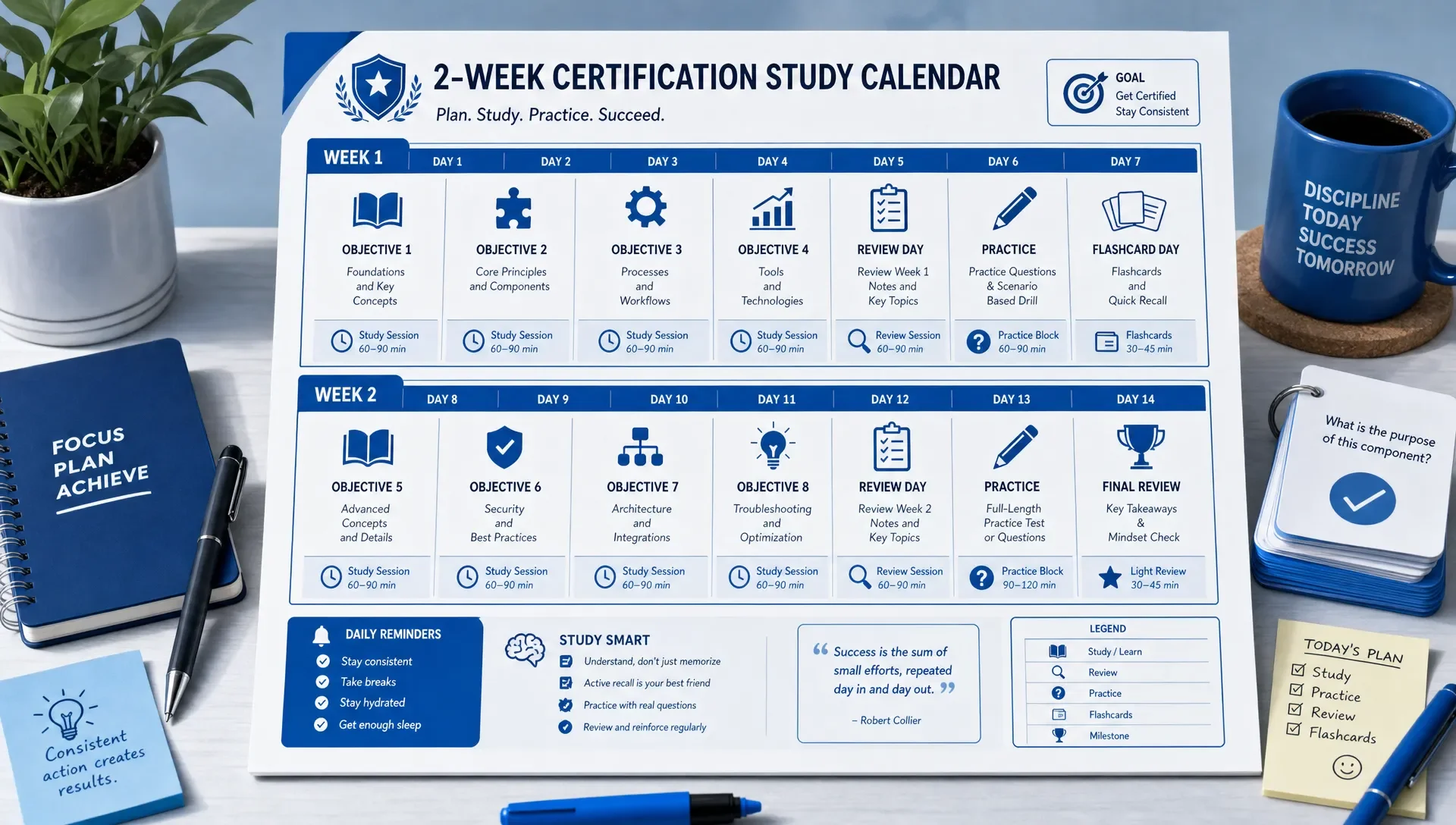
A two-week starter plan provides enough structure to build momentum without requiring you to predict your study needs for the next three months. Use it to gauge your pace, identify weak areas, and determine if your weekly time budget is realistic.
| Day | Main action | Proof of progress |
|---|---|---|
| 1 | Choose the exam and download or open the official objectives | You can name the domains and your first objective |
| 2 | Study one small objective | You can explain it without notes |
| 3 | Answer practice questions on that objective | You reviewed every missed explanation |
| 4 | Review flashcards or mistake notes | You recalled key terms without looking |
| 5 | Study the next objective | You wrote a short summary from memory |
| 6 | Mixed review of days 2 to 5 | You identified one weak topic |
| 7 | Light review or rest | You planned next week's first session |
| 8 | Study a new objective | You answered targeted questions afterward |
| 9 | Review the weak topic from day 6 | You corrected the reason for the miss |
| 10 | Practice scenario-based questions | You explained why each distractor was wrong |
| 11 | Study a new objective | You added only the notes you need for recall |
| 12 | Mixed quiz | You tracked misses by topic |
| 13 | Flashcards and explanations | You reduced repeat mistakes |
| 14 | Review results and adjust the schedule | You know what to keep, cut, or repeat |
Whether you're starting to study for AWS, Azure, CompTIA, Cisco, PMI, or another certification, this starter plan works because it relies on objectives and feedback, not just motivation. After two weeks, your next step isn't to create an entirely new plan. Instead, keep what worked, discard what didn't, and increase practice only where your data suggests it's needed.
Know When Your Plan Is Working
A sustainable study plan should offer more meaningful signals than simply, "I studied a lot." Look for evidence that your recall is improving and your mistakes are becoming more precise. Early in preparation, missed questions might seem random. Later, you should be able to articulate, "I understand the definition, but I struggle with scenario questions asking when to apply it."
Positive indicators include steadier quiz scores by topic, fewer repeated mistakes, quicker explanations in your own words, and stronger performance on mixed practice. Conversely, negative signs involve constantly switching resources, avoiding practice questions, only reviewing comfortable topics, and lacking a record of what you've missed.
This is where readiness tracking truly matters. MindMesh Academy offers a connected study workflow with study guides, practice questions, flashcards, adaptive practice, and progress tracking by topic. This ensures your plan can adapt to your actual weak areas, not just your mood.
Frequently Asked Questions
How do I start studying when I feel overwhelmed? Select one official exam objective and dedicate 25 minutes to studying it. Afterward, answer a small set of questions or write a brief explanation from memory. Overwhelm often diminishes when the task is specific enough to get started.
How many hours should I study each week for a certification exam? Aim for a number of hours you can consistently maintain. For many busy professionals, 2 to 6 focused hours per week is more realistic than an ambitious, weekend-only plan. Increase your study time only after successfully sticking to your base schedule for two weeks.
Should I read everything before taking practice questions? No. Use practice questions early, but strategically. After learning a small objective, answer targeted questions and review their explanations. Save larger, mixed exams for later readiness checks.
What should I do if I keep missing the same topic? Pause taking random quizzes on that topic. Go back to the objective, review the explanation, write the concept in your own words, and then attempt a smaller, targeted question set.
How do I keep studying after I miss a day? Don't restart your entire plan. Simply complete your next planned session or a brief 10-minute recovery session. A missed day only becomes a problem if you allow it to extend into a missed week.
Start With a Plan Small Enough to Keep
You don't need to wait for a free weekend or the perfect notebook. Choose one certification path, select a single objective, and make today's session small enough that you'll actually finish it.
If you're looking for a structured way to put these principles into practice, MindMesh Academy provides exam-objective study guides, practice questions with detailed explanations, and readiness tracking across over 30 certification paths. Start with one objective today, and let your results guide your next steps. For those beginning their journey into cloud fundamentals, you can build your AZ-900 foundation with our practice exam.

Written by
Alvin Varughese
Founder, MindMesh Academy
Alvin Varughese is the founder of MindMesh Academy and an enterprise architecture leader. An electrical engineer by training, he moved from factory automation in South Africa to cloud architecture at GE Appliances and Humana (Fortune 50), and holds 20 professional certifications including AWS Solutions Architect Professional, Azure DevOps Engineer Expert, and Microsoft Agentic AI Business Solutions Architect. He built MindMesh Academy after interviewing too many highly certified candidates who couldn't answer basic questions: the goal is prep that makes you better at the job, not just able to pass the exam.