Things to Study First When Your Exam Date Is Close
How to Prioritize Your Study When Your Exam Date Is Close
If your exam date is close, the first things to study are the areas most likely to boost your score. This includes official exam objectives you still miss, high-weight domains, scenario or performance-based tasks, questions you got wrong or guessed on, and small memory items that can unlock multiple answers. Don't try to reread every chapter. While that might feel productive, it often just hides weak spots instead of fixing them.
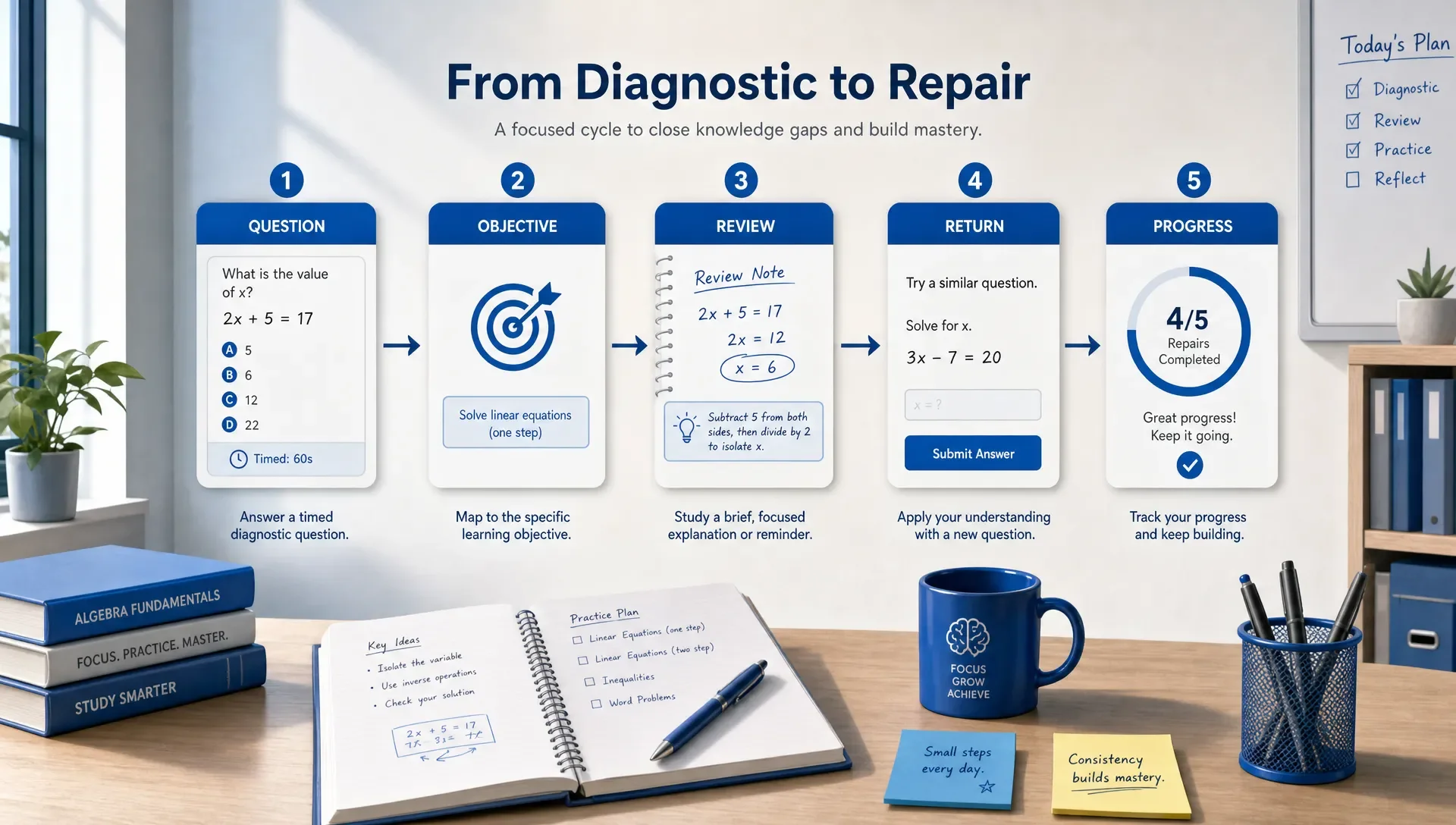
Start with evidence. Take a short, timed diagnostic practice test today. Map every missed question to a specific exam objective, then spend your remaining time drilling the patterns that cost you points. Your goal isn't to become an expert in every detail before test day. Your goal is to turn uncertain objectives into answerable questions under exam conditions.
What to Study First When Time Is Short
When you have limited time, your study order matters more than the sheer number of resources you use. A good last-stretch plan prioritizes score impact over comfort. This means you should focus on topics that appear in the exam blueprint, show up in your missed questions, or require application rather than simple recognition.
Use this priority order as your filter before opening another video, chapter, or PDF.
| Priority | Study first | Why it matters when time is short | What to do now |
|---|---|---|---|
| 1 | Missed exam objectives | These are proven gaps, not guesses about what you don't know | Match each missed question to one objective and review that objective |
| 2 | High-weight domains | A weak major domain can drag down your whole score | Spend more time where the official blueprint puts more emphasis |
| 3 | Scenario and performance tasks | These questions test application, not memorized definitions | Practice realistic troubleshooting, configuration, or decision questions |
| 4 | Repeated mistake patterns | One bad habit can affect many questions | Label mistakes as knowledge, wording, timing, or application errors |
| 5 | Must-know facts | Some facts help you eliminate answers quickly | Use flashcards for ports, formulas, acronyms, commands, phases, and terms |
| 6 | Exam timing and format | Knowing content isn't enough if you run out of time | Do at least one timed set and practice flagging questions |
This order works because it removes the biggest source of last-minute panic: vague studying. If you only think, "I need to study networking," your brain has no clear next action. If you think, "I need to review subnetting question types I missed and then do 15 timed questions," you have a concrete plan.
Start With Official Exam Objectives, Not Random Chapters
Official objectives are the closest thing you have to a map of what the exam can test. Certification vendors publish exam guides, objective domains, or skill outlines so candidates know the scope. AWS, for example, provides official AWS Certification prep resources that point learners toward exam guides, sample questions, and preparation materials.
When your exam is close, don't study from the front of a book to the back. Study by objective. Put a mark next to each objective using three labels: confident, shaky, or weak. Confident objectives only need light practice. Shaky objectives need questions and explanation review. Weak objectives need a short concept review followed by immediate retrieval practice.
For cloud fundamentals, this objective-based approach is especially useful because the exam often mixes terminology, service selection, pricing concepts, governance, security, and support models. If you're preparing for Microsoft Azure Fundamentals, a structured AZ-900 study guide by exam objective can help you avoid wasting time on unrelated platform details.
A close exam date is also the wrong time to chase advanced rabbit holes. If an objective says you should identify a service, don't spend two hours learning every configuration option for that service unless your practice questions prove you need it. Depth matters, but only when it matches the exam role and level.
Use a Diagnostic Practice Set to Rank Your Weak Areas
Before you decide what to study tonight, answer questions. Even a 30 to 60 question set can reveal more than three hours of passive review. Keep the set timed, closed-book, and representative of your exam if possible. If you pause to look something up, the score no longer tells you what you can do on test day.
After the set, don't just count the score. Sort every missed, guessed, and slow question into a useful category.
| Practice signal | What it usually means | Next action |
|---|---|---|
| Wrong and you had no idea | Knowledge gap | Review the objective, then answer similar questions |
| Wrong but you were between two answers | Concept boundary gap | Compare the two concepts and write the deciding clue |
| Correct but guessed | Unstable knowledge | Treat it as a miss and review the explanation |
| Correct but very slow | Timing risk | Practice the same question type in short timed sets |
| Wrong because of wording | Reading discipline issue | Underline qualifiers like best, first, least, except, and most likely |
If you're unsure when a practice test fits into your plan, use a diagnostic now and save a fuller timed exam for after your highest-priority review. MindMesh Academy has a deeper breakdown of this decision in when to take a practice test in your study plan.
High-Weight Domains and Objective Gaps Should Come Next
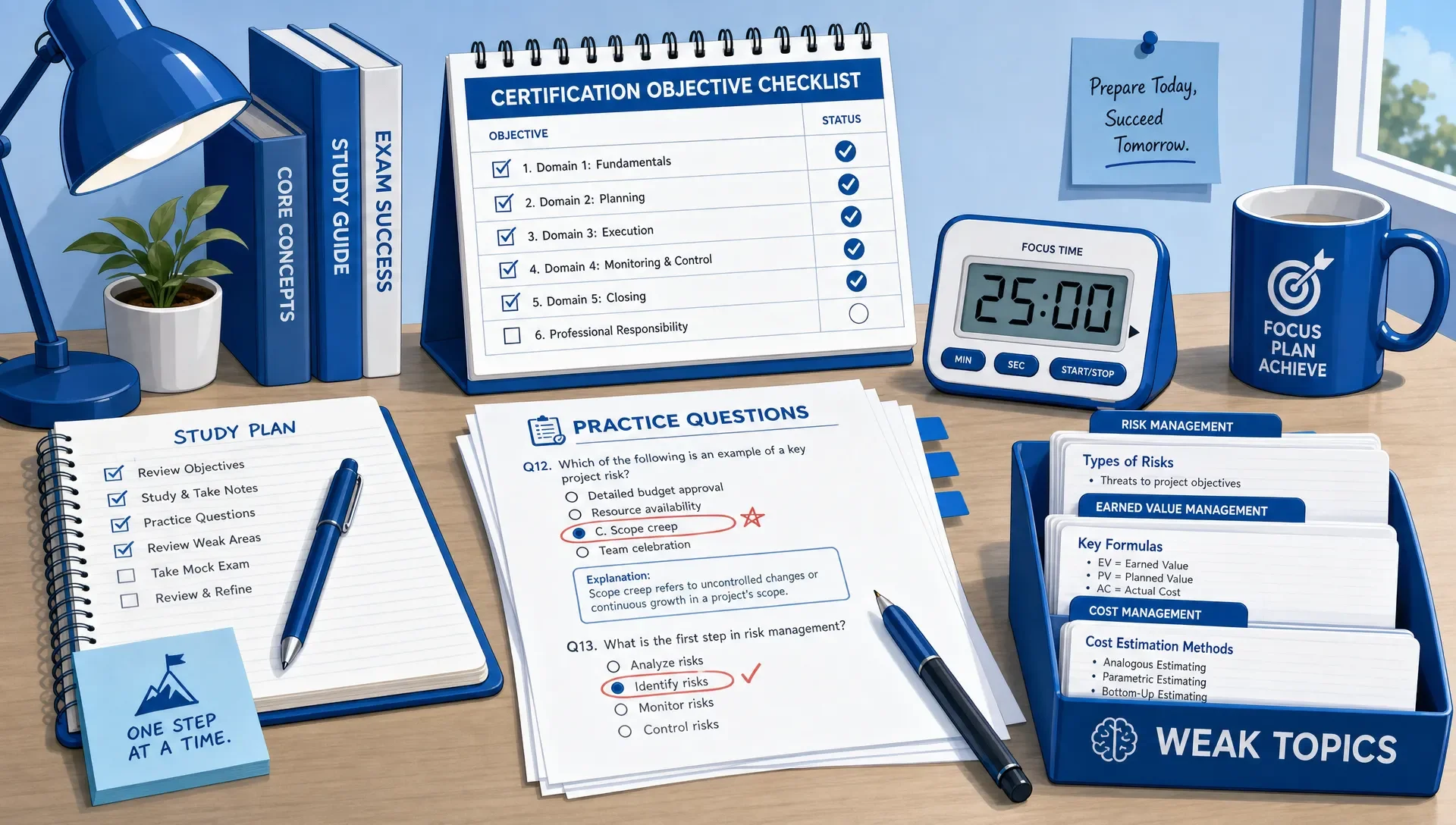
Most certification exams organize content into domains or skill areas. Some domains carry more weight than others, and some appear more often because they connect to many tasks. If your official exam guide lists domain percentages, use them. If it doesn't, use the structure of the objectives and your practice results to infer what deserves attention.
A simple rule works well: study high-weight weak areas before low-weight weak areas. A weak major domain can cost you points across many questions. A weak minor fact may only affect one or two.
For example, if you're preparing for a security certification like CompTIA Security+ and you keep missing risk management, access control, incident response, and network defense questions, don't spend your best energy memorizing obscure acronyms first. Start with the concepts that shape decisions. Then use facts and acronyms to support those decisions.
This is also where explanations matter. A question explanation shouldn't just tell you which answer was right. It should show why the distractors were wrong and what objective the question tested. That review is often where the real learning happens.
Practice Scenario and Performance-Based Questions Before Flashcards
Many IT certification exams don't just ask what a term means. They ask what you should do next, which service fits a requirement, which configuration is safest, or which troubleshooting step is most appropriate. If your exam includes performance-based question formats, scenario questions, labs, or case-style decisions, practice those before you spend your final hours on flashcards.
Scenario questions are difficult because they combine reading, prioritization, and technical judgment. You need to identify the constraint in the question. Is the priority cost, availability, security, speed, least privilege, recovery time, or operational simplicity? The right answer often depends on that constraint.
For CompTIA-style exams, performance-based questions may ask you to apply concepts in a more practical format. If Security+ is your target, working through a CompTIA Security+ practice exam with explanations can help you see whether you can apply security concepts under timed pressure rather than just recognize definitions.
A good scenario review routine is short but precise. After each missed scenario, write one sentence that captures the decision rule. For example: "Choose least privilege when access is broader than the job requires." Or: "Isolate affected systems before broad recovery steps when containment is the priority." These one-sentence rules are easier to reuse under exam pressure than long notes.
Review Missed Questions Before You Add New Material
When time is short, the highest-value content is often found in the questions you've already missed. A missed question is a diagnostic result. It tells you exactly where your understanding broke down.
The Institute of Education Sciences practice guide on learning strategies recommends practice testing and spaced review as evidence-based ways to improve learning, not just rereading notes. You can see those recommendations in the IES guide Organizing Instruction and Study to Improve Student Learning.
Use a tight review loop after every practice set:
- Identify the objective tested by each missed or guessed question.
- Explain why the correct answer is correct without looking at the explanation.
- Explain why each attractive wrong answer is wrong.
- Create one flashcard or note only if the mistake depends on a reusable fact or rule.
- Re-answer a similar question later, not immediately after reading the explanation.
That last step matters. If you answer the same question right away, you may only remember the explanation. If you come back later and still get it right, you're closer to test-ready recall. For a deeper routine, MindMesh Academy covers how to turn practice into retrieval training in practice examination habits that improve recall.
Memorize Only the Facts That Unlock Questions
Flashcards are useful near the exam, but only if you choose the right facts. Don't turn whole paragraphs into cards. Memorize compact items that help you eliminate answers, decode a scenario, or avoid confusion between similar concepts.
Good late-stage flashcard targets include command syntax, port numbers listed in your exam scope, cloud service names, project management formulas, security control types, networking terms, lifecycle phases, and acronyms that appear in objectives. The key is usefulness. If a fact doesn't help you answer questions, it can wait.
| Memory item | Examples by exam type | How to drill it close to the exam |
|---|---|---|
| Acronyms and terms | Security controls, cloud billing terms, project roles | Use quick definition cards and ask for an example |
| Commands or syntax | Network checks, access commands, basic administrative commands | Practice recognition and purpose, not only spelling |
| Formulas | Project management or networking calculations | Work mini problems, then check the steps |
| Ports and protocols | Common services in scope for your exam | Match protocol, port, and use case together |
| Service selection clues | Cloud storage, compute, identity, monitoring, governance | Tie each service to a short scenario trigger |
If your exam is tomorrow, spaced repetition still helps in a compressed form. Do a short flashcard pass in the morning, another after your main practice review, and a final light pass before you stop studying. Keep the final pass easy. The night before an exam isn't the time to build a 300-card deck.
What Not to Study When Your Exam Date Is Close
Last-minute studying goes wrong when candidates keep adding material instead of increasing score confidence. More input can make you feel busy while your actual weak areas remain unchanged.
Stop doing anything that doesn't produce a measurable improvement in recall, accuracy, timing, or confidence.
| Stop studying this way | Replace it with this |
|---|---|
| Rereading full chapters from the beginning | Review only the objectives connected to missed questions |
| Watching long review sessions passively | Pause every few minutes and answer a question from memory |
| Memorizing rare edge cases first | Learn the common decision rules and high-value exceptions |
| Opening multiple new resources | Use one main source and one question bank workflow |
| Repeating only easy questions | Mix weak areas into timed sets |
| Studying until exhaustion | Stop early enough to sleep and think clearly |
One more thing to avoid: changing your entire strategy in the final stretch. If your current plan has produced improving scores, refine it. Don't replace it with a completely new system two days before the exam.
Study Plan for 7 Days, 72 Hours, or 24 Hours Before the Exam
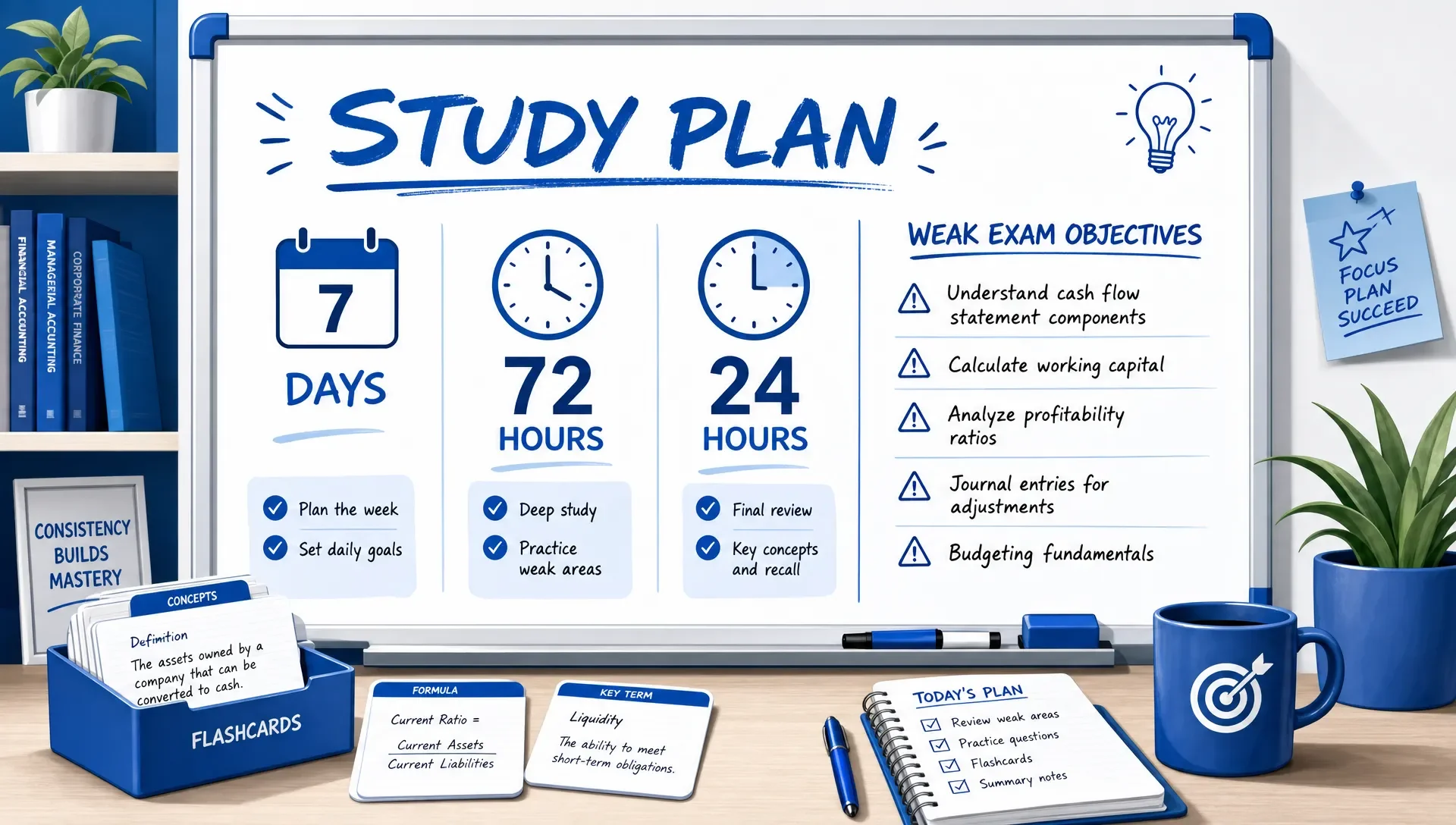
The closer the exam, the less you should experiment. Use the remaining time to cycle through practice, review, targeted study, and rest. The table below provides a practical schedule based on how much time you have left.
| Time left | Main goal | Best use of study time | What to avoid |
|---|---|---|---|
| 7 days | Close objective gaps | Take a diagnostic, study weak domains, do daily mixed practice, review flashcards | Starting a huge new course |
| 3 to 4 days | Stabilize performance | Focus on missed questions, high-weight domains, scenario practice, and timing | Trying to master every low-priority detail |
| 72 hours | Reduce score leaks | Do timed sets, review explanations deeply, memorize compact facts, retest weak areas | Passive rereading and late-night cramming |
| 24 hours | Protect recall and confidence | Light review, flashcards, exam logistics, sleep, and a small warm-up set if useful | Full-length panic testing if it will drain you |
| Exam morning | Enter ready and calm | Review formulas, acronyms, and decision rules, then stop | Learning brand-new topics at the last second |
If you have a full week, you can still make meaningful progress. Use the first day to diagnose, the middle days to repair weak domains, and the final day to consolidate. If you only have 24 hours, focus on recall, timing, and composure. A tired brain with more notes is often worse than a rested brain with slightly less content.
What to Do the Night Before and the Morning of the Exam
The night before your exam should be boring on purpose. Confirm your exam time, ID requirements, testing location or online testing setup, permitted materials, and check-in rules. Then stop making major content decisions.
Sleep is part of exam prep. The National Heart, Lung, and Blood Institute notes that sleep deficiency can make it harder to learn, focus, and react, which are exactly the skills you need in a timed exam. Their overview of sleep deprivation and deficiency is a useful reminder that one more exhausted hour isn't always worth it.
The morning of the exam, review only your highest-yield memory sheet. That might include formulas, common ports, service selection cues, project process terms, subnetting reminders, or security control categories. Then do a few easy warm-up questions if that helps you get into rhythm. Don't start a difficult practice set that could damage your confidence right before check-in.
How MindMesh Academy Supports Your Late-Stage Exam Prep
When your exam date is close, you need a connected study workflow, not scattered tabs and notes. MindMesh Academy is designed with this in mind, offering structured study guides aligned with exam objectives, practice questions with explanations, adaptive weakness-based practice, and readiness tracking.
This combination matters because late-stage preparation should quickly answer three key questions: what do I still miss, why do I miss it, and am I prepared enough to sit for the exam? Progress tracking by topic and mastery tracking help you spend your remaining sessions on the objectives that still need work.
This doesn't mean you should study more hours than your brain can handle. It means each session should have a specific job. One session might repair an identity and access management gap. Another might target CompTIA Security+ risk questions. Another might focus only on flashcards for must-know terms. Clear focus beats general review every time.
Frequently Asked Questions
What should I study first if my certification exam is in one week? Start with a timed diagnostic practice set, then study the exam objectives connected to your missed, guessed, and slow questions. Prioritize high-weight domains, scenario questions, and repeated mistake patterns before low-priority details.
Is it worth taking a practice test the day before the exam? It depends on your energy and confidence. A short timed set can be useful for rhythm, but a full-length exam the day before can drain you if it leads to panic review. Use the final day for light practice, explanation review, flashcards, logistics, and sleep.
Should I learn new topics or review weak areas when the exam is close? Review weak areas first, especially if they appear in official objectives and practice questions. Learn a new topic only if it's clearly in scope and likely to affect multiple questions. Don't add unrelated material just because it feels productive.
How many practice questions should I do when time is short? Do enough to identify patterns and retest weak areas, not so many that you stop reviewing explanations. For many learners, smaller timed sets followed by deep review are more useful than hundreds of rushed questions.
What should I memorize last before an IT certification exam? Memorize compact, high-utility facts such as formulas, common ports, acronyms, command purposes, lifecycle steps, service selection clues, and key definitions from your exam objectives. Avoid building a huge new flashcard deck at the last minute.
What if my practice scores are still low close to test day? Look for the reason. If scores are low because of one or two weak domains, targeted review may still help. If scores are low across most domains, consider whether rescheduling is possible and allowed. If you must sit for the exam, focus on high-weight objectives, timing, and eliminating avoidable mistakes.
Focus Your Remaining Study Time
A close exam date doesn't mean you should study everything faster. It means you should study the right things first. Use the official objectives, your practice results, and your weakest question types to build a short, focused plan.
To put these strategies into action, consider starting with our AZ-900 practice exam. MindMesh Academy provides structured practice questions with detailed explanations and adaptive weakness-based tracking, so you can pinpoint exactly what you need to master before exam day. Get started at MindMesh Academy.

Written by
Alvin Varughese
Founder, MindMesh Academy
Alvin Varughese is the founder of MindMesh Academy and an enterprise architecture leader. An electrical engineer by training, he moved from factory automation in South Africa to cloud architecture at GE Appliances and Humana (Fortune 50), and holds 20 professional certifications including AWS Solutions Architect Professional, Azure DevOps Engineer Expert, and Microsoft Agentic AI Business Solutions Architect. He built MindMesh Academy after interviewing too many highly certified candidates who couldn't answer basic questions: the goal is prep that makes you better at the job, not just able to pass the exam.