SAT Test Prep Questions That Build Real Confidence
SAT Test Prep Questions That Build Real Confidence
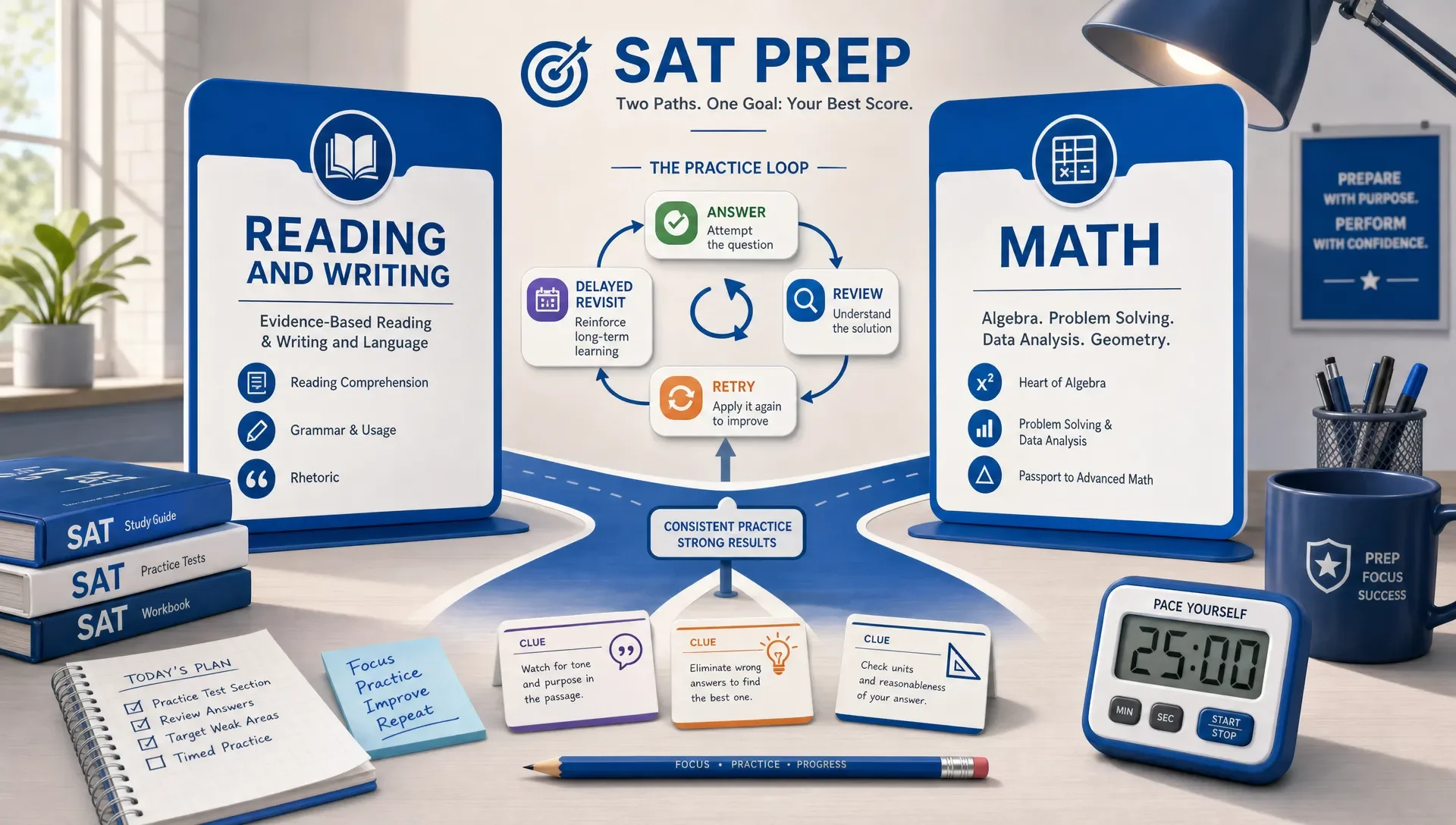
SAT test prep questions help you build real confidence when they make you prove a skill, review the result, and try the same skill again later. Don't start by chasing a huge question count. Instead, begin with small sets that target one skill. Answer them without notes, mark every miss and lucky guess, then repeat the weak skill under light time pressure.
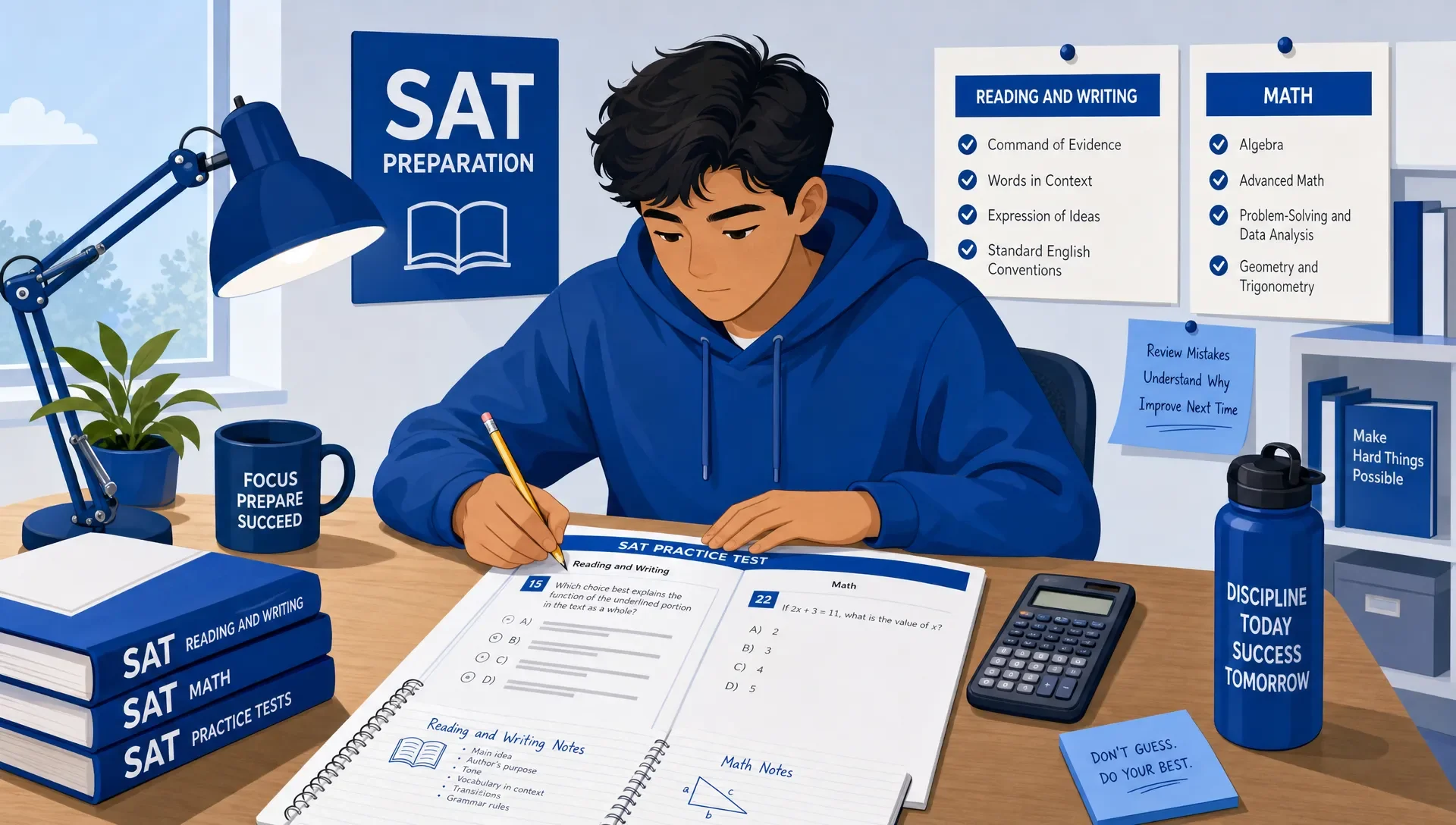
The official SAT overview from College Board organizes the exam around Reading and Writing and Math, so your practice should follow that structure. The goal isn't to memorize prompts. It's about building a reliable process for evidence, grammar, algebra, data, and pacing. You're not hoping the test feels familiar; you're actively making it familiar.
What Makes SAT Test Prep Questions Build Confidence
A good SAT practice question does more than simply tell you if you were right. It shows you which skill you used, explains why the wrong answers were tempting, and points you to your next study step. This feedback is critical. Confidence without accuracy often becomes overconfidence, while accuracy without review fades quickly.
Learning research supports this method. A review in Psychological Science in the Public Interest highlights practice testing and distributed practice as highly effective learning techniques. These work best when students actively retrieve information repeatedly over time, rather than passively rereading material. Simply put, questions are most effective when you use them as training tools, not just one-time score checks.
If you're looking for a broader study framework, MindMesh Academy's guide to test prep methods that actually stick explains how active recall, spaced repetition, mixed practice, and mistake review work together. For SAT prep, the same principle applies: every question should generate feedback you can act on.
| Weak SAT practice | Confidence-building SAT practice |
|---|---|
| You answer, check the letter, and move on | You explain why the right answer is right and why each distractor fails |
| Questions are random from the start | Questions begin by skill, then become mixed later |
| You count only wrong answers | You also flag guesses, slow solves, and questions that felt unclear |
| You repeat questions immediately | You retry the same skill after a delay to prove retention |
| Timed sets start too early | Timing is added after the method is stable |
A useful question should leave you with one clear next step: review a grammar rule, practice a linear equation setup, slow down on evidence questions, or build more stamina with timed sets.
SAT Reading and Writing Questions That Build Reading Confidence
Reading and Writing confidence comes from understanding how SAT answer choices are designed. The correct answer is typically precise, well-supported, and limited to what the text explicitly states. Wrong answers often go too far, reverse the meaning, sound plausible but lack evidence, or use a word in the wrong context.
The following are original SAT-style examples, not real SAT questions.
Main idea question
Question: Biologist Maya Chen expected the coastal plants to grow more slowly in salty soil. The results were surprising: plants exposed to moderate salt levels produced more root mass than plants in the control group. Which choice best states the main idea of the text?
A) Moderate salt exposure may increase root mass in some coastal plants.
B) Coastal plants cannot survive in salty soil.
C) Chen's results confirmed her original prediction.
D) The control group produced more root mass than the treated plants.
Answer: A. The phrase "may increase" is careful and aligns with the evidence. B is too extreme, C reverses the outcome, and D contradicts the text. This type of question builds confidence by training you to select the answer that is directly supported, rather than one that just sounds scientific.
Words in context question
Question: In the sentence "The editor offered a concise summary of the report," which word is closest in meaning to "concise"?
A) Lengthy
B) Brief
C) Uncertain
D) Decorative
Answer: B. "Concise" means brief but complete. The confidence habit here is to substitute the word in the sentence before looking at the choices. If "brief summary" fits and "decorative summary" doesn't, you can eliminate options quickly.
Standard English conventions question
Question: Which choice completes the sentence correctly?
After reviewing the data, the researchers revised their hypothesis.
A) After reviewing the data the researchers, revised their hypothesis.
B) After reviewing the data, the researchers revised their hypothesis.
C) After reviewing the data; the researchers revised their hypothesis.
D) After, reviewing the data the researchers revised their hypothesis.
Answer: B. The opening phrase needs a comma after "data," and the main clause should remain intact. This builds confidence by making punctuation a rule-based decision instead of a guess.
SAT Math Questions That Build Problem-Solving Confidence
SAT Math confidence grows when you can recognize the structure of a problem before doing heavy calculations. For many students, the issue isn't the math itself. It's figuring out what the problem is asking under time pressure.
Linear equation question
Question: If 3(2x - 5) = 4x + 9, what is the value of x?
A) 5
B) 9
C) 12
D) 24
Answer: C. First, distribute: 6x - 15 = 4x + 9. Subtract 4x from both sides: 2x - 15 = 9. Add 15: 2x = 24. Divide by 2: x = 12. The confidence habit is to write out each algebra step, especially when the equation includes parentheses.
Percent change question
Question: A jacket with original price p is increased by 20% and then discounted by 20% from the new price. What is the final price in terms of p?
A) 0.80p
B) 0.96p
C) p
D) 1.04p
Answer: B. A 20% increase makes the price 1.20p. A 20% discount from that new price gives 0.80(1.20p), which calculates to 0.96p. This question builds confidence because it helps you avoid a common trap: assuming equal percent increases and decreases cancel each other out.
Function question
Question: If f(x) = 2x^2 - 3, what is f(4) - f(2)?
A) 12
B) 16
C) 24
D) 32
Answer: C. Calculate f(4) = 2(16) - 3 = 29, and f(2) = 2(4) - 3 = 5. So f(4) - f(2) = 24. The confidence habit is to compute each function value separately before subtracting.
How to Use SAT Practice Questions Without Memorizing Answers
Memorizing an answer choice can feel productive, but it doesn't transfer well to new problems. A stronger move is to use each question as a diagnostic tool. If you can solve a similar problem later, with different numbers or a different passage, you're building real confidence.
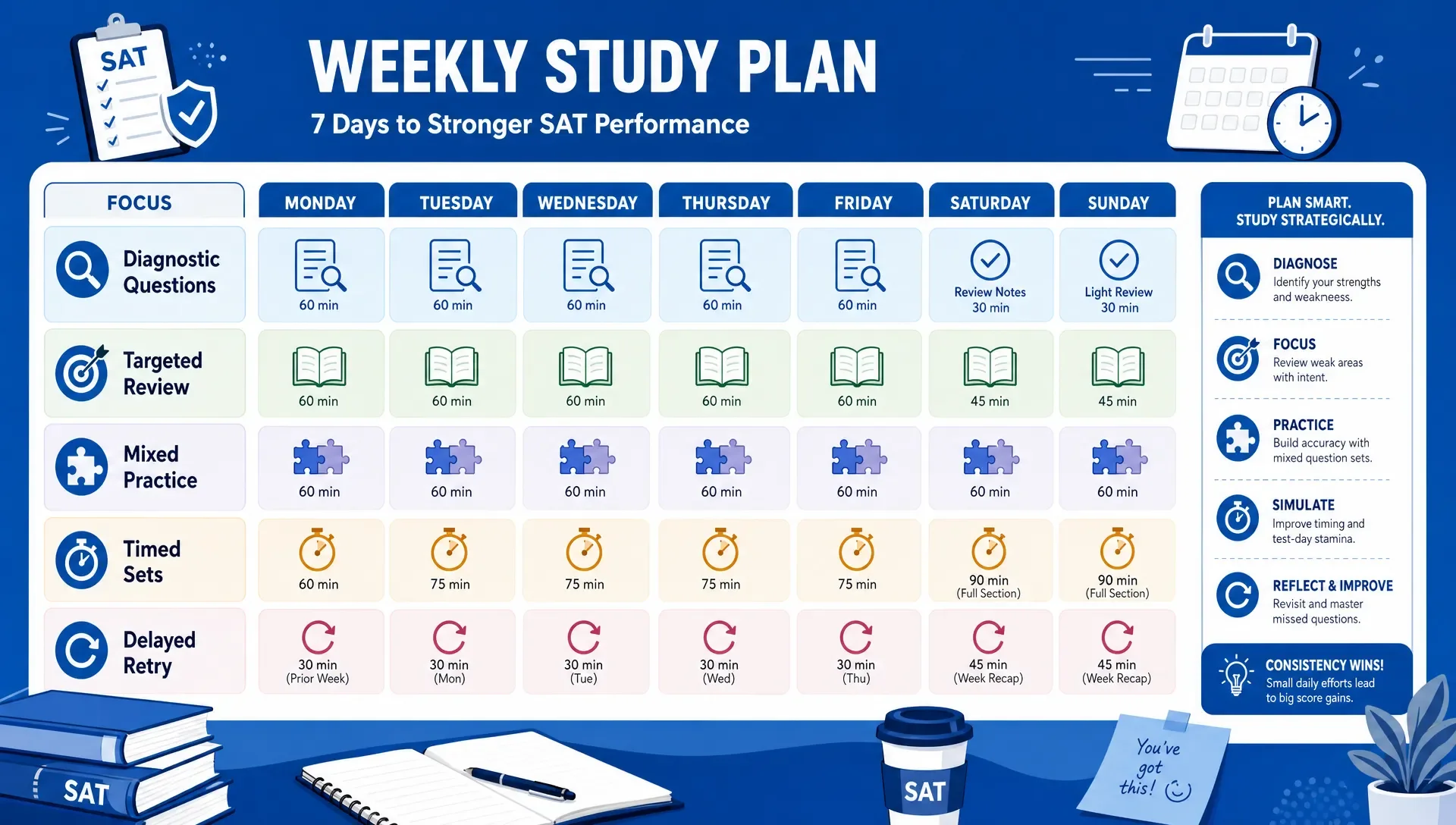
A simple weekly cycle works well: diagnose, target, mix, time, and review. If you want to sharpen the diagnostic part, our article on study questions that reveal what you actually know shows how to separate recognition from true understanding.
| Practice mode | What to do | Confidence signal |
|---|---|---|
| Diagnostic set | Try a balanced set across Reading and Writing and Math | You can name your two or three weakest skills |
| Targeted set | Practice one skill, such as transitions, punctuation, linear equations, or percentages | Your explanation becomes faster and clearer |
| Mixed set | Combine several skills so you must identify the task first | You stop relying on topic labels to know what to do |
| Timed set | Add realistic time pressure after your method is stable | Accuracy stays steady while pacing improves |
| Delayed retry | Revisit the same skill a few days later with new questions | You can solve without remembering the old answer |
This is also where explanations matter. A strong explanation should cover the skill tested, the clue, why the correct answer works, and why each wrong answer fails. If an explanation only says "choice B is correct," it's not teaching enough.
How to Review Wrong Answers Until Confidence Becomes Reliable
Wrong answers aren't the problem. Repeating the same type of wrong answer is. After each SAT practice set, review your misses while the reasoning is still fresh. Don't just write down the correct answer; rebuild the decision process.
Use a three-pass review. First, try redoing the question without looking at the answer. Second, explain the correct answer in one sentence. Third, write down the specific correction you'll apply next time. For example, "check the transition relationship before choosing" is more helpful than "read more carefully."
| Mistake pattern | How to spot it | Better correction |
|---|---|---|
| Evidence miss | You chose an answer that sounded reasonable but wasn't stated | Underline the exact words that prove the answer |
| Grammar rule gap | You guessed based on how the sentence sounded | Name the rule, such as "comma after introductory phrase" |
| Algebra setup error | Your equation didn't match the situation | Define the variable before writing the equation |
| Arithmetic slip | Your method was right but the calculation was wrong | Slow down on the final two steps and check signs |
| Timing guess | You rushed because the problem looked long | Mark it, skip strategically, and return if time allows |
For deeper review habits, MindMesh Academy's written exam practice test review tips can help you turn missed questions into a repeatable study plan, rather than just a frustrating score report.
How Many SAT Test Prep Questions Should You Do Each Week
There isn't one perfect number. The right amount depends on your starting point, test date, school workload, and attention span. Still, quality consistently beats volume. A student who reviews 60 questions deeply usually gains more than a student who rushes through 200 and forgets every mistake.
Use this as a practical planning guide, then adjust based on your energy and accuracy.
| Weekly study time | Question target | Best use of time |
|---|---|---|
| 2 hours | 30 to 45 questions | One diagnostic set and one targeted review set |
| 4 hours | 60 to 90 questions | Two targeted sets, one mixed set, and review notes |
| 6 or more hours | 100 to 140 questions | Targeted practice, mixed practice, timed sections, and delayed retry |
If your accuracy drops sharply because you're tired, stop and review. Exhausted guessing only teaches bad habits. You want enough repetition to build fluency, but enough reflection to fix the root cause of each mistake.
Signs Your SAT Practice Is Building Real Confidence
Real confidence is visible in your study behavior. You don't just feel better; you solve more consistently, recover faster from hard questions, and know exactly what to review next.
Look for these signs during practice:
- You can identify the skill being tested before choosing an answer.
- You can explain wrong choices without checking the explanation first.
- You solve similar questions correctly after a few days away.
- Your missed questions cluster into fewer categories over time.
- Your timed accuracy is close to your untimed accuracy.
- You know when to skip a question and return instead of panicking.
The biggest shift is both emotional and practical: practice stops feeling like a verdict. It becomes actionable information. That is the kind of confidence you can carry into test day.
Frequently Asked Questions
Are SAT test prep questions better than reading lessons? They serve different purposes. Lessons introduce skills, while SAT test prep questions prove whether you can use those skills under exam conditions. For most students, the best plan combines short lessons with frequent practice and careful review.
How many SAT practice questions should I do per day? On a normal school day, 10 to 20 well-reviewed questions can be enough. On a longer study day, you might do 30 to 50. The key is to review every miss, guess, and slow question before adding more volume.
Should I repeat SAT questions I've already answered? Yes, but not immediately and not to memorize the letter. Wait a few days, cover the explanation, and solve again. If you can explain the method without remembering the answer, the repeat is useful.
When should I start timed SAT practice questions? Start timing after you understand the question type and can solve it accurately. If you time yourself too early, you may just practice rushing. Once your method is stable, timed sets help you build pacing and stamina.
What should I write down after missing an SAT question? Write down the tested skill, the reason your answer was wrong, the clue you missed, and the rule or method you'll use next time. Keep it short. A useful correction is something you can apply on the very next practice set.
Build a Question-First Study Habit You Can Reuse
SAT prep offers a strong foundation for evidence-based study: answer questions, review results, target weaknesses, and retry later. This workflow is highly transferable to future career certifications, especially when the stakes shift from college admissions to IT, cloud, project management, or cybersecurity exams. MindMesh Academy helps IT professionals apply this question-first approach, offering practice questions with detailed explanations, adaptive weakness-based practice, and readiness tracking. If you're building your foundation for exams like the AWS Certified Cloud Practitioner, explore how our AWS Certified Cloud Practitioner study guide can support your focused preparation.

Written by
Alvin Varughese
Founder, MindMesh Academy
Alvin Varughese is the founder of MindMesh Academy and an enterprise architecture leader. An electrical engineer by training, he moved from factory automation in South Africa to cloud architecture at GE Appliances and Humana (Fortune 50), and holds 20 professional certifications including AWS Solutions Architect Professional, Azure DevOps Engineer Expert, and Microsoft Agentic AI Business Solutions Architect. He built MindMesh Academy after interviewing too many highly certified candidates who couldn't answer basic questions: the goal is prep that makes you better at the job, not just able to pass the exam.