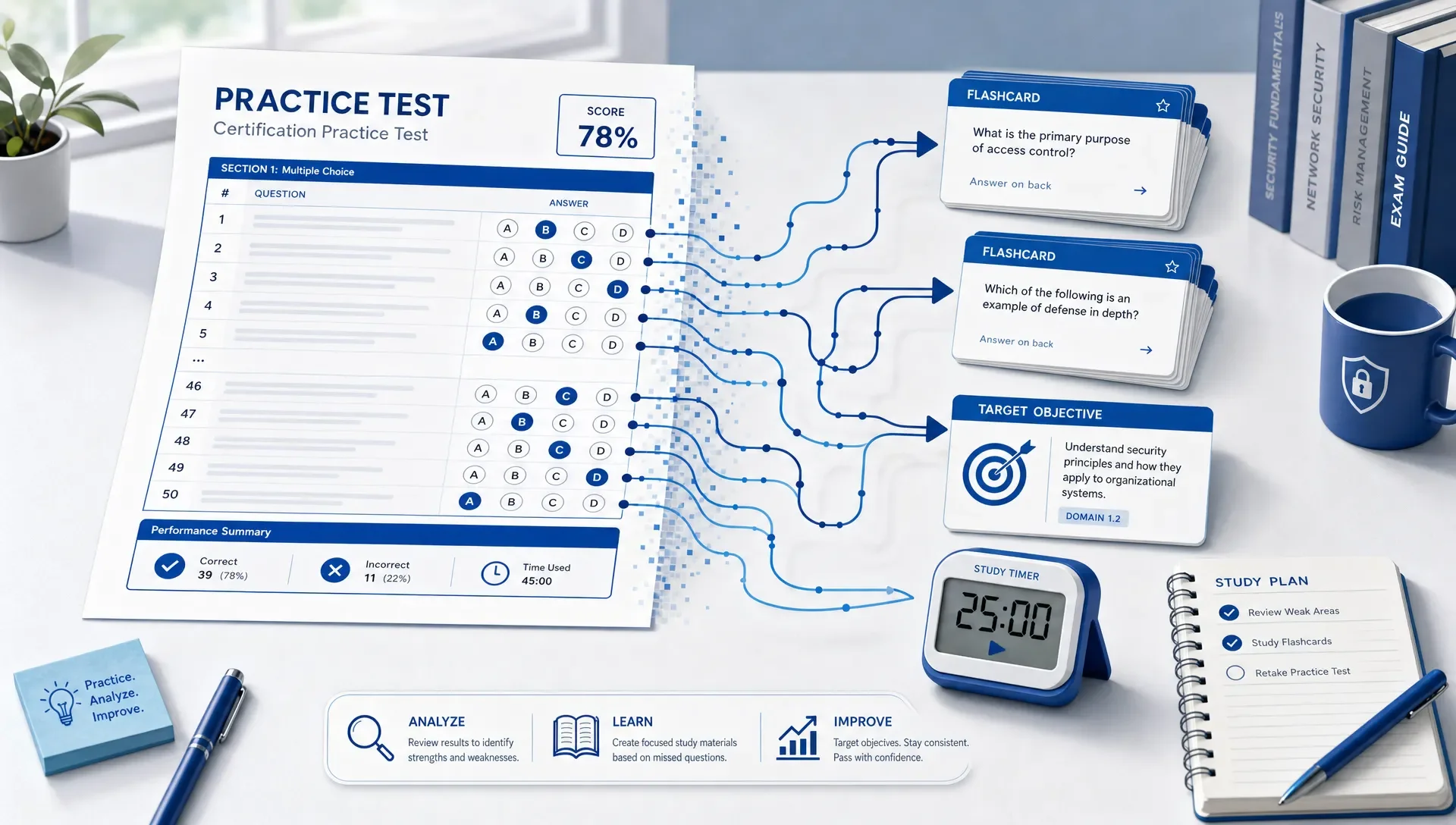
Written Exam Practice Test Review Tips That Work
Written Exam Practice Test Review Tips That Work
A practice test is only truly effective if you review it while your reasoning is still fresh. Before you look at explanations, record four things: your score, time used, confidence level, and why you chose each answer on the questions you missed or flagged. This transforms a practice test from a simple score into a powerful study map.
Don't stop at marking answers right or wrong. The real value comes from identifying the patterns behind your results: weak objective knowledge, misread questions, poor answer elimination, timing pressure, or educated guesses. If you want a deeper step-by-step workflow for scoring and logging results, MindMesh Academy's guide on how to review an exam practice test pairs well with the review tips below.
How to Review a Written Exam Practice Test Immediately
Start your review within 15 minutes of finishing the test if you can. You don't have to study everything immediately, but you do need to capture your reasoning before it fades.
For each question you missed, guessed, or spent too long on, write a short note in plain language. Good notes sound like this: I confused availability with durability, I ignored the word least, I knew the concept but couldn't apply it, or I changed from the right answer to the wrong one.
That note matters. Two students might miss the same question for entirely different reasons. One needs to relearn the topic. The other needs to slow down and parse the stem more carefully. Same score, different fix.
Use this confidence matrix before you read the explanation:
| Result | Confidence | What it means | Review priority |
|---|---|---|---|
| Correct | High | You likely understand the concept and the wording | Low, verify quickly |
| Correct | Low | You may have guessed or used weak reasoning | Medium, review the explanation |
| Wrong | Low | You knew you were missing something | High, rebuild the concept |
| Wrong | High | You were confidently mistaken | Highest, find the faulty rule you used |
The most crucial row is Wrong with High Confidence. These questions expose false rules, outdated assumptions, or oversimplified memory shortcuts. If you only review low-confidence misses, you leave your most dangerous blind spots unaddressed.
Use a Three-Pass Review Before You Retake
Many students make a common mistake: taking a practice test, reading all explanations in one sitting, then immediately retaking the same test. That approach feels productive. However, it often measures short-term memory of answers rather than true readiness.
A better review uses three passes.
First pass: explain your answer without help
For every missed or flagged question, cover the explanation. Explain why your chosen answer seemed right. If you can't explain your own reasoning, mark the question as a reasoning gap, not just a content gap.
This is especially useful on certification exams where several answer choices are technically plausible. The exam usually rewards the best answer for the scenario, not the answer that contains a familiar keyword.
Second pass: compare your reasoning to the explanation
Now, read the explanation. Compare it to your original thinking. Don't copy the explanation word for word. Instead, write the rule you should use next time.
For example, a weak note says: I missed encryption question. A useful note says: When data must be protected at rest, look for storage-level encryption, not only network controls.
Third pass: create a small follow-up task
Every serious mistake should become one action. That action might be a flashcard, a short topic review, a five-question drill, or a retake of similar questions later in the week.
This approach works because testing is not just assessment. In research by Roediger and Karpicke, students who practiced recalling information retained more later than students who only restudied. Your review should make you retrieve, explain, and apply, not just reread.
How to Diagnose Mistakes on Written Exam Practice Tests
Your goal is to label mistakes by cause, not by emotion. Don't write careless, bad question, or need to study more unless you can make that label specific.
Use a simple error code so your next study session is obvious:
| Error type | What it looks like | Best fix |
|---|---|---|
| Knowledge gap | You didn't know the term, service, process, or rule | Review the exam objective, then answer new questions |
| Application gap | You knew the definition but couldn't apply it to the scenario | Practice scenario-based questions and explain the decision point |
| Wording error | You missed qualifiers like best, first, least, most, except, or not | Slow down and underline the task in the stem |
| Distractor trap | You picked a true statement that didn't answer the question | Identify why each wrong option is wrong |
| Time pressure | You rushed late questions or left items blank | Practice timed sets and build a skip strategy |
| Overconfidence | You answered quickly and incorrectly | Force a one-sentence justification before moving on |
| Format issue | Matching, ordering, or performance-style items slowed you down | Practice that format separately before full exams |
If you see the same error type three times in one review, that's your next study priority. A lower score caused by five different topics may need broad review. A lower score caused by one repeatable habit may improve quickly once you fix the habit.
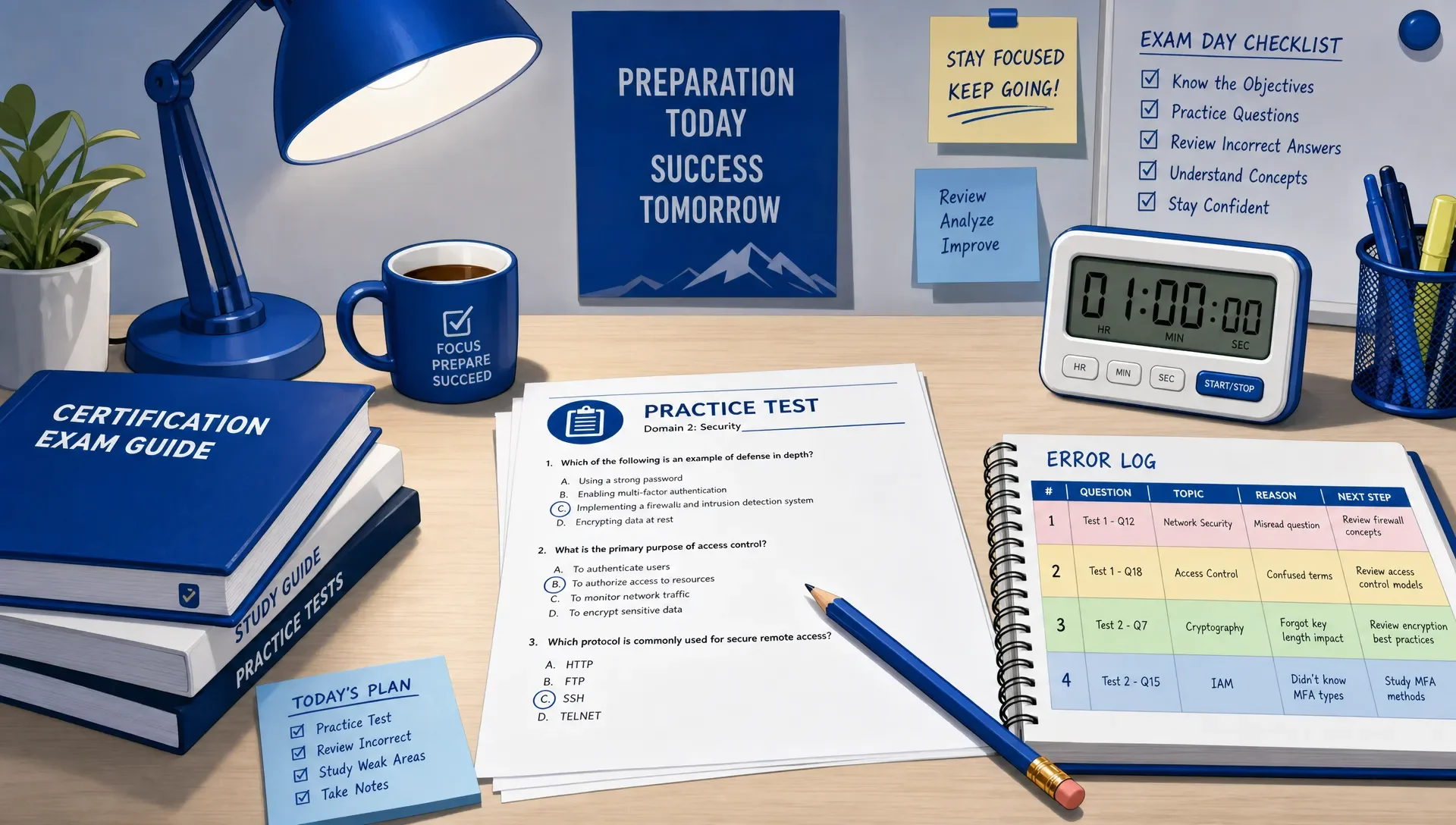
Turn Each Missed Question Into a Specific Study Task
Every practice test should inform your next study steps. If your review only ends with study networking or review cloud services, it's too vague to be useful.
Whenever possible, tie each missed question to a specific exam objective. Certification exams structure their content around objectives, domains, or skill areas. Mapping your missed questions to these areas helps you pinpoint if you have a broad weakness in a topic or just made a few isolated errors.
For cloud fundamentals learners, using an AWS Certified Cloud Practitioner practice exam can help you test cloud concepts in exam-style wording after you review a weak objective. For cybersecurity learners, a CompTIA Security+ practice exam can help you rebuild weak domains with scenario and performance-based question formats.
The key is to avoid random practice after review. If you missed identity and access questions, don't spend the next hour doing storage questions just because they're available. Practice should follow the evidence from your last test.
A strong follow-up task is small, measurable, and tied to a reason. Here are examples:
- Create five flashcards for terms you confused, then review them tomorrow.
- Answer 10 new questions from the weakest objective, then explain every miss.
- Rewrite the rule behind a high-confidence wrong answer in your own words.
- Run a short timed set if your errors clustered near the end of the test.
Keep the task small enough that you'll actually do it before your next full practice test.
Review Correct Answers You Guessed
Correct guesses pose a hidden risk. If you guessed correctly, your score might improve, but your true readiness doesn't.
During review, treat low-confidence correct answers almost like misses. Read the explanation, identify why the right answer is right, and explain why the most tempting wrong answer is wrong. This builds the judgment you need on written exams, where distractors often use familiar terms from the same domain.
Also, watch for lucky pattern recognition. For example, if you picked the longest answer, the most familiar acronym, or the option that sounded more technical, you didn't prove understanding. You proved that the strategy happened to work once.
A good rule is simple: if you can't explain why the correct option is best, it goes into your review queue.
How to Use Timing Data From a Practice Test
Timing problems are not all the same. Finishing late might mean you don't know the material well enough. But it could also mean you're spending too long on low-value decisions.
Review timing by section, question type, and error pattern. If your first half is strong and your second half collapses, you may need pacing practice. If hard scenario questions take too long but basic recall questions are fast, you may need a better elimination process.
| Timing signal | Likely cause | What to practice next |
|---|---|---|
| You ran out of time with many unanswered questions | No skip strategy or too much time on hard items | Use a strict first-pass limit and flag hard questions |
| You finished very early with many mistakes | Rushing or shallow reading | Add a stem-check habit before selecting an answer |
| You missed mostly long scenarios | Difficulty finding the actual task | Identify the decision point before reading options |
| You missed mostly format-heavy items | Unfamiliar question format | Drill that format separately |
| You changed many correct answers to wrong answers | Low trust in reasoning | Require evidence before changing an answer |
Written certification exams can include more than standard multiple-choice questions. Microsoft's exam duration and question types documentation shows why format familiarity matters. Case studies, build-list items, drag-and-drop questions, and other formats can change how you manage time, even when you know the content.
Don't use timing data to panic. Use it to adjust behavior. A student who finishes 20 minutes early and misses easy items doesn't need to study more hours first. They need to slow down, read the last sentence of the stem twice, and justify the answer before moving on.
Build a Retake Plan That Measures Readiness
Retaking a test too soon is one of the quickest ways to inflate your score without actually improving your readiness. If you remember that question 17 was B, you're not practicing retrieval. You're recognizing a recent answer.
Space your review and retakes. The Institute of Education Sciences practice guide on organizing instruction and study recommends spacing learning over time, which fits certification prep well. You want repeated retrieval across days, not one long cram session that fades before exam day.
A practical retake schedule looks like this:
| When | What to do | Goal |
|---|---|---|
| Same day | Review missed, guessed, and slow questions | Find causes while memory is fresh |
| Next day | Review flashcards and weak objective notes | Strengthen recall without the answer visible |
| 2 to 3 days later | Take a targeted practice set from weak objectives | Test whether the fix worked |
| 4 to 7 days later | Take a mixed timed set | Check transfer across topics |
| After consistent improvement | Take a fresh full-length practice test | Measure exam readiness |
If you must reuse the same test, wait until you've done targeted practice first. A retake score only matters if you can explain the reasoning and handle similar new questions.
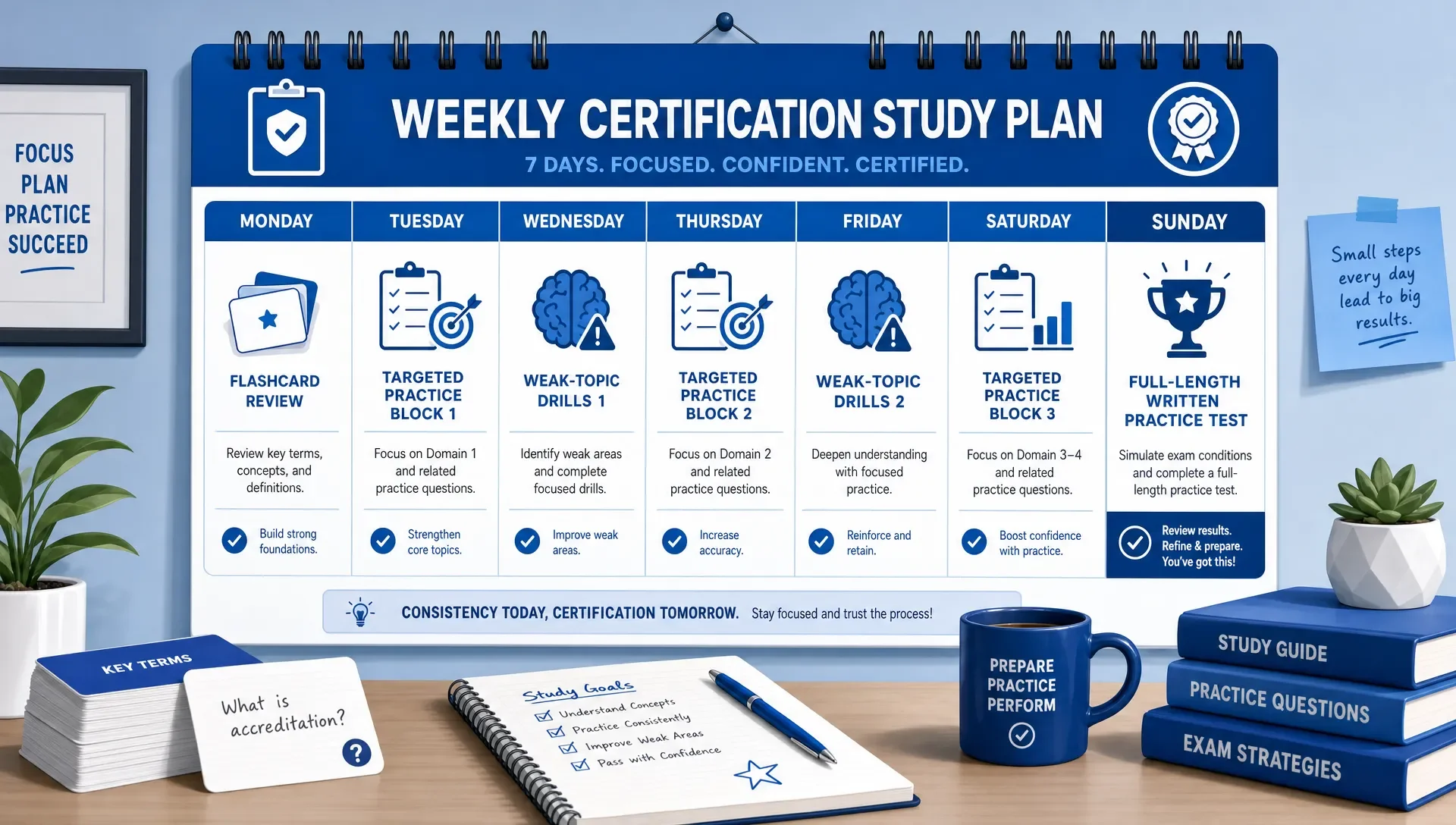
How to Review Written Exam Practice Test Explanations
Explanations are helpful, but only if you read them actively. Don't just confirm that the right answer is right. Look for the rule that separates the best answer from the distractors.
When reading an explanation, ask five questions:
- What word or phrase in the stem points to the correct answer?
- Why is the correct option better than the closest wrong option?
- Did I miss a concept, a condition, or a qualifier?
- What would need to change in the scenario for another option to become correct?
- How would I recognize this pattern in a new question?
That fourth question is especially powerful. It forces you to understand boundaries. Many exam topics are not about whether a tool, process, or control is good. They're about when it is the best fit.
For example, backup, replication, high availability, fault tolerance, and disaster recovery can all sound related. A written exam question will usually include clues about recovery time, data loss, regional failure, cost, or operational complexity. Your review should train you to notice those clues.
Common Practice Test Review Habits That Waste Time
Some review habits feel disciplined but don't yield significant improvement. If your scores are stuck, check whether one of these is in your routine.
| Habit | Why it feels useful | Better approach |
|---|---|---|
| Reading every explanation in order | It feels thorough | Prioritize missed, guessed, slow, and high-confidence wrong items first |
| Retaking the same test immediately | The score usually rises | Wait, fix weak areas, then test with fresh or mixed questions |
| Studying only wrong answers | It seems efficient | Also review correct guesses and slow correct answers |
| Blaming careless mistakes | It protects confidence | Identify the exact reading or timing behavior that caused the miss |
| Tracking only total score | It's easy to measure | Track objective, confidence, timing, and error type |
The best review system is not complicated. It is consistent. After each written exam practice test, you should know what you missed, why you missed it, what you'll do next, and when you'll test that skill again.
Frequently Asked Questions
How long should I spend reviewing a written exam practice test? Plan for 60 to 90 minutes for a full-length test, longer if the exam is advanced or scenario-heavy. Short quizzes may only need 15 to 30 minutes. The review should be long enough to diagnose causes and create follow-up tasks, not just read explanations.
Should I review every question or only the ones I missed? Review every missed question, every guessed question, and every question that took too long. You can skim high-confidence correct answers, but don't ignore correct answers you couldn't explain.
Is it bad to retake the same written exam practice test? It's not bad, but timing matters. Retake after you've reviewed mistakes, practiced weak objectives, and waited long enough that you're testing understanding instead of answer memory.
What score should I get on practice tests before scheduling the real exam? Use score as one signal, not the only signal. Look for consistent performance across objectives, stable timing, fewer high-confidence wrong answers, and the ability to explain your reasoning on missed and guessed questions.
Why do I understand the material but still miss scenario questions? Scenario questions test application, not just recall. During review, identify the decision point in the stem, compare the best answer with the closest distractor, and practice explaining why the scenario rules out tempting options.
How do I stop making careless mistakes on written exams? Replace the word careless with a specific behavior. Common fixes include underlining qualifiers, reading the final sentence first, setting a pacing checkpoint, and requiring evidence before changing an answer.
Improve Your Next Practice Test Review With MindMesh Academy
A good review process turns every practice test into a study plan. MindMesh Academy supports that workflow with study guides organized by exam objectives, practice questions with explanations, and readiness tracking. After your next practice test, don't just ask what score you got. Ask what the test proved, what it exposed, and what you'll practice next. That's how review becomes genuine preparation instead of mere repetition. Ready to put these tips into practice? Strengthen your IT fundamentals with a CompTIA A+ Core 1 practice exam from MindMesh Academy.

Written by
Alvin Varughese
Founder, MindMesh Academy
Alvin Varughese is the founder of MindMesh Academy and an enterprise architecture leader. An electrical engineer by training, he moved from factory automation in South Africa to cloud architecture at GE Appliances and Humana (Fortune 50), and holds 20 professional certifications including AWS Solutions Architect Professional, Azure DevOps Engineer Expert, and Microsoft Agentic AI Business Solutions Architect. He built MindMesh Academy after interviewing too many highly certified candidates who couldn't answer basic questions: the goal is prep that makes you better at the job, not just able to pass the exam.