My Exam Is Close: What Should I Study First?
My Exam Is Close: What Should I Study First?
If your exam is close and you're unsure what to study first, don't panic and restart everything. Your immediate task is triage: pinpoint the few topics most likely to impact your score, then tackle them actively. Prioritize missed objectives, high-weight domains, scenario or performance-based formats, and facts you can quickly memorize.
The aim isn't just to feel productive. It's to define what your next 60 to 90 minutes of study should achieve. For a companion checklist focused purely on prioritizing near-term study, MindMesh Academy offers a guide on things to study first when your exam date is close. This article provides a quick decision-making process you can use right away, even if you only have a few study sessions remaining.
Start With a 45-Minute Exam Triage, Not a Full Restart
When time is short, your initial study session shouldn't involve starting a new chapter, watching another video, or simply rereading old notes. Instead, dedicate 45 minutes to a triage session designed to reveal where your score is weakest.
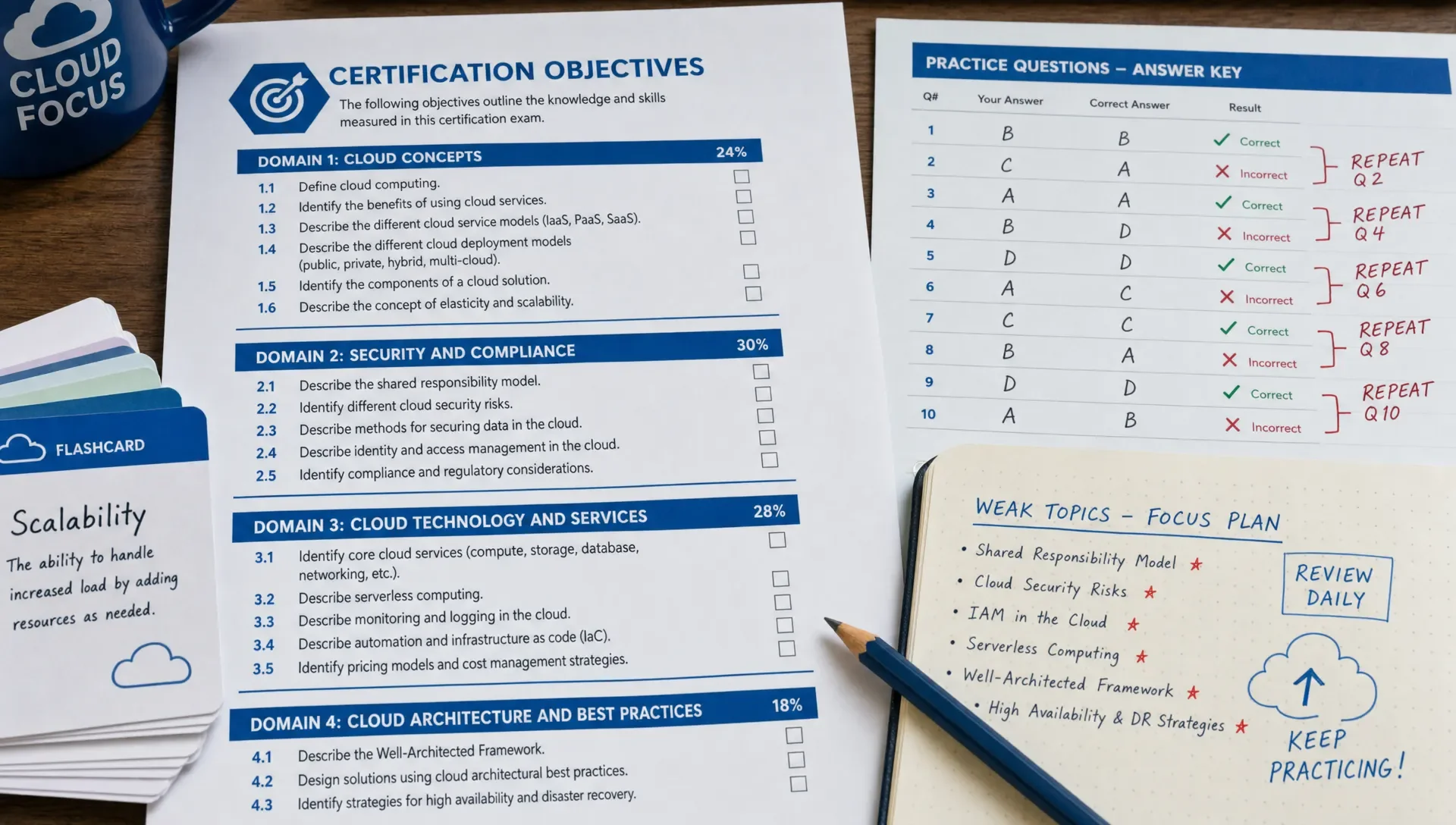
Collect three items: the official exam objectives, your latest practice question results, and any notes or flashcards you've already created. If you haven't taken a practice set recently, complete a short closed-book quiz before planning anything else. Even 20 to 30 questions can expose patterns your memory might not accurately recall.
Use this initial review to label topics, not to master them yet. Your goal is to decide the study order. If my exam were tomorrow or next week, I'd prefer to know precisely which five objectives are weak than spend two hours crafting a perfect schedule.
| Evidence to check | What to mark | Why it goes first |
|---|---|---|
| Official objectives | Domains you have not studied or cannot explain | They define the exam boundary |
| Practice results | Questions missed more than once | Repeated misses usually signal concept gaps |
| Scenario questions | Cases where you picked the wrong service, command or process | These errors cost time and confidence |
| Flashcards | Facts you keep forgetting | Many are fixable with short, repeated recall |
| Strong topics | Objectives you can explain without notes | These move to maintenance review |
Here's a useful rule: if a topic is weak, appears frequently on the exam, and is fixable within one or two study sessions, prioritize it. If it's weak but represents a huge area, break it down into smaller, manageable objectives before you tackle it.
What to Study First When Time Is Short
The best starting topic isn't always the one you fear most. It's the one where your effort can realistically translate into points before exam day. Follow this order when your exam is close and every study hour counts.
| Priority | Study this first | What to do with it |
|---|---|---|
| 1 | Repeatedly missed objectives | Read the relevant explanation, restate the rule and answer a new set of questions |
| 2 | High-weight exam domains | Focus on common decisions, workflows and comparisons inside that domain |
| 3 | Performance-based or scenario formats | Practice under timed conditions and review why each wrong option fails |
| 4 | Easy-to-forget facts | Use flashcards for ports, definitions, acronyms, formulas, command syntax or service limits |
| 5 | Topics you already know | Review lightly, only to prevent decay |
This order works because it distinguishes between confidence and actual readiness. Many learners spend too much time on topics they already feel comfortable with. Comfort, however, matters less than the objective evidence from your practice. If your practice results consistently highlight issues with access control, subnetting, incident response, or change management, those topics deserve priority, even if another subject feels more engaging.
Use Official Exam Objectives to Avoid Studying the Wrong Material
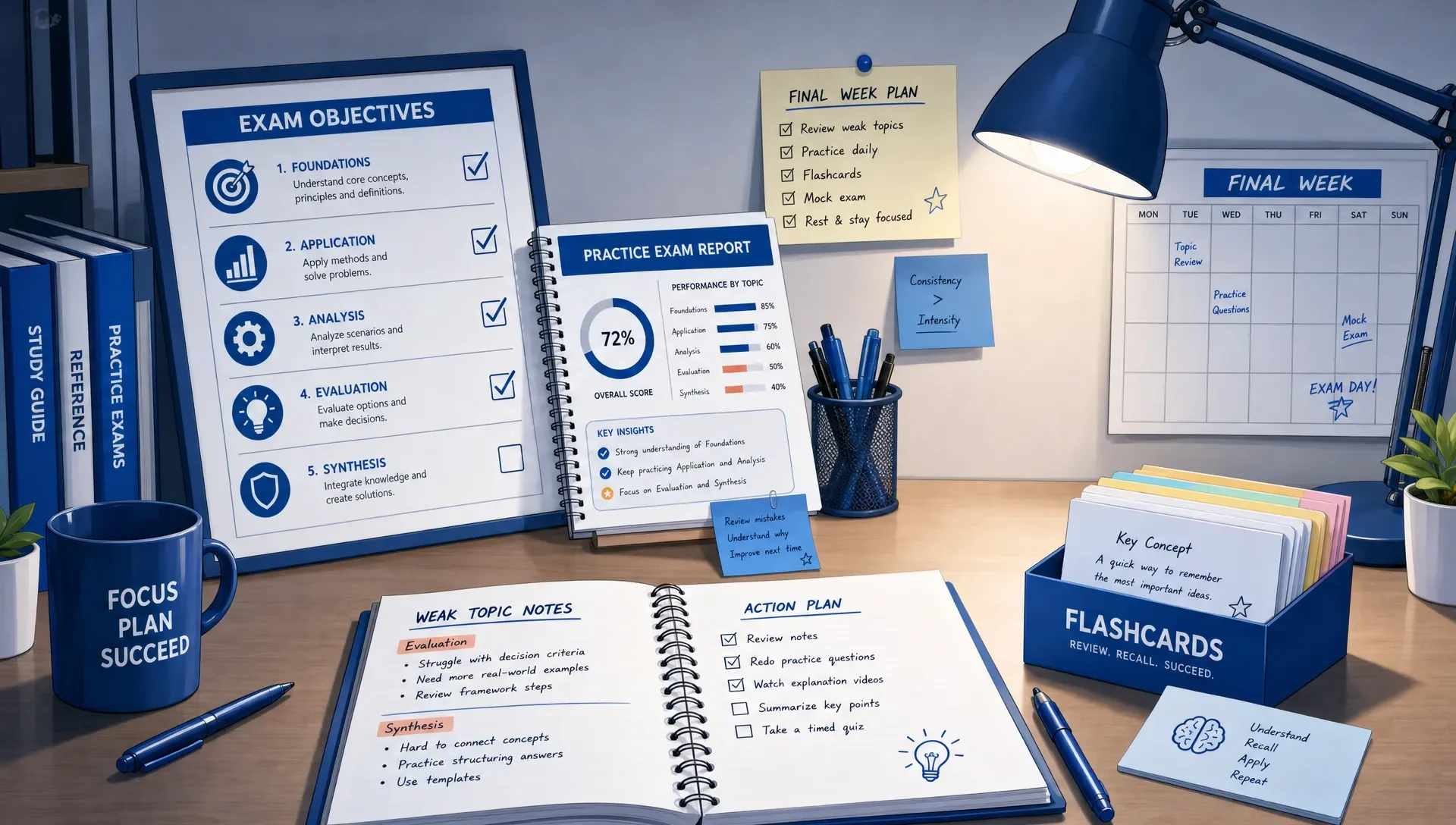
Official exam objectives are the clearest way to determine what should be in your final study plan. While vendors don't publish every question, they do outline the skills and knowledge areas the exam covers.
For instance, AWS describes exam scope and domains on its AWS Certified Cloud Practitioner certification page. Microsoft provides a detailed AZ-900 skills measured study guide. These official pages should guide your study order more than random forum advice or disorganized notes.
If you're preparing for AWS fundamentals, combine the official outline with a targeted AWS Certified Cloud Practitioner practice exam to pinpoint your weak domains. If Azure is your focus, a structured AZ-900 study guide organized around exam objectives helps you avoid studying cloud topics that, while useful generally, aren't urgent for the specific test you're facing.
When reviewing objectives, label each one as 'can explain,' 'can recognize,' or 'cannot do.' Items you 'can explain' only require a light review. Those you 'can recognize' need practice questions, as recognition can often fail under exam pressure. The 'cannot do' items require a focused study block before you test yourself further.
Convert Practice Questions Into a Study Order
Practice questions aren't just for checking your score; they're routing signals. A missed question shows you what to study next, but only if you accurately classify why you missed it.
Research supports this active approach. In a study, Roediger and Karpicke found that testing improved long-term retention more than repeated studying. A review by Dunlosky, Rawson, Marsh, Nathan, and Willingham rated practice testing and distributed practice as high-utility learning techniques. For certification prep, this means you should attempt questions first, review your answers afterward, and then retest yourself later.
Don't just note if you were right or wrong. Use the pattern of your misses to choose your next study action.
| Practice result | What it probably means | What to study first |
|---|---|---|
| You had no idea | Missing foundation | Read the objective section and create a short explanation in your own words |
| You confused two similar choices | Weak comparison | Build a contrast table and answer more questions on both concepts |
| You knew the concept but missed the clue | Poor question reading | Practice slower review of keywords and scenario constraints |
| You ran out of time | Slow recall | Drill the same format in small timed sets |
| You changed a correct answer to wrong | Low confidence | Write why the correct answer is correct and why the tempting answer is not |
Many learners waste their final days here: they take a full practice exam, get a low score, then try to study everything. A more effective habit is to review explanations, group your missed questions by objective, and then build your next study block around the largest cluster of errors. MindMesh Academy's guide to practice examination habits that improve recall explores using practice tests for retrieval training, not just a single score report.
If You Have One Week, Three Days Or One Day
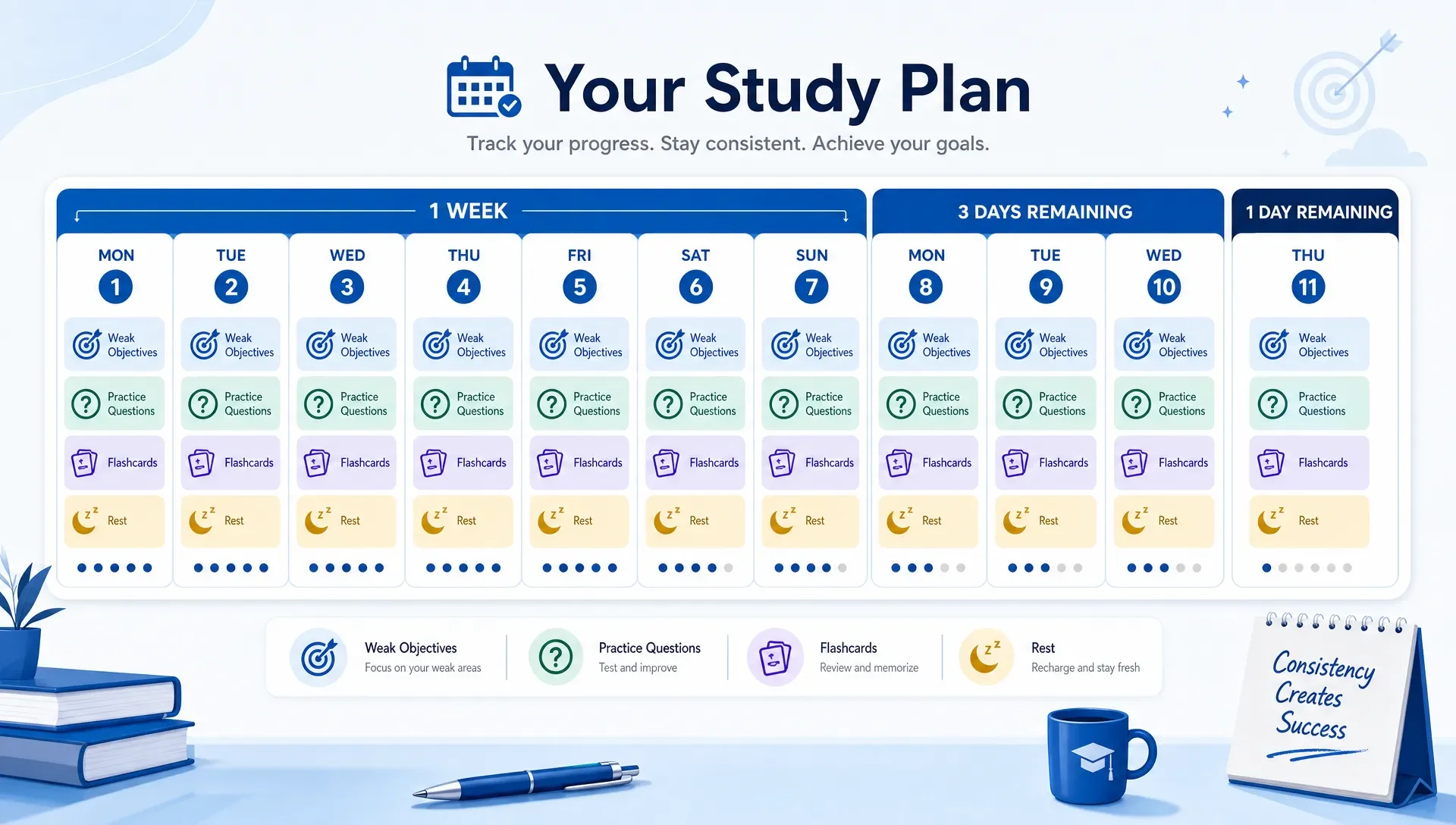
Your study priorities shift as the exam date approaches. With a week remaining, you can still strengthen weak concepts. With only one day left, your decisions need to be sharper, and you should focus on reinforcing, not learning new material.
| Time left | Main goal | Best study order |
|---|---|---|
| 7 days | Repair weak domains and stabilize recall | Objective gaps, practice sets, flashcards, then a mixed review |
| 3 to 4 days | Convert mistakes into points | Repeated misses, high-weight topics, scenario formats, then quick facts |
| 24 hours | Reduce avoidable errors | Top missed objectives, flashcards, exam logistics and light mixed practice |
| Morning of exam | Stay sharp without overloading | Short recall, formulas or facts, calm review of common traps |
If my exam were in one week, I'd follow a daily loop of study, practice, and review. If it were tomorrow, I wouldn't try to learn an entirely new domain unless it was absolutely core to the exam. Instead, I'd focus on repeated mistakes, memorizing facts, and clarifying misunderstood comparisons.
A full-length practice exam can still be beneficial if you have sufficient time to review it thoroughly. Without review time, a full test can just add stress. In the final 24 hours, shorter question sets with immediate explanation review typically offer more actionable feedback.
Stop Doing Low-Yield Work First
As the exam date nears, low-yield work can become tempting because it offers a sense of control. Rereading notes, highlighting old PDFs, and reorganizing materials might make you feel productive, but they don't actively test your recall.
Prioritize these less effective activities last:
- Recopying notes you already understand
- Watching long lessons without pausing to answer questions
- Making perfect flashcards for topics that are unlikely to appear
- Studying every domain for the same amount of time
- Taking practice tests without reviewing explanations
If you find yourself doing passive review, switch to a question. Challenge yourself to define a concept, differentiate between two similar answers, or explain why an option is incorrect. MindMesh Academy's article on study methods for exams that beat rereading is helpful if you recognize your current routine is too passive.
Reading still has its place. Use it after a question reveals a knowledge gap, not before you've identified that gap. This keeps your reading focused and prevents you from spending an entire night on material that wasn't your highest priority risk.
Build a Final Daily Review Loop You Can Repeat
An effective final review loop is straightforward enough to repeat even when you're tired. Don't design a study plan that demands perfect energy, especially if you're preparing after work or juggling other responsibilities.
Try this structure for each study block:
| Step | Time | Output |
|---|---|---|
| Recall | 10 minutes | Flashcards or closed-book prompts for known weak facts |
| Repair | 25 to 45 minutes | Focused study on one objective or concept cluster |
| Practice | 20 to 40 minutes | Questions only from that weak area, then a small mixed set |
| Explain | 15 to 25 minutes | Written explanation of why missed answers were wrong |
| Track | 5 minutes | Update weak topics and choose the next block |
This loop is intentionally short, providing feedback every session. If your score improves in a weak area, shift that topic to maintenance review and select your next focus. If the same topic remains weak, narrow it down further. For example, don't just label the issue as 'networking.' Instead, specify 'subnet masks,' 'routing tables,' 'security groups,' or 'DNS records.'
MindMesh Academy supports this connected workflow: objective-based study guides, practice questions with detailed explanations, flashcards using spaced repetition, adaptive weakness-based practice, and readiness tracking. These tools help you stay organized in the final days, removing the guesswork about what to study next.
How to Choose Between Two Weak Topics
Sometimes two topics seem equally challenging. When this happens, don't automatically choose the one that feels scarier. Instead, use these four tie-breakers.
First, prioritize the topic connected to a larger exam domain. Second, select the topic that frequently appears in scenario questions, as these can influence multiple answers. Third, choose the topic that prevents you from understanding related concepts. Fourth, pick the topic you believe you can improve fastest.
For instance, if you're deciding between a broad governance concept and a specific encryption comparison you consistently miss, the best first move depends on its exam weight and how quickly you can fix it. A 30-minute contrast table for encryption types might yield points faster than a broad reread of governance. However, if governance is a high-weight domain and your errors span several subtopics, it merits a dedicated repair block.
If my exam is close, I want each session to conclude with a clear decision: this topic is fixed, needs another review, or should be set aside. Setting a topic aside isn't quitting. It means you're safeguarding limited time for the work most likely to boost your score.
Frequently Asked Questions
What should I study first if my exam is tomorrow? Prioritize your repeated misses, especially those within high-weight objectives. Then, review short memory items like formulas, ports, definitions, acronyms, or process steps. Avoid starting large new topics unless they are absolutely central to the exam.
Should I take a full practice test close to exam day? Only take a full practice test if you have ample time and energy to review every missed answer thoroughly. If you can't review it, opt for shorter timed sets instead. The actual learning primarily occurs during the review process.
Is it better to study weak topics or high-weight topics first? Begin where weakness and exam weight intersect. A weak topic within a high-weight domain takes precedence over a weak topic that rarely appears. If two topics seem equally important, choose the one you can improve fastest.
How many hours should I study when my exam is close? Study for the number of focused hours you can sustain, not the maximum you can imagine. Two concentrated sessions with practice and review are often more effective than five tired hours of rereading. Protect your sleep on the final night, as fatigue contributes to careless errors.
Should I review notes or do practice questions first? Do practice questions first if you've already studied the material. Questions reveal what you truly recall. Use your notes after the question set to address specific knowledge gaps.
What if my exam score is not improving? Pause from taking random mixed tests. Group your missed questions by objective, address the largest cluster of errors, and then retest that specific cluster before resuming mixed practice.
Make Your Final Study Sessions Count
When the exam date is near, you don't need more study materials; you need a clearer next step. Select the objective most likely to impact your score, practice it actively, review the explanations, and track your improvement.
To streamline this workflow, MindMesh Academy helps you prepare with objective-based study materials, practice questions, and readiness tracking for your certification path. Start with the exam you're facing, and let your weakest areas guide your study priorities. Prepare for your AZ-900 certification with confidence and put your knowledge to the test through our AZ-900 practice exam.

Written by
Alvin Varughese
Founder, MindMesh Academy
Alvin Varughese is the founder of MindMesh Academy and an enterprise architecture leader. An electrical engineer by training, he moved from factory automation in South Africa to cloud architecture at GE Appliances and Humana (Fortune 50), and holds 20 professional certifications including AWS Solutions Architect Professional, Azure DevOps Engineer Expert, and Microsoft Agentic AI Business Solutions Architect. He built MindMesh Academy after interviewing too many highly certified candidates who couldn't answer basic questions: the goal is prep that makes you better at the job, not just able to pass the exam.