Exam Objectives: Turn Every Domain Into a Study Task
Exam Objectives: Turn Every Domain Into a Study Task
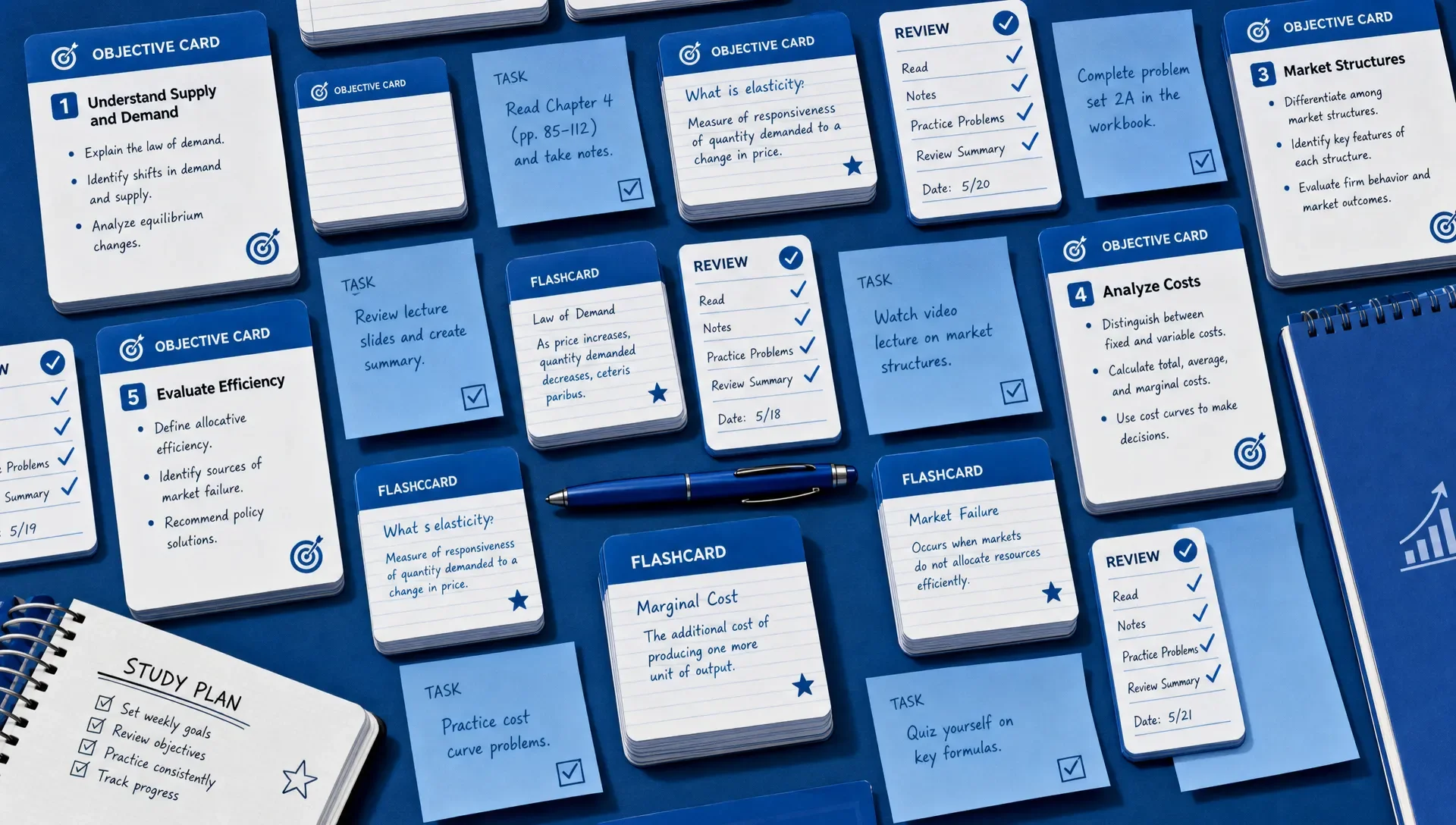
Preparing for a certification? Your first step should be converting the official exam objectives into clear, trackable study tasks. Skip starting with a stack of videos or a hefty 500-page book. Instead, begin with the exam blueprint. Break down each domain into actionable steps, and ensure every study session builds toward proving a specific skill.
An effective study task has three components: what you need to grasp, what you need to perform, and how you'll confirm your readiness. For instance, an objective requiring you to identify cloud pricing models could translate into a task like: "Compare pay-as-you-go, reserved capacity, and free tier limits, then answer 15 mixed scenario questions without using notes."
Why Official Objectives Guide Your Study Plan
Certification providers don't expect you to memorize every single fact about a technology. They publish a scope – often called an exam guide, skills outline, or content blueprint. This document sets the boundaries for what can appear on the test, helping you avoid wasting time on topics that won't make a difference.
Official resources differ by vendor. AWS provides certification exam guides on its AWS Certification pages. Microsoft details skills measured on Microsoft Learn, for example, the AZ-900 study guide. Cisco lists exam topics for certifications like CCNA, and CompTIA offers objective documents on its certification pages, including Security+.
Many candidates read these documents once and then forget them. A more effective strategy is to view them as your personal work breakdown structure. Every single line in those objectives becomes a concrete job to finish, not just a general suggestion to "learn networking" or "understand cloud billing."
Converting Exam Objectives into Study Tasks
To transform exam objectives into practical study tasks, rephrase each one as an actionable step. The specific wording chosen by vendors is crucial. These verbs indicate the depth of preparation required.
For example, if an objective uses "identify," you'll likely need to recognize and compare options. If it says "configure," aim for hands-on familiarity or at least a detailed procedural understanding. An objective with "troubleshoot" means you must diagnose problems from symptoms, rule out incorrect choices, and select the safest immediate action.
Follow this straightforward conversion pattern:
| Objective element | What to extract | Example study task |
|---|---|---|
| Domain | The broad area being tested | Security controls, IAM, routing, risk management |
| Verb | The required skill level | Explain, configure, compare, troubleshoot, calculate |
| Object | The topic or feature | Encryption types, subnet masks, project constraints |
| Proof | How you'll verify readiness | Scenario questions, flashcards, lab notes, timed quiz |
This approach keeps your study plan actionable. Instead of a vague "study IAM," create a task like: "Compare identity-based and resource-based permissions, then explain which policy applies first in five access scenarios." This task has a clear goal.
Match Resources to the Objective's Verb
Much study time is wasted by mismatching resources to objectives. A lengthy lecture might support a conceptual objective, but it's insufficient for tasks requiring you to implement, calculate, or troubleshoot.
Let the objective's verb guide the type of work you assign to a task. You don't need every study resource for every topic; you need the one that aligns with the performance expected on exam day.
| Objective wording | What it usually requires | Best study activity |
|---|---|---|
| Identify or recognize | Spot the correct option among distractors | Flashcards, matching drills, short quizzes |
| Explain or describe | Connect concepts and tradeoffs | Notes in your own words, teach-back practice |
| Compare or differentiate | Choose based on scenario constraints | Side-by-side tables, scenario questions |
| Configure or implement | Know steps, settings and consequences | Guided labs, command review, procedural recall |
| Troubleshoot | Diagnose from symptoms | Case questions, elimination practice, error analysis |
This is also where a cohesive study workflow is beneficial. MindMesh Academy structures study guides by objectives, then links them to practice questions, flashcards, and readiness tracking. This way, you clearly see your weak areas instead of relying on memory or guesswork.
Prioritize Study Time with Domain Weights
Not all exam domains require equal study time. If an official guide assigns a higher weight to a domain, it warrants more study tasks, more practice questions, and more review cycles. For lighter-weight domains, ensure you still cover them, but don't let them dominate your schedule.
Domain weights are particularly helpful for broad exams, such as cloud fundamentals, security certifications, networking exams, and project management tests. These cover numerous topics. Without weights, students often gravitate towards familiar or interesting subjects first, which can lead to a deceptive feeling of progress.
Structure your study plan so that higher-weighted domains generate a larger task backlog. If the vendor's current guide specifies exact percentages, use them. If only domains are listed without percentages, estimate effort based on the number of subtopics, the complexity of the verbs, and your diagnostic assessment results.
Build a Task Backlog for Each Domain
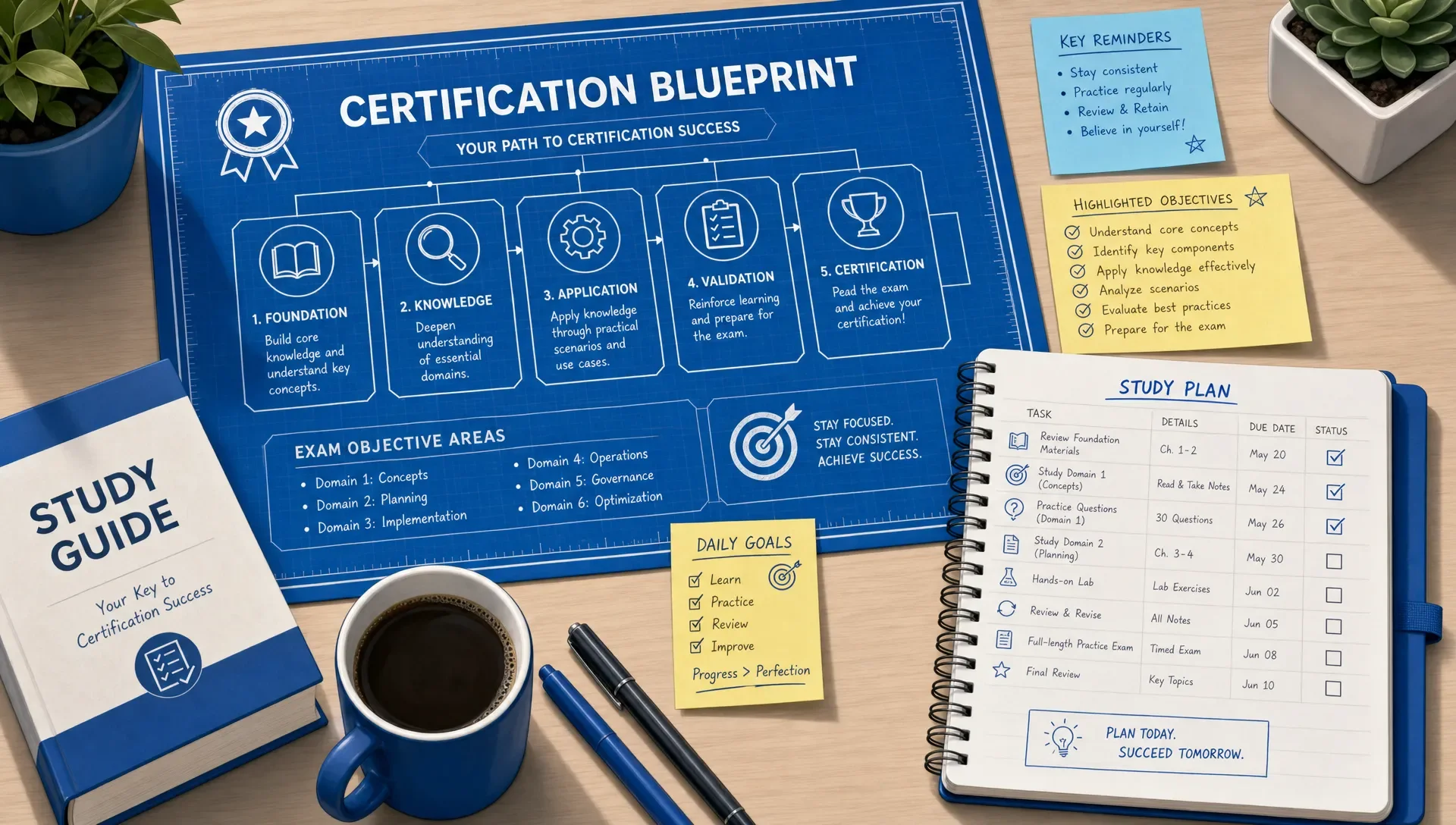
Think of a task backlog as a dynamic list of all work you need to finish before your exam. For certification preparation, organize it by domain and link it directly to exam objectives, not to textbook chapters, video modules, or a course's arbitrary sequence.
Begin with a single domain. Transfer each objective into your tracker, then write a task in clear, simple language. Keep each task small enough to complete in one sitting. If a task requires more than 45 to 60 minutes, divide it.
| Domain area | Objective style | Weak task | Better task |
|---|---|---|---|
| Cloud billing | Compare pricing models | Study billing | Explain three pricing models and answer 10 billing scenarios |
| Networking | Troubleshoot connectivity | Review routing | Given a failed connection, identify whether DNS, routing or firewall rules are likely at fault |
| Security | Implement access control | Learn IAM | Build a decision table for users, groups, roles and least privilege scenarios |
| Project management | Analyze constraints | Read constraints | Classify 12 scenarios by scope, schedule, cost, risk or stakeholder constraint |
For a more in-depth explanation of building this larger study framework, MindMesh Academy offers a related guide on turning official objectives into an exam study guide. The method discussed here is more focused: taking that overarching structure and converting it into the very next task you can concretely accomplish.
Making Vague Objectives Testable
Some objectives, especially in foundational exams, are written broadly. Terms like "understand," "demonstrate knowledge of," or "describe" can seem too general for effective study. Don't leave them that way. Transform broad language into specific, observable behaviors.
A vague objective becomes measurable once you add a scenario, a constraint, or a decision point. For example, "understand shared responsibility" isn't a study task yet. A better task is: "Classify 20 responsibilities as customer, provider, or shared across IaaS, PaaS, and SaaS situations."
This same approach applies to management and governance topics. "Know risk management" turns into "Identify the best response to avoidance, mitigation, transfer, and acceptance scenarios." "Understand change control" becomes "Choose the next step after a change request affects schedule, cost, or scope."
If you struggle to create a task from an objective, you're likely missing either the action verb or the proof. Ask yourself: "What decision would the exam expect me to make?" and "What common mistake would a distractor try to trick me into choosing?"
Your Weekly Workflow: An Objective-Driven Cycle
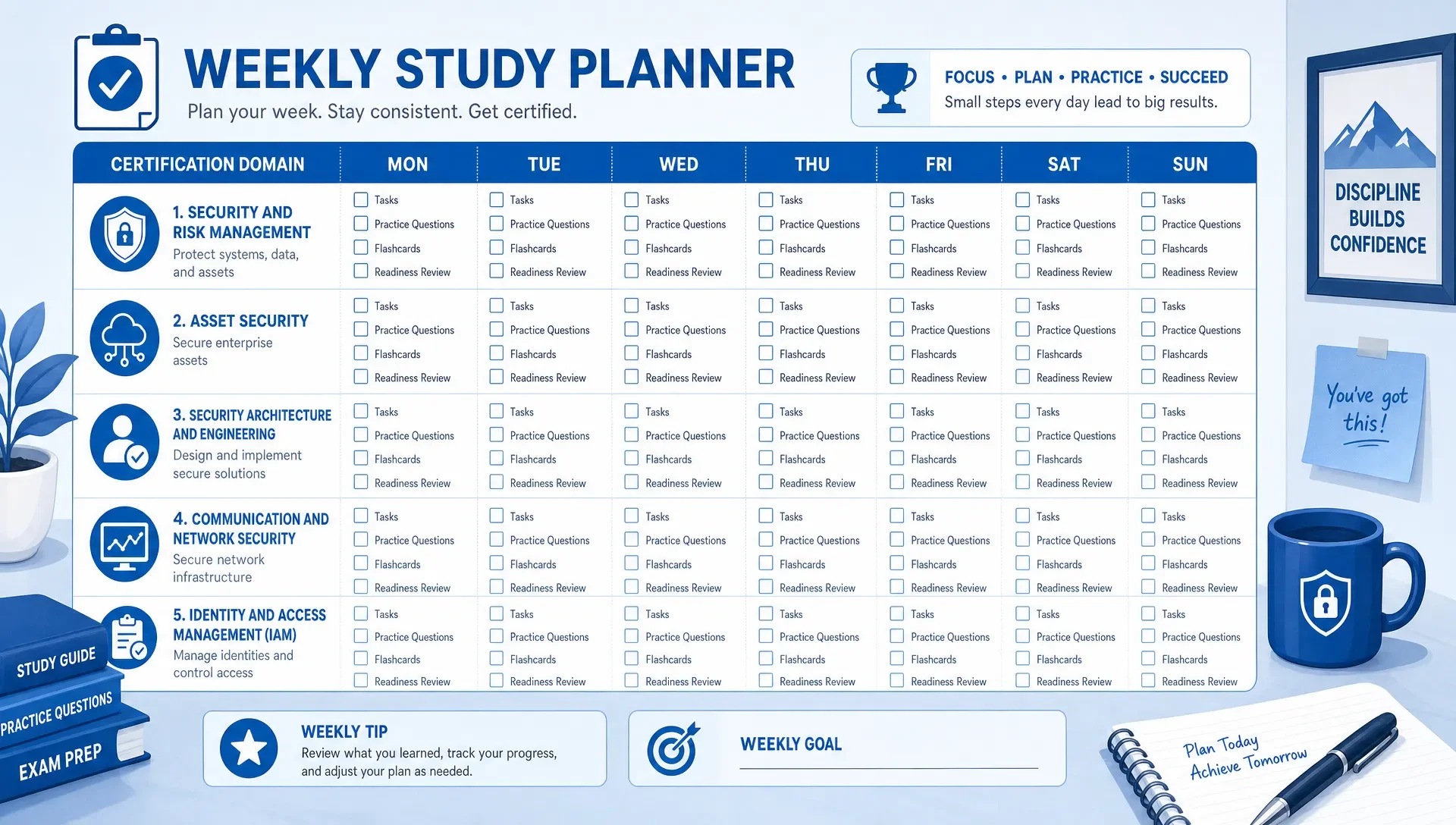
With your backlog in place, your week should follow a simple, repeating cycle: select objectives, actively learn, practice, review incorrect answers, and update your mastery status. This iterative process is crucial; a static plan that doesn't adapt to practice results is just a checklist.
Here's what a practical weekly rhythm could look like:
- Choose 3 to 6 objectives from one or two domains.
- Read or watch only the material necessary to address those objectives.
- Create flashcards for definitions, steps, formulas, or command differences.
- Answer mixed practice questions even before you feel completely ready.
- Review every wrong answer and link it back to the specific objective.
- Transition mastered items to spaced review, rather than daily re-reading.
That final step saves you time. Objectives you've already mastered don't need the same intense focus as those consistently causing errors. If you appreciate routines, the MindMesh Academy article on how to study for a certification exam with a weekly loop complements this task-based approach well.
Update Your Objective Map with Practice Results
Practice questions offer the most value when they directly influence your next study decision. Don't simply log a score. Instead, identify which objective led to the mistake, why you made it, and what specific task will resolve that weakness.
For instance, missing a question on subnetting doesn't automatically mean your entire networking domain is weak. The actual problem might be calculating CIDR ranges under time constraints. Similarly, an incorrect AWS security question might not indicate a general security weakness; you might just need to clarify the distinction between IAM policies, resource policies, and service control policies.
MindMesh Academy's practice questions, explanations, adaptive weakness-based practice, and topic-specific progress tracking are built for this type of feedback. If you're studying for a cloud fundamentals exam, you might use an AWS Certified Cloud Practitioner practice exam alongside your objective map, allowing each incorrect answer to guide your next study task. For cybersecurity focus, a CompTIA Security+ practice exam helps you assess your domain knowledge under scenario-based pressure.
For a more robust review, don't just check if you were right or wrong. Also examine the distractors. Our guide on how to review every answer in practice exam questions shows you how to use each option to pinpoint gaps in your reasoning.
Defining "Done" for Each Study Task
A study task is complete when you can perform the skill without needing to consult explanations, not merely when you've finished a study resource. This is where many candidates misjudge their readiness. They read a chapter, feel a superficial familiarity with the terms, and then move on before truly testing their recall.
Establish clear completion rules for every task. A conceptual task might demand explaining an idea in your own words and passing a short quiz. A configuration task could involve listing steps in sequence and predicting the outcome of changing a setting. A scenario task might require selecting the correct answer and confidently dismissing distractors with sound reasoning.
Your completion rule should align with the objective type:
| Task type | Completion rule |
|---|---|
| Definition or term | Recall the meaning and recognize a misleading distractor |
| Comparison | Choose the better option based on constraints |
| Procedure | List the steps and explain what each step changes |
| Troubleshooting | Identify the likely cause and the safest next action |
| Governance or policy | Apply the rule to a realistic scenario |
With defined completion rules, your study plan becomes quantifiable. You can clearly see what's finished, what's still uncertain, and what remains unaddressed.
Track and Address Your Recurring Errors
Your objective map guides what to study. Your error list reveals how you typically falter. Maintain both. Recurring errors often span multiple domains, and resolving them can boost your score more quickly than simply rereading an entire topic.
Common patterns include rushing past qualifiers like "most cost-effective," overlooking negative phrasing, selecting a technically correct answer that doesn't fit the scenario, or confusing two similar services or processes. Add each observed pattern to your review list, along with an example from your own practice.
Then, create specific tasks to address these patterns. If you consistently miss negative wording, consciously slow down and underline the command phrase in every practice question. If you pick overly complex answers, practice identifying the simplest solution that meets the requirement. When two services or concepts blend together, create a three-column comparison table: "When to use it," "When not to use it," and "Common distractor wording."
A Customizable Template for Your Study Tasks
Apply this template to each domain. You can maintain it in a spreadsheet, a notes application, or a dedicated certification tracker.
| Field | What to write |
|---|---|
| Domain | The official domain name from the vendor guide |
| Objective | The exact objective or subobjective |
| Verb | Identify, explain, configure, troubleshoot, or another action |
| Study task | One concrete action you can finish in one sitting |
| Proof | Quiz score, teach-back, scenario set, flashcard accuracy, or lab result |
| Status | Not started, learning, practicing, mastered, needs review |
| Next review | The date you'll revisit it through spaced repetition |
This adaptable format works for AWS, Azure, CompTIA, Cisco, ITIL, ISC2, and PMI-style exams because it focuses on the skill the objective requires you to demonstrate, rather than being tied to a specific vendor. If you're using MindMesh Academy, you can complement this template with our study guides organized by exam objectives, flashcards that use spaced repetition, adaptive practice questions, and readiness tracking. For foundational cloud knowledge, the AZ-900 Microsoft Azure Fundamentals study guide offers a solid example of starting with objectives instead of generic topic review.
Frequently Asked Questions
What are exam objectives in certification prep? Exam objectives define the official topics and skills a certification vendor deems testable. You might find them labeled as domains, tasks, skills measured, exam topics, or a content outline, depending on the provider.
Should I study objectives in the vendor's listed order? Not necessarily. Prioritize high-weight domains, prerequisite knowledge, and your weakest areas first. While the vendor's order ensures full coverage, your personal study sequence should prioritize what builds your readiness most effectively.
How detailed should each study task be? Each task should be small enough to complete in one sitting and specific enough to demonstrate mastery. "Study networking" is too general. "Explain how VLANs separate broadcast domains and answer 10 related questions" is far more effective.
What if an objective covers material I already know? Quickly test your knowledge before skipping. If you can answer mixed questions and explain your reasoning without notes, move that objective to a spaced review schedule instead of dedicating full study time to it.
How do I integrate practice questions with objectives? Link each missed question to the specific objective it tested, then create a corrective task. The aim isn't just a higher score; it's to pinpoint the failed skill and practice it directly.
Do performance-based questions need a different task plan? Yes. For performance-based exam formats, include tasks where you apply steps, interpret outputs, configure settings, or choose actions in a specific sequence. Simply recognizing information usually won't suffice.
Make Every Study Session Count Towards Progress
An effective certification plan doesn't just ask, "What should I study today?" Instead, it shifts to, "Which objective will I prove today?" This mindset keeps your preparation focused, measurable, and easily adjustable when practice results highlight a weak area.
To build this kind of focused study plan and connect objectives with clear explanations, flashcards, and readiness tracking, consider MindMesh Academy. Explore our certification paths, transform each domain into actionable tasks, and let your practice results guide your next steps. For example, you can build a strong foundation for the CompTIA Network+ exam with our dedicated CompTIA Network+ practice exam to see how well you've mastered each objective.

Written by
Alvin Varughese
Founder, MindMesh Academy
Alvin Varughese is the founder of MindMesh Academy and an enterprise architecture leader. An electrical engineer by training, he moved from factory automation in South Africa to cloud architecture at GE Appliances and Humana (Fortune 50), and holds 20 professional certifications including AWS Solutions Architect Professional, Azure DevOps Engineer Expert, and Microsoft Agentic AI Business Solutions Architect. He built MindMesh Academy after interviewing too many highly certified candidates who couldn't answer basic questions: the goal is prep that makes you better at the job, not just able to pass the exam.