How to Turn Objectives Into an Exam Study Guide
How to Turn Objectives Into an Exam Study Guide
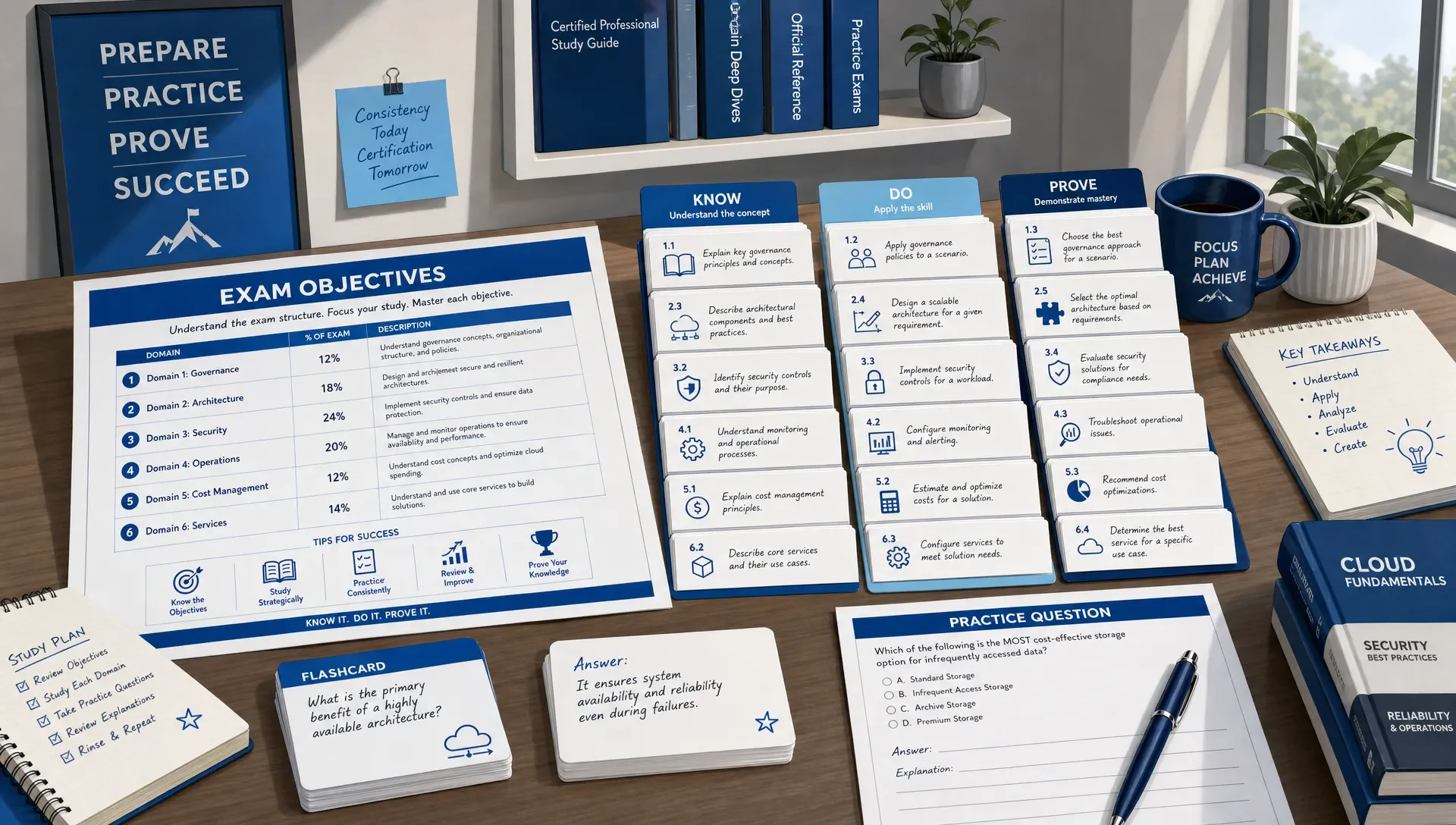
A strong exam study guide starts with the official objectives, not a stack of random notes. Your job is to transform each objective into three core components: what you must know, what you must be able to do, and how you'll prove your readiness for exam conditions.
Use the official objectives as your table of contents. Then, build a study workflow around them: learn the concept, practice recall, answer scenario questions, review mistakes, and mark your readiness by objective. This approach keeps your preparation focused, especially for certification exams where the outline is broad and questions test application, not just definitions.
Start With the Official Exam Objectives
Exam objectives act as your blueprint. They detail the tested domains, how content groups together, and often the weight of each domain. Before you open a textbook, watch a video, or take a practice exam, download the current objective list directly from the certification provider.
Don't rewrite the objectives just yet. Scan them first as a whole and consider a few practical questions:
- Which domains have the highest exam weight?
- Which objectives contain action verbs like configure, troubleshoot, compare, or recommend?
- Which topics are completely new to you?
- Which objectives require hands-on understanding instead of rote memorization?
- Which topics overlap with your current job experience?
This initial review prevents a common study mistake: treating every line item equally. A small definition objective and a heavily tested scenario objective should never receive the same amount of study time.
For instance, if you're preparing for a fundamentals-level cloud exam, an objective-aligned resource like the AZ-900 Microsoft Azure Fundamentals study guide can show you how official skills organize into a learner-friendly path instead of a flat checklist.
Convert Each Objective Into Know, Do, and Prove
The simplest way to build an exam study guide from objectives is to split each one into three columns: know, do, and prove. This method works because certification exams typically test a blend of recall, decision-making, and applied judgment.
| Objective layer | What it means | What to put in your study guide |
|---|---|---|
| Know | The facts, terms, services, formulas, or definitions behind the objective | Short explanations, comparison tables, diagrams, and flashcards |
| Do | The task or decision the exam expects you to perform | Step-by-step workflows, configuration logic, troubleshooting paths, or scenario notes |
| Prove | The evidence that you can answer under exam conditions | Practice questions, timed drills, mistake reviews, and readiness checks |
For example, an objective stating you must compare storage options shouldn't become a page of copied definitions. Instead, it should turn into a decision table: when to use each option, which tradeoffs matter, what constraints change the answer, and what question wording points to a specific choice.
This translation skill extends beyond exam prep. Any objective-driven system improves when broad goals become concrete actions. Think about mapping certification domains or how civic technology groups define technology-driven participation goals in practical terms. For exams, the same rule applies: if an objective can't translate into actions and evidence, your guide remains too vague.
Build a Domain Map Before You Write Notes
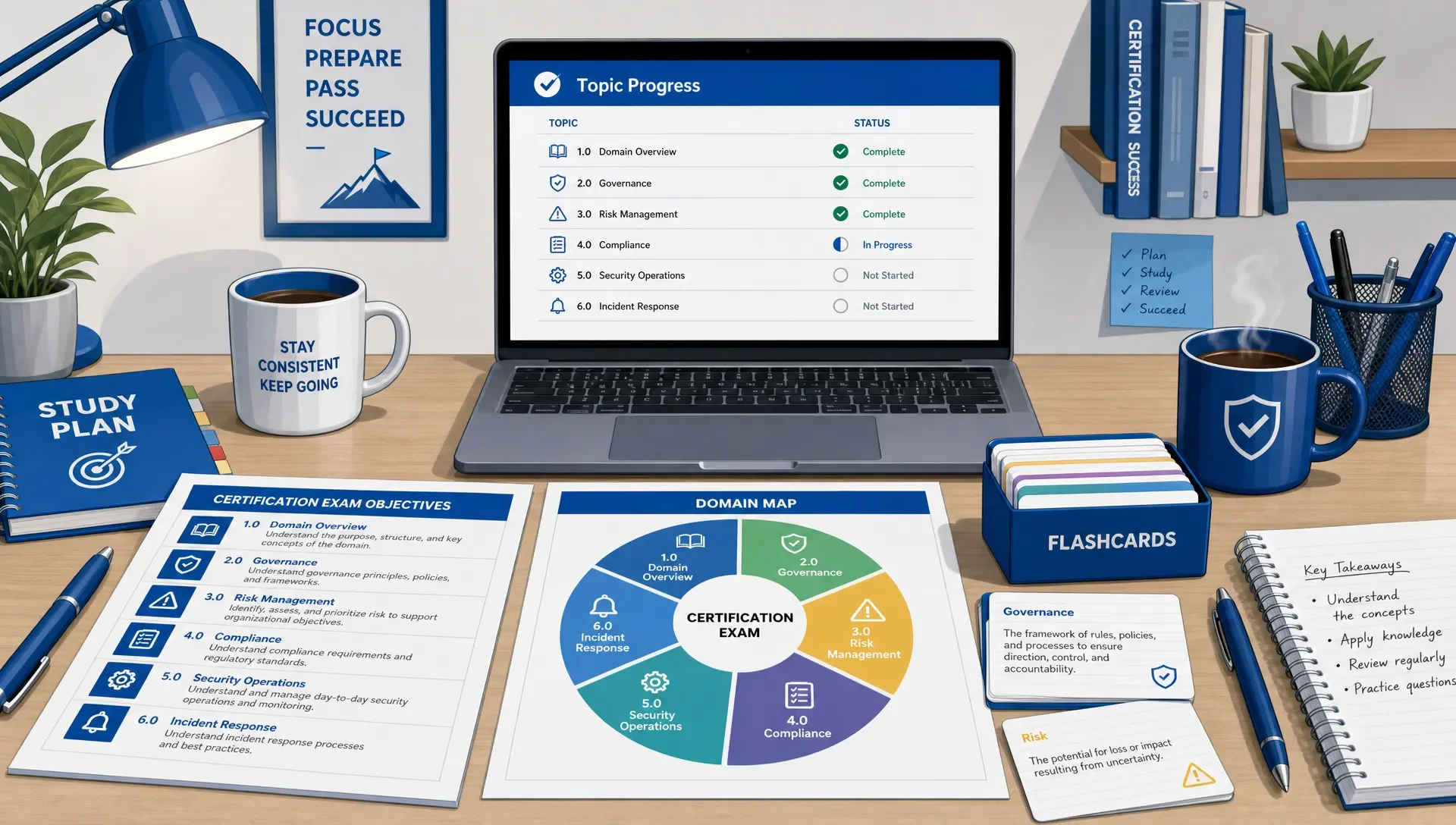
A domain map forms the working skeleton of your exam study guide. It prevents you from studying isolated facts without understanding their context. Build it in a spreadsheet, notebook, or study app, but keep the structure simple enough that you'll actually use it.
Your domain map should include the domain name, objective, subtopics, study source, practice format, confidence level, and next review date. The goal isn't to create a perfect document. The goal is to ensure every study session ties back to a tested skill.
| Domain | Objective | Subtopics to learn | Practice type | Status |
|---|---|---|---|---|
| Cloud concepts | Explain core service models | IaaS, PaaS, SaaS, shared responsibility | Flashcards and comparison questions | Learning |
| Security | Identify access control methods | MFA, roles, policies, least privilege | Scenario questions | Needs practice |
| Networking | Troubleshoot connectivity | DNS, routing, firewalls, ports | Performance-style walkthrough | Not started |
| Operations | Choose monitoring tools | Metrics, logs, alerts, dashboards | Case-based questions | Review scheduled |
Use domain weights to guide your first draft, then adjust based on your practice performance. If a domain accounts for a large portion of the exam but your diagnostic results are strong, you'll still review it, but you don't need to overinvest. If a smaller domain repeatedly causes mistakes, it deserves focused repair time.
Write Study Guide Sections Based on Objective Verbs
The verb in an objective tells you what kind of study content you need. Ignoring this verb means your guide might look complete but fail to prepare you for the actual question style.
| Objective verb | What the exam may expect | Best study guide format |
|---|---|---|
| Define or identify | Recognize terms, services, components, or roles | Concise definitions, flashcards, matching drills |
| Describe or explain | Understand purpose, relationships, and basic behavior | Short concept summaries and diagrams |
| Compare or differentiate | Choose between similar tools, methods, or services | Side-by-side tables and decision rules |
| Configure or implement | Know the sequence or conditions for setup | Workflow notes and hands-on practice prompts |
| Troubleshoot | Diagnose symptoms and select the best fix | Symptom-to-cause tables and scenario questions |
| Recommend | Choose the best option from constraints | Case studies, tradeoff charts, and elimination logic |
This is where many learners accidentally create the wrong kind of guide. They generate definition-heavy notes for objectives that truly require comparison. Or they write long conceptual summaries for tasks that demand troubleshooting logic.
A good exam study guide should adapt its format to the objective. A governance objective might need a responsibility matrix. A networking objective might need a packet-flow sketch. A security objective might need a table comparing authentication, authorization, encryption, and auditing. A project management objective might need triggers, inputs, outputs, and decision criteria.
Add Practice Questions and Flashcards While You Study
Don't wait until the very end to start practicing. If you complete all your reading before testing yourself, you'll discover weaknesses too late. Build recall and application into each objective as soon as you study it.
Research supports this approach. A major review in Psychological Science in the Public Interest rated practice testing and distributed practice as high-utility learning techniques, meaning they generally work across many learning conditions when used well (Dunlosky et al., 2013). The Institute of Education Sciences also recommends spacing learning over time and using questions to support deeper understanding in its practice guide on organizing study (IES Practice Guide).
For your guide, this means each objective should include at least one recall prompt and one application prompt.
A recall prompt checks whether you remember the idea without looking. For example: "What is the purpose of least privilege?"
An application prompt checks whether you can use the idea. For example: "A user needs temporary access to a resource for one project. Which access control approach best reduces long-term risk?"
Flashcards work best for definitions, command meanings, formulas, service limits, lifecycle stages, and short comparisons. Practice questions are better for multi-step decisions, troubleshooting, and scenarios where several answers seem plausible.
MindMesh Academy's study workflow is built around this connection, offering study guides aligned to exam objectives, practice questions with explanations, flashcards with spaced repetition, adaptive weakness-based practice, and readiness tracking. The value comes from keeping these pieces connected rather than treating them as separate study chores.
Schedule Review by Domain Weight and Weakness
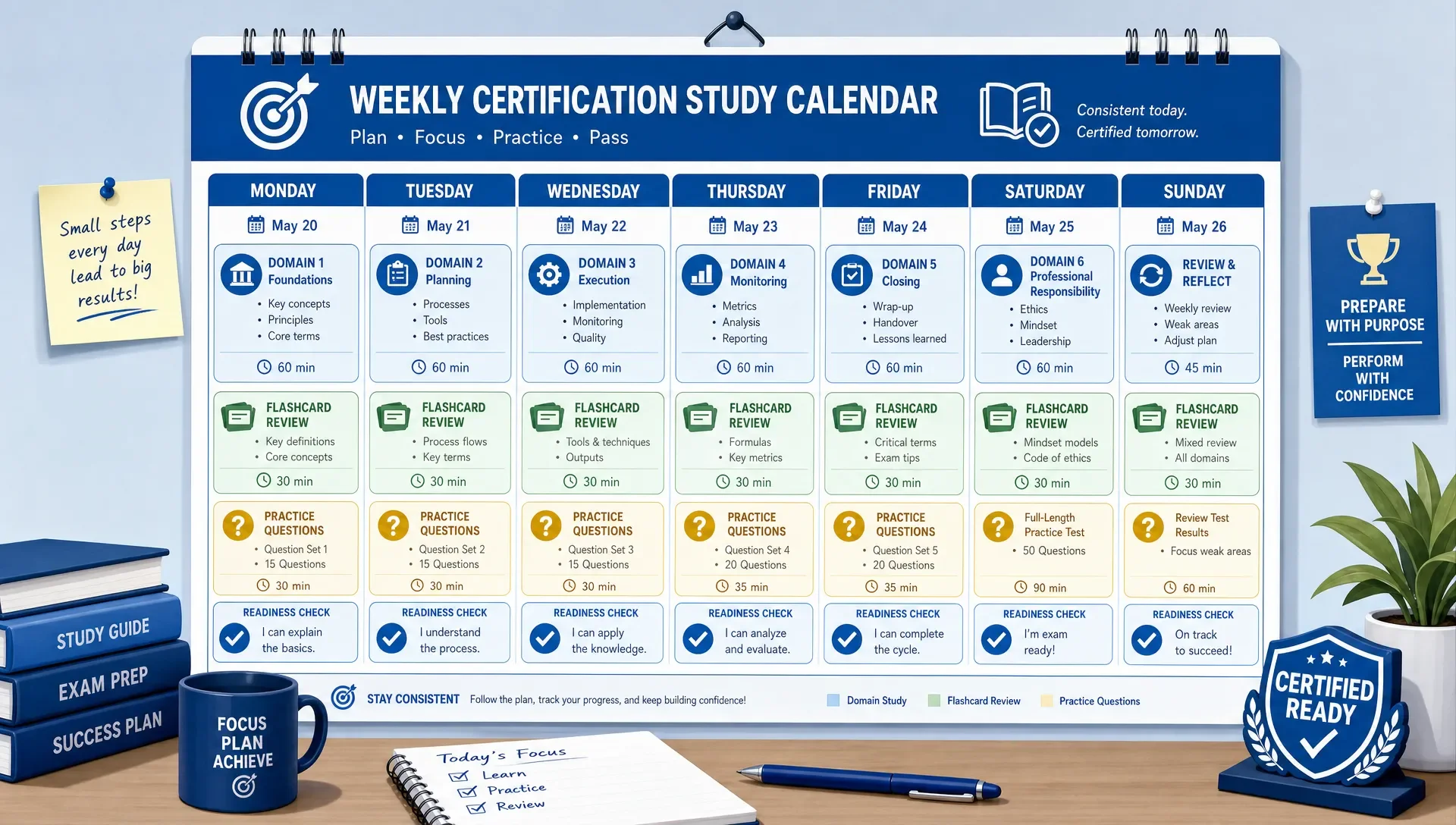
Once you've mapped your objectives, turn that map into a weekly plan. Don't schedule by chapter count. Instead, schedule based on domain weight, difficulty, and evidence from your practice sessions.
A simple weekly cycle often works well for most certification candidates:
- Learn two to four related objectives.
- Create or review flashcards for those objectives.
- Answer practice questions tied to the same objectives.
- Review every missed question and tag the cause.
- Revisit older weak objectives through spaced repetition.
If you need a planning structure, adapt a certification learning plan template so each week includes a domain focus, a review block, a practice block, and a catch-up buffer. The buffer is crucial because objectives often take longer than expected, especially when they require hands-on practice or scenario-based reasoning.
Here's a practical way to allocate your time without overcomplicating it:
| Objective priority | How to identify it | Study action |
|---|---|---|
| High weight, low confidence | Major domain and weak diagnostic results | Study first, practice often, review twice per week |
| High weight, high confidence | Major domain and strong performance | Maintain with mixed practice and periodic review |
| Low weight, low confidence | Smaller domain but repeated mistakes | Schedule focused repair sessions |
| Low weight, high confidence | Smaller domain and accurate answers | Use light spaced review |
This approach keeps your guide dynamic. It's not just a document you read; it's a control panel that tells you what to study next.
Track Readiness at the Objective Level
A total practice score can be helpful, but it can also obscure critical gaps. You might score well overall while consistently missing the same security, networking, or governance objective. That's why you should track readiness at the objective level.
Use a straightforward readiness scale:
| Readiness level | Evidence | Next action |
|---|---|---|
| Not started | You haven't studied the objective yet | Schedule a first-pass study block |
| Familiar | You recognize the terms but still need notes | Create flashcards and summaries |
| Recall ready | You can explain the objective from memory | Add practice questions |
| Application ready | You can answer scenarios and explain why wrong answers are wrong | Mix into timed practice |
| Exam ready | You perform accurately under timed, mixed conditions | Maintain with spaced review |
The phrase "explain why wrong answers are wrong" is particularly important. Many candidates can pick the correct answer after seeing similar questions, but the exam might change the wording. If you understand why the distractors are incorrect, you're better equipped to handle new scenarios.
When you're ready for broader testing, take a full-length or domain-mixed practice exam and map every mistake back to its objective. For example, if you're preparing for an entry-level AWS exam, an AWS Certified Cloud Practitioner practice exam can help you test whether your objective map holds up when topics are mixed.
After each practice session, update your guide. Add missing decision rules, rewrite confusing explanations, and schedule targeted review. The best guide is the one that gets sharper after every mistake.
Common Mistakes When Building an Exam Study Guide
The biggest mistake is simply copying the objective list and calling it a study guide. Objectives tell you what may be tested, but they don't teach the concept, show the decision logic, or prove readiness.
Another mistake is studying material in the order someone else presents it, without checking your own weakness patterns. A published order can be useful, but your final plan should reflect your diagnostic results, work experience, deadline, and the exam's weighting.
Watch for these specific problems:
| Mistake | Why it hurts | Better approach |
|---|---|---|
| Writing long notes for every objective | You spend time producing notes but avoid recall | Keep notes short and add questions early |
| Ignoring objective verbs | You prepare for definitions when the exam asks for decisions | Match the study format to the verb |
| Saving practice exams for the final week | Weaknesses appear too late to fix | Use objective-level practice throughout prep |
| Reviewing only correct answers | You miss the reasoning behind distractors | Review wrong and guessed answers carefully |
| Tracking only total score | Weak domains stay hidden | Track score and confidence by objective |
A good guide should challenge you in the right way. It should force you to retrieve, compare, decide, and explain. If your guide only helps you reread, it isn't doing enough.
Frequently Asked Questions
How do I start an exam study guide from objectives? Start by copying the official domains and objectives into a table. For each objective, add what you need to know, what you need to do, how you'll practice it, and how you'll prove readiness.
Should I follow the exam objectives in order? Not always. Use the official order for structure, but prioritize by domain weight, difficulty, and your diagnostic results. High-weight weak areas should move earlier in your plan.
How detailed should each objective section be? Detailed enough that you can explain the concept, answer a scenario, and identify why wrong answers are wrong. Avoid turning your guide into a textbook. Short explanations combined with active practice usually work better.
When should I take practice tests? Use short objective-level practice early in your preparation. Then, move into mixed and timed practice as more domains become application-ready. Don't wait until the final week to discover gaps.
Do flashcards work for certification exams? Yes, when used for the right content. Flashcards are useful for terms, definitions, comparisons, formulas, commands, and service characteristics. Pair them with scenario practice for applied objectives.
How do I know my exam study guide is working? Your guide is working when weak objectives become easier to recall, practice explanations make sense without memorizing them, and your mistakes become less random over time.
Build an Objective-Based Study Workflow
Transforming exam objectives into a structured study guide gives you clear control over your preparation. You'll know exactly what the exam expects, which areas demand more attention, and what evidence confirms you're truly ready.
To streamline this entire workflow and get the most out of your study time, MindMesh Academy offers structured study guides, detailed practice questions with explanations, and spaced repetition flashcards across major certification paths. If you're tackling the AWS Certified Cloud Practitioner exam, for example, explore our AWS Certified Cloud Practitioner study guide to build your foundation and ensure every study session drives real progress.

Written by
Alvin Varughese
Founder, MindMesh Academy
Alvin Varughese is the founder of MindMesh Academy and an enterprise architecture leader. An electrical engineer by training, he moved from factory automation in South Africa to cloud architecture at GE Appliances and Humana (Fortune 50), and holds 20 professional certifications including AWS Solutions Architect Professional, Azure DevOps Engineer Expert, and Microsoft Agentic AI Business Solutions Architect. He built MindMesh Academy after interviewing too many highly certified candidates who couldn't answer basic questions: the goal is prep that makes you better at the job, not just able to pass the exam.