
Maximize Your IT Career Advancement Opportunities
Maximize Your IT Career Advancement Opportunities
You're probably in one of two places right now. You're good at your job, people trust you, and yet your role feels oddly fixed. Or you're looking at adjacent IT roles like cloud, security, data, or platform engineering and realizing that “work hard and wait” isn't a strategy anymore.
This change is key to understanding career advancement today. Advancement used to feel tied to tenure, manager approval, and a predictable org chart. In modern IT, movement is more deliberate. You need a target role, a visible skill stack, proof you can operate at the next level, and a system for tracking whether you're closing the gap.
Many junior professionals get stuck because they mix up effort with direction. They keep delivering tickets, supporting production, writing scripts, or handling incidents, but they never translate that work into a promotion case or a transition plan. The fix is practical: pick a destination, map the missing skills, earn recognized proof where it matters, and make your progress visible to the people who can open doors.
Moving Beyond the Annual Review
If your career plan currently depends on your next performance review, you're giving away too much control.
Many still carry an outdated model: do solid work, stay patient, and eventually move up. That model breaks down fast in IT because the path isn't the same across employers, and sometimes there isn't a real path at all. A Gallup 2025 study on advancement opportunities found that 63% of employees say their organization provides advancement opportunities, while 1 in 4 workers report lacking them entirely. The same study shows a sharp company-size gap. Only one-third of employees at very small companies report advancement opportunities, compared with 74% at organizations with 1,000 or more employees.
That matters more than many are willing to admit. Sometimes the problem isn't your effort. It's the structure around you.
Stop expecting a ladder
In practice, IT careers often look more like a lattice than a ladder. A help desk technician moves into endpoint administration. A system administrator shifts into cloud operations. A QA analyst learns automation and becomes a test engineer. A business analyst picks up data tooling and grows into analytics engineering or product operations.
None of those moves are strictly “up” on day one. Some are lateral first. Some look diagonal. But they create better long-term career advancement opportunities than waiting for a single title change inside a stagnant team.
Practical rule: If your company can't show you what the next role looks like, what skills it requires, and how people actually get there, assume you need to build the path yourself.
What actually holds people back
The most common blocker I see isn't lack of talent. It's passive career management.
People say they want to become a cloud engineer, security analyst, or team lead, but they haven't done the basic translation work between their current role and their next role. They haven't identified which skills carry over, which ones are missing, and which proof points a hiring manager will trust. So they stay busy instead of becoming promotable.
A better operating model looks like this:
- Own the target: Choose the role you want next, not just the title you want to leave.
- Audit your environment: If your employer has weak internal mobility, plan for external movement too.
- Build visible evidence: Certifications, projects, documentation, mentoring, and cross-team work all make your readiness easier to see.
- Review quarterly: Annual reflection is too slow in a skills-driven market.
The annual review still matters. It just can't be the center of your career system.
Chart Your Course from Ambition to Actionable Goals
“Get promoted” is not a career plan. It's a wish with no operating detail.
A useful plan starts by getting specific about the kind of advancement you want. In IT, that usually falls into one of three buckets: deeper technical specialization, leadership, or a pivot into a better market. Each path has different skill demands, different proof requirements, and different timelines.
The market is already signaling where momentum sits. The World Economic Forum's Future of Jobs Report 2025 digest projects that the fastest-growing roles include Big Data Specialists, AI and Machine Learning Specialists, Fintech Engineers, and Software and Application Developers. The same report says analytical thinking is the top core skill employers seek. That's a useful filter because it tells you not to chase trends loosely. You need role-specific capabilities plus the ability to reason through systems, trade-offs, and failure patterns.
Start with the role, not the certification
I've seen people collect certifications in the wrong order because they started with what looked impressive instead of what matched the job they wanted. Reverse that.
Ask yourself:
- Do you want to go deeper in infrastructure, cloud, security, data, or automation?
- Do you want to lead people, or do you want to become the technical person others rely on?
- Do you want to change domains entirely, such as moving from support into cybersecurity or from networking into cloud?
Then build a one-page role brief for each target role. Keep it simple:
- Core responsibilities
- Tools used every week
- Skills expected on day one
- Skills that separate junior from mid-level
- Credential or portfolio proof that hiring managers recognize
For a more structured way to turn broad ambition into milestones, these career goal tracking strategies are useful. If you want examples geared more directly towards technical paths, this guide to career planning for tech professionals helps translate general planning into role-based actions.
Map your gaps in plain language
Don't make this complicated. Write down what you can already do without help, what you can do with guidance, and what you can't do yet.
Here's a practical role-mapping template.
| Target Role | Essential Skills | Recommended Certifications |
|---|---|---|
| Cloud Administrator | IAM, virtual networking, compute, storage, monitoring, scripting | AWS Certified SysOps Administrator, Microsoft Azure Administrator |
| Solutions Architect | Cloud design, cost trade-offs, resilience, security patterns, stakeholder communication | AWS Certified Solutions Architect, Azure Solutions Architect Expert |
| Cybersecurity Analyst | SIEM workflows, incident triage, identity security, endpoint basics, risk thinking | CompTIA Security+, CySA+ |
| Data Engineer | SQL, data pipelines, Python, ETL concepts, cloud data services | Azure Data Engineer, cloud data platform certifications |
| IT Project or Service Lead | Delivery planning, stakeholder management, service operations, prioritization | PMP, ITIL Foundation, agile certifications |
The point of a table like this isn't perfection. It's clarity.
A vague goal creates vague effort. A named role creates a shopping list of missing skills.
Pick one primary route
The fastest way to stall is to chase three futures at once. Security, cloud, data, and management all sound attractive when you're stuck. They don't combine well as a first move.
Choose one primary route for the next cycle. Then define:
- the role you're targeting
- the tools you need to use
- the certification or portfolio proof that supports it
- one project that demonstrates the skill in practice
That gives you a blueprint instead of a fantasy.
Build Your Skill Stack with Strategic Certifications
Certifications are useful when they solve a specific trust problem.
If a hiring manager doesn't know whether your current title reflects your actual ability, a relevant certification can reduce that uncertainty. It won't replace hands-on work. It will help you get taken seriously faster, especially when you're changing tracks or trying to move up before your company gives you the “official” experience.
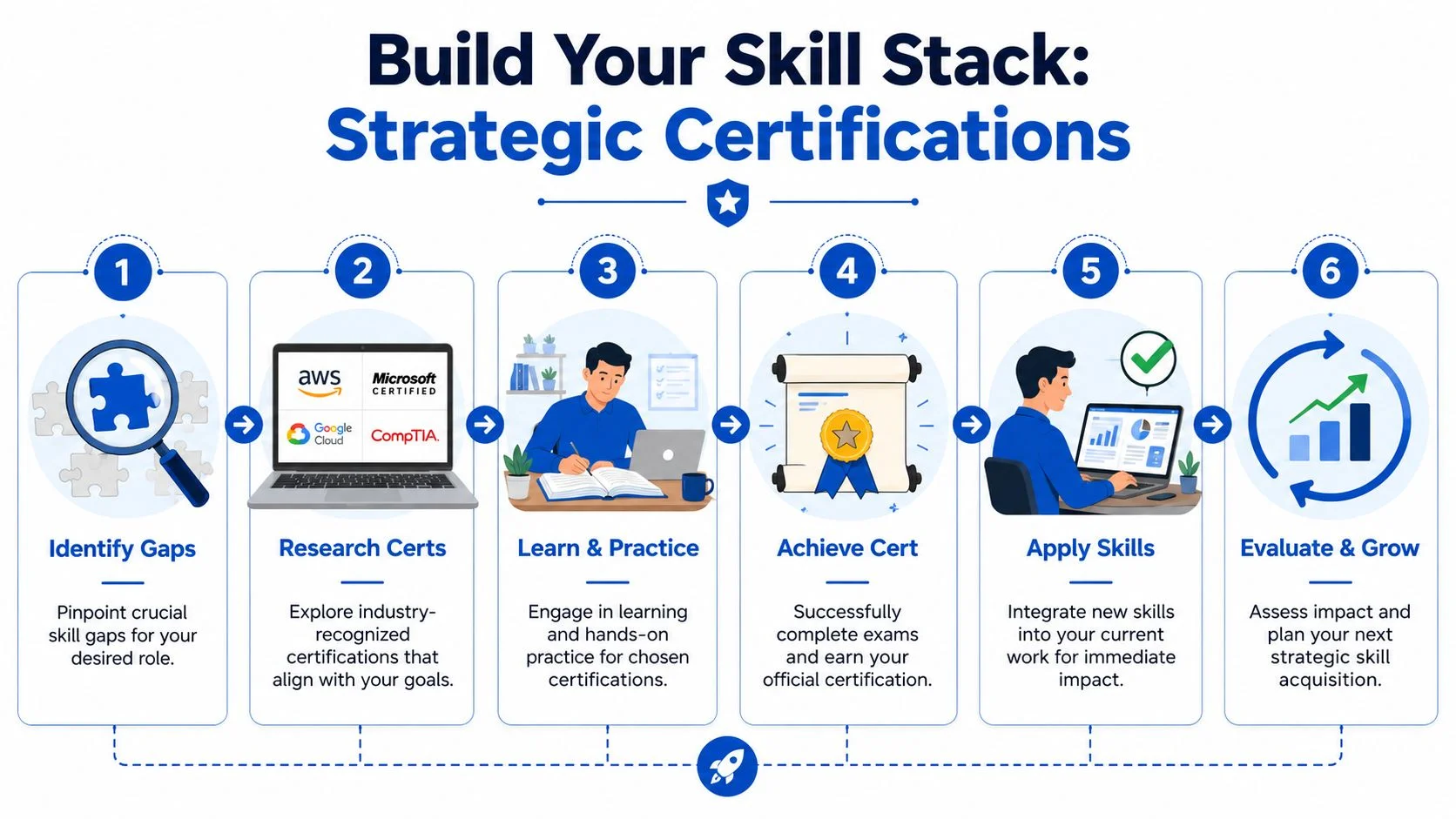
A sound career-pathing model starts with current capabilities, compares them to future needs, defines role expectations, and monitors progress. That aligns with Great Place To Work's guidance on career pathing, which also identifies internal promotion rates and employee retention as core indicators that development efforts are working. The lesson for individuals is straightforward. Don't study randomly. Study against a target role and track whether the effort changes your mobility.
Choose the cert that matches your next job
Not all certifications do the same job for your career.
If you want to move from system administration into cloud operations, AWS Certified SysOps Administrator or Microsoft Azure Administrator usually makes more sense than jumping straight to an architect-level track. If your company is already deep in Azure, forcing an AWS-first path may create unnecessary friction. If the environments around you are mostly AWS and Terraform, an Azure admin cert won't carry the same practical weight internally.
The same logic applies outside cloud:
- Security path: Start with foundational security and operational analysis before chasing specialized tracks.
- Project and service path: Choose PMP when you need formal project delivery credibility. Choose ITIL Foundation when service management and operational process matter more.
- Platform path: Prioritize certifications that match the stack your target employers use.
What works and what wastes time
People waste months on certification prep for two reasons. They choose the wrong exam, or they study like they're cramming for trivia.
Good certification prep should do three things:
- build conceptual understanding
- expose weak spots early
- turn study into applied recall instead of passive review
That's why I prefer methods like spaced repetition, scenario questions, and short practice loops over rereading notes. If you're evaluating tools, look for something that shows topic-level weaknesses instead of just giving you a giant bank of questions. MindMesh Academy fits that practical use case because it supports certification prep across tracks like AWS, Azure, CompTIA, ITIL, PMP, and ServiceNow, uses spaced repetition and adaptive learning paths, and gives you a dashboard to visualize progress by domain.
If you're weighing which tracks are worth considering, this guide for high-paying IT certifications is a solid starting point. For a broader view of why structured learning matters, this piece on upskilling for career advancement is also worth reading.
A simple decision filter
Use this filter before paying for any exam:
| Question | If yes | If no |
|---|---|---|
| Does this certification match the role I want next? | Keep evaluating | Skip it |
| Do employers in my target market recognize it? | Strong signal | Find a better proof asset |
| Can I apply the content in my current work or a lab? | High value | Risk of shallow retention |
| Does it complement my current experience gap? | Good investment | May be redundant |
Certifications help most when they sit on top of real practice. Without application, they become résumé decoration.
Activate Your Network to Create Opportunities
People like to say networking matters. In practice, what matters is making your direction visible to the right people without sounding opportunistic.
That starts inside your company. If your manager doesn't know what role you want next, they can't line up the right projects, introductions, or stretch work. If senior engineers on adjacent teams haven't seen you operate, they won't think of you when a role opens. Visibility is not politics. It's context.

The retention side of this is real. MIT Sloan cites Pew Research data showing that 63% of people who quit their jobs in 2021 said lack of advancement opportunities was a reason for leaving. That's why career path visibility matters so much. If the path is unclear, strong people leave.
The wrong conversation versus the useful one
Here's the weak version of a manager conversation:
“I'd like to grow, so please keep me in mind for future opportunities.”
That puts all the burden on the manager. It's vague and easy to forget.
A better version sounds like this:
“I want to move toward cloud engineering. I've been building my skills in IAM, networking, and monitoring. Over the next quarter, I'd like to take on one project that touches our cloud stack and get feedback on what I'd need to demonstrate for that move.”
That gives your manager something concrete to work with.
Internal networking that doesn't feel fake
Useful internal networking usually comes from shared work, not random coffee chats.
Try these moves instead:
- Volunteer for adjacent problems: If the security team needs help documenting controls, if the platform team needs test support, or if the cloud team needs someone to clean up monitoring noise, raise your hand.
- Ask for skill-specific feedback: Don't ask “How am I doing?” Ask, “What would make you trust me with more production ownership?”
- Find a working mentor: The best mentor is often someone one or two levels ahead who still remembers the transition you're trying to make.
External networking without the spam
LinkedIn outreach fails when it's generic. Nobody wants another “I'd love to pick your brain” message from a stranger.
Use a tighter approach:
- mention the role or project that caught your attention
- ask one narrow question
- show that you've done some homework
- keep the message short enough to answer in a few minutes
For example:
“I saw you moved from support engineering into cloud operations. I'm making a similar transition and currently focusing on IAM and monitoring. If you had to pick one type of project that helped you get taken seriously for that move, what would it be?”
That works because it respects the other person's time and gives them an easy opening.
Networking creates career advancement opportunities when it's tied to direction, evidence, and follow-through. Without those, it turns into surface-level social activity.
Position Yourself for the Role You Want
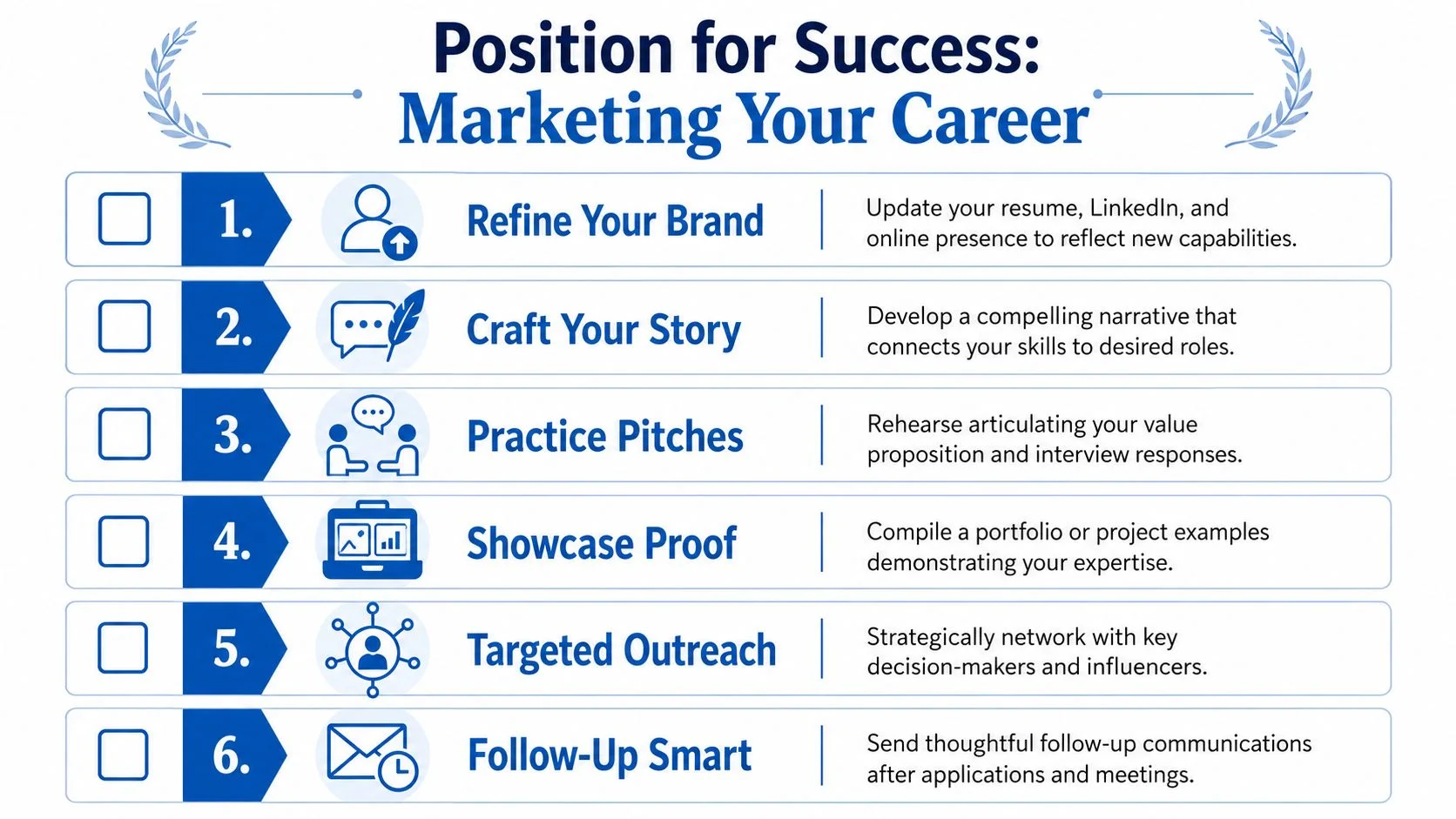
Once you've built real capability, you need to package it so a recruiter, hiring manager, or internal decision-maker can understand it quickly.
That means your résumé, LinkedIn profile, project examples, and interview stories should reflect the role you want next, not just the tasks you've performed so far. In today's market, portable proof matters. American Progress workforce research summarized through the High Road Training discussion emphasizes ecosystem-driven advancement through mechanisms like registered apprenticeships and recognized credentials, which reinforces a simple point. Employers respond to skills they can recognize and trust.
Start with this checklist.
Rewrite your profile around capability
A weak LinkedIn headline says what you are now. A strong one signals where you're going and what you work with.
Examples:
- Weak: “IT Support Specialist”
- Stronger: “IT Support Specialist building cloud operations skills in Azure, identity, automation, and monitoring”
The same rule applies to bullet points on your résumé. Don't just list duties. Show technical ownership, judgment, and evidence of transition.
Examples:
- Weak: “Handled user tickets and system issues”
- Better: “Resolved endpoint, access, and system issues across user environments while documenting repeat patterns and automating recurring support tasks with scripts”
If you need help polishing that public-facing narrative, this guide on how to build your LinkedIn brand is a practical complement. Long-term, the broader objective is to future proof your career by aligning your profile with skills that travel across companies and sectors.
Prepare interview stories that prove the move makes sense
Many career changers fail interviews because they explain desire instead of evidence. Wanting the role isn't persuasive. Showing how your past work already overlaps with it is.
Use the STAR method, but keep it technical:
- Situation: What environment or problem were you in?
- Task: What specifically were you responsible for?
- Action: What did you analyze, build, troubleshoot, or improve?
- Result: What changed operationally, for the team, or for the customer?
A short video refresher can help if you haven't practiced this in a while.
For pivot questions, frame the transition like this:
- what drew you to the target domain
- what you've already done to build competence
- where your existing experience transfers directly
- why you can contribute before you're fully seasoned
Your story should reduce hiring risk. Show that the move is a continuation of your trajectory, not a random jump.
Measure and Iterate with a Career Dashboard
The people who make steady career progress usually aren't more motivated than everyone else. They're more measurable.
They know what role they're chasing, what proof they still need, what they studied this month, who they spoke to, and where they keep getting stuck. That turns career advancement opportunities from something abstract into a managed system.

Track leading indicators, not just outcomes
A promotion or job offer is a lagging indicator. By the time it happens, the core work has already been done.
Your dashboard should track leading indicators such as:
- Skill coverage: Which target-role skills are strong, weak, or untested
- Credential progress: Exams planned, in progress, completed
- Applied practice: Labs, projects, documentation, or production tasks tied to the new role
- Network activity: Managers, mentors, peers, and hiring contacts you've had meaningful exchanges with
- Market response: Interview invites, recruiter replies, internal conversations, and where your story is landing flat
Use short review cycles
Review your dashboard every month and do a harder reset every quarter.
Ask:
- What skill did I turn into evidence?
- Which cert or project moved me closer to a real role?
- Where am I still too theoretical?
- Which conversations created traction?
- What should I stop doing because it looks productive but isn't creating movement?
That last question matters. Plenty of smart professionals hide inside endless preparation. They keep studying, keep polishing, keep waiting for confidence to arrive. Confidence usually comes after applied reps, not before.
Career growth works better when planning, learning, visibility, and iteration stay connected. Once you run your career like a system, you stop depending so heavily on your current employer's structure. You start creating your own momentum.
If you want a structured way to turn certification prep into measurable career movement, MindMesh Academy can support that workflow. Explore our comprehensive certification resources to map exam goals to target roles, study with spaced repetition and adaptive paths, spot weak domains through the dashboard, and keep your learning tied to a concrete advancement plan instead of vague ambition. Start building your path today at https://www.mindmeshacademy.com/certifications.

Written by
Alvin Varughese
Founder, MindMesh Academy
Alvin Varughese is the founder of MindMesh Academy and an enterprise architecture leader. An electrical engineer by training, he moved from factory automation in South Africa to cloud architecture at GE Appliances and Humana (Fortune 50), and holds 20 professional certifications including AWS Solutions Architect Professional, Azure DevOps Engineer Expert, and Microsoft Agentic AI Business Solutions Architect. He built MindMesh Academy after interviewing too many highly certified candidates who couldn't answer basic questions: the goal is prep that makes you better at the job, not just able to pass the exam.