
Top 7 Highest Paying Tech Certifications to Fast-Track Your Career
Top 7 Highest Paying Tech Certifications to Fast-Track Your 2025 Career
For IT professionals aiming to elevate their careers and maximize earning potential, strategic certification choices are paramount. The digital landscape is constantly evolving, making up-to-date credentials a powerful differentiator. This guide delves into seven top-tier certification platforms—AWS Training and Certification, Google Cloud Certification, Microsoft Learn Certifications, ISC2, ISACA, GIAC by SANS, and Pearson VUE—that host some of the highest paying tech certifications available today.
Choosing the right certification path can feel overwhelming amidst a sea of options. This article cuts through the noise, focusing on official vendor platforms that provide clarity on exam formats, study resources, and pricing models. We’ll equip you with the insights needed to make informed decisions, allowing you to dedicate more time to actual study and less to scouting resources.
In this comprehensive guide, you’ll find:
- A detailed overview of each platform with its key features and educational value.
- Insights into typical salary figures associated with these certifications, based on industry data.
- Essential prerequisites and potential career paths unlocked by each credential.
- Practical study strategies and connections to real-world certification scenarios.
- Visual aids and direct links to official resources for every option.
Each section offers clear, actionable insights designed to guide you through platform interfaces and lead you directly to registration and study materials. Our goal is to provide precise data, helping you compare top platforms, select the certification that aligns with your professional aspirations, and craft a study plan that delivers maximum return on investment (ROI). Whether you're an experienced IT professional, a student, or an organization investing in talent development, this resource is your roadmap to selecting, registering for, and excelling in your certification journey. Let's unlock your next career milestone by exploring the highest paying tech certifications.
1. AWS Training and Certification
Amazon Web Services (AWS) stands as a dominant force in cloud computing, and its official exam hub, AWS Training and Certification, is the definitive starting point for earning industry-leading credentials. This platform allows candidates to thoroughly prepare for some of the highest paying tech certifications in the market, such as the AWS Certified Solutions Architect – Professional or AWS Certified DevOps Engineer – Professional. Here, you can easily access comprehensive exam blueprints, register for both online and in-person exams, and tap into official study materials, all from a centralized account.
What You Can Do
- Explore all AWS cloud certifications: From Foundational (e.g., Cloud Practitioner) through Associate (e.g., Solutions Architect Associate), Professional (e.g., Solutions Architect Professional), and Specialty (e.g., Security, Database). Understanding this hierarchy helps you map your career progression.
- Purchase and schedule exams: Seamlessly book your exam through Pearson VUE or opt for convenient online proctoring from your home or office.
- Access Skill Builder courses: Leverage official, high-quality content including hands-on labs, video tutorials, and digital training modules to solidify your understanding. This is critical for practical application, not just theoretical knowledge.
- Download official practice questions: These questions are meticulously aligned to exam blueprints, offering a realistic preview of the actual exam content and format. This direct alignment significantly enhances your preparation strategy.
Key Features
Transparent Pricing AWS maintains a clear pricing structure for its exams, making budgeting straightforward:
| Level | Exam Fee |
|---|---|
| Foundational | $100 |
| Associate | $150 |
| Professional / Specialty | $300 |
Delivery Options Flexibility in testing environments caters to diverse candidate needs:
- Online-proctored exams: Take your exam from the convenience of your home or office, subject to environment checks.
- In-center appointments: Utilize Pearson VUE test centers globally for a structured testing environment.
Skill Builder Training This official learning platform provides robust resources:
- Self-paced modules and interactive labs: Crucial for building practical skills, which are heavily tested in scenario-based questions.
- Team plan: Available at $449 per seat per year, often leveraged by organizations investing in their IT talent.
“Official practice questions ensure you study exactly what appears on exam day, bridging the gap between learning and successful performance.”
Pros and Cons
Pros
- Direct-from-vendor accuracy: Ensures all policies, content, and pricing are current and authoritative, minimizing ambiguity during preparation.
- Strong alignment: Official training paths are meticulously aligned with exam blueprints, guaranteeing that your study efforts are directly relevant to passing the exam.
- Centralized dashboard: A unified portal for scheduling, tracking progress, and reporting simplifies the entire certification journey.
Cons
- Third-party exam delivery: While flexible, reliance on Pearson VUE means adherence to their specific reschedule and cancellation rules, which can vary.
- Team subscription pricing: While valuable for organizations, the Skill Builder team plan might not be cost-effective for individual learners compared to a per-course purchase model.
Practical Tips for Effective Use
- Strategically use the exam blueprint: Download the detailed exam blueprint PDF for your target certification. Outline weekly study targets based on the weight of each domain to ensure comprehensive coverage.
- Pilot with free modules: Before committing to a paid Skill Builder plan, explore the free modules and introductory labs to assess if the learning style suits you.
- Bookmark key policy documents: Use AWS’s central console to save important policy documents, such as recertification requirements and exam security protocols, for quick reference.
- Supplement with peer discussions: While official practice questions are invaluable, complement them with insights from peer-reviewed forum discussions on platforms like Reddit or official AWS communities. This helps clarify complex concepts and understand diverse problem-solving approaches.
- Learn more about AWS Training and Certification on MindMesh Academy
By combining vendor-verified content, clear pricing, and flexible delivery options, AWS Training and Certification is a premier platform for IT professionals pursuing the highest paying tech certifications in cloud computing.
2. Google Cloud Certification
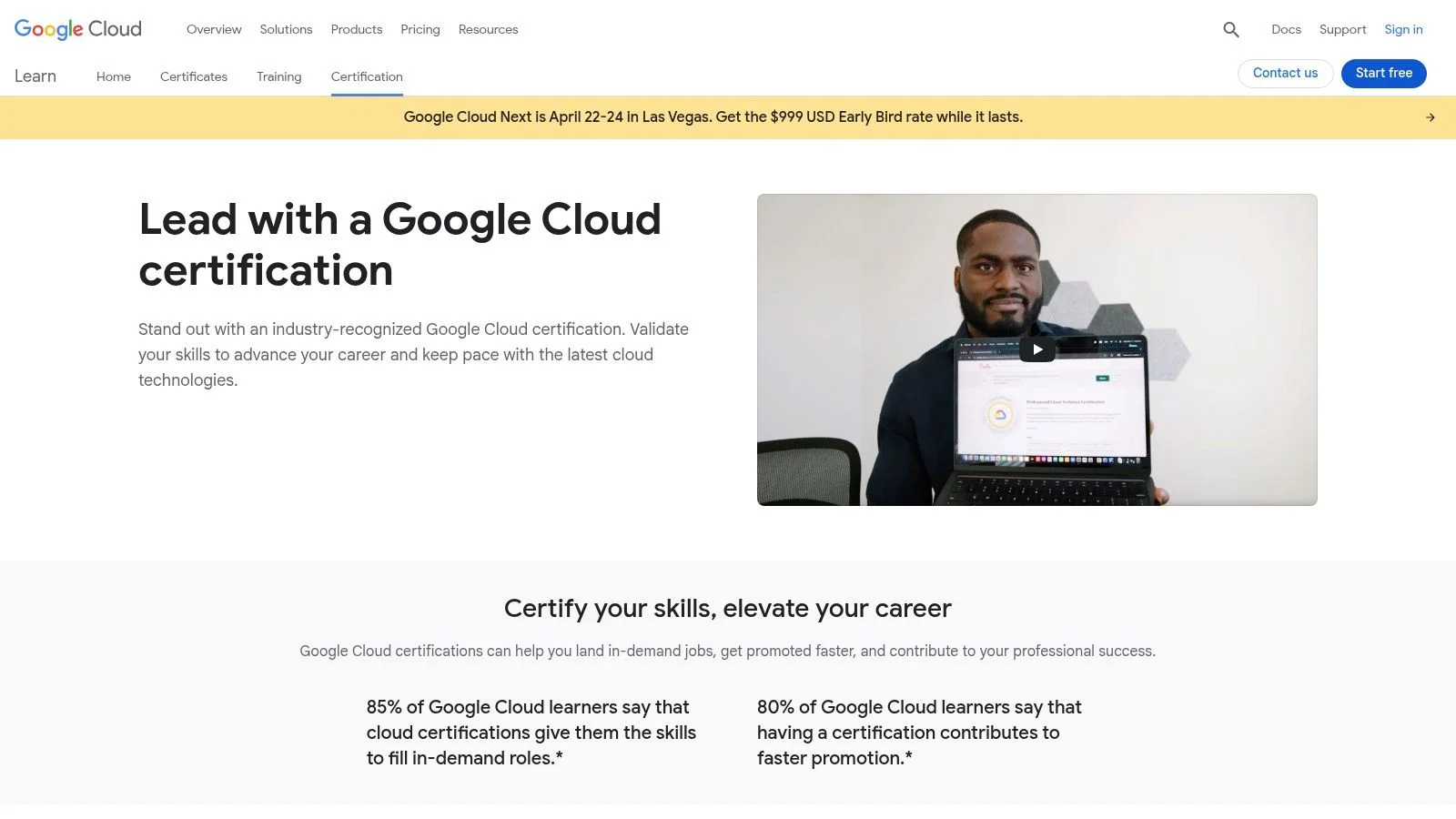
Google Cloud Certification is an essential hub for professionals aiming for some of the highest paying tech certifications, particularly those focused on specialized cloud roles like the Professional Cloud Architect or Professional Cloud Developer. The official site, available at Google Cloud Certification, is your gateway to published fees, diverse delivery options, and structured learning paths that incorporate hands-on Qwiklabs environments. Its intuitive interface simplifies comparing validity periods and accessing in-depth exam guides tailored to each certification.
What You Can Do
- Browse all Google Cloud certifications: Explore the full spectrum from Associate (e.g., Cloud Engineer) through Professional (e.g., Data Engineer, Security Engineer).
- Register for exams: Choose between convenient online proctoring from your location or in-person testing at authorized PSI test centers.
- Access learning paths: Follow curated, role-based learning journeys that include sequenced courses and immersive Qwiklabs labs, crucial for practical skill development.
- Download exam guides: Obtain detailed guides outlining the skills measured, exam topics, and sample questions for each certification. These are your roadmap to focused study.
- Check renewal timelines: Understand certification validity periods and renewal requirements to ensure your credentials remain current.
Key Features
Transparent Pricing Google Cloud offers a straightforward pricing model for its certification exams:
| Level | Exam Fee |
|---|---|
| Associate | $125 |
| Professional | $200 |
| Specialty (beta) | $99 |
Delivery Options Candidates have flexible options for taking their exams:
- Online proctoring: Complete your exam from home under supervised conditions.
- In-person testing: Visit authorized PSI centers for a traditional test-taking experience.
Learning Paths & Hands-On Labs These features are central to Google Cloud's educational approach:
- Role-based learning journeys: Structured sequences of courses designed to prepare you for specific job roles within the Google Cloud ecosystem.
- Live Qwiklabs environment: Provides real-world scenario practice in an actual Google Cloud environment, which is indispensable for applying theoretical knowledge.
- Periodic partner programs: Keep an eye out for limited-time discount codes, which can help offset exam fees.
“Clear exam guides and integrated labs make every study session count, turning theoretical knowledge into actionable, job-ready skills.”
Pros and Cons
Pros
- Fully documented exam details: Each certification provides clear exam objectives, renewal guidelines, and validity information, reducing uncertainty for candidates.
- Direct links to hands-on Qwiklabs: Immediate access to practical labs allows for instant application of learned concepts, a critical component for mastering cloud skills.
- Partner voucher programs: Opportunities to secure promotional codes can significantly reduce the financial barrier to certification.
Cons
- Variable promotional codes: Discount vouchers may not be consistently available year-round, requiring candidates to plan their exams strategically.
- Experience for professional exams: Professional-level certifications often require substantial real-world experience for the best pass odds, meaning they are not typically entry-level credentials.
Practical Tips for Effective Use
- Domain-centric study: Download each exam guide PDF and outline weekly study targets by domain. Prioritize areas where you have less experience.
- Bridge skill gaps with Qwiklabs: Map Qwiklabs modules directly to skill gaps identified in the exam guide. This targeted practice ensures you're building competencies where they matter most.
- Stay informed on discounts: Subscribe to the Google Cloud newsletter for announcements on partner voucher programs and other cost-saving opportunities.
- Engage in community forums: Participate in Google Cloud community forums or platforms like Stack Overflow for troubleshooting, conceptual clarification, and peer support.
- Learn more about Google Cloud Certification on MindMesh Academy
3. Microsoft Learn Certifications
Microsoft's official certification portal, Microsoft Learn Certifications, serves as your comprehensive resource for registering and scheduling a wide array of Azure and role-based Microsoft certifications. From the highly sought-after Azure Solutions Architect Expert to the specialized Security Engineer, this platform empowers you to manage your entire certification pathway, schedule appointments with Pearson VUE or online-proctored exams, and unlock exclusive offers and renewal options. These credentials are vital for IT professionals navigating Microsoft's extensive ecosystem, offering access to some of the highest paying tech certifications in the industry.
What You Can Do
- Browse and register for exams: Explore the full range of Fundamentals, Associate, Expert, and Specialty exams, allowing you to tailor your certification journey to specific career goals.
- Schedule exams: Conveniently book your exam through Pearson VUE test centers worldwide or opt for online proctoring from home with ID verification.
- Redeem Exam Replay vouchers and 30 Days to Learn It challenges: Take advantage of programs like Exam Replay, which allows a free retake, and "30 Days to Learn It," offering free access to select learning modules for passing within a month.
- Complete annual renewal assessments: For most active Associate, Expert, and Specialty certifications, you can complete annual renewal assessments at no cost, ensuring your credentials remain current without additional fees.
Key Features
Registration & Scheduling Microsoft Learn provides flexible exam delivery:
| Option | Details |
|---|---|
| Pearson VUE | In-center appointments available worldwide. |
| Online Proctoring | Book from home, requiring identity verification and environment checks. |
Renewal & Discounts Microsoft offers unique benefits to maintain and acquire certifications:
- Annual free renewal assessments: A significant advantage, allowing you to extend the validity of most Associate, Expert, and Specialty certifications without incurring extra costs.
- Exam Replay: This valuable offer allows you to retake your exam once if you don't pass the first time, providing a safety net for your investment.
- 30 Days to Learn It: A fantastic program offering free access to selected learning modules, incentivizing rapid learning and certification completion.
First-Party Guidance Leverage Microsoft's authoritative resources:
- Curated exam guides, practice tests, and learning paths: These official resources are meticulously developed to align with exam objectives, ensuring focused and effective study.
- Central hub for offers: A single portal for all Microsoft certification deals and bundle offers, simplifying the discovery of cost-saving opportunities.
“Annual free renewals keep your credentials current without extra cost, ensuring your expertise is recognized year after year, similar to how regular software updates maintain system relevance.”
Pros and Cons
Pros
- Official Microsoft portal: Guarantees access to the most up-to-date exam data, policies, and learning resources directly from the source.
- No-cost renewal assessments: A major benefit that significantly reduces the long-term cost of maintaining your professional credentials.
- Aggregated offers: The centralized platform makes it easy to discover and leverage discounts, bundles, and special challenges.
Cons
- Regional pricing variability: Exact exam pricing can differ significantly by region and is typically only displayed at checkout, requiring early budgeting.
- Strict discount windows: Some discounts and free offers, like "30 Days to Learn It," require adherence to strict completion windows, demanding disciplined study.
Practical Tips for Effective Use
- Early budgeting: Check regional pricing for your target certification early in your planning process to accurately budget for exam fees.
- Unlock free content: Actively enroll in "30 Days to Learn It" challenges to gain free access to valuable prep content and accelerate your study.
- Blueprint-driven study: Bookmark exam guides and blueprint PDFs. Translate these into weekly study goals to ensure comprehensive coverage of all domains.
- Proactive renewals: Schedule your annual renewal assessments well before expiration dates to avoid the need for full-fee retakes and maintain continuous credential validity.
- Learn more about Microsoft Learn Certifications on MindMesh Academy: Learn more about Microsoft Learn Certifications on MindMesh Academy
4. ISC2 (official)
ISC2, a globally recognized leader in cybersecurity certifications, provides the definitive pathway to credentials like the Certified Information Systems Security Professional (CISSP) and advanced specializations such as ISSAP, ISSEP, and ISSMP. The official ISC2 site is where candidates can access detailed exam outlines, purchase official training materials, and register for ISC2 exams through Pearson VUE. The CISSP, in particular, remains one of the highest paying tech certifications and is often considered the gold standard for security leadership careers, akin to a Project Management Professional (PMP) certification for project managers in its industry recognition.

What You Can Do
- Review CISSP exam blueprint: Understand the Computer Adaptive Testing (CAT) format, scoring rules, and comprehensive domain coverage for the CISSP. This is crucial for familiarizing yourself with the adaptive nature of the exam.
- Register for exams: Schedule your exam at local Pearson VUE centers or opt for online-proctored options, offering flexibility in your testing environment.
- Purchase official training: Invest in instructor-led bootcamps or online self-paced courses directly from ISC2, ensuring your study materials are current and aligned with exam objectives.
- Download detailed certification outlines: Access outlines for advanced credentials like ISSAP (Information Systems Security Architecture Professional), ISSEP (Information Systems Security Engineering Professional), and ISSMP (Information Systems Security Management Professional).
Key Features
Exam Structure and Scoring
- CISSP uses CAT format: The exam adapts to your performance, typically featuring 100–150 adaptive items. This format requires deep conceptual understanding rather than rote memorization.
- Passing score: A minimum of 700 out of 1000 points is required to pass.
Exam Pricing ISC2 certifications represent a significant investment, reflecting their value:
| Certification | Exam Fee (Americas) |
|---|---|
| CISSP | $749 |
| ISSAP / ISSEP | $699 each |
| ISSMP | $699 |
Annual Maintenance Fee Maintaining your certification requires ongoing commitment:
| Certification | AMF per Year |
|---|---|
| CISSP | $125 |
| Senior-level cert | $85 |
Official Training Options
- Live instructor-led bootcamps: Intensive, focused training ideal for structured learning.
- Online self-paced modules with labs: Offers flexibility for busy professionals, including practical application exercises.
- Official practice exams: Designed to align with real test items, providing a realistic simulation of the actual exam experience.
“Earning CISSP opens doors to senior security roles that command six-figure salaries, solidifying your reputation as a trusted cybersecurity leader.”
Pros and Cons
Pros
- Gold standard for policies: ISC2 is the definitive source for official exam policies and blueprints, ensuring accuracy and reliability.
- Regularly updated training: Content for senior security credentials is consistently updated to reflect the latest threats and best practices.
- Centralized portal: The portal at https://www.isc2.org offers a unified experience for all certification-related activities.
Cons
- Higher costs: Exam and annual maintenance fees are notably higher than many entry-level cloud certifications, reflecting the advanced nature of the credentials.
- Experience requirement: A minimum of five years of cumulative paid work experience in two or more of the eight CISSP domains is required before full certification endorsement, making it a credential for seasoned professionals.
Practical Tips for Effective Use
- Master the CISSP exam outline: Download the detailed CISSP exam outline PDF and set weekly study milestones, ensuring you understand each domain's depth and breadth.
- Practice adaptive testing: Regularly practice with official CAT-style exams to build proficiency in adaptive testing, a critical skill for the CISSP.
- Strategic exam scheduling: Schedule your exam at a nearby Pearson VUE center well in advance to minimize travel stress and secure your preferred date.
- Network locally: Join local ISC2 chapters for peer support, study groups, and networking opportunities. Learning from others' experiences can be invaluable.
- Amplify your badge: Share your ISC2 digital badge on LinkedIn and other professional platforms to maximize visibility and showcase your expertise.
By offering vendor-verified content, transparent pricing, and robust training, ISC2’s official site stands out as a premier destination for IT professionals seeking the highest paying tech certifications in cybersecurity leadership.
5. ISACA (official)
The ISACA credentialing portal is the authoritative hub for some of the highest paying tech certifications in governance, risk, and audit. For IT professionals focused on these critical areas—often working closely with frameworks like ITIL for service management—ISACA offers globally recognized credentials such as CISM, CISA, CRISC, and CGEIT. Here, candidates can easily compare member vs. non-member rates, register for remote or test-center exams, and review comprehensive application and maintenance requirements, all from a single, centralized platform.
What You Can Do
- Browse official certifications: Explore the full range of governance, risk, and audit certifications, including CISM (Certified Information Security Manager), CISA (Certified Information Systems Auditor), CRISC (Certified in Risk and Information Systems Control), and CGEIT (Certified in the Governance of Enterprise IT).
- View detailed pricing: Transparently compare exam fees for members vs. non-members, allowing for precise calculation of the total certification cost.
- Schedule exams: Choose between online-proctored exams via PSI with essential environment checks, or book in-center appointments at authorized test labs for a more traditional setting.
- Access post-exam application steps: Understand the necessary procedures after passing an exam, including experience verification and annual maintenance/Continuing Professional Education (CPE) requirements.
Key Features
Transparent Pricing ISACA provides clear pricing, differentiating between members and non-members:
| Certification | Member Fee | Non-Member Fee |
|---|---|---|
| CISM | $575 | $760 |
| CISA | $575 | $760 |
| CRISC | $575 | $760 |
| CGEIT | $575 | $760 |
Delivery Options Flexibility for test-takers is a key consideration:
- Remote proctoring: Conducted through PSI, complete with environmental checks to ensure exam integrity.
- In-center appointments: Available at authorized test labs globally, providing a dedicated testing environment.
Maintenance & CPE Certifications require ongoing commitment to maintain validity:
- Initial application fee: A $50 fee is required after successfully passing the exam.
- Annual maintenance fees: Member fee is $45, non-member fee is $85.
- Required CPE credits: 20–40 CPE credits are required per year, depending on the specific certification, ensuring continuous professional development.
“ISACA credentials are universally recognized by enterprise risk and audit teams worldwide, serving as a benchmark for excellence in IT governance and security.”
Pros and Cons
Pros
- Clear member vs. non-member pricing: Facilitates straightforward budgeting and helps candidates evaluate the ROI of ISACA membership.
- Flexible exam delivery options: Caters to a global candidate base, offering both remote and in-person testing convenience.
- Strong employer recognition: ISACA certifications are highly regarded in IT audit, risk, and governance roles across enterprises.
Cons
- Membership upfront cost: While membership offers reduced exam fees, it adds an initial upfront cost that candidates must consider.
- Experience requirement: Candidates must meet specific professional experience requirements after passing the exam to be awarded the final certification, which can delay formal recognition.
Practical Tips for Effective Use
- Comprehensive cost calculation: Before committing, calculate the total cost, including the exam fee, application fee, and projected annual maintenance fees.
- Evaluate ISACA membership: If you plan to pursue multiple certifications, joining ISACA can lead to significant savings on exam rates and access to member-exclusive resources.
- Proactive CPE mapping: Use the "Credentialing FAQs" section to understand and map out your CPE credits early, ensuring you meet ongoing maintenance requirements.
- Advance scheduling for remote proctoring: Book remote proctoring slots 4–6 weeks in advance, especially during peak periods, to secure your preferred date and time.
- Maintain your dashboard: Keep your MyISACA dashboard updated to effectively track renewal deadlines and manage your CPE activities.
By combining transparent pricing, robust scheduling choices, and enterprise-grade credibility, ISACA’s official site excels for IT professionals targeting the highest paying tech certifications in the crucial domains of governance, risk, and audit. Visit https://www.isaca.org/credentialing to get started.
6. GIAC (by SANS)
The GIAC (Global Information Assurance Certification) program, meticulously run in partnership with the SANS Institute, is renowned for providing deeply practical and highly specialized cybersecurity credentials. These include sought-after certifications like GSEC (GIAC Security Essentials), GPEN (GIAC Penetration Tester), and various Digital Forensics and Incident Response (DFIR)-focused exams. The official GIAC site is where candidates can purchase certification attempts, practice exams, and renewals, either individually or bundled with SANS training courses. With its transparent pricing and extensive global proctor network, GIAC stands out among platforms offering the highest paying tech certifications for hands-on cybersecurity expertise.

What You Can Do
- Browse GIAC’s catalog: Explore a comprehensive range of certifications, from foundational security concepts to highly advanced specialties.
- Register and pay for certification attempts: Conveniently manage your exam registrations and payments online.
- Access standalone practice exams: Purchase individual practice exams to test your knowledge and identify areas for improvement before the actual exam.
- Renew expiring credentials: Utilize the user portal to manage and renew your certifications, ensuring continuous professional recognition.
- Schedule remote or onsite proctored tests: Choose between remote testing through ProctorU or onsite appointments at Pearson VUE centers for flexible delivery.
Key Features
Transparent Pricing GIAC maintains clear pricing for its offerings, though it represents a significant investment:
| Item | Cost |
|---|---|
| Certification attempt | $999 |
| Practice exam | $399 |
| Certification renewal | $499 |
Proctoring Options Candidates have flexible choices for taking their exams:
- Remote testing: Conducted through ProctorU, allowing you to take the exam from a secure remote location.
- Onsite appointments: Available at Pearson VUE centers worldwide, offering a traditional testing environment.
Training Bundles For a holistic learning experience, GIAC often integrates with SANS training:
- Combine exam attempts with SANS courses: Option to bundle your exam attempt with SANS instructor-led training or OnDemand courses for comprehensive preparation.
- Multi-attempt bundle discounts: Discounts may be available for purchasing multiple attempts, along with deferred payment options.
Renewal Policy GIAC certifications require periodic renewal to ensure ongoing competency:
- Renewal frequency: Certified professionals must renew their credentials every four years.
- Early renewals and extensions: Options are available for early renewals and retake extensions at fixed rates.
“GIAC’s hands-on focus gives hiring managers unparalleled confidence in certified professionals, as these credentials validate deep, practical cybersecurity skills essential for real-world threat mitigation.”
Pros and Cons
Pros
- Strong market recognition: GIAC certifications are highly valued by employers for their emphasis on in-depth, practical technical skills, particularly in offensive and defensive security roles.
- Clear policies: Transparent retake, extension, and renewal policies provide clarity and predictability for candidates.
- Flexible purchase options: Candidates can choose to purchase standalone exam attempts or bundle them with comprehensive SANS training.
Cons
- Premium exam fees: GIAC exams are among the most expensive compared to other certification vendors, reflecting the specialized nature and rigor of the credentials.
- Investment in SANS courses: Many candidates choose to invest in costly SANS courses to achieve the best results, adding to the overall financial commitment.
Practical Tips for Effective Use
- Strategic objective mapping: Meticulously map GIAC exam objectives to specific SANS training modules. This ensures your learning is directly aligned with what will be tested.
- Early practice exam utilization: Purchase practice exams early in your study process to accurately identify knowledge gaps and tailor your study plan.
- Proactive session booking: Book proctored sessions at least two weeks in advance to secure your preferred date and time, especially during busy periods.
- Set renewal reminders: Crucially, set calendar reminders for renewal deadlines to avoid any lapse in your certification status.
- Learn more about GIAC certifications on MindMesh Academy
By blending rigorous, real-world testing with transparent pricing and flexible delivery, GIAC (by SANS) remains a top choice for professionals aiming at the highest paying tech certifications in specialized cybersecurity domains. Explore more at https://www.giac.org.
7. Pearson VUE
Pearson VUE serves as a vital global exam delivery and voucher store, acting as a practical one-stop shop for purchasing official exam vouchers, scheduling exams, and locating local test centers or opting for online proctoring. While not a certification vendor itself, Pearson VUE is a critical logistical partner for many IT professionals pursuing the highest paying tech certifications from various providers. Unlike vendor-specific portals, Pearson VUE centralizes dozens of vendor exams—including those from AWS, Cisco, and Microsoft—into one unified interface, offering transparent fee structures and real-time seat availability.

What You Can Do
- Purchase official exam vouchers: Acquire vouchers directly from various vendors like AWS, Cisco, and Microsoft, streamlining the payment process for your chosen certification.
- Schedule exams: Utilize a unified dashboard to book both in-center and online-proctored exams, simplifying the logistics across multiple certification programs.
- Locate authorized test centers: Easily find test centers worldwide, with filtering options for accessibility and available amenities, ensuring a convenient testing location.
- Track voucher status and manage logistics: Monitor your voucher status, download admission tickets, and manage any necessary cancellations or rescheduling through a centralized portal.
Key Features
Voucher Pricing and Validity Pearson VUE provides transparent information on vouchers:
| Vendor | Voucher Fee Range | Voucher Validity |
|---|---|---|
| AWS | $100 - $300 | 12 months |
| Cisco | $125 - $400 | 12 months |
| Microsoft | $99 - $165 | 12 months |
Delivery Options Flexibility is key to Pearson VUE's offerings:
- Online-proctored exams: Conducted with stringent system checks and live identity verification to ensure a secure testing environment from home.
- In-center appointments: Available at Pearson VUE authorized facilities, providing a professional and distraction-free testing setting.
- Automated email reminders: Receive timely reminders for upcoming exams and alerts for rescheduling options, helping you stay organized.
- Voucher transfer options: Available under strict policy guidelines, offering some flexibility for organizations or individuals.
“A single platform to secure, schedule, and manage exam logistics efficiently across dozens of vendors, allowing IT professionals to focus purely on their study.”
Pros and Cons
Pros
- Centralized booking: Offers a streamlined process for managing exams across dozens of high-value tech certifications, reducing administrative overhead.
- Occasional retail discounts: Keep an eye out for promotional offers and discounts that can sometimes reduce the overall cost of exam fees.
- Clear voucher terms: Digital voucher delivery with clearly stated terms minimizes surprises regarding expiration and usage.
Cons
- Nonrefundable vouchers: Vouchers are generally nonrefundable and subject to Pearson VUE's strict policies, requiring careful planning before purchase.
- Variable candidate experience: The quality of the in-center testing experience can vary by test center location and staff, impacting your comfort on exam day.
- Strict online proctoring requirements: Online proctoring demands specific hardware, software, and a clean, quiet environment, which can be challenging to meet for some candidates.
Practical Tips for Effective Use
- Thorough voucher review: Review voucher terms closely, noting expiration dates and any transfer restrictions, before making a purchase.
- Optimize test center selection: Use the test-center locator map to pick the most convenient and highly-rated site, considering factors like accessibility and parking.
- Proactive scheduling: Schedule exams well in advance, especially during peak seasons, to secure your ideal date and time.
- Pre-exam technical verification: Verify your hardware, software, and network requirements for online proctoring at least 48 hours before exam day to prevent technical issues.
- Leverage reminders: Book email and SMS reminders to avoid missing your exam slot or forgetting important deadlines.
- Explore Pearson VUE exam prep resources on MindMesh Academy
Top 7 Highest‑Paying Tech Certifications Comparison
| Item | Implementation complexity | Resource requirements | Expected outcomes | Ideal use cases | Key advantages |
|---|---|---|---|---|---|
| AWS Training and Certification | Low–Moderate: self-paced Skill Builder + exam scheduling | Exam fees $100–$300; Skill Builder Team ~$449/seat/yr (org-focused) | Vendor-aligned AWS certifications and cloud role credibility | Individuals/teams preparing for AWS roles and certs | Official materials aligned to exam blueprints; transparent pricing |
| Google Cloud Certification | Moderate: hands-on labs and learning paths plus scheduling | Exam fees ~ $99–$200; labs may require credits or subscriptions | Google Cloud role certifications with practical lab experience | GCP-focused architects, developers, and cloud engineers | Strong hands-on labs and detailed renewal/validity documentation |
| Microsoft Learn Certifications | Low: guided learning with streamlined scheduling and renewals | Regional exam pricing; free annual renewals via short assessments | Role-based Azure certifications kept current via renewals | Azure administrators, architects, security engineers | No-cost renewals for many certs; centralized official guidance and offers |
| ISC2 (official) | High: rigorous exam formats and experience requirements | Higher exam fees (e.g., CISSP ~ $749) + annual maintenance fees (e.g., ~$135) | Senior cybersecurity credentials with wide industry recognition | Experienced security professionals and leadership roles | Authoritative exam outlines and up-to-date senior-level training |
| ISACA (official) | Moderate–High: exam prep plus post-exam application/experience steps | Member vs non-member fees (e.g., CISM member ~$575 / non-member ~$760); membership cost | Certifications in governance, risk, and audit with enterprise recognition | GRC, audit, risk management professionals | Transparent member pricing and strong enterprise recognition |
| GIAC (by SANS) | High: practical, hands-on exams often paired with intensive training | Among highest costs (many exams ~$999; practice exams/renewals extra) | Deep, practical cybersecurity skill validation recognized by employers | Hands-on security specialists (pen-testing, DFIR, advanced ops) | Strong employer recognition; clear retake and bundling policies with SANS |
| Pearson VUE | Low: scheduling, voucher purchase, and delivery management | Voucher costs vary; vouchers often nonrefundable; delivery fees possible | Reliable exam delivery logistics and voucher management across vendors | Candidates scheduling exams or buying vendor vouchers | One-stop scheduling and voucher store; global test-center locator and delivery options |
Next Steps to Certification Success
Investing in the highest paying tech certifications is a strategic career move, but successful implementation requires a clear roadmap. These credentials don't just validate skills; they open doors to advanced roles and significantly boost earning potential.
Recap of Top Highest Paying Tech Certifications and Their Impact
- AWS Training and Certification: Master cloud architecture and engineering, paving the way for roles like Cloud Solutions Architect or DevOps Engineer, often paying over $150K. This solidifies your expertise in the most widely adopted cloud platform.
- Google Cloud Certification: Specialize in cutting-edge areas like data engineering, machine learning, or cloud security, with strong salary growth potential in innovative tech environments.
- Microsoft Learn Certifications: Validate your expertise in Azure and Microsoft 365. This is critical for enterprise environments, leading to diverse high-pay roles such as Azure Solutions Architect Expert or Security Engineer.
- ISC2 (CISSP): The gold standard for cybersecurity leadership, enabling you to lead security teams and command salaries upwards of $140K, often reaching $200K+ for experienced professionals.
- ISACA (CISA, CISM, CRISC): Excel in highly demanded IT audit, risk management, and information security management positions, crucial for enterprise governance and compliance.
- GIAC (GSEC, GCIH, GPEN): Demonstrate advanced, practical security skills valued by top employers in roles requiring deep technical proficiency in areas like penetration testing, incident handling, and forensics.
- Pearson VUE: The essential central hub for over 500 certification exams across a vast array of tech domains, streamlining your registration and scheduling process for diverse credentials.
“Choosing the right certification is more than just adding a line to your resume; it's a calculated investment that fast-tracks career growth and maximizes earning potential by aligning your skills with industry demand.”
Key Takeaways for IT Professionals
- Salary impact is multifaceted: Your actual earning potential is influenced by the specific role, your ability to apply hands-on practice, and the current industry demand for that particular skillset. Certifications act as catalysts.
- Prerequisites are non-negotiable: Thoroughly understand and plan your study timelines around any experience requirements (e.g., for CISSP or ISACA) to avoid delays in credentialing.
- Practical labs reinforce learning: Hands-on labs (like those in AWS Skill Builder or Google Qwiklabs) are indispensable. They transform theoretical knowledge into practical, job-ready skills, accelerating exam readiness and real-world application.
- Community support is invaluable: Engaging with peer discussions, study groups, and professional communities boosts motivation, clarifies complex concepts, and keeps you updated on exam changes and industry trends.
Actionable Next Steps for Your Certification Journey
- Define Your Strategic Goal:
- Pinpoint your target role (e.g., Senior Cloud Architect, Cybersecurity Manager) and research the associated salary range in your region.
- Honestly map certification prerequisites to your current skills and experience. Identify any gaps that need to be addressed before embarking on a rigorous study path.
- Reflection Prompt: What specific job title would make you feel most accomplished in the next 3-5 years, and what skills are absolutely critical for that role?
- Select Your Certification Wisely:
- Use this comprehensive roundup to compare salary data, exam format (e.g., CAT vs. linear), required experience, and available study resources.
- Factor in the total cost (exam fees, training, maintenance), exam length, and ongoing renewal cycles (e.g., free Azure renewals vs. annual ISC2 AMF).
- Reflection Prompt: Considering your current career stage and desired growth, which certification offers the best balance of challenge, relevance, and ROI for YOU?
- Leverage Adaptive Learning Methodologies:
- Combine a diverse range of learning resources: structured video tutorials, extensive practice exams, and crucial live labs for hands-on experience.
- Track your progress diligently and be prepared to adjust your focus areas as you identify strengths and weaknesses. Focus on understanding concepts, not just memorizing answers.
- Schedule and Plan with Precision:
- Once confident, book your exam through Pearson VUE or the respective vendor portal. Commit to a date to create accountability.
- Create a detailed weekly study calendar with specific milestones and allocate dedicated time slots for active learning and review. Don't forget to include buffer time for unexpected events.
- Engage the Professional Community:
- Join relevant online forums (e.g., Reddit's r/sysadmin, r/cloud, r/cybersecurity), LinkedIn groups, and local study groups.
- Actively share resources, ask questions, and stay updated on any exam changes, new technologies, or industry best practices. Networking can also lead to mentorship opportunities.
Selecting the Right Tool for Your Needs
- For hands-on learners: Prioritize platforms that offer interactive environments and practical labs, as these will solidify your understanding more effectively than passive learning.
- For exam-style practice: Choose providers with extensive question banks, timed simulations, and detailed explanations for correct/incorrect answers to build exam endurance and confidence.
- For advanced topics: Seek out mentors and peer networks when tackling complex security or cloud architecture topics. Their real-world experience can provide invaluable context.
- Balance cost vs. value: Explore trial access periods or bundled course packages to maximize your investment and ensure the resources align with your learning style and budget constraints.
Important Implementation Factors
- Budget constraints and ROI: Carefully evaluate the financial investment against the potential career and salary growth.
- Time commitment: Be realistic about the time you can dedicate to study, aligning it with your work-life balance and personal schedule.
- Technical prerequisites and required experience: Do not underestimate these. They are critical for success and often non-negotiable for certification endorsement.
- Renewal and continuing education requirements: Understand the long-term commitment needed to maintain your credentials.
Stay focused on your unique goals and adapt this roadmap as you progress through your learning journey. With a clear plan, the right resources, and persistent effort, you can successfully earn one of the highest paying tech certifications and profoundly elevate your IT career.
Ready to accelerate your journey toward top-tier credentials? Empower your certification path with MindMesh Academy’s adaptive courses and hands-on labs. Visit MindMesh Academy to start mastering the highest paying tech certifications today.
Ready to Get Certified?
Prepare with expert-curated study guides, practice exams, and spaced repetition flashcards at MindMesh Academy:

Written by
Alvin Varughese
Founder, MindMesh Academy
Alvin Varughese is the founder of MindMesh Academy and holds 20 professional certifications including Microsoft Agentic AI Business Solutions Architect, AWS Solutions Architect Professional, and Azure DevOps Engineer Expert. He's held senior engineering and architecture roles at Humana (Fortune 50) and GE Appliances. He built MindMesh Academy to share the study methods and first-principles approach that helped him pass each exam.