
Best Study Methods for Exams: Ace Your Tests
Master Your Certification Exams: Evidence-Based Study Methods for IT Professionals
If your current exam preparation involves endlessly rereading dense textbooks or highlighting every other sentence, you are likely expending significant effort without truly improving your learning. Many traditional study habits, learned during your school years, are surprisingly inefficient. They often lead to information fading quickly after you finish the test. Cognitive science offers a much clearer path forward. It reveals powerful, evidence-based learning strategies that can reduce total study time while dramatically increasing retention and exam scores. This provides a major advantage for any IT professional working through difficult technical certifications.
This guide avoids generic advice like "study harder." We explain 10 effective study methods for exams and provide actionable steps to help IT professionals master technical topics. MindMesh Academy focuses on techniques that compel your brain to actively engage with the material to build a durable, long-term understanding. This helps you move beyond cramming for a test to internalizing concepts for real-world application. This approach is vital in the fast-moving technology sector.
Forget the frustrating cycle of rereading and forgetting. The methods detailed here, from Spaced Repetition to the Feynman Technique, are designed to make learning stick. We provide practical implementation details and clear examples to help you integrate these strategies into your routine immediately. Use these strategies to prepare for the AWS Solutions Architect, CompTIA Network+, or a PMP certification. Ready to turn your study sessions into powerful, efficient learning sessions? Let us look at how top IT performers achieve exceptional results without burning out.
1. Spaced Repetition
Spaced repetition acts as an essential learning strategy to combat natural memory decay. Instead of trying to cram all your material into one grueling marathon, you review concepts at specific, increasing intervals. This method draws on the 19th-century research of psychologist Hermann Ebbinghaus regarding the "forgetting curve." By timing your reviews, you shift information from short-term to long-term memory. It remains one of the most reliable ways to prepare for high-stakes IT certification exams.
The logic is simple. You revisit a fact just as your brain starts to lose its grip on it. Every time you successfully recall that fact, you strengthen the memory. This allows you to wait longer before the next review. Active recall like this builds the lasting retention needed for command syntax, architectural blueprints, or security protocols. Be well-prepared for the test and keep the knowledge long after you finish.
How to Implement Spaced Repetition
You can start using this technique immediately with modern software or simple paper cards. The goal is to build a custom schedule where easy concepts appear less often and difficult ones show up more frequently.
- Use Digital Tools: Applications such as Anki, SuperMemo, or Quizlet provide a high-quality entry point. You create digital flashcards for questions like "What is the TCP three-way handshake?" or "What is the purpose of an AWS VPC?" The software uses an internal algorithm to schedule these cards based on your performance. This automation saves time and keeps your study sessions focused on your weakest areas.
- Manual Leitner System: For physical cards, use the Leitner system. Set up several boxes that represent different review cycles, such as daily, every three days, and weekly. When you answer a card correctly, move it to the next box for less frequent review. If you miss a card, it goes back to the daily box. This physical movement tracks your progress and forces you to face difficult material more often.
Practical Application for IT Professionals
IT certifications require memorizing high volumes of technical data, making spaced repetition a perfect fit.
- AWS and Azure Certifications: Apply the method to service limits, API parameters, or specific security configurations.
- CompTIA and Networking Certifications: Use it to master port numbers, subnetting math, cable standards, and network protocols.
- Project Management (PMP, ITIL): Organize your study of process groups, knowledge areas, ITIL lifecycle stages, and specific terminology.
Start your review sessions weeks or months before the exam. This builds a strong knowledge base that stays accessible under the pressure of a timed environment. To learn more about memory techniques, read these strategies on how to retain information when studying.
Reflection Prompt: Consider your current study material. What are 3-5 key pieces of information (e.g., a specific command, a cloud service definition, a protocol step) that you struggle to retain? How could you turn these into spaced repetition flashcards?
2. Active Recall
Active recall is a highly effective study method. It involves retrieving information from your memory rather than passively rereading your notes. This technique fundamentally shifts how you spend your study time. You move from simply receiving information to actively retrieving it. Instead of glancing at a textbook, you challenge your brain to produce facts, concepts, or procedures from scratch. Research by cognitive psychologists like Dr. Jeffrey Karpicke shows that this mental effort strengthens memory pathways. It makes knowledge much easier to access during high-stakes exams.
The principle behind active recall is that the mental strain required to pull information from your brain makes the memory durable. This process solidifies what you already know. More importantly, it highlights exactly what you don't know. Regular self-testing is one of the most reliable study methods because it simulates the pressure of the test itself. It builds retrieval strength, which helps you avoid blanking out when the clock is running and the stakes are high.
How to Implement Active Recall
To implement active recall, you must transform your study material into a series of questions. You must then answer these from memory. The goal is to force your brain to work hard to find and state the information without relying on external cues.
- Practice Questions & Mock Exams: Do not just read through concepts. Create practice questions for yourself or use existing question banks. After you finish a chapter or watch a module, close your materials. Write down everything you remember on a blank sheet of paper before you check for gaps in your knowledge.
- The Feynman Technique (as Active Recall): Choose a concept and try to explain it in the simplest terms possible. Act as if you were teaching it to a complete novice. This process quickly reveals where your understanding of the topic is weak or incomplete.
- Flashcards (Used Actively): Create flashcards with a question on one side and the answer on the other. State the answer out loud before you turn the card over. If you cannot recall the fact, that is a learning opportunity.
Practical Application for IT Professionals
Active recall applies to all technical fields and professional certifications.
- Cybersecurity Certifications (e.g., CompTIA Security+, CISSP): Use this method to recall specific threat vectors, mitigation strategies, or security frameworks. Try to list the steps in an incident response plan without looking at a manual.
- Developer Certifications (e.g., AWS Certified Developer, Microsoft Certified: Azure Developer Associate): Try to write code snippets that use specific functions or API calls from memory. Do this before you check the official documentation or your IDE.
- ITIL Certifications: Actively recall the definitions of ITIL processes and the purpose of specific ITIL roles within a business structure.
To make your sessions more dynamic, consider using tools that offer AI-generated video quizzes. These turn passive video lectures into interactive testing opportunities. By practicing recall, you train your brain for high-pressure performance.
3. The Feynman Technique
The Feynman Technique is a mental model that turns difficult topics into simple ideas. Physicist Richard Feynman developed this method on a clear premise: if you cannot explain a topic in plain language to a beginner, you do not truly understand it. This is a top-tier study method for IT certification exams. It pushes you past basic memorization and toward a clear grasp of how systems work together.
Success with this method relies on spotting knowledge gaps. When you try to "teach" a concept, you find the weak points in your logic or the parts of a process you have glossed over. This active engagement requires you to break down data, organize it, and speak clearly. This process builds mental connections that reading alone cannot match, helping you learn to reconstruct the logic from scratch.
How to Implement The Feynman Technique
This technique follows a four-step process to strip away complexity and reveal hidden gaps in your knowledge. Your goal is to refine the information until a novice can follow your logic.
- Step 1: Choose a Concept: Write the name of the topic you want to master at the top of a blank sheet of paper. This could be "Container Orchestration with Kubernetes," "CIDR Block Allocation," or "Principles of the PMP Framework."
- Step 2: Teach It to a Child (or a Novice): Write out an explanation of the concept as if your audience has no prior technical background. Use simple language. If you must use a technical term like "encapsulation," define it using a common analogy.
- Step 3: Identify Your Gaps: If you get stuck or use complex buzzwords to mask confusion, you have found the limit of your understanding. Return to your source material, such as official documentation or lab guides, to fix these specific weaknesses.
- Step 4: Review and Simplify: Read your explanation back to yourself. Look for clunky sentences or technical crutches. Simplify the wording and create a smooth narrative. Repeat this until you have a clear explanation that anyone could understand.
Practical Application for IT Professionals
The Feynman Technique works well for subjects that require a solid conceptual understanding of how different parts of a system interact. This is common in professional-level IT certifications.
- Cloud Architecture (AWS/Azure/GCP): Explain how a serverless service like AWS Lambda scales and manages state. Describe how it integrates with other services to a manager who does not use the console daily.
- Networking (CCNA/CompTIA Network+ N10-009): Break down how routing protocols like OSPF or BGP work. Explain their core principles, why one might be chosen over another, and how they react when a link fails. (Verify current exam requirements on the vendor site).
- Software Development/System Design: Articulate the differences between SQL and NoSQL databases. Explain design patterns, such as Singleton or Observer, in plain language to show you understand when to use them.
Simplifying a topic tests your preparation. It helps you handle complex solutions in real-world scenarios. To see how this method can help you think more clearly during an exam, explore these strategies on how to improve critical thinking skills.
4. Interleaving
Interleaving is a study strategy that involves mixing different topics or subjects within a single session. Most students rely on "blocking," a practice where they master one topic entirely before moving to the next. While blocking provides a sense of immediate progress, interleaving breaks that pattern to improve long-term retention. Cognitive psychologist Robert Bjork notes that this method forces the brain to switch between concepts constantly. This process prepares you for IT exams by teaching you how to choose the right solution strategy when you aren't told which chapter the problem comes from. It mimics the actual testing environment where questions appear in a random sequence rather than in neat, topical categories.
The strategy works because it introduces "desirable difficulty." While it feels harder to learn this way at first, it creates more durable and flexible knowledge. Every time you switch topics, your brain must reload the specific rules, formulas, or troubleshooting steps for that subject. This practice improves your ability to tell the difference between similar concepts. Discrimination is vital for exams where questions from various domains are mixed together. If you only study one topic at a time, you might learn how to perform a task, but you won't learn why a specific protocol or tool is the best choice for a particular scenario.
How to Implement Interleaving
Implementing interleaving requires moving away from traditional, chapter-by-chapter study habits. You want to create practice sessions that look like the actual certification exam.
- Create Mixed Problem Sets: Avoid spending an entire hour solely on one topic like subnetting. Instead, build a practice sheet that includes problems from four different areas. For a networking test, combine subnetting questions with routing protocols, security policies, and cloud VPN configurations. This forces you to identify the problem type before you can solve it.
- Randomize Your Flashcards: If you use tools like Anki or Quizlet, avoid reviewing cards in the order of the textbook. Shuffle decks from different domains together. This prevents your brain from relying on the context of the previous card—a common trap that leads to a false sense of mastery—and forces active retrieval of information.
- Alternate Between Subjects or Domains: Divide your study block into segments for different certification domains. Spend 25 minutes on AWS EC2 scaling, then move to 25 minutes of Azure AD identities, and finish with 25 minutes on ITIL incident management principles before taking a break. This approach keeps your mind sharp and prevents the burnout that comes from repetitive blocking.
Practical Application for IT Professionals
Interleaving works well for IT subjects involving complex troubleshooting or scenarios where you must select a specific tool from several options.
- Cloud Certifications (AWS, Azure, GCP): Move away from studying only compute, then only storage. Practice with scenarios that require you to pick the correct compute, storage, and networking components simultaneously. This reflects the design tasks found in professional-level exams.
- Networking Certifications (CCNA, Network+): Mix questions on the OSI model layers, TCP/IP concepts, VLANs, and wireless security in every session. Being able to jump from a physical layer issue to a routing logic problem is essential for success.
- Cybersecurity Certifications (Security+, CySA+): Rotate between questions on cryptography, access control, risk management, and security architecture. This helps you understand how these different domains interact to form a defense-in-depth strategy.
Constantly reloading different mental models builds a deeper understanding. This adaptability helps you stay calm under exam pressure and solve unpredictable problems in real-world IT environments.
5. Mind Mapping
Mind mapping is a visual tool that organizes information into a non-linear, hierarchical diagram. Tony Buzan popularized this technique. It begins with a central concept and spreads into related ideas to show clear relationships. This method works well for IT certification exams because it mirrors the brain's natural way of connecting data. It improves how you understand and recall technical details.
Turning linear notes into a visual map makes them easier to remember. This approach helps you see the broad view of a topic while identifying connections between different subjects. You can break down a complex system into smaller, interconnected parts. This is very useful for certifications focused on architecture or system design.
How to Implement Mind Mapping
Effective mind maps use specific principles to increase memory retention, resulting in a logical structure that remains easy to read even as topics grow complex.
- Start Centrally: Put your main topic or certification domain in the center of a blank page. You might use "AWS EC2" or "PMP Project Integration Management" as your starting point.
- Branch Out Organically: Draw thick, curved branches from the center for your main subtopics. Create thinner lines for specific details and examples. Organic, curved shapes are easier for the brain to process than rigid straight lines.
- Use Keywords and Images: Avoid writing long sentences. Use single words or short phrases for each branch. Include symbols or small sketches to trigger your visual memory and make the map more distinct.
- Color-Code Your Map: Assign a unique color to each major branch. This helps you group related information visually. It makes the map easier to navigate when you need to find a specific section quickly.
- Utilize Digital Tools: MindMeister, XMind, and Coggle allow you to build maps easily. These tools are helpful for large IT certification topics that require frequent updates as you study.
Practical Application for IT Professionals
Mind mapping helps when you need to understand how many different parts or processes work together.
- Networking Certifications (e.g., CCNA, CompTIA Network+ N10-009): Create a map with the "OSI Model" in the center. Make each layer a primary branch. List specific protocols, functions, and hardware for every layer.
- Cloud Architecture Certifications (e.g., AWS Solutions Architect, Azure Administrator): Diagram a specific application structure. Show how compute, database, and security services interact. Map out dependencies and potential failure points.
- ITIL Service Management: Draw the relationships between various processes like Incident Management and Change Management. This shows how they contribute to the service lifecycle.
Elaborative interrogation is a proactive learning technique that forces you to move past surface-level memorization. You stop reading or listening without engagement. Instead, you actively question the material. You must focus on asking "why" and "how." Researchers like Michelene Chi and John Dunlosky identified this method as a way to push students toward generating explanations for facts. This helps you form meaningful connections with the knowledge you already have.
The core principle requires you to treat learning as an investigation. You should ask why a concept is true or how it functions in a system. When you explore the implications of a fact, you engage in discovery. This builds a richer, interconnected understanding. This approach is highly effective for IT certification exams. It improves memory encoding. It also ensures you can apply knowledge flexibly in varied scenarios rather than just reciting isolated facts.
How to Implement Elaborative Interrogation
Integrating this technique into your routine requires an inquisitive mindset. You must consistently challenge the material and construct explanations for every piece of information you see.
- Question Everything: As you study, ask "Why is this true?" and "How does this relate to what I already know?" For instance, if you learn a new cloud security principle, ask why it serves as a best practice. Investigate how it prevents a specific vulnerability.
- Generate Your Own Explanations: Do not look for the answer immediately. Try to create your own explanation first. Articulate the reasoning behind a concept, a command, or an architectural choice in your own words. Do this before you verify the details with your study materials. This act of generation serves as a powerful memory aid.
- Connect to Prior Knowledge: Link new information to your existing mental models. When studying a new database type, ask how its architecture compares to a system you already know. Determine why an engineer would choose it over another option in a specific environment.
Practical Application for IT Professionals
Elaborative interrogation works well for IT subjects that require conceptual understanding and complex decision-making.
- Cybersecurity Certifications (e.g., CISSP, CySA+): Ask why a specific encryption algorithm is the standard for data at rest. You might also ask how a firewall rule prevents a network intrusion and what side effects it creates.
- Cloud Certifications (e.g., AWS DevOps Engineer, Azure Solutions Architect): Question why you would choose microservices over a monolithic architecture for a specific application. Ask how serverless computing optimizes costs and scalability compared to traditional virtual machines.
- Data Science/AI Certifications: Explore why a specific statistical model fits a certain dataset. Look at how a machine learning algorithm learns and makes predictions.
By generating these explanations, IT professionals build a solid mental framework. This is more durable than rote memorization. It prepares you to troubleshoot, design, and implement technical solutions.
7. The Pomodoro Technique
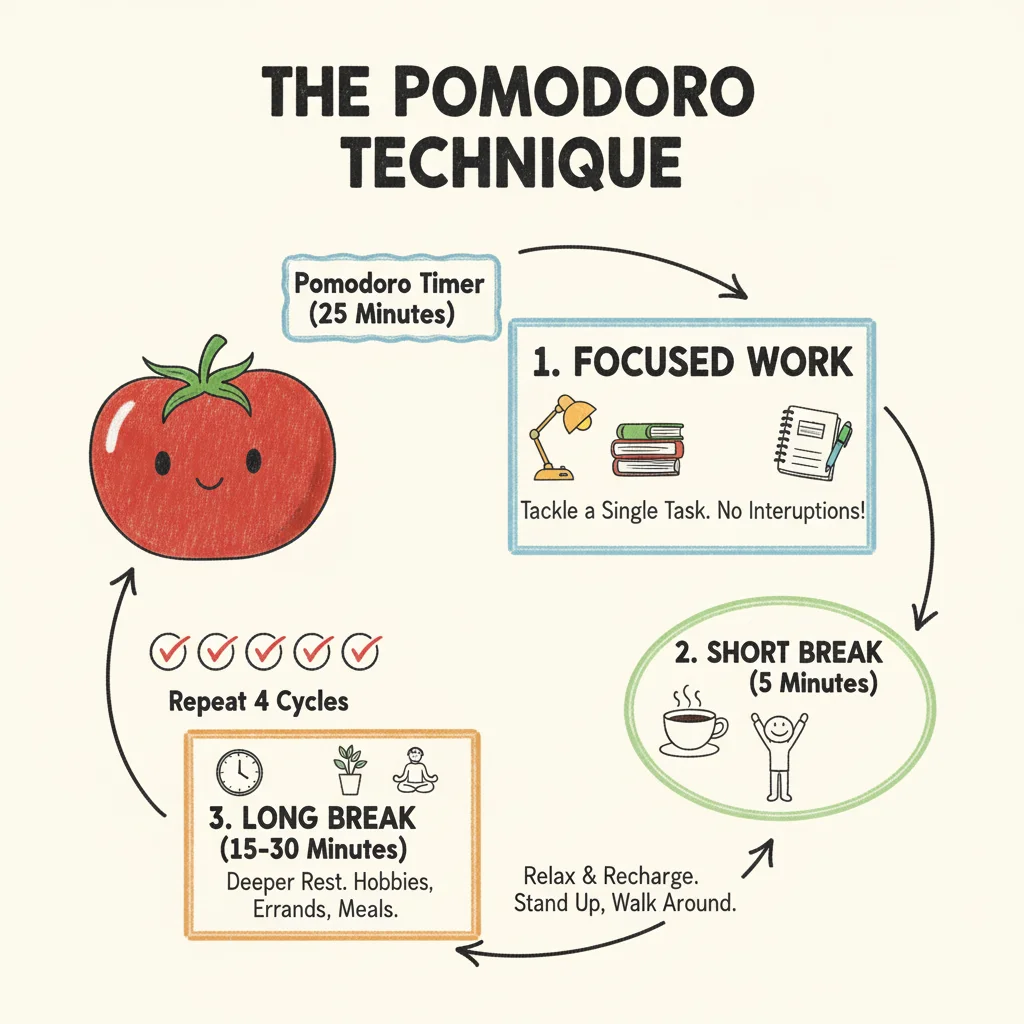
Francesco Cirillo created the Pomodoro Technique in the late 1980s to help people fight mental fatigue and keep focus sharp. This time management system divides study time into short, intense intervals—usually 25 minutes long—separated by quick breaks. It remains a top-tier study method for exams because it turns exhausting marathons into manageable sprints. This structure helps students avoid the burnout and procrastination that often stall technical exam preparation.
The system relies on the idea that frequent, brief pauses maintain concentration and mental agility over the long term. Committing to exactly 25 minutes of quiet, focused work makes a difficult subject feel less intimidating. This helps you start a task without the usual friction. These repeating cycles of work and rest train your brain to concentrate effectively, which often leads to better information retention and higher productivity.
How to Implement The Pomodoro Technique
Using this method successfully requires discipline, though the actual steps are easy to learn. You must commit to the focus interval and then truly disconnect during the break to allow your brain to process the new information.
- Choose a Specific Task: Pick one clear task to tackle during the next 25 minutes. Avoid vague goals. Instead, try tasks like "Review AWS S3 storage classes," "Solve 5 Python coding challenges," or "Read the ITIL Service Operation chapter."
- Set a Timer: Use a kitchen timer or a phone app for exactly 25 minutes. This single block is one "pomodoro."
- Work Uninterrupted: Focus only on your chosen task until the timer sounds. Do not check your phone, read email, or browse social media. If a random thought pops up, write it down quickly to handle later and return to your work immediately.
- Take a Short Break: When the timer rings, mark one pomodoro as finished and take a 5-minute break. Get up, stretch, grab some water, or rest your eyes. Do something that does not involve studying.
- Take a Longer Break: After finishing four pomodoros, take a 15-to-30-minute break. This longer rest provides a vital mental reset before you start the next round of study cycles.
Practical Application for IT Professionals
Technical experts find this technique useful when studying heavy material or high-volume content that feels impossible to finish in one sitting.
- Cloud Certifications: Dedicate one pomodoro to learning virtual networking components like VPCs, subnets, and route tables. Use the next block to study identity and access management, such as IAM roles and policies.
- Programming/Scripting: Spend one interval reviewing a specific algorithm. Use the following interval to practice writing the code or solving a related set of challenges.
- Cybersecurity: Focus on a single attack vector and its specific defenses during one pomodoro, then switch to a different threat model in the next.
By breaking your workload into these small chunks, the technique makes consistent, productive study easier to maintain. It keeps you on track while preventing the mental exhaustion that often comes during long stretches of certification prep.
8. Practice Testing
Practice testing, often called retrieval practice, is a high-impact study strategy that involves simulating the actual exam. It is active. Instead of re-reading textbooks or highlighting notes, you answer questions that mirror the real test format. Jeffrey Karpicke and other cognitive psychologists support this approach because it does more than just assess current knowledge. The effort of pulling information from your memory makes it easier to recall that data later, particularly when you are under pressure. This is a key method for technical exams.
This active process forces you to distinguish between what you truly understand and what you merely recognize on a page. When you simulate the test environment, you strengthen your knowledge while lowering exam anxiety. You also build the mental stamina needed for long sessions and get comfortable with specific question formats and time limits. This preparation is vital for technical certifications where performance is measured by speed, accuracy, and the ability to apply logic to technical problems.
How to Implement Practice Testing
The objective is to mimic the testing center experience as closely as possible. Finding and fixing weaknesses before the exam date is the priority. This requires a disciplined routine and a commitment to honest self-assessment.
- Simulate Real Conditions: Set a timer and work without your notes, books, or internet access. Treating a practice session like the real thing helps you manage your clock and builds the focus required for a multi-hour exam.
- Analyze Your Performance: Do not just look at your final score. Thoroughly review every wrong answer to find the root cause of the error. Determine if the mistake came from a knowledge gap, misreading the question, or a lack of hands-on experience. Group these errors by domain to see if a specific topic needs more attention.
- Space Out Your Tests: Avoid cramming practice tests into the last 48 hours. Spread them across your entire study schedule to see how your scores improve over time. This helps track progress and reinforces learning by giving you time to revisit weak areas.
Practical Application for IT Professionals
This technique works for nearly every technical path and is essential for passing professional certifications.
- Cloud Certifications (AWS, Azure, GCP): Use official practice exams to get used to scenario-based questions and architecture choices. This helps you understand how different services interact. It also prevents you from choosing the wrong tool for a specific problem.
- Networking Certifications (CCNA, CCNP, Network+ N10-009): Solve subnetting problems and command-line simulations. Frequent practice helps you remember configurations and troubleshooting steps without having to look them up.
- Project Management Certifications (PMP): Focus on situational questions that test your grasp of process groups and ethics. These tests force you to apply PMBOK principles to the types of complex dilemmas you see in the field.
By making timed practice tests a regular part of your routine, you change your study habits from passive reading into an active, results-oriented exercise. To sharpen these skills further, learn how to improve test-taking skills and boost your scores.
9. Chunking
Chunking is a cognitive strategy for organizing large amounts of information into smaller, more meaningful units. Short-term memory is limited. George A. Miller famously found that we can hold about seven pieces of information at once. Chunking overcomes this bottleneck by grouping individual elements into interconnected concepts. This lets your brain process information as a single unit rather than as a series of isolated data points.
This approach is a highly effective study method for exams because it reduces cognitive load and makes technical material easier to store and retrieve. Instead of memorizing strings of disconnected facts or commands, you create logical clusters. For instance, most people remember a phone number as three chunks (555-123-4567) instead of ten individual digits. This structure makes recall significantly easier during a high-stakes test.
How to Implement Chunking
To use chunking, find patterns, relationships, or natural categories within your material. The goal is to transform blocks of data into a structured format.
- Identify Patterns and Group Logically: Scan your material for items that share a theme, category, function, or chronology. For example, group Linux commands by their purpose. You might group
lsandcdunder file management, placepsandkillunder process management, and grouppingornetstatunder networking. - Use Acronyms and Mnemonics: Create memorable phrases to represent larger groups of information. The mnemonic "OSI Model's Please Do Not Throw Sausage Pizza Away" (Physical, Data Link, Network, Transport, Session, Presentation, Application) helps students remember the OSI Model layers. This turns seven distinct layers into one cohesive sentence.
- Create Hierarchies and Outlines: Organize information into a top-down format. Start with a main concept and break it down into key subtopics. For cloud architecture, you might start with "Cloud Service Models" and branch out into IaaS, PaaS, and SaaS. This creates a mental map that is easy to follow.
Practical Application for IT Professionals
Chunking works well for IT subjects full of dense lists and procedures.
- Networking Certifications (e.g., CompTIA Network+, CCNA): Chunk the OSI model by grouping layers 1-3 as "media layers" (physical transmission) and layers 4-7 as "host layers" (application communication). Group common networking protocols, such as SSH, FTP, and HTTP, by their layer or function.
- Cybersecurity Certifications (e.g., Security+, CISSP): Group different types of attacks like phishing, DDoS, and SQL injection by their common vectors. Chunk security controls into clear categories such as "Preventive," "Detective," and "Corrective" to help identify which control applies to a specific scenario.
- Programming/Scripting: Learn a complex algorithm by breaking it into core components: initialization, main loop, conditional logic, and return statement. Group related functions or libraries into modules to understand how a script functions as a whole.
By grouping related vocabulary, formulas, command-line syntax, or code snippets, you build a mental framework that makes recall under exam pressure far more efficient.
10. Study Groups and Peer Teaching
Study groups and peer teaching change the way you prepare for exams by turning solitary review into a social, active process. This involves learning as a team, explaining concepts to one another, and tackling difficult problems collectively. Teaching a topic to a teammate—the "protégé effect"—is a top-tier study method. It forces you to organize your knowledge, spot gaps in your understanding, and explain technical ideas clearly and concisely without relying on jargon.
The logic is simple: explaining a subject to others reinforces your memory through active retrieval. When you break down a complex system for a peer, you engage with the material more intensely than through passive reading. Group settings also offer different viewpoints and the mutual accountability required for success. This helps prevent the mental fatigue and isolation that often follows weeks of intensive IT certification preparation.
How to Implement Study Groups and Peer Teaching
Productive group study depends on structure. Without a specific plan, these sessions often turn into social hours. Your goal is to build an environment where everyone contributes and receives value from the interaction.
- Form a Strategic Group: Limit the size to 3-5 people. Ensure members share similar goals, such as passing the current AWS Certified Solutions Architect - Associate exam. A shared target keeps the sessions focused and ensures the material remains relevant to everyone involved.
- Set a Clear Agenda and Roles: Define the topics or practice questions before the meeting starts. Assign a specific concept to each person in advance. That member prepares to "teach" that topic to the group. This ensures everyone arrives ready to participate actively rather than just listening.
- Encourage Active Participation and Questioning: Use the Feynman Method during your sessions. One person explains a concept in simple terms, while others ask questions to test that explanation. Solve practice problems as a group and have each member talk through their reasoning for an answer.
Practical Application for IT Professionals
This approach works well for IT certifications that include scenario-based questions, architectural design, or troubleshooting labs.
- Cloud Certifications (AWS, Azure, GCP): Groups can analyze architectural diagrams together. You might troubleshoot a mock scenario, such as a web application that fails to scale, and argue for specific service choices based on the business requirements provided.
- Cybersecurity Certifications (e.g., CompTIA CySA+, PenTest+): Members can explain different attack vectors or walk through testing methodologies step-by-step. You might debate how to implement specific security controls or discuss the best way to respond to a simulated data breach.
- Project Management Certifications (PMP, Agile): Discuss situational questions where the best answer depends on context. Explain PMBOK process flows to one another or role-play agile ceremonies to see how they function in a practical, real-world setting.
Meeting regularly to teach these concepts builds both technical depth and the readiness needed to pass with confidence. This collaborative approach turns the preparation process into a tool for both exam success and professional growth.
Top 10 Exam Study Methods Comparison
| Technique | Implementation complexity | Resource requirements | Expected outcomes | Ideal use cases | Key advantages |
|---|---|---|---|---|---|
| Spaced Repetition | Moderate — requires a strict schedule and specific apps | Flashcards (digital or physical), time for regular reviews | Solid long-term memory and time-efficient review sessions | Memorizing commands, definitions, protocols, and ITIL terms | Minimizes study time while maximizing how much you remember |
| Active Recall | Low–moderate — requires the mental effort of pulling facts from memory | Practice questions, blank paper, and self-testing time | Stronger memory retrieval and awareness of knowledge gaps | Any IT subject; concept mastery and troubleshooting | Pinpoints specific weaknesses so you stop wasting time on known material |
| The Feynman Technique | Moderate — involves iterative rounds of explanation and refinement | Time for writing, a notebook, and a "student" (real or imagined) | True conceptual mastery and simpler mental models | Complex architecture, advanced protocols, and abstract IT concepts | Exposes false confidence and forces you to simplify complicated ideas |
| Interleaving | Moderate — requires organizing study sessions to mix different topics | Varied problem sets and different study materials | Better knowledge transfer and flexible problem-solving skills | Troubleshooting and scenario-based questions across mixed IT domains | Helps the brain distinguish between similar concepts for varied exams |
| Mind Mapping | Moderate — time goes into the initial creation of visual maps | Paper or digital tools (MindMeister), visual elements | Improved understanding of how different components connect | Visualizing system architectures, process flows, or exam domains | Organizes complex systems into a single, digestible visual structure |
| Elaborative Interrogation | Low–moderate — consists of asking "why" after learning a fact | Existing notes and time for logical reasoning | Flexible application of knowledge and deeper mental integration | Conceptual IT topics, design principles, and the "why" behind solutions | Links new technical facts to what you already understand |
| The Pomodoro Technique | Low — easy to adopt using structured work and break blocks | A basic timer or app and a prioritized task list | High levels of focus, less mental fatigue, and sustained productivity | Long study sessions and tackling overwhelming prep timelines | Breaks the cycle of procrastination by creating short work bursts |
| Practice Testing | Moderate — involves finding or creating high-quality assessments | Practice exams, answer keys, and a timed environment | Stronger memory retention and better performance under pressure | Standardized IT certification exams and technical interviews | Effectively simulates actual exam conditions to build confidence |
| Chunking | Low — requires grouping related bits of information into sets | Time to organize information, mnemonics, and outlines | Increased working memory capacity and easier data recall | Memorizing command syntax, lists of services, or procedures | Transforms a wall of text into smaller, more memorable units |
| Study Groups & Peer Teaching | Moderate — requires coordinating schedules and active participation | Peers, meeting tools (virtual), and prepared agendas | Reinforced learning, accountability, and diverse perspectives | Complex problem-solving and architectural design discussions | Teaching a topic to a peer forces you to master the material |
Building Your Ultimate Study System
You have explored ten effective study methods for exams. Each of these strategies is grounded in cognitive science and has been used by IT professionals to achieve better results. We have moved through the memory-building power of Spaced Repetition and Active Recall and analyzed how the Feynman Technique and Elaborative Interrogation help you understand deep concepts. The main lesson is clear: you must move away from passive reading. Shifting toward active, strategic learning is the most reliable way to pass your IT certification tests and keep that knowledge for your entire career.
The real strength of these techniques comes from combining them into a single, cohesive approach. You do not have to use a single method by itself. Instead, you should use these tools to build a personalized study system that fits your specific goals. You are essentially the designer of your own learning process for complex technical projects. Your goal is to create a routine that is effective, sustainable, and interesting. It must fit your current work schedule and the specific requirements of the technical material you are trying to master.
From Individual Tactics to an Integrated System
Progress happens when you move from reading about these methods to using them every day. Many students make the mistake of trying to use all ten techniques at once. This usually leads to fatigue and burnout. A better approach is to build your system slowly. Add new techniques only after you feel comfortable with the ones you are already using. Start by picking two or three methods that solve your biggest study problems.
- The Focus and Recall Combo: Pair the Pomodoro Technique with Active Recall to maximize your concentration and memory. Set a timer for 25 minutes and focus entirely on one topic, such as memorizing networking port numbers or AWS service names. When the timer goes off, take a five-minute break. During that break, try to summarize the key points you just learned without looking at your notes. This combination prevents mental fatigue while forcing your brain to retrieve information frequently, which strengthens your memory of discrete facts.
- The Conceptual Breakdown Combo: Use Chunking and the Feynman Technique for difficult topics like architectural design or security protocols. First, break the complex subject into smaller, logical pieces. Take one piece at a time and try to explain it out loud as if you were talking to someone who has no technical background. If you struggle to explain a specific part of the architecture, go back to your study materials and review that section. This ensures you understand the core principles instead of just repeating technical jargon you do not actually comprehend.
- The Synthesis and Retention Combo: After you finish a chapter on cloud technology or a video lecture, create a Mind Map. Use this to visually organize the main concepts and show how they relate to each other. A day or two later, look at the central topic of your mind map and try to recreate the branches from memory. This uses Spaced Repetition to ensure the information moves from your short-term memory into long-term storage. This multi-layered approach helps you see the big picture while keeping the details fresh in your mind.
This integrated approach changes your study sessions. You are no longer just looking at a screen. You are actively processing information in different ways. This strengthens neural pathways and makes your knowledge more durable.
Adapting Your System for Lasting Success
An effective study system is not a static plan. It should change as you progress through different stages of your career. The methods you use for a foundational CompTIA A+ certification might not be enough for more advanced exams. For example, a scenario-based AWS Solutions Architect Professional exam or a PMP certification requires more focus on application than simple memorization. Treat your learning like a scientific experiment. Observe your progress, check your practice exam scores, and change your tactics when you stop seeing improvement.
If you find your motivation dropping, try Study Groups and Peer Teaching. Working with others provides accountability and offers new perspectives on difficult topics. Explaining a concept to a peer is one of the fastest ways to find gaps in your own knowledge. If a specific networking concept remains confusing after several attempts, use Elaborative Interrogation. Keep asking "Why does this happen?" and "How does this connect to the previous step?" until the logic is clear. For those who face unique challenges with focus, finding tailored strategies is important. You may find helpful advice in these ADHD study tips to help you refine your focus.
The final goal is to create a study habit that feels like a strategic process you manage. By using these principles, you are doing more than preparing for a single test date. You are learning how to learn effectively for the rest of your career, which is a vital skill in the tech field. Using the best study methods for exams builds your confidence and reduces the anxiety that comes with big tests. You are ensuring that the time you spend studying today results in professional skills you can rely on for years to come.
Ready to use these study methods on a platform designed for IT success? MindMesh Academy includes Active Recall and Spaced Repetition in its learning paths for top certifications. Master complex topics and pass your exams with confidence. Visit MindMesh Academy to explore our courses and start your path today!

Written by
Alvin Varughese
Founder, MindMesh Academy
Alvin Varughese is the founder of MindMesh Academy and an enterprise architecture leader. An electrical engineer by training, he moved from factory automation in South Africa to cloud architecture at GE Appliances and Humana (Fortune 50), and holds 20 professional certifications including AWS Solutions Architect Professional, Azure DevOps Engineer Expert, and Microsoft Agentic AI Business Solutions Architect. He built MindMesh Academy after interviewing too many highly certified candidates who couldn't answer basic questions: the goal is prep that makes you better at the job, not just able to pass the exam.