
AWS Practice Questions That Test Architecture Skills
AWS Practice Questions That Test Architecture Skills
If you're using AWS practice questions to build your architecture skills, don't start by asking whether you know the service name. Start by asking whether you can defend the design. A strong architecture question gives you requirements, constraints, and trade-offs, then expects you to choose the option that best satisfies all of them with the least unnecessary complexity.
Use every scenario as a mini design review. Before you look at the answers, write down the workload pattern, failure tolerance, security boundary, data requirement, and cost constraint. After you answer, explain why the correct option wins and why each distractor fails. That habit turns question practice into architecture training, not memorization.
What AWS Practice Questions Need to Measure
Architecture questions test judgment. You may know that Amazon S3 stores objects, Amazon RDS runs managed relational databases, and Amazon CloudFront caches content globally, but that knowledge is only the starting point. The exam-style skill is deciding which combination fits the workload, constraints, and risk.
AWS's own Well-Architected Framework offers a useful mental model because it organizes design quality around operational excellence, security, reliability, performance efficiency, cost optimization, and sustainability. Good AWS practice questions usually pull from more than one of those pillars at the same time.
| What the question tests | Strong architecture signal | Weak memorization signal |
|---|---|---|
| Reliability | It asks how the workload behaves during an Availability Zone failure | It asks which service is highly available |
| Security | It includes identity, network access, encryption, or audit requirements | It asks for a definition of IAM |
| Performance | It gives latency, throughput, or burst behavior | It asks which service is fastest |
| Cost | It includes usage pattern, retention, or operational overhead | It asks which service is cheapest |
| Operations | It asks for the least manual maintenance or fastest recovery | It asks which console page to open |
A useful practice question also has plausible wrong answers. If three options are absurd, you're not practicing architecture, you're practicing vocabulary. The best distractors are technically possible but wrong for one constraint, such as choosing a read replica for high availability when the real requirement is automatic database failover.
For certification alignment, use the official AWS Certified Solutions Architect - Associate exam guide as your boundary. It keeps your practice focused on secure, resilient, high-performing, and cost-optimized architectures instead of random service trivia. If you want a broader map of how exam objectives shape your study plan, MindMesh's article on AWS certification exam domains is a good companion.
How to Read Architecture Scenarios Before Looking at Answers
Most wrong answers come from reading too quickly. AWS scenarios often contain one or two decisive constraints that eliminate otherwise reasonable choices. The final sentence usually tells you what the architect must optimize for: lowest cost, least operational overhead, highest availability, fastest recovery, simplest migration, or strongest security posture.
Use this short pass before answer choices:
- Identify the final ask, such as improve availability or reduce operational effort.
- Circle hard constraints, such as no public internet access, RPO of minutes, or multi-Region requirement.
- Separate workload facts from noise, such as steady traffic versus unpredictable bursts.
- Decide which Well-Architected pillar is dominant.
- Eliminate any answer that violates a requirement, even if the service is familiar.
This reading habit matters because AWS questions often include two answers that could work in the real world. The exam usually wants the best fit for the stated constraints, not every design that could be made to work. If scenario wording trips you up, review MindMesh's guide on how to read AWS certification exam questions before doing another full practice set.
AWS Practice Questions for Architecture Decisions
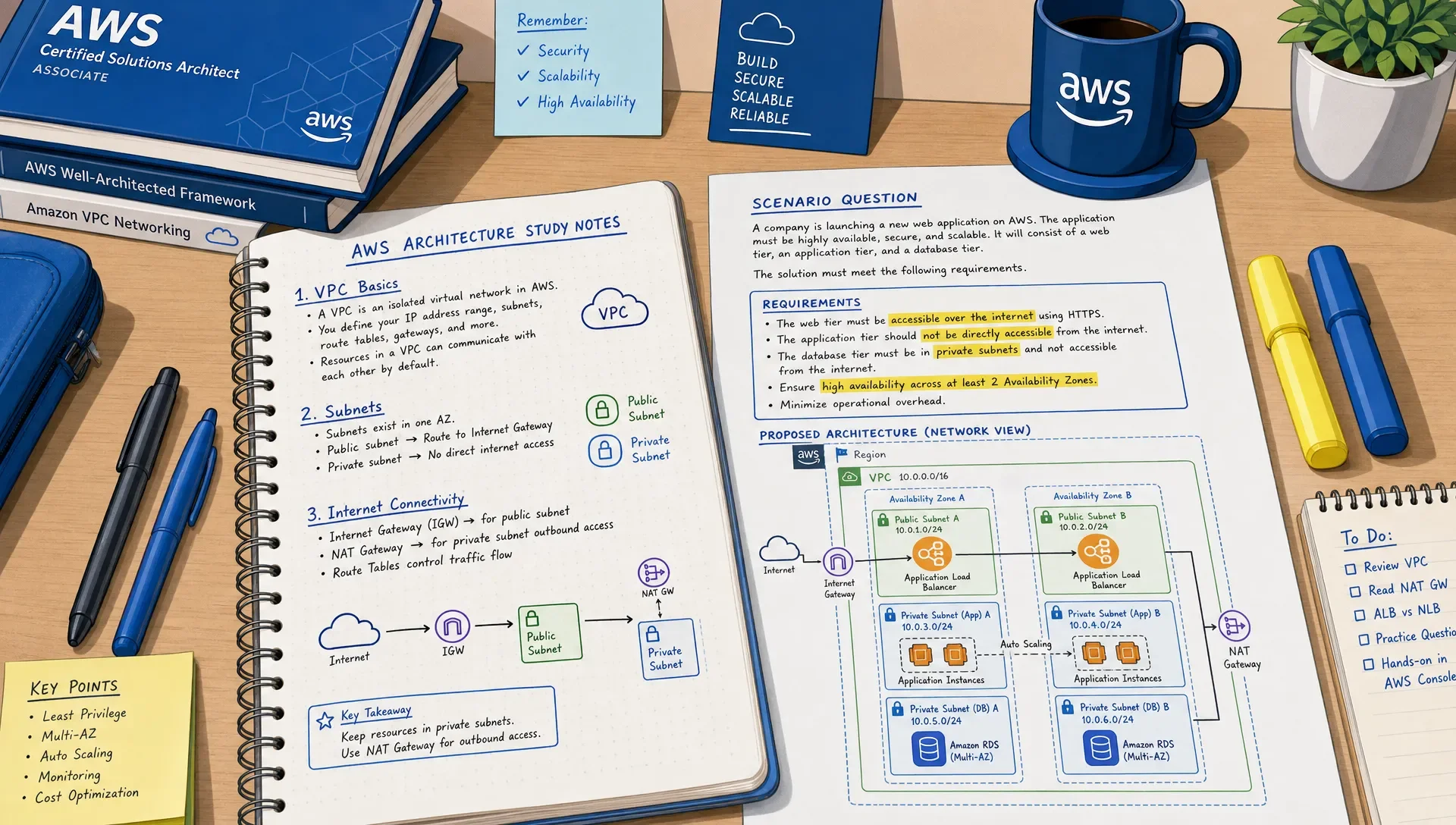
The following original examples are written to test architecture reasoning. Don't just pick the answer. State the dominant requirement, eliminate the distractors, and then compare your reasoning to the explanation.
Question 1: Improve Database Availability With Minimal Application Change
A company runs a web application on Amazon EC2 instances in an Auto Scaling group across two Availability Zones. The application uses an Amazon RDS for MySQL Single-AZ database. During database maintenance or an Availability Zone issue, the application becomes unavailable. The team wants better database availability with minimal application changes.
| Option | Design choice |
|---|---|
| A | Add an Amazon RDS read replica in another Availability Zone and send all writes to the replica during failure |
| B | Modify the database to use an Amazon RDS Multi-AZ deployment |
| C | Take more frequent automated backups and restore the database when an outage occurs |
| D | Deploy a self-managed MySQL server on EC2 in another Availability Zone and replicate data manually |
Correct answer: B. RDS Multi-AZ is built for managed database availability and failover. It addresses the failure scenario without forcing the application team to design its own replication and recovery process. A read replica can help scale read traffic, but it isn't the simplest answer for automatic high availability of the primary database. Backups improve recoverability, not immediate availability. Self-managed replication adds operational risk and doesn't match the minimal-change requirement.
Question 2: Decouple Bursty Image Processing
Users upload images to an application. The app must generate thumbnails, but upload traffic is unpredictable and can spike during marketing campaigns. The product team wants uploads to stay responsive even when thumbnail generation falls behind. Failed image jobs must be retried and reviewed later.
| Option | Design choice |
|---|---|
| A | Process thumbnails synchronously in the upload request before confirming success |
| B | Store uploads in Amazon S3, place a message in Amazon SQS, and process jobs asynchronously with a dead-letter queue |
| C | Store uploaded files on an EC2 instance and use a cron job to process them every night |
| D | Use Amazon CloudFront to cache the uploads and generate thumbnails at edge locations |
Correct answer: B. This is a decoupling question. S3 handles object storage, SQS absorbs bursts, and asynchronous workers can process jobs at their own rate. A dead-letter queue gives the team a place to inspect repeated failures. Synchronous processing makes users wait during spikes. A cron job delays processing and creates instance-level durability concerns. CloudFront improves content delivery, but it doesn't perform background thumbnail generation.
Question 3: Administer Private Instances Without Opening SSH
A security team manages EC2 instances in private subnets. The company wants administrators to connect for troubleshooting without assigning public IP addresses, opening inbound SSH from the internet, or maintaining bastion hosts. Access must be controlled by IAM and auditable.
| Option | Design choice |
|---|---|
| A | Add public IP addresses to the instances and restrict SSH to the office IP range |
| B | Deploy a bastion host in a public subnet and allow SSH from administrators |
| C | Use AWS Systems Manager Session Manager with IAM permissions and required instance configuration |
| D | Move the instances to a public subnet and use security groups for protection |
Correct answer: C. Session Manager supports interactive access to managed nodes without inbound SSH when the required setup is in place. It also aligns with IAM-based access control. AWS documents Session Manager as a capability of AWS Systems Manager. A bastion host can be valid in some architectures, but the question explicitly says the company doesn't want to maintain one. Public IP addresses and public subnets violate the network access constraint.
Question 4: Give Private Subnets Resilient Outbound Internet Access
An application runs on EC2 instances in private subnets across two Availability Zones. The instances need outbound internet access for patching and package downloads. They must not accept inbound connections from the internet. The company wants the design to remain available if one Availability Zone has a problem.
| Option | Design choice |
|---|---|
| A | Attach an internet gateway directly to each private subnet |
| B | Place one NAT gateway in a single public subnet and route all private subnets to it |
| C | Place a NAT gateway in a public subnet in each Availability Zone and route each private subnet to the NAT gateway in the same Availability Zone |
| D | Assign public IP addresses to the EC2 instances and block inbound traffic with security groups |
Correct answer: C. A NAT gateway allows outbound internet access from private subnets without allowing unsolicited inbound internet connections to the instances. Using one NAT gateway per Availability Zone avoids routing all private traffic through a single AZ dependency. An internet gateway alone doesn't make a private subnet design work as stated. Public IP addresses violate the requirement that instances remain private.
Question 5: Reduce Storage Cost for Long-Term Reports
A finance team stores monthly report files in Amazon S3. Reports are accessed frequently for the first 30 days, then rarely for compliance reviews. The company must retain the files for seven years. Retrieval after the first month can take several hours, but the team wants to avoid manual movement between storage classes.
| Option | Design choice |
|---|---|
| A | Keep all files in S3 Standard for seven years |
| B | Use an S3 Lifecycle rule to transition objects after 30 days to a lower-cost archival storage class that matches the retrieval requirement |
| C | Download reports to an on-premises file server after 30 days |
| D | Delete reports after 30 days and rely on monthly database backups |
Correct answer: B. The core signal is a predictable access pattern. S3 Lifecycle rules can move objects between storage classes without manual work. Keeping everything in S3 Standard may be simple, but it ignores the long retention and rare-access cost constraint. Moving data on premises adds operations and may weaken durability. Deleting required reports violates the retention requirement.
How to Score Your Architecture Reasoning
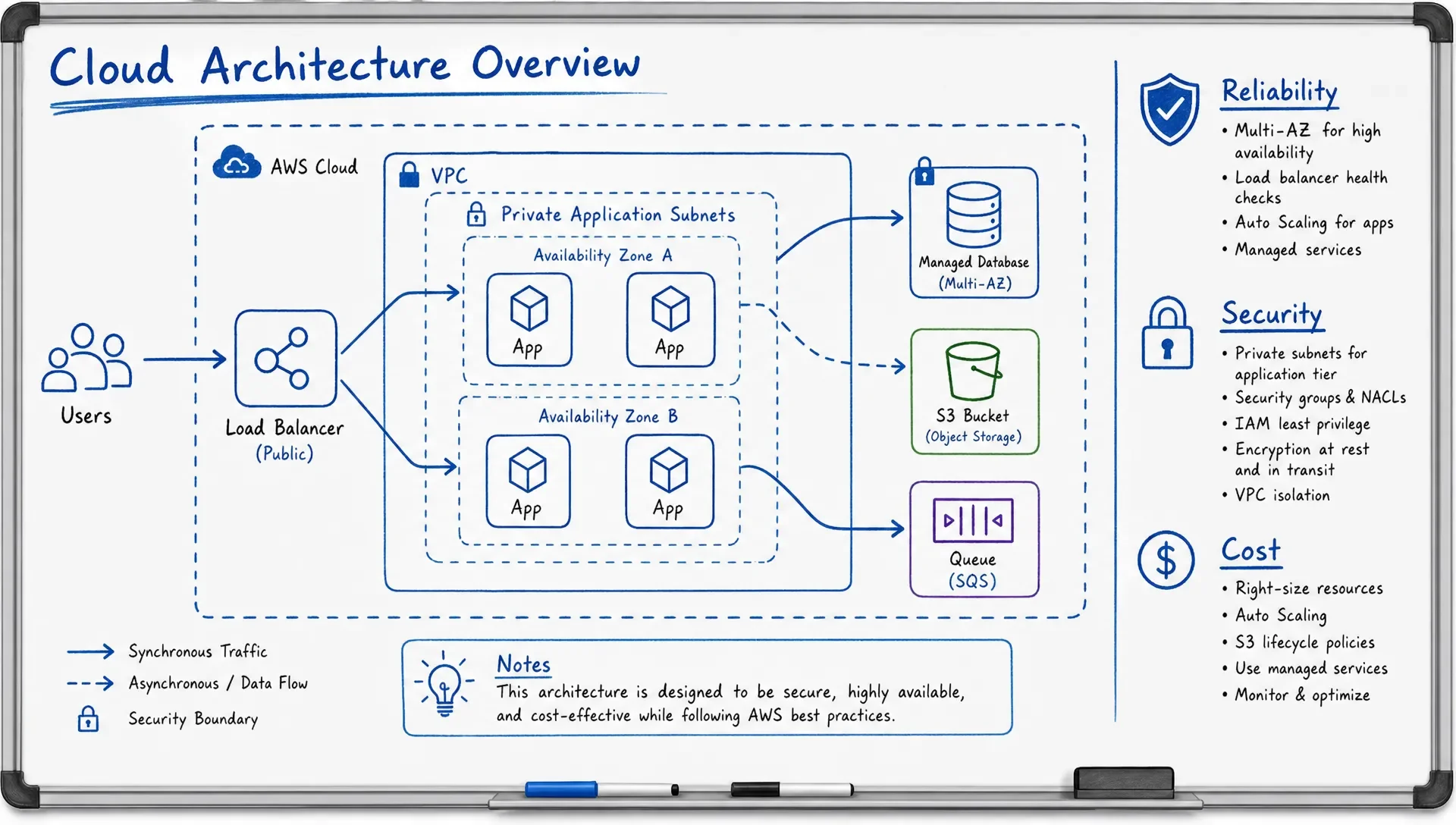
A raw percentage doesn't tell you enough. Two learners can both score 75 percent, but one may be guessing well and the other may understand the design patterns but miss wording details. Score the reasoning behind each answer.
| Skill to score | Good sign | Warning sign |
|---|---|---|
| Requirement extraction | You can name the constraint that drives the answer | You choose based on the first familiar service |
| Service fit | You know why the service matches the workload | You know the service definition but not when to use it |
| Distractor analysis | You can explain why each wrong answer fails | You only read the explanation for the correct answer |
| Trade-off awareness | You mention cost, operations, security, or reliability impacts | You treat all working designs as equally correct |
| Exam timing | You finish with time to review flagged questions | You reread every scenario because you lack a process |
After each practice session, tag misses by skill, not just by AWS service. A miss on RDS Multi-AZ may be a database knowledge gap, but it may also be a reliability-pattern gap or a final-sentence reading error. That distinction tells you what to fix next.
If you're transitioning from short drills to timed work, MindMesh's guide to using an AWS practice exam explains how to use full-length simulation without turning every session into a score-chasing exercise.
How to Turn Missed AWS Questions Into Better Designs
The review session is where most of the learning happens. Don't write down only the correct answer. Write the rule that would help you solve a similar question next time.
For example, if you missed the NAT gateway question, the rule might be: private instances that need outbound internet access use NAT, and high availability usually means avoiding a single-AZ dependency. If you missed the SQS question, the rule might be: bursty work that doesn't need immediate completion is often better behind a queue.
A useful error log has four columns:
| Column | What to write |
|---|---|
| Missed requirement | The phrase you overlooked or misunderstood |
| Correct pattern | The architecture pattern the question expected |
| Distractor trap | Why your answer seemed attractive |
| Next action | The flashcard, lab review, or focused question set you'll do next |
This method also helps with spaced repetition. Turn your rules into flashcards, then revisit them until the pattern feels automatic. For hands-on study, connect the flashcard to a small diagram or console walkthrough so the concept isn't floating by itself.
How to Build a Weekly Practice Routine for Architecture Skills
A balanced AWS study week should include reading, retrieval practice, and timed decision-making. Reading alone feels productive, but scenario questions reveal whether you can apply the material under pressure.
Here is a simple weekly structure:
| Session type | Purpose | What to do |
|---|---|---|
| Objective review | Build the mental model | Study one exam objective and summarize the main design patterns |
| Targeted practice | Fix weak areas | Answer 15 to 25 focused questions in one domain |
| Explanation review | Build judgment | Rewrite missed questions into architecture rules |
| Flashcards | Improve recall | Review service limits, patterns, and decision triggers |
| Timed set | Build exam stamina | Complete a mixed set and practice flagging uncertain questions |
MindMesh Academy provides a structured workflow for this, connecting study guides by exam objectives, practice questions with explanations, flashcards with spaced repetition, and adaptive practice based on your weak areas. If you're building AWS fundamentals before more advanced architecture work, our AWS Certified Cloud Practitioner practice exam can help reinforce service selection and core cloud concepts. For more focused scenario work, consider pairing this article with MindMesh's in-depth guide to AWS Solutions Architect practice questions.
The key is to stop treating practice questions as isolated trivia. Each question should update your design instincts. If you can't explain why an answer is safer, cheaper, more resilient, or easier to operate, mark it for review even if you guessed correctly.
Frequently Asked Questions
Are AWS practice questions enough to learn architecture? They help, but they shouldn't be your only study method. Use practice questions to test judgment, then return to AWS documentation, study guides, diagrams, and hands-on review when you find a weak pattern.
How do I know if an AWS question tests architecture instead of memorization? Architecture questions include constraints such as availability, latency, access control, retention, cost, or operational overhead. Memorization questions usually ask for a service definition without forcing a trade-off.
Should I review wrong answers immediately or after the full practice set? For short targeted drills, review immediately so the pattern is fresh. For timed sets, finish the set first, then review missed and flagged questions together so you preserve exam timing practice.
How many AWS practice questions should I answer before taking the exam? Use readiness as the measure, not a fixed question count. You want consistent performance across domains, clear explanations for distractors, and fewer misses caused by wording rather than knowledge gaps.
Are flashcards useful for architecture questions? Yes, if they capture decision triggers instead of only definitions. A good flashcard might ask when to use SQS to decouple work or when Multi-AZ matters more than a read replica.
What should I do when two answers both look correct? Return to the final ask. If the question says least operational overhead, eliminate designs that require manual management. If it says highest availability, look for single points of failure or single-AZ dependencies.
Practice Architecture, Not Just Recall
AWS architecture skill grows when you repeatedly connect requirements to design choices. The best AWS practice questions make you slow down, extract constraints, choose a service pattern, and defend your decision.
To truly build your AWS architecture skills, consistent practice is essential. MindMesh Academy helps you move beyond rote memorization by providing practice questions with detailed explanations, targeted feedback on your weak areas, and structured study plans. You'll learn to dissect complex scenarios and make sound architectural decisions, preparing you to pass the AWS Solutions Architect Associate exam with confidence. Get started with our AWS Solutions Architect Associate practice exam today to put your knowledge to the test and refine your cloud design expertise.

Written by
Alvin Varughese
Founder, MindMesh Academy
Alvin Varughese is the founder of MindMesh Academy and an enterprise architecture leader. An electrical engineer by training, he moved from factory automation in South Africa to cloud architecture at GE Appliances and Humana (Fortune 50), and holds 20 professional certifications including AWS Solutions Architect Professional, Azure DevOps Engineer Expert, and Microsoft Agentic AI Business Solutions Architect. He built MindMesh Academy after interviewing too many highly certified candidates who couldn't answer basic questions: the goal is prep that makes you better at the job, not just able to pass the exam.