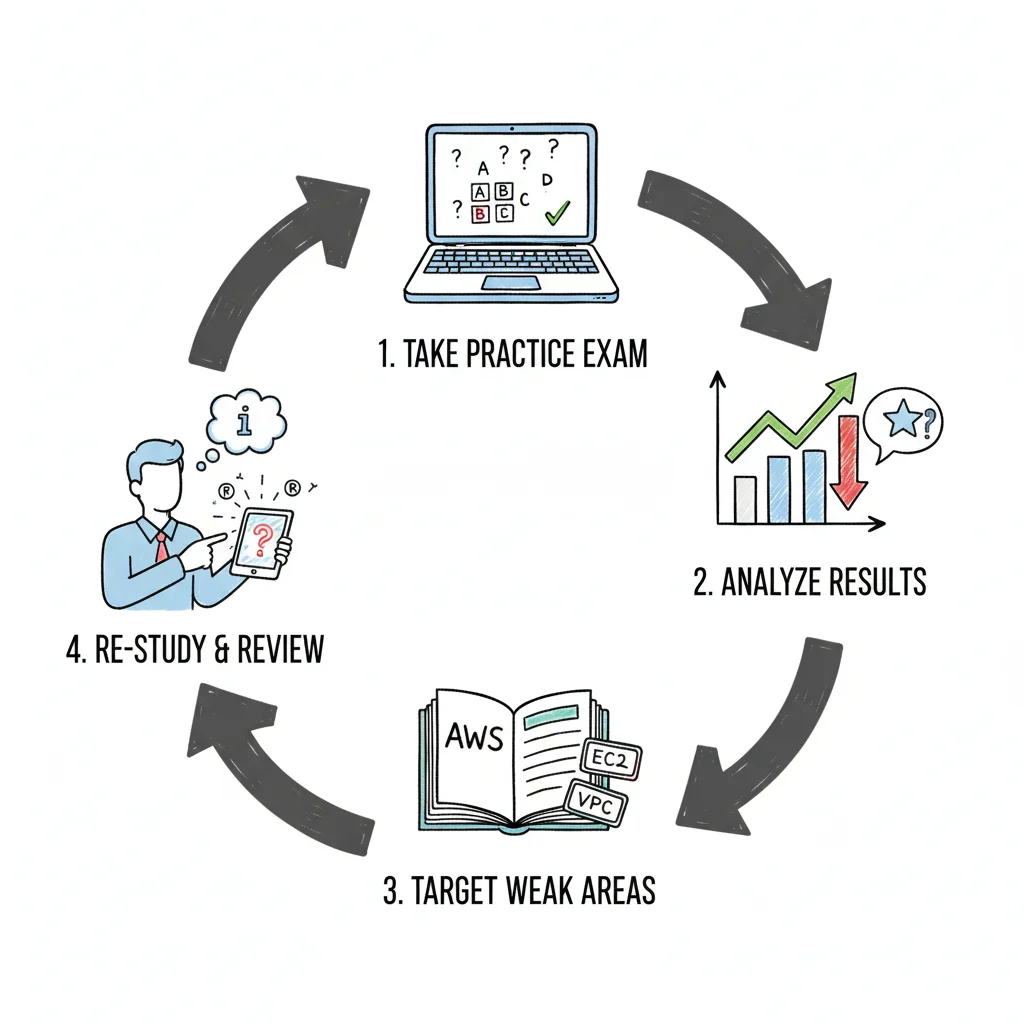
Ace AWS Practice Exam With Strategic Study Methods
Mastering AWS Practice Exams: Strategic Study Methods for Certification Success
AWS certification remains a powerful credential for any IT professional seeking to validate their technical expertise. However, earning it requires more than reading documentation; you must apply theory to scenario-based problems and demonstrate actual cloud proficiency. High-quality practice exams are vital here. At MindMesh Academy, we treat these simulations as essential tools for preparation. They mirror real certification scenarios, allowing you to build the necessary skills to pass with confidence when taking the official exam.
How AWS Practice Exams Train You for Real-World Challenges
 Caption: Just as flight simulators prepare pilots for complex operations, AWS practice exams build real-world cloud proficiency.
Consider a pilot training in a flight simulator. They practice difficult maneuvers and emergency procedures without risking a real aircraft. AWS exam mocks work on this same principle, placing actual cloud problems into a controlled environment. These simulations use scenario-based questions to test your logic and troubleshooting skills. This approach replicates the mental effort required in a production AWS account or when pursuing other credentials like PMP or ITIL.
Timed practice tests help build technical muscle memory for frequent tasks. You might need to configure IAM policies, deploy EC2 instances, or design highly available architectures using S3 and DynamoDB. Each session serves as a diagnostic tool. It shows you exactly where your knowledge falls short and turns theory into practical experience. Repeating these tests improves how much you remember and helps reduce stress on the day of the test.
By using these simulated environments regularly, you will:
- Experience real-world scenarios before you sit for the actual exam.
- Pinpoint weak spots early to focus your study time on the most difficult services.
- Practice pacing strategies for multiple-choice and multiple-response questions to manage your time.
- Advance through progressive difficulty levels, sharpening your technical skills step by step.
Benefits of Simulated Exams
Simulated exams offer a space where you can test cloud configurations without the risk of breaking a live system or running up a high bill. Think of every session as a lab exercise. If you fail a question, you find the solution and try again. This process is key to making abstract concepts stick.
Key benefits include:
- Matching the actual exam's pace and format so you know what to expect from current AWS certification standards.
- Reinforcing key concepts by seeing the same topics in different contexts.
- Tracking your improvements with data and scores that show your growth over several weeks.
- Getting comfortable with time pressure gradually to maintain your concentration when it matters most.
The Power of Deliberate Practice: A Flight Simulator Analogy
The flight simulator comparison shows why focused repetition leads to high performance. Pilots spend hundreds of hours in simulators to build their reactions and improve their choices. You should use AWS mocks with the same intent. A mistake in a practice test is a chance to learn, not a failure. It prepares you to manage the intricacies of real cloud infrastructure later.
Reflect: Think about a time you learned a new skill. How much did repetition and safe practice contribute to your mastery? How can you apply that to your AWS certification process?
Structured Roadmap to AWS Certification
Using practice exams as part of a specific study plan makes the preparation process easier to manage. We suggest following this three-phase approach:
- Phase 1: Untimed Concept Drills. Start by learning the basics without worrying about the clock. This gives you time to understand how EC2, S3, VPC, and IAM function.
- Phase 2: Timed Quizzes. Once you know the services, start taking shorter, timed quizzes. This builds your speed and helps you recall information under pressure. Focus these quizzes on specific domains.
- Phase 3: Full-Length Mocks. End your preparation with full simulations. Use the exact time limits and question counts found in the real exam to recreate the test environment.
Short study blocks followed by quick challenges help lock in what you have learned. By the time you finish this process, you can enter the testing center with the right skills and a steady mind. This method works well for AWS, Azure, or Google Cloud certifications.
After setting your plan, put your timed mocks on your calendar. Use a study scheduler to find specific times for your prep. Look at your results after every mock to see what needs more work.
- Schedule daily or weekly mock exams to make them a standard part of your week.
- Analyze mistakes immediately to find out exactly why you chose the wrong answer.
- Adjust your study topics based on your scores to fix your weakest areas first.
This routine makes the path to certification organized and less stressful. If you stay consistent and use the feedback from your practice tests, you will be well-prepared for the exam.
Understanding AWS Exam Formats
AWS certifications use a tiered structure—foundational, associate, and professional—with each level requiring different skill sets and question styles. Understanding these tiers provides a clear roadmap for your AWS practice exam strategy.
- Foundational level: For exams like the Cloud Practitioner (CLF-C02), you will mostly see straightforward multiple-choice questions (MCQs). These test your basic understanding of cloud concepts and the AWS global infrastructure.
- Associate stage: Certifications such as the Solutions Architect Associate, Developer Associate, or SysOps Administrator Associate use a mix of MCQs and multiple-response questions (MRQs).
- Professional exams: At the highest level, including the Solutions Architect Professional and DevOps Engineer Professional, performance-based tasks (PBTs) often appear. These simulate technical scenarios that require hands-on configuration.
Multiple Choice and Multiple Response Questions
Multiple-choice questions (MCQs) provide several options, but only one is correct. This is like choosing the single most appropriate AWS service for a specific technical requirement. Selecting the wrong service often leads to a solution that is either inefficient or fails to meet the project's goals.
Multiple-response questions (MRQs) require you to select every correct answer from a list. This format tests how well you understand service capabilities and how different components interact. It is like assembling all the necessary parts for a well-architected solution. If you miss a required element or include an unnecessary one, the entire answer is marked incorrect.
"Success with MRQs depends on knowing the specific details of AWS services, not just the high-level descriptions. For example, you must understand the different consistency models for S3 or the various routing policies available in Route 53."
- MRQ focus: These questions usually look for technical nuances and the subtle distinctions between similar services.
- Exam weighting: They frequently account for 25–30% of your total score on associate and professional exams.
- Distractor options: These questions include distractors designed to test your knowledge of specific policy details, service limits, or architectural best practices.
Quick Tip: On your AWS practice exam, use the process of elimination to remove choices that clearly do not fit the requirements. This narrows your options and helps you make a decision faster.
| Question Type | Typical Weight in Exam | Difficulty Level |
|---|---|---|
| MCQ | 60% | Easy to Medium |
| MRQ | 25% | Medium to Hard |
| PBT | 15% | Hard |
Performance-Based Tasks and Scenarios
Performance-based tasks (PBTs) place you in a simulated AWS console environment where you must configure services, fix technical issues, or implement solutions while the clock is running. This is a test of your practical skills under pressure. You might be asked to adjust VPC settings to permit specific traffic, update IAM policies to follow the principle of least privilege, or deploy a Lambda function.
Scenario-driven challenges use a storyline to connect multiple technical steps. You are expected to plan, configure, and troubleshoot as if you are managing a live deployment for a client. These questions prove you can apply theoretical knowledge to solve complex, real-world technical problems.
"Technical scenarios allow you to apply theory without the risk of breaking a production system. This lets you learn from mistakes in a safe, simulated environment."
Key Steps for PBT Success:
- Analyze requirements: Read every detail of the scenario carefully before you start making changes in the console.
- Map the logic: Sketch a quick flowchart or diagram on scratch paper to visualize how your solution should work.
- Use console tools: Use the search functions and shortcuts within the AWS console to find the resources you need quickly.
- Watch the clock: Monitor your remaining time closely and try to save a few minutes to double-check your configurations.
Adding these different formats to your study plan makes your preparation more effective. Once you understand the weight and difficulty of each question type, you can focus your energy on the areas that will impact your score the most.
Tailoring Your Question Focus
Your mock exam results provide clear feedback on where you need to improve. If MRQs are consistently lowering your score, dedicate more of your study sessions to those specific types of questions.
Try a structured weekly schedule to build your skills:
- Week 1: Practice MCQs to memorize core concepts and service definitions across the AWS catalog.
- Week 2: Focus on MRQs using scenario worksheets that highlight service interdependencies and policy details.
- Week 3: Work through PBTs in live AWS console labs or realistic simulations to build your hands-on expertise.
Try to match the actual exam environment by dividing your mock exam time according to the likely question distribution. For associate-level exams, this usually means 60% MCQs, 25% MRQs, and 15% PBTs.
"Targeted practice turns your technical weaknesses into strengths, ensuring you use your study time effectively."
Track your accuracy and your speed for every question type. These metrics act as a guide for your final review before you take the actual certification exam.
By using this breakdown, every study session has a clear purpose. In the next section, we will look at the best practices that help make each mock exam truly count.
Benefits of Using AWS Practice Exams for Certification Prep
Practice exams serve as dry runs for the actual test. They force you to recall information under strict time limits, which helps build the mental stamina you need on the day of your appointment. Rather than just reading documentation, these simulations prepare you for the pressure of a live environment.
Building Test Muscle Memory and Operational Fluency
A musician practices technical drills to gain speed and accuracy. Similarly, timed mock tests help you handle AWS concepts with speed. These sessions train you to recognize architectural patterns and service workflows quickly. You move beyond memorizing static facts and start thinking about how services function together in a real-world setting. This practice builds your operational fluency across the platform.
- Simulate Real Exam Pacing: Practice until you understand exactly how much time to give each question type so you do not run out of minutes at the end.
- Repeat Scenario Challenges: Review common problems until your solutions for standard AWS issues become instinctive.
- Track Progress: Use score history charts to see how your knowledge improves and identify which AWS domains still need more attention.
 Caption: This infographic illustrates the typical distribution of question types in an AWS certification exam.
The data suggests that about 60% of the questions you face are multiple choice. Another 25% require multiple responses, and the remaining 15% consist of performance-based tasks that test your ability to configure services in a live or simulated environment.
Exposing Knowledge Gaps Early
Mock exams provide a safe space to fail. If you take a simulation and find yourself confused by the differences between SQS, SNS, and Kinesis, you have found a specific area to study. You might realize you struggle with VPC routing tables or security group configurations. Finding these weaknesses early allows you to stop guessing and start focusing your time on the topics that actually lower your score.
"Early identification of knowledge gaps transforms guesswork into targeted learning, optimizing your study efforts."
AWS Practice Exam Usage Growth and Impact
The following table shows how more candidates are using these tools every year and how those efforts translate into higher scores on the official test:
| Year | Usage Percentage | Average Score Improvement |
|---|---|---|
| 2020 | 45% | 8% |
| 2021 | 56% | 10% |
| 2022 | 63% | 11% |
| 2023 | 68% | 12% |
| 2024 | 72% | 12% |
These figures demonstrate a clear trend: as the use of practice material increases, so does the average performance of candidates. The data shows steady growth in adoption over a five-year period.
Tracking Usage and Outcomes
Data indicates that candidates who spend between 20–40 hours on practice exams before their first official attempt usually earn higher scores. Leading platforms report that more than 1.2 million users every year use these tools to prepare. To see how these tests fit into a broader plan, you can look at our guide on AWS practice tests.
Real-World Success Stories
Learning from others can provide new ideas for your own preparation. Alex, who works as a solutions architect, used 15-minute quiz sessions during his daily train rides. By doing this for three weeks, he saw his accuracy on performance-based tasks jump from 60% to 85%.
"Weekly practice exams boosted my confidence more than reading documentation alone, providing the hands-on feel I needed." – Alex W.
- Focused Drills: Priya improved her multiple-response scores from 50% to 90% by concentrating on specific topics like IAM roles and resource-based policies.
- Group Study: Members of study groups often identify new question trends or updates to service features before they are widely discussed in textbooks.
Community-Driven Insights
Platforms like Reddit (specifically r/aws) and various Slack groups offer spaces to review mock questions. Discussing a difficult scenario with others helps you see different perspectives on how to solve an AWS problem.
- Virtual Meetups: Schedule sessions to break down complex scenarios and compare different AWS solutions.
- Voice Calls: Use audio to walk through hands-on tasks together, sharing screens to ensure everyone understands the configuration steps.
Measurable Exam Lift
Those who use practice exams as a regular part of their study routine often see a 12% increase in their pass rates on the first try. Every mock test you complete is a step toward passing with confidence. Mastering these concepts does more than just help you earn a badge; it prepares you to pursue remote AWS jobs by proving you have the practical skills employers want.
Integrating Practice Exams Into Your Study Plan
 Caption: A well-structured study plan with regular practice exams acts as your roadmap to certification success.
Reviewing material at random often feels aimless. To fix this, you should weave AWS practice exams into your calendar systematically. Doing so turns each test into a tool that shows you exactly what to study next. Think of your first mock exam as a diagnostic check. It reveals your current standing and identifies the specific areas where you need to spend more time.
Setting Your Baseline Score
Start your preparation with an untimed mock exam to establish your current knowledge level. This initial attempt serves as a diagnostic tool to find your natural strengths and expose gaps in your understanding of various AWS domains. Because the test is untimed, you can focus entirely on the technical content without the pressure of a ticking clock.
To get the most out of this baseline, track these metrics from the start:
- Accuracy Rate Per Section: Look at your scores for specific categories like EC2, VPC, Databases, and Security. This tells you if you need to read more documentation on networking or if you already understand compute basics.
- Time Spent On Each Question: Note which questions make you hesitate. If you spend five minutes on a single IAM question, you likely need to review identity logic, even if you eventually get the answer right.
- Common Error Categories: Identify if you are misinterpreting scenario requirements, confusing different service functionalities, or making mistakes with security policies.
Seeing these numbers in a simple chart provides clear motivation. It is similar to checking your pace during a long run. Once you have the data, you know exactly where to increase your effort or change your study method.
Mapping SMART Milestones
Break your preparation into clear goals that are specific, measurable, achievable, relevant, and time-bound (SMART). Instead of a vague goal like "I want to get better at AWS," set targets that you can track with data. For example:
- Increase your overall mock exam score by 10% in the next two weeks.
- Reduce mistakes on networking (VPC) scenario questions by half within one month.
- Achieve 90% accuracy on questions about IAM best practices.
Once you have these targets, use targeted drills to reach them:
- Hands-on labs for the services where you struggle most. If your VPC scores are low, spend an hour setting up a multi-AZ VPC with public and private subnets. If S3 is a problem, practice configuring lifecycle policies to move data to Glacier.
- Rapid-fire multiple-choice practice sessions to strengthen your memory of facts and service limits.
- Timed scenario simulations to practice applying your knowledge of different services together while under time pressure.
Each milestone is a checkpoint. These allow you to celebrate small wins, check your progress, and stay focused on the end goal.
Scheduling Practice Windows
Set aside specific study blocks that strictly follow the timing of the real exam. For example, give yourself 90 minutes to finish 60 questions. Once the questions are done, spend at least 15 minutes on a detailed review of your answers. This approach helps you build the mental stamina required for the actual test day.
You should also schedule short review sessions throughout the week. Use these to look at tough topics or re-examine the specific questions you got wrong in your last mock test.
"Consistent mock practices build exam readiness and endurance, much like mileage builds a runner's stamina."
After every practice session, write down a few notes about your mistakes. Record the correct reasoning and the concepts you need to see again. These notes will grow into a personalized study guide that is tailored to your specific needs.
Tracking and Adjusting Focus
Use a spreadsheet or a simple dashboard to log your results over time. Use colors to prioritize your work: use red for sections where you are struggling, yellow for areas that are improving, and green for topics you have mastered.
| Action Step | Frequency | Outcome Metric |
|---|---|---|
| Baseline mock | Once | Initial accuracy |
| Focused scenario drills | Twice weekly | Error reduction rate |
| Full-length timed exam | Weekly | Endurance measure |
Check these numbers after each study cycle. If your scores in security stay in the red while your compute scores are green, change your schedule to spend more time on encryption and identity management. This turns your study goals into a clear list of manageable steps for your AWS preparation.
Learn more about building an effective study routine in our guide on AWS certification preparation strategies.
Maintaining Consistency and Preventing Burnout
Study fatigue is a common problem during long certification projects. To keep your mind sharp, rotate your study methods. Do not just read whitepapers for hours. Instead, mix technical documentation with hands-on labs, flashcards, and timed practice tests.
Try to cover four different AWS services each week. This variety prevents mental exhaustion and helps you remember information more effectively through active recall.
"Short, varied practice sessions sharpen recall and actively prevent study burnout, keeping you motivated."
As your exam date gets closer, change your strategy. Reduce the number of full-length mock exams to avoid getting tired. Instead, focus heavily on fixing your remaining weak spots. Schedule your final full-length practice test two days before the real exam. After that, spend your remaining time on rest and a light review of your notes. On the day of the test, you will be familiar with the format and ready to pass with confidence.
Best Practices for AWS Practice Exams
*Caption: Learn how to effectively use AWS practice exams to boost your certification readiness.*Mock exams serve as essential dress rehearsals for your AWS certification. These tests are designed to do more than just measure your knowledge. They reveal specific technical gaps and reinforce your understanding of cloud architecture. When you apply targeted strategies, every practice session becomes a practical step toward passing the exam and building technical skills.
Selecting a high-quality question bank is the first step in this process. You need the right tools before you begin your study sessions. An outdated or inaccurate resource can lead you to study services that AWS has already modified or retired.
Key considerations for a reliable question bank:
- Align with blueprints: Always match content to the latest AWS exam blueprint and official documentation. For instance, ensure your materials reflect the current AWS CLF-C02 objectives rather than the retired version.
- Detailed explanations: Look for clear descriptions of why specific answers succeed or fail. The logic should focus on AWS best practices and the Well-Architected Framework.
- Realistic timing: Use timers to mimic the pace of the official exam. This helps you manage the pressure of the testing environment.
- Service updates: Confirm the bank covers new AWS services and features. Exam versions change to include recent releases like Amazon Bedrock or updated Lambda configurations.
- Trade-off analysis: Seek rationales that discuss AWS trade-offs. This includes cost implications, performance requirements, and architectural reliability.
- Simulated tasks: Prefer items that simulate the actual AWS console experience. This prepares you for the format of performance-based questions.
Choosing Reliable Question Banks
A solid question bank evolves alongside AWS updates. Before you pay for a resource, check that its questions align with the current official exam guide for your specific certification. If the guide mentions the AWS SCS-C03, your practice questions should not be based on the older SCS-C01 or SCS-C02 versions.
Peer reviews and community feedback can help you find dependable sources. Many successful candidates suggest finding providers that maintain high relevancy ratings in user surveys. You want to practice with material that accurately reflects the difficulty level you will face on test day.
"A trustworthy question bank feels like a precise rehearsal stage. It is a vital tool for any IT certification preparation, including AWS, Azure, or PMP."
Verifying Content Accuracy and Scoring
Accurate content is vital for effective practice. You should cross-reference explanations against official AWS documentation and technical whitepapers. If a practice test explanation seems confusing, check the source at docs.aws.amazon.com. AWS updates its service limits and features often, and third-party questions may occasionally lag behind these changes.
Understand that scoring methods vary by platform. Some providers offer a breakdown by AWS exam domains, such as Security, Storage, or Networking. Others provide a simple percentage.
- Compare score reports: Align your practice results with the official exam domains. This shows you exactly where you need more study time.
- Spot subscore trends: Look for patterns across multiple mock tests. If you consistently score low in "High Availability," prioritize that topic in your review.
- Adjust your focus: Shift your study schedule based on these trends. Spend more time on your weakest areas to ensure a balanced knowledge base.
Simulating Exam-Day Conditions
Recreating actual test-day pressure helps you build the mental stamina required for a long exam. Find a quiet space where you will not be interrupted.
Set a strict clock for your sessions. For most associate-level exams, having 130 minutes for 65 questions mirrors the real exam window. This averages out to about two minutes per question. Try to avoid using hints or outside notes during these sessions to keep the experience authentic.
- Silence your phone and place it in another room.
- Close all unrelated browser tabs to prevent distractions.
- Keep a visible timer on your desk to help you manage your pace.
Practicing under these conditions ensures you remain calm and focused when you take the actual test. It also helps you get used to the "Flag for Review" feature, which allows you to skip difficult questions and return to them later.
Mastering Elimination Techniques and Common Pitfalls
Elimination tactics can improve your score when you are unsure of the correct answer. Treat incorrect options as distractors designed to test your attention to detail.
Keep a log of common distractors you encounter. Over time, you will start to see how certain answers are technically correct but do not fit the specific constraints of the question. This awareness improves your decision-making and helps you pass with confidence.
| Strategy | Purpose | AWS Example |
|---|---|---|
| Rule Out Extremes | Eliminate answers that use absolute terms like "always" or "never." AWS solutions are usually based on specific requirements rather than absolute rules. | If a question asks for the most cost-effective solution, an option suggesting you "always provision the largest instance type" is likely wrong. |
| Keyword Matching | Identify terms that align with standard AWS behavior or service capabilities. | If a scenario requires "durable object storage," look for Amazon S3. If the requirement mentions "event-driven processing," Amazon Lambda is a likely match. |
| Context Clues | Use details like cost, performance, or security to narrow your choices. | A requirement for "real-time data streams" points toward Amazon Kinesis. If the goal is "private connectivity," you should look for Direct Connect or a VPN rather than a public endpoint. |
You can find more information on general study techniques in our guide: Best Study Methods For Exams.
Using a simple session log to record dates, scores, and specific notes about why you missed certain questions will help. Reviewing this log once a week turns random practice into a structured improvement plan.
Tapping Into Niche Study Communities
Joining an AWS study group provides different perspectives on complex topics. Forums and chat channels dedicated to AWS certifications often highlight emerging trends in exam questions and common areas of confusion.
Participating in mini review sessions with peers can be helpful. Discussing tricky scenarios, such as cross-account IAM roles or complex VPC peering, can clarify your understanding. Explaining a concept to someone else is a proven way to master it yourself.
"Collaborative problem-solving reduced my preparation time and helped me understand how different services work together," says a veteran cloud engineer.
Incorporate these practices into your daily routine. By tracking your progress and engaging with the community, you turn each practice exam into a precision tool. This approach prepares you for the technical demands of the exam and your future work in the cloud.
Analyzing Sample AWS Practice Questions
Working through real-world practice questions is similar to a dress rehearsal before an opening night performance. Each question you analyze hones your professional instincts, teaching you to identify plausible-sounding distractors and focus on the official AWS services and solutions that matter most for any given scenario. Over time, you will build an effective mental checklist for identifying the correct answer under the pressure of a ticking clock. This analytical approach helps you understand not just what the right answer is, but why the other options fail to meet the specific technical or business requirements provided in the prompt.
In this section, we examine three core formats you will encounter on the exam: multiple-choice puzzles, scenario-based case studies, and performance-based tasks. Along the way, you will learn time-saving methods, identify common technical pitfalls, and learn to recognize crucial decision points that frequently appear on AWS certification exams. By understanding the underlying structure of these questions, you can approach the testing center with much greater confidence.
Breaking Down Multiple Choice Puzzles
Multiple-choice questions (MCQs) frequently include distractors that are designed to look correct at first glance. These incorrect options often use real AWS service names but apply them to the wrong use case or suggest a configuration that violates best practices. The key to success is to focus on precise AWS terminology. Phrases such as "real-time processing," "granular control," "event-driven," or "serverless" often act as a compass. These terms guide you toward a specific service or feature, such as using Amazon Kinesis for data streaming or AWS Lambda for code execution without managing servers.
To improve your accuracy, apply these specific tactics:
- Eliminate absolute terms: Exclude options that use language like "always" or "never." Cloud solutions are almost entirely based on trade-offs between cost, performance, and reliability. AWS documentation rarely suggests a single "always-correct" path, as architecture depends on specific customer needs.
- Filter by defaults: Keep standard AWS service behaviors and default settings in mind. This allows you to quickly filter out options that suggest configurations that are impossible or highly inefficient within the standard AWS framework.
- Identify goal conflicts: Find terms or services that directly conflict with the scenario's stated context. If a question emphasizes "minimum cost," you can often rule out any answer that includes high-end features like Provisioned IOPS or multi-region replication unless those features are strictly necessary for the technical requirements.
Spotting subtle service limits, default behaviors, or architectural patterns can save significant time. Every second you save on an easy MCQ is an extra second you can spend on a complex troubleshooting scenario later in the exam.
Exploring Scenario-Based Questions
Scenario questions function like a technical brief. They present a complex business problem and require you to act as a cloud architect or system administrator. In these cases, you are responsible for mapping out Virtual Private Clouds (VPCs), Identity and Access Management (IAM) roles, data flows, and service integrations. Before you look at the answer choices, it is helpful to mentally sketch out your solution. This "storyboarding" technique helps you identify missing pieces or logical inconsistencies in your plan before you are influenced by the provided options.
For example, imagine a scenario where you must migrate terabytes of on-premises data into Amazon S3 with the goal of achieving near-zero downtime and minimal network impact. You must evaluate the specific tools available for data transfer. Choosing a service like AWS DataSync instead of a manual upload or a more complex AWS Storage Gateway configuration might be the best choice for speed and cost-efficiency. However, this conclusion only becomes clear after you have analyzed the end-to-end data path, considered security requirements, and checked the available network bandwidth. By breaking the scenario down into its individual components—source, destination, constraints, and requirements—you can more easily identify which AWS service fits the architecture.
Caption: Example of an AWS certification practice question interface, featuring a timer and navigation options.
A high-quality practice environment includes features like a visible timer, clear navigation between questions, and contextual hints. These elements mirror the actual exam console, helping you become comfortable with the user interface well before your testing date.
The table below compares the most common question formats you will face. Use this guide to tailor your study sessions and determine where to allocate your practice time.
Sample Question Types Comparison for AWS Certifications
| Question Type | Difficulty Level | Skill Focus |
|---|---|---|
| MCQ | Easy to Medium | Core concepts, definitions, and basic functions of AWS services |
| MRQ | Medium to Hard | Policy configuration, service interdependencies, and best practices |
| PBT | Hard | Hands-on deployment, troubleshooting, and solution implementation |
This side-by-side view shows how each format tests different professional strengths. Identifying your weaker areas early in your preparation means you can focus your practice where it will have the most impact on your final score.
Tackling Performance-Based Tasks (PBTs)
Performance-based tasks (PBTs) are similar to mini-labs performed under a strict time limit. You may be required to modify a security group to allow specific inbound traffic, run a query in Amazon DynamoDB to retrieve a specific dataset, or deploy a basic serverless application using AWS Lambda and Amazon API Gateway. You should approach each task as a technical checklist. Jot down the required steps on your provided scratch paper, use the AWS console's search functionality to jump to the necessary services, and verify your changes using the preview pane or specific verification steps before you finish the task.
You should aim to finish each PBT within 15 minutes. If you encounter a technical problem or feel stuck, flag the task and move on to the next set of questions. Maintaining your momentum is more important than solving one difficult lab, as you want to ensure you have time to answer every question on the exam.
- Read instructions first: Read every detail in the task description before you begin clicking in the simulated AWS console. A single sentence at the end of the instructions can change the entire configuration required for the task.
- Search for services: Use the AWS console search bar to find services immediately. This saves significant time compared to manually navigating through the various service categories in the main menu.
- Group configuration steps: Apply related settings together. If you are setting up an Amazon EC2 instance, try to configure the network settings, storage, and IAM roles in one pass through the wizard to avoid going back and forth between different screens.
"Every minute saved on a PBT translates into extra confidence and time to return to a challenging flagged task."
Building Your Answering Strategy
On the day of your exam, a repeatable and efficient process will help you manage your time and reduce stress. Start by quickly skimming through all the questions to find the ones you can answer immediately. These "quick wins" build your confidence and ensure that you don't leave easy points on the table. Once you have finished the easy questions, go back and focus on the more difficult scenarios. Finally, save at least 10% of your total time for a final review of your flagged items and a quick check to ensure you haven't made any obvious errors.
"A quick first pass over all questions effectively lays out your strongest and weakest sections, allowing for strategic time management."
Follow this four-step answering strategy during your practice exams:
- Skim every question in the first 5 minutes to get an overview of the exam and identify the easiest questions first.
- Answer the simplest questions right away to build your momentum and secure the points you are most certain about.
- Flag and skip the difficult or time-consuming questions so you can address them once you know how much time remains.
- Spend your remaining time reviewing all flagged questions and performing a final sanity check on every answer you provided.
Practice this routine until it becomes second nature during your mock exams. Developing a steady rhythm will lead to higher practice scores and greater success.
FAQ: Your Top Questions About AWS Practice Exams Answered
Finding the right rhythm for mock exams is similar to training for a marathon. You need enough practice to build endurance and refine technical skills without hitting a wall before the big day. A strong schedule includes two targeted quizzes on specific AWS domains—such as IAM or VPC—plus one full-length mock exam every week. This blend sharpens specific skills while building the mental stamina needed for the testing environment.
- Short, focused quizzes help you zero in on specific AWS services or policy configurations where you need to improve.
- Full-length mocks recreate the actual exam environment, including the time limits and the specific question formats you will face.
- Recovery days are vital because they allow new concepts to settle into your memory and prevent burnout.
Choosing Free Versus Paid Tests
Free practice tests provide a basic look at AWS concepts and question styles, but they often lack the depth or accuracy required for thorough preparation. These resources might not reflect the most recent updates to the exam. Paid question banks generally offer detailed explanations for every answer, including why incorrect options are wrong. These professional resources are updated regularly to match the current exam blueprint and provide a more realistic simulation of the testing interface.
Look for platforms that align with the current AWS exam layout and weighting. This alignment is what transforms a set of practice questions into a high-yield study tool.
"Investing in higher-quality mocks often correlates with a significant 12% score lift on the actual exam (verify current statistics and pricing on vendor sites), making it a worthwhile investment in your certification path."
Tackling Scenario-Based Questions Effectively
Scenario-based questions test your ability to solve complex cloud challenges. Break these questions down methodically to avoid being overwhelmed by the details.
- Identify the core AWS services and features required to solve the specific business or technical problem described.
- Sketch a rough architecture or flowchart on your scratch paper to visualize how different components interact.
- Verify each assumption against AWS best practices and the specific constraints of the scenario before choosing an answer.
Essential Time Management Strategies for the Exam
On exam day, you typically have 130 minutes to complete 65 questions. Pacing is the difference between a calm finish and a rushed conclusion.
- Scan the exam: Spend the first 5 minutes identifying easy questions to build confidence and early momentum.
- Answer and flag: Use the next 90 minutes to move through the questions. Answer what you know and flag any complex scenarios to revisit.
- Review and double-check: Reserve the final 35 minutes to look at flagged items and verify your answers.
"A clear, practiced time plan transforms exam pressure into a strategic guide, enabling optimal performance," says a certified AWS architect.
| Phase | Time Allotment |
|---|---|
| Skim and Plan | 5 min |
| Answering | 90 min |
| Review | 35 min |
Final Tips for AWS Certification Success
- Revisit flagged questions and the logic behind your mistakes within 24 hours to ensure you understand the underlying concept.
- Utilize spaced repetition techniques for memorizing AWS commands, service limits, and technical terminology.
- Join a study group or online community to discuss difficult scenarios and stay motivated during your preparation.
"Consistent review and active engagement with the material are the keys to cementing knowledge and achieving certification."
Ready to sharpen your AWS skills and pass your exam with confidence? Explore MindMesh Academy for curated AWS practice exam resources and expert guidance designed for IT professionals. Start today and improve your cloud proficiency!
Ready to Get Certified?
Prepare for your next exam with expert-curated study guides, practice exams, and spaced repetition flashcards at MindMesh Academy:

Written by
Alvin Varughese
Founder, MindMesh Academy
Alvin Varughese is the founder of MindMesh Academy and holds 20 professional certifications including Microsoft Agentic AI Business Solutions Architect, AWS Solutions Architect Professional, and Azure DevOps Engineer Expert. He's held senior engineering and architecture roles at Humana (Fortune 50) and GE Appliances. He built MindMesh Academy to share the study methods and first-principles approach that helped him pass each exam.