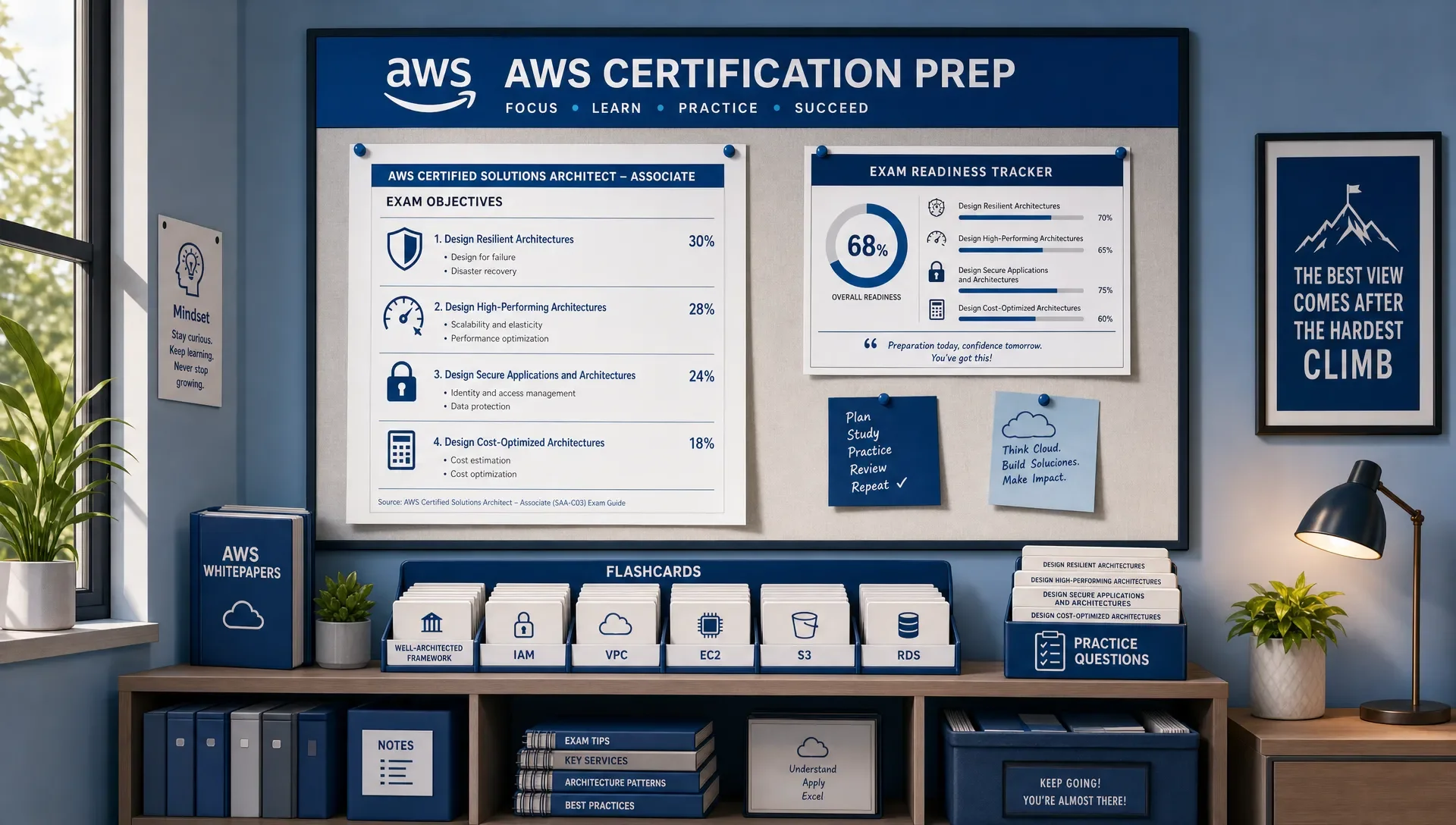
AWS Certification Exam Questions and How to Read Them
AWS Certification Exam Questions and How to Read Them
If you're missing AWS certification exam questions, even after understanding the services, your reading process might be the problem. Don't start by comparing answer choices. Instead, find the task, the constraint, and the success condition. Then, treat each answer choice as a proposal that must satisfy all three.
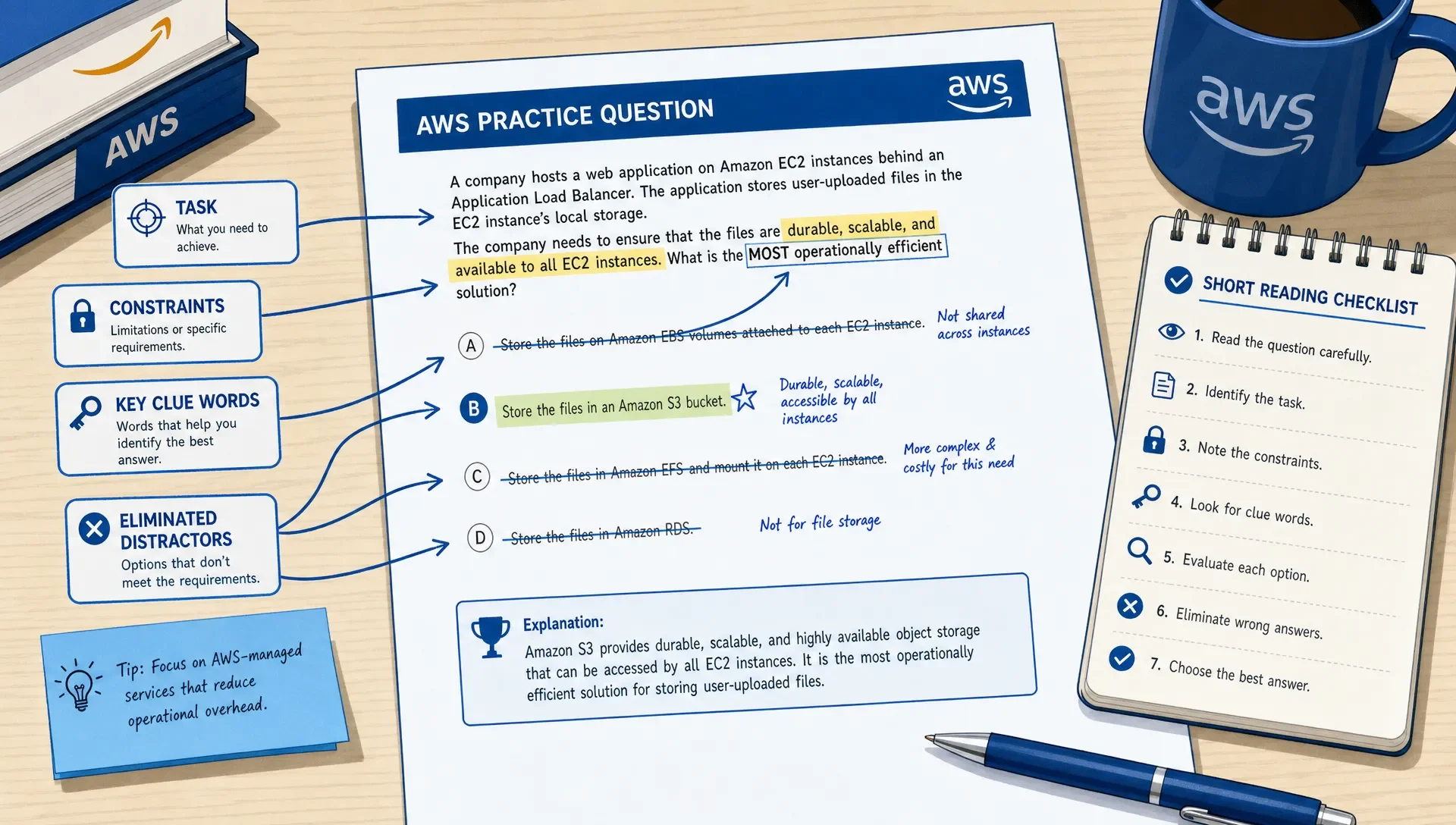
Make this sequence a habit for every practice item: Read the final sentence first, identify what the customer needs, underline limiting words like "least operational overhead" or "most cost-effective," then eliminate options that solve a different problem. This approach turns long AWS scenarios into smaller, manageable decisions, even under time pressure.
How to Read AWS Certification Exam Questions Step by Step
Most AWS certification exam questions don't ask, "Do you recognize this service name?" They ask if you can choose the best AWS design for a specific situation. This distinction matters because several answer choices might be technically possible, but only one best fits the scenario.
A reliable reading process looks like this:
- Read the final sentence first: Pinpoint the exact request before you absorb the scenario details. Look for phrases such as "Which solution meets these requirements?" or "What should the solutions architect do?"
- Name the workload or task: Determine if the question focuses on identity, networking, storage, compute, migration, monitoring, cost, security, or reliability.
- Circle the constraints: Constraints are the words that narrow the correct answer. Common examples include "minimum operational overhead," "no public internet," "highly available," "existing application," and "lowest cost."
- Predict the answer type: Before reading the choices, anticipate the kind of solution you expect. For instance, a decoupling problem often suggests a queue, an event service, or an asynchronous architecture.
- Eliminate by violation, not preference: Remove any option that breaks a stated requirement, even if the service itself is familiar or popular.
AWS publishes exam guides and certification information through its official AWS Certification FAQ. These guides organize content around domains, task statements, and exam expectations. If you study by domain instead of jumping between random service facts, classifying questions becomes easier. MindMesh Academy's article on AWS certification exam domains you need to master offers a useful companion to connect question clues back to the exam blueprint.
Why AWS Exam Questions Feel Harder Than the Services
AWS services are often easy to define in isolation. Amazon S3 stores objects. AWS Lambda runs code without managing servers. Amazon RDS provides managed relational databases. Exam scenarios become harder because they combine service knowledge with specific constraints.
For example, a question might mention S3, encryption, IAM, VPC endpoints, cost, and operational overhead in the same stem. If you read it as a memory test, every option can look plausible. If you read it as a design decision, the question becomes more manageable: what must the answer accomplish, and what must it avoid?
The AWS Well-Architected Framework is helpful here, as many exam scenarios reflect its decision areas: operational excellence, security, reliability, performance efficiency, cost optimization, and sustainability. You don't need to quote the framework during the exam, but you do need to recognize which priority is driving the answer.
A question asking for the "least operational overhead" isn't just asking for any working solution. It's asking for the option that reduces management burden, often by choosing a managed service over self-managed infrastructure. A question stating "highly available across multiple Availability Zones" isn't just asking for scalability. It's asking you to avoid single points of failure.
Common AWS Question Clues and What They Mean
The fastest way to improve your score is to build a clue vocabulary. AWS question writers often use small phrases that signal the design priority. These words determine which otherwise-correct answer is the best fit.
| Clue in the question stem | What it usually points to | How to read it |
|---|---|---|
| "Least operational overhead" | Managed service, automation, or serverless option | Avoid answers that require manual patching, custom scripts, or ongoing administration unless the stem specifically demands them |
| "Most cost-effective" | Right-sized, usage-based, or storage class choice | Don't choose the cheapest option if it fails durability, availability, or performance requirements |
| "Highly available" | Multi-AZ, managed redundancy, or failover | Watch for answer choices that rely on a single instance, single subnet, or single data path |
| "Decouple components" | Queue, event, or asynchronous design | Look for a buffer between producers and consumers, especially during traffic spikes |
| "No public internet access" | Private networking, VPC endpoint, or private connectivity | Reject answers that depend on public IPs, internet gateways, or public buckets unless carefully controlled |
| "Minimum changes to the application" | Solution that fits the current architecture | Avoid options that require large rewrites if a compatible managed option exists |
| "Shared responsibility" | Correct boundary between AWS and the customer | Identify whether the question is about AWS-managed infrastructure or customer-managed configuration |
Security questions deserve special attention because one word can change the answer. The official AWS Shared Responsibility Model separates what AWS is responsible for from what the customer is responsible for. On foundational and associate exams, this distinction often appears in questions about patching, encryption configuration, IAM permissions, data protection, and network access.
How to Separate Requirements From Background Details
AWS certification exam questions often include more information than you need. This doesn't mean the extra detail is random. Some details set context, some create constraints, and some distract you from the main task.
A practical way to sort the stem is to label each sentence as one of three types.
| Sentence type | Example | What to do with it |
|---|---|---|
| Environment detail | "A company runs a web application on Amazon EC2 instances." | Use it to understand the current architecture, but don't assume the answer is EC2 just because EC2 appears |
| Requirement | "The solution must continue operating if one Availability Zone fails." | Treat it as mandatory. Any answer that violates it should be eliminated |
| Constraint | "The team wants the least operational overhead." | Use it to choose between two technically valid answers |
| Failure symptom | "Processing jobs are lost during traffic spikes." | Identify the design weakness the answer must fix |
| Distractor detail | "The company recently migrated its DNS to Route 53." | Ignore it unless the final ask is about DNS, routing, or domain configuration |
Many learners lose points here. They see a familiar service name early in the stem and fixate on it. Then they choose an answer that uses that service, even though the final sentence asks about a different problem.
If you're focusing on this skill, the MindMesh Academy guide on how to spot the key clue in exam test questions offers more depth on separating clue words from noise across various certification exams.
How to Eliminate AWS Answer Choices Without Second-Guessing
After you understand the stem, read each answer choice like a design review. Your job isn't to find a service you like. Your job is to reject any option that fails the requirements.
Strong elimination usually follows one of these patterns:
- The answer solves the wrong problem: It improves performance when the question asks for security, or it reduces cost when the question asks for disaster recovery.
- The answer violates a stated constraint: It uses the public internet when the stem says private access only, or it requires manual work when the stem asks for minimal operational overhead.
- The answer is overbuilt: It introduces unnecessary services, replication, or custom infrastructure when a simpler managed option satisfies the requirement.
- The answer is incomplete: It names the right service family but misses an essential configuration, such as routing, permissions, encryption, or scaling.
- The answer is true but not best: It could work in real life, but another option satisfies the scenario more directly with fewer tradeoffs.
When two choices seem similar, compare them against the exact wording of the stem. "Most secure" and "least operational overhead" can lead to different answers. "Cost-effective" and "highest performance" can also diverge. The best answer is the one that matches the priority the question gave you, not the priority you would personally choose.
Worked Examples of Reading AWS Practice Questions
The examples below are original practice-style questions, not real AWS exam content. Use them to practice the reading method rather than memorize the answers.
Example 1: Decoupling and traffic spikes
A company runs a web application on Amazon EC2 instances behind an Application Load Balancer. Users upload images that are processed by the same EC2 instances. During traffic spikes, uploads succeed but some image processing tasks fail. The company wants to avoid losing processing jobs and scale image processing independently from the web tier. Which solution best meets these requirements?
| Answer choice | How to read it |
|---|---|
| Increase the EC2 instance size for the web tier | This may add capacity, but it does not decouple processing or prevent job loss during spikes |
| Store uploaded images on an EBS volume and run a cron job | This creates storage and scheduling concerns but still doesn't provide a durable queue between upload and processing |
| Send processing requests to Amazon SQS and process them with a separate Auto Scaling worker group | This matches the clues: avoid lost jobs, decouple components, and scale processing independently |
| Add Amazon CloudFront in front of the Application Load Balancer | This can improve content delivery, but it doesn't solve backend job processing failure |
The key clue is "scale image processing independently from the web tier." Once you identify that, the answer needs a buffer between upload and processing. Amazon SQS fits the requirement because it allows the web tier to place work into a queue while workers process messages separately.
Example 2: Private access to S3
A company's EC2 instances run in private subnets. The instances need to retrieve objects from Amazon S3. The company does not want traffic to traverse the public internet and wants a cost-effective solution. What should the company configure?
The key clues are "private subnets," "S3," "does not want traffic to traverse the public internet," and "cost-effective." A NAT gateway might allow private subnet instances to reach public AWS service endpoints, but it doesn't best match the private and cost-conscious wording for S3. For S3, a gateway VPC endpoint is the stronger fit. AWS documents this pattern in its guide to gateway endpoints for Amazon S3.
Notice how the service name alone isn't enough. If the question were about connecting privately to a different AWS service, the endpoint type could change. The right reading move is to identify the destination service, the network constraint, and the cost condition before choosing.
Example 3: Shared responsibility
A team runs a custom application on Amazon EC2 instances. The security team asks who is responsible for patching the guest operating system on those instances. Which party is responsible?
The clue is "guest operating system on EC2 instances." Under the shared responsibility model, AWS manages the security of the cloud, while customers manage security in the cloud. For EC2, the customer is responsible for guest operating system updates and application-level configuration. If the same question were about an AWS managed service where AWS controls the underlying operating system, the answer could be different.
How to Review AWS Practice Questions After You Answer
The review is where practice becomes improvement. If you only check whether you got the question right, you miss the reason your reading process succeeded or failed.
After each practice set, write a short error note for every missed or guessed question. Keep it simple: what clue did you miss, what wrong assumption did you make, and what rule will you apply next time? Over a week or two, patterns will appear. Maybe you keep confusing security groups and network ACLs. Maybe you miss "least operational overhead" and choose self-managed options. Or maybe you understand services but run out of time on long stems.
MindMesh Academy's AWS Certified Cloud Practitioner practice exam is built for this kind of deliberate review, with practice questions, explanations, adaptive weakness-based practice, and readiness tracking. If you're still building the fundamentals, the AWS Certified Cloud Practitioner study guide can help you connect each question back to exam objectives before you drill more questions.
Use this review table to decide what to do next.
| Practice result | Likely issue | Next study action |
|---|---|---|
| You missed a question because you didn't know the service | Knowledge gap | Review the service concept, then answer a few targeted questions in that domain |
| You knew the service but chose a weaker answer | Reading gap | Re-read the stem and identify the constraint that made the correct answer better |
| You eliminated the right answer too early | Assumption gap | Check whether you added a requirement that was not actually in the question |
| You got it right but guessed | Confidence gap | Put it into flashcards or spaced repetition so the reasoning becomes easier to recall |
| You ran out of time | Timing gap | Practice reading the final sentence first and summarizing the stem in one phrase |
Don't wait until the week of your exam to track these patterns. Readiness isn't just an overall score. You need stable performance by domain, consistent timing, and fewer careless misreads. The MindMesh Academy article on AWS exam readiness signs you shouldn't ignore can help you decide whether your practice results are strong enough or still uneven.
Timing Tips for Long AWS Scenario Questions
Long questions can drain time if you read every word with equal weight. The fix isn't to skim carelessly. The fix is to read with purpose.
Start with the final ask, then read the scenario looking only for information that affects that ask. If the final sentence asks for a storage class, networking details may be less important unless they affect access or performance. If it asks for secure access from a VPC, storage lifecycle details may be background noise.
For multiple-response questions, slow down after you choose your first answer. These items often require a complete set of correct choices. One correct choice plus one weak choice can still make the item wrong. Treat each selected answer as part of a combined solution and ensure the set satisfies every requirement.
A useful timing target during practice is to summarize the question in one sentence before answering. For example: "They need private, cost-effective access from EC2 to S3" or "They need to decouple image processing from the web tier." If you can't summarize the question, you're probably reacting to service names instead of reading the scenario.
Frequently Asked Questions
Are AWS certification exam questions mostly memorization? No. You do need service knowledge, but many questions test whether you can apply that knowledge to a scenario. The best answer usually depends on constraints such as cost, availability, security, scalability, or operational overhead.
What should I read first in an AWS exam question? Read the final sentence first. It tells you what decision you're being asked to make. Then read the scenario to find the requirements and constraints that control the answer.
How do I handle AWS questions where two answers look correct? Compare both choices against every word in the stem. One answer may be technically valid but weaker because it costs more, requires more management, ignores availability, or solves a different problem than the one asked.
Should I memorize every AWS service before practicing questions? No. Learn the core services and exam domains, then use practice questions to improve application and judgment. When you miss a question because of a service gap, go back to the study guide and review that specific objective.
How many AWS practice questions should I review at a time? Smaller, thoroughly reviewed sets often beat large, unreviewed sets. A focused block of 20 to 30 questions with explanations, error notes, and follow-up flashcards can teach more than racing through a full exam without analysis.
Why do I score well in study mode but poorly on timed AWS practice exams? Timed exams add pressure, longer reading load, and decision fatigue. If your score drops under time limits, practice summarizing each stem quickly and track whether misses come from knowledge gaps, missing clues, or rushing.
Build a Better AWS Question-Reading Habit
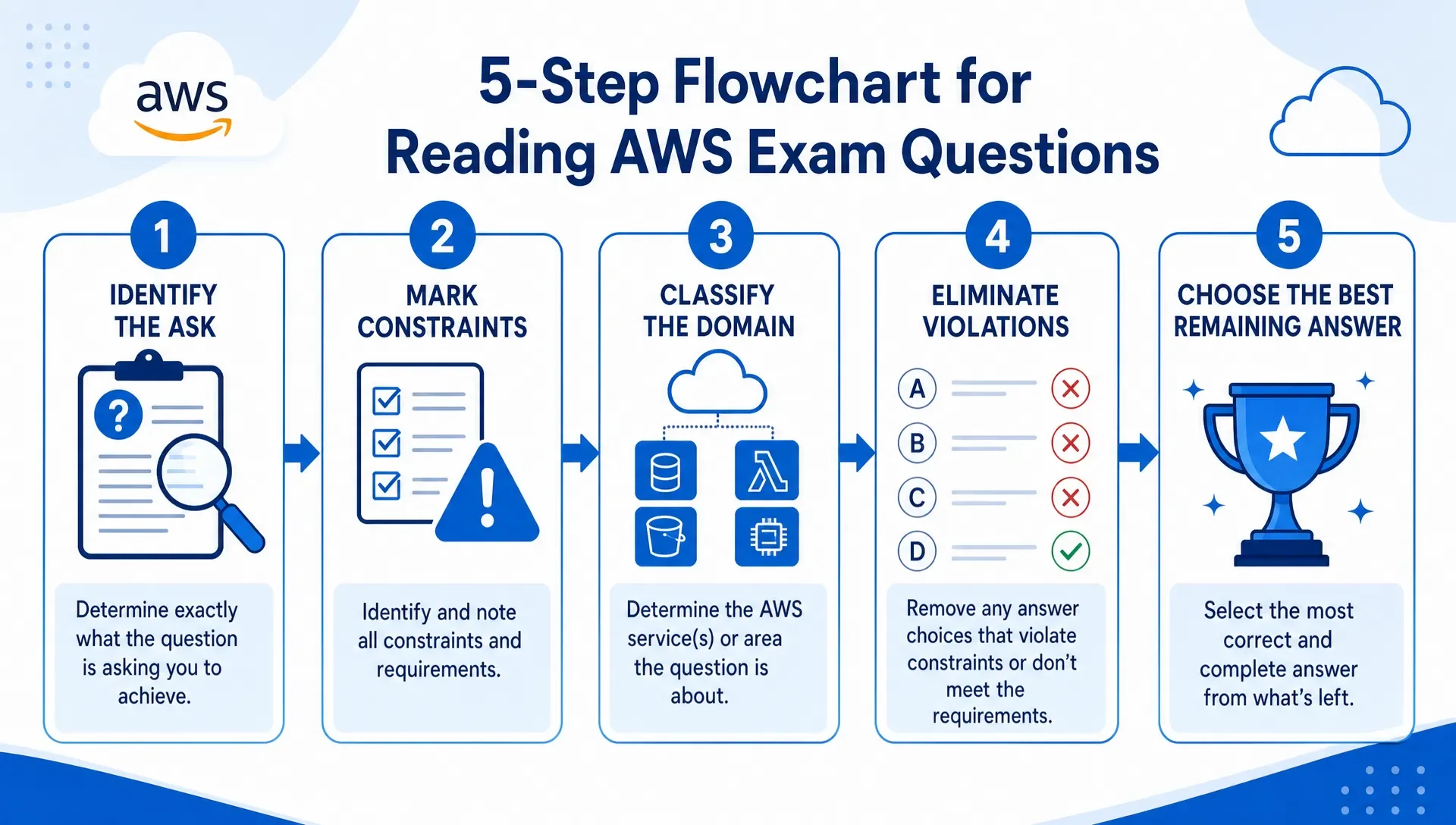
You don't need a clever trick to answer AWS certification exam questions more reliably. You need a repeatable process: identify the ask, mark the constraints, classify the domain, eliminate violations, and review every miss for the clue you overlooked.
MindMesh Academy helps you practice that process with study guides by exam objective, practice questions with explanations, adaptive weakness-based practice, and readiness tracking. Choose an AWS path, work through targeted questions, and make every review session show you what to fix next. Start building your AWS knowledge and prepare to pass the exam with confidence using our AWS Certified Cloud Practitioner practice exam.

Written by
Alvin Varughese
Founder, MindMesh Academy
Alvin Varughese is the founder of MindMesh Academy and an enterprise architecture leader. An electrical engineer by training, he moved from factory automation in South Africa to cloud architecture at GE Appliances and Humana (Fortune 50), and holds 20 professional certifications including AWS Solutions Architect Professional, Azure DevOps Engineer Expert, and Microsoft Agentic AI Business Solutions Architect. He built MindMesh Academy after interviewing too many highly certified candidates who couldn't answer basic questions: the goal is prep that makes you better at the job, not just able to pass the exam.