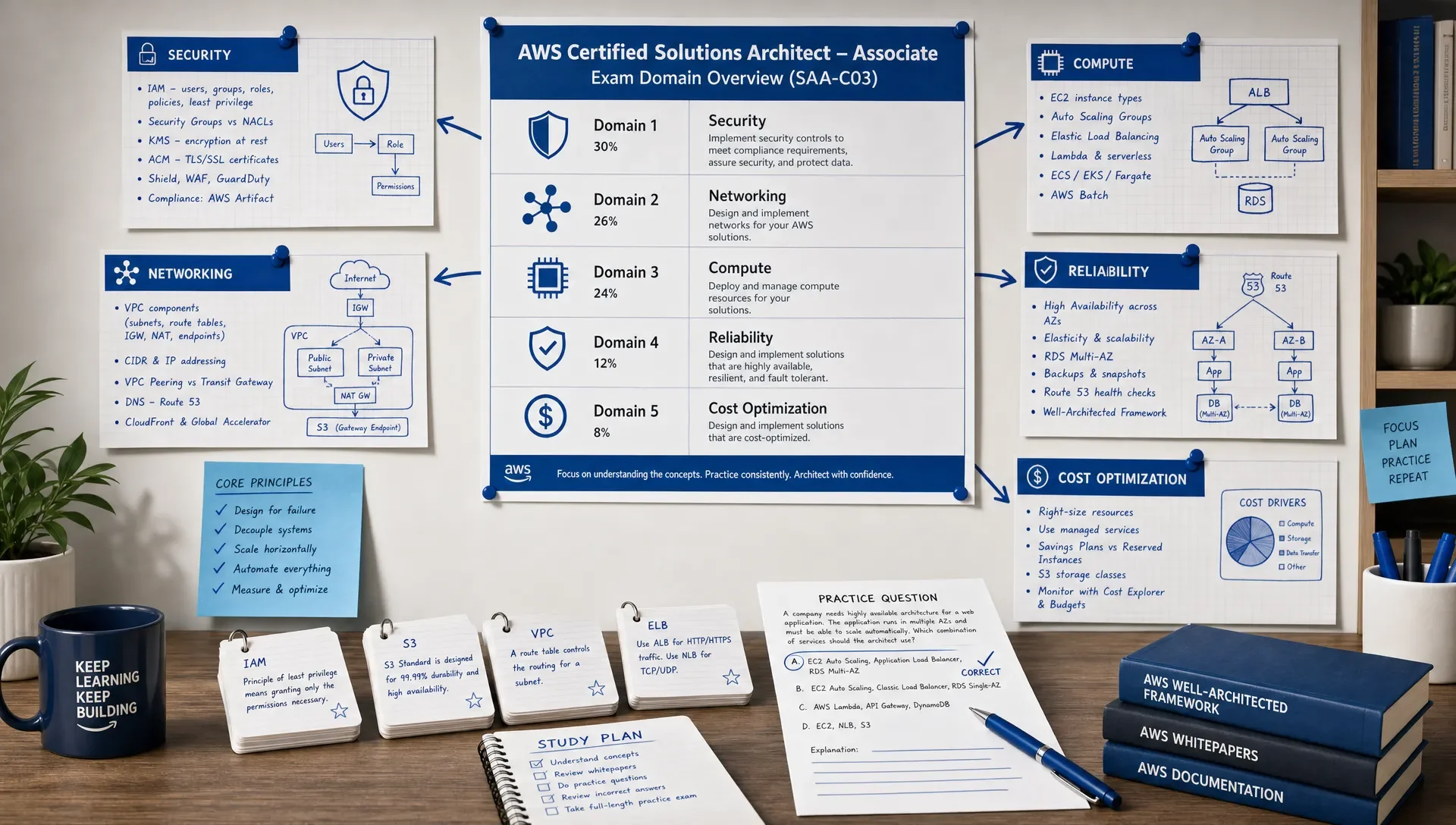
AWS Certification Exam Domains You Need to Master
AWS Certification Exam Domains: Your Key to Study Success
When you're getting ready for an AWS certification exam, the last thing you should do is try to memorize every AWS service in alphabetical order. Instead, focus on the exam domains. These domains tell you exactly what AWS will test, how much each area contributes to your score, and where you should spend your study time each week.
The most effective approach is straightforward: download the official AWS exam guide for your certification. Turn each domain into a checklist. Then, study and test yourself by domain until you consistently conquer your weak spots. This method works for any AWS certification you're pursuing, whether it's Cloud Practitioner, Solutions Architect, Developer, SysOps, a professional-level exam, or a Security - Specialty certification.
How AWS Certification Exam Domains Work
An AWS certification exam domain represents a significant category of knowledge and skills the exam measures. AWS doesn't just ask, "Do you know S3?" It expects you to apply S3, IAM, VPC, CloudWatch, databases, and cost controls within a realistic business scenario.
This is why domain-based preparation is far more effective than trying to cram service-by-service. A domain describes the job outcome AWS expects from a certified professional. Take, for example, "Design Secure Architectures" in the Solutions Architect - Associate exam. This isn't just about IAM definitions. It covers identity boundaries, encryption choices, network controls, least privilege, secure access patterns, and the tradeoffs between operational complexity and risk.
Domain weights are also important. A domain worth 30% of your score deserves more practice than one worth 12%. But don't dismiss the lower-weight domains. AWS exams frequently combine multiple areas in a single question, such as cost optimization with storage lifecycle policies and compliance requirements.
AWS Certification Exam Domain Weights by Exam
AWS publishes exam guides for every certification. These guides are your definitive source of truth before you schedule your exam. Exam versions can change, so always check the current blueprint on the official AWS page for your target exam.
| AWS certification exam | Current major domains to plan around | Study implication |
|---|---|---|
| AWS Certified Cloud Practitioner | Cloud Concepts 24%, Security and Compliance 30%, Cloud Technology and Services 34%, Billing, Pricing, and Support 12% | Build broad AWS literacy, with extra attention to security basics and core service selection. |
| AWS Certified Solutions Architect - Associate | Design Secure Architectures 30%, Design Resilient Architectures 26%, Design High-Performing Architectures 24%, Design Cost-Optimized Architectures 20% | Practice architecture tradeoffs. Most questions are scenario-driven, not definition-driven. |
| AWS Certified Developer - Associate | Development with AWS Services 32%, Security 26%, Deployment 24%, Troubleshooting and Optimization 18% | Focus on building, securing, deploying, and debugging applications using AWS services. |
| AWS Certified SysOps Administrator - Associate | Monitoring, Logging, and Remediation 20%, Reliability and Business Continuity 16%, Deployment, Provisioning, and Automation 18%, Security and Compliance 16%, Networking and Content Delivery 18%, Cost and Performance Optimization 12% | Prepare for operational judgment, monitoring signals, automation, backups, and incident response. |
| AWS Certified Solutions Architect - Professional | Design Solutions for Organizational Complexity 26%, Design for New Solutions 29%, Continuous Improvement for Existing Solutions 25%, Migration and Modernization 20% | Expect multi-account, hybrid, migration, governance, and enterprise-scale design scenarios. |
| AWS Certified DevOps Engineer - Professional | SDLC Automation 22%, Configuration Management and IaC 17%, Resilient Cloud Solutions 15%, Monitoring and Logging 15%, Incident and Event Response 14%, Security and Compliance 17% | Know CI/CD, infrastructure as code, observability, automated recovery, and secure operations. |
| AWS Certified Security - Specialty | Threat Detection and Incident Response 14%, Security Logging and Monitoring 18%, Infrastructure Security 20%, Identity and Access Management 16%, Data Protection 18%, Management and Security Governance 14% | Go deep on security services, investigation workflows, encryption, logging, network controls, and governance. |
For a first AWS exam, many learners begin with Cloud Practitioner or Solutions Architect - Associate. If you choose Cloud Practitioner, a focused AWS Certified Cloud Practitioner practice exam can help you test your understanding of the broad domains before moving into deeper associate-level content. If your goal is architecture, a structured Solutions Architect - Associate study guide is a better fit because the domains revolve around design decisions.
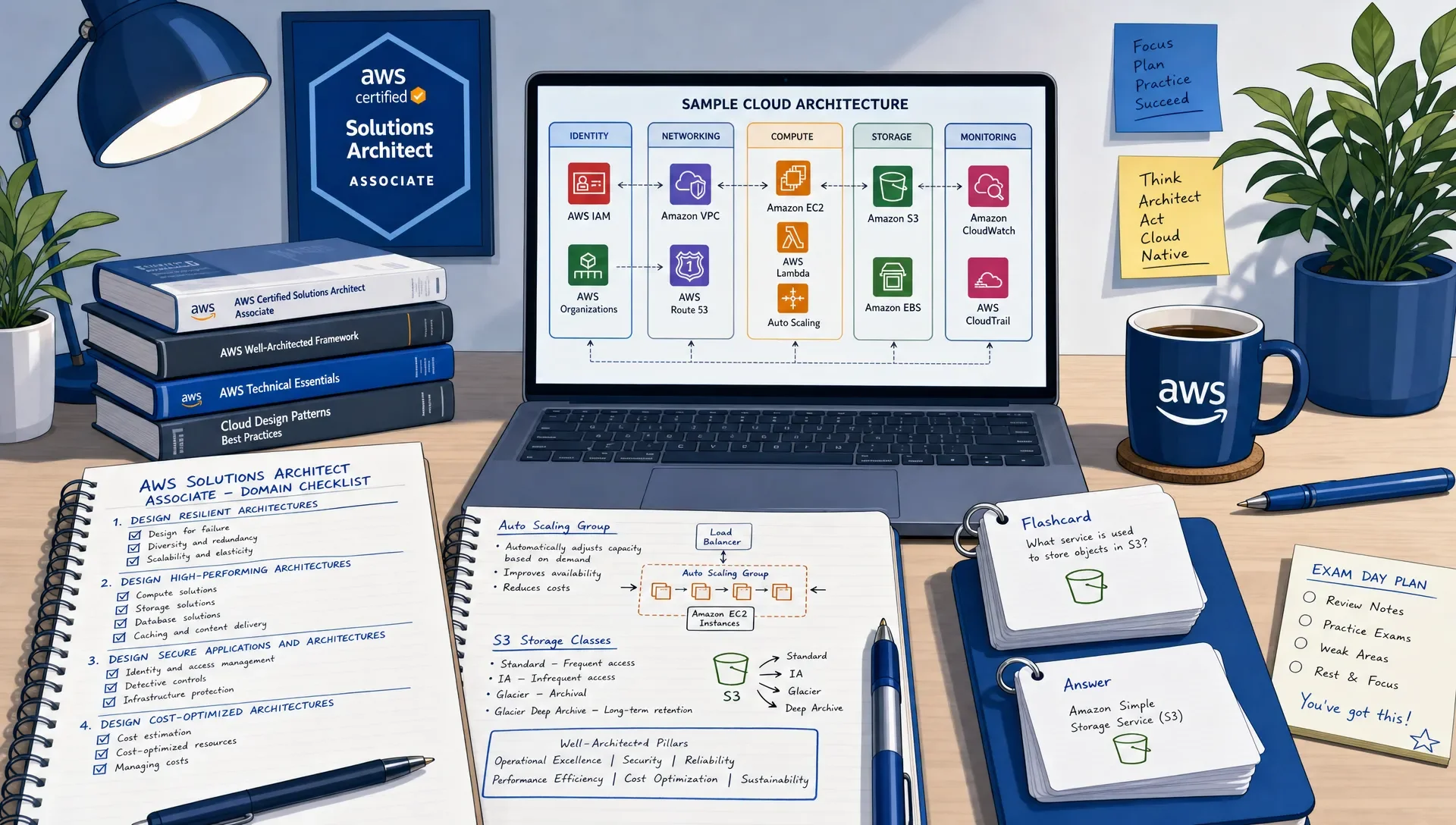
Security and Identity Domains You Need to Master
Security shows up in almost every AWS certification exam. Even if the exam title isn't security-focused, AWS expects you to understand shared responsibility, least privilege, identity-based policies, resource-based policies, encryption, logging, and secure connectivity.
Start with IAM (Identity and Access Management). You should be able to explain the difference between users, groups, roles, policies, permission boundaries, and service control policies. Then, practice scenario questions that ask which identity pattern is safest. For example, an application running on EC2 should typically use an IAM role, not long-term access keys stored on the instance.
You also need to know where responsibility shifts between AWS and the customer. AWS manages security of the cloud, while customers manage security in the cloud. This distinction appears in Cloud Practitioner questions, but it's also crucial in advanced architecture and operations scenarios.
For specialty-level preparation, security concepts become more in-depth. You'll need to reason through incident response, logging evidence, cross-account access, key management, AWS Organizations, and detective controls. If you're heading down that path, MindMesh's guide to the AWS Security Specialty exam is a useful next read after you understand the general domain structure.
Networking and Connectivity Domains You Need to Master
Networking is where many AWS candidates struggle because the questions are very practical. You don't just need to define a VPC (Virtual Private Cloud). You need to know how traffic flows, where it's filtered, and which design fits specific requirements.
At minimum, master VPCs, subnets, route tables, internet gateways, NAT gateways, security groups, network ACLs, VPC endpoints, load balancers, Route 53, CloudFront, and hybrid connectivity options. Associate-level exams often ask you to choose between public and private subnet patterns, endpoint access, high availability across Availability Zones, and secure service-to-service communication.
A good test of your knowledge is whether you can trace a request from a user to an application and back. Ask yourself: Where does DNS resolve? Where does TLS terminate? Where does routing happen? Where is traffic allowed or denied? And where would logs prove what happened?
Networking also directly affects cost. A design that moves unnecessary traffic across NAT gateways, Availability Zones, or Regions might meet a technical requirement but fail a cost-optimization goal. AWS exams reward candidates who recognize these tradeoffs.
Compute, Storage, Database, and Integration Domains You Need to Master
The core AWS service domains aren't about memorizing every feature. They're about picking the right managed service for a specific workload.
For compute, compare EC2 (Elastic Compute Cloud), Auto Scaling, Elastic Load Balancing, Lambda, containers, and managed orchestration options. Know when you need full operating system control and when serverless or managed services reduce operational overhead.
For storage, distinguish between object storage, block storage, file storage, archival storage, and backup use cases. S3 (Simple Storage Service) is central, but you also need to understand EBS, EFS, FSx at a high level, lifecycle policies, storage classes, encryption, versioning, replication, and durability patterns.
For databases, focus on access patterns. Relational workloads, key-value access, document use cases, caching, analytics, global distribution, and migration requirements all point to different services. You don't need to become a database administrator for every AWS database, but you do need to identify the correct fit under various constraints.
For integration, learn the difference between synchronous and asynchronous designs. SQS, SNS, EventBridge, Step Functions, and API Gateway often appear in questions about decoupling, retries, failure isolation, and event-driven architectures.
Reliability, Monitoring, and Operations Domains You Need to Master
Reliability questions test whether your design can survive real-world failures. This includes Availability Zones, Regions, health checks, Auto Scaling, backup and restore, multi-AZ databases, disaster recovery strategies, and fault isolation.
AWS architecture guidance often aligns with the AWS Well-Architected Framework. This framework has pillars for operational excellence, security, reliability, performance efficiency, cost optimization, and sustainability. You don't need to quote the framework directly, but you should recognize its patterns in exam scenarios.
For monitoring and operations, know what each service does. CloudWatch metrics help you see resource behavior. Logs help you investigate application and system events. CloudTrail records API activity. AWS Config tracks configuration changes. Systems Manager supports operational management. The exam will often ask which tool provides the evidence or automation needed for a specific problem.
SysOps and DevOps exams go further. You need to understand deployment strategies, rollback behavior, infrastructure as code, alarms, runbooks, patching, remediation, and incident response. The correct answer is often the one that reduces manual work while improving repeatability.
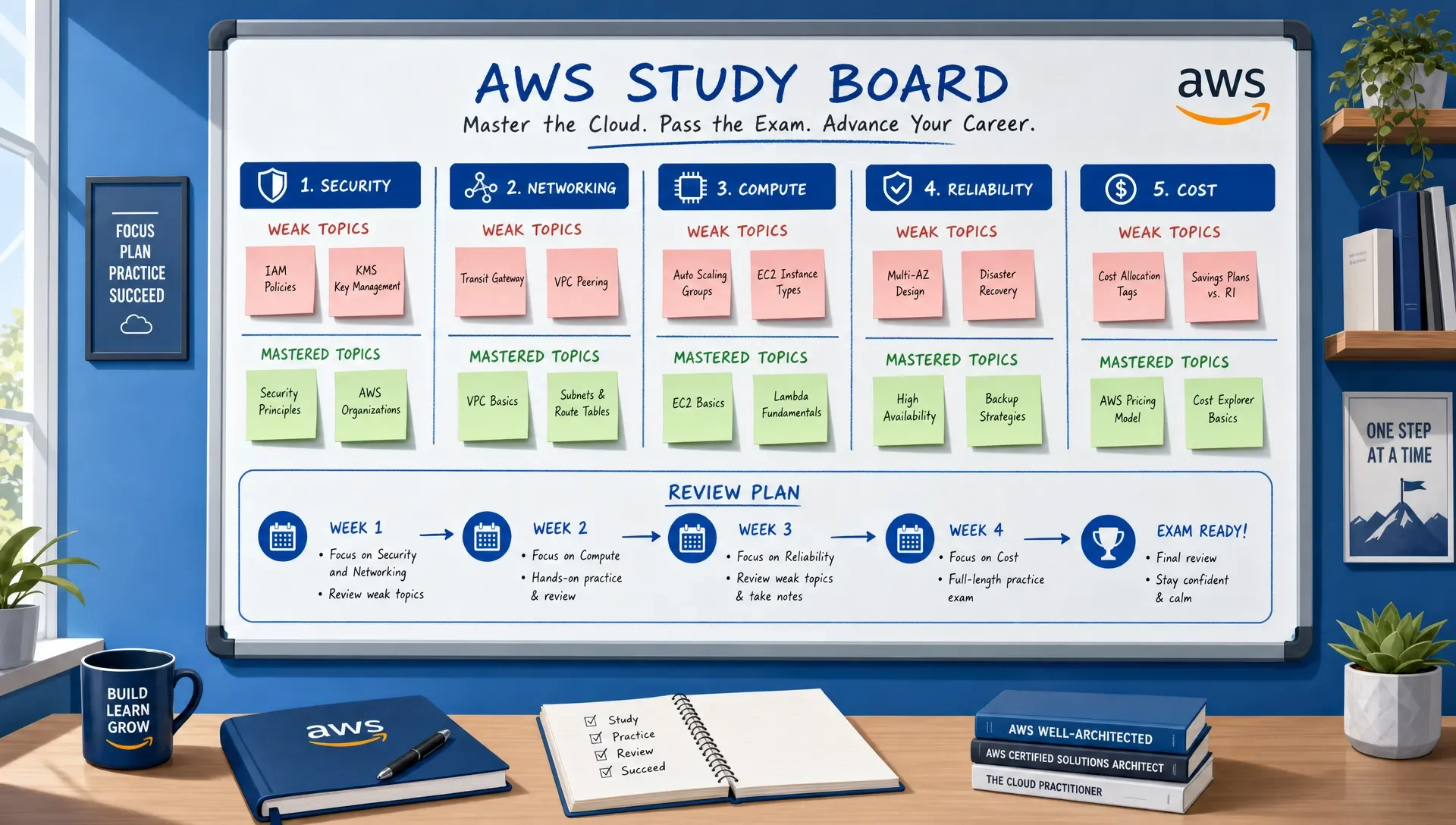
Cost Optimization and Tradeoff Domains You Need to Master
Cost optimization isn't just a section on billing trivia. It's a design skill. AWS exams frequently ask you to meet a requirement while minimizing unnecessary spending.
You should understand pricing models, right-sizing, storage lifecycle rules, Savings Plans and Reserved Instances at a conceptual level, data transfer costs, managed service tradeoffs, and scaling behavior. Cloud Practitioner includes billing and pricing directly, while architecture exams weave cost into scenario questions.
The difficult part is recognizing when the cheapest option isn't the best answer. If the requirement states "lowest latency globally," the answer might involve CloudFront, Global Accelerator, or multi-Region patterns, even if they add complexity. If the requirement specifies "infrequent access with retrieval delay acceptable," archival storage might be a better fit.
Use this simple filter for cost questions:
- Meet the stated requirement first.
- Remove unnecessary operational burden second.
- Then, optimize cost without breaking the initial requirement.
How to Build a Domain-Based AWS Study Plan
A domain-based plan prevents you from spending weeks on services you already know while neglecting areas that will cost you points. Start with the official exam guide, then create one row for each domain and subtopic.
Use a four-pass approach:
- Pass 1: Read the domain objectives and mark every topic as new, familiar, or confident.
- Pass 2: Study the weakest topics using official AWS documentation, labs, and concise notes.
- Pass 3: Answer practice questions by domain and review every explanation, including the questions you got right.
- Pass 4: Take mixed timed exams only after your domain scores are stable.
When you're working through long AWS whitepapers, service documentation, or dense PDF notes, an AI reading companion can help reframe complex material, turning dense content into teachable explanations. Just remember to always treat AWS documentation and the official exam guide as your final authority.
MindMesh Academy uses this kind of connected workflow: study guides aligned with exam objectives, practice questions with explanations, flashcards with spaced repetition, adaptive weakness-based practice, and readiness tracking by topic. This matters because "I watched the lessons" isn't a readiness signal. Consistent domain performance is.
How to Know When You Have Mastered an AWS Exam Domain
Mastery isn't the same as recognition. If you only recognize a term when you see it in a multiple-choice option, you're not ready for scenario-heavy AWS questions.
You're close to mastering a domain when you can explain the concept, apply it to a new scenario, eliminate tempting wrong answers, and identify the underlying tradeoffs. You should also be able to recover from missed questions by pinpointing the exact reason your answer failed.
| Readiness signal | What it looks like | What to do if it is weak |
|---|---|---|
| Stable domain scores | Your practice results stay consistent across multiple sessions, not just one lucky quiz. | Re-test the same domain after a day or two, not immediately after reviewing answers. |
| Clear explanations | You can explain why the right answer is right and why the distractors are wrong. | Write a one-sentence rule for every missed question. |
| Scenario transfer | You can apply the same concept when the service names or business context change. | Practice mixed questions that combine security, networking, cost, and reliability. |
| Time control | You finish domain sets without rushing the final questions. | Practice timed blocks and flag questions instead of spending too much time early on. |
| Weakness reduction | The same topic stops appearing in your mistake log. | Use flashcards, objective-based study, and targeted practice before full exams. |
If your overall score looks fine but one domain keeps dipping, don't ignore it. AWS exams are broad enough that a repeated weakness can show up on exam day in several forms. For a deeper checklist, review these AWS exam readiness signs before you schedule.
Common Domain Study Mistakes to Avoid
The most common mistake is studying AWS services in isolation. You might know what Lambda does, but can you decide when Lambda is better than EC2, ECS, or Step Functions in a scenario with latency, scaling, cost, and operational constraints?
Another mistake is overusing full-length exams too early. Full practice exams are useful diagnostic tools, but if you take them before you have adequate domain coverage, you're mostly measuring what you haven't studied yet. Use domain quizzes first, then mixed timed exams later.
Also, avoid treating domain percentages as permission to skip topics. A 12% billing or cost domain can still influence questions in architecture, operations, and service selection. Lower-weight domains often act as tie-breakers between two plausible answers.
Finally, don't just memorize answer patterns from practice questions. AWS can phrase the same concept many ways. Your goal is to understand the decision rule behind the correct answer.
Frequently Asked Questions
Which AWS certification exam domain should I study first? Start with the highest-weight domain in your official exam guide, unless you are completely new to AWS. New learners should first cover cloud basics, shared responsibility, IAM fundamentals, core services, and global infrastructure so the higher-weight domains make sense.
Are AWS exam domains the same across all certifications? No. Security, networking, reliability, operations, and cost appear across many exams, but the depth changes. Cloud Practitioner tests broad awareness, associate exams test applied implementation or design, and professional or specialty exams test deeper tradeoffs.
How much should domain weights affect my study schedule? Use weights to allocate time, not to exclude topics. A 30% domain should receive more study and practice than a 12% domain, but lower-weight domains can still appear inside scenario questions that combine multiple skills.
Can I pass an AWS certification exam by using practice questions only? Practice questions help, but they are not enough if you only memorize answers. Use them to find weak domains, read explanations, revisit the exam objectives, and practice applying concepts to new scenarios.
How do I know if I am ready for the real AWS exam? You are closer to ready when your domain scores are consistent, your timing is controlled, and you can explain why wrong answers are wrong. If one domain keeps lagging, fix that before scheduling.
Do I need hands-on AWS experience for every domain? Hands-on practice is strongly recommended, especially for associate, professional, and specialty exams. Even simple labs with IAM, VPCs, EC2, S3, CloudWatch, and databases make scenario questions easier to reason through.
Turn AWS Exam Domains Into a Study Workflow
AWS certification preparation becomes much simpler when each study session has a clear target domain, a measurable outcome, and a feedback loop. Don't just study more; study the specific domain that is preventing you from reaching your target score.
With MindMesh Academy, you can access study guides based on exam objectives, practice questions with detailed explanations, flashcards using spaced repetition, adaptive weakness-based practice, and readiness tracking by topic. This helps you build confidence in each domain. When your performance data shows you're ready for the real thing, you'll be well-prepared to take your AWS Certified Solutions Architect - Associate practice exam and schedule your certification.

Written by
Alvin Varughese
Founder, MindMesh Academy
Alvin Varughese is the founder of MindMesh Academy and an enterprise architecture leader. An electrical engineer by training, he moved from factory automation in South Africa to cloud architecture at GE Appliances and Humana (Fortune 50), and holds 20 professional certifications including AWS Solutions Architect Professional, Azure DevOps Engineer Expert, and Microsoft Agentic AI Business Solutions Architect. He built MindMesh Academy after interviewing too many highly certified candidates who couldn't answer basic questions: the goal is prep that makes you better at the job, not just able to pass the exam.