What Is Project Management Methodology in 2026
Consider the task of migrating an entire corporate infrastructure to a cloud platform like AWS or Azure without a clear blueprint. Even with skilled engineers and resources, a lack of structure leads to delays, security vulnerabilities, and budget overruns. Running an IT project without a defined project management methodology creates this friction. Standardized approaches help organizations avoid the chaos caused by miscommunication and fragmented workflows.
A methodology provides the framework directing a team from concept to final delivery. It uses a system of principles, tools, and processes to keep everyone aligned. By following consistent practices, teams work toward unified goals. For IT professionals pursuing certifications like PMP, ITIL, or Agile credentials, understanding these methodologies is mandatory. It is vital for professional application and passing current exams. These systems transform abstract goals into manageable tasks, ensuring technical deployments meet business requirements without wasting capital. Mastering these frameworks allows project leaders to predict risks and manage stakeholder expectations through every phase of the development lifecycle.
So, What Is a Project Management Methodology, Really?
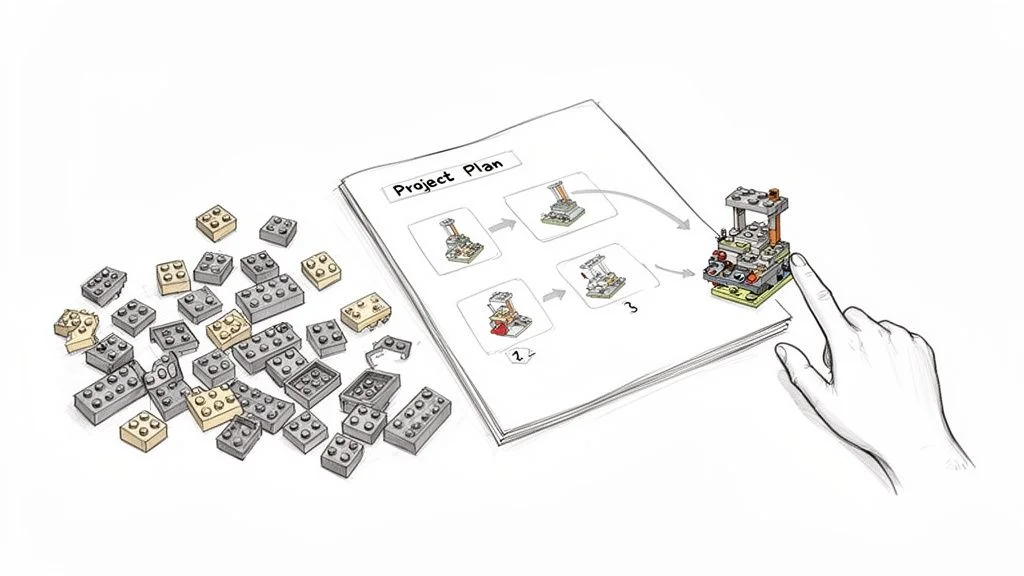
A project management methodology functions as a repeatable, systematic blueprint for how IT projects are initiated, planned, executed, monitored, and finally closed. It serves as a guide that answers the specific questions that arise during technical initiatives. For instance, what specific tasks must the team complete to deploy an AWS Lambda function? Who carries the responsibility for testing a newly developed API? How will the team track the specific phases of an Azure migration while maintaining clear communication channels?
If a team lacks this level of discipline, even the most talented IT engineers can see their projects fail. They might fall victim to 'scope creep,' where the project requirements grow uncontrollably, or 'analysis paralysis,' where the team cannot make a decision to move forward. Releasing a software update that blows past its deadline and exceeds its budget can alienate users and damage a company's reputation. These outcomes usually stem from a lack of methodological rigor.
Contrast a disorganized, 'hack-it-together' coding session with a structured DevOps pipeline. The first approach might produce a working product, but it often leaves behind technical debt and unpredictable bugs. The second approach, supported by frameworks like Scrum or Kanban, provides professional structure and consistency. This structured thinking is exactly what the PMP and ITIL certifications focus on, as they prepare professionals to manage complex projects with a high success rate.
The Real-World Value of a Game Plan
Implementing a formal project management methodology is not a matter of adding bureaucratic layers. It is a strategic move to ensure project outcomes are predictable and successful. This is vital in the current IT sector. Industry research shows that organizations using mature project management practices experience 28 times less financial waste on their strategic initiatives (verify the latest figures at PMI.org). This efficiency helps prevent expensive failures in critical infrastructure deployments. You can explore these project management statistics and their financial impact for more detail.
For IT professionals, a clear methodology provides several concrete advantages:
- Clarity and Direction: Whether you are setting up an Azure tenant or implementing a new CRM system, a roadmap ensures everyone knows what to do. From the network engineers to the front-end developers, every team member sees how their specific work helps reach the project goal. This clarity is vital when managing teams with diverse technical skills.
- Greater Efficiency: By using standard processes for server provisioning, code reviews, and system testing, teams reduce the need for rework. When everyone follows the same steps, the team can spend more time on innovation and less time fixing process errors.
- Smarter Risk Management: Methodologies include specific steps to find and handle IT risks. These might include potential data breaches, integration failures between legacy and new systems, or technology that becomes obsolete mid-project. Finding these issues early prevents small bugs from becoming major project blockers.
- Consistent Results: A repeatable framework ensures that every deployment, whether it is a small app update or a massive infrastructure overhaul, meets the same quality standards. This reliability builds trust with stakeholders and end-users, which is the foundation of a strong reputation in IT services.
Reflection Prompt: Think about a past IT project you were involved in. How might a clearly defined methodology have improved its outcome, especially concerning communication, risk, or scope?
A methodology does not act as a rigid cage. Instead, it serves as a stable skeletal structure. It provides the foundation and direction needed to succeed, allowing your team to solve technical problems within a controlled and organized environment.
A High-Level Map of Methodologies
For IT professionals pursuing certifications, it is helpful to understand the most common project management methodologies. Each one fits a different type of project. Knowing these differences is vital for your daily work and for passing exams like the PMP or Agile certifications.
Quick Guide to Popular Project Management Methodologies for IT Professionals
| Methodology | Core Principle | Best For |
|---|---|---|
| Waterfall | Sequential, linear progression through distinct project phases. | IT projects with stable requirements, such as hardware deployments, system migrations, or software for medical devices. This is common in PMP predictive scenarios. |
| Agile | Iterative development with a focus on flexibility and customer feedback. | IT projects with changing requirements, like new software development or digital transformation. This is central to the PMI-ACP and Certified ScrumMaster exams. |
| Scrum | A framework within Agile that uses short, time-boxed cycles called Sprints. | Complex software projects, cloud infrastructure (AWS or Azure), and product development that requires fast delivery and high collaboration. |
| Kanban | Visualizing workflow to manage and improve the flow of tasks continuously. | IT operations, help desk support, and DevOps pipelines where work arrives at random times and needs a steady flow. |
| PRINCE2 | A process-based approach with a strong emphasis on business justification and roles. | Large government IT projects, complex multi-vendor integrations, or highly regulated fields like defense or finance. It is common in the EMEA region. |
The choice of methodology is essential for the success of the work. If you try to build a modern AI application using a rigid Waterfall model, you will likely limit innovation and waste time. On the other hand, trying to upgrade a critical server room with a purely Agile approach might lead to dangerous risks. Developing the skill to choose the right game plan for each project is a requirement for leadership and a major part of professional certification exams.
The Evolution of Project Management Methodologies
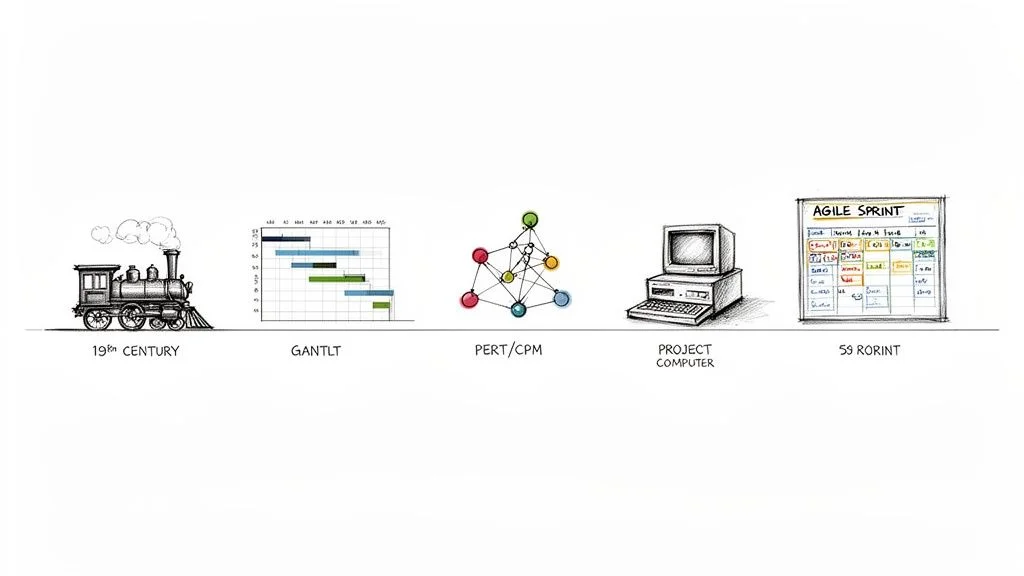
Project management methods did not appear overnight. They are the result of over a hundred years of development, shaped by the pressure of difficult engineering and organizational goals. Every new framework grew out of a specific failure or a need for better control. IT professionals who study this history gain a better understanding of why we use certain tools today and can better identify which method fits a specific project.
Modern structure started with massive industrial projects in the late 19th century. Building the U.S. transcontinental railroad in the 1860s stands as a primary example. This effort required moving thousands of workers and tons of material across a continent. Success depended on a level of scheduling and supply chain management that had never been seen before. These early logistics efforts set the stage for how we plan modern technical deployments.
By the 1910s, formal techniques began to take shape. Henry Gantt introduced the Gantt chart, a visual tool that changed how managers looked at schedules. During World War I, this method helped track munitions production and improved output by making task dependencies clear. Even today, IT project management software relies on the Gantt chart to map out project phases and track progress against deadlines. You can read more about the origins of project management and its key milestones.
The Rise of Formal and Predictive Models
The middle of the 20th century forced another transition. Cold War military and aerospace programs involved high stakes and extreme technical difficulty. Engineers and commanders needed tighter control over every variable. This period produced two specific techniques that define predictive project management:
- PERT (Program Evaluation and Review Technique): The U.S. Navy created PERT for the Polaris missile program. It was designed for projects where task durations were hard to predict. It uses statistical probability to estimate how long an activity will take, giving managers a range of possible finish dates. PMP students must understand this when studying schedule management.
- CPM (Critical Path Method): Developed in the private sector around the same time, CPM takes a different approach. It identifies the longest sequence of tasks that must finish on time for the whole project to stay on schedule. This sequence is the "critical path." It is a fundamental part of schedule management in the PMBOK Guide.
These tools created the base for predictive project management. This style assumes that if you plan thoroughly enough at the start, you can define every part of the project before it begins. It follows a "plan the work, work the plan" logic. This is the heart of Waterfall models, where teams finish one phase completely before moving to the next.
Key Takeaway for PMP Candidates: Predictive methods work best in stable settings where requirements do not change after the project starts. While software teams rarely use them for app development, they remain standard for building IT data centers, deploying hardware, or managing systems in highly regulated industries where strict change control is required.
The Digital Shift and the Agile Revolution
The rise of computing changed the rules. Building software is not like building a bridge. Software is fluid. User needs change, markets shift, and new technology arrives while the code is still being written. Rigid plans often became useless before the project was half-finished. This resulted in wasted budgets and missed deadlines.
Frustration in the industry led to a search for more flexible ways to work. This effort resulted in the Agile movement of the late 1990s and early 2000s. To see why this was such a major change, look at the older software development process models that teams used at the time.
Agile changed how work gets done. Instead of one giant plan, teams break work into short cycles. They build a small part of the product, get feedback, and adjust. This moved the industry from "plan the work" to "inspect and adapt." For IT professionals, this mindset is now a requirement. These frameworks make up a large portion of the current PMP exam and several specialized Agile certifications.
Detailed Analysis of Traditional Methodologies
While the focus frequently shifts toward newer, adaptive methodologies, a strong grasp of traditional, plan-driven approaches remains essential for any IT professional focused on project management. These methodologies provide the framework for disciplined execution. They are valued for their structure, predictability, and thorough nature—all of which are core concepts tested in certifications like the PMP.
The guiding principle is straightforward: plan the work with extreme detail, then work that plan with precision.
A useful comparison is the process of constructing a new data center. An engineering team does not begin by simply racking servers in a random room. They require approved, detailed schematics before a single cable is laid or a concrete slab is poured. This high level of foresight and phased execution forms the basis of the most recognized traditional methodology: Waterfall.
The Waterfall Model: A Sequential Cascade
The Waterfall model follows a linear, sequential progression. The project flows steadily downward through a series of distinct phases, similar to a physical waterfall. A primary characteristic of this approach is the requirement that each stage must be fully finished, reviewed, and formally signed off before the next phase begins.
This model creates a strict commitment to the initial plan. Just as a building's foundation cannot be easily moved after the concrete sets, changing direction once a Waterfall phase is closed is difficult and expensive.
A typical Waterfall project for an IT professional generally includes these six phases:
- Requirements: This initial stage involves gathering, analyzing, and documenting every project need. This might involve defining every technical specification for an enterprise resource planning (ERP) system or outlining security compliance requirements for a healthcare data solution. The result is a 'Statement of Work' or a Requirements Traceability Matrix that serves as the foundation for the entire project.
- Design: Using the approved requirements, the team creates a technical design. This involves crafting system architecture diagrams for a cloud migration, such as specifying AWS EC2 instances, S3 buckets, or Azure Virtual Networks. It also includes database schemas, network maps, and user interface mockups that provide a clear technical roadmap.
- Implementation: Engineers, developers, and systems administrators build the system according to the design specifications. This phase includes writing code in languages like Java or Python, configuring physical or virtual servers, and deploying the necessary network infrastructure to support the software.
- Testing: A quality assurance (QA) team conducts thorough testing of the finished system against the original requirements. They look for code defects, performance bottlenecks, and security vulnerabilities. This stage often includes unit testing, integration testing, and user acceptance testing (UAT) to ensure the product meets user expectations.
- Deployment: After the system passes all tests, the IT solution is officially released into the production environment. This step requires a detailed cutover plan to move users from old systems to the new one while minimizing downtime.
- Maintenance: Once the system is live, the team provides support, applies security patches, and releases updates to fix bugs. This phase is vital for the long-term stability and health of any IT service.
The structure of Waterfall results in high predictability. Because the scope is clearly defined from the start, project managers can forecast budgets, timelines, and resource needs with high accuracy. It is a logical choice for IT projects with stable requirements, projects where compliance is a primary concern (such as financial or medical software), or physical infrastructure projects where changes are too expensive to manage mid-stream. This emphasis on upfront planning is a major component of the predictive domain in the PMP certification.
The main disadvantage of Waterfall is its lack of flexibility. Adapting to new requirements or shifts in the market is difficult. If a client requests a major new feature when the project is already in the testing phase, it often causes significant rework, budget increases, and long delays. In many cases, the team must return to the requirements phase to start the process over.
PRINCE2: A Process-Driven Approach
While Waterfall defines the order of project phases, PRINCE2 (PRojects IN Controlled Environments) provides a structured framework for managing the entire project lifecycle. Developed by the UK government, it is a methodology centered on organization and control rather than just a simple linear sequence of tasks.
PRINCE2 is built on seven core principles:
- Continued Business Justification: Every project must have a valid reason to start and a valid reason to continue. If a project no longer offers value to the business, it should be stopped immediately.
- Learn from Experience: Teams are required to keep a lessons log. They look at previous projects to avoid making the same mistakes and to repeat successful actions.
- Defined Roles and Responsibilities: The methodology defines a clear organizational structure. This includes the Project Board (representing the business, users, and suppliers), the Project Manager, and the technical teams.
- Manage by Stages: Projects are broken into manageable sections called management stages. The Project Board reviews the progress at the end of each stage before authorizing the next one.
- Manage by Exception: This principle sets tolerances for time, cost, quality, and scope. The Project Manager only needs to alert the Project Board if the project is likely to exceed these pre-set limits.
- Focus on Products: The project focuses on the definition and delivery of products, specifically their quality requirements, rather than just the activities being performed.
- Tailor to Suit the Project: PRINCE2 is not a "one size fits all" system. It must be adapted to fit the size, complexity, and importance of the specific IT project.
This methodology also includes seven themes—such as Risk, Change, and Quality—and seven processes that guide the project from start to finish. The focus on control and detailed documentation makes PRINCE2 a common choice for large government or corporate IT initiatives, especially in highly regulated sectors. IT professionals pursuing international roles will find PRINCE2 certifications (Foundation and Practitioner) particularly useful in European and Commonwealth markets.
The PMBOK Guide: A Foundation, Not a Method
A key distinction for those pursuing the PMP (Project Management Professional) certification is that the PMBOK® Guide (A Guide to the Project Management Body of Knowledge) is not a methodology. It is a standard that describes the "how-to" of project management.
The PMBOK® Guide is the primary reference library for the profession. It gathers globally recognized standards, tools, and techniques, providing a shared language for project managers everywhere.
It functions as a manual of best practices. Both Waterfall and Agile frameworks use the knowledge areas outlined in the guide. These areas cover everything from how to communicate with stakeholders to how to manage technical risks.
For example, creating a Work Breakdown Structure (WBS) is a technique described in the guide. It is a vital tool for planning a Waterfall project, an Azure cloud migration, or a software integration. You can see how this works in practice by reviewing our project management WBS example.
The PMBOK® Guide is the main resource for the PMP exam. It ensures that project managers understand the core principles of the field, allowing them to work effectively regardless of the specific methodology their company uses.
Reflection: How might understanding the knowledge areas in the PMBOK® Guide, like Risk Management or Stakeholder Engagement, help you even if your team uses an Agile framework like Scrum?
While traditional methodologies are effective in stable environments, the fast pace of modern IT often requires a more flexible approach. When a project's goals are not fixed and must adapt to new information, Agile methodologies become necessary.
The Agile Mindset: More Than a Method
Agile is not a single set of rules. It is a mindset based on the Agile Manifesto. This philosophy prioritizes people and their interactions over processes and tools. It also values responding to change over following a strict plan. For a detailed look at how this applies to software, see our guide on what is agile software development.
Agile is now the standard approach for many IT teams. Roughly 71% of organizations use Agile methods in some capacity. This high rate of adoption is why Agile is a major part of the PMP exam and is the entire focus of certifications like PMI-ACP and Certified ScrumMaster.
Two of the most common frameworks used to apply Agile principles are Scrum and Kanban.
Scrum: The Team Sport Approach
Scrum is the most popular Agile framework. It uses a "team sport" model where everyone works together toward a single goal. It is very effective for complex IT projects where requirements are expected to change as the work progresses.
In Scrum, work is not done all at once. It is broken into short iterations called Sprints. These usually last between one and four weeks. During a Sprint, the team produces a functional and usable increment of the project, such as a new security feature or a configured database in an AWS environment.
The Scrum framework consists of three parts: Roles, Events, and Artifacts.
- Roles:
- The Product Owner: This person represents the customer. They manage the Product Backlog, which is a list of everything the project needs. They decide which features are the most important and ensure the team is building something that provides actual value.
- The Scrum Master: This is a leadership role that focuses on coaching the team. They facilitate meetings, help remove technical blockers (like server access issues or software bugs), and make sure the team follows Scrum rules.
- The Development Team: These are the experts—developers, testers, and architects—who do the actual work. They are self-organizing, meaning they decide how to complete the tasks assigned to the Sprint.
- Events (Ceremonies):
- Sprint Planning: The team meets to decide which items from the Product Backlog will be completed during the next Sprint.
- Daily Scrum: A 15-minute meeting held every day. The team discusses what they did yesterday, what they will do today, and any obstacles in their way. This keeps everyone aligned on technical tasks like API development or network optimization.
- Sprint Review: At the end of the Sprint, the team shows their work to the stakeholders. They get feedback on the features they built.
- Sprint Retrospective: The team looks back at how they worked during the Sprint. They identify ways to improve their process for the next cycle.
- Artifacts (Tools):
- Product Backlog: A living list of all requirements and features.
- Sprint Backlog: The specific list of tasks chosen for the current Sprint.
- Increment: The finished, usable piece of work produced during the Sprint. Every increment must meet the "Definition of Done" to be considered complete.
This cycle of planning and feedback allows IT teams to deliver value quickly. It also allows them to change their strategy based on what they learn during the project. Scrum is the basis for the Certified ScrumMaster (CSM) and Professional Scrum Master (PSM) certifications.
Kanban: Visualizing the Flow of Work
While Scrum uses set time periods, Kanban focuses on the continuous flow of tasks. You might see this in an IT operations center where tickets for server issues or software bugs move from "New" to "In Progress" to "Resolved." Kanban makes this process visible and efficient.
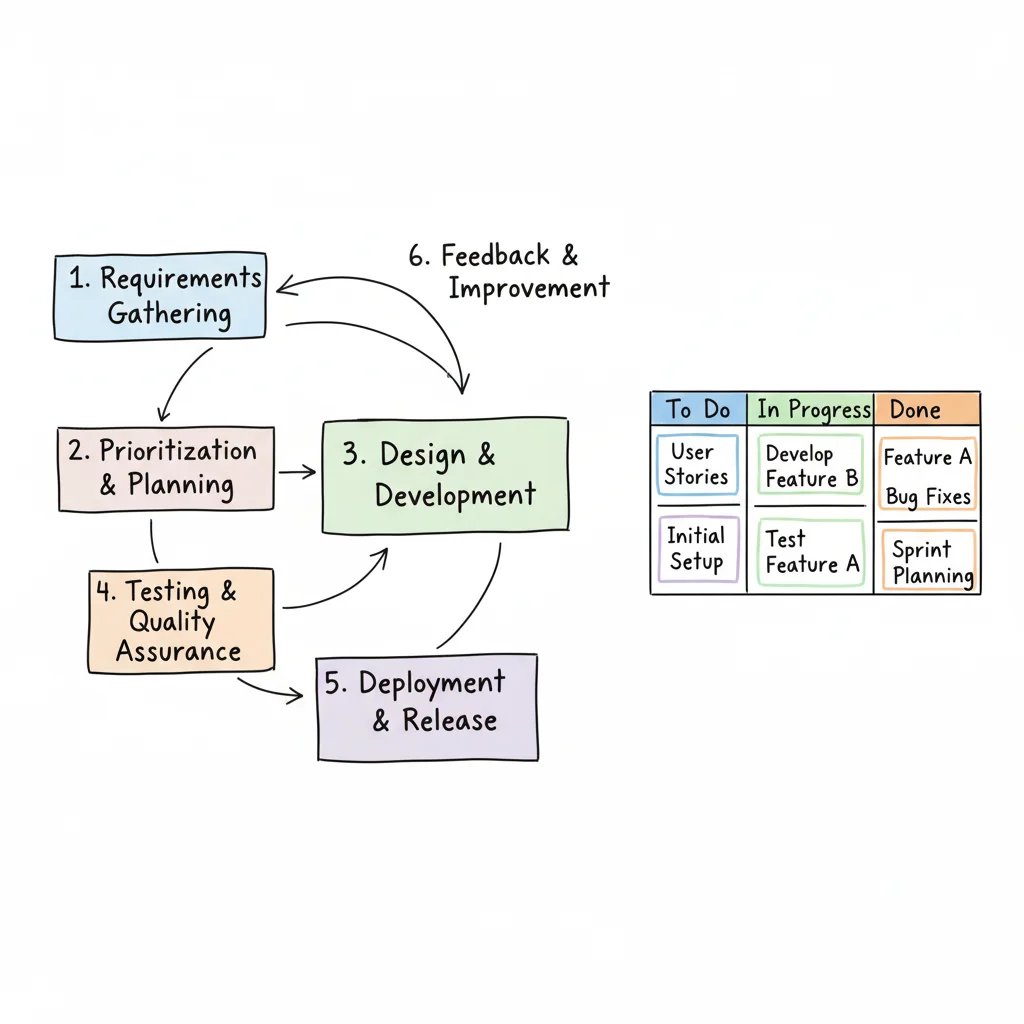
The primary tool is the Kanban board. It uses columns to show different stages of the work. A simple board might have columns like 'To Do,' 'Doing,' and 'Done.' Tasks are represented by cards that move from left to right as the work is finished.
The real power of Kanban comes from Work-in-Progress (WIP) limits. By limiting how many tasks can be in the 'Doing' column at one time, the team can find bottlenecks quickly. If a developer is trying to work on five different coding tasks at once, the WIP limit forces them to finish one before starting another. This reduces the time wasted by switching between different tasks.
Kanban does not use fixed schedules. It is a great fit for teams that have a constant stream of incoming requests, such as IT help desks or DevOps teams managing continuous integration and deployment (CI/CD) pipelines. It helps maintain a steady pace of work without overwhelming the team. For more information on how these systems function, A PM's Guide to the Agile Product Development Process offers more detail on these workflows.
Understanding the differences between the structure of Waterfall and the flexibility of Agile is a requirement for modern project management. Choosing the right method for a specific project is a skill that project leaders must develop and is a common topic on certification exams.
Waterfall vs. Agile at a Glance
The following table compares Waterfall and Agile methodologies. This comparison is a major part of the PMP exam, which tests your ability to choose the right approach for different IT scenarios.
| Characteristic | Waterfall (Predictive) | Agile (Adaptive) |
|---|---|---|
| Project Approach | A linear process where phases happen one after another. | A cyclical process based on small, frequent updates. |
| Flexibility | Rigid. Changes are hard to make once a phase is finished. | Flexible. Changes are expected and welcomed at any time. |
| Customer Involvement | Customers are involved mostly at the start and the very end. | Customers and Product Owners collaborate with the team daily. |
| Planning Style | All planning is done upfront before the work begins. | Planning happens throughout the project as the team learns more. |
| Delivery Model | One single delivery of the complete system at the end. | Frequent delivery of small, working parts of the system. |
Success in project management does not come from choosing one methodology over the other in every case. It comes from knowing which approach fits the specific needs of the project, the technical skills of the team, and the goals of the organization. Mastering these concepts will help you prepare for certifications and lead your IT projects more effectively.
How to Choose the Right Methodology for Your Project
Choosing a project management methodology is a major strategic decision for IT leaders. This choice dictates the project’s flow and how the team interacts. Because no single framework works for every situation, you must match the methodology to the specific needs of the work. Forcing a project into a rigid structure that does not fit its goals leads to wasted effort and failed deliverables.
To understand the stakes, look at the logic of your choice. Managing a cybersecurity incident response requires immediate, iterative action. Using a fixed, 12-month Waterfall plan for a data breach would be useless. On the other hand, constructing a physical data center requires strict architectural plans and sequential construction steps. Using daily Agile stand-ups without a long-term structural blueprint in that scenario would lead to construction failures. Using the wrong methodology leads to drained budgets and frustrated staff. Professional certifications teach you how to avoid these traps by matching the method to the specific project goal.
Key Factors in Your Decision
The process of picking a methodology depends on a clear analysis of project variables. You must ask whether you need a predictive model, an adaptive one, or a pragmatic mixture. This analytical skill is a major part of IT certification exams, as understanding the environment is a requirement for any effective manager.
Ask yourself these critical questions:
- Requirements Stability and Scope Clarity: Examine the technical specifications. If you are upgrading a legacy ERP system or setting up standard AWS infrastructure, the requirements are usually stable. These projects benefit from upfront planning. However, if you are developing a new mobile app or integrating AI models, requirements will change based on user testing. In those cases, you need a system that can handle frequent changes without crashing the project budget.
- Stakeholder Engagement and Delivery Cadence: Look at the needs of your business unit leads and compliance officers. Do they need to see working software every 14 days? Or is the project a large-scale database migration where stakeholders only need to see major milestone reports? Frequent feedback loops favor Agile, while long gaps between reviews usually lean toward Waterfall.
- Team Dynamics and Location: Consider the size and location of your staff. A small, highly skilled team in one office is often the best fit for Scrum. If the team is large, global, and spreads across different time zones, you might need more formal handoffs and documentation. This often points toward Waterfall or a highly structured Hybrid model to keep every developer and engineer on the same page.
- Organizational Culture and Governance: Review your company’s internal values. Does the organization prioritize strict processes, detailed planning, and top-down control? Predictive models or PRINCE2 work best in those environments. If the culture promotes flexibility and gives teams the power to make their own decisions, Agile principles will be more effective for your goals.
This decision tree shows how project scope and requirement certainty act as the main factors in your choice:
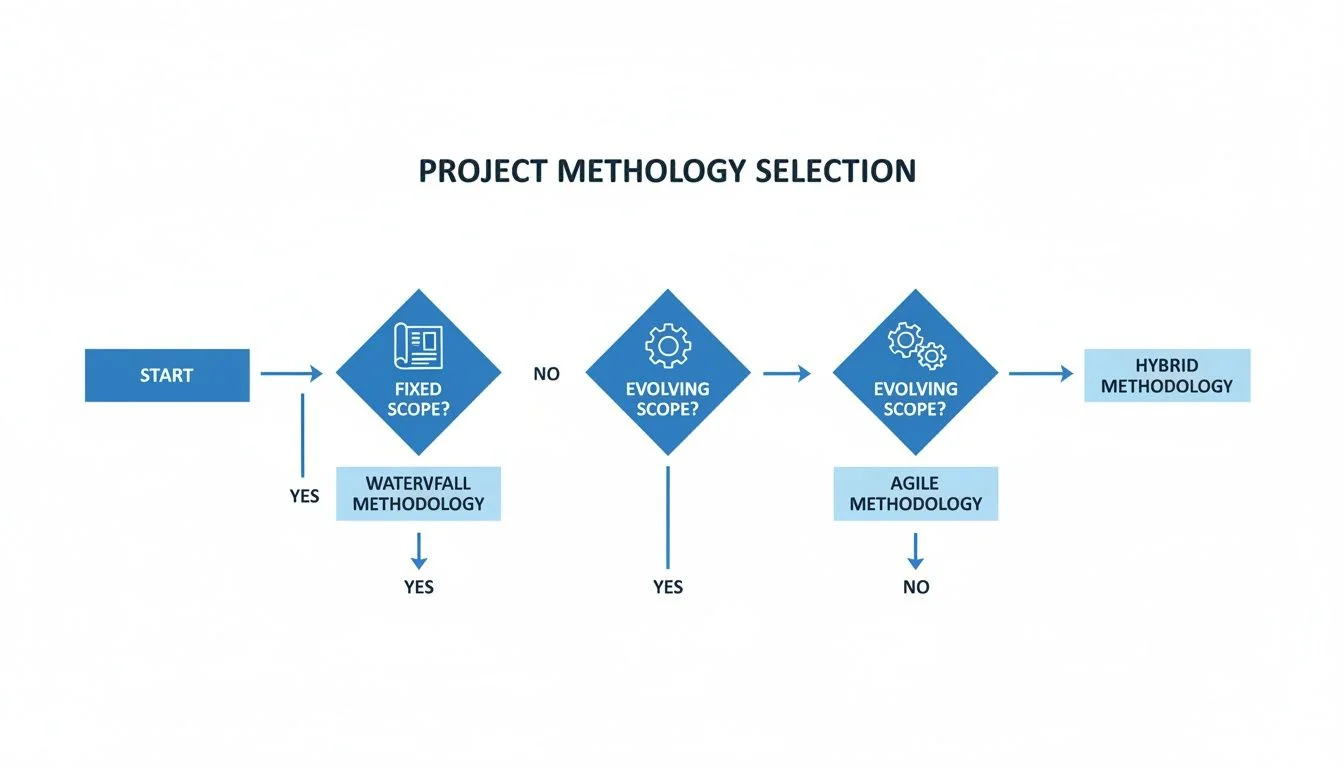
As the graphic shows, projects with stable goals fit Waterfall or similar predictive models. Projects with high uncertainty need the resilience of an Agile framework to succeed.
The Rise of the Hybrid Model
In modern IT, few projects fit perfectly into one category. Many exist in a gray area. You might face a fixed deadline and budget while the technical solution remains unclear. The Hybrid model solves this by combining predictability with flexibility. It is a functional middle ground for organizations that need both structure and speed.
A Hybrid approach mixes elements from different methodologies. You take the strengths of traditional planning and the speed of Agile execution to fit your specific needs.
One common Hybrid model in IT involves using Waterfall for the initial high-level planning, budgeting, and hardware procurement phases. Once the foundation is set, the team moves into two-week Scrum Sprints for the software coding or cloud configuration. (Verify current industry standard sprint lengths on the Scrum Alliance or PMI websites). This gives the organization the cost and schedule estimates they need for capital expenditures. At the same time, it gives the developers the room to pivot when they encounter technical bugs or new user requirements during the build phase.
This blended strategy provides the best results for many firms. Stakeholders get the long-term planning and governance they expect, and the project team gets the agility to innovate. Knowing how to select and blend these methods is a core skill for any project manager. It shows you can apply theoretical knowledge to real-world problems. Modern certifications like the PMP focus heavily on this ability to tailor processes to the specific needs of a project. Mastering these choices turns a standard manager into a leader who can deliver results regardless of the project constraints.
Connecting Methodologies to Your PMP Certification
Understanding the differences between various project management methodologies is not an academic exercise. It is a strategic requirement for IT professionals who want to earn the Project Management Professional (PMP) certification and move their careers forward. This knowledge provides the basis for effective project leadership in the real world. To do well on the PMP exam—and to lead teams in difficult IT environments—you must do more than memorize definitions. You need a practical understanding of why one approach is better than another in a specific situation.
The current PMP exam reflects how the industry works now. It does not focus only on traditional, predictive models like Waterfall. About half of the exam now covers Agile and Hybrid scenarios. This change shows how modern IT organizations use adaptive strategies to stay competitive. For example, you will likely see questions about managing an Azure DevOps pipeline or launching a new AWS service using Scrum within a larger corporate structure. Being able to speak the different languages of project management, from structured Waterfall to iterative Scrum, is required for anyone in an IT leadership role.
Mastering Methodologies for Exam Success
The Project Management Institute (PMI) updated its certifications, especially the PMP, because the old way of using one style for every project is over. This is why the exam features so many questions based on Agile and Hybrid situations. These questions require you to do more than just repeat what you read in a book. You should build a solid mental framework for breaking down complicated exam scenarios. Work on finding the small clues in a question that point toward the right methodology for that specific case.
Analogy: The Project Detective. View yourself as a project detective. Every exam question gives you a set of clues. One question might mention a fixed budget and a client who needs to see progress every week. Another might describe a high-risk technical environment for a new software feature or a project to upgrade infrastructure that must follow strict legal rules. Your job is to look at these clues and pick the best methodology for the task.
This ability to analyze a situation is what helps people pass the PMP. It is not enough to know the definition of Scrum. You must understand why Scrum, Kanban, or a Hybrid model is a better choice than Waterfall when a stakeholder keeps changing the requirements for a user interface. You must also know when Waterfall is the better choice, such as when you are integrating a new cloud service that requires a specific, linear sequence of steps with little room for change.
Practical Study Tips for Methodology Questions
When you study for methodology questions on the PMP or other IT exams, do not just memorize facts. You need to understand how these concepts work in real IT settings. Success comes from knowing how to apply these frameworks to solve problems. Here are some steps to improve your preparation:
- Build Comparison Tables: Do not just list pros and cons. Create tables that compare methodologies like Scrum, Kanban, and Waterfall based on IT factors. Look at how each one handles technical changes and security risk management. Compare how fast each method allows you to release software and how much stakeholder time is needed to validate new features.
- Ask Why the Method Exists: For every methodology, ask what problem it was made to solve. Waterfall is effective when you have fixed requirements, such as building a new physical data center. Agile was created because software development is often unpredictable and needs to change quickly. If you understand the core purpose of the method, choosing the right one becomes much easier during the exam.
- Practice with Scenarios: Find as many scenario-based practice questions as you can. For every question, look closely at the details to find the best fit:
- Identify Constraints: What parts of the project cannot change? Look for fixed budgets, specific timelines, or government regulations that apply to the IT system.
- Assess Team Dynamics: Is the team working in the same office or are they in different countries? Do they have experience with Agile methods, or are they used to traditional Waterfall projects?
- Understand Stakeholder Needs: Does the client want to see working software every few weeks, or do they want one finished product at the very end of the project?
- Explain Your Choice: For every practice question, explain why your chosen methodology is the best fit. Also, explain why the other options would not work as well. This builds the logic you need to answer difficult questions quickly.
This type of study helps you build the critical thinking skills you need for the exam and for leading IT projects. If you are looking for a clear study path, the PMP certification study guide at MindMesh Academy is a helpful resource.
Learning these methodologies for your PMP exam is about more than just a line on your resume. It gives you the confidence to handle any project challenge. Whether you are moving a company to a new cloud platform or leading a software development team, you will know how to pick the right strategy. This knowledge makes you more than a manager; it makes you an IT leader who can deliver results in any situation. Focusing on the "how" and "why" of these methods ensures you are ready for the test and for your future career.
Your Top Project Management Questions, Answered
Understanding core methodologies is only the first step. Applying them to real-world IT projects often reveals specific challenges and practical obstacles. These frequently asked questions address the common issues that arise when you put project management theory into practice during your professional career.
Can an IT Project Switch Methodologies Midway Through?
Switching methodologies while a project is in progress is possible, but it is a high-risk move with significant consequences. For instance, transitioning a large-scale infrastructure project from a Waterfall plan to an Agile approach is difficult. This type of change usually happens when a project encounters unexpected and fundamental shifts in technology, software requirements, or market conditions. These shifts can make an initial predictive plan impossible to maintain.
A government IT system development might begin with a rigid Waterfall structure but then face urgent feature requests driven by new legislation. These requests require rapid iteration that the original plan cannot accommodate. In this situation, the project team must re-evaluate the entire scope, timeline, and budget. This process requires active change management and agreement from every stakeholder and project sponsor. The team will also need specific training and support to adapt to the new way of working. Most experienced IT project managers avoid this risk by choosing a Hybrid model from the start. If they expect high volatility or changing requirements, they build flexibility into the project structure from day one.
Is the PMBOK Guide an IT Project Methodology?
This is a common point of confusion, but the answer is no. The PMBOK® Guide is not an IT project methodology. It is the "Body of Knowledge" for the profession. It serves as a foundational reference that defines global standards, terminology, processes, and best practices. These standards apply to all projects, including those in the IT sector. It provides the "what" and "why" of project management rather than a specific "how-to" for a technical solution.
A methodology provides the specific, step-by-step instructions for executing a project. Examples include Scrum for software development or PRINCE2 for managing large government IT contracts. While the PMBOK® Guide describes processes that align with traditional phases, such as defining scope or managing risks, its core principles are flexible. Its guidelines regarding quality, communication, and stakeholder engagement apply to both Agile and predictive IT projects.
What Is the Difference Between a Methodology and a Framework in IT Projects?
These terms overlap frequently, but there is a specific distinction that matters for IT certifications and project execution.
A methodology acts as a detailed, prescriptive recipe for an IT deployment. It provides exact instructions, specific tools, and a strict sequence of activities. An example of this is the rigid phases used in a traditional system implementation. A framework functions as an architectural blueprint or a set of principles for building a solution. It offers the structural components, roles, and guidelines but gives the team the freedom to decide how the work is actually performed within those boundaries. Scrum is a framework because it defines roles and events, but it lets the team choose its own technical stacks and coding practices.
Reflection Prompt: Consider how the choice between a methodology and a framework would change your approach to a new cloud service development project, such as building an AWS Serverless application.
How Do I Gain IT Project Experience Without a Formal Methodology?
If your current employer does not use a specific project management methodology, you can still build the skills required for the IT industry and certification exams. You do not need a formal corporate structure to practice these principles.
- Initiate Personal IT Projects: Practice your skills on your own time. You could manage the process of building a home server, learning a new programming language, or setting up a personal cloud environment. Use a simple Kanban board through a tool like Trello to track your progress, or define clear Waterfall phases for the project. This is a low-stakes way to learn how to manage tasks, deadlines, and project scope.
- Volunteer for Internal Initiatives: Look for small, informal projects at your current job. Offer to add structure to these tasks. You might create a risk register for a minor software upgrade or suggest short, daily meetings to improve how the team communicates about a specific task. Showing the immediate value of a structured approach can help your team work more efficiently and build momentum for better processes.
- Introduce Concepts Incrementally: You do not have to implement an entire methodology overnight. Instead, introduce single practices that provide immediate value. You could improve task tracking with a shared digital board, create standardized meeting agendas, or use simple dashboards to show project progress to others. Small, consistent wins often lead to the adoption of more formal methods later on.
Ready to master these concepts and earn your certification? At MindMesh Academy, we provide expert-led courses and evidence-based study tools to help you pass your exams with confidence and become a leader in the IT field. Check out our full range of certification prep at MindMesh Academy.

Written by
Alvin Varughese
Founder, MindMesh Academy
Alvin Varughese is the founder of MindMesh Academy and an enterprise architecture leader. An electrical engineer by training, he moved from factory automation in South Africa to cloud architecture at GE Appliances and Humana (Fortune 50), and holds 20 professional certifications including AWS Solutions Architect Professional, Azure DevOps Engineer Expert, and Microsoft Agentic AI Business Solutions Architect. He built MindMesh Academy after interviewing too many highly certified candidates who couldn't answer basic questions: the goal is prep that makes you better at the job, not just able to pass the exam.