What is Agile Software Development: A Practical Guide
What is Agile Software Development: A Practical Guide for IT Professionals
Agile software development is a practical methodology that has changed how IT teams deliver results. It focuses on flexibility, close collaboration, and continuous customer feedback. For specialists pursuing certifications like the PMI-ACP, CSM, or ITIL 4, understanding Agile is about more than passing an exam; it is a mindset required for modern project success.
Teams using this approach avoid rigid, long-term planning. Instead of a "big reveal" after months or even years of work, developers produce functional software in small, manageable increments. This iterative cycle allows the team to learn from each release and adapt quickly. By working in short bursts, developers ensure the final product consistently aligns with evolving user needs and business goals.
So, What Is Agile Software Development Really?
To understand Agile, consider a project that most people can visualize: building a custom house.
The traditional construction method, often called the Waterfall model, requires finalized blueprints and signed contracts before a single worker arrives on site. In this scenario, you approve every detail—from the depth of the foundation to the specific style of the guest bathroom faucets—at the very beginning. You then wait a year for the house to be finished. If you realize six months into construction that the kitchen layout feels cramped, or if a more efficient heating technology becomes available, you face a significant problem. Changing the plan at that stage is expensive and technically difficult. It usually involves halting work, renegotiating legal agreements, and paying for materials and labor you no longer need.
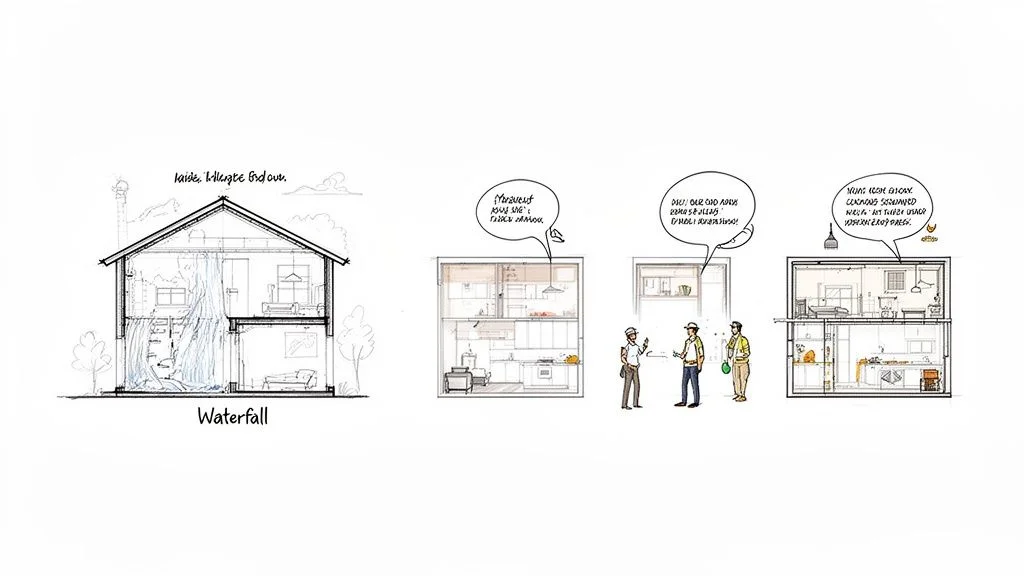 A traditional "Waterfall" approach requires a complete blueprint before construction begins, making changes difficult and expensive.
The Agile method handles construction differently. Instead of working from one massive, frozen plan, the team builds the house in distinct stages. They start with the foundation and the frame, then review the progress with you. If the skeleton looks right, they move forward. When it is time to build the kitchen, the team might install the basic plumbing, cabinetry, and appliances to create a functional version of the room. You, acting as the customer, walk through the space and provide immediate feedback. You might decide to move the kitchen island three feet to the left or add an extra window to bring in more natural light. The team incorporates that feedback into the next building cycle before they have installed the permanent flooring or finished the electrical work.
This is the core of Agile: a continuous loop of building, gathering feedback, and refining the product. This approach reduces the chance of finishing a project only to find out it is already out of date or doesn't actually meet your needs.
Moving From Rigid Plans to Flexible Progress
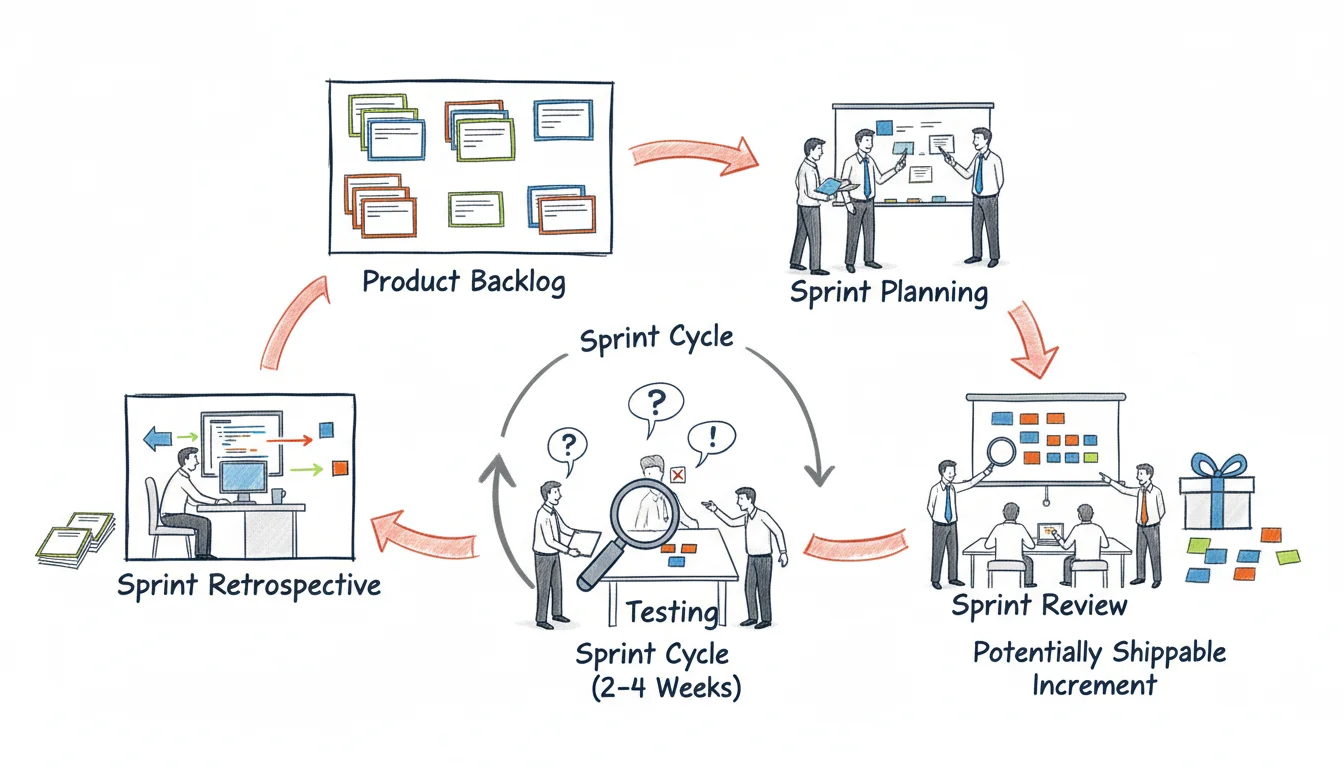
This iterative style works by breaking large, complex projects into small, manageable pieces. The team completes these pieces during short, time-boxed cycles called sprints or iterations. Most sprints last between one and four weeks. For example, during an AWS cloud migration, a team might use a single sprint to move one specific microservice and its related database. They verify that the networking is secure and the service is functional before they attempt to move the rest of the infrastructure.
At the end of each sprint, the team delivers a potentially shippable piece of the product. This is a working increment of the software that could be released to users, even if the total project isn't finished. This ensures that there is always a functional version of the software that improves with every cycle. This is a significant shift from older methodologies where development phases occurred in a strict sequence—requirements, then design, then coding—often leaving the customer with nothing to see or test for many months.
Agile vs. Traditional Waterfall at a Glance
For IT professionals who are studying for the PMP certification or specialized Agile credentials, knowing these differences is essential. The PMP exam now includes a heavy focus on Agile practices. In a Waterfall project, each phase must be 100% complete before the next can start. All design work must finish before any coding begins, and all coding must finish before testing can start. If a requirement was misunderstood in the first month, the error might not be found until the final testing phase near the end of the year, which can lead to project failure. Agile avoids this by integrating planning, development, and testing from the first day of the project.
The following table compares the two approaches:
| Characteristic | Agile | Waterfall |
|---|---|---|
| Approach | Iterative and incremental | Linear and sequential |
| Flexibility | Welcomes and adapts to change | Resistant to change; changes are costly |
| Planning | Continuous planning and refinement | Upfront, detailed planning |
| Customer Involvement | High; constant collaboration and feedback | Restricted to initial and final stages |
| Delivery | Frequent delivery of small, working parts | Single delivery at the end of the project |
| Testing | Integrated throughout the project lifecycle | A separate, distinct phase near the end |
| Risk | Lower; risks are identified and mitigated early | Higher; issues are often discovered late |
Agile provides a more effective way to manage the uncertainty that comes with building complex software and IT services. Most modern companies face shifting requirements, and a rigid plan often cannot survive the realities of a changing market.
The Core Philosophy Behind Agile
Agile is a mindset rather than a rigid set of instructions. It is based on the reality that in software development, you cannot know everything at the start of a project. Customer requirements change, markets move, and new technologies like serverless computing or advanced AI can appear unexpectedly. Agile provides a framework for teams to work with this uncertainty rather than trying to avoid it through massive, fragile plans.
This philosophy is based on several principles that are frequently tested in certification exams:
- Customer Collaboration: The customer is an active partner throughout the process. They do not just provide requirements at the beginning; they offer the feedback that determines the final shape of the product.
- Responding to Change: The ability to pivot based on new information or shifting requirements is considered a strength. Teams do not view a deviation from the original plan as a failure.
- Working Software: The primary measure of success is whether the software functions correctly. While documentation is useful, a functional product is more valuable than detailed status reports or Gantt charts.
By following these values, teams avoid the risk of building the wrong software. Instead of spending a year on a project that fails to meet user needs—such as an enterprise resource planning system that does not fit the actual company workflow—Agile allows for constant course correction every few weeks. This proactive approach to managing risk is a fundamental part of Agile project management and is a key concept for those pursuing PMP or Agile-specific certifications.
The Agile Manifesto: A New Philosophy for Software
To understand Agile, we must look at its origins. This methodology did not emerge from a corporate boardroom or a committee of executives. It began as a rebellion. During the 1990s, software development was dominated by rigid, top-down models that were famous for missing deadlines and exceeding budgets. These processes often exhausted development teams and left clients with products that no longer met their needs by the time they were finished. Many projects suffered from "analysis paralysis," where teams spent months on planning while producing zero functional code. Documentation grew into massive piles that were often obsolete before the first line of code was even written.
The industry required a different direction. Developers needed a system that prioritized flexibility and human talent over bureaucratic oversight. This tension peaked during a significant gathering in early 2001.
The Birth of a Movement
In February 2001, seventeen software visionaries met at a ski resort in Snowbird, Utah. These participants were not observers; they were practitioners working in the field. They represented various "lightweight" frameworks, including Scrum, Extreme Programming (XP), and the Dynamic Systems Development Method (DSDM). While their specific day-to-day techniques varied, they were united by a shared frustration. They were tired of the heavy, documentation-driven processes that acted as a drag on creative software work.
They sought a common ground that could unify these different approaches. The result was a concise document titled the "Manifesto for Agile Software Development." It was not designed as a rigid rulebook or a series of mandatory steps. Instead, it serves as a declaration of priorities. These four core values have guided software teams for decades. To see how this document moved from a small meeting to an industry standard, you can read more about the history of Agile.
The Four Core Values of Agile
The Manifesto uses a specific structure to define its philosophy. It presents four values as trade-offs. The authors explicitly stated that while the items on the right side of the comparison have value, Agile teams place a higher priority on the items on the left. Grasping this distinction is necessary to adopt the Agile mindset, and it is a frequent topic in professional certification exams.
-
Individuals and interactions over processes and tools. This value places people at the center of development. Agile suggests that the best technical solutions do not come from a perfectly tuned piece of software or a strict workflow. They come from engineers and designers talking to each other. For example, consider a developer who finds a bug during an Azure deployment. In a traditional environment, that developer might be forced to file a formal ticket, wait for a manager to triage it, and then wait for an assignment. An Agile team handles this differently. The developer walks to the QA engineer's desk, explains the issue in a five-minute conversation, and they fix the bug together. This direct communication removes technical friction and speeds up the resolution.
-
Working software over comprehensive documentation. In an Agile environment, the primary measure of progress is functional code. Documentation still serves a purpose for maintaining architectural records or meeting compliance standards, but it is never the final goal. A team could spend six months drafting a 200-page requirement document that remains unread. Alternatively, they could use that time to build a functional piece of the application, such as a user authentication module, that stakeholders can test immediately. Agile prioritizes the functional feature. If you have to choose between a detailed plan and a working prototype, choose the prototype.
This focus on functional code changes the definition of success. Instead of checking off boxes on a project plan, the goal is to provide actual utility to the user. For IT professionals, this means every sprint results in something tangible rather than just a status report. It leads to earlier returns on investment and clearer evidence of progress.
Customer Collaboration and Embracing Change
The final two values address the traditional gap between developers and clients. They acknowledge that requirements are rarely static. This reality is clear in technical fields like cloud migrations or cybersecurity, where new threats and technologies emerge weekly.
-
Customer collaboration over contract negotiation. Traditional software projects were often built on adversarial relationships. Teams used rigid, all-encompassing contracts to protect themselves from changing requirements. Agile changes this by making the customer a partner in the process. Instead of citing contract clauses when a problem arises, the team and the customer engage in constant, open communication. This often takes the form of weekly demonstrations where the customer reviews the latest build and provides feedback. If a team is building a new internal HR portal, getting weekly input from the HR staff ensures the final product actually solves their problems.
-
Responding to change over following a plan. In older development models, a change request was treated as a failure or a crisis. Agile views change as a regular part of the work. A plan created a year ago for an IT infrastructure project will likely be outdated by the time execution begins. Vendor offerings change and new security vulnerabilities appear. Agile teams expect to shift their focus. If user testing shows that a specific feature is not useful, the team removes it from the backlog. They then move on to a more valuable task without ruining the project schedule. This is not a lack of planning; it is a commitment to learning and adaptation.
Reflection Prompt: Review a project you completed recently. How would the results have changed if the team prioritized "individuals and interactions" or "responding to change" instead of following a fixed plan?
Exploring Popular Agile Frameworks: Scrum vs. Kanban
Agile frameworks act as the practical "how-to" guides for software teams. If the Agile Manifesto provides the underlying philosophy, these frameworks offer the specific playbooks and rules teams use to apply those principles to their daily work. These methodologies are different recipes that use the same core ingredients: collaboration, iterative cycles, and consistent feedback from users. Professionals working toward certifications like Certified Scrum Master (CSM), Professional Scrum Master (PSM), or Kanban Management Professional (KMP) must understand the mechanics of these systems to manage projects successfully.
Iterative development is not a new concept, despite the recent surge in its popularity. Some early forms of these methods date back to 1957, when teams at IBM and other organizations began moving away from rigid planning. The movement gained significant momentum in the 1990s. Software developers became increasingly frustrated with the slow, top-down nature of traditional waterfall projects, where changes were difficult and expensive to make late in the process. This collective dissatisfaction led to the creation of Scrum and Extreme Programming (XP), which established the groundwork for modern software engineering. The history of the Agile Manifesto and its predecessors provides a detailed account of how these ideas evolved from niche experiments into industry standards.
Scrum: The Structured Sprint
Scrum is the most widely adopted Agile framework. It is a central topic in the PMP-ACP and various Scrum-specific certification exams. This framework uses a highly structured approach, organizing work into fixed-length cycles known as Sprints. These cycles typically last between two and four weeks. The primary objective of every Sprint is to build a "Done," usable, and potentially shippable increment of the product. This ensures that the team produces value at regular intervals rather than waiting until the very end of a long development cycle.
Consider a team developing a new mobile banking application. Instead of attempting to build every feature at once, they might focus their first Sprint on a single high-priority goal: a secure user login screen and a basic account balance view. By the end of those two weeks, they have a functional piece of software to demonstrate. This allows them to gather immediate feedback from stakeholders before they move on to more complex features like wire transfers or check deposits.
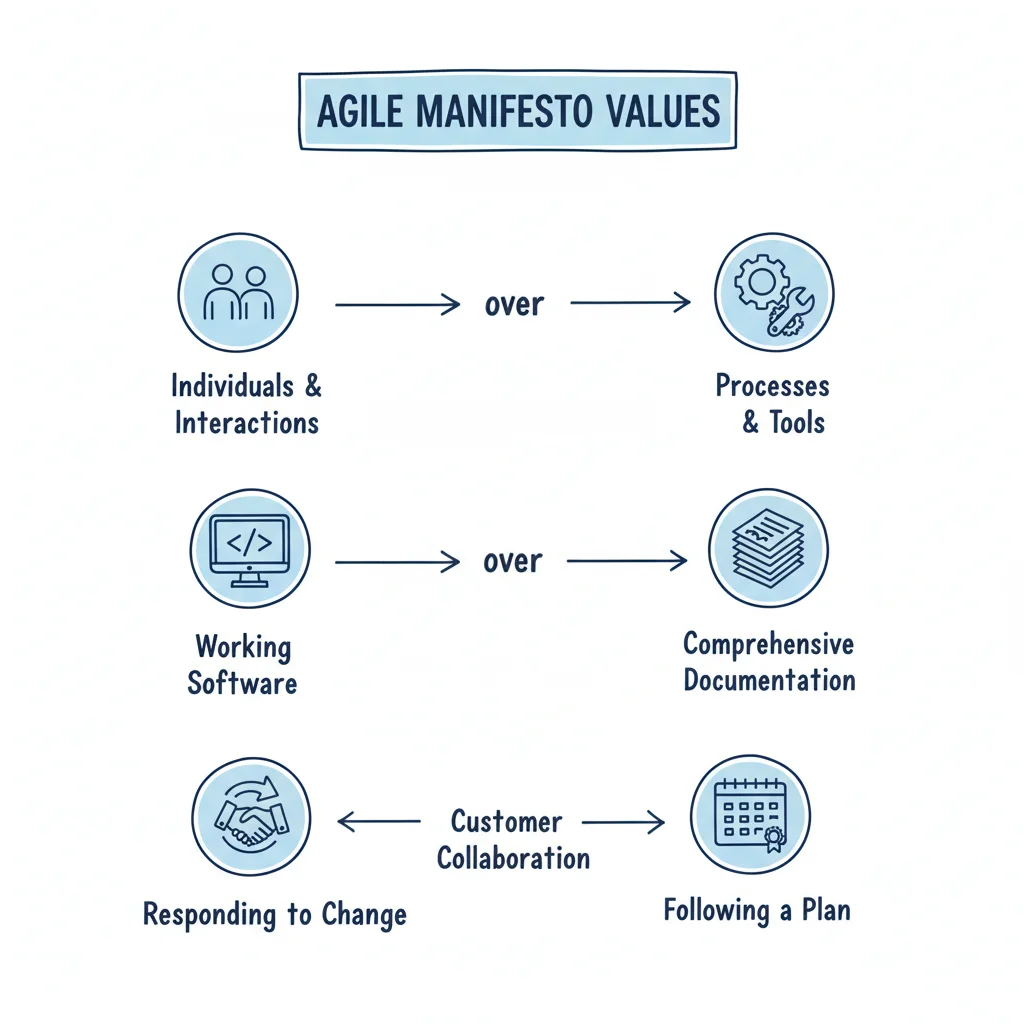 The Agile Manifesto values are the guiding principles for all Agile frameworks.
To maintain this consistent pace, Scrum defines specific roles and events that guide the team:
- Product Owner: This individual represents the interests of the customer and the business. They are responsible for managing the Product Backlog, which is an ordered list of every feature, change, and bug fix required for the product. The Product Owner ensures the team works on the most valuable tasks first to maximize the return on investment.
- Scrum Master: This role functions as a servant-leader and coach for the team. The Scrum Master does not act as a traditional boss; instead, they help the team apply Scrum theory and practice. They work to remove blockers—such as technical issues or bureaucratic hurdles—and protect the team from outside interruptions that could derail a Sprint.
- Development Team: This is a cross-functional, self-organizing group of professionals who do the actual work of building the product. A typical team might include developers, testers, designers, and DevOps engineers. They have all the skills necessary to turn a backlog item into a finished product increment without relying on outside help.
Scrum also uses a series of time-boxed meetings to keep the project on track. Every Sprint begins with Sprint Planning, where the team decides which items from the backlog they can finish. Every day, the team meets for a 15-minute Daily Scrum to sync their progress and identify obstacles. At the end of the Sprint, the team holds a Sprint Review to demonstrate the new work to stakeholders and a Sprint Retrospective to discuss how they can improve their internal processes. Our complete guide to the Scrum framework provides a more detailed breakdown of these ceremonies.
Understanding Kanban: The Visual Workflow
While Scrum relies on fixed time blocks, Kanban focuses on continuous flow. Kanban is a visual system for managing work as it moves through a process. It emphasizes efficiency and encourages teams to deliver tasks as soon as they are ready, rather than waiting for a Sprint deadline. This makes it a popular choice for IT operations, system administration, and help desk teams where work arrives unpredictably and priorities change by the hour.
A busy restaurant kitchen provides a clear example of how Kanban works. As customers place orders, tickets are posted on a board. A chef pulls the first ticket, prepares the food, and then passes it to the next station for plating. The goal is to keep the food moving steadily through the kitchen. If one station becomes overwhelmed, the entire system slows down. Kanban helps identify these trouble spots before they cause a total halt in production.
Teams use a Kanban board to make their workflow visible. The board is divided into columns representing different stages of work, such as "To Do," "In Progress," "Code Review," and "Done." Each task is written on a card that moves from left to right as work progresses. Most modern teams use digital boards in software like Jira or Azure DevOps to track their progress in real-time.
A fundamental rule of Kanban is to limit Work in Progress (WIP). By setting a maximum number of tasks that can exist in any single column at one time, teams prevent themselves from taking on too much at once. If the "Code Review" column reaches its limit, the team stops starting new tasks and instead focuses on helping the reviewers clear the existing cards. This prevents bottlenecks and ensures that work actually gets finished rather than just started. Kanban is an excellent fit for teams that need to react quickly to incoming requests while maintaining a steady throughput.
A Glimpse into Extreme Programming (XP)
Extreme Programming (XP) is a framework that prioritizes technical excellence and high-quality code. While Scrum and Kanban focus on the process of managing work, XP focuses on the specific practices of writing software. It is a disciplined approach that is particularly useful for developers seeking certifications from cloud providers like AWS or Microsoft Azure, where building resilient and efficient systems is a core requirement.
XP promotes several practices that are designed to reduce bugs and make code easier to maintain over time:
- Pair Programming: In this practice, two developers work at a single workstation. One person, the "driver," writes the code, while the other, the "navigator," reviews every line as it is typed. The navigator looks for errors, considers edge cases, and thinks about how the code fits into the larger system. This leads to higher code quality and allows team members to learn from one another.
- Test-Driven Development (TDD): TDD reverses the traditional development sequence. Instead of writing code and then testing it, developers write an automated test that defines a specific function before they write the code itself. The code is only considered complete once it passes the test. This results in very high test coverage and ensures that the software behaves exactly as intended.
- Continuous Integration (CI): Developers using XP merge their code into the main repository several times a day. Automated systems then build the software and run tests to catch any integration errors immediately. This prevents the "integration hell" that happens when developers wait until the end of a project to combine their work, only to find that their different pieces of code do not work together.
XP is a strong choice for environments where the cost of a software failure is very high, such as in financial services or healthcare systems. It requires significant discipline from the team, but the result is often a much more stable and maintainable product. By combining the process structures of Scrum or Kanban with the technical rigor of XP, many teams find they can achieve the best possible results.
The Real-World Benefits and Challenges of Adopting Agile
Moving to an Agile methodology can refresh a team that feels stuck in slow, rigid workflows. The promise is clear: ship software faster, create better products, and build a more motivated workforce. In many cases, Agile delivers on these goals.
However, changing how a business operates is rarely a simple task. Transitioning involves significant friction and steep learning curves. Leaders must understand these dynamics to guide an organization through the shift. Agile is not a quick fix; it is a strategic framework that yields results when teams apply it with intent.
The data supports this transition. Roughly 71% (verify current percentages on the vendor site) of companies use Agile methods, and it is more than a trend. This shift drives growth; 60% (verify current percentages on the vendor site) of organizations see higher profits after adopting these practices. Project outcomes also improve significantly. Agile projects fail 8% (verify current percentages on the vendor site) of the time, while traditional Waterfall projects fail at a rate of 21% (verify current percentages on the vendor site). These Agile adoption statistics on Planview.com show why the model is so popular.
Key Benefits of an Agile Approach
When a team correctly implements Agile, the positive effects reach far beyond the developers. The entire business feels the impact, making it a compelling case for IT professionals to support this approach.
- Faster Time-to-Market: Instead of a single massive release at the end of a long cycle, teams ship working software in small increments. This gets features—like a security patch or a new dashboard tool—to customers early. It creates a shorter path to revenue and helps a company stay ahead of its competitors.
- Enhanced Customer Satisfaction: Agile relies on frequent collaboration with stakeholders. Regular feedback loops ensure the team does not spend a year building a tool that misses the mark, such as an internal IT application with unusable navigation that no one wants to adopt.
- Improved Team Morale and Productivity: Agile gives teams ownership of their work. When people are trusted to solve problems and see the direct impact of their work, they become more engaged. They stop taking orders and start finding better ways to build. Our guide on how to build high-performing teams covers this dynamic in detail.
- Increased Adaptability: Markets shift and security threats appear suddenly. Iterative development allows a team to change direction without stopping the whole project. This flexibility makes a business more resilient when conditions change, which is vital in a digital world that does not stand still.
The ability to respond to change is Agile’s primary strength. It turns uncertainty into an advantage by allowing teams to adjust based on real-time data. This resilience is a core concept in the PMP-ACP and ITIL 4 certifications.
To get a complete picture of the upside, you can explore the core benefits of Agile software development and see just how it fuels success.
Common Hurdles in Agile Implementation
For all its advantages, the path to Agile is often difficult. Organizations face specific obstacles that can stall progress. Identifying these early is vital for a successful transition.
One of the biggest roadblocks is cultural resistance. Agile requires moving from a top-down, command-oriented mindset to one based on transparency and trust. In companies with deep hierarchies, this is a difficult transition. Resistance often comes from middle managers who worry about losing authority or developers who feel uncomfortable with the high level of accountability that comes with self-organization.
Another classic problem is insufficient stakeholder engagement. Agile depends on a steady flow of feedback. If product owners, business users, or compliance officers are too busy to check in, the development team lacks direction. This disconnect causes delays and results in features that do not meet business requirements. When stakeholders only see the product at the end of the project, the cost of making changes is much higher.
Finally, teams often wrestle with vague or undefined requirements. While Agile accommodates change, the team still needs a clear vision and well-articulated problem statements. Without a Product Owner to manage the backlog and set goals for each sprint, a team will drift. They might build functional features that fail to serve a cohesive purpose or solve the actual business problem at hand. Clear communication remains the most important part of the process.
Reflection Prompt: Thinking about your organization, which of these challenges do you foresee as the biggest hurdle for an Agile transformation, and why?
Your First Steps to Implementing Agile Successfully
Moving to an Agile model involves much more than adopting a few buzzwords or scheduling a daily stand-up meeting. It requires a fundamental shift in company culture. If you attempt to force a new workflow onto a team without a clear strategy, the transition will likely be difficult. A structured, step-by-step method is necessary to move from abstract theory to daily practice, ensuring your team supports the change and can maintain it over the long term.
Use this roadmap to guide your implementation.
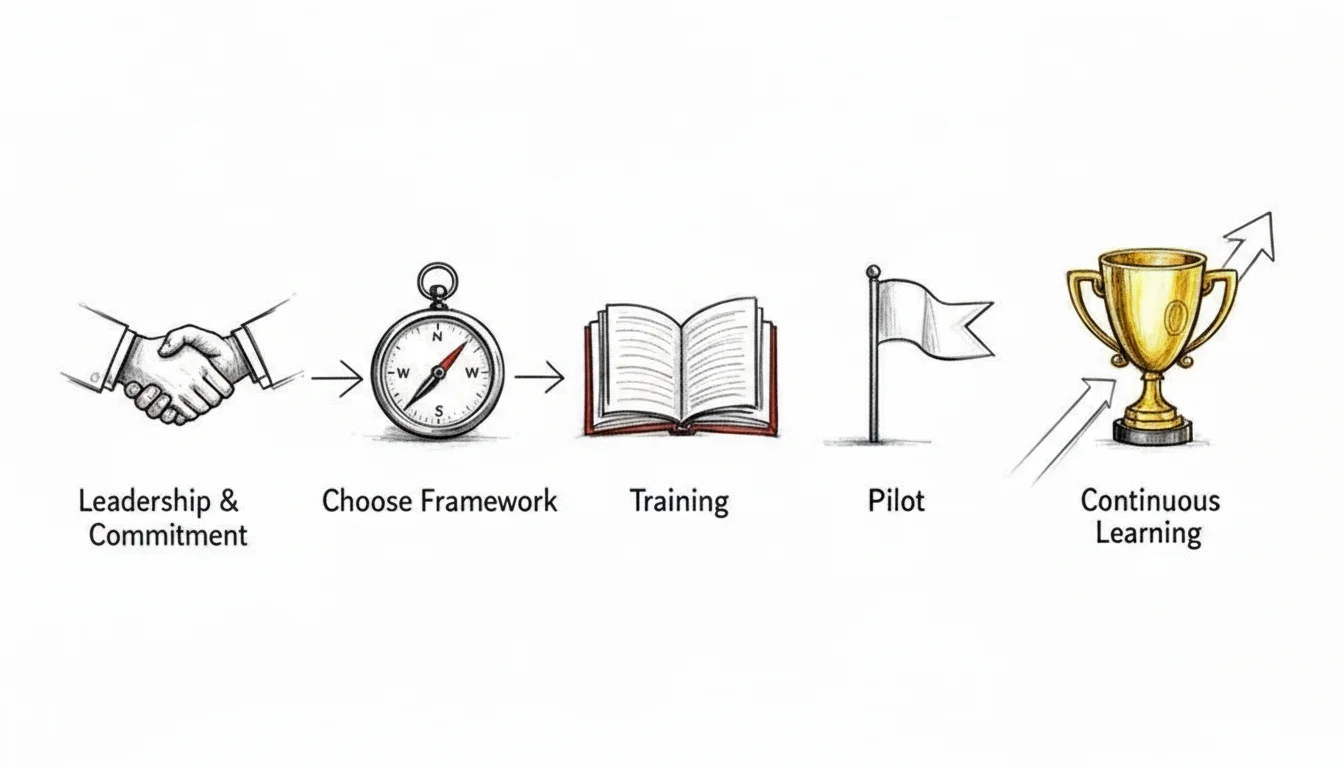 A structured approach to Agile implementation is crucial for success and sustained adoption.
Your initial discussions should target leadership rather than the development floor. Securing executive support requires explaining the change in terms of concrete business value. Focus on faster delivery cycles, improved product quality, lower financial risk, and the agility to respond when market conditions shift. Without this high-level backing, Agile efforts often fail because they lack the necessary budget, authority, and strategic alignment. Aspiring IT leaders should view this as a vital management skill.
Secure Leadership Buy-In and Choose Your Framework
Once leadership approves the transition, you must select an initial framework. Avoid over-analyzing the options. The decision between Scrum or Kanban usually depends on the specific daily tasks of your team and the nature of their commitments.
- Scrum works best for complex development projects that have a defined end goal but an unpredictable path to get there. The use of Sprints and specific roles creates a structured environment for tasks such as building a new customer portal or launching a mobile application.
- Kanban serves teams that manage a steady flow of incoming requests with changing priorities. This makes it a strong choice for maintenance groups, IT support desks, or DevOps teams that handle frequent infrastructure updates.
Do not feel tied to one framework indefinitely. Pick a starting point that aligns with your current reality. You can modify the process as the team gains experience. You can see how these methods overlap by reviewing what DevOps methodology is and how it integrates with Agile principles.
Invest in Training and Start Small
Do not cut corners on the training budget. It is essential to provide professional education for everyone involved, including Product Owners, Scrum Masters, and primary stakeholders. When the entire group understands the core values and the specific mechanics of the framework, you reduce future friction and confusion. Earning certifications like the Certified ScrumMaster (CSM), Professional Scrum Master (PSM), or PMP-ACP can help establish this necessary baseline of knowledge.
After the team completes their training, avoid the urge to transform the entire company at once.
Start with a pilot project. Choose a project that carries low risk but still provides enough value to be noticed. This provides a protected environment where the team can test the new workflow, learn from errors, and gain confidence without the stress of a high-stakes deadline. Examples include developing a small internal tool, adding a minor feature to an existing product, or improving a specific IT service.
Publicize the successes of the pilot project. Even small wins help generate momentum and demonstrate to the broader organization that this approach produces tangible results.
Equip Your Team and Support Continuous Improvement
Agile prioritizes people and interactions, but specific software tools can streamline the process. Select project management and communication platforms like Jira, Azure DevOps, Trello, Slack, or Microsoft Teams that complement your preferred workflow. The software should support your specific processes rather than dictating how your team functions. Maintaining speed and quality also requires integrating automated testing best practices, which are vital for modern software delivery.
Finally, integrate a culture of constant improvement into your team’s DNA. Use your Scrum retrospectives or Kanban review meetings to have candid discussions about successes and failures. Urge team members to try new techniques and ensure they feel safe offering suggestions for change. Agile is not a final destination; it is an ongoing process of learning, adjusting, and finding better ways to provide value to customers.
Mastering Key Agile Concepts for Your Certification Exam
*Understanding core Agile concepts is critical for both certifications and real-world application.*To pass an Agile certification exam such as the PMP-ACP, Certified ScrumMaster (CSM), Professional Scrum Master (PSM), or sections of the ITIL 4 framework, you must go beyond memorizing definitions. You must understand how these concepts function in actual projects. View this section as a study guide that focuses on the topics most likely to appear on your exam. We will move move beyond basic answers to clarify what distinguishes specific Agile roles, why specific ceremonies occur, and how different development methods function.
Differentiating Key Roles and Concepts
One frequent challenge on exams is distinguishing between the Scrum Master and the Product Owner. Both positions provide leadership, but they focus on different aspects of the project. This distinction is a frequent topic in certification questions.
-
The Product Owner: This individual focuses on the "what." They serve as the voice of the customer and manage the product backlog. Their main task is to prioritize tasks to deliver the highest value to the business. They constantly evaluate if the team is building the correct solution to solve user problems or reach business targets. For example, on a project involving an Azure data pipeline, the Product Owner decides which data sources are priority based on business needs.
-
The Scrum Master: This individual focuses on the "how." They act as a servant-leader for the team, teaching Agile practices and removing obstacles. They ensure the process remains efficient. They focus on whether the team is building the product correctly. If a team lacks the proper permissions for an AWS deployment, the Scrum Master works to resolve that issue so work continues without delay.
Candidates also frequently confuse iterative and incremental development. Agile uses both simultaneously, but they represent different concepts. Exams often test your ability to tell them apart through scenario-based questions.
Incremental development involves delivering a product in functional chunks. If you were building a vehicle, the first increment might be a functional chassis with wheels. It is not a complete car, but it is a working piece of the whole. The next increment might add the engine and steering components. Each stage adds a new, usable piece.
Iterative development focuses on refinement through repeated cycles. You might start with a basic pencil sketch of that car to get initial feedback. In the next cycle, you create a detailed digital rendering. Finally, you produce a 3D model. You repeat the process to improve the design based on what you learned in the previous step.
Agile teams combine these strategies. Every sprint produces a usable product increment. Teams then iterate on that increment in following sprints based on user feedback and technical discoveries. This dual approach ensures the product stays feature-rich while undergoing constant refinement.
The Purpose of Core Agile Ceremonies
Certification exams rarely ask for a simple definition of a ceremony. Instead, they test your understanding of why these meetings occur and what they should produce. Knowing the functional intent helps you apply Agile principles to different exam scenarios.
Consider the Sprint Retrospective. This is more than a session for venting about frustrations or technical debt. The primary goal is to drive continuous improvement. The team identifies one or two specific, actionable changes they can implement in the next sprint. For instance, a team might decide to automate a deployment script to reduce manual errors. This practice aligns with the ITIL 4 principle to "Progress iteratively with feedback." The retrospective serves as a structured period for learning and adaptation rather than a session for assigning blame.
The Daily Standup, or Daily Scrum, serves a similar specific purpose. It is not a status report for management or stakeholders. It is a brief, 15-minute planning session for the developers. The team addresses three core points: what they finished yesterday, what they plan to do today, and what obstacles are blocking their progress. These questions help the team synchronize their efforts and identify impediments early. They use this time to plan the next 24 hours of work and stay focused on the sprint goal.
A strong study method involves explaining these ideas in your own words. Try relating them to an IT project or a scenario from an AWS or Azure certification. This practice builds more confidence than simple memorization and helps you handle difficult, scenario-based questions on the exam. Focus on the outcomes of each ceremony and role to ensure you can identify the correct path in a testing environment.
Common Questions We Hear About Agile
Practical questions often arise once the core ideas of Agile become familiar. These scenarios appear frequently during certification exam prep or when applying the methodology to daily operations. Let’s address some common points of confusion to help you understand how these concepts function in practice.
Can You Use Agile for Things Other Than Software?
Agile began in software development, but the mindset works well across various IT and business functions. The core principles involve breaking large, complex problems into manageable units, collaborating with stakeholders, and adjusting direction based on feedback. This approach is effective in many environments because it addresses the universal challenge of managing work in a changing environment.
Marketing teams use Kanban boards to track campaign workflows and ensure that content production stays on schedule. HR departments manage recruitment cycles in sprints to ensure they are meeting hiring targets for different departments. IT infrastructure teams use Agile for cloud provisioning or data center migrations, where requirements might shift as hardware is evaluated. The goal is to apply values like transparency and adaptability rather than focusing on software-specific terminology. Many PMP-certified project managers apply Agile methods to non-software projects with high success rates. If a project requires frequent feedback and has a high degree of uncertainty, Agile is likely a viable candidate regardless of the industry or the final deliverable.
Which Agile Framework is the "Best" One?
Selecting a framework is like choosing a tool; there is no universal "best" option. The right choice depends on the team, the project requirements, and the organizational culture. Certification exams often test your ability to recognize which framework fits a specific scenario rather than asking you to name a single superior method.
- Scrum works well for complex product development where the team has a clear goal and needs predictable delivery cycles. It relies on specific roles like the Scrum Master and Product Owner to keep the team focused on the Sprint Goal.
- Kanban is effective for continuous work streams, such as IT helpdesks, production support, or maintenance queues. It emphasizes visualizing work on a board to optimize the flow and reduce the time it takes to complete an individual task from start to finish.
- Extreme Programming (XP) focuses on technical excellence and high quality. It includes practices like pair programming and test-driven development. It is a strong choice for mission-critical applications or teams building products where the cost of a software defect is high.
Many of the most effective teams create their own hybrid model. They might borrow ceremonies from Scrum and use the workflow visualization of Kanban, a concept often called "Scrumban." The objective is to be agile, not to follow a specific set of rules without question.
The framework is a tool to serve the team and achieve business objectives, not the other way around. The most successful teams are the ones who adapt their process to better fit their specific challenges and goals.
How Does Agile Work With Fixed Deadlines and Budgets?
A common misunderstanding is that Agile cannot handle fixed constraints because the methodology encourages teams to "embrace change." In reality, Agile works effectively within fixed budgets and hard deadlines. It simply shifts the focus from a fixed scope to a model where time and cost are fixed while the scope remains flexible.
Instead of promising a list of exactly 100 features by December 1st for $500,000 (verify current pricing for project estimates on the vendor site), the team identifies the most valuable product possible within those constraints. Scope becomes the primary variable. This allows the team to focus on the highest-priority items first.
By prioritizing critical features and delivering them in tested increments, the team ensures a usable product is ready well before the final deadline. If resources run out or the deadline arrives, the business still has a functional product that provides value. This provides better predictability than traditional Waterfall methods, which often carry higher risks of total failure if the project goes over budget or misses a launch window. In a Waterfall project, you might spend the entire budget and have nothing to show for it until the end. In Agile, you have working software at the end of every iteration. Modern project management certifications emphasize this approach to value delivery as a way to manage risk and ensure stakeholder satisfaction.
At MindMesh Academy, we believe mastering concepts like these is what separates passing an exam from truly excelling in your career. Our expert-led certification prep courses provide a practical understanding of Agile and other critical tech skills. We prepare you to pass with confidence and handle real-world challenges. Start your learning journey with us today!

Written by
Alvin Varughese
Founder, MindMesh Academy
Alvin Varughese is the founder of MindMesh Academy and an enterprise architecture leader. An electrical engineer by training, he moved from factory automation in South Africa to cloud architecture at GE Appliances and Humana (Fortune 50), and holds 20 professional certifications including AWS Solutions Architect Professional, Azure DevOps Engineer Expert, and Microsoft Agentic AI Business Solutions Architect. He built MindMesh Academy after interviewing too many highly certified candidates who couldn't answer basic questions: the goal is prep that makes you better at the job, not just able to pass the exam.