What is Formative Assessment? A Practical Guide to Learning Outcomes
What is Formative Assessment? A Practical Guide to Learning Outcomes for IT Professionals
IT professionals preparing for certifications need more than raw information. They must verify that their knowledge is accurate and applicable. Formative assessment fills this gap. It is a continuous process of evaluating your understanding during the study phase, providing immediate feedback to guide your progress. While a summative final exam measures your ultimate performance, formative assessment focuses on making small, frequent adjustments to your strategy. This approach ensures you master the material before facing the actual test. By identifying weak spots early, you can adjust your study habits to stay on track toward passing your chosen certification exam with confidence.
Your Learning GPS for IT Certs
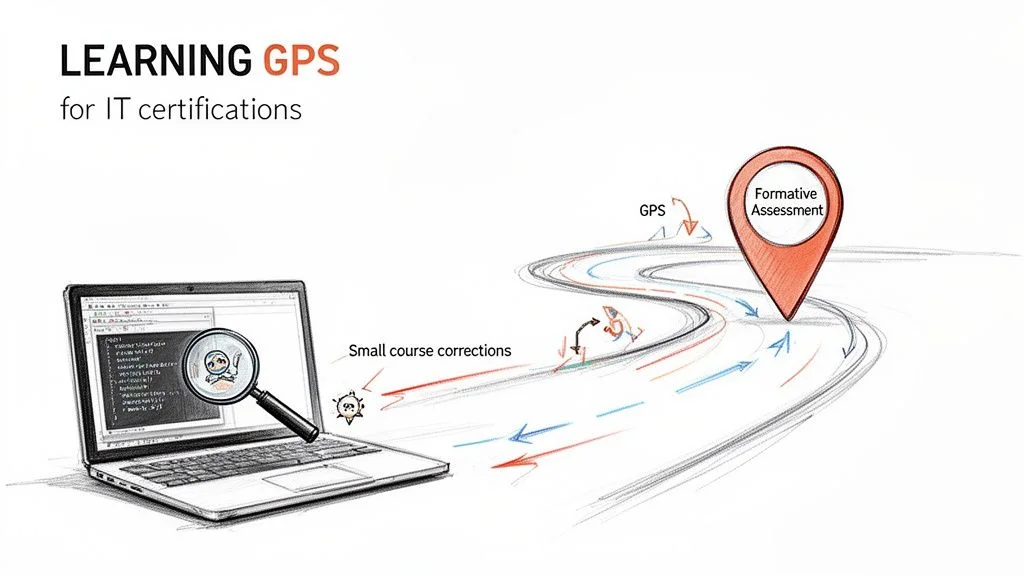
As an IT professional, you would never deploy a complex system without testing it at every stage. You write code, you debug it, you test individual modules, and you integrate components one step at a time. This iterative, feedback-driven approach is exactly how formative assessment functions during certification prep. If you are studying for the AWS Certified Solutions Architect, the PMP, or the CompTIA Security+, formative assessment serves as a debugging tool for your technical knowledge.
Instead of viewing your study plan as one massive project that only gets validated on the day of the exam, formative assessment breaks your work into small, testable units. It consists of frequent checks—like a short quiz after a module on Azure networking configurations or a quick question that checks your knowledge of a specific Cisco IOS command. These small assessments find misunderstandings before they turn into major knowledge gaps that could lead to a failing score on exam day.
This approach changes the question you ask yourself. You stop asking "Am I passing?" and start asking "What do I need to work on next?" Assessment stops being a judgment and becomes a tool to help you get better.
In this model, wrong answers are not failures. They are data points. Every incorrect practice question shows a specific gap in your knowledge. This provides a clear signal on where you should focus your attention right now.
Reflection Prompt: Look at your current study habits. How often do you actively debug your understanding versus just consuming content?
Why This Method Actually Works
Formative assessment is not just a good idea; it is a validated method with significant effects on learning efficiency and retention. Research from the late 1990s showed its impact, proving that consistent feedback can move a student's performance from the 50th percentile to the 85th percentile. This 35-point improvement happens because of the feedback loop. This loop is known as one of the most effective strategies for learning a new subject quickly.
For IT professionals, using this feedback loop provides clear advantages when preparing for certifications:
- Identify Knowledge Gaps: You get specific clarity rather than general doubt. You will know exactly which ITIL processes, ServiceNow modules, or advanced Python concepts are causing trouble. This allows you to step in and fix the problem long before the actual exam starts.
- Build Exam Confidence: Regular tests with no risk provide proof of your progress. These consistent wins reduce anxiety and build confidence. They confirm that your study methods are working as expected.
- Improve Long-Term Retention: Actively recalling information during polls, quizzes, or when explaining a concept to yourself strengthens neural pathways. This moves technical data from short-term memory into long-term storage. This is necessary for passing difficult certifications.
- Increase Study Efficiency: By identifying the topics you have already mastered, you stop wasting time on redundant reviews. This focused approach ensures your study time goes only to the areas where you need to improve. This makes every hour of study more productive.
Formative vs. Summative Assessment
To use this strategy, you must understand the difference between formative assessment and its partner: summative assessment. Summative assessments are the final verdict. They are evaluations performed after you finish learning to measure your total mastery and memory. Your official certification exam—whether for AWS, Azure, PMP, or CompTIA—is the classic summative assessment.
The purpose is the main difference. Formative assessment guides your path by providing constant data. Summative assessment measures the final result with a score. Grasping this distinction helps you maintain a mindset of constant improvement. This is a philosophy we explain in our guide on what is continuous learning.
Let's clarify these two assessment types side-by-side:
Formative vs Summative Assessment at a Glance
This table shows the core differences. You can compare this to the diagnostics and changes made during software development (formative) versus the final acceptance testing before a product goes live (summative).
| Characteristic | Formative Assessment (The Learning GPS) | Summative Assessment (The Final Verdict) |
|---|---|---|
| Purpose | To monitor and improve learning in real-time. | To evaluate mastery at the end of a unit. |
| Timing | Ongoing and frequent (during the learning process). | End-of-unit, mid-term, or end-of-course. |
| Stakes | Low-stakes or no-stakes (usually not graded). | High-stakes (heavily graded or pass/fail). |
| Feedback | Immediate, specific, and diagnostic. | Delayed, often just a final score or grade. |
| Analogy | A chef tasting the soup while cooking. | A food critic rating the final dish. |
| Example | A 5-question quiz after a PMP module. | The official PMP certification exam. |
Both types of assessment are necessary. However, IT professionals who want to excel in their certifications should focus on using formative methods throughout their study time. This is the most effective way to arrive at exam day with actual confidence in your skills.
A Closer Look at Key Formative Assessment Techniques
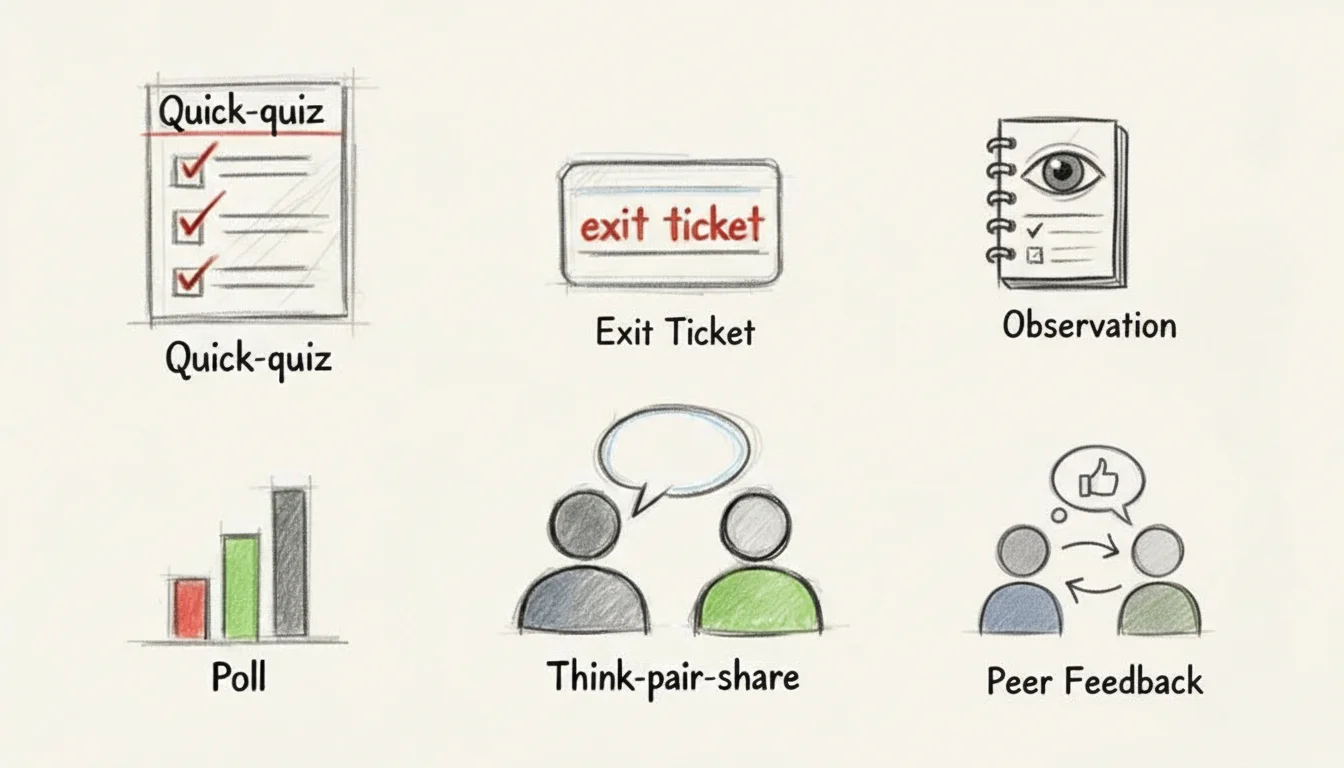
Understanding the theory of formative assessment is the starting point, but the real benefit occurs when you apply it to your certification study. The goal is to move away from high-pressure, exhausting study blocks toward a sequence of low-stakes, high-feedback activities. These techniques are not just academic exercises. They serve as your technical diagnostic toolkit for acquiring new skills.
These methods work like the targeted scripts you run to monitor server health or network performance. Each technique provides quick, specific data regarding your current understanding and, more importantly, identifies your knowledge gaps. This allows for immediate, real-time adjustments. Instead of waiting for a total system failure—like a failing score on a final practice exam—you identify and fix minor configuration errors early in your study process. This data-driven method builds solid knowledge and steady confidence. It transforms your study routine from a guessing game into an efficient, evidence-based process. Below are some of the most effective formative assessment methods, specifically adapted for difficult IT certifications.
Quick Knowledge Check-Ins
Some of the most direct formative tools include quick quizzes and interactive polls. Do not view these as intimidating tests. They are focused "temperature checks" meant to measure how well you understand a topic immediately after learning it. For example, if you just finished a lesson on Azure Virtual Networks, a three-question quiz can instantly show if you understand subnetting, Network Security Groups (NSGs), or routing tables.
The goal here is not just to get a high score. The value lies in active recall. Research in cognitive science shows that pulling information from memory, even for a simple multiple-choice question, strengthens neural pathways much more than passive review like re-reading a textbook. This active participation improves memory and shows you exactly where you need to spend more time.
You can add these quick assessments to your study routine using these methods:
- Pre-Module Primers: Before starting a new section, such as ITIL Service Strategy or advanced security services in the AWS Certified Security - Specialty (SCS-C03) exam, use a short poll on a general concept. This prepares your mind for the material and helps set a clear goal for the session.
- Immediate Post-Lesson Quizzes: Finish every video lecture, reading, or lab session with a targeted quiz. If you answer a question incorrectly, do not see it as a failure. It is a specific signal to review that exact video segment or document section to clear up confusion.
- Confidence Self-Ratings: Use a simple 1-to-5 scale to rate how well you think you know a topic after studying it. This self-assessment takes only a few seconds but helps you prioritize what to study next and how to schedule your future reviews.
Reflection Prompt: How can you add a 5-minute 'quick check' to your next study session to test active recall rather than just looking at your notes?
Summarizing and Synthesizing Your Learning
Real understanding in the IT field requires you to explain complex ideas in your own words. Techniques that require you to summarize and synthesize information are extremely useful. Tools such as exit tickets and one-minute papers are effective formative strategies. They force you to pause and process what you have learned, turning it into its most important parts.
An exit ticket is a short, focused prompt you complete at the end of a study session. For example, after spending an hour on the CompTIA A+ (220-1201/220-1202) curriculum regarding hardware troubleshooting, your prompt could be: "List the three most important things to check when diagnosing intermittent RAM issues." This task confirms the information in your mind and points out any areas where your understanding is still blurry. It gives you instant feedback on your ability to combine different facts into a useful conclusion.
The one-minute paper is a similar tool. It asks you to answer two specific questions quickly:
- What was the most important concept or takeaway from this study session?
- What specific part of this topic is still confusing or unclear?
Answering these questions reinforces your main ideas while highlighting the areas that need more work. Finding your own learning needs is a sign of an effective student. To find strategies that help you keep this knowledge long-term, our detailed guide on how to master spaced repetition studying provides a thorough look at the subject.
Collaborative and Interactive Methods
Preparing for a certification does not have to be a solo task. Collaborative learning techniques, like Think-Pair-Share, can change how you master difficult topics. This method uses a simple three-step process:
- Think: Work by yourself to analyze a hard problem. This could be designing a fault-tolerant architecture for the AWS Certified Cloud Practitioner (CLF-C02) exam or planning a secure hybrid network connection for a CompTIA Network+ (N10-009) scenario.
- Pair: Talk to a study partner about your ideas. Compare your solutions and discuss the pros and cons of different service configurations or design choices.
- Share: Give your final solution to a larger study group or an online forum. Ask for feedback and look at other ways to solve the problem. This step is vital for finding things you missed and making your understanding more complete.
This process forces you to explain your logic, defend your technical choices, and evaluate what others say. These are the same skills you need for the scenario-based questions that appear on modern IT exams.
To make your study more engaging, you might look into gamification in education. Gamified tasks add a bit of competition while providing immediate feedback in a dynamic way. By using a mix of these formative techniques, you create a flexible study system. This system responds to your changing needs and prepares you for the different types of questions you will face on exam day. You move from simply reading material to actively proving you can use the technology in real-world situations.
The Critical Role of Feedback in Your Learning
If formative assessment provides the structural framework for steady improvement, then quality feedback is the high-octane fuel that drives the engine. Merely seeing a red "X" next to an answer offers very little value to a student. Genuine progress happens during the feedback loop. This is a specific cycle where you make a mistake, identify exactly why it happened, and receive clear instructions on how to fix it next time. This process is very similar to a thorough code review in professional software engineering.
Imagine a junior developer pushing code to a repository for a new application. The least helpful feedback they could receive is a brief comment stating, "This is wrong; fix it." That response provides zero context, creates frustration, and kills any chance for the developer to learn from the error. A better code review provides specific, technical insights. For instance, a senior engineer might say: "This authentication logic works, but it creates a single point of failure. It also ignores the principle of least privilege. You should implement an IAM role with restricted permissions and require multi-factor authentication for administrative access. This change improves security, which is a requirement for this project." This feedback does more than fix a bug. It builds a better way of thinking about system architecture. It prevents the same mistake from happening in the next sprint or on a different project. This is the heart of what makes feedback an educational tool.
Turning Mistakes into Learning Opportunities
Good feedback acts as the bridge that turns a wrong answer into a moment of clarity. It works to close the gap between what you currently know and what you must know to pass a certification exam. To be effective, feedback needs three specific traits:
- Timely: Feedback is most useful when it arrives right after the action. If you just finished a difficult subnetting calculation or a complex AWS IAM policy question, your thought process is still fresh in your mind. Getting a correction immediately allows you to see exactly where your logic went off the rails. If you wait days for a result, you might forget why you chose a specific answer in the first place, making the correction less relevant.
- Specific: Vague comments like "Incorrect, see chapter 5" do not help most learners. High-quality feedback identifies the precise reason for the failure. It might be a factual error, a misunderstanding of a core principle—like the difference between security groups and network access control lists (NACLs)—or a mistake in how you applied a specific formula or algorithm.
- Forward-Looking: The best feedback looks ahead. It does not just point out the past error; it gives you a map for what to do next. This might mean pointing you toward a specific page in the official documentation, suggesting a new practice scenario, or recommending a short video lesson that covers your specific area of weakness to reinforce the concept.
Feedback is not meant to be a punishment. It should act as a strategic briefing that provides the data you need to succeed on your next attempt. Instead of a critique, look at it as a way to gather the intel required for a better result.
Reflection Prompt: Recall a time you received feedback that was confusing or unhelpful versus a time you received feedback that clicked. How did each experience change your motivation to keep studying?
Good vs. Bad Feedback: An IT Certification Example
Let’s look at a scenario from an AWS certification course. Suppose you are studying for a cloud security exam and you get a practice question wrong. The quality of the feedback you see determines whether you actually learn the material or just feel frustrated.
Ineffective Feedback (The Counterproductive):
- The Result: "Incorrect. The correct option was C."
- The Vague Critique: "You failed this security domain question."
- The Broad Advice: "You need to re-study the entire security module."
This kind of feedback has no diagnostic value. It confirms you are wrong without explaining why. It offers no clear path to improvement, leaving you stuck in the same place you started.
Effective Feedback (The Productive):
- The Correction: "Your answer is incorrect because it violates the principle of least privilege. Your security group setup opens ports to a much wider IP range than necessary, which increases the potential attack surface."
- The Action Plan: "To fix this, go back to the AWS IAM policies module. Focus on best practices for custom roles and resource-level permissions. Then, try this related scenario question (link to question) to see if you can apply these rules correctly."
This second example offers actual direction. It points out the specific conceptual error regarding least privilege and explains the consequence of that error. Finally, it gives a clear action plan. When you combine this with methods found in our guide on the best study methods for exams, every mistake becomes a permanent lesson. You are not just losing points; you are gaining knowledge for your actual exam day.
Integrating Formative Assessment into Your Study Routine
Understanding the theory behind formative assessment is a good start, but it becomes effective only when you build it into your daily certification study routine. You need to move away from reading chapters passively. Instead, adopt an active cycle where you test yourself, change your strategy based on the results, and lock in what you have learned. This shift is where you see real gains in exam readiness.
Modern learning platforms are designed to handle this work for you by automating the feedback loop. You no longer need to write every flashcard by hand or track your mistakes in a manual spreadsheet. These digital tools act as an assessment engine that turns your study time into a data-driven process. They help you focus on the right material at the right time. Below, we look at how specific features put formative assessment into practice.
Using Spaced Repetition for Continuous Recall
Spaced repetition is a core part of self-directed assessment. This technique involves reviewing facts at specific, increasing intervals to fight the forgetting curve. Every time you successfully recall a Linux command or explain the OSI model for the CompTIA Network+ (N10-009) exam, you are performing a micro-test on your long-term memory. It confirms that the information is sticking.
Platforms like MindMesh Academy build spaced repetition into their study plans. If you just finished a lesson on the OSI model, the software will schedule a review for later that day, then again in three days, and once more in a week. If you fail to recall a concept during one of these checks, the system records the error. It then adjusts your schedule to show you that challenging content more frequently. This process ensures you spend your time on difficult topics rather than repeating things you already know. It forces you to move beyond simple memorization toward true understanding.
Creating Personalized Paths with Adaptive Learning
Adaptive learning uses your performance data to change your study path in real time. It works like a private tutor who adjusts the lesson based on how you answer questions. When you finish a quiz on Azure security, for example, the platform does more than just calculate a percentage. It analyzes your choices, noting which wrong answers you picked and even how long you hesitated before clicking. This data reveals whether you truly understand a concept or if you are just guessing.
If the system sees that you are struggling with identity management or network security groups, it will change your curriculum. You might see a new video tutorial, a hands-on lab that lets you practice the skill, or a set of targeted practice questions. This approach makes your study time much more efficient. You stop wasting hours on material you have already mastered and focus your energy on the specific gaps that could hold you back on exam day.
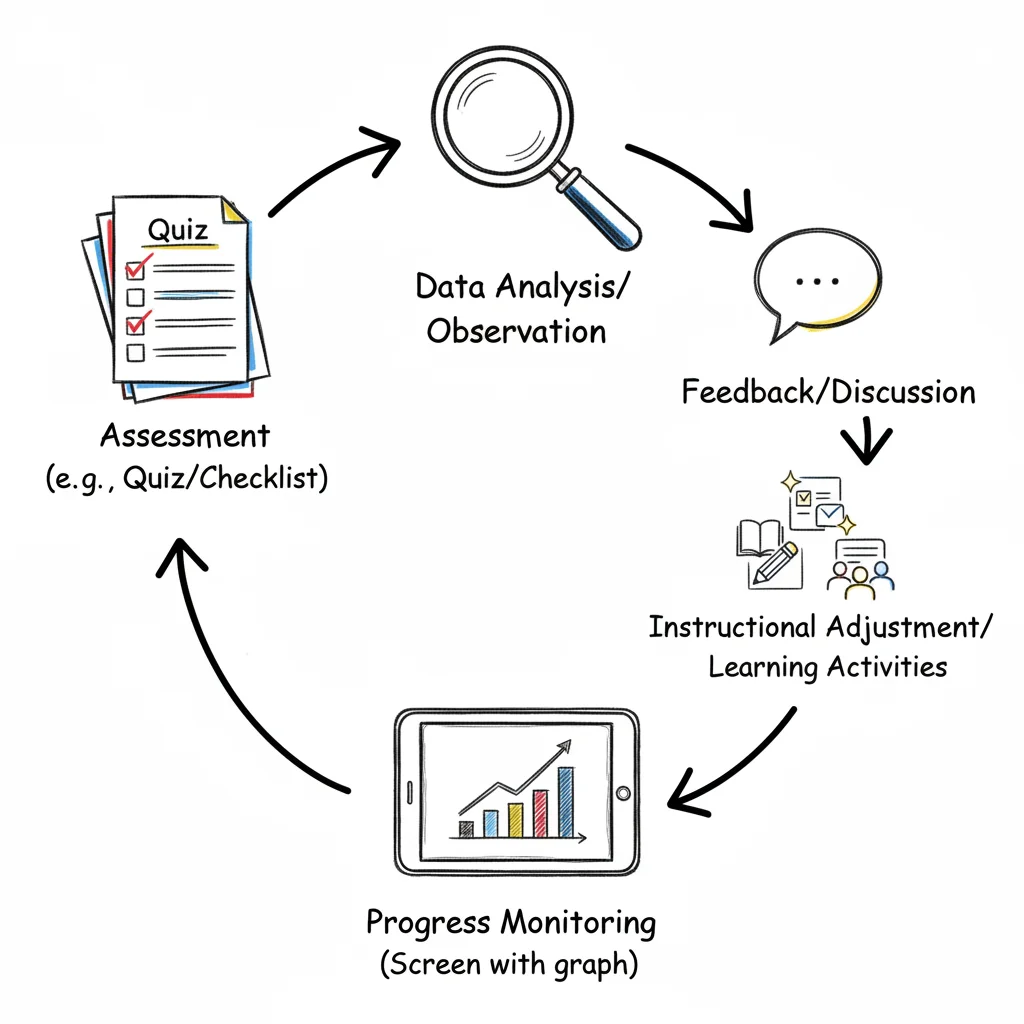
The diagram below shows the feedback loop that powers these systems. It is a simple, repeating cycle of finding a mistake, getting feedback, and taking action to fix it.
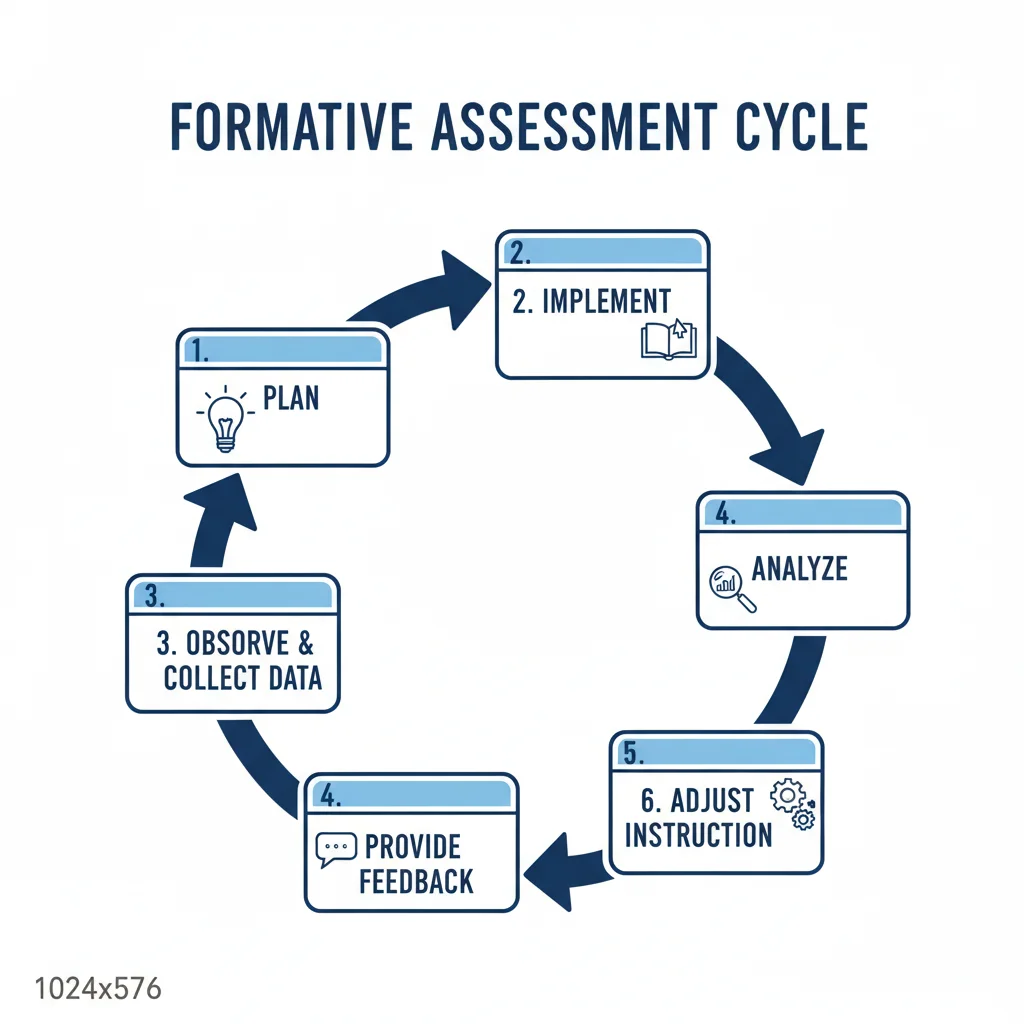
This three-step cycle is the main engine of effective learning. It ensures that every mistake you make becomes a clear chance to improve your knowledge before you sit for the actual exam.
A Sample Study Plan for CompTIA Security+
To see how this works in the real world, let’s look at a sample study week for the CompTIA Security+ (SY0-701) exam. This is a common goal for IT professionals moving into security roles.
A Week of Formative-Driven Study:
- Monday (Threats, Vulnerabilities & Mitigations): Start your session with a 5-question pre-quiz. This sets a baseline and tells you what to look for in the lesson. After studying, take a 10-question practice set. Read the feedback for every wrong answer to understand the logic the exam expects.
- Tuesday (Security Operations & Incident Response): Open with a 3-minute review of the terms you learned on Monday. This uses spaced repetition to keep those concepts fresh. After you finish the new module, write a quick summary of the most important point you learned and note any parts that still confuse you.
- Wednesday (Security Architecture & Engineering): Take an adaptive quiz. The questions should get harder or easier based on your answers. Use the results to find your weak spots, such as cryptography or secure network design. Spend the rest of your session re-watching videos or reading about those specific topics.
- Thursday (Review & Targeted Reinforcement): Check your progress dashboard. If it shows you have a low mastery score in "Threats and Attacks," spend this block doing nothing but practice questions and labs in that specific area. Do not move on until your score improves.
- Friday (End-of-Week Consolidation): Finish the week with a 20-question quiz that mixes topics from the whole week. This acts as an "exit ticket." It provides a thorough, formative overview of what you have retained and what you might need to review again over the weekend.
This routine makes sure every minute you spend studying is active. It keeps you on the most efficient path to passing your exam with confidence.
How to Measure Your Progress Formatively
How can you tell if you are making progress when formative assessments do not use traditional grades? For an IT professional, the answer involves shifting focus from lagging indicators—like a final exam score—to tracking leading indicators. These indicators provide a live look at your learning trajectory while you are still in the middle of a course.
Look at this through the lens of business intelligence. A startup does not wait for its annual tax report to see if it is healthy. It tracks weekly metrics such as user engagement and churn rates. Your learning should follow the same logic. Formative assessment metrics act as your personal performance indicators. They provide actionable data on whether you are moving toward your certification goals or if you are wasting time on the wrong topics.
Interpreting Your Learning Dashboard
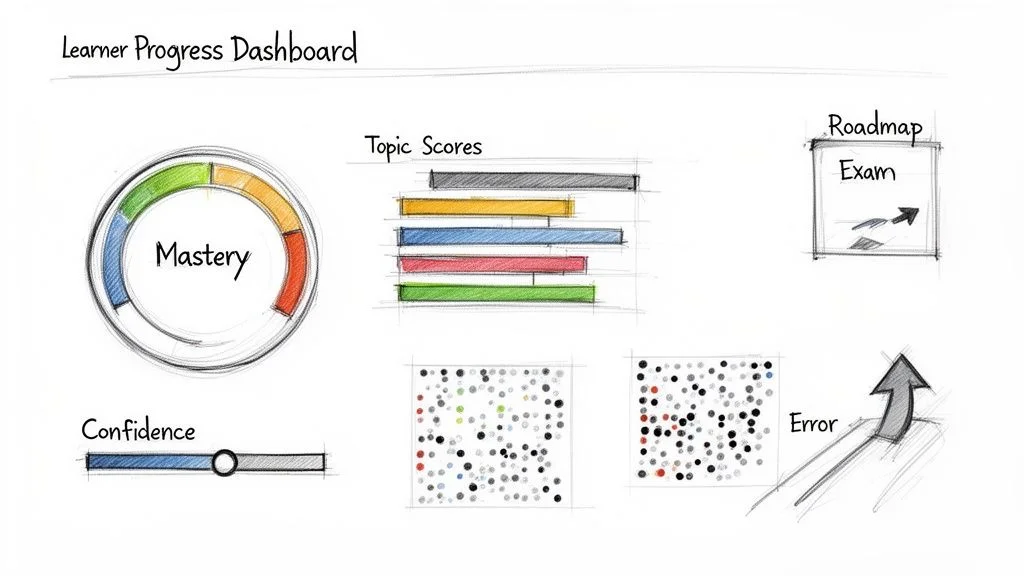
Many advanced study platforms include a detailed progress dashboard that acts as a central hub for your exam preparation. It takes your performance data from quizzes and labs and turns it into easy-to-read visual charts. These tools are helpful for identifying skill gaps with high precision, allowing you to see exactly where your knowledge is falling short.
Key metrics to track include:
- Mastery Level by Domain: This percentage shows your proficiency in specific exam areas, such as AWS Networking or PMP Process Groups. It uses your performance on practice questions to provide a data-backed view of what you know.
- Confidence Ratings: Some platforms ask you to rate your confidence immediately after answering a question. This helps you understand your own thinking. It separates what you truly understand from lucky guesses, showing where you need to spend more mental energy.
- Error Pattern Analysis: This tool looks at your wrong answers to find recurring problems. If you frequently miss questions on subnetting for the CompTIA Network+, the system flags that specific blind spot. You can then fix the issue before it costs you points on the actual exam.
These tools lead to measurable growth. A study by the Institute of Education Sciences (IES) found that learners who used these formative methods achieved gains of 0.20 to 0.40 standard deviations (verify these figures in the original report). This equals roughly 4-8 months of additional learning progress in a single year. Data-driven tracking makes the study process much faster.
Using Data to Steer Your Study Plan
The value of formative assessment shows up when these metrics guide your study choices. Your dashboard is not just a report card. It is a live map that shows your next objective.
By analyzing your data, you move from random studying to a targeted strategy. This allows you to stop spending time on concepts you have already mastered. Instead, you can put your effort where it will have the biggest impact on your score.
For example, imagine your dashboard shows 95% mastery in CompTIA Security Operations, but your score in Security Architecture and Design is only 60%. This insight changes your schedule immediately. You can skip the operations review for a few days. Instead, you can focus on architecture using specific practice questions and labs for that one weak area. You can keep working until your score reaches the passing mark. This data-driven approach keeps you in control. It ensures that every minute you spend studying is an investment in your success.
Your Questions About Formative Assessment, Answered
You are likely looking for ways to use these formative assessment techniques in your daily certification study. Questions usually pop up when you change how you learn. We address the most frequent questions here. These answers provide clear and direct guidance for IT professionals trying to manage their time while preparing for exams. This section helps you apply these methods to your own study routine. It covers both individual study and the use of digital learning tools.
Isn't This Just a Fancy Name for Practice Exams?
This is a common question. It is helpful to see the difference between the two. A practice exam is a summative tool. You should view it as a final dress rehearsal. Most people take these near the end of their study cycle to check their total readiness. They use them to get used to the exam environment and timing. They are useful for building stamina for the long testing window.
Formative assessment is different. It is part of the daily study process. It consists of small and frequent checks you do while learning. For example, if you are studying for an AWS Certified Cloud Practitioner (CLF-C02) exam, a 120-minute full-length mock exam (verify current duration on the vendor site) taken the weekend before your test is summative. A short, five-question quiz taken right after you finish a module on VPCs is formative. That quiz checks if you understand subnets and routing before you move to the next topic.
The goal of a formative check is not to get a high score. The goal is to get feedback you can act on immediately. A good learning tool will do more than tell you that you missed a question. It will show you exactly why the answer was wrong. It will point out the specific error in your logic. Then, it will send you to the specific micro-lesson or technical manual you need to read to fix that gap. This is the difference between a final audit and the drills that build the skills for the exam.
Wouldn’t It Be Faster to Just Memorize Everything?
Memorizing facts might feel like a shortcut. However, modern IT exams are full of scenario-based questions. Exams like the Azure Administrator (AZ-104), CCNA (200-301), and PMP test how you apply what you know. Relying on rote memory is a high-risk move. It rarely leads to a passing score on these types of tests. Vendors want to see if you can troubleshoot a network or manage a project budget, not just recite definitions.
Formative assessment is actually a faster path to getting certified. It helps you study with more focus. By using frequent checks, you find out where you are weak very early. You do not have to waste time re-reading a whole chapter on CompTIA Network+ (N10-009) basics (verify current exam code on vendor site). You can spend your time on the parts that are hard for you, like CIDR notation or routing protocols.
This method builds memory that lasts much longer. It is more effective than cramming at the last minute. It lets you skip the topics you already know well. This makes your study plan more efficient. You get the most out of every hour you spend with your books or videos. Using these checks ensures you are ready for the varied question types you will see on the current exam.
Can I Do This on My Own for Self-Study?
Yes, you can. Formative assessment works well for people who study on their own. You do not need an instructor to do this. You just need a system to verify what you have learned. IT pros often find that self-checks keep them on track when studying for certifications like CompTIA A+ (220-1201/220-1202).
- The Teach-Back Method: Try explaining a new concept out loud. If you just learned about cloud service models, try explaining them to a colleague or even to yourself in a mirror. Do it without looking at your notes. If you find yourself pausing or getting confused, you know you have not mastered that topic yet. You need to go back and review the documentation.
- Design Your Own Micro-Quizzes: When you finish a section, write down three questions that cover the most important points. Do not answer them right away. Wait a few hours or until the next morning. Then try to answer them. This is a very effective way to check your recall. It forces your brain to pull the information from long-term memory.
- Post-Mortem Error Analysis: When you get a practice question wrong, do not just look at the right answer and keep going. Stop and look at why you chose the wrong answer. Did you forget a specific port? Did you misunderstand how a firewall processes rules? Figure out the mistake. This helps you avoid making the same error during the actual exam.
These strategies work for any student. You can use them manually, even if you are not using a digital platform. The key is to be honest about what you do not know.
How Does a Learning Platform Use My Formative Data?
A learning platform acts as a data assistant for your studies. It tracks your performance on every quiz and practice question. It uses that information to create a study plan that fits your needs. This is more efficient than a one-size-fits-all approach.
Every answer you give provides a data point. An algorithm looks at these points to understand your knowledge. It finds the specific areas where you have gaps. For instance, if you keep getting questions about Azure identity management wrong, the platform will notice. It will then change your plan. It will suggest more video lessons, labs, or quiz questions on that topic. It might also suggest you skip a section on storage if you have already proven you understand it.
This data also shows up on your dashboard. You get a visual map of how well you know each part of the exam. If the exam blueprint includes security, operations, and networking, the dashboard shows your progress in each one. This makes studying a data-driven process. You no longer have to guess if you are ready. You will know exactly where to spend your time to improve your score. This approach ensures that your time is used on the domains that carry the most weight or cause you the most trouble.
Ready to change how you prepare for exams? MindMesh Academy uses these formative assessment methods to help you study. Our system uses feedback to build a plan for you. You can see our list of courses and see how our data-driven approach helps you reach exam readiness. You can pass with confidence. Visit us at Explore IT Certification Practice Exams to get started and see how targeted practice can change your results.

Written by
Alvin Varughese
Founder, MindMesh Academy
Alvin Varughese is the founder of MindMesh Academy and an enterprise architecture leader. An electrical engineer by training, he moved from factory automation in South Africa to cloud architecture at GE Appliances and Humana (Fortune 50), and holds 20 professional certifications including AWS Solutions Architect Professional, Azure DevOps Engineer Expert, and Microsoft Agentic AI Business Solutions Architect. He built MindMesh Academy after interviewing too many highly certified candidates who couldn't answer basic questions: the goal is prep that makes you better at the job, not just able to pass the exam.