What Is Cybersecurity Framework: Why You Need It
A cybersecurity framework serves as a blueprint for building resilient digital defenses. For IT professionals aiming to strengthen security and advance their careers, understanding these structures is essential. A framework is a structured guide rather than a single piece of software you can install. It is packed with best practices, standards, and practical recommendations for managing digital risk effectively across an entire organization. At MindMesh Academy, we believe this foundational knowledge is absolutely critical for anyone currently pursuing certifications like CompTIA Security+, CISSP, or even cloud-specific security specializations.
Clarifying the Digital Blueprint
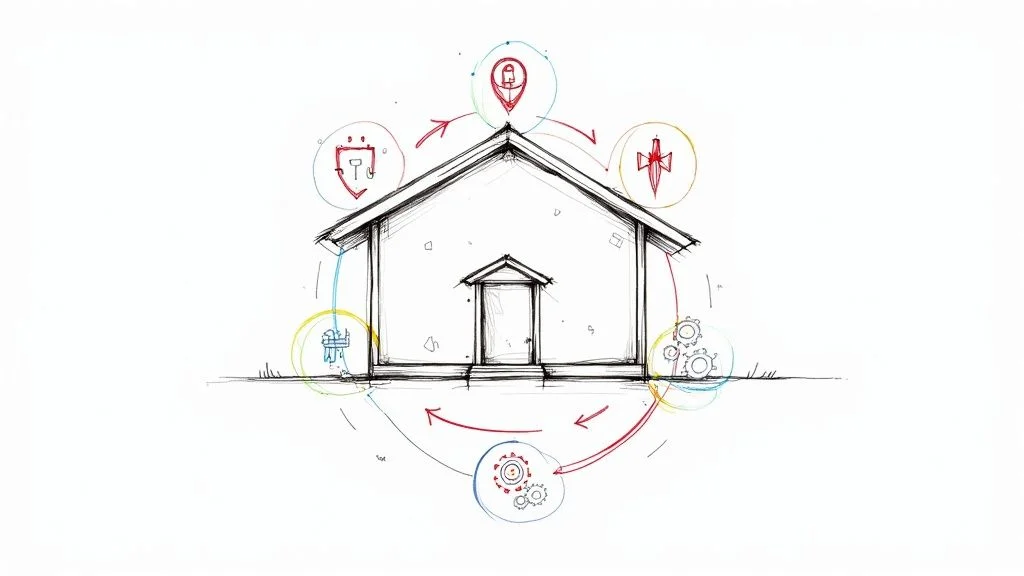
 A visual representation of a cybersecurity framework as a detailed digital blueprint.
Building a house without a blueprint usually leads to disaster. You might install a heavy front door but forget to put locks on the ground-floor windows, leaving easy entry points for anyone looking to get in. A cybersecurity framework prevents this type of disjointed, failing security by providing an organized plan before the first tool is ever purchased. For IT professionals, this move is essential. It shifts the daily workload away from reactive "firefighting" and toward a proactive, strategic defense.
A construction blueprint specifies the foundation, plumbing, electrical wiring, and alarm systems. Similarly, a security framework offers a clear map for protecting the most valuable digital assets an organization owns. It ensures that every part of the security program is weighed and used in a logical, coordinated way. This makes it much easier to prepare for incidents and recover when things go wrong.
From Chaos to Cohesion
Without a framework, security efforts feel scattered. One IT team might scramble to install a new firewall because they heard about a specific threat on the news. Meanwhile, another department focuses entirely on phishing training. Both actions have value, but without a unified strategy, the team is just plugging holes as they appear. This leaves other gaps wide open for attackers to exploit. This uncoordinated approach creates compliance problems and increases risk, which is a situation many IT professionals face every day.
A framework changes this by establishing a common language and a shared set of objectives. It aligns every member of the organization. From the network engineers in the data center to the executives making budget decisions, everyone understands what needs protection and the best way to do it. This strategic alignment is the basis of a resilient security posture. It is a concept required for certifications that cover governance, risk, and compliance (GRC), such as CISM or CRISC.
A cybersecurity framework is not about purchasing more tools. It is about using a structured methodology to make smarter, risk-based decisions about the people, processes, and technology you already have. It shifts the focus from "what products do we need?" to "what outcomes do we need to achieve?"
This structured approach provides a repeatable and measurable way to manage security. Instead of guessing where the weaknesses are, the framework leads you through a systematic process of identifying, assessing, and improving defenses. It helps you answer the difficult questions that appear on certification exams:
- What are our most critical digital assets and data? (Examples include customer PII, intellectual property, and cloud infrastructure.)
- What are the biggest threats we face? (This includes ransomware, insider threats, or zero-day exploits targeting AWS or Azure environments.)
- Are the security controls we have in place actually working effectively?
- How will we react and recover when a breach happens? (The goal is to minimize downtime and prevent data loss.)
Core Functions of a Cybersecurity Framework Explained
Most major frameworks, such as the NIST Cybersecurity Framework, use five core functions. These functions provide a strategic view of the entire lifecycle of managing security risk. Understanding this is vital for almost any IT security certification. The following table breaks these down using a house blueprint analogy and real-world IT examples.
| Core Function | What It Means | House Blueprint Analogy | IT Professional's Focus (Example) |
|---|---|---|---|
| Identify | Understanding your digital assets, risks, and business environment. | Knowing what valuables are inside the house and identifying potential entry points for a burglar. | Performing asset inventories, risk assessments, and vulnerability scanning. Understanding business impact, such as data classification for a project. |
| Protect | Implementing safeguards to prevent or limit the impact of a security event. | Installing strong locks, a security fence, and reinforced windows. | Implementing access controls and IAM in AWS or Azure. Using encryption, firewalls, security awareness training, and patch management. |
| Detect | Putting systems in place to quickly identify when a security breach occurs. | Setting up motion detectors and security cameras that alert you to an intruder. | Deploying SIEM (Security Information and Event Management) systems, intrusion detection systems (IDS), log analysis, and continuous monitoring. |
| Respond | Having a plan to take action once a security incident is detected. | Calling the police, containing the intruder, and assessing the immediate damage. | Developing incident response plans, activating playbooks, isolating compromised systems, and communicating with stakeholders. |
| Recover | Developing plans for resilience and restoring capabilities after an incident. | Filing an insurance claim, repairing damages, and improving security for the future. | Managing data backups and restoration. Implementing disaster recovery and business continuity plans. Conducting post-incident reviews. |
These five functions work together in a continuous cycle. This ensures the security posture of an organization changes as threats change. Understanding this cycle is a requirement for certifications like CompTIA CySA+ or EC-Council CEH, which focus on practical security operations.
A Foundation for Modern Defense
A structured, risk-based approach is now the standard for protecting digital operations worldwide. One of the most important examples is the NIST Cybersecurity Framework (CSF). It was first released in 2014. It provides a voluntary system that helps organizations of any size manage their security risks through the five functions mentioned above: Identify, Protect, Detect, Respond, and Recover. This design is useful for professionals who want a flexible model that covers all the bases.
The flexibility and logical structure of the CSF have led to high adoption rates. It serves as a guide for businesses that want to build a resilient organization that can defend itself against modern threats. Many government contractors and organizations that handle sensitive data in the United States align their security programs with the NIST standards to meet regulatory expectations. By following these guidelines, IT teams can move away from reactive habits and build a defense that lasts.
The Building Blocks of a Strong Cybersecurity Framework
Understanding the internal mechanics of a cybersecurity framework is necessary to apply its principles effectively. While specific terminology often differs between various standards, nearly every framework consists of three primary components: the Core, Implementation Tiers, and Profiles. These elements work in unison to translate a high-level security strategy into a practical, tailored, and measurable action plan for any organization.
Consider these components similar to an architect's blueprint for a building. The Core represents the list of standard requirements every secure structure needs, such as locks, alarms, and emergency exits. The Tiers allow an organization to determine the sophistication of those features—deciding whether to install basic manual locks or a biometric access system requiring multi-factor authentication for entry. Finally, the Profile serves as the specific floor plan designed for the owner's unique requirements and constraints. Each component remains distinct, yet all are essential for constructing a reliable defense.
The Framework Core: The "What"
The Core functions as the central catalog of all cybersecurity activities and desired outcomes an organization should strive to achieve. It is organized in a logical, structured format that identifies what a business should do to manage risk without mandating how they must do it. For technical professionals, the Core serves as a thorough checklist of best practices, many of which align with the objectives found in major certification exams.
The NIST Cybersecurity Framework provides a prominent example, organizing its Core around five key functions: Identify, Protect, Detect, Respond, and Recover (verify the current NIST version for potential updates). These functions are further divided into categories and subcategories, providing specific guidance on diverse topics like asset management, access control, and incident response. The Core addresses the fundamental question of which activities are necessary for a functional security program.
- Identify: This involves cataloging all physical and software assets to understand the data environment, including legal requirements and risk assessments.
- Protect: This covers safeguards like encryption, identity management, and employee training to limit the impact of a potential security event.
- Detect: This defines the activities necessary to identify a cybersecurity incident as soon as it happens through continuous monitoring and anomaly detection.
- Respond: This focuses on the actions taken once a threat is detected, including response planning and communication to contain the influence of the breach.
- Recover: This centers on restoring any services or capabilities that were impaired, ensuring the business returns to normal operations while improving future defenses.
Implementation Tiers: The "How Well"
After identifying the necessary actions, an organization must evaluate the quality of its execution. This is the role of Implementation Tiers. These tiers function as a maturity scale, providing a method to gauge the sophistication and consistency of risk management practices. This evaluation is a key requirement for professionals preparing for exams that focus on governance and organizational security.
Tiers track the transition from reactive, informal methods to proactive and adaptive strategies. This scale allows a business to conduct an honest assessment of its current status, much like how a project manager assesses the maturity of a project using PMP standards.
- Tier 1: Partial – Risk management activities are typically unorganized and reactive. Security measures are implemented in response to specific incidents rather than as part of a formal strategy, and risk management is not integrated into the broader organizational culture.
- Tier 2: Risk-Informed – The organization is aware of its security risks, but practices are not applied consistently across all departments. While some risk management processes exist, they are often siloed and lack formal institutional support or standardized methods.
- Tier 3: Repeatable – Formal security policies and procedures are established and followed consistently across the organization. Risk management processes are standardized, and the staff possesses the necessary training and resources to maintain these standards consistently.
- Tier 4: Adaptive – The organization continuously learns from past incidents and utilizes predictive modeling to improve its defenses. Security is fully integrated into the strategic risk management process, allowing the organization to respond to threats before they manifest.
These tiers do more than provide a grade; they offer a roadmap for future development. They show leadership where to allocate resources to improve the overall security posture. For example, a business attempting to move from Tier 2 to Tier 3 might focus on formalizing an ITIL-based incident management process to ensure every department responds to threats using the same protocol.
Reflection Prompt: Consider your current organization or a past one. Which Implementation Tier would you assign to its cybersecurity practices? What specific evidence supports your assessment?
Profiles: The "Custom Fit"
A Profile allows an organization to make the framework its own. It takes the general best practices found in the Core and aligns them with the unique business requirements, risk tolerance, and resource availability of the company. A firm understanding of the principles of risk management is necessary at this stage. It ensures the Profile focuses on the most significant threats, such as compliance requirements for HIPAA-regulated data or the security of a complex AWS cloud environment.
A Profile bridges the gap between the generic best practices of the Framework Core and the unique operational reality of your organization. It makes the framework relevant and actionable for you, enabling a targeted approach to security.
Organizations typically develop two distinct Profiles:
- Current Profile: This provides a snapshot of the existing cybersecurity state. It maps current activities against the categories in the Core to identify what is already being done through audits and internal reviews. It answers the question: "Where are we today?"
- Target Profile: This represents the goal state. It describes the desired security outcomes based on the organization's specific goals, available budget, and the evolving threat environment. It answers the question: "Where do we want to be?"
The difference between the Current and Target profiles creates a gap analysis that functions as a prioritized action plan. This process helps managers direct their budgets and personnel toward the changes that will most effectively reduce risk. For those seeking to master this application, researching the complete risk management process provides the context required to build effective profiles, which is a skill frequently tested in CISSP and CISM certification paths.
Comparing Major Frameworks: NIST vs. ISO and Others
Selecting a cybersecurity framework requires an objective analysis of organizational requirements. A global corporation faces different regulatory pressures than a local startup. The decision depends on industry standards, company size, and specific security objectives. IT professionals must recognize these distinctions to provide accurate advice and answer scenario-based questions on certification exams.
Frameworks vary in purpose and structure. Some provide flexible guidelines for growth, while others establish rigid, auditable standards required for legal compliance. This analysis examines three prominent frameworks: NIST CSF, ISO/IEC 27001, and the CIS Controls.
The NIST Cybersecurity Framework: The Flexible Guide
The NIST Cybersecurity Framework (CSF) is a widely adopted set of guidelines within the United States. The U.S. National Institute of Standards and Technology created it to safeguard critical infrastructure, but organizations of all types now use it. It appears frequently in the objectives for CompTIA Security+ and CySA+.
The CSF functions as a collection of industry-vetted practices. It is a voluntary framework that helps teams manage risk using five core functions: Identify, Protect, Detect, Respond, and Recover. This structure creates a shared vocabulary for security teams and a repeatable method for improving defenses over time. It serves organizations that prioritize continuous operational improvement.
NIST does not offer a formal certification program. You cannot become "NIST Certified." Instead, the framework acts as a tool for internal assessment and strategic planning. It helps administrators implement technical controls and define security policies based on a risk-management approach.
- Identify: This function requires an organization to understand its internal environment. It involves documenting every piece of hardware and software on the network. Security teams must also identify the specific legal and regulatory requirements that apply to their data. Without this visibility, an organization cannot know what it needs to defend.
- Protect: This stage focuses on safeguards to limit or contain the impact of a potential security event. It includes managing user identities and controlling access to sensitive data. Training employees on security awareness and maintaining hardware through regular updates also fall under this category.
- Detect: This function defines the activities required to identify a security breach quickly. It involves continuous monitoring of network traffic and analyzing logs for suspicious behavior. The goal is to ensure that when a threat enters the system, the security team knows about it immediately.
- Respond: When a detection occurs, the organization must act. This function covers communications during an incident, analysis of the threat, and mitigation activities to stop the attack from spreading. It ensures the team has a plan to contain the damage.
- Recover: The final function focuses on returning to normal operations. This includes restoring systems from backups and improving the security posture based on lessons learned during the incident. It ensures the business can remain functional after a crisis.
This screenshot from NIST shows how these five core functions create a complete cycle for managing security.
 The NIST Cybersecurity Framework's core functions illustrating a continuous risk management cycle.
This visual shows how the framework covers everything from preparing for an incident to cleaning up afterward, providing a broad view of cybersecurity.
ISO/IEC 27001: The International Standard
While NIST offers guidance, ISO/IEC 27001 provides the formal international standard for an Information Security Management System (ISMS). An ISMS is a documented system designed to protect sensitive data through risk management. This standard is a focus for professionals in governance, risk, and compliance (GRC) or those pursuing the CISM credential.
ISO 27001 is a benchmark that allows for third-party auditing. Organizations operating in international markets often require this certification to satisfy partners and regulatory bodies. It demonstrates that a security program is mature and verified by external experts. The standard emphasizes the management and improvement of the ISMS itself rather than listing specific technical tools.
ISO 27001 certification acts as a global mark of quality. It demonstrates a formal commitment to information security management, which can provide a competitive advantage in the international market and build confidence among stakeholders.
Certification requires significant effort. Organizations must complete internal audits and host an accredited third-party auditor for a final review. The process often takes months and requires a high level of documentation for every security process. Some teams integrate Global Standards like ISO 27001 with AI-powered risk detection to address modern threats.
The framework consists of several clauses that outline how to build the management system, followed by Annex A, which contains specific security controls. These controls cover everything from physical security to how the organization handles its human resources. To achieve certification, an organization must create a Statement of Applicability. This document explains which of the ISO controls apply to the business and how the team has implemented them.
The CIS Controls: The Hands-On Action Plan
The Center for Internet Security (CIS) Controls provide a prioritized list of defensive actions. These controls focus on technical implementation and offer concrete steps to stop the most frequent cyberattacks. Security engineers and analysts use these controls to guide daily tasks, such as endpoint protection or cloud security settings in platforms like Microsoft Azure.
These controls serve as a practical checklist for a security team. They directly impact daily operations and influence the selection of security tools. The framework organizes safeguards into Implementation Groups (IGs). This allows organizations to apply protections based on their specific risk profile and available budget.
- Implementation Group 1 (IG1): This group covers basic cyber hygiene. These safeguards represent the essential steps every organization must take. They address roughly 80% of common attack vectors, such as unauthorized access or simple malware infections. Examples include maintaining an inventory of assets and using strong, unique passwords.
- Implementation Group 2 (IG2): This group supports organizations with more digital assets and higher risk profiles. It adds layers of technical controls beyond the basic level. Organizations in this group often handle sensitive client information and must manage more complex network infrastructures.
- Implementation Group 3 (IG3): This group is for mature organizations managing sensitive data. These entities must defend against highly targeted attacks using advanced security architectures. This often involves automated detection and response tools and specialized security personnel.
Teams often use the CIS Controls to satisfy the high-level requirements found in NIST or ISO frameworks. They act as the manual for achieving broader security goals. This structured approach relates to other operational methodologies. To see how this compares with other frameworks, you might want to check out our guide on what is ITIL service management.
The CIS Controls are updated frequently to reflect the current threat environment. This keeps the guidance relevant as attackers develop new methods. For an IT professional, mastering these controls means knowing exactly which settings to change on a firewall or how to configure a secure workstation image.
At a Glance: NIST vs. ISO 27001 vs. CIS Controls
To make the choice clearer, here is a side-by-side comparison of these three frameworks. This table is useful for quick reference during exam preparation for certifications like Security+ or CISM.
| Feature | NIST Cybersecurity Framework (CSF) | ISO/IEC 27001 | CIS Controls |
|---|---|---|---|
| Primary Goal | Provides a flexible, risk-based approach to improve overall cybersecurity posture. | Establishes and maintains a formal Information Security Management System (ISMS). | Offers a prioritized, actionable set of cyber defenses to stop common attacks. |
| Compliance | Voluntary. Used for self-assessment and program improvement. No formal certification. | Auditable. Leads to a formal, internationally recognized certification. | Voluntary. Used as a practical implementation guide. No formal certification. |
| Best For | U.S. organizations (public & private) of all sizes looking for a flexible starting point. | Organizations needing to prove compliance to international partners or clients. | Organizations of any size needing a prioritized, hands-on action plan for technical controls. |
No single framework is the best for every situation. Many organizations find success by blending them. They might use NIST for overall strategy, ISO 27001 for management and compliance, and CIS for day-to-day technical implementation. The right mix depends on your unique needs, business context, and the regulatory environment in which you operate. By understanding the strengths of each, you can build a more resilient defense against evolving threats.
Why Adopting a Framework Is a Smart Business Move
*Video: The Business Value of Cybersecurity Frameworks.*Viewing a cybersecurity framework as a mere IT checklist is a significant error. It functions as a strategic business choice that produces actual results in organizational resilience, public reputation, and financial health. When you look past the technical jargon, you see that a well-chosen framework provides a logical roadmap to transform security from a resource drain into a true business asset. This approach allows leadership to make defensible choices regarding risk, which is a perspective highly valued by operations managers and IT directors.
Security discussions between technical teams and executive leadership often suffer from a lack of clarity. A framework solves this by establishing a standard language for everyone involved. When a Chief Information Security Officer (CISO) aligns their requirements with a recognized standard like NIST, budget discussions become much more objective. Instead of asking for a new firewall without context, the request becomes specific: the team needs to implement a control to satisfy the "Protect" function of the framework, which is projected to lower the overall risk score by 15% (confirm this value against current risk assessment data). This clarity makes it easier for IT staff to secure necessary resources.
Strengthening Risk Management and Resilience
At its core, a cybersecurity framework acts as a tool for systematic risk management. It requires an organization to audit its most vital assets, identify the threats targeting those assets, and apply the correct security controls. This structured method moves the organization away from a reactive "firefighting" mode and toward a proactive strategy aimed at building real resilience. This shift is a fundamental requirement for modern security operations.
This isn't only about stopping attacks; it is about preparing to respond and recover when a breach happens. A framework ensures that incident response plans are more than just documents on a shelf. They must be tested and practiced by everyone from cloud architects to help desk technicians. This creates a more adaptable organization that can manage security events while maintaining business continuity and minimizing operational downtime. This level of preparation ensures that the company can absorb a hit and return to normal operations quickly.
Simplifying Regulatory Compliance and Building Trust
Managing the various requirements of regulations like GDPR, HIPAA, and CCPA can feel like a constant struggle. A framework provides a structured path to satisfy these demands. Standards like ISO 27001 are built to align with many legal mandates, allowing a company to address multiple regulatory requirements through a single, unified effort. For technical professionals, knowing how frameworks correspond to legal compliance is a vital skill for working in regulated sectors.
Using a framework signals to customers, partners, and regulators that your organization prioritizes data security. This demonstration of due diligence builds trust and creates a competitive advantage by proving your commitment to international standards.
This dedication to security standards also matters to investors and insurance providers. Showing that your security program follows a recognized model builds confidence in the boardroom and can lead to lower cyber insurance premiums. Insurance companies increasingly require evidence of framework-based security maturity before issuing policies, which creates a direct financial incentive for adoption. This proof of maturity simplifies the process of securing coverage and can lead to better terms.
The Clear Financial Upside
If you are still weighing the costs, consider the financial benefits. Proactive security based on a framework is less expensive than the chaotic cleanup required after a data breach. Implementing solid controls reduces the probability of an incident and lowers the potential costs if one occurs. The data supports this. For example, organizations using zero-trust architecture see breach costs that are, on average, $1.76 million lower than organizations without one (verify this against the latest industry breach reports).
With global cybercrime costs expected to hit $10.5 trillion by 2025 (verify these projections with current market analysis), the need to manage risk systematically is urgent. You can discover more insights about these cybersecurity statistics at AppseCure. Adopting a framework is more than a line-item expense; it is a necessary investment in the financial stability of the company. It highlights the value that IT professionals provide when they implement these long-term strategies to protect the bottom line and ensure the company remains competitive in a challenging environment.
Your Step-by-Step Guide to Implementing a Framework
 A team collaborates to plan and implement a cybersecurity framework, symbolizing a strategic roadmap.
Understanding the definition and necessity of a cybersecurity framework is only the first stage of the process. The transition from theory to actual practice requires a structured approach to move security from a concept to a daily operational reality. Implementing a framework often seems like an overwhelming technical project. However, when broken into logical phases, the process becomes a predictable series of improvements. For technical professionals, this implementation plan converts static security standards into active defense mechanisms.
The process is similar to physical training. An athlete does not attempt their maximum lift on the first day of training. Instead, they define their objectives, measure their current strength, and develop a sustainable program. Executing a security framework follows this same progression. This project is not a static event that ends with a final report. It marks the start of a repetitive cycle aimed at hardening defenses against evolving threats. By following a structured path, organizations can avoid the common trap of implementing tools without a clear strategy.
Phase 1: Prioritize and Define Scope
Effective security begins with preparation rather than immediate configuration. Before drafting policies or acquiring hardware, you must establish the operational boundaries and secure necessary support. Organizations often fail in their security efforts because they try to protect everything at once without clear direction. Proper alignment at the start prevents project bloat and ensures that technical efforts match business goals.
Your first objective is to secure executive support. Cybersecurity frameworks affect every department, from finance to operations. Leadership must recognize the business value of these protections to provide the budget and personnel required for success. Once leadership is aligned, assemble a team that includes members from IT, legal, human resources, and specific business units. This multidisciplinary group ensures that security decisions do not accidentally break business workflows. This cross-functional approach is a core element taught in certifications like PMP or ITIL Foundation to ensure project success.
Defining the operational scope is the next critical task. You must decide where the framework applies first. Will you secure the entire organization, or will you start with a specific high-value asset, such as a customer database hosted in Azure? Starting with a smaller, clearly defined scope allows the team to prove the framework’s effectiveness before expanding it to the rest of the company. Clear boundaries help the team focus on high-priority assets without being distracted by low-risk systems.
Phase 2: Assess and Set Goals
After establishing the scope and team, you must determine your current standing and your ultimate destination. This phase requires a candid evaluation of your existing security posture. You will use your professional knowledge of network security, cloud architecture, and data privacy to inspect current defenses. You cannot chart a path to a more secure state without an accurate starting point.
The core of this phase involves a thorough risk assessment. This technical and administrative review identifies your most important digital assets and the specific threats they face. You must analyze vulnerabilities and determine the potential financial or operational damage if a breach occurs. This is not a simple check-the-box exercise. It is a detailed analysis of business risk, which is a major focus of the CISSP and CISM certification objectives.
The results of this assessment allow you to build two distinct operational profiles:
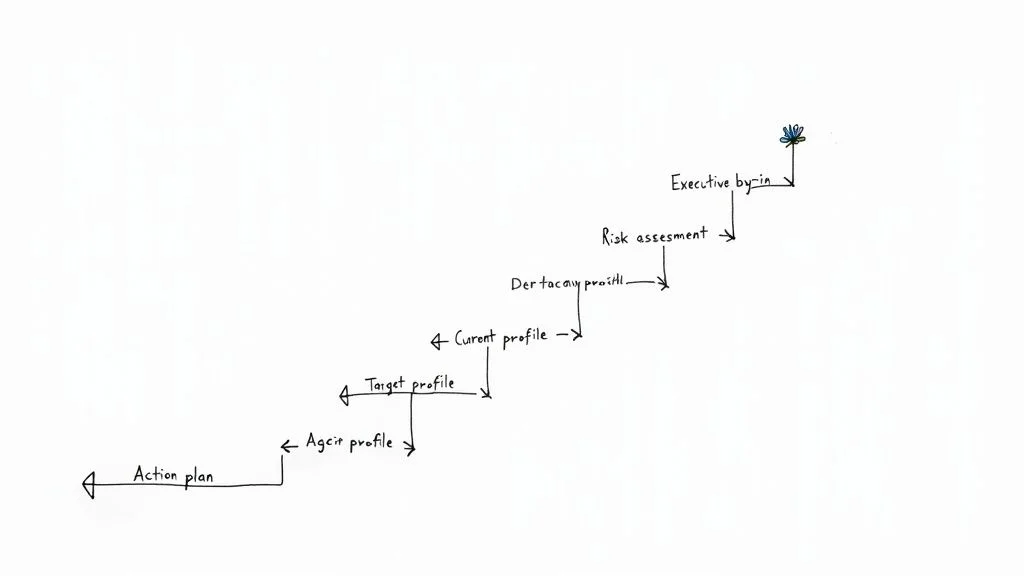
- The Current Profile: This is a technical inventory of your existing security controls. You map these controls against the functions of your framework, such as the NIST Cybersecurity Framework categories. This profile provides an honest answer to the question of where your defenses stand today.
- The Target Profile: This profile serves as your operational goal. It describes the specific security outcomes you need to achieve based on your risk tolerance. By defining these target controls, you establish a clear standard for what "success" looks like for your organization.
Phase 3: Analyze Gaps and Create an Action Plan
With both profiles in hand, you can begin the gap analysis. This involves comparing your current state to your target state to identify exactly where your security measures are failing. These gaps represent the specific weaknesses—such as missing encryption, outdated patching schedules, or weak access controls—that require immediate attention. The gap analysis becomes the master list for your implementation strategy.
Once the gaps are identified, you must create a prioritized action plan. Attempting to fix every vulnerability simultaneously leads to resource exhaustion and configuration errors. Prioritize your tasks based on the level of risk they mitigate. For example, if a critical web application is vulnerable to SQL injection, fixing that vulnerability should take precedence over minor policy updates. This focused approach ensures the fastest possible return on your security investments.
The action plan serves as the transition from planning to execution. It must include specific tasks, assigned owners, clear deadlines, and metrics to track success. This structure mirrors the project management methodologies used in large-scale IT deployments. A realistic plan accounts for both technical requirements and the availability of skilled personnel.
As of 2025, approximately two-thirds of organizations report a moderate-to-critical shortage of cybersecurity skills. This talent gap often hinders the implementation of sophisticated frameworks. According to the global cybersecurity outlook from the World Economic Forum, a framework must guide more than just technology. It must also influence internal policies, employee training, and hiring practices to build a resilient workforce. (Verify current workforce statistics and report dates on the WEF website).
Phase 4: Implement, Monitor, and Improve
The final phase involves executing the action plan and maintaining the new standards. This is a continuous cycle of deploying new technical controls, revising internal policies, and educating the workforce. Effective communication is mandatory during this stage. Cloud security engineers must understand the new deployment standards, and help desk technicians must be trained on updated incident response protocols.
Successful adoption often depends on how the organization handles change. If security measures are too restrictive, employees may find ways to bypass them. For technical strategies on integrating these updates into existing workflows, our guide on change management in IT processes offers detailed methods for managing this transition.
Implementation is not the conclusion of the project. A cybersecurity framework is a living system that requires constant maintenance and oversight. You must monitor control performance, conduct regular audits, and perform new risk assessments as the threat environment changes. This iterative loop—assessing, acting, and improving—shifts your security from a reactive stance to a proactive and resilient capability. This mindset is the foundation of modern DevOps and SecOps methodologies, where security is integrated into every phase of the lifecycle rather than added as an afterthought.
Reflection Prompt: If you were leading the implementation of a new security control, such as multi-factor authentication for all cloud accounts, what specific steps would you take in Phase 4 to ensure successful adoption and continuous improvement?
Your Top Questions About Cybersecurity Frameworks Answered
Even after you understand the fundamentals, practical questions often arise when you apply a cybersecurity framework to a real-world business. These questions help bridge the gap between theoretical knowledge and the daily operations of IT professionals. This section addresses common concerns using the same logic a security architect or senior consultant would apply during a project.
Is a Framework the Same as Compliance?
Frameworks and compliance are distinct concepts, though they often overlap in a security strategy. A framework serves as your internal training plan, while compliance represents the official rulebook for a specific race.
A framework, such as the NIST Cybersecurity Framework, is a set of best practices you choose to adopt. It helps your organization organize its security program and manage risk. It offers a structured way to build a defense. Compliance involves following mandatory rules set by an outside authority. Examples include HIPAA for healthcare data or GDPR for customer privacy. These are legal or contractual obligations. You must follow them to avoid fines or legal action.
A solid framework provides a roadmap to reach your compliance targets. Strategy is driven by the framework, while compliance focuses on meeting tactical demands and providing proof to auditors. Using a framework makes the auditing process more efficient. It organizes your security activities into categories that demonstrate your commitment to data protection. This structured approach helps Governance, Risk, and Compliance (GRC) professionals track progress and identify gaps before an official audit begins.
How Often Should We Review Our Framework?
A cybersecurity framework is not a static document. It is a functional part of your operations that must evolve. Threats change, new technologies like generative AI enter the workplace, and your defenses must keep pace. Static security plans eventually fail because they address old problems rather than current realities.
Conduct a formal review of your framework at least once a year. This annual check ensures your controls still align with your business goals. You should also trigger a review if specific events occur:
- Security Incidents: If you suffer a major breach or a significant near-miss, you must perform a "lessons learned" analysis. Use these findings to update your framework and prevent a recurrence.
- Business Changes: Mergers, acquisitions, or shifts in how you operate require an update. For example, moving your entire server infrastructure to AWS changes your risk profile.
- Product Launches: Releasing a new service that handles sensitive customer data requires a review to ensure your current controls cover the new data flows.
- Emerging Threats: If a new type of malware or a zero-day vulnerability specifically targets your industry or technology stack, you must adjust your framework to counter that threat.
- Regulatory Updates: When governments introduce new privacy laws or security requirements, your framework needs an update to maintain compliance.
Continuous improvement is the goal. Regular updates keep your security posture relevant to the actual risks your company faces today.
Can a Small Business Really Use a Framework?
Small businesses can and should use frameworks. The idea that these systems are only for large corporations is a common misconception. Frameworks like the NIST CSF or the CIS Controls are designed to be scalable. They are effective for a five-person startup or a global corporation.
For a business with a limited budget, a framework is a vital tool. It helps you make decisions based on risk rather than guesswork. Instead of spending money on every new security tool, you can identify your most critical assets—your "crown jewels"—and protect those first.
Frameworks take complex security concepts and make them manageable. They allow small teams to prioritize their time and resources on the actions that provide the most protection. This builds a defense that protects the company's reputation and supports its long-term growth. By following a structured path, a small business can achieve a level of security that rivals much larger organizations.
Ready to master the concepts behind industry-leading certifications like CompTIA Security+, CISSP, or AWS Certified Security - Specialty? MindMesh Academy provides curated study materials and evidence-based learning techniques to help you pass your exams while ensuring you understand how to apply the material in real-world scenarios. Advance your career by visiting CompTIA Security+ Practice Exams to explore our courses and grow your cybersecurity expertise.

Written by
Alvin Varughese
Founder, MindMesh Academy
Alvin Varughese is the founder of MindMesh Academy and an enterprise architecture leader. An electrical engineer by training, he moved from factory automation in South Africa to cloud architecture at GE Appliances and Humana (Fortune 50), and holds 20 professional certifications including AWS Solutions Architect Professional, Azure DevOps Engineer Expert, and Microsoft Agentic AI Business Solutions Architect. He built MindMesh Academy after interviewing too many highly certified candidates who couldn't answer basic questions: the goal is prep that makes you better at the job, not just able to pass the exam.