Types of Contract in Project Management: A Complete Guide
Picking the right contract type isn't just an administrative chore; it's one of the most strategic decisions a project manager or IT professional will make. It fundamentally defines who bears financial risk, how costs are managed, and ultimately, whether a project achieves its desired outcomes. A well-chosen contract aligns the interests of all parties and can be the bedrock of a successful project.
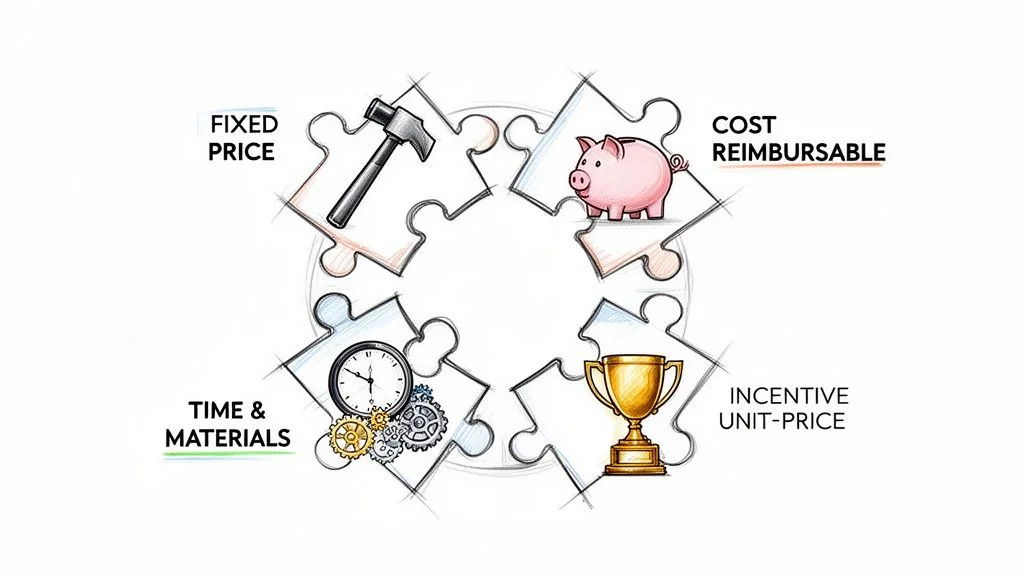
At their core, project management contracts simplify into three main families: Fixed-Price, Cost-Reimbursable, and Time & Materials (T&M). Understanding these distinctions is crucial, not just for practical project execution but also for navigating scenario-based questions in certifications like the PMP (Project Management Professional) exam, AWS Certified Project Manager, or ITIL Foundation.
Why Your Contract Choice Defines Project Success
Consider your project contract as the foundational operating system. It's the central document that brings clients, vendors, and stakeholders into alignment regarding expectations, responsibilities, and financial frameworks. Misaligning the contract type with the project's inherent characteristics is akin to trying to run a complex cloud application on outdated hardware—the system will eventually falter.
This guide provides a practical roadmap for anyone involved in managing projects—from seasoned IT project leads overseeing complex software builds to PMP candidates preparing for their certification exams. We'll move beyond dry definitions to explore how these contract types function in real-world IT scenarios, with a particular focus on risk management.
Here’s a high-level overview:
- Fixed-Price Contracts: Ideal when your project scope is crystal clear and stable, offering maximum cost certainty to the buyer.
- Cost-Reimbursable Contracts: Designed for projects brimming with uncertainty, providing the flexibility needed when the path forward is exploratory or evolving.
- Time & Materials (T&M) Contracts: A balanced hybrid solution, perfect for situations where the workload might fluctuate but specific expertise is required.
A deep understanding of these differences is non-negotiable. Furthermore, applying sound best practices for contract management throughout the project lifecycle is essential for sustained success.
For those studying for certifications, particularly the PMP exam, pay close attention. The exam frequently presents scenario-based questions that test your ability to match project characteristics with the most appropriate contract type. To delve deeper into this and other core topics, our complete PMP study guide offers invaluable insights.
The Three Core Contract Families Explained
Before diving into the specifics of various agreements, it's essential to grasp the three foundational families that encompass nearly all types of contract in project management. These blueprints dictate how risk, cost, and responsibility are distributed between you (the buyer/client) and your chosen vendor (the seller).
At their core, each family addresses a critical question: "Who ultimately bears the financial burden if things deviate from the plan, take longer than expected, or encounter unforeseen challenges?"
Making the correct choice sets the entire financial and operational tone for your project. A mismatch between your project’s unique reality and the contract type can quickly lead to budget overruns, uncontrolled scope creep, and strained relationships. Let's break down these core concepts to empower you to make informed, strategic decisions.

Fixed-Price Contracts: The Foundation Of Certainty
Fixed-Price contracts are precisely what their name implies: a single, agreed-upon price for a well-defined scope of work. This model is the preferred choice when your project requirements are meticulously detailed and stable from the outset.
Example Scenario: Imagine commissioning a standard corporate website or a pre-defined module for an existing enterprise resource planning (ERP) system. You know exactly what features are needed, the design specifications are clear, and the Statement of Work (SOW) is comprehensive. A Fixed-Price contract provides the buyer with absolute cost certainty. You know what you're paying, and that's the final price. The majority of the financial risk is transferred to the seller; they must deliver the promised work for that price, regardless of the actual hours or resources expended.
Key Takeaway for IT Professionals: The success of a Fixed-Price agreement hinges entirely on the clarity and stability of your initial requirements. Ambiguity is your greatest adversary here. Any deviation from the defined scope, no matter how minor, will almost certainly trigger a formal and potentially expensive change order. For instance, adding a new API integration feature to a fixed-price web development project after the contract is signed will necessitate a scope change and renegotiation.
Cost-Reimbursable Contracts: Embracing The Unknown
At the opposite end of the spectrum are Cost-Reimbursable contracts. These are specifically designed for projects where the scope is inherently vague, experimental, or cannot be fully defined upfront. This often includes pioneering Research & Development (R&D) initiatives, complex cloud architecture migrations with evolving requirements, or agile software development where product features emerge iteratively.
In this model, the buyer agrees to cover all of the seller's legitimate project costs—such as labor, materials, and overhead—and then adds a pre-negotiated fee on top, which constitutes the seller's profit. This structure completely flips the risk profile: the buyer assumes nearly all cost fluctuations and potential overruns. The significant trade-off is unparalleled flexibility to pivot, innovate, and adapt as the project unfolds. If your team is developing a groundbreaking AI application for data analytics or exploring a novel blockchain solution, attempting to define a fixed price would be pure speculation, making Cost-Reimbursable the logical choice.
Time And Materials Contracts: The Hybrid Solution
Time and Materials (T&M) contracts represent a practical middle ground, combining elements from both Fixed-Price and Cost-Reimbursable models. Under a T&M agreement, the buyer pays a pre-negotiated rate for labor (e.g., an hourly or daily rate for a specialized developer or cybersecurity expert) and also reimburses the seller for the direct cost of materials or necessary expenses.
This approach is highly effective for scenarios such as staff augmentation (bringing in a temporary AWS Solutions Architect), engaging specialized consultants for a specific IT audit, or any project where the total effort is initially unknown but the required skills are clear. T&M offers more flexibility than a rigid Fixed-Price agreement but provides more cost control than an open-ended Cost-Reimbursable one. Many T&M contracts incorporate a "not-to-exceed" (NTE) clause, which places a hard cap on the total budget, providing the buyer with crucial cost predictability.
It's also beneficial to consider how different contract types in public procurement are structured, as these often provide robust frameworks for managing a diverse array of project agreements, including those within the IT sector.
High-Level Comparison of Project Management Contract Types
To help consolidate these concepts, here’s a quick-reference table summarizing the core differences between the three main contract families, particularly relevant for IT project managers:
| Contract Family | Primary Use Case | Primary Risk On | Payment Structure |
|---|---|---|---|
| Fixed-Price | Well-defined scope (e.g., standard software module, website build) | Seller | One lump sum or milestone-based payments |
| Cost-Reimbursable | Evolving or unknown scope (e.g., R&D, new AI algorithm dev) | Buyer | Actual costs plus a fee (fixed or percentage) |
| Time & Materials | Staff augmentation, variable workload (e.g., IT consulting) | Shared / Buyer | Fixed unit labor rates plus material costs |
This table provides a solid starting point for determining which contract family best aligns with the level of certainty—or uncertainty—inherent in your IT project.
Mastering Fixed-Price Contracts for Predictable Outcomes
When you possess an exact understanding of your project requirements and deadlines, a Fixed-Price contract becomes an invaluable tool. It’s the optimal agreement when your project's scope is meticulously documented, "locked down," and unlikely to deviate. The most significant benefit for the buyer here is clear and compelling: unwavering cost certainty.
Example Scenario: Consider a project to develop a specific API integration for an existing system. The API endpoints, data structures, security protocols, and performance requirements are all clearly defined. A Fixed-Price contract will establish the total cost for this entire development effort. This effectively transfers financial risks—such as unforeseen technical complexities or underestimations of development hours—directly onto the development agency.
It's important to acknowledge that this risk transfer typically comes at a cost. A knowledgeable seller will factor this inherent risk into their proposal, often including a buffer for potential unknowns. Industry data supports this: while fixed-price IT projects can reduce cost overruns by an average of 15% compared to more flexible contract types, their initial bids may be approximately 10% higher. Nevertheless, the model proves effective, with one report indicating that 62% of organizations employing fixed-price contracts for software projects successfully meet their budget targets. Further insights can be found by reviewing general project management contract findings.
This dynamic highlights the core trade-off of fixed-price agreements. The buyer gains peace of mind through a predictable budget, while the seller must meticulously account for every conceivable contingency. This framework thrives only when both parties share an unambiguous, crystal-clear alignment on all requirements from day one.
Exploring Variations of Fixed-Price Contracts
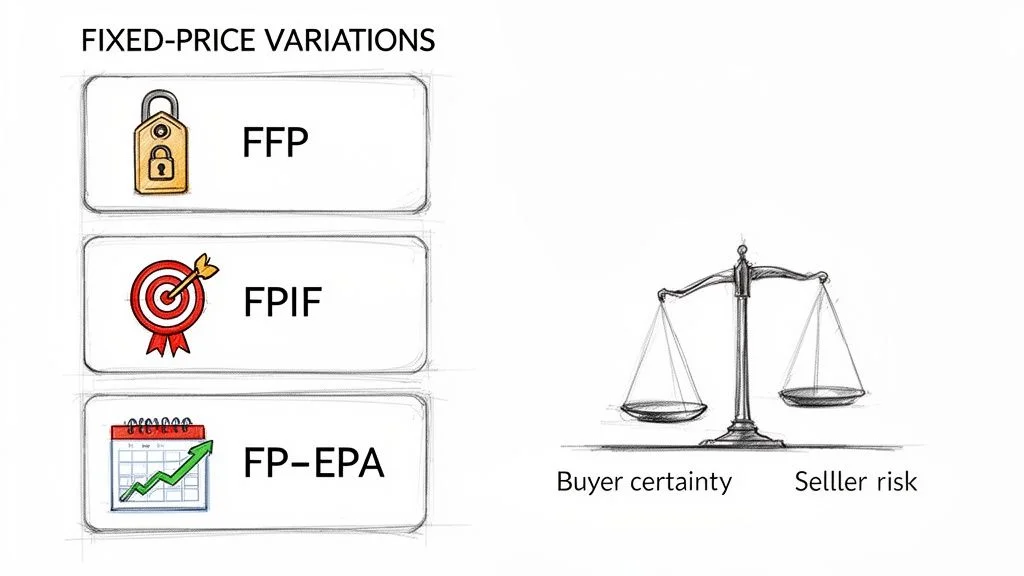
Fixed-Price isn't a singular, inflexible solution. The model boasts several variations, each designed to address specific scenarios, from incentivizing superior performance to mitigating long-term economic shifts. Familiarity with these variations is crucial for selecting the most appropriate tool for your IT project.
The three primary types you'll encounter are:
- Firm Fixed Price (FFP): The most common and rigid form, where the price remains constant.
- Fixed Price Incentive Fee (FPIF): A hybrid that encourages exceptional performance through bonuses.
- Fixed Price with Economic Price Adjustment (FP-EPA): A specialized contract for multi-year engagements, designed to protect against factors like inflation.
Let's explore how each of these variations operates in a real-world context.
Firm Fixed Price (FFP): The Gold Standard of Certainty
The Firm Fixed Price (FFP) contract is the most straightforward of all types of contract in project management. The price agreed upon is the exact price paid, unless a formal change to the scope is executed. The seller is solely responsible for delivering the work for that precise amount. It’s clean, simple, and virtually eliminates financial surprises for the buyer.
You'd opt for an FFP contract when your Statement of Work (SOW) for an IT project is as solid as concrete. It’s like procuring a standard server rack with specific components—you know the exact final cost before the purchase order is issued.
PMP Exam Tip: For the PMP exam, a crucial point to remember is that FFP contracts place the maximum risk on the seller. You will encounter scenario questions designed to test your ability to associate a well-defined project scope with an FFP agreement and understand the resulting risk allocation.
Fixed Price Incentive Fee (FPIF): Sharing the Success
But what if you desire the budget security of a fixed price alongside a mechanism to motivate your vendor to exceed expectations? This is where the Fixed Price Incentive Fee (FPIF) contract comes in. This structure maintains the core elements of an FFP but adds a bonus for achieving or surpassing specific performance targets.
These targets, explicitly defined in the contract, might be tied to cost savings, an accelerated project schedule, or superior technical results. For instance, a cloud migration contract could include a $20,000 bonus if the team completes the transition a month ahead of schedule with zero critical downtime. This incentivizes the seller to innovate and work efficiently, fostering a win-win situation. The buyer achieves a better, faster outcome, and the seller earns additional profit.
Fixed Price with Economic Price Adjustment (FP-EPA): Future-Proofing Long-Term Projects
Now, envision signing a five-year contract for comprehensive managed IT services. A standard FFP contract would represent a substantial gamble for the service provider. Over such an extended period, factors like inflation could significantly increase their labor costs or the price of hardware components, potentially eroding their profit margins entirely.
This is precisely the problem the Fixed Price with Economic Price Adjustment (FP-EPA) contract addresses. It establishes a baseline fixed price but includes a clause that permits predefined adjustments based on external economic shifts. These adjustments are typically linked to a reliable, impartial metric, such as the Consumer Price Index (CPI) or specific industry-standard labor cost indices. This mechanism safeguards the seller from long-term market volatility while providing the buyer with a predictable, foundational cost. It's an essential tool for ensuring long-running IT projects remain fair and financially sustainable for all parties involved.
Embracing Flexibility with Cost-Reimbursable Contracts
Sometimes, you know the ultimate goal, but the exact path to achieve it remains unclear. This is where Cost-Reimbursable contracts truly excel. They are built for environments of high uncertainty, making them the preferred choice for projects where the scope is fluid, exploratory, or guaranteed to evolve significantly.
Consider pioneering R&D efforts in quantum computing, developing a brand-new AI algorithm for predictive analytics, or managing an agile software project where the final feature set emerges through iterative sprints and user feedback. In such situations, attempting to establish a fixed price is largely speculative. Instead, this contract type allows work to commence with a fundamental understanding: the buyer will cover the seller's legitimate project costs, with an additional fee for their profit.
The fundamental trade-off here is a complete reversal from the fixed-price model. All financial risk shifts from the seller squarely onto the buyer's shoulders. While this grants the project team unparalleled flexibility to pivot and innovate, it also places a significant administrative burden on the buyer's project manager, who must meticulously track every single expense to prevent the budget from spiraling out of control.
The Straightforward Approach: Cost Plus Fixed Fee (CPFF)
The most basic variant within this family is the Cost Plus Fixed Fee (CPFF) contract. Its structure is quite simple: the seller is reimbursed for all allowable project costs, and in addition, they receive a predetermined, flat fee representing their profit.
This fixed fee is negotiated upfront and remains constant, irrespective of how high the final project costs may escalate. For example, a company might engage a cybersecurity firm to investigate a complex data breach. The agreement could stipulate covering all expert hours, forensic tools, and technology costs, plus a fixed fee of $50,000 for the firm's services.
From the seller's perspective, the primary advantage is that their profit is guaranteed once the work is completed. The inherent drawback, however, is the lack of direct financial incentive for them to operate with maximum efficiency or to actively contain costs. Whether the project costs $500,000 or $1,000,000, their fixed fee does not change. This necessitates a vigilant project manager on the buyer's side, meticulously monitoring progress and expenditures.
Sharing the Wins with Cost Plus Incentive Fee (CPIF)
To address the motivational shortcomings of CPFF, we introduce the Cost Plus Incentive Fee (CPIF) model, which incorporates a performance-based incentive. This structure is one of the more dynamic types of contract in project management, as it actively encourages both the buyer and seller to work collaboratively towards shared objectives. The seller's costs are still fully covered, but their final profit is directly linked to achieving specific, predefined targets.
These targets are clearly articulated in the contract and typically revolve around cost efficiency, schedule adherence, or superior technical performance. A common setup includes a target cost, a target fee, and a sharing ratio for any cost savings or overruns.
Real-World IT Example: Let's say you're building a new cloud-native platform (e.g., on AWS or Azure) with a target cost of $2 million and a target fee of $200,000. The contract includes an 80/20 sharing ratio (80% buyer, 20% seller). If the vendor successfully completes the project for $1.8 million—resulting in a $200,000 savings—they receive their costs reimbursed, their target fee, plus an additional $40,000 (20% of the savings) as a bonus. This structure creates a powerful win-win, incentivizing efficiency and effective cost management.
Rewarding Great Work with Cost Plus Award Fee (CPAF)
The Cost Plus Award Fee (CPAF) contract takes a more subjective approach to motivation. It still covers all of the seller's allowable costs, but the fee component is bifurcated. There's a relatively small, fixed base fee, and then a significantly larger "award" pool that the seller can earn based on the buyer's evaluation of their performance.
This evaluation typically occurs at key milestones and is based on criteria that may not always be quantifiable with hard numbers, such as:
- The quality of technical innovation or architectural design
- Effectiveness of team communication and collaboration (e.g., during complex system integrations)
- Proactive problem-solving and adaptability to unforeseen IT challenges
- Overall satisfaction of project stakeholders with the process and outcomes
The decision to grant the award fee rests entirely with the buyer, often determined by a formal review board. This contract type is ideally suited for long-term strategic IT partnerships, highly complex R&D projects, or situations where subjective quality, collaboration, and innovation are as critical as meeting numerical targets.
For anyone studying for the PMP exam, a key insight is to identify scenarios characterized by high uncertainty or a strong need for adaptability. If the project requires ample room to breathe and evolve, a cost-reimbursable contract is almost invariably the correct answer.
The Flexible Middle Ground: Time & Materials Contracts
Sometimes, a project's scope is too ambiguous for a fixed-price agreement, yet you're not prepared to issue a blank check with a purely cost-reimbursable contract. This is precisely where the Time and Materials (T&M) contract finds its purpose. It's a pragmatic hybrid model, perfectly suited for the nuanced "gray areas" of project management, especially prevalent in the IT sector.
Think of T&M as a practical synthesis of both worlds. You benefit from pre-established labor rates, similar to a cost-plus model, but simultaneously gain a degree of cost control that feels more akin to a fixed-price agreement. This synergistic combination makes T&M one of the most versatile types of contract in project management, particularly vital for today's dynamic and fast-moving IT projects.
Example Scenario: Imagine your organization is facing a severe, unpredictable cybersecurity breach. You urgently require a highly specialized incident response team, and the full extent of the compromise is unknown. You cannot possibly define the entire scope upfront. A T&M contract is your ideal solution. You agree on a fixed hourly rate for the cybersecurity consultants' time and cover the cost of any specialized tools or software licenses they require. This enables you to scale their efforts up or down as the situation evolves, without being constrained by a speculative initial scope.
It is this inherent adaptability that establishes T&M as a go-to for the tech world, whether you are engaging specialized contractors, augmenting your internal development team, or embarking on a project where the workload is inherently prone to fluctuation.
How T&M Spreads the Risk Around
In a pure cost-reimbursable contract, the buyer shoulders almost all the financial risk. T&M fundamentally alters this dynamic by distributing the load. By establishing fixed hourly or daily rates for services, the buyer is protected from sudden, unforeseen spikes in labor costs. The seller, conversely, is protected from extensive scope creep, as they are compensated for every hour they genuinely expend.
This collaborative setup naturally fosters a more cooperative partnership. However, it also places a significant spotlight on the project manager. Your role becomes critical in actively overseeing progress and meticulously verifying every hour logged and material expense. Without diligent oversight, costs can still escalate if the work drags on or is not executed efficiently.
Fortunately, most T&M contracts incorporate a crucial safety mechanism.
Key Takeaway for IT Project Managers: The most potent risk-control feature within a T&M contract is the Not-to-Exceed (NTE) clause. This simple yet powerful addition establishes a firm ceiling on the total project cost, providing the buyer with ultimate budget protection, even with a flexible scope.
Understanding the Not-to-Exceed Clause
The NTE clause is truly a game-changer. It transforms a potentially open-ended agreement into one with a definitive budget cap. Once the combined costs of labor and materials reach that specified limit, the seller cannot bill for any further work without a formal, approved change to the contract. This imperative fosters constant, open communication between all parties regarding budget utilization.
Example Scenario: Consider a custom software development project operating under a T&M contract with an NTE of $150,000. The development team retains the flexibility to address emergent requirements as they arise, but the client can rest assured that their total investment will never exceed that pre-defined amount. The NTE effectively grants the best of both worlds: the operational flexibility of T&M combined with the budget certainty typically associated with a fixed-price contract.
And this isn't merely theoretical; empirical data corroborates its effectiveness. T&M contracts are now utilized in approximately 40% of agile projects globally, and these projects demonstrate a 28% higher success rate compared to similar endeavors managed with fixed-price agreements. In U.S. government projects, employing T&M for cloud migrations has led to an average of 18% cost savings relative to pure time-based billing. You can explore these trends further by reviewing published studies on contract success rates in project management.
How to Choose the Right Contract for Your Project
This is where the theoretical understanding translates into practical application. Grasping the what and why of different contract types is foundational, but the ability to select the optimal one for your specific project is where a skilled project manager truly shines. This isn't a mere checkbox exercise; it's a strategic decision that dictates risk allocation, establishes financial boundaries, and shapes the entire working relationship with your vendor.
Your decision hinges primarily on four key factors: the clarity of your project scope, your organization's willingness to accept risk, the degree of flexibility required, and the project's overall complexity. These are not isolated variables but rather interconnected elements that mutually influence one another. Making the right choice upfront can prevent a multitude of headaches and costly rework later in the project lifecycle.
Analyzing Your Project's DNA
Before even considering a contract template, you must engage in a candid assessment of your project's inherent nature. What are its fundamental characteristics? The most effective way to do this is by posing direct, incisive questions.
Reflection Prompt: Consider your most recent IT project. Was the scope completely "buttoned up" with a detailed Statement of Work (SOW) that left no room for interpretation? Or was it more of an evolving concept, continually shaped and refined as you progressed?
Think about it in these terms: if you're building a standard, well-documented cloud infrastructure (e.g., provisioning specific EC2 instances, S3 buckets, and VPCs according to a strict design), a Fixed-Price contract is often the logical choice. The scope is clear, the outcome is predictable, and everyone benefits from budget certainty.
However, what if you're developing a novel mobile application using an Agile framework, constantly integrating user feedback into new sprints? The feature backlog is inherently dynamic. Attempting to force such a project into a rigid Fixed-Price model would likely lead to constant change orders and significant frustration. This type of work demands the adaptability offered by a T&M or Cost-Reimbursable agreement.
This simple flowchart offers a valuable visual aid for the decision-making process, especially when you're deliberating between a T&M contract and a Fixed-Price one for an IT project.
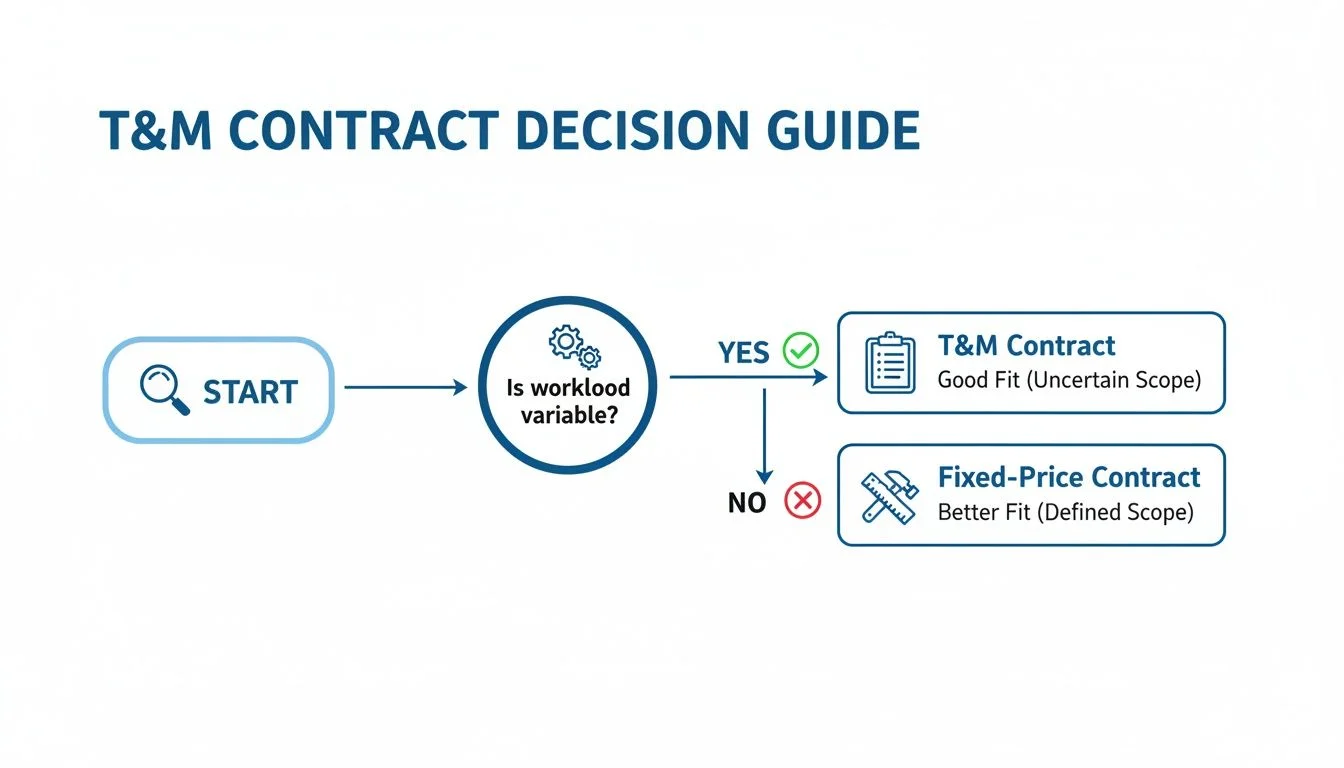
As illustrated, when the workload is highly variable and challenging to quantify precisely, a T&M contract generally proves to be the more sensible choice.
A Practical Decision-Making Checklist for IT Projects
To introduce more structure to your thought process, run through this quick checklist. It ensures you've considered all critical angles before committing to a contract that will define your project's entire lifecycle.
- Scope Clarity: On a scale of 1-10, how well-defined is your IT project's scope? A 1 implies pure exploratory research (e.g., investigating feasibility of a new blockchain technology), while a 10 represents a detailed blueprint (e.g., upgrading a specific software version). Higher scores strongly favor Fixed-Price.
- Risk Tolerance: How much financial risk can your organization (the buyer) realistically absorb for this IT initiative? If the answer is "very little," you'll gravitate towards the predictability of a Fixed-Price deal. If you can manage some uncertainty, Cost-Reimbursable becomes a viable option.
- Need for Flexibility: How likely is the IT project's scope or technical approach to change once work is underway? If changes are almost guaranteed (e.g., in an iterative DevOps project), you require a flexible structure like T&M or Cost-Reimbursable.
- Administrative Overhead: Do you have the internal resources (people, tools, processes) to meticulously track and verify every vendor hour, expense, and deliverable? If not, the significant administrative burden of a Cost-Reimbursable contract might be too challenging to manage effectively.
PMP Exam Insight: Be prepared for scenario-based questions that rigorously test this exact logic. The exam typically won't ask for a direct definition; instead, it will describe a project situation and expect you to select the best-fit contract type. If you encounter keywords like "exploratory," "innovative," "research," or "prototype development" in an IT context, your mind should immediately consider Cost-Reimbursable contracts.
Choosing the correct contract is a cornerstone of effective project procurement management, a discipline focused on ensuring you secure precisely the value you're investing in for your IT initiatives.
Contract Selection Guide for Common IT Project Scenarios
To help connect these concepts to the real world of IT, here’s a table that maps common project types to the most suitable contracts. Consider it a quick-reference guide to validate your decisions against established industry norms.
| Project Scenario | Recommended Contract Type | Rationale |
|---|---|---|
| Standard Website/Application Module Build | Firm Fixed Price (FFP) | The scope, features, and technical specifications are well-defined. Client prioritizes knowing the final cost upfront. |
| Agile Software Development | Time & Materials (T&M) with NTE | Workload is unpredictable, and requirements evolve iteratively. A budget cap (NTE) protects the buyer from runaway costs. |
| Groundbreaking AI/ML R&D Initiative | Cost Plus Incentive Fee (CPIF) | Final outcome is highly uncertain. An incentive fee motivates the vendor to control costs and deliver innovative results. |
| Hiring a Specialist Cloud Architect | Time & Materials (T&M) | Paying for an expert's time and effort over a variable period for specific tasks (e.g., AWS migration planning). |
| Long-term Managed IT Services Agreement | Fixed Price with Economic Price Adjustment (FP-EPA) | For multi-year services, this protects both sides from major economic shifts like inflation in labor or hardware costs. |
By skillfully pairing the appropriate contract to your IT project's unique characteristics, you are not merely managing risk—you are proactively establishing the conditions for a successful partnership and a predictable outcome.
Your Project Contract Questions Answered
Even with a solid grasp of the main contract families, specific questions invariably arise. Let's address some of the most common queries I hear from IT project managers to clarify any lingering confusion.
What Is the Difference Between a Contract and an Agreement?
In casual conversation, "agreement" and "contract" are often used interchangeably. However, in the realm of project management and legal frameworks, they possess distinct meanings.
An agreement is simply a mutual understanding or arrangement. It can be entirely informal, such as agreeing with a team member on a task division. A contract, conversely, is a specific type of agreement that is legally binding and enforceable in a court of law. It typically involves an offer, acceptance, consideration (something of value exchanged), and the intention to create legal relations.
Here’s a practical distinction for IT professionals: telling a vendor you'll consider their proposal is an agreement. Signing a detailed Statement of Work (SOW) that meticulously outlines every deliverable, deadline, intellectual property rights, and payment schedule for a software development project is a contract. For project managers, this is not just semantics—that formal contract is essential for protecting the interests of all involved parties.
Which Contract Type Is Best for Agile Projects?
This is a frequently asked and critical question. Attempting to force an agile IT project—which thrives on adaptability and iterative development—into a strict Firm Fixed Price (FFP) contract is usually a recipe for conflict and dissatisfaction. Agile methodologies are built to embrace change, whereas FFP contracts are designed to resist it.
So, what alternatives are a better fit? Several options align more effectively with agile principles:
- Time & Materials (T&M) with a Not-to-Exceed (NTE) Clause: This is arguably the most popular and practical choice for agile IT projects. It provides the development team with the flexibility to adjust and refine the scope from sprint to sprint, while the NTE clause imposes a hard ceiling on the budget, thereby protecting the buyer from uncontrolled cost escalation.
- Cost-Reimbursable Contracts (especially CPIF): When tackling truly innovative or highly experimental IT initiatives where the ultimate scope is genuinely unknown (e.g., developing a novel AI component), this model is ideal. It allows work to commence without a fully defined endpoint, and a Cost Plus Incentive Fee (CPIF) further encourages the vendor to operate efficiently and achieve performance targets.
The overarching goal is to select a contract structure that fosters and accommodates change, rather than one that penalizes it.
Can You Change a Contract Type Mid-Project?
Technically, yes, but it is an exceptionally rare, complex, and generally inadvisable undertaking. Fundamentally altering the entire foundation of a deal—for instance, switching from a Fixed-Price model to a T&M agreement—is arduous. You are effectively voiding the original contract and initiating negotiations from scratch, often incurring additional legal fees, consuming valuable project time, and introducing significant new risks.
In the context of IT projects, it is almost always more efficient and less risky to utilize the contract’s built-in change control process to manage scope adjustments or significant shifts in project direction. If the project's trajectory has veered so dramatically that the original contract terms are no longer viable or sensible, the cleaner and more legally sound approach is typically to formally close out the current contract and then draft a completely new one for the subsequent phase of work.
What Is a Statement of Work (SOW)?
The Statement of Work (SOW) is the critical centerpiece of your procurement package in project management. It is a detailed, narrative document that precisely describes the products, services, or results the vendor is required to deliver. Essentially, it serves as the definitive rulebook for the scope of work.
Think of the SOW as the architectural blueprint for the contract itself in an IT project. A vague, ambiguous, or poorly written SOW is a leading cause of project disputes, cost overruns, and scope creep within the technology sector. Meticulously crafting and refining this document is a substantial and indispensable part of the overall project risk management process.
Ready to master essential project management concepts and ace your certification exam, whether it's PMP, AWS, Azure, or ITIL? MindMesh Academy offers expert-led courses and evidence-based study tools designed to help IT professionals like you succeed. Explore our comprehensive prep materials and accelerate your career today at PMP Practice Exams.

Written by
Alvin Varughese
Founder, MindMesh Academy
Alvin Varughese is the founder of MindMesh Academy and an enterprise architecture leader. An electrical engineer by training, he moved from factory automation in South Africa to cloud architecture at GE Appliances and Humana (Fortune 50), and holds 20 professional certifications including AWS Solutions Architect Professional, Azure DevOps Engineer Expert, and Microsoft Agentic AI Business Solutions Architect. He built MindMesh Academy after interviewing too many highly certified candidates who couldn't answer basic questions: the goal is prep that makes you better at the job, not just able to pass the exam.