Effective Management of Project Procurement Strategies
Many people view procurement as a back-office function limited to placing orders. In project management, however, it entails much more.
Project Procurement Management defines the complete process of acquiring goods, services, or specific results from entities outside the core project team. It functions as a framework to manage external vendors effectively. This approach ensures you receive necessary items on schedule and within budget while maintaining quality standards. Effective coordination prevents external issues from stalling your progress or draining resources during the project lifecycle.
What Is Project Procurement Management Really About?
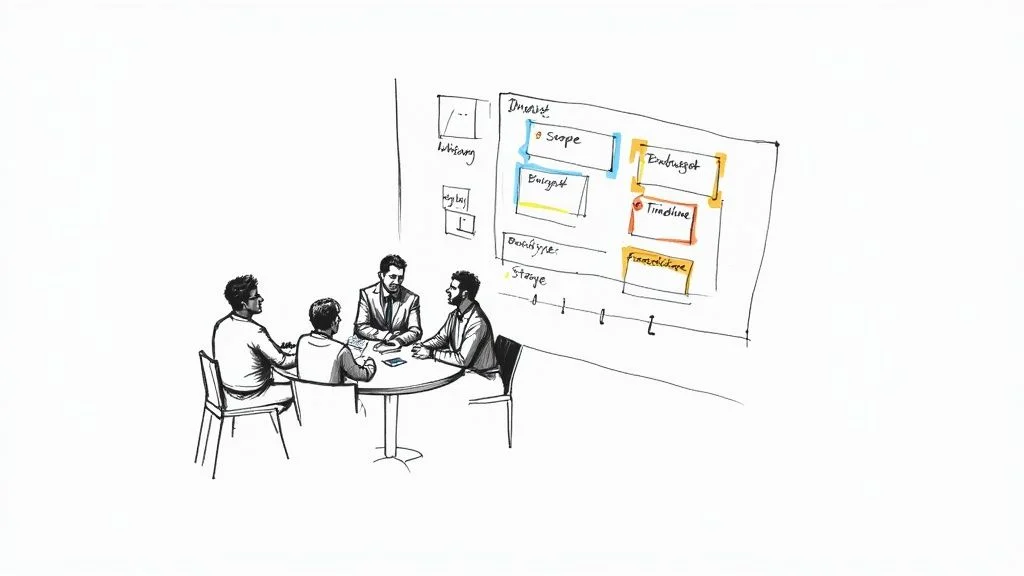
Project procurement involves securing the external resources necessary to execute a project's specific goals. While many equate it with simple buying, it encompasses a full lifecycle: identifying needs, sourcing vendors, negotiating legal agreements, and supervising those external partners until the work is finished.
Directing a feature film provides a clear comparison. A director cannot handle every technical task alone. Success depends on recruiting a skilled cinematographer, a capable special effects crew, and a composer who can write a score that fits the tone of the movie. The quality of the final film relies on acquiring this specialized talent at a price that fits the production budget.
The Director's Playbook
In this context, project procurement management serves as a strategic manual. Effective managers do not hire the first available contractor who applies for a job. Instead, they follow a specific process to ensure both value and performance.
- Identify the need: Determine which specialized tasks require outside help rather than using existing internal staff.
- Define requirements: Create a detailed brief for each role. This document must list specific skills, technical standards, and the exact results expected from the vendor.
- Select vendors: This stage involves talent scouting. Managers review proposals and check references to ensure the contractor can deliver on their promises.
- Negotiate contracts: Finalize a binding agreement that covers work scope, specific deadlines, payment schedules, and intellectual property ownership.
- Manage the relationship: Oversee the contractor’s work throughout the project. Ensure they remain in sync with the internal team and resolve conflicts or performance issues as they arise.
A project manager acts much like that film director. Selecting the right partners and managing their specific contributions keeps the project on schedule and within its financial limits.
Effective procurement management acts as the structural support for project success. It controls spending, reduces legal risks, and maintains the quality of deliverables from start to finish.
It’s Not Just Purchasing
People often confuse procurement with purchasing, but they are distinct functions. Purchasing is a narrow, transactional task. It involves the mechanical act of placing an order and paying the resulting invoice.
Procurement management is the strategic framework surrounding that transaction. Buying a camera is a purchase. Ensuring you have a high-end camera with specific lenses, operated by a professional under a contract that protects the project, is procurement.
Candidates preparing for the PMP exam must understand this distinction. A PMP study guide provides the context needed to see how these knowledge areas interact. Maintaining this high-level oversight prevents projects from failing due to scope creep, budget gaps, or poor performance from outside vendors.
The Three Phases of a Successful Procurement Strategy
Effective project procurement results from following a structured lifecycle. This process consists of three distinct phases that guide a project from initial concept to final delivery. Consider the process similar to building a custom house. You first collaborate with an architect to create the blueprints. Next, you select the right builders and oversee the actual construction. Finally, you inspect the finished work to ensure everything meets the original specifications.
This logical sequence—Plan, Conduct, and Control—establishes a framework for the management of project procurement. It ensures that every choice is intentional and that no critical steps are skipped. Once you understand this progression, you can manage vendor interactions and complex acquisitions with confidence. This structure prevents the confusion that often occurs when organizations attempt to hire outside help without a clear internal roadmap.
Phase 1: Plan Procurement Management
This is the blueprinting stage of the process. Before you contact a single vendor, you must complete the necessary preparation. Many projects fail because this stage was rushed. When planning is ignored, it often leads to scope creep, exhausted budgets, and a total mismatch between what the project needs and what the vendor delivers. Solid planning serves as the base for every action that follows.
The primary objective here is to answer three questions: What do we need, why are we seeking an external provider, and how will we acquire the goods or services? This phase involves several specific activities:
- Make-or-Buy Analysis: This is the first major decision point for any project manager. You must determine if your team has the internal skills, time, and resources to build a component or deliver a service in-house. If you choose to make, you keep total control but use up internal capacity. If you choose to buy, you may save time or access specialized skills, but you must manage an external entity and the associated risks.
- Defining Requirements: If you decide to purchase, you must create a clear Statement of Work (SOW). This document serves as the heart of the procurement. It describes the work to be done, the specific deliverables expected, and the quality standards the vendor must meet. Clear language prevents disputes later in the project. You must also define the criteria you will use to select the winner, such as technical ability or past performance.
- Identifying Potential Sellers: You must research the market to find vendors capable of delivering the requested items. This goes beyond a surface-level search. It involves vetting the reputations of various firms, checking their track record on similar projects, and creating a short list of qualified sellers who are financially stable and technically competent.
The infographic below shows how these early steps flow together.
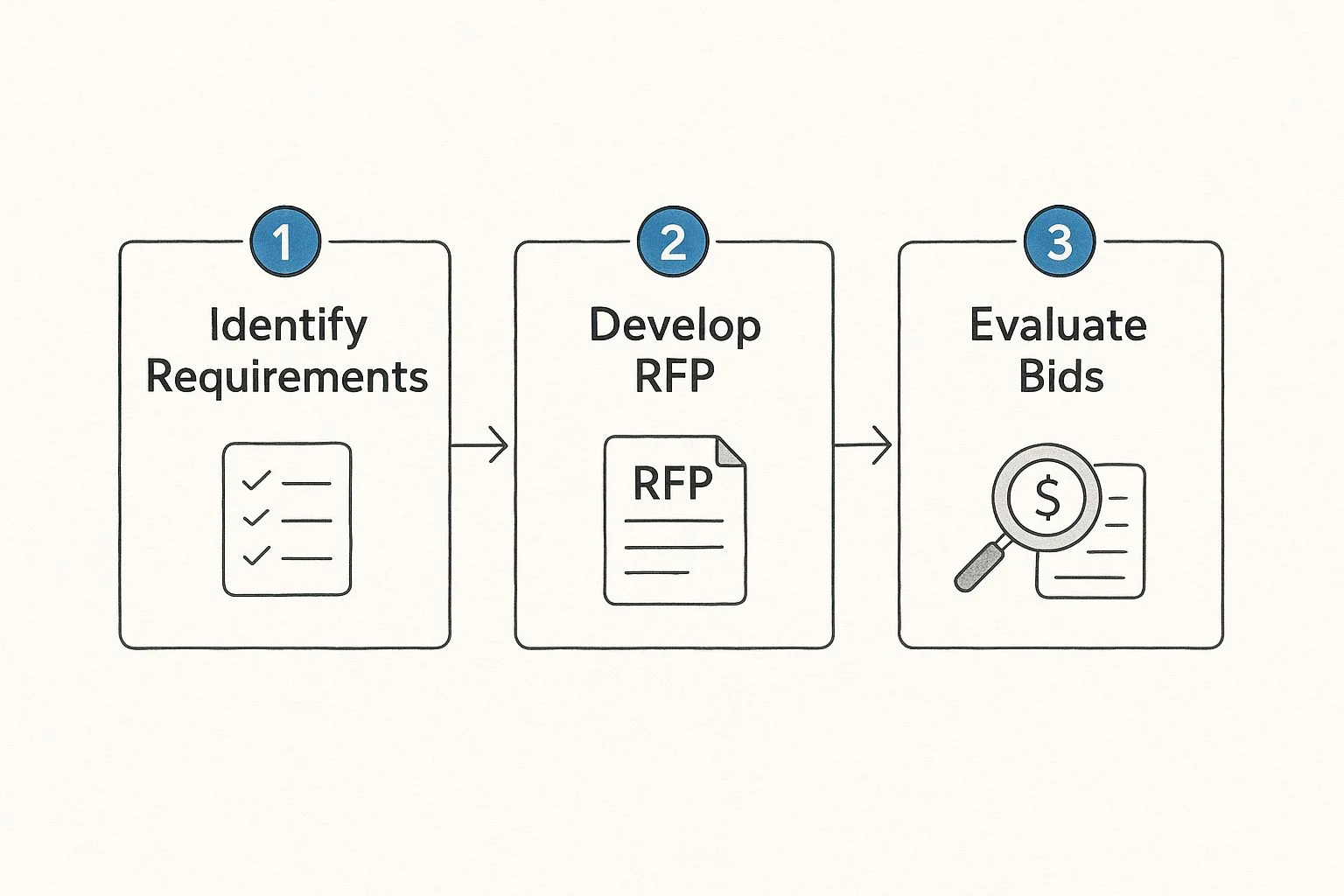
As the graphic indicates, determining your requirements is the essential first step. That clarity allows your team to create a strong Request for Proposal (RFP), which allows you to evaluate bids fairly and accurately.
Phase 2: Conduct Procurements
With a strong plan ready, you move to the execution phase. This is where you engage with potential vendors, answer their questions, review their formal proposals, and select the right partner. This phase requires active communication and firm negotiation skills. The goal is to create a transparent environment where every potential vendor has the information required to submit a high-quality bid.
This stage is not just about finding the lowest price. Instead, the focus is on selecting the seller who provides the best overall value. This requires a balance of cost, quality, risk management, and the vendor's specific capabilities.
Here are the specific steps taken during this phase:
- Soliciting Proposals: You send your official documents, such as a Request for Proposal (RFP) or a Request for Quote (RFQ), to the vendors on your short list. An RFP is typically used for complex services where the "how" is just as important as the price, while an RFQ is used for standardized products.
- Holding Bidder Conferences: These meetings ensure fairness. You host a session where all potential sellers can ask questions about the SOW at the same time. This ensures every bidder receives the same information and works from the same set of assumptions, which reduces the risk of protests or bias claims later.
- Evaluating Proposals: Using the objective criteria developed during the planning phase, your team scores each proposal. This systematic approach keeps the selection process objective. You might weight certain factors, like technical expertise, more heavily than price to ensure the project goals are met.
- Negotiating and Awarding the Contract: After choosing a preferred vendor, you negotiate the final terms. This includes the final price, the delivery schedule, and specific legal clauses. Once both parties reach an agreement, the contract is signed, and the work is officially awarded to the seller.
Many of these activities use specific tools and documents. To understand these better, look at the project manager's toolkit of key models, methods, and artifacts, which covers the tools used across all project management work.
Phase 3: Control Procurements
The work does not end when the contract is signed. Signing is simply the start of a relationship that requires active management. This phase focuses on monitoring vendor performance to ensure you receive exactly what you are paying for. It is often the most demanding part of the management of project procurement because it requires constant oversight.
During this phase, you manage the vendor relationship, track progress against the contract, handle payments, and resolve issues before they can damage the project timeline.
Key activities include:
- Contract Administration: This involves making sure both your team and the vendor follow the terms of the signed agreement. It includes reviewing legal obligations, processing invoices promptly, and ensuring that any required insurance or bonds remain valid throughout the life of the project.
- Performance Monitoring: You must verify that the vendor is meeting deadlines and maintaining quality. This is done through regular status reports, site inspections, and formal performance reviews. If a vendor falls behind, you must address the variance quickly to bring the work back on track.
- Change Management: Project needs often shift. When the scope changes, it must be handled through a formal process. Any adjustments to the vendor's work must be documented, approved by the correct stakeholders, and officially added to the contract to avoid legal or financial confusion.
- Closeout: Once the vendor completes the work and you formally accept the deliverables, the contract is closed. This involves making final payments, releasing any retainage, and documenting lessons learned. An audit of the procurement process helps you identify ways to improve vendor management on future projects.
To help tie all this together, the summary below outlines the three phases.
Core Project Procurement Phases at a Glance
| Procurement Phase | Key Activities | Primary Outputs |
|---|---|---|
| Plan Procurements | Make-or-buy analysis: deciding to outsource or build. Defining requirements: creating the SOW. Identifying sellers: finding qualified firms. | Procurement Management Plan, Statement of Work (SOW), Bid Documents. |
| Conduct Procurements | Soliciting proposals: sending RFPs/RFQs. Bidder conferences: answering questions. Evaluating bids: scoring sellers. Awarding: signing the contract. | Selected Sellers, Signed Agreements/Contracts. |
| Control Procurements | Administering contracts: ensuring compliance. Monitoring performance: tracking KPIs. Managing changes: handling scope shifts. Closing out: final payments. | Work Performance Information, Change Requests, Closed Procurements. |
The flow from planning and documentation to selection and active management clarifies how each phase builds on the last. This creates a defensible and logical process for acquiring the resources your project needs to succeed.
Choosing the Right Procurement Tools and Techniques
Translating a high-level strategy into actual results requires a specific set of tools. In procurement, these tools act as the mechanism for turning plans into physical assets or services. Without a structured approach, you are essentially guessing with the project budget. Making the right calls here will directly influence your project's financial health, schedule, and overall risk profile.
These methods go beyond academic theory. They provide practical frameworks for making choices that are objective, defensible, and focused on value. Gaining proficiency with these techniques prevents your team from simply purchasing items. Instead, you begin acquiring assets and services that align with your specific project objectives. If you use the right wrenches for a complex engine, the job gets done correctly; if you use the wrong ones, you risk stripping the bolts and stalling the entire project.
Make-or-Buy Analysis: The First Critical Decision
Before you start looking for a vendor, you must answer a more fundamental question: should we even be buying this at all? This is the purpose of a Make-or-Buy Analysis. It is a structured technique used to weigh the advantages and disadvantages of creating a solution in-house versus outsourcing that work to an external provider.
Consider a software project that requires a specialized data visualization component. Your internal development team has coding experience, but data visualization is not their primary area of expertise. A "make" decision involves assigning your own staff to build the component from the ground up. A "buy" decision involves purchasing a license for a ready-made solution from a third-party software company.
To reach a sound conclusion, you should evaluate several specific factors:
- Cost: Is it less expensive to build the solution when you factor in salaries, benefits, and the opportunity cost of what else your team could be doing? Or is the one-time or recurring license fee more cost-effective over the life of the project?
- Capability: Does your internal team truly possess the technical skills required to build a high-quality, reliable product that meets all performance requirements?
- Time: Can your team complete the build within the existing project schedule, or is purchasing an off-the-shelf solution a faster way to reach the finish line?
- Strategic Focus: Is building this specific component a core part of your business identity, or is it a distraction from your primary project mission?
A disciplined make-or-buy analysis prevents you from spending internal resources on tasks that fall outside your team's specialty. It ensures you only enter the marketplace when doing so provides a clear strategic or financial advantage.
Navigating Different Contract Types
Once you decide to buy, your next task is to select the most appropriate contract type. This decision is significant because it determines how financial risk is distributed between you and the vendor. You should view a contract as a set of rules for a specific engagement—different types of work require different rule sets to be successful.
Most projects utilize one of these three primary contract categories:
- Fixed-Price Contracts: The vendor agrees to a single, set price for a clearly defined scope of work. This arrangement places most of the risk on the vendor, as they must manage their own costs to maintain profit margins. This is often the best choice when your requirements are stable and unlikely to change.
- Cost-Reimbursable Contracts: Under this model, you agree to pay the vendor for all legitimate costs incurred during the work, plus an additional fee for their profit. This shifts the majority of the risk to the buyer. These contracts are useful for research and development or projects where the scope is not yet fully defined and is expected to evolve.
- Time and Materials (T&M) Contracts: This hybrid approach involves paying a set hourly or daily rate for labor along with the actual cost of materials. T&M contracts provide significant flexibility and are frequently used for staff augmentation or projects where the total level of effort is difficult to estimate at the beginning of the engagement.
Selecting the appropriate contract is a major part of risk management. A fixed-price contract provides budget certainty, while a cost-reimbursable contract allows for the flexibility needed during innovative or experimental phases.
Current market data indicates that the global market for procurement software is expected to hit $9.5 billion by 2028 (verify current market projections on industry analyst sites), growing at a compound annual growth rate (CAGR) of 7.6% (verify current CAGR figures on vendor sites). This growth suggests that organizations are increasingly relying on technology to manage contract selection and regulatory compliance. To find out more about these trends, you can find more insights on procurement statistics and software adoption.
Establishing Objective Source Selection Criteria
When you receive a stack of proposals, you need a way to choose a winner that avoids personal bias or the influence of a persuasive sales presentation. This is where Source Selection Criteria become necessary. These are the objective, pre-defined standards used to score and compare every proposal on an equal basis.
Your team should establish these criteria before you solicit any bids. Common standards for evaluation include:
- Technical Capability: Does the vendor have the specific technical skills, equipment, and personnel required to perform the work to your standards?
- Past Performance: What is the vendor's history with similar projects? Have they demonstrated reliability and quality in their previous engagements?
- Financial Stability: Is the company financially sound? You need to be sure they will remain in business long enough to finish the project and provide any necessary long-term support.
- Price: While price is always a factor, it should be weighed alongside other criteria rather than being the only point of consideration.
By assigning a specific weight to each of these criteria, you can create a scoring model that produces a clear, data-driven result. This methodical approach is fair to all vendors and provides a defensible audit trail for your procurement decisions. It ensures your management of project procurement remains transparent and leads to more reliable partnerships and better project results.
Public vs. Private Sector Procurement: Two Different Worlds
Project procurement strategies vary based on the nature of the organization. The rules, motivations, and definitions of success change significantly when moving between the public (government) and private (corporate) sectors.
The two environments function like basketball and soccer. Both involve a ball and a goal, but the field, the rules, and the winning strategies are fundamentally different. Success in the corporate world does not translate to the government sector without a complete change in tactics.
The Public Sector: Driven by Fairness and Transparency
Public sector procurement operates on transparency, fairness, and accountability. When spending taxpayer funds, the process must be regulated and legally sound. Agencies prioritize a level playing field over simple price reduction.
This legal framework creates a procurement lifecycle that is formal and rigid. Every stage, from the initial advertisement to the final award, requires documentation to withstand public audits or legal challenges.
- Strict Regulations: Laws dictate the entire process. Negotiation or flexibility rarely occurs once a supplier submits a bid.
- Open Competition: Agencies advertise contracts publicly to attract the maximum number of bidders.
- Formal Evaluation: Evaluators score bids against objective, predefined checklists. This method minimizes subjective judgment.
Winning a government contract requires carefully following every requirement in the bid document rather than relying on a persuasive sales pitch.
The Private Sector: Built for Speed and Value
The private sector operates differently. While fairness remains relevant, the primary drivers are speed, flexibility, and competitive advantage. Corporations aim to secure the best value to improve the bottom line and beat competitors.
Private firms operate with high agility. Managers negotiate terms, form partnerships with preferred vendors, and finalize deals much faster than government officials. The process emphasizes long-term relationships and mutual benefit.
The core difference is simple: public procurement is a compliance-driven process designed to ensure fairness, while private procurement is a value-driven process designed to achieve a competitive advantage.
The scale of this market is massive. Governments worldwide spend approximately $13 trillion annually (verify current global spending stats on official government finance portals) through private contracts. This represents nearly one out of every three dollars of government spending. Understanding these compliance-heavy rules is vital for anyone entering this space. You can gain more perspective by reviewing procurement data insights from the Global Data Barometer.
A Tale of Two Vehicle Fleets
Consider the procurement of vehicle fleets to see these differences in action. Imagine a city government needs 50 patrol cars while a logistics company needs 50 delivery vans.
- The City Government (Public): The city issues a public Invitation for Bid (IFB) with exact vehicle specifications. Dealerships submit sealed bids. The city usually awards the contract to the lowest bidder who meets every technical requirement. Negotiation is not permitted.
- The Logistics Company (Private): The procurement manager invites three trusted manufacturers to propose terms. They negotiate with all three, comparing prices, warranties, and delivery schedules to find the best deal. They may even sign a multi-year partnership to secure future discounts.
This scenario highlights why procurement management must adapt. One environment requires strict adherence to legal procedure. The other thrives on strategic negotiation to maximize the return on investment. Professionals must identify which set of rules applies before drafting a procurement plan. Missing a single regulatory requirement in the public sector can disqualify a bid, while failing to negotiate in the private sector can lead to wasted capital. Success depends on aligning the strategy with the specific goals of the organization.
How AI and Technology Are Reshaping Procurement
The future of procurement has arrived, and it is built on sophisticated technology. Digital tools now define the management of project procurement, moving far beyond the basic e-procurement platforms used in previous decades. Artificial Intelligence and high-level automation are converting procurement from a reactive, administrative burden into a predictive, strategic operation that anticipates needs before they arise.
This change is about more than just speed or reducing paperwork. It allows project managers to make data-driven decisions that were once impossible due to the sheer volume of information involved. Organizations that integrate these tools effectively gain a distinct advantage over competitors who still rely on manual processes and legacy systems. By using data to guide every purchase, these firms minimize waste and maximize the value of every dollar spent.
From Automation to Intelligence
The transition from simple automation to true machine intelligence marks a significant turning point for the industry. While older systems could generate a purchase order or track an invoice, modern AI explores vast, messy datasets to identify strategic patterns. It functions like a high-speed financial analysis team rather than a simple calculator, spotting trends that humans might overlook in the rush of a project.
AI-driven tools process tasks in minutes that previously required days of manual data entry and cross-referencing. This efficiency transforms several core areas:
- Predictive Cost Analytics: AI models evaluate market trends, historical pricing data, and even geopolitical events to forecast material cost fluctuations. This enables managers to build budgets with higher precision and account for potential inflation or supply shocks early.
- Automated Proposal Evaluation: Machine learning algorithms scan hundreds of vendor proposals to score them against specific project criteria. This identifies potential risks and outliers objectively, ensuring that the selection process remains fair, thorough, and free from human bias.
- Proactive Risk Identification: These systems monitor global supply chains in real time, pulling data from news feeds and shipping logs. They alert managers to factory shutdowns or logistics delays before these issues disrupt a project timeline, allowing for alternative sourcing.
Gartner predicts that by 2025, 50% of large global organizations will use AI and advanced analytics within their supply chains (verify current figures on the vendor site). This movement points toward autonomous workflows that manage complex procurement decisions with minimal human intervention.
The objective is to support the project manager, not replace them. By automating repetitive, data-heavy tasks, these tools allow professionals to focus on building vendor relationships and handling high-stakes negotiations that require a human touch.
The New Skillset for Project Managers
Project managers must adapt their skills to handle these new capabilities. The role is shifting from document management to data strategy. Success now requires the ability to interpret AI-generated insights and turn them into actionable project plans. Professionals must learn to ask the right questions of their data to get the best results from their software.
Understanding how these technologies function in practice is vital for career growth. Professionals looking to refine these skills can study guides on identifying practical use cases for AI, which illustrate how these concepts solve actual project problems.
Integrating technology into the management of project procurement provides clear advantages. It increases efficiency, reduces human error, and improves strategic outcomes. Adopting these tools is no longer a luxury; it is a requirement for anyone leading complex projects in a data-driven world.
Answering Your Toughest Procurement Questions
Standard textbook definitions provide a base, but project procurement involves many difficult, real-world scenarios. This is the stage where theory meets practical application. Knowing how to handle these common friction points can determine whether your project succeeds or fails.
The following sections address questions that arise frequently during the project lifecycle. Use this as a practical guide for times when procurement variables become complicated.
What's the Real Difference Between a Procurement Manager and a Project Manager?
Confusion often exists regarding these roles, particularly on large-scale projects where responsibilities overlap. While both roles must work in sync, their primary objectives are distinct.
The project manager (PM) manages the entire project from initiation to closing. They act as the primary integrator. Their job is to ensure the final deliverable meets the scope, schedule, and quality requirements while staying within the total budget. The PM views the project through a wide lens, balancing the needs of various departments and stakeholders.
The procurement manager is a specialist focusing on external acquisitions. Their work revolves around the mechanics of the market. They are experts in contract law, price negotiation, vendor vetting, and supply chain logistics. While the PM identifies the need for a resource, the procurement manager identifies the best source for that resource and secures the most favorable terms.
A helpful way to distinguish them involves a film production analogy. The project manager acts as the film director, responsible for the final movie and the overall artistic vision. The procurement manager acts as the casting director. They use their expertise to find, evaluate, and sign the best talent or vendors required to make the director's vision possible.
How Should I Handle a Dispute with a Vendor?
You will eventually encounter a dispute with a vendor; it is a standard part of business operations. The key is to manage the disagreement systematically and professionally rather than reacting with emotion. Your first move should always be to review the signed contract.
A well-drafted contract includes a disputes clause. This section outlines the specific steps required to resolve disagreements. It serves as your primary guide for returning the relationship to a productive state.
Follow this standard escalation path to resolve issues:
- Talk it Out: Start with an informal, direct discussion with your primary vendor contact. Aim to resolve the problem at the lowest administrative level. You must document every conversation, email, and meeting during this phase to maintain a clear record of the facts.
- Formal Escalation: If informal talks fail, move to the next level. Use the communication plan defined in the contract to involve senior managers from both organizations. This signals that the issue is serious and requires executive attention.
- Alternative Dispute Resolution (ADR): If the internal management teams cannot reach an agreement, look to a neutral third party. This involves mediation, where a facilitator helps both parties reach a voluntary compromise, or arbitration, where an expert listens to both sides and renders a decision. Depending on the contract terms, an arbitrator's decision may be legally binding.
- Litigation: Filing a lawsuit in court is the last resort. Litigation is expensive and often takes years to resolve. It almost always results in the permanent termination of the business relationship.
Your goal is to identify problems early and solve them quickly. Clear contract language and honest communication are the most effective tools for stopping minor issues from expanding into project-ending crises.
RFP vs. RFQ: When Should I Use Each One?
Selecting the correct solicitation document is a critical step in the procurement process. Using the wrong format can lead to confusing bids or poor vendor selection. A Request for Proposal (RFP) and a Request for Quote (RFQ) serve different functions.
An RFQ (Request for Quote) is appropriate when:
- You have defined your requirements with total precision.
- Your primary deciding factor is the unit price.
- You are purchasing standard commodities or well-defined services.
- Example: You need to purchase 200 specific, pre-configured laptops for your staff. The technical specifications (CPU, RAM, storage) are fixed. You simply need to find the vendor who can provide that exact hardware at the lowest cost with the fastest delivery.
An RFP (Request for Proposal) is appropriate when:
- You have identified a problem or a goal but need the vendor to design the solution.
- You are evaluating vendors based on technical expertise, creative approach, and past performance rather than price alone.
- The project scope is not yet fully defined and requires professional consultation.
- Example: You need a custom software application to manage complex project data. You know the required outputs, but you need the vendor to propose the architecture, the coding language, and the implementation strategy.
An RFQ is used for buying items you already understand. An RFP is used for finding solutions to problems you have not yet solved.
Can the Project Scope Change After We’ve Signed a Contract?
Yes, scope changes are common after contract execution. However, these changes must be handled through a disciplined, formal process. Failing to control these changes leads to scope creep, which can quickly exhaust your budget and delay your timeline.
Every change to the work described in the contract must pass through the project's integrated change control process. This applies to every modification, regardless of how small it seems. A formal change request must be submitted and then reviewed for its impact on the budget, the schedule, and the project risk profile. Only after this analysis should the change be approved or denied.
If a change is approved, the contract must be formally amended. Verbal agreements or informal email threads are insufficient. You need a signed contract amendment or an addendum to ensure the new requirements are legally enforceable. This creates a transparent audit trail and protects both the buyer and the seller from future disputes regarding the work performed or the final payment amount.
Ready to master these concepts and pass your certification exam? MindMesh Academy provides expert-curated study guides and evidence-based learning tools to help you succeed. Prepare with confidence at Explore IT Certification Practice Exams.
Ready to Get Certified?
Pass with confidence using the expert-curated study materials available at MindMesh Academy:

Written by
Alvin Varughese
Founder, MindMesh Academy
Alvin Varughese is the founder of MindMesh Academy and holds 20 professional certifications including Microsoft Agentic AI Business Solutions Architect, AWS Solutions Architect Professional, and Azure DevOps Engineer Expert. He's held senior engineering and architecture roles at Humana (Fortune 50) and GE Appliances. He built MindMesh Academy to share the study methods and first-principles approach that helped him pass each exam.