Test Guides That Help You Study by Objective
Test Guides That Help You Study by Objective
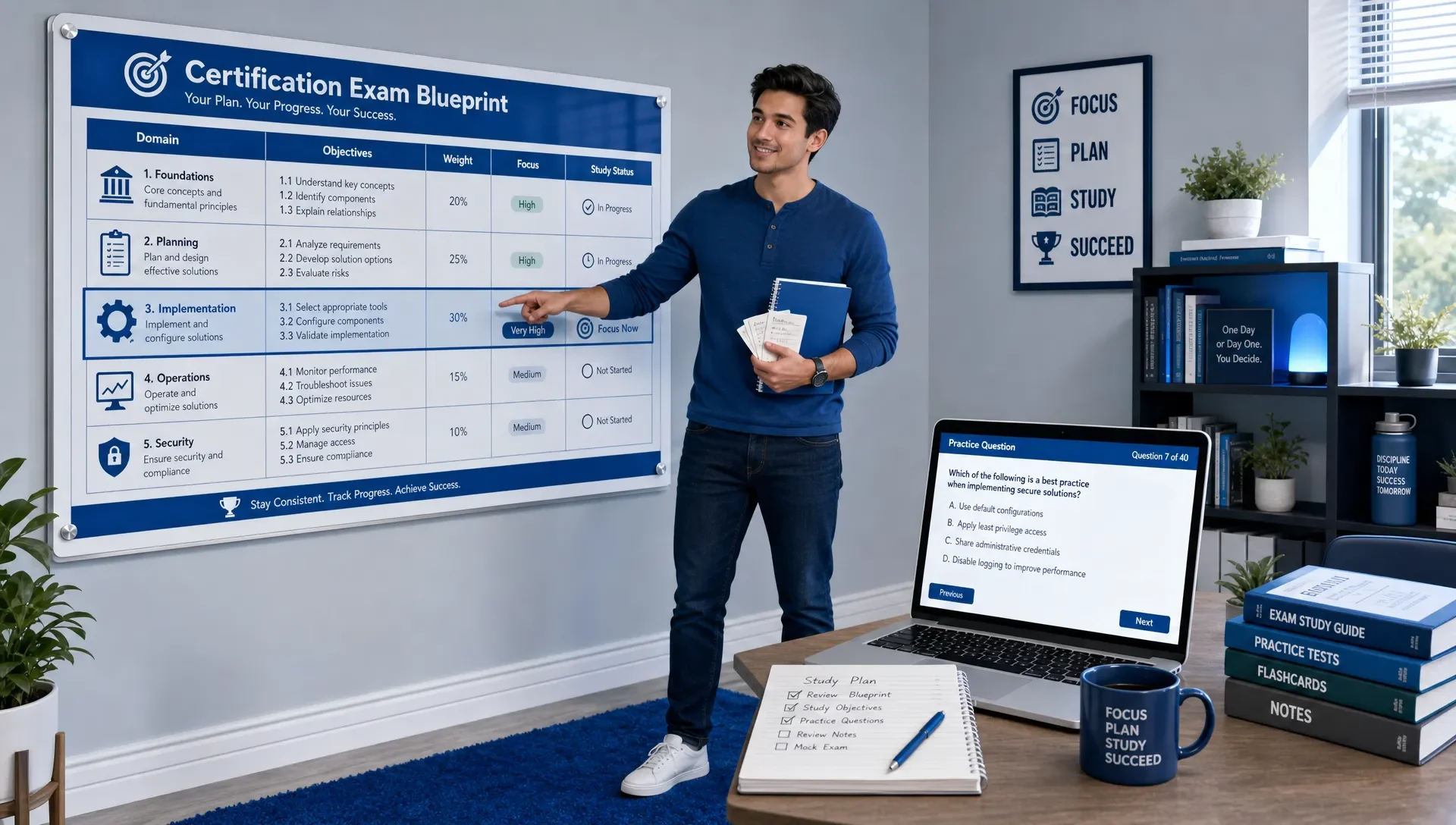
Good study guides go beyond just listing topics. They connect each exam objective to the skills you need, explain what you must be able to do, and provide ways to prove your readiness. If your certification preparation feels disorganized, start by linking every study session to the official objective list. Then, use practice questions to check if you can apply the concepts under exam conditions.
This objective-first approach is key because most certification exams follow a published blueprint. Organizing your notes, flashcards, and practice sessions by this blueprint lets you stop guessing what to review next and instead make informed decisions based on your progress.
Why Test Guides Should Follow Official Exam Objectives
Official objectives represent the exam provider's public scope for a certification test. While they don't reveal specific questions, they outline the domains, tasks, and knowledge areas the exam measures. For instance, the AWS Certified Cloud Practitioner exam page, Microsoft AZ-900 certification page, CompTIA Security+ certification page, and Cisco CCNA exam topics all provide this scope information, which learners can use to plan their study.
The most effective study guides translate these objectives into practical study actions. Instead of simply stating "understand identity and access management," a helpful guide breaks it down into actions like "explain," "configure," "compare," "troubleshoot," or "choose the best option in a scenario." This kind of wording helps you study for performance and application, not just recognition.
Studying by objective also keeps your preparation balanced. Without this structure, it's easy to spend too much time on familiar topics because they feel productive. An exam blueprint forces you to confront weaker domains early, giving you time to improve.
What an Objective-Based Study Guide Should Include
An effective guide doesn't need to be lengthy; it must connect each objective to the specific kind of thinking the exam expects. For many IT, cloud, security, and project management exams, this means going beyond simple definitions and into scenarios, tradeoffs, and troubleshooting.
Use this table to assess whether a guide truly helps you prepare by objective or just provides more material to read.
| Guide element | What it should do | Why it helps |
|---|---|---|
| Objective map | Match each section to the official exam domains | Prevents gaps and overstudying |
| Action verbs | Show whether you need to define, configure, compare or analyze | Turns vague topics into tasks |
| Key concepts | Explain the facts, terms and relationships behind the objective | Builds baseline understanding |
| Scenario prompts | Ask how the concept appears in real exam situations | Improves application under pressure |
| Practice questions | Test one or more objectives with explanations | Reveals weak areas quickly |
| Review notes | Capture mistakes and corrections by topic | Keeps review focused |
Effective study guides make it clear what you're studying, why it's on the exam, and how you'll prove you can apply it. If a section doesn't connect back to a published objective, treat it as optional background material until you've covered the core exam scope.
How to Use Test Guides Without Wasting Study Time
Start with the official objectives, then work through one domain at a time. For each objective, write a concise outcome statement, like "I can choose the right storage option for a given workload" or "I can identify which security control reduces this risk." These statements make your study sessions measurable.
Then, follow a simple cycle: learn the concept, answer targeted questions, review the explanation, create a flashcard for what you missed, and retest later. This cycle is more effective than rereading a chapter twice because it actively forces retrieval. A controlled experiment published in Science by Karpicke and Roediger confirmed that repeated retrieval practice significantly improves long-term retention compared to repeated studying.
For a more detailed setup process, check out MindMesh Academy's article on turning official objectives into an exam study guide, which guides you through converting a blueprint into an actionable study plan.
How to Match Practice Questions to Each Objective
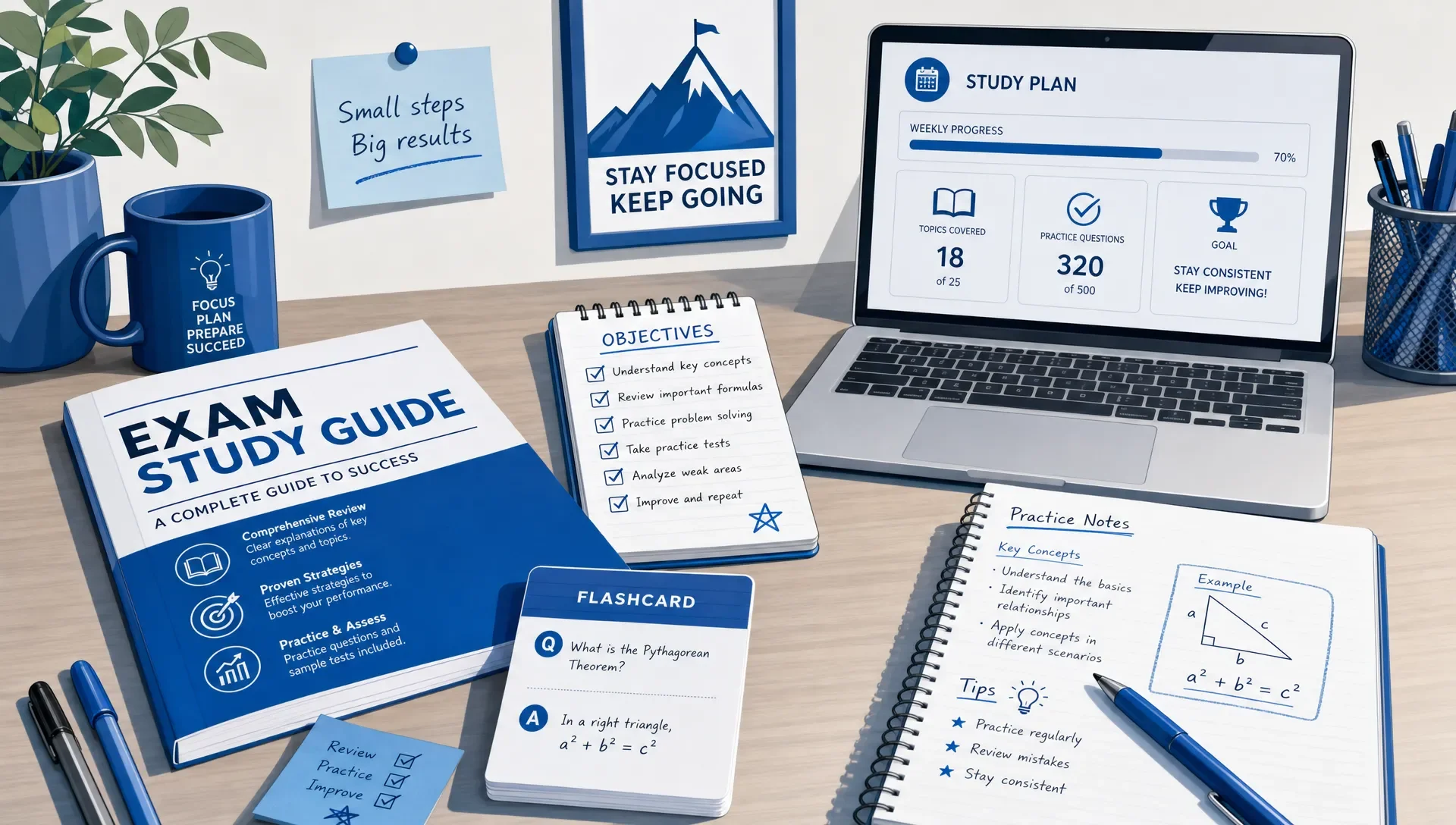
Practice questions are most effective when you know exactly what they're testing. A question asking for a definition confirms vocabulary but won't prove you can handle a scenario. Instead, questions that ask you to choose a service, identify a misconfiguration, or select the next project action provide stronger evidence of your readiness.
Objective-aligned study guides should pair questions with explanations that identify the underlying objective. The explanation must tell you why the correct answer is right and why the distractors are wrong. This second part is crucial because certification exams often test close alternatives, particularly in cloud, networking, and security topics.
| Practice question type | Best used for | Weak signal to watch for |
|---|---|---|
| Definition recall | Terms, acronyms and basic concepts | You know the word but can't use it |
| Scenario selection | Choosing a tool, method or control | You pick based on familiarity instead of requirements |
| Troubleshooting | Diagnosing symptoms and causes | You memorize fixes without understanding root cause |
| Performance-based format | Applying steps in a realistic task | You understand theory but hesitate in execution |
| Mixed-domain question | Testing tradeoffs across objectives | You miss how domains interact |
When reviewing questions, don't just look at the score. Instead, note the objective you missed and the specific reason why. Common reasons include reading too quickly, confusing similar services, missing a keyword in the scenario, or not understanding the underlying concept.
MindMesh Academy offers practice questions with detailed explanations and performance-based formats. This helps learners connect their review directly to objectives, rather than just seeing practice as a score-only activity. For instance, if you're preparing for AWS fundamentals, an AWS Certified Cloud Practitioner practice exam can help you test cloud concepts after studying the relevant domains.
How to Track Readiness by Objective
A raw practice test score can often hide uneven preparation. You might score well overall because you're strong in two large domains, yet remain weak in a smaller domain that still appears enough times to affect your pass rate. Tracking readiness by objective provides a much clearer view of your strengths and weaknesses.
Effective study guides support at least three readiness signals: accuracy, explanation quality, and consistency over time. Accuracy tells you if you got the item right. Explanation quality indicates whether you could justify the answer without guessing. Consistency shows if you can still answer correctly after spaced review.
A simple readiness scale works well:
- Not started: You haven't studied the objective yet.
- Recognize: You understand the terms when you see them.
- Explain: You can describe the concept without looking.
- Apply: You can answer scenario questions correctly and explain your reasoning.
- Maintain: You can still perform after delayed review.
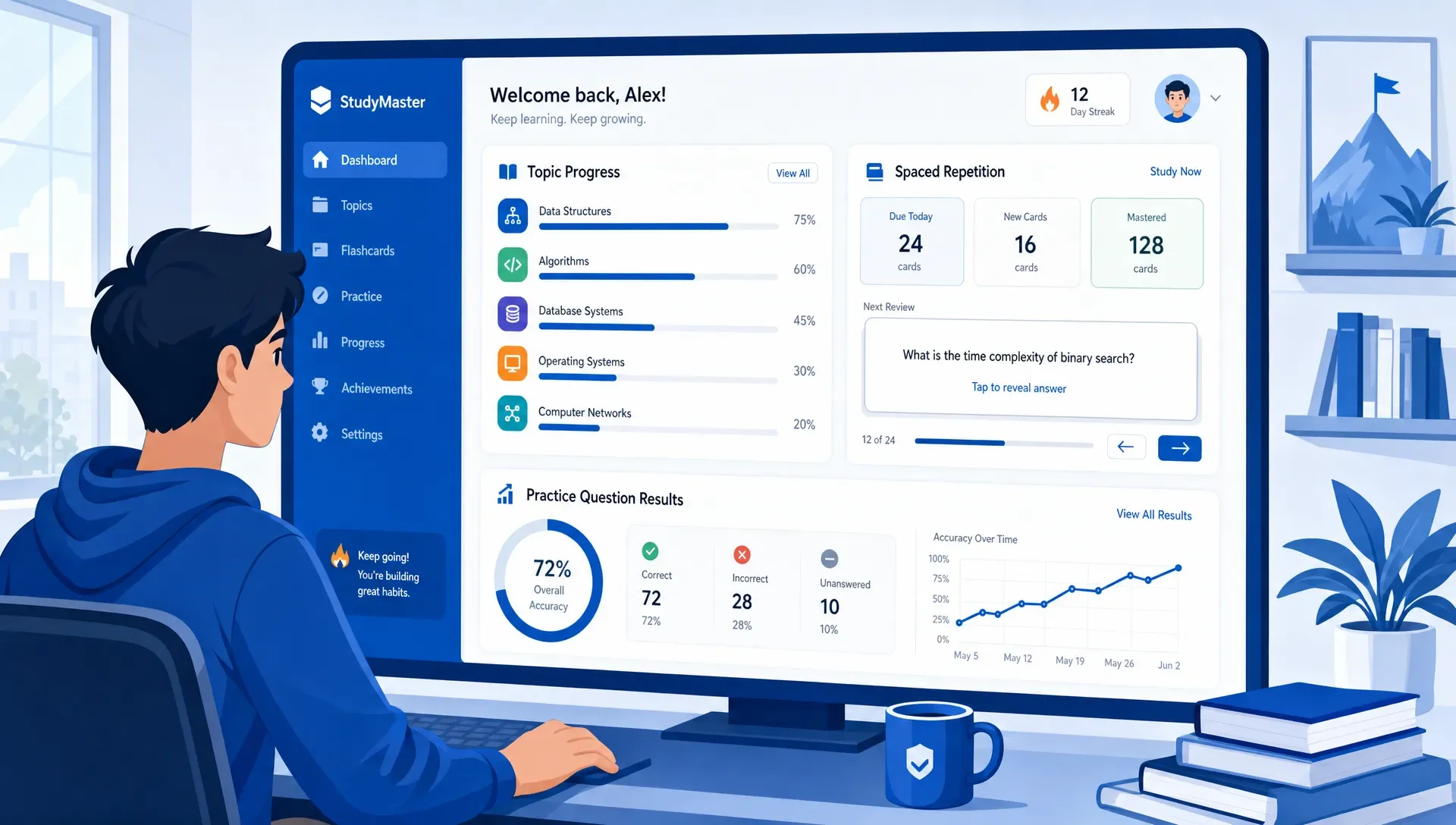
This is where integrated preparation tools shine. MindMesh Academy combines study guides organized by exam objectives, flashcards with spaced repetition, adaptive weakness-based practice, and progress tracking for both topic mastery and overall readiness. These features are valuable because they keep learning, practice, and review directly linked to the same objective map.
Example Objective-Based Study Workflow for Certification Exams
At this point, your study guides should transform into a weekly execution plan, not just a document open in another browser tab. Your goal is to decide precisely what to study, what to practice, and what evidence confirms your improvement.
Here's a practical workflow you can adapt to most certification exams.
| Study stage | What to do | Evidence of progress |
|---|---|---|
| Objective preview | Read the domain and rewrite objectives as tasks | You can state what each objective asks you to do |
| Focused learning | Study one small objective group | Notes answer the objective, not the whole chapter |
| Retrieval practice | Answer questions without notes | You can explain correct and incorrect answers |
| Flashcard review | Add missed facts, rules and comparisons | Weak concepts reappear on a schedule |
| Mixed practice | Combine old and new objectives | You can switch topics without losing accuracy |
| Readiness check | Take a timed practice set | Scores and explanations are stable across domains |
For a fundamentals exam, this workflow could involve studying Azure identity, governance, and cost management as separate objective groups before combining them. A structured AZ-900 Microsoft Azure Fundamentals study guide helps keep these groups aligned with the exam scope.
The same principle applies to security, networking, or project management exams. Study one objective cluster, test your knowledge with questions, then revisit it after a delay. If your review shows you recognized an answer but couldn't explain it, use study questions that reveal what you actually know to move past surface-level familiarity.
Mistakes to Avoid When Choosing a Study Guide
Avoid study guides organized solely by chapter title, product feature, or author preference. While these structures can offer useful background knowledge, they don't provide a reliable map of actual exam coverage.
Also, be cautious of any guide promising shortcuts without explicit objective coverage. Certification exams frequently update domains, weighting, and task wording. If a resource doesn't clearly align with the current exam page, you risk spending hours on outdated content or missing newly added topics.
Watch for these warning signs:
- The guide doesn't reference the current official objectives.
- Practice questions don't explain which objective they test.
- Review sections only tell you to reread instead of retest.
- Weak topics aren't tracked separately from your overall score.
- The guide overemphasizes memorized facts and ignores scenarios.
A solid guide should actively help you make better study decisions week by week. If it only makes you feel busy, it's time to replace it or rebuild your study approach around the official exam blueprint.
Frequently Asked Questions
Are test guides better than official documentation? They serve different purposes. Official documentation defines the source material and exam scope. A good guide, however, organizes that material into a structured study path, complete with practice, review, and readiness checks.
How closely should my study guide follow the exam objectives? For core preparation, very closely. While you can use extra resources for deeper understanding, your main study plan should map every study session and practice set directly to the current objectives.
Should I study objectives in order? If the exam blueprint builds logically, starting in order makes sense. However, don't feel locked into that sequence. Once you've covered the basics, mix older and newer objectives. This helps you adapt to the topic switching often required on exam day.
How do I know when an objective is mastered? Consider an objective mastered when you can explain it without notes, correctly answer scenario questions, and consistently perform well on it after a delayed review.
Can one guide work for multiple certification exams? A general study method can apply across different exams. However, the guide itself should be specific to one exam's objectives. AWS, Azure, CompTIA, Cisco, and PMI exams each have unique scopes and task wording.
Study by Objective With MindMesh Academy
If your current preparation involves a scattered collection of notes, videos, and random question sets, it's time to rebuild your approach around clear objectives. Pick one domain, define exactly what you need to prove you know, practice against that specific target, and track how your weak areas improve.
MindMesh Academy is designed to support this objective-driven workflow. Our platform offers practice questions with detailed explanations, spaced repetition flashcards, and readiness tracking across many certification paths. Ready to put your knowledge to the test? Start with our AZ-900 Microsoft Azure Fundamentals practice exam to gauge your understanding of key Azure concepts and identify areas for improvement.

Written by
Alvin Varughese
Founder, MindMesh Academy
Alvin Varughese is the founder of MindMesh Academy and an enterprise architecture leader. An electrical engineer by training, he moved from factory automation in South Africa to cloud architecture at GE Appliances and Humana (Fortune 50), and holds 20 professional certifications including AWS Solutions Architect Professional, Azure DevOps Engineer Expert, and Microsoft Agentic AI Business Solutions Architect. He built MindMesh Academy after interviewing too many highly certified candidates who couldn't answer basic questions: the goal is prep that makes you better at the job, not just able to pass the exam.