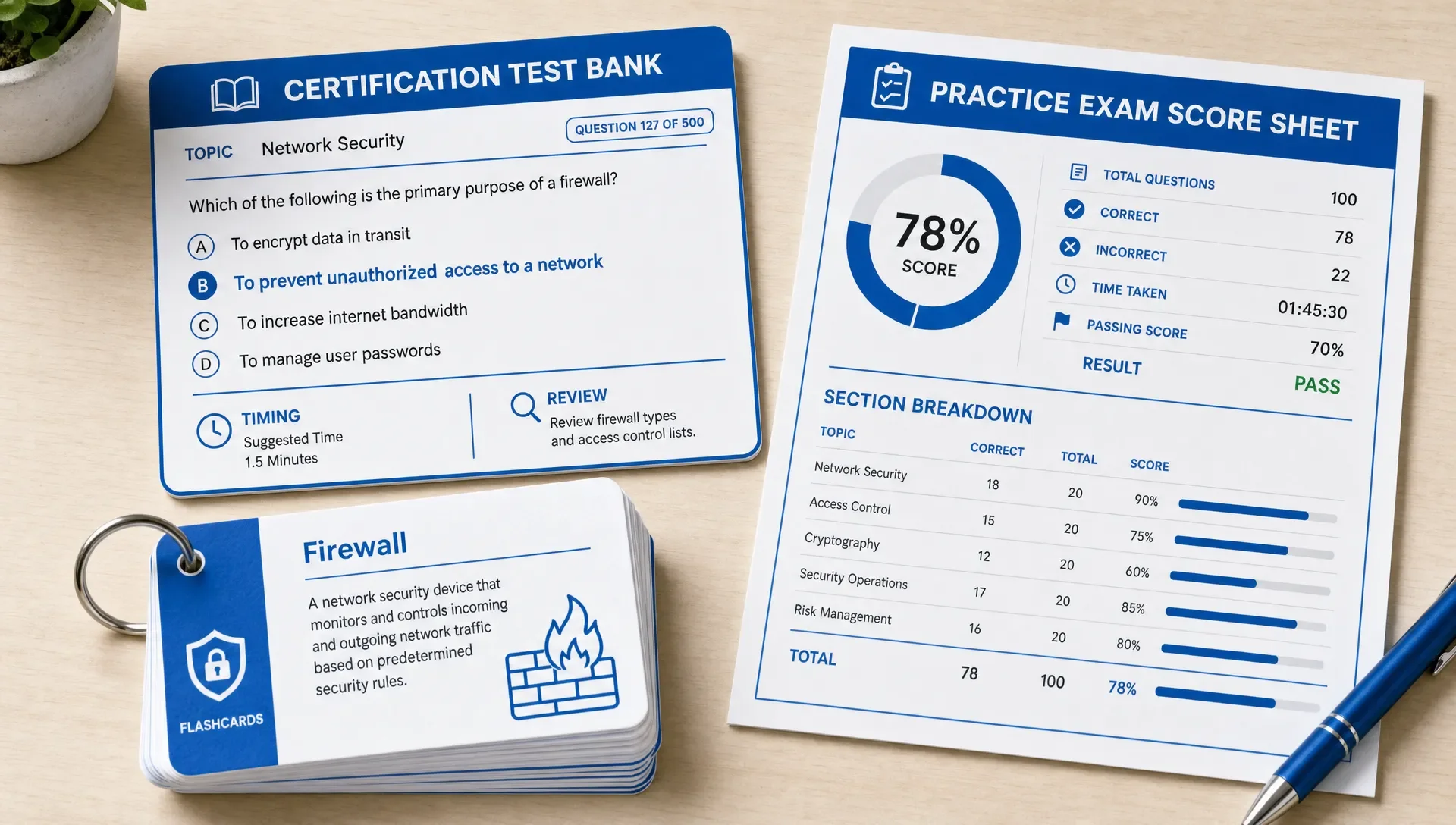
Test Bank vs. Practice Exam: What to Use and When
Test Bank vs. Practice Exam: What to Use and When
When you're learning new material, patching up weak spots, or building recall for specific objectives, reach for a test bank. Save practice exams for when you need to check if your knowledge holds up under timed, exam-like pressure.
This distinction matters because each tool answers a different core question. A test bank helps you ask, "Can I grasp and use this topic after getting feedback?" A practice exam pushes you to ask, "Am I truly ready to perform across the entire exam blueprint, without any assistance?" Using them out of sequence means you either waste realistic exam attempts too soon or get a false sense of readiness from memorizing answers.
Test Bank vs. Practice Exam Comparison
A test bank is a collection of practice questions. You can usually filter these by objective, domain, topic, difficulty, or question type. A practice exam, in contrast, is a timed simulation built to closely resemble the structure and pressure of the actual certification exam.
| Feature | Test bank | Practice exam |
|---|---|---|
| Best purpose | Learning, drilling, remediation | Readiness check, timing, endurance |
| Best timing | Early and middle of your study plan | After you have covered most objectives |
| Question order | Often filtered by topic or weakness | Mixed across domains like the real exam |
| Feedback style | Immediate or review-based explanations | Score report and post-exam review |
| Main risk | Memorizing answers instead of concepts | Taking it too early and wasting a benchmark |
| Success metric | Fewer repeated mistakes by objective | Stable score, timing control, clear rationale |
Here's the simplest rule: test banks build capability; practice exams measure performance. You need both tools, but they serve distinct purposes.
What a Test Bank Is Best For
A well-designed test bank helps you tackle exam objectives in manageable chunks. Whether you're studying for an AWS, Azure, CompTIA, Cisco, or another IT certification, always let the vendor's official exam guide or objective list dictate your practice. For instance, AWS shares official exam guides through AWS Certification, and CompTIA offers its exam objective resources on its certification pages. These blueprints are far more important than just picking random, hard-feeling questions.
The true power of a test bank lies in its feedback. When you get a question wrong, the explanation should clarify why the correct answer is right, why the incorrect options are wrong, and what underlying concept you need to review. If you just mark the right answer and move on, you're using a learning tool as nothing more than a score counter.
Test banks prove especially useful for these tasks:
- Topic-by-topic learning: Work on IAM policies, subnetting, risk management, change enablement, or routing protocols without mixing in unrelated domains too soon.
- Weakness repair: Filter practice to the objectives that are dragging down your score instead of reviewing everything equally.
- Retrieval practice: Force yourself to recall and apply knowledge instead of rereading notes passively.
- Question pattern recognition: Learn how certification exams frame scenarios, constraints, and distractors.
- Explanation mining: Turn missed concepts into flashcards, notes, or targeted study tasks.
Retrieval practice isn't just a study tip; it's a proven method. A 2008 Science paper by Jeffrey Karpicke and Henry Roediger showed that repeated retrieval significantly improves long-term retention more than repeated study. For anyone studying for certification, this means actively answering questions, articulating your reasoning, and fixing errors often builds stronger knowledge than simply rereading chapters.
A legitimate test bank never consists of live exam content or brain dumps. If you find a resource claiming to have actual exam questions, stay away. Beyond the ethical and exam-policy issues, dumps train recognition instead of critical judgment. This approach quickly fails when the real exam alters wording, introduces a new condition, or asks for the best answer rather than just a familiar one.
What a Practice Exam Is Best For
A practice exam offers more than just a longer test bank session. It simulates the decision fatigue, time pressure, and mixed-domain challenge of the real exam. This makes it far more valuable later in your study plan, once you've built a solid foundation and the results can genuinely reflect your readiness.
Use a practice exam to answer questions like these:
- Can I manage time without rushing the final questions?
- Do I perform well when topics are mixed together?
- Can I eliminate distractors when two answers look plausible?
- Do I understand the exam's scenario style and wording?
- Are my weak areas isolated or spread across the blueprint?
View a practice exam score as a signal, not a final judgment. A high score might just be luck if it's from questions you've seen before. Conversely, a low score can be incredibly useful if it uncovers a fixable issue, like slow reading, overthinking, weak command-line recall, or confusion between similar services.
For a closer look at scheduling full simulations, MindMesh Academy offers a guide on when to take a practice test in your study plan. In short, a practice exam provides the most insight after you've studied the core material and completed enough targeted drilling to make a full benchmark meaningful.
When to Use a Test Bank in Your Study Plan
Start using a test bank earlier than you might expect, but don't chase scores right away. In the initial stages of your prep, your goal is exposure and diagnosis. You want to understand how the exam writers think, what language they use, and which objectives still feel new to you.
As you make your first pass through a study guide, answer a small set of questions after each objective or topic. Keep the number manageable. Ten thoughtful questions with a complete review are often more effective than 50 rushed ones that don't help you track what went wrong.
During the middle of your study plan, use the test bank more aggressively. Sort by objective, retake questions only after a delay, and track whether you're missing the same concept or simply the same question. If you struggled with a firewall rule question yesterday, getting it right today doesn't mean you've truly mastered it unless you can explain the traffic flow and apply that knowledge to a new scenario.
Closer to your exam date, use the test bank for targeted remediation between practice exams. If a full simulation reveals weaknesses in areas like cloud pricing, incident response, subnetting, or project risk, return to topic-filtered questions before attempting another full exam.
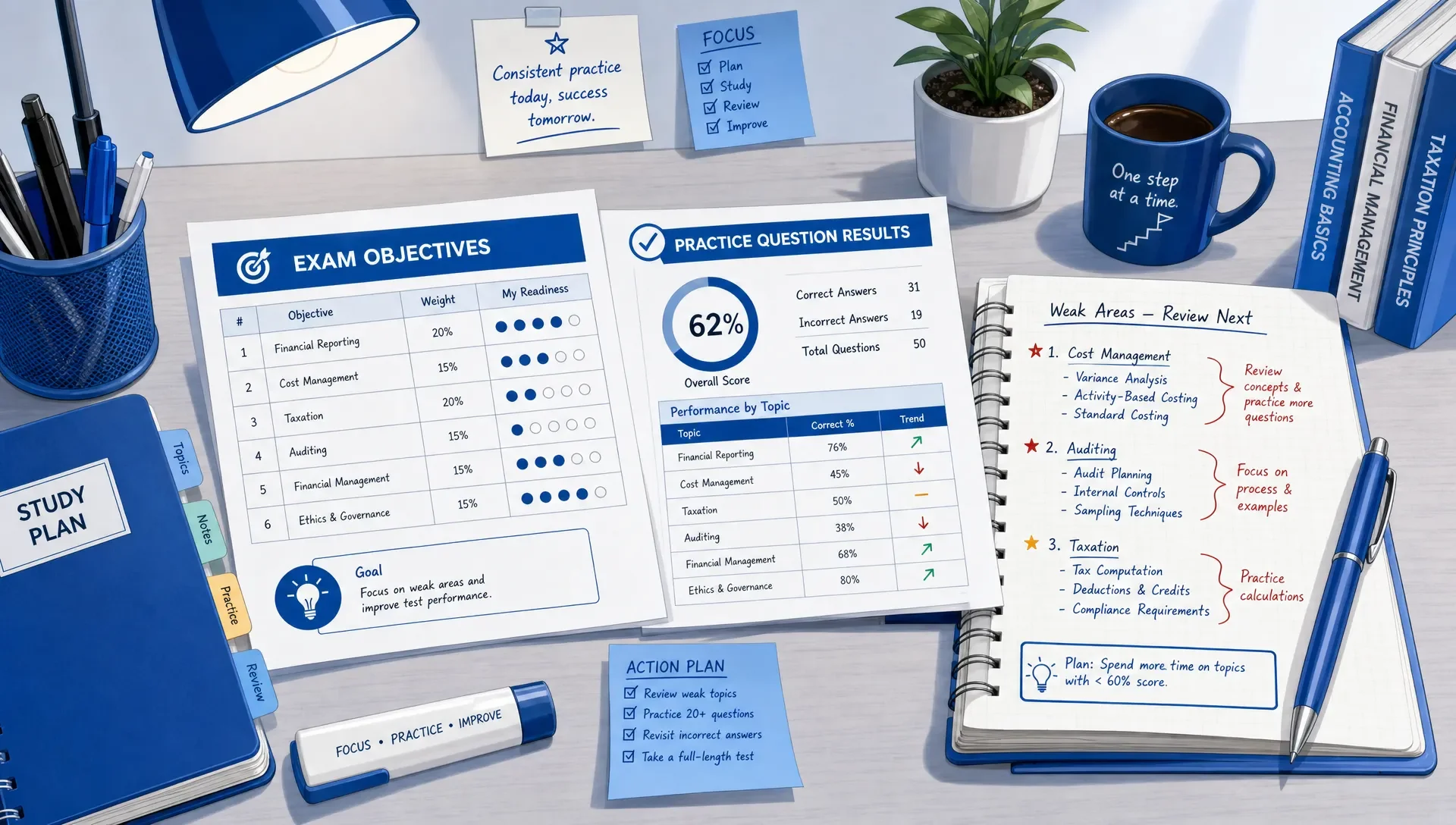
When to Use a Practice Exam Before Test Day
Schedule your first full practice exam after you've covered most exam objectives and completed at least one round of focused practice. You don't need to feel perfectly ready, but you should know enough for the score report to reflect your actual preparation, not just a lack of exposure.
A frequent error is taking full practice exams too early, simply because it feels productive. If you score low because you haven't even learned half the domains yet, the result offers little meaningful insight. This can also make subsequent scores less reliable, as you've already seen too many of the questions.
A better sequence looks like this:
| Study phase | Main tool | What to do | What to avoid |
|---|---|---|---|
| First exposure | Study guide and small test bank sets | Learn one objective, then answer a few questions | Judging readiness by early scores |
| Skill building | Test bank by objective | Drill weak topics and review explanations | Repeating questions until answers look familiar |
| First benchmark | Practice exam | Take it timed and closed-book | Pausing to check notes |
| Remediation | Test bank and flashcards | Repair weak domains from the score report | Taking another full exam immediately |
| Final check | Practice exam | Confirm timing, stamina and mixed-domain performance | Overloading yourself the night before |
For example, if you're preparing for a broad cloud fundamentals exam, a tool like the AWS Certified Cloud Practitioner practice exam works best after you've studied the major domains and need a realistic check of your readiness. For a security certification, the CompTIA Security+ practice exam becomes most helpful after you've drilled into acronyms, controls, attack types, governance concepts, and implementation scenarios by topic.
How to Combine a Test Bank and Practice Exams
The most effective study plan uses test banks and practice exams in a continuous loop, not as isolated tools. Each practice exam should reveal a concise list of your weaknesses. Each test bank session then targets those specific weak spots. The next practice exam confirms whether your efforts to repair those areas held up under pressure.
A practical weekly rhythm might look like this:
| Day | Activity | Tool | Output |
|---|---|---|---|
| Monday | Study one or two objectives | Study guide | Notes tied to the blueprint |
| Tuesday | Answer targeted questions | Test bank | Missed concepts and confidence ratings |
| Wednesday | Review explanations and make flashcards | Test bank and flashcards | Recall prompts for weak facts and decisions |
| Thursday | Do mixed-question practice | Test bank | Better switching between topics |
| Friday | Repair one weak objective | Study guide and test bank | Fewer repeated errors |
| Weekend | Take or review a practice exam, depending on phase | Practice exam | Readiness signal and next study priorities |
This loop only works if you safeguard your first attempts. Your initial answer is the purest measure of what you truly know. If you glance at explanations, hit pause to search documentation, or retake the same question set right away, you compromise the usefulness of that data.
If you're working with large question pools, following a repeatable review system helps immensely. MindMesh Academy's article on question bank tactics that build real understanding offers a deeper look into transforming practice questions into genuine learning, rather than just memorizing answers.
Common Mistakes With Test Banks and Practice Exams
Most learners don't struggle because they picked the wrong study tool. Instead, they hit roadblocks because they used the right tool for the wrong purpose.
| Mistake | Why it hurts | Better approach |
|---|---|---|
| Retaking the same questions too soon | You remember the answer pattern, not the concept | Delay retakes and require an explanation in your own words |
| Taking full practice exams before learning the objectives | The score mostly reflects missing coverage | Use test bank questions after each objective first |
| Reviewing only wrong answers | Correct guesses stay hidden | Review low-confidence correct answers too |
| Ignoring timing data | Knowledge may not translate under pressure | Track time per question and rushing patterns |
| Chasing a target score only | Scores can hide uneven domain weakness | Map results back to exam objectives |
| Using dumps as a test bank | Memorization fails when wording changes | Use original practice questions with explanations |
The riskiest score to get is a high one achieved from memorized questions. While it feels reassuring, it doesn't prove you can handle new, unfamiliar scenarios. If you can correctly answer a question and explain why the other options are wrong, you're in a far stronger position.
How to Review Test Bank Questions and Practice Exams
Review sessions are where the bulk of learning happens. The correct answer itself is less important than the reasoning you construct after seeing the result.
For test bank questions, review immediately to correct any misconceptions, then revisit the concept later using flashcards or fresh questions. For practice exams, tackle a two-stage review. First, record your raw performance: your score, time spent, confidence levels, and any domains that felt especially difficult. Then, go through the explanations and rebuild your understanding.
Use these four labels when reviewing misses:
- Knowledge gap: You didn't know the concept, command, service, formula, or process.
- Misread scenario: You missed a constraint such as least cost, highest availability, first action, or best next step.
- Distractor trap: You knew the topic but chose an answer that was true, just not best for the scenario.
- Timing pressure: You rushed, second-guessed yourself, or spent too long on an early item.
These labels directly inform your next steps. A knowledge gap means more study. A misread scenario calls for slower, more careful question parsing. A distractor trap requires practice comparing similar-looking options. A timing pressure issue means focused pacing exercises and full simulations.
For full simulations, a structured post-test process is crucial. If you're looking for a step-by-step review method, check out MindMesh Academy's guide on how to review an exam practice test the right way before your next timed exam.
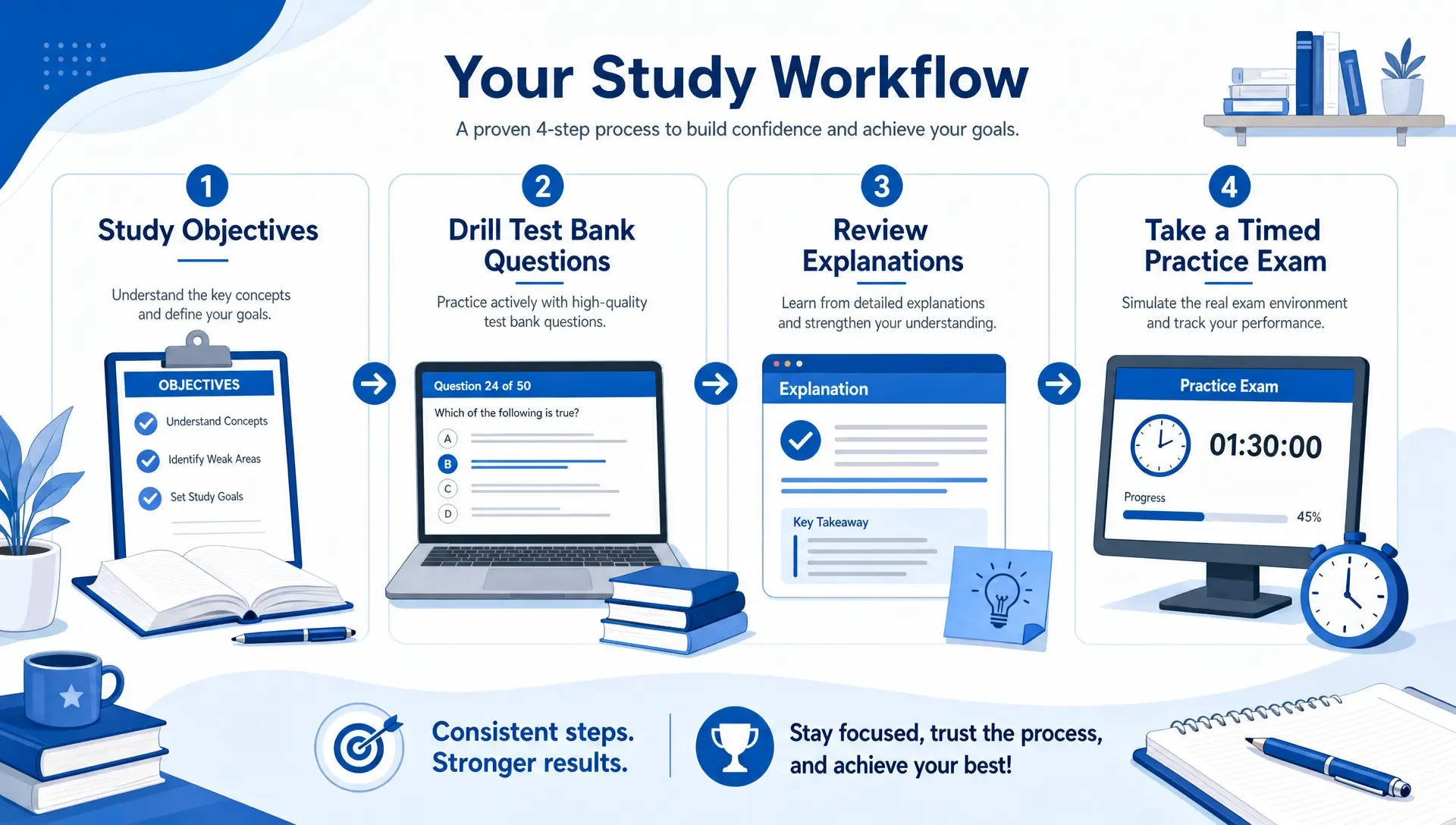
How MindMesh Academy Supports Both Study Modes
MindMesh Academy builds certification prep around connecting learning, practice, and readiness tracking. This integrated approach is especially important for the test bank vs. practice exam decision, as you want connected signals, not isolated tools.
You can use our study guides, structured by exam objectives, to build your core knowledge. Then, move to practice questions with detailed explanations to test your understanding topic by topic. Flashcards with spaced repetition help reinforce important facts and distinctions over time. Our adaptive, weakness-based practice and progress tracking by topic ensure you focus your efforts where they'll have the most impact.
As your exam date nears, practice exam formats and readiness tracking help you shift from learning to performance mode. For certifications that include applied tasks, our performance-based questions also allow you to practice more than just simple recall. Across our 30+ certification paths, our goal extends beyond just offering more questions. We aim to provide a connected study workflow that clearly shows what you know, what needs work, and when you're truly prepared.
Test Bank or Practice Exam: Which Should You Choose Today?
Choose a test bank today if you still have objectives to learn, your weak areas are undefined, or your last practice exam highlighted specific domains needing repair. Keep your session focused, thoroughly review every explanation, and note down the rule, command, concept, or decision you need to remember for next time.
Opt for a practice exam today if you've already covered the full blueprint, can answer topic-level questions without constantly consulting notes, and need to assess your timing, endurance, and performance on mixed-domain content. Take it closed-book, complete it in a single sitting, and treat the review as your next study assignment.
If you're unsure, default to a smaller test bank session. A full practice exam provides the most value when it can offer accurate insights into your readiness.
Frequently Asked Questions
Is a test bank the same as a practice exam? No. A test bank is a collection of practice questions, often filtered by topic, objective, or weakness. A practice exam, however, is a timed simulation designed to measure your performance across a wider mix of exam content.
Should I use a test bank before reading the study guide? You could start with a small diagnostic set before deep study, but don't let that initial score define your progress. After the diagnostic, return to the objectives, study any unfamiliar concepts, and then use more questions to confirm your understanding.
How many practice exams should I take before a certification exam? There isn't a magic number. Take enough to confirm you perform steadily under timed conditions, but not so many that you start memorizing the specific questions. Most of your real improvement should still come from reviewing and addressing weak objectives.
What score should I get on a practice exam before scheduling the real exam? Treat your practice exam score as one readiness signal, not the only indicator. Also consider your consistency across domains, timing, confidence, the quality of your explanations for answers, and whether you're encountering truly new questions or just rehashed items.
Can I pass using only a test bank? While some learners attempt this, it's a risky strategy. A test bank excels at building knowledge and recall for individual topics. However, a full practice exam uniquely tests your ability to apply that knowledge across mixed topics while under real time pressure.
How do I avoid memorizing test bank answers? To truly learn, delay retakes, shuffle questions frequently, explain your reasoning aloud before looking at the explanation, and track your confidence. If you can't solve a reworded version of a question, you likely haven't mastered the underlying concept yet.
Build a Study Plan That Uses Both Tools Well
A test bank's purpose is to make you a better-prepared candidate. A practice exam then confirms if that improvement holds firm under actual exam conditions. By using them in this sequence, your prep becomes more manageable, and your scores provide more genuine insight.
Ready to build a smart study plan for your next certification? MindMesh Academy offers detailed study guides and practice questions with explanations to help you understand topics deeply and track your progress. For example, you can begin strengthening your foundational cloud knowledge with our AWS Certified Cloud Practitioner study guide today.

Written by
Alvin Varughese
Founder, MindMesh Academy
Alvin Varughese is the founder of MindMesh Academy and an enterprise architecture leader. An electrical engineer by training, he moved from factory automation in South Africa to cloud architecture at GE Appliances and Humana (Fortune 50), and holds 20 professional certifications including AWS Solutions Architect Professional, Azure DevOps Engineer Expert, and Microsoft Agentic AI Business Solutions Architect. He built MindMesh Academy after interviewing too many highly certified candidates who couldn't answer basic questions: the goal is prep that makes you better at the job, not just able to pass the exam.