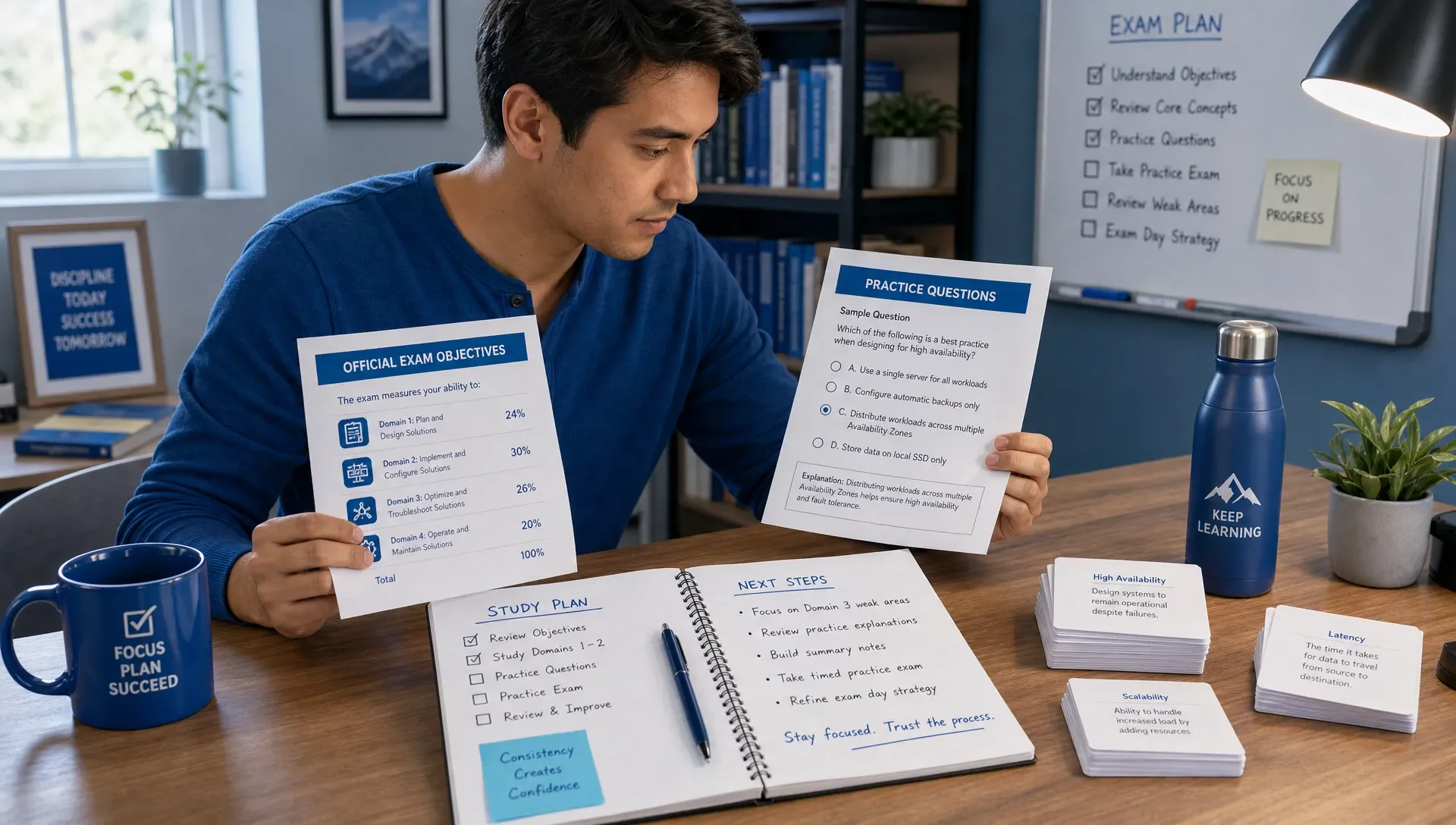
Study Resources That Match Your Exam Objectives
Study Resources That Match Your Exam Objectives
A good study resource should answer one question quickly: Does this help me with a specific exam objective? If you can't connect it to a domain, task, or skill statement in the official outline, the resource might be interesting, but it's likely not the best use of your limited study time.
Start by downloading the current exam objectives from the certification vendor. Then, sort your study materials by what they help you achieve: learn concepts, practice decisions, memorize facts, perform tasks, or prove readiness. This simple filter prevents you from accumulating random videos, notes, and question banks that feel productive but leave critical gaps on exam day.
Why Official Exam Objectives Should Drive Your Resource Choices
Certification exams aren't built from a textbook's table of contents. They're built from an exam blueprint, exam guide, skills outline, or content outline. Different vendors use different labels, but the goal is always the same: to tell candidates exactly what the exam can test.
For instance, AWS publishes certification exam guides on its AWS Certification pages. Microsoft provides "skills measured" pages, such as the AZ-900 study guide. CompTIA lists certification domains on pages like Security+. These official outlines are far more reliable than general search results because they come directly from the organization that owns the exam.
Use these objectives as your single source of truth for three key decisions:
- What to study: The objective defines the scope, not a forum thread or someone else's notes.
- How deeply to study it: A heavily weighted domain deserves more time than a small supporting topic.
- Which resource to use: Some objectives require reading, some need hands-on practice, and others need repeated recall.
If you're unsure how to turn an official outline into a study plan, MindMesh Academy's guide on turning objectives into an exam study guide offers a useful next step before you choose any materials.
Which Study Resource Fits Each Type of Exam Objective
Most candidates use the same type of resource for everything, often a long course or a huge set of practice questions. This approach often falls short because certification objectives test different kinds of knowledge. Matching the resource to the objective makes your study time much more efficient.
| Exam objective type | What the objective asks you to do | Best matching resource | Weak match to avoid |
|---|---|---|---|
| Define or describe a concept | Recognize terms, roles, models, or service categories | Objective-based study guide and flashcards | Long labs before you understand the terms |
| Compare options | Choose the best service, control, command, or method for a scenario | Scenario-based practice questions with explanations | Memorizing isolated definitions only |
| Configure or implement | Perform steps in a tool, console, or command line | Hands-on lab, sandbox task, or guided walkthrough | Passive reading without doing the task |
| Troubleshoot | Diagnose symptoms and select likely fixes | Case questions, labs, and explanation-heavy review | Answer dumps or questions without reasoning |
| Apply governance or process | Use policies, frameworks, or workflow rules correctly | Process diagrams, decision tables, and practice questions | Random summaries that skip edge cases |
| Recall facts under pressure | Remember ports, acronyms, formulas, or command syntax | Flashcards with spaced repetition | Rereading the same notes every night |
You'll notice that practice questions appear in several rows, but they're not a replacement for learning. They are most useful when they force you to retrieve information and explain why each answer is correct or incorrect. In an effective study workflow, questions expose weak objectives, and then guides, flashcards, or labs help you close those gaps.
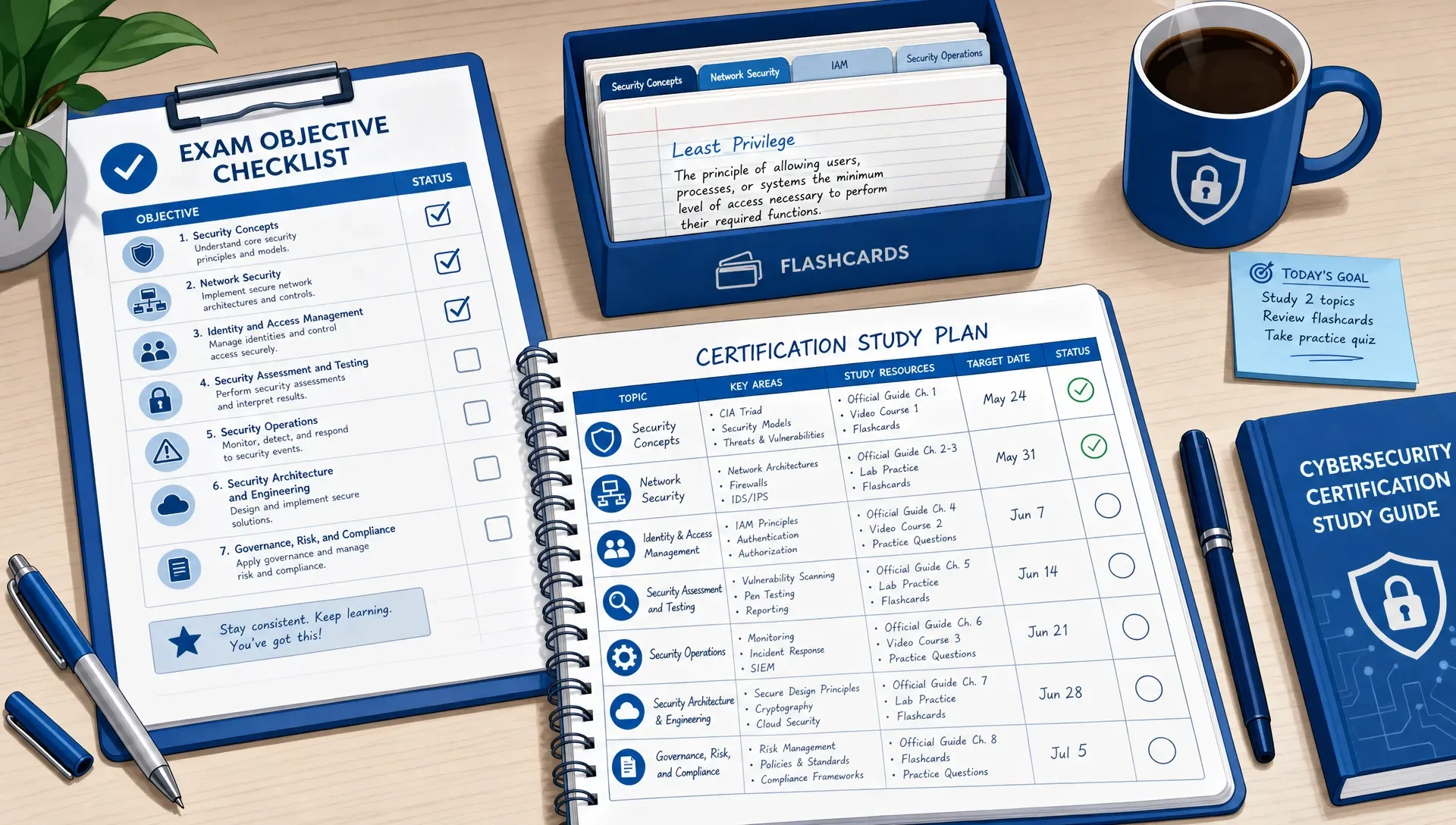
How To Audit A Study Resource Before You Trust It
Before you commit hours to any book, course, guide, question set, or flashcard deck, run a quick audit. You don't need a complicated rubric. You just need evidence that the resource genuinely matches the exam you're taking.
First, check currency. Confirm the resource names the current exam code or version. For cloud and cybersecurity exams especially, outdated terminology can subtly train you on retired services, old defaults, or superseded security guidance.
Second, compare the resource's outline against the official domains. A reliable study guide should make it easy to see which sections map to which objectives. If a resource spends 30 percent of its time on a topic barely present in the blueprint, consider that a warning sign.
Third, inspect the depth. Some resources cover objectives only at a vocabulary level. That's fine for basic recall, but it won't prepare you for scenario questions that ask you to select the best solution from several plausible answers.
Fourth, check the feedback quality. A practice question that only marks "A" as correct doesn't teach much. Strong explanations tell you why the correct answer fits the objective and why the distractors fail. This distinction matters because many certification exam choices are designed to sound almost right.
If you're organizing a full set of materials, the exam material checklist for certification candidates can help you spot missing pieces before you get deep into your schedule.
How To Build An Objective-Matched Resource Stack
You don't need every possible resource. You need a stack that covers each objective from initial learning through recall and readiness checking. The right stack changes depending on the certification type.
| Certification focus | What tends to matter most | Resource stack that usually fits |
|---|---|---|
| Cloud fundamentals | Concepts, shared responsibility, billing, service categories, and basic use cases | Official objectives, structured study guide, flashcards, and short scenario questions |
| Cloud associate or administrator | Service selection, configuration, security, monitoring, and troubleshooting | Objective-based guide, hands-on labs, scenario questions, and topic-level readiness tracking |
| Networking and infrastructure | Protocols, subnetting, commands, device behavior, and troubleshooting | Study guide, command practice, diagrams, labs, and performance-style questions |
| Cybersecurity | Controls, risk, attacks, identity, architecture, and incident response | Study guide, scenario practice, flashcards, and mistake review by domain |
| Project management or IT service management | Process flow, roles, governance, documents, and decision-making | Study guide, process tables, scenario questions, and repeated review of weak domains |
For example, someone preparing for a fundamentals cloud exam might use the AZ-900 Microsoft Azure Fundamentals study guide as their primary learning material. They would then use flashcards and short practice sets to reinforce terms and service choices.
A candidate preparing for an entry-level cloud certification could use an AWS Certified Cloud Practitioner practice exam after studying the objectives to confirm they can apply concepts under exam-like pressure.
The point isn't to collect more. It's to assign each resource a specific job. If a resource doesn't teach, reinforce, test, or diagnose a specific objective, leave it out.
How To Use Study Resources During The Week
An objective-matched stack works best if you rotate resources intentionally. A simple weekly rhythm can keep your study active without turning every night into a full mock exam.
Use your study guide at the start of the week to learn or reinforce one domain. Keep notes short and tied to the objective wording. If the objective says "compare storage options," don't just write definitions. Create a small decision table that helps you choose between options in a scenario.
Use flashcards in shorter sessions throughout the week. Spaced repetition helps because it brings material back after a delay, when recall takes more effort. In a 2013 review in Psychological Science in the Public Interest, Dunlosky and colleagues rated practice testing and distributed practice as high-utility learning techniques compared with several common study habits.
Use practice questions after you've studied the objective, not before you've seen the material at all. Retrieval practice is powerful because it forces you to produce an answer, then compare your reasoning to the feedback. In a 2006 paper in Psychological Science, Roediger and Karpicke found that testing improved long-term retention compared with repeated studying in their experiments.
Then, close the loop with review. Don't just record your score. Tag missed questions by objective and cause: a concept gap, misread wording, weak scenario judgment, or a memory slip. MindMesh Academy supports this kind of connected workflow with study guides aligned to exam objectives, practice questions with explanations, flashcards with spaced repetition, adaptive weakness-based practice, and readiness tracking.
How To Tell A Resource Does Not Match Your Exam
Some resources look polished but still waste your time. The fastest way to detect a mismatch is to compare the resource's claims to the exam outline and question style.
| Red flag | Why it hurts your prep | What to use instead |
|---|---|---|
| The resource doesn't mention the current exam code | It may teach retired objectives or outdated terminology | Vendor objectives and current objective-mapped material |
| Questions have no explanations | You can't fix reasoning errors | Practice questions with answer rationales |
| The content is organized only by broad chapters | You can't see which objectives are covered or missing | A guide mapped to exam domains and tasks |
| Everything is passive reading or video | Recognition feels like knowledge until the exam asks you to choose | Retrieval practice, flashcards, and labs where relevant |
| The resource focuses on trivia not listed in objectives | It consumes time without improving readiness | Objective-weighted review and scenario practice |
| Scores are not broken down by topic | You don't know what to repair next | Progress tracking by topic and weakness-based practice |
A resource doesn't have to be bad to be wrong for your specific exam. A detailed networking book might be excellent, but it can still be inefficient for a cloud fundamentals candidate who needs service selection, pricing concepts, and shared responsibility more than packet-level detail.
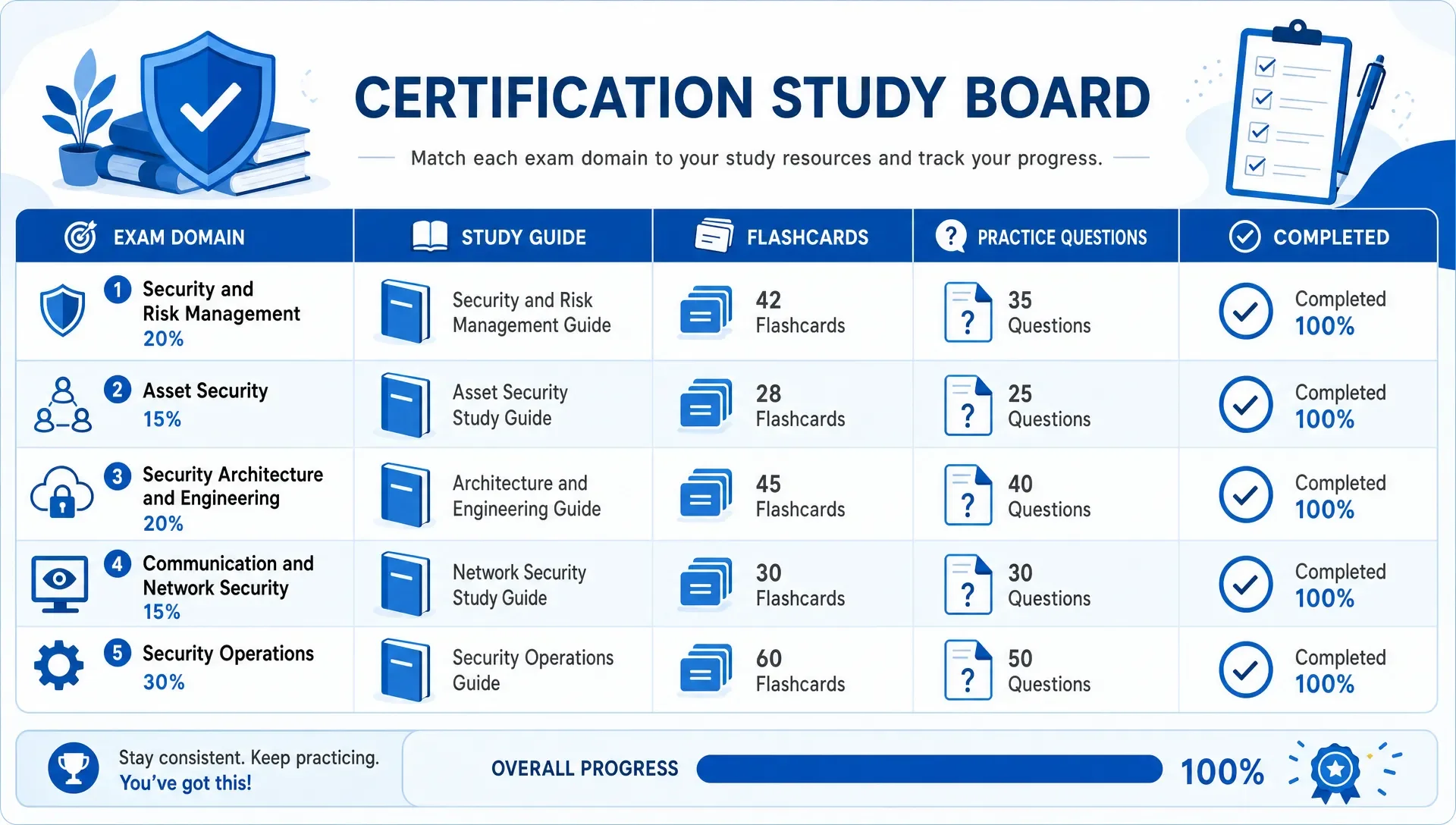
A Simple Objective-To-Resource Map You Can Copy
When you review an exam objective, don't just ask if you've read about it. Ask what proof would show that you're truly ready. This short map works for most IT, cloud, and project management certifications.
| Objective example | You need to know | You need to do | Best readiness check |
|---|---|---|---|
| Explain a shared responsibility model | Which party owns which responsibility | Apply the model to a scenario | Scenario questions with explanations |
| Configure secure access | Identity terms, permissions, and security boundaries | Choose or perform the correct configuration steps | Lab task plus practice questions |
| Compare network troubleshooting tools | What each tool reveals | Select the right tool for a symptom | Troubleshooting cases |
| Identify risk responses | Risk terminology and response categories | Choose the best response in context | Process-based scenario questions |
| Recall common ports or acronyms | Exact facts | Retrieve them quickly without prompts | Spaced flashcards |
This map also helps you avoid overstudying. If an objective only requires recognition, you probably don't need a long lab. If it requires implementation, reading alone won't be enough. The resource has to match the verb.
How MindMesh Academy Helps Keep Resources Aligned
MindMesh Academy is built on the idea that prep should stay connected to the exam, not scattered across disconnected notes. Our study guides organize content by exam objectives, making it clear what you're covering. Practice questions include detailed explanations, so you can fix knowledge gaps instead of just checking a score. Flashcards use spaced repetition to reinforce recall over time.
For candidates who need more than a fixed schedule, adaptive weakness-based practice and progress tracking by topic help you decide what to review next. Mastery and readiness tracking also give you a clearer view of whether your preparation is broad enough across all exam domains.
This is especially important in the final stages. Many learners tend to keep reviewing topics they already like because those sessions feel easier. Objective-based tracking pushes you toward the areas that still need work.
Frequently Asked Questions
What is the best study resource for certification exams? The best study resource is one that maps clearly to the official exam objectives and helps you practice the specific skill being tested. Most candidates benefit from a mix of an objective-based study guide, practice questions with explanations, flashcards, and hands-on practice when the exam includes implementation or troubleshooting.
Should I use official exam objectives before choosing resources? Yes. The official objectives should serve as your filter for every resource you consider. If a guide, course, or question set doesn't align with the current objectives, you risk spending time on content that won't improve your exam readiness.
Are practice exams enough if they cover all objectives? Usually not. Practice exams excel at retrieval practice, diagnosis, and timing. However, if you miss questions because you don't understand a core concept or process, you still need a study guide, lab, or flashcard review to address that underlying gap.
How do I know if a resource is too shallow? A shallow resource typically defines terms but doesn't ask you to compare, troubleshoot, or apply them. If the official objective uses verbs like "implement," "configure," "analyze," or "recommend," the resource should include scenarios, tasks, or explanations that go beyond simple recognition.
How often should I review flashcards? Review flashcards in short, repeated sessions throughout the week, rather than in one long session right before the exam. Spaced repetition works best when cards reappear after enough time has passed that recalling the information requires some effort.
What should I do when two resources disagree? First, check the current vendor objectives and official documentation. Then, look at the publication date, exam code, and explanation quality of each resource. If the disagreement affects an exam objective, update your notes to match the official source.
Choose Resources That Prove Readiness, Not Just Coverage
A well-chosen resource stack should make your exam objectives easier to master, not harder to track. Start with the official outline, match each objective to the right type of resource, and use topic-level results to decide what to study next.
If you want that workflow in one place, MindMesh Academy offers study guides aligned with exam objectives, practice questions with detailed explanations, spaced flashcards, adaptive weakness-based practice, and readiness tracking across 30+ certification paths. Get started and build a strong foundation for your AZ-900 exam day with our AZ-900 Microsoft Azure Fundamentals practice exam.

Written by
Alvin Varughese
Founder, MindMesh Academy
Alvin Varughese is the founder of MindMesh Academy and an enterprise architecture leader. An electrical engineer by training, he moved from factory automation in South Africa to cloud architecture at GE Appliances and Humana (Fortune 50), and holds 20 professional certifications including AWS Solutions Architect Professional, Azure DevOps Engineer Expert, and Microsoft Agentic AI Business Solutions Architect. He built MindMesh Academy after interviewing too many highly certified candidates who couldn't answer basic questions: the goal is prep that makes you better at the job, not just able to pass the exam.