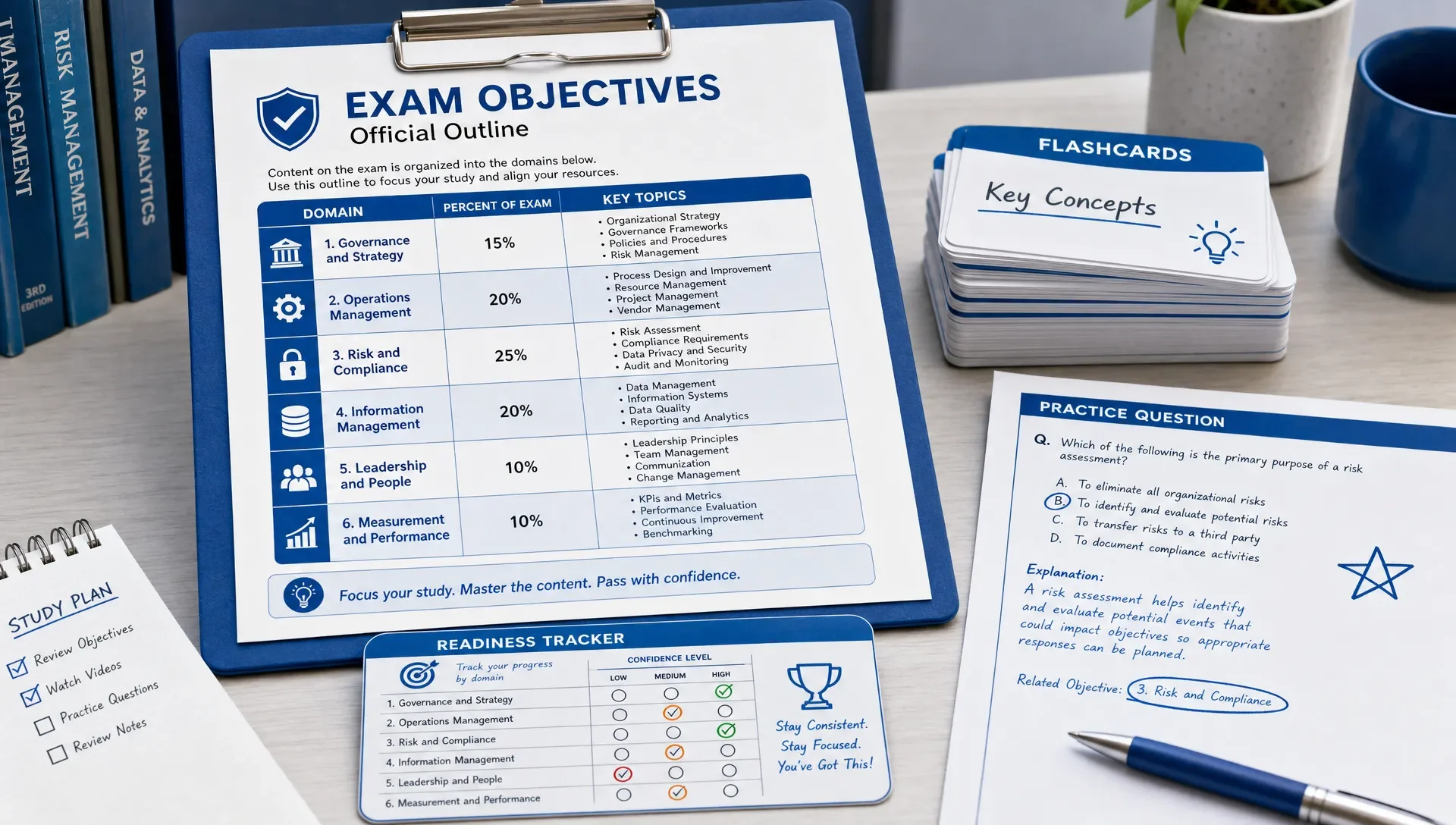
Exam Material Checklist for Certification Candidates
Exam Material Checklist for Certification Candidates
Effective exam material does three things: it outlines the testable content, clearly teaches each objective, and prepares you to answer questions under exam conditions. Before you add another book, course, PDF, or question bank to your study plan, ensure it aligns with current exam objectives, explains the reasoning behind answers, and helps you measure your readiness by topic.
Use this checklist to evaluate your existing resources. If a resource doesn't link to official objectives, fails to explain why incorrect choices are wrong, or doesn't help you practice weak areas, replace it. Don't let it waste your study time.
Your Essential Exam Material Checklist
A certification candidate doesn't need every available resource. Instead, you need a small, reliable set of materials that work together. The goal is comprehensive coverage, effective practice, strong recall, and useful feedback – not a bulky collection of half-used resources.
| Exam Material | Purpose | Keep It If... |
|---|---|---|
| Official exam objectives | Defines the exact scope of what the exam can test | It matches your specific exam code and its current version. |
| Structured study guide | Teaches each objective in a logical, step-by-step manner | It's organized by exam domains or objectives, not random topics. |
| Vendor documentation | Confirms how the technology or framework truly operates | It's official, up-to-date, and relevant to your exam's knowledge level. |
| Practice questions | Develops exam reasoning skills and improves pacing | It includes clear explanations for both correct and incorrect answers. |
| Flashcards | Strengthens memory recall for terms, commands, formulas, ports, and processes | It supports repeated review, rather than just one-time reading. |
| Hands-on or scenario material | Prepares you for troubleshooting, configuration, and performance-based tasks | It reflects the specific skills mentioned in the objectives. |
| Readiness tracker | Shows your improvement across different topics | It helps you distinguish between strong and weak subject areas. |
The most effective exam material collection typically includes one main study path, one official source of truth, one system for practice, and one for recall. More resources can be helpful, but only if each serves a distinct, clear purpose.
Official Exam Objectives: Your Study Anchor
Your first resource should always be the official exam objectives or exam guide. These documents detail the domains, skill areas, task statements, and often the relative weight of major topics. If your study material doesn't map directly to this official outline, you can't be sure you're learning what the exam actually measures.
Use this official source to create a simple coverage map. Mark each domain as 'not started,' 'learning,' 'practiced,' or 'ready.' Then, connect every study guide chapter, documentation page, practice set, and flashcard deck back to that map.
| Certification Family | Official Source to Start With | What to Confirm |
|---|---|---|
| AWS | AWS Certification exam pages and guides | Exam guide, domains, recommended knowledge, question format. |
| Microsoft Azure | Microsoft Learn certification study guides | Skills measured, exam updates, product scope. |
| CompTIA | CompTIA certification exam objectives | Objective domains, acronyms, performance-based expectations. |
| Cisco | Cisco exam topics | Networking domains, configuration skills, troubleshooting scope. |
| PMI | PMI PMP exam preparation resources | Exam content outline, domains, people-process-business environment balance. |
Don't rely on a third-party outline when the vendor provides the official scope. Third-party resources can teach and test you, but the official objectives dictate what belongs in your study plan.
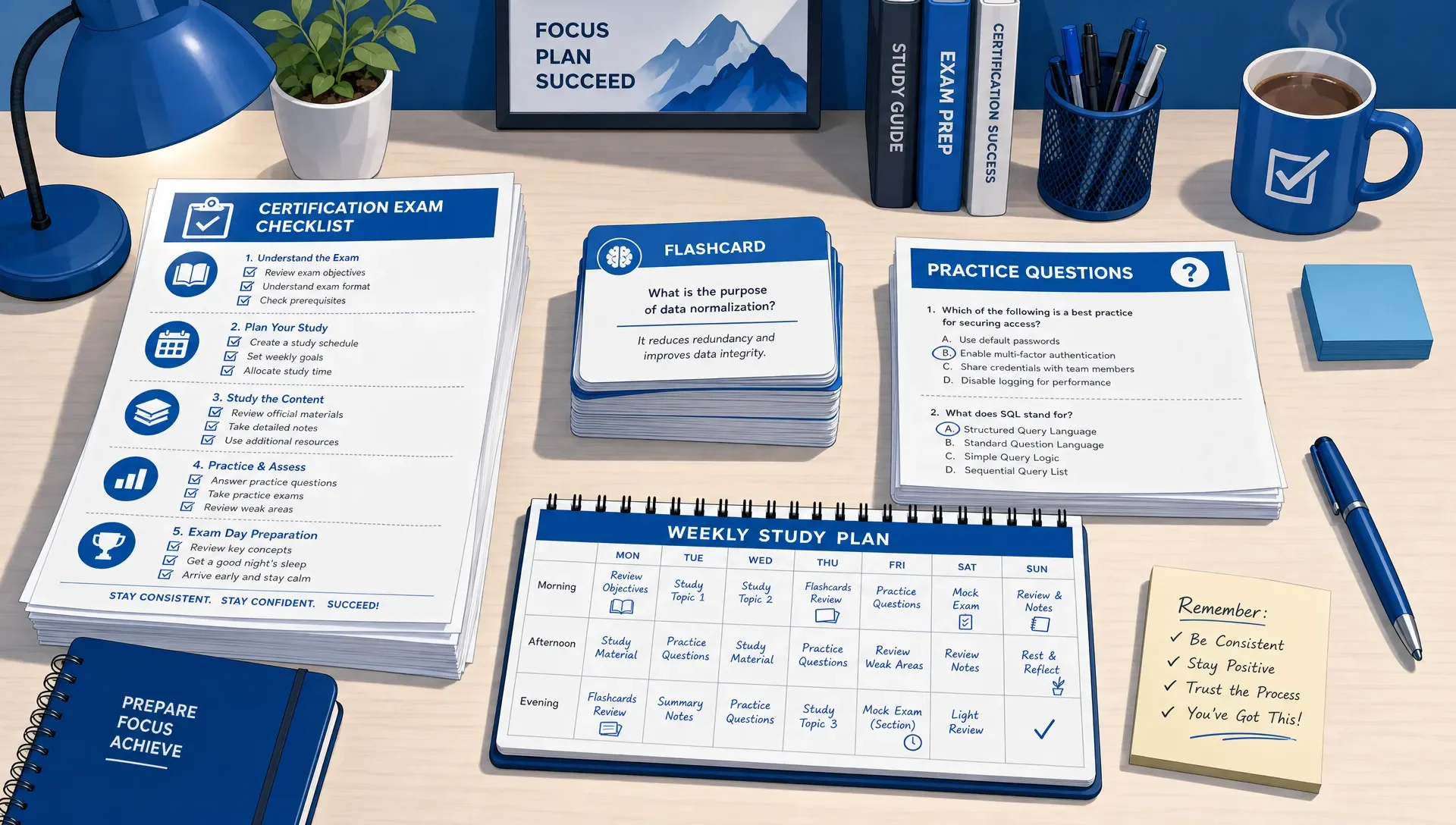
Study Guides and Vendor Documentation: Teaching the Objectives
A quality study guide translates exam objectives into clear, digestible lessons. It should explain the concept, show its real-world application, highlight common points of confusion, and offer a way to check your understanding before you move on.
When comparing books, PDFs, notes, or courses, choose a guide that closely follows the exam's structure. MindMesh Academy also offers a more detailed guide on how to evaluate IT certification study guides if you're deciding which format best fits your study stack.
Vendor documentation differs from a study guide. It isn't always written for exam preparation and can cover much more detail than your certification requires. Use it to verify specifics, clarify confusing features, and understand official terminology. Avoid attempting to read an entire documentation site from beginning to end unless the exam objectives explicitly demand that level of depth.
| Study Material Quality Check | Strong Sign | Warning Sign |
|---|---|---|
| Objective alignment | Each chapter or module maps directly to an exam domain. | Topics appear because they're popular, not because they're tested. |
| Explanation depth | Concepts explain the "why," "when," and "how." | Material consists mostly of definitions without scenarios. |
| Version control | The exam code and update date are clearly stated. | The guide doesn't identify the exam version it covers. |
| Examples | Scenarios reflect the job role tested. | Examples are too general or unrelated to the exam content. |
| Review structure | Includes summaries, comprehension checks, and recall prompts. | You only passively read or watch content. |
Your notes shouldn't become a second textbook. Keep them concise, focusing on what you misunderstood, what you forgot, and what the official objectives require you to know.
Practice Questions: Training Reasoning, Not Memorization
Practice questions aren't just for predicting your score. They're where you learn how the exam phrases questions, identify distractors, and practice applying knowledge without relying on notes. The Institute of Education Sciences practice guide on organizing instruction and study recommends using tests and quizzes as learning events, not just final checks.
A strong practice question includes a clear scenario, plausible answer choices, and an explanation that teaches the decision process. This explanation should detail why the correct answer fits and why the other options do not. If a question bank only provides answer letters, it's an incomplete study resource.
For example, if you're preparing for cloud fundamentals, an AWS Certified Cloud Practitioner practice exam can help you test your understanding after each domain. If you're pursuing a security certification, a CompTIA Security+ practice exam offers a way to practice with explanations and pinpoint weak areas before exam day.
| Practice Material | Use It For | Don't Use It For |
|---|---|---|
| Topic quizzes | Checking a domain immediately after studying. | Declaring full exam readiness. |
| Mixed question sets | Practicing topic switching and integration. | Learning brand-new content from scratch. |
| Timed practice exams | Testing your pacing and stamina. | Memorizing repeated question patterns. |
| Missed-question review | Rebuilding weak knowledge and understanding. | Only counting the final score. |
| Performance-based items | Practicing tasks and troubleshooting. | Replacing conceptual study. |
A practice score without review offers limited insight. Most learning happens during the review session, especially when you record why a certain answer seemed tempting and what crucial detail you missed.
Flashcards, Labs, and Scenario Material: Beyond Multiple-Choice
Some exam knowledge relies on pure recall. Ports, service names, formulas, command meanings, process groups, risk terms, and protocol behavior often demand repeated retrieval. Flashcards are effective here because they require you to actively pull the answer from memory, rather than just recognizing it in a paragraph.
Use flashcards for facts and distinctions, not for lengthy explanations. A card asking one clear question is easier to review than one attempting to cover an entire chapter. Spaced repetition is particularly helpful, as it brings challenging cards back more frequently and delays those you already know well.
Hands-on and scenario material are also crucial when the exam tests practical judgment. For cloud, networking, and security exams, you may need to understand configurations, logs, access controls, troubleshooting steps, or architecture tradeoffs. For project management and IT service management exams, scenarios often assess process judgment, stakeholder responses, and priority decisions.
| Material Type | Best Use | Example Candidate Need |
|---|---|---|
| Flashcards | Recall and distinction practice. | Remembering terms, acronyms, ports, formulas, phases. |
| Labs | Skill practice. | Configuring, observing, troubleshooting, validating behavior. |
| Scenario prompts | Judgment practice. | Choosing the best next step in a realistic situation. |
| Performance-based practice | Task flow practice. | Completing a configuration or analysis under time pressure. |
| Error log | Pattern detection. | Finding repeated mistakes across domains. |
The right mix of materials depends on the specific certification. A vocabulary-heavy fundamentals exam might require more flashcards. A configuration-heavy networking exam needs more hands-on repetition. A management exam benefits from more scenario-based judgment practice.
How to Audit Exam Material Before You Trust It
Before committing to any resource, examine it like an instructor would. You're looking for alignment with objectives, accuracy, clarity, and effective feedback mechanisms. If a resource fails a basic audit, don't make it the core of your plan.
MindMesh Academy provides a separate guide on how to judge study material before you trust it. The short version is simple: cross-reference it with official objectives, inspect the explanations, and verify that it helps you correct mistakes.
Use this audit before you buy, download, or build your study around a resource:
- Confirm the exact exam code, version, and update date.
- Compare the table of contents to the official exam objectives.
- Check whether practice explanations cover why wrong answers are wrong, not just why correct ones are right.
- Look for scenario-based and performance-based practice when the exam requires application of skills.
- Remove "answer-only" PDFs, copied question lists, and materials marketed as "real exam questions."
- Ensure the resource gives you topic-level feedback, not just a total score.
- Stick to one primary study path to avoid bouncing between conflicting explanations.
This audit should take less than an hour. That hour can save you weeks of ineffective study from a mismatched resource.
Exam Material Checklist by Certification Category
Different certifications demand different study emphasis. You can use the same checklist categories, but the balance shifts depending on the exam type.
| Certification Category | Must-Have Exam Material | Extra Material That Often Helps |
|---|---|---|
| Cloud fundamentals | Official objectives, service summaries, scenario questions, flashcards. | Simple architecture diagrams and pricing model notes. |
| Cloud associate or professional | Vendor documentation, labs, architecture scenarios, timed practice exams. | Well-organized service comparison notes. |
| Cybersecurity | Official objectives, terminology flashcards, log and control scenarios, practice questions. | Risk frameworks, incident response scenarios, performance-based tasks. |
| Networking | Exam topics, command references, subnetting practice, troubleshooting labs. | Packet flow diagrams and configuration drills. |
| Project management | Exam content outline, process and people scenarios, terminology flashcards. | Decision trees for stakeholder, risk, and change questions. |
| IT service management | Syllabus or exam outline, concept definitions, lifecycle scenarios, practice questions. | Process relationship maps and service value examples. |
If your exam covers a broad range of topics, don't try to go deep on everything simultaneously. First, cover the objectives at a baseline level, then use practice results to determine where deeper study is needed.
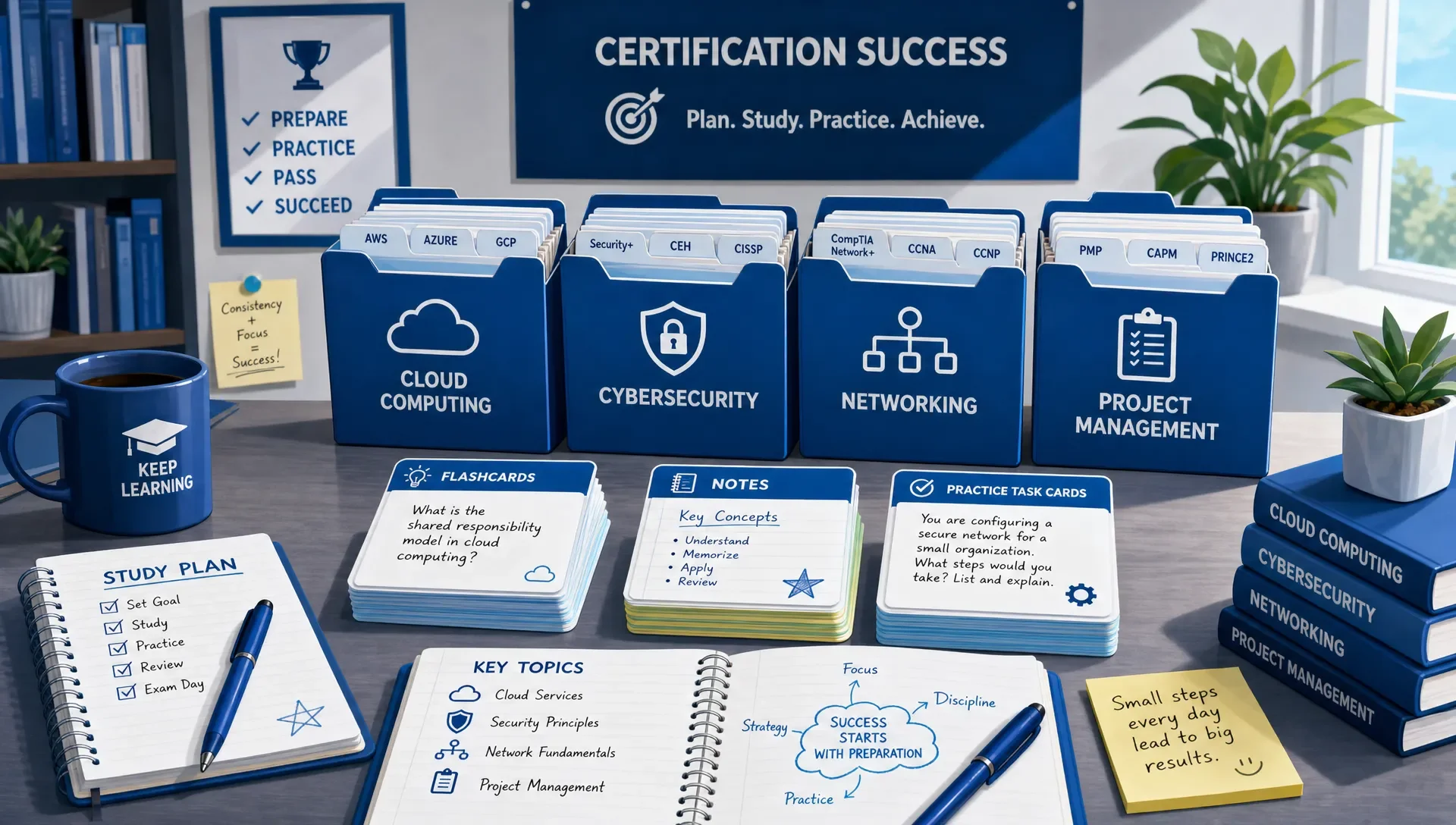
Four-Week Exam Material Audit Plan
If your exam date is approaching, stop accumulating resources and start refining your study system. The final weeks should focus on closing coverage gaps, practicing under timed conditions, strengthening recall, and building confidence in weak domains.
| Time Before Exam | Main Exam Material to Use | What to Do | Readiness Evidence |
|---|---|---|---|
| Four weeks | Official objectives and study guide | Mark each domain as strong, medium, or weak. | You know exactly which topics need work. |
| Three weeks | Topic quizzes and flashcards | Drill weak domains and revisit missed concepts. | Weak-topic scores start to stabilize. |
| Two weeks | Mixed practice sets and scenarios | Practice switching between domains and applying knowledge. | You can explain why answers are right and wrong. |
| Final week | Timed practice exam and error log review | Review patterns, refine pacing, and address recurring mistakes. | You have fewer unexpected knowledge gaps and better time control. |
This plan works best when your study materials provide topic-level feedback. A single overall percentage isn't enough; you need to know if your weakness lies in identity, networking, risk, governance, storage, stakeholder response, troubleshooting, or another specific domain.
Common Exam Material Mistakes to Avoid
Most candidates don't fail due to a lack of material. They struggle because their material was scattered, outdated, passively consumed, or not reviewed correctly. Keep your study stack lean and purposeful.
Avoid these common mistakes:
- Studying from a guide that doesn't match the current official exam outline.
- Watching lessons without following up with closed-book recall exercises.
- Taking practice exams repeatedly without thoroughly reviewing the explanations.
- Tracking only total scores instead of analyzing domain-level weaknesses.
- Ignoring hands-on or performance-based practice for practical exams.
- Using too many resources at once and never completing a single study path.
- Saving flashcards for the final week instead of reviewing them consistently throughout your preparation.
If you've already made one of these mistakes, there's no need to restart from scratch. Audit your materials, keep what aligns with the objectives, and rebuild your plan around your identified weak domains.
Frequently Asked Questions
What is the most important exam material for a certification candidate? The official exam objectives are the most important starting point because they define the scope. After that, you need a structured study guide, practice questions with explanations, flashcards or recall prompts, and a way to track readiness by topic.
How many certification study resources do I actually need? A practical collection usually includes one official objective document, one main study guide, one practice question system, one flashcard system, and selected vendor documentation for clarification. Add labs or performance-based practice when the exam tests practical tasks.
Are practice exams enough to pass a certification exam? Practice exams are important, but they aren't enough on their own. They help identify knowledge gaps and build exam reasoning, but you still need study material that teaches concepts and recall material that helps you retain facts.
How do I know if my exam material is outdated? Check the exam code, version, publication date, and the official exam page. If the resource doesn't identify the version it covers, or if its topics don't match the current objectives, consider it a risky resource.
Should I make my own flashcards or use prebuilt flashcards? Both approaches can work. Create your own cards for mistakes, confusing terms, and details you personally struggle to remember. Prebuilt flashcards can save time for common definitions and acronyms, especially when they support spaced repetition.
What should I do when two resources disagree? Use the official vendor documentation or official exam objectives as the definitive source. If the disagreement concerns exam interpretation, look for the explanation that best matches the current objective wording and the job role the exam is designed to test.
Build an Exam Material Stack That Shows Real Readiness
The best exam material doesn't just help you study more. It helps you study the right topics, practice effectively, and confidently know when you're prepared.
To get started, explore the certifications available at MindMesh Academy. You'll find tools like adaptive practice questions with explanations and mastery tracking to help you identify and improve weak areas. Map your materials to the objectives, and let your weak areas guide your next study steps. Find your path to certification success by checking out our practice exams.

Written by
Alvin Varughese
Founder, MindMesh Academy
Alvin Varughese is the founder of MindMesh Academy and an enterprise architecture leader. An electrical engineer by training, he moved from factory automation in South Africa to cloud architecture at GE Appliances and Humana (Fortune 50), and holds 20 professional certifications including AWS Solutions Architect Professional, Azure DevOps Engineer Expert, and Microsoft Agentic AI Business Solutions Architect. He built MindMesh Academy after interviewing too many highly certified candidates who couldn't answer basic questions: the goal is prep that makes you better at the job, not just able to pass the exam.