
Should I Get ITIL Certification? 2026 Career Guide
Should I Get ITIL Certification? Your Current Career Path
You're likely facing a common question for many IT professionals: job postings mention ITIL, your manager discusses "service maturity," and you're wondering if this certification will advance your career or just consume your free time.
From my experience hiring individuals with and without ITIL, my honest assessment is straightforward. ITIL certification helps in some roles, is useful but not essential for others, and can be merely resume decoration for a few. The mistake is treating it as a universal career solution. It isn't.
If your daily work involves service delivery, incident management, change enablement, problem management, vendor coordination, service desks, IT operations leadership, or ITSM tools like ServiceNow, ITIL can definitely be beneficial. If you're a developer who rarely interacts with operational governance, the benefits are typically less direct, unless you're moving into platform engineering, Site Reliability Engineering (SRE), delivery leadership, or service ownership roles.
So, if you're asking should I get ITIL certification, don't begin with the syllabus. Start by evaluating your current role, your desired future role, and the type of company you want to work for. These factors truly determine whether ITIL becomes a career-builder or just another line on LinkedIn.
Is an ITIL Certification Your Next Best Career Move?
Many professionals consider this question at the wrong time and for the wrong reasons. They ask it when they feel stuck, hoping a single certification will solve everything. It won't.
ITIL provides the most value when you already have operational accountability. This means you manage tickets, queues, Service Level Agreements (SLAs), changes, outages, service reviews, support workflows, or cross-team handoffs. In these positions, ITIL offers a language employers already understand. It also signals your ability to work within structured environments without causing disruption.
For those early in their career, ITIL can enhance credibility for support, operations, and service management roles. Mid-career professionals can use it to transition from a "good technical person" to someone who can "run services effectively." For senior professionals, its value shifts from a knowledge source to a hiring filter, especially within larger enterprises.
Practical rule: Get ITIL when your next role requires process ownership, service accountability, or stakeholder-facing IT operations. Skip it if you're pursuing a deeply technical specialist path with minimal service management exposure.
Use this decision filter to guide your choice:
- Get it now if you're targeting roles such as service desk lead, ITSM analyst, incident manager, problem manager, change manager, service delivery manager, or IT operations manager.
- Get it soon if you're in support, sysadmin, or infrastructure roles and aim for promotion into coordination or leadership positions.
- Probably skip it if you're primarily a software engineer and your career path remains focused on coding, architecture, or product engineering.
- Pair it with something else if you lead projects, manage cloud operations, or bridge technical and business teams.
This is the accurate perspective. The question isn't "Is ITIL good?" but rather "Does ITIL align with the kind of work I want people to trust me with?"
What Is ITIL and Why Do Companies Use It?
ITIL is a framework for IT Service Management (ITSM). Simply put, it's a structured approach to managing IT so services aren't dependent on chance, last-minute heroics, or who happens to be available.
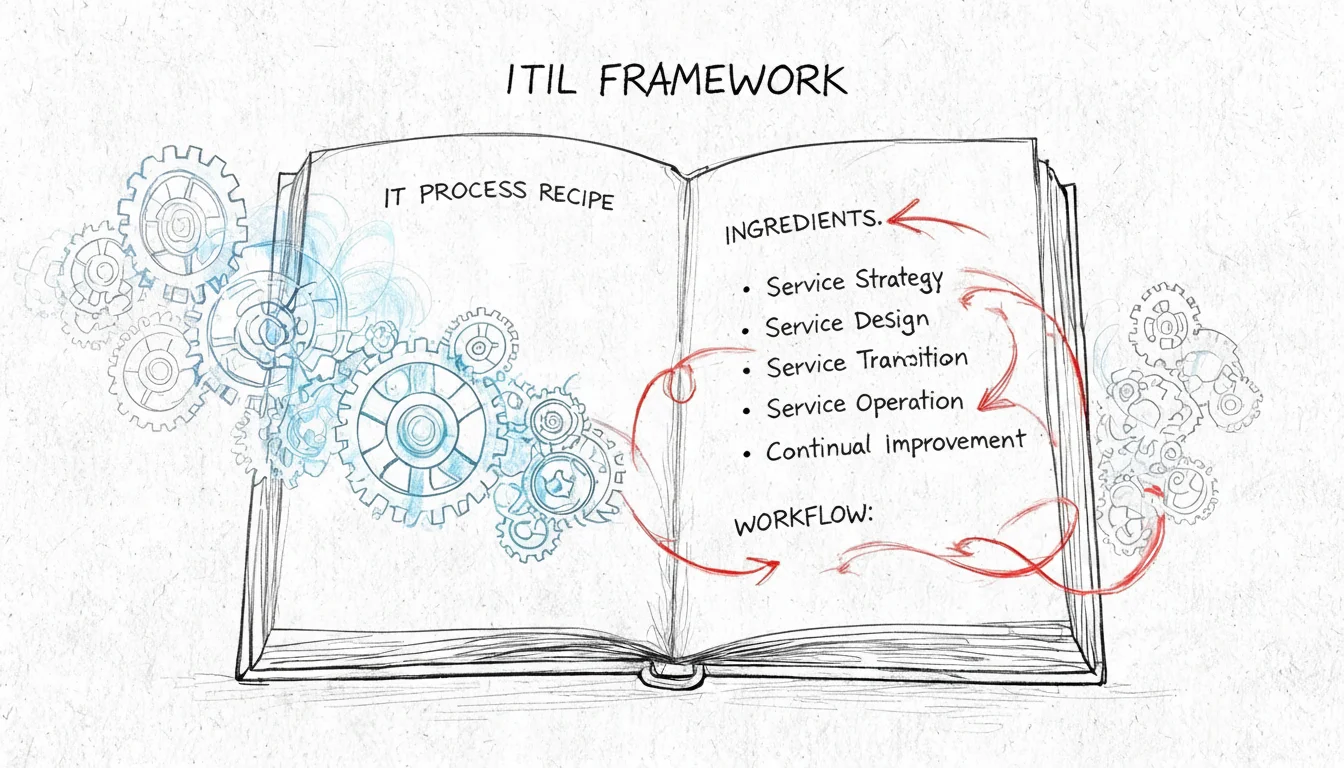
Think of ITIL as an operating manual for an IT organization—not a rigid script or a law, but more like a cookbook with proven methods for handling recurring tasks such as incidents, requests, changes, service levels, continual improvement, and delivering customer value. Effective teams adapt it; less effective ones turn it into bureaucracy.
Why large companies value it
Large organizations adopt ITIL not for its impressive name, but because informal processes fail at scale. When you have multiple support teams, outsourced vendors, change windows, executive reporting, compliance demands, and customer-facing systems, undocumented habits become unsustainable.
Information suggests that ITIL 4 is widely adopted, with 60% of enterprises using it as the standard framework for IT service management roles. Additionally, 85% of Fortune 500 companies use ITIL frameworks for managing IT services, and IBM requires it for 70% of its IT roles.
This highlights an important point: ITIL isn't a niche framework. It's fundamental to how enterprise IT communicates and operates.
What companies gain from it
On a practical level, companies use ITIL to streamline these critical areas:
- Incident handling: Establishing clear ownership, escalation paths, and response expectations.
- Change control: Reducing reckless production changes and avoidable outages.
- Service requests: Ensuring repeatable fulfillment instead of chaotic email management.
- Problem management: Stopping teams from repeatedly fixing the same issues.
- Business alignment: Connecting IT work directly to the services customers consume.
For a clearer explanation of ITIL's place within the broader service management world, this overview of the ITSM career path at Mindmesh Academy can be helpful.
Companies don't acquire ITIL for theoretical knowledge. They buy predictability.
This is why the certification carries weight. It demonstrates to employers that you understand the fundamentals of running IT as a service, not merely as a collection of tools and tickets.
The ITIL 4 Certification Path Explained
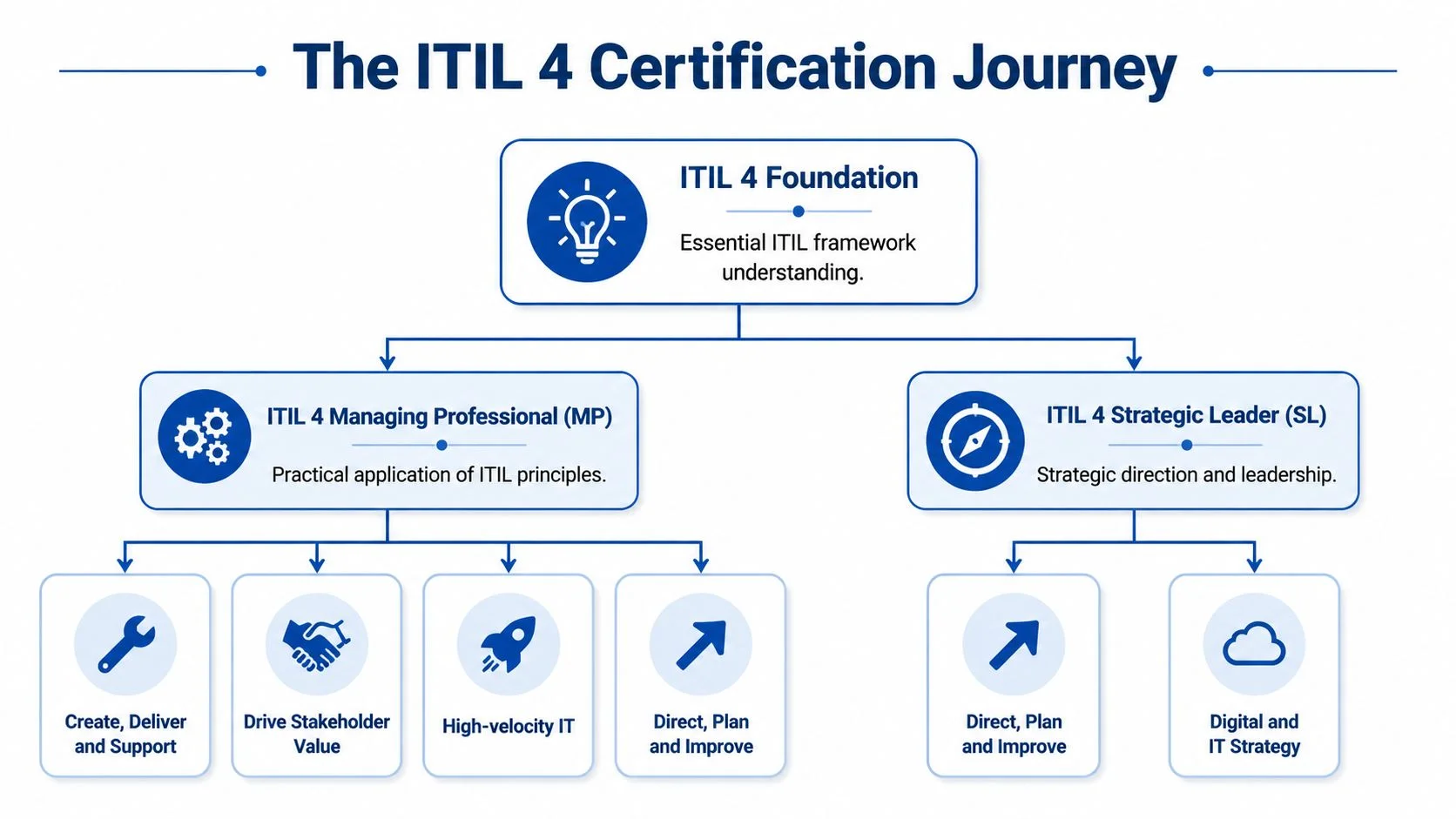
Many professionals are only familiar with ITIL 4 Foundation. This is the entry point, and for many, it's sufficient. However, if you're planning a long-term ITSM career, there's more to the path than just a single exam.
Where most professionals should begin
Foundation is designed for understanding the ITIL model. You'll learn the service value system, key practices, core terminology, and how ITIL integrates with modern delivery approaches. If you're new to service management, this is the only logical first step.
Beyond Foundation, the path diverges based on your specific work responsibilities.
The two primary advanced directions
The Managing Professional (MP) stream suits individuals who manage or improve services in day-to-day delivery. This path is appropriate if you oversee operational workflows, support models, stakeholder value, or high-velocity environments.
The Strategic Leader (SL) stream is for those who connect IT decisions to business strategy. If you're moving toward leadership, governance, digital operating models, or enterprise planning, this track offers greater value.
Many professionals eventually pursue both, but typically not at the outset. Choose the path that aligns with your actual job functions, not simply to impress with a title.
ITIL 4 certification levels compared
| Certification Level | Who It's For | Key Prerequisites | Estimated Cost (USD) | Estimated Time Commitment |
|---|---|---|---|---|
| ITIL 4 Foundation | Entry-level IT support, sysadmins, analysts, career changers | None | Varies by provider and exam package (verify current pricing on the vendor site) | Usually manageable with self-study or short structured preparation |
| ITIL 4 Managing Professional | IT operations, service delivery, platform, and support leaders | Foundation | Higher than Foundation, varies by module and training path (verify current pricing on the vendor site) | Multi-module commitment over time |
| ITIL 4 Strategic Leader | IT managers, senior leads, digital transformation roles | Foundation | Higher than Foundation, varies by module and training path (verify current pricing on the vendor site) | Multi-module commitment with more strategic study focus |
| Legacy ITIL Expert path | Professionals on older tracks and deep ITSM specialists | Multi-stage progression | Significant cumulative investment (verify current pricing on the vendor site) | Long-term commitment across several modules |
Don't underestimate the effort
People often speak of "getting ITIL" as if it's a single, quick exam. This is true only at the Foundation level. The older, advanced structure illustrates the depth required for true proficiency. For instance, the ITIL Expert designation previously required at least 17 credits from multiple modules plus the Managing Across the Lifecycle exam. This shows that advanced ITIL has never been a casual badge.
Here's my recommendation:
- Foundation only if you need credibility quickly and your role is operational.
- Move to MP if you're responsible for how services are delivered.
- Move to SL if your job is becoming more business-facing and strategic.
- Don't pursue advanced levels unless your work clearly requires them.
If you're looking for a structured starting point, these comprehensive ITIL exam guides can help you plan your path before committing financially.
The Concrete Career and Salary Benefits of ITIL
This is often the most pressing concern for professionals. And rightly so. A certification should either help you earn more, get shortlisted more frequently, or secure more fulfilling work. Otherwise, it's merely an academic credential.

What the data suggests about earnings
Information indicates that ITIL certification holders earn an average salary of $93,601 in North America. The same source also highlights that recent data shows ITIL certification can boost salaries by 15% to 25% above industry standards, citing a concrete example of IT Service Managers moving from an average of $85,000 to $105,000 after certification.
It's important to remember that the certification alone rarely causes such a raise. Typically, the certification combines with role progression, stronger professional positioning, and access to jobs that pay more due to increased operational responsibility. However, the trend is clear: ITIL holds genuine market value in the right career lane.
Where ITIL offers the most help
I've observed ITIL making the biggest difference in hiring for roles like these:
- Service desk lead
- ITSM analyst
- Incident or problem manager
- Change manager
- Service delivery manager
- IT operations manager
- ServiceNow process owner or implementation-focused roles
In these positions, the certification achieves two things. First, it helps you pass resume screening. Second, it reassures the hiring manager that you already understand basic process language and won't require fundamental explanations.
If you're early in your career and need to present certifications effectively, this guide on professional certifications for graduates offers resume-side advice.
What the salary bump doesn't always reveal
Consider this: ITIL delivers the best financial returns when it changes the kind of role you qualify for. It doesn't magically make an underperforming technician highly paid. Instead, it strengthens a profile already geared toward service ownership, process discipline, and cross-team coordination.
That's why I advise people to compare it against other certification paths before committing. If your primary goal is raw compensation, it helps to compare current high-paying IT credentials and see how ITIL fits your market.
A brief explainer can also clarify where ITIL fits in modern IT careers.
If your target job involves owning service outcomes, ITIL can increase your value. If your target job focuses on shipping code all day, the payoff is typically indirect.
Weighing the Pros, Cons, and Costs For Your Role
Let's be direct: ITIL isn't equally valuable for everyone.
The strongest criticism against ITIL is that it can become "paper knowledge." This is a fair point when individuals memorize terms without applying them. However, it's also often overstated. Data indicates that 76.5% of intermediate and advanced ITIL certification holders applied what they learned directly to their work activities and projects.
So, yes, ITIL can be practical. But only if your job provides opportunities to use it.
Role-by-role return on investment (ROI)
Help desk and desktop support
This is one of the best entry points for ITIL.
Pros: You deal with incidents, requests, escalations, and user expectations daily. ITIL provides structure to your existing work. It also improves interview performance because you can articulate ticket flow, prioritization, service impact, and process discipline using employer-recognized language.
Cons: Foundation is usually sufficient. Pursuing deeper levels too early won't significantly alter your role unless you're moving into a team lead or service coordination position.
System administrator and infrastructure engineer
This is a mixed scenario.
You'll benefit if your work includes change windows, root cause analysis, operations handoffs, maintenance governance, and shared service ownership. You'll benefit less if you're primarily focused on hands-on engineering tasks with minimal process leadership.
Good fit: Enterprise environments, managed services, regulated industries, large internal IT teams. Weak fit: Small startups where individuals mostly troubleshoot immediate issues.
Developer and software engineer
For most developers, ITIL isn't the first certification I'd recommend.
If your day revolves around coding, frameworks, architecture, and delivery pipelines, ITIL won't yield the same return as role-aligned technical learning. It becomes more valuable when you begin owning production support, platform reliability, release governance, or customer-facing service commitments.
Don't acquire an operations credential because job boards frequently list it. Acquire it when your actual work responsibilities are shifting toward operations.
Project manager and delivery lead
ITIL can be useful, but it's rarely the primary certification. It adds value if you manage the launch of new services, service transitions, or operational readiness. If your focus is primarily on timelines, budgets, and stakeholder delivery, another project-focused credential might be more relevant.
IT manager and aspiring service leader
ITIL offers some of its greatest benefits in this context.
Managers need a common framework for incident reviews, service quality, continual improvement, and operational accountability. If you lead teams responsible for supporting business services, ITIL transforms from an academic concept into essential management shorthand.
The actual costs to consider
Don't just account for the exam fee. Factor in the total investment:
- Training cost: This varies significantly by provider, format, and whether the exam is bundled.
- Study time: Nights, weekends, and the mental effort of learning new terminology if ITSM is unfamiliar.
- Opportunity cost: Time spent on ITIL is time not spent on cloud skills, security, automation, or other areas that might advance your career.
- Renewal or continued progression: Advanced paths require ongoing commitment if you plan to continue climbing.
My straightforward recommendation by profile
| Your profile | Recommendation |
|---|---|
| Early-career support analyst | Get Foundation |
| Sysadmin moving toward service ownership | Get Foundation, then reassess |
| Developer staying technical | Usually skip |
| ServiceNow or ITSM tooling professional | Strong yes |
| IT manager in enterprise operations | Strong yes |
| Consultant serving large enterprise clients | Yes, especially for credibility |
If your daily work involves services, workflows, and accountability, ITIL is a wise investment. Otherwise, it's often just a neat badge.
ITIL vs. Other Certifications Like DevOps, PMP, and COBIT
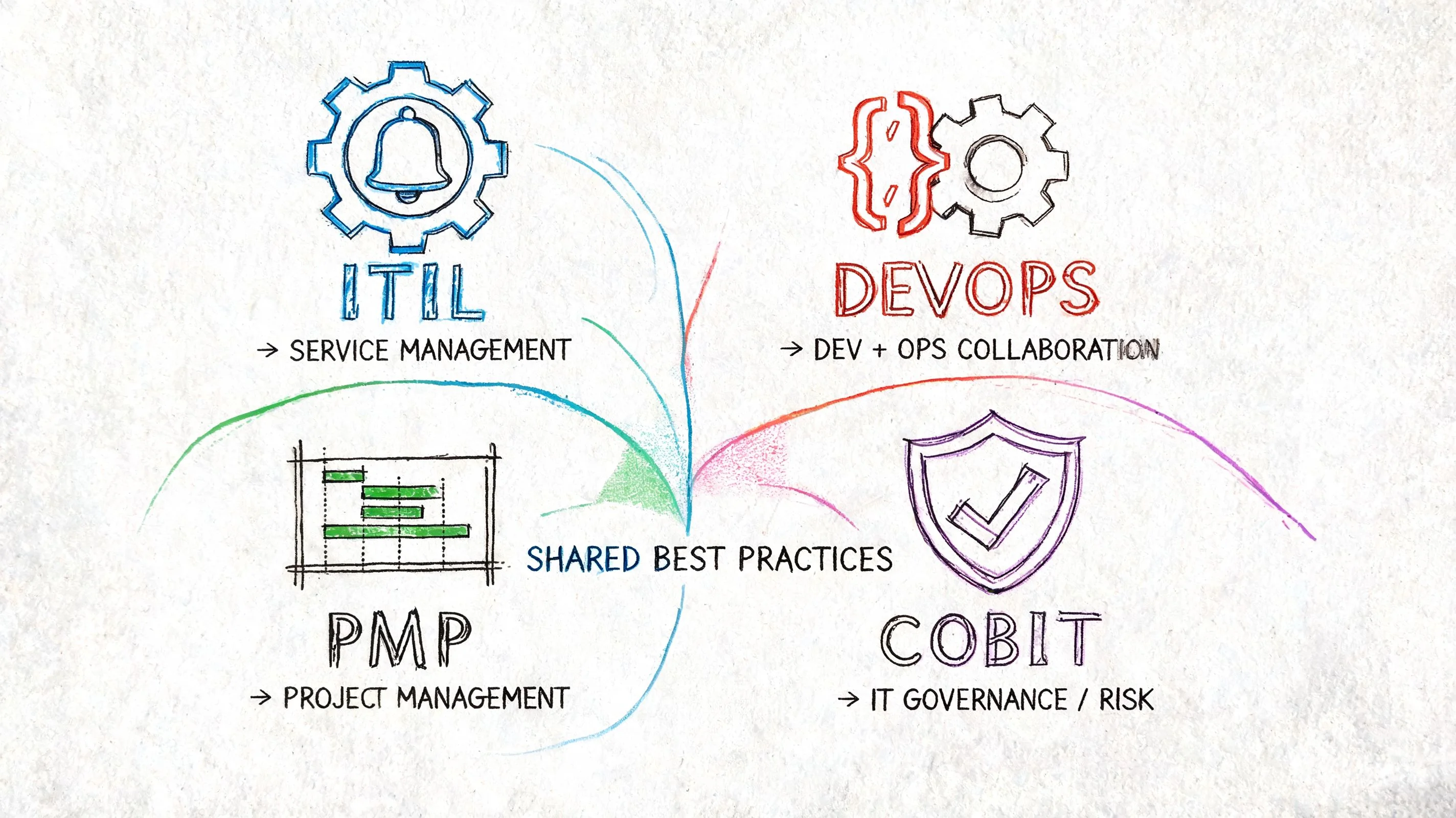
ITIL doesn't directly compete with every certification. Much of the confusion arises from comparing frameworks designed to solve different problems.
Choose based on the job, not the brand
Here's the clearest way to approach this decision.
| Certification | Best for | Weak fit when |
|---|---|---|
| ITIL | Service management, operations process, support governance, service delivery | You want a purely technical or coding-focused credential |
| DevOps certifications | Automation culture, CI/CD, collaboration between development and operations, delivery speed | You primarily need formal service process language |
| PMP | Project execution, deadlines, budgets, stakeholder management | Your role is ongoing service operations rather than finite projects |
| COBIT | Governance, control, audit alignment, enterprise oversight | You need practical service desk and operations guidance |
Where ITIL excels
ITIL is the stronger choice when your career depends on addressing questions like:
- Who is responsible for this service?
- How do we manage changes effectively?
- How do we prioritize incidents?
- How can we reduce recurring issues?
- How do we align IT work with customer value?
This differs from DevOps, which focuses more on delivery flow, automation, and shared responsibility. If you're trying to clarify that distinction, this article on choosing between Agile and DevOps offers useful insights into how delivery culture differs from service management thinking.
When to combine certifications
The most effective strategy often involves combining certifications, rather than choosing one over another.
- ITIL + PMP is effective for managers who launch and transition services.
- ITIL + DevOps suits platform, SRE-adjacent, or operations leaders who require both structured service management and modern delivery practices.
- ITIL + COBIT is a good fit for governance-heavy environments where audit, control, and service discipline are all critical.
The wrong certification doesn't just waste money. It can steer you toward an unsuitable professional identity.
If you aim to run reliable IT services, ITIL is the primary choice. If you manage projects, prioritize PMP first. If you want to modernize delivery pipelines and foster team collaboration, start with DevOps. If you work in governance or audit-intensive environments, COBIT may carry more weight.
This is why blanket advice often falls short. The right certification depends on the specific problems your employer expects you to solve.
Your Final Decision Checklist and How to Get Started
For a concise answer, here it is:
Get ITIL if your career is progressing toward IT operations, service management, process ownership, or enterprise IT leadership. Skip it if your work remains purely technical and service governance rarely impacts your day.
Final checklist
Say yes to ITIL if most of these apply to you:
- Your target roles explicitly mention service delivery or ITSM.
- You work in a larger enterprise or aspire to.
- You deal with incidents, requests, changes, support models, or service reviews.
- You want to move from individual contributor work into coordination or management.
- You need a credential that operations-heavy hiring managers immediately recognize.
Pause before purchasing if these resonate more with your situation:
- You're a developer focused on code, architecture, or product engineering.
- You're pursuing a cloud, security, or data role where another certification would be more directly relevant.
- You dislike process work and prefer to avoid jobs involving service accountability.
- You want a quick return on investment, but your current role offers no opportunity to apply ITIL concepts.
How to start without wasting time
For many IT professionals, Foundation is the correct first step. Don't overcomplicate it. Pass the entry exam, grasp the vocabulary, and observe whether it improves your interview quality and internal credibility.
If you already hold older credentials, your decision is more specific. Current job postings frequently request ITIL 4. ITIL v3 experts can transition to ITIL 4 Managing Professional by completing two modules, offering a faster and more cost-effective path than starting from scratch. So, if you've already invested in v3 and still work in relevant environments, bridging makes more sense than discarding your previous efforts.
Pick a study method that matches your habits
Your options are clear:
- Self-study: Best if you already work in ITSM and primarily need to align with exam content.
- Structured online preparation: Better if you prefer guided practice, flashcards, and a defined study sequence.
- Bootcamp or instructor-led course: Useful if your employer funds it and you need a fixed schedule.
My advice as a hiring manager is simple: don't stop at passing. Use the certification to enhance how you discuss incidents, service quality, risk, stakeholder value, and continual improvement. That's how ITIL transforms from a piece of paper into a strategic advantage.
If you've decided ITIL fits your career path, prepare for your ITIL 4 Foundation exam with confidence. You can build a strong foundation for the exam and be well-prepared on exam day with the practice-driven learning resources at MindMesh Academy. Check out our ITIL 4 Foundation practice exam to begin.

Written by
Alvin Varughese
Founder, MindMesh Academy
Alvin Varughese is the founder of MindMesh Academy and an enterprise architecture leader. An electrical engineer by training, he moved from factory automation in South Africa to cloud architecture at GE Appliances and Humana (Fortune 50), and holds 20 professional certifications including AWS Solutions Architect Professional, Azure DevOps Engineer Expert, and Microsoft Agentic AI Business Solutions Architect. He built MindMesh Academy after interviewing too many highly certified candidates who couldn't answer basic questions: the goal is prep that makes you better at the job, not just able to pass the exam.