ITSM vs ITIL Understanding the Key Differences
ITSM vs ITIL: Understanding the Key Differences
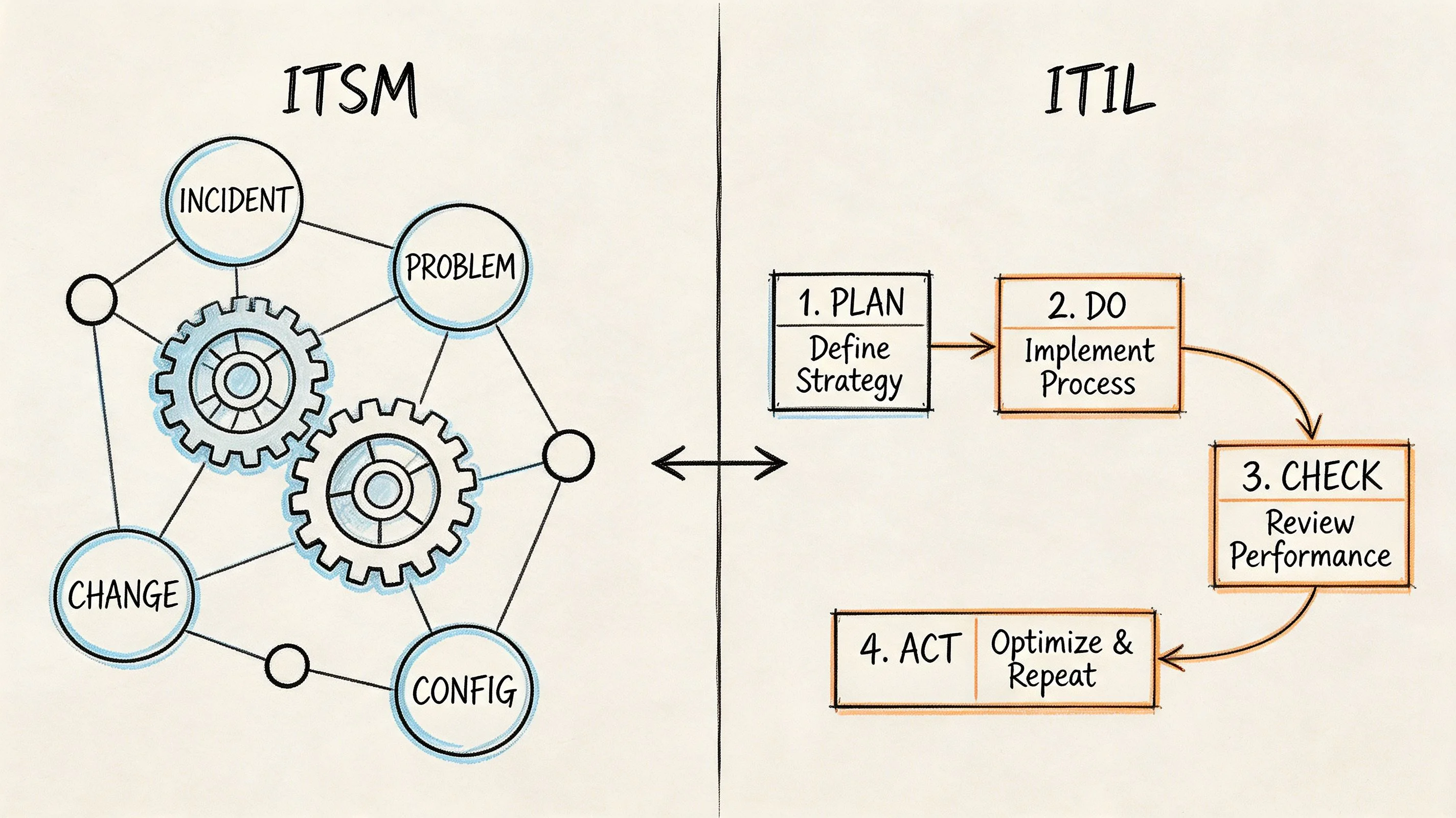
Many IT professionals find themselves confused by the distinction between ITSM and ITIL. To clarify this simply: ITSM defines what you're doing, and ITIL is a popular framework detailing how to do it effectively.
You don't pick one over the other. Instead, you adopt an ITSM approach, and the ITIL framework can guide you toward success.
ITSM vs. ITIL: The Core Distinction Explained
Think of IT Service Management (ITSM) as a complete mindset shift for your IT department. It’s the overarching discipline of managing all your IT activities—from planning and building to delivering and supporting—as services that provide real value to the business. The core goal is to stop viewing IT as just a cost center and start treating it as a strategic partner that helps the business succeed.
So where does ITIL fit in? ITIL, which originally stood for IT Infrastructure Library, is the most widely recognized and used framework for implementing ITSM. It’s a collection of best practices, processes, and recommendations, refined over decades by thousands of professionals. It gives you a structured way to achieve your ITSM goals.
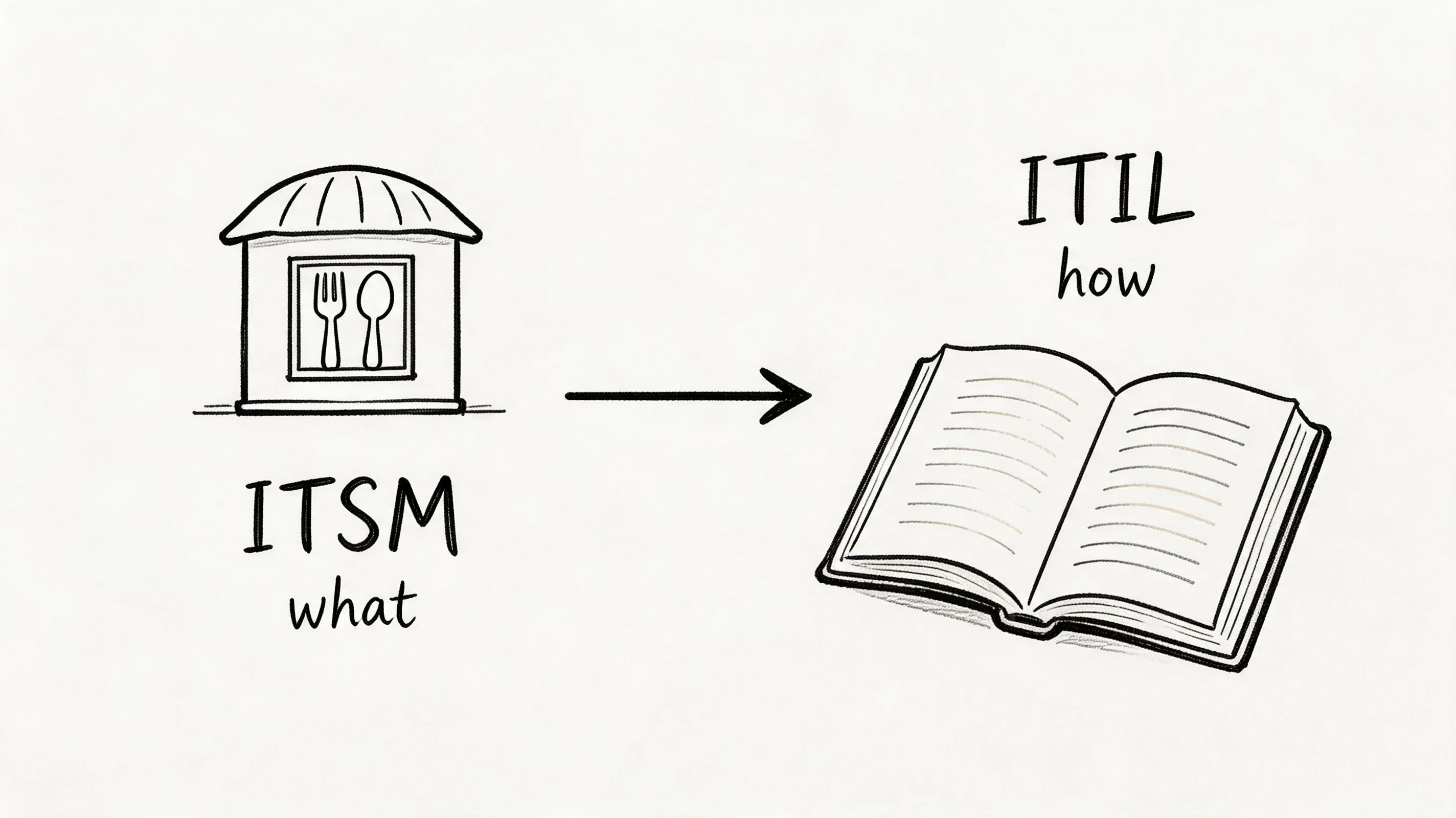
Key Takeaway: You can't be "ITIL compliant" the way you can with a standard like ISO 27001. ITIL is not a rigid set of rules; it's a library of guidance that you adapt to your organization's specific needs to build an effective ITSM strategy.
The Restaurant Analogy
Here’s a practical analogy I often use to make this relationship clear:
-
ITSM is your mission: to open and operate a world-class restaurant. This mission covers everything—designing the menu, sourcing fresh ingredients, managing the kitchen staff, training the front-of-house team, and ensuring every customer leaves happy.
-
ITIL is your set of Michelin-star cookbooks. These books provide proven recipes, advice on kitchen workflow, techniques for perfect plating, and standards for impeccable service. You don't have to follow every single recipe, but the guidance offers a powerful roadmap to achieving that world-class status.
ITSM and ITIL At a Glance
To truly understand the differences, let's look at a side-by-side summary. This table breaks down how ITSM represents the strategic "what" while ITIL provides the operational "how."
| Aspect | ITSM (The Discipline) | ITIL (The Framework) |
|---|---|---|
| Definition | An organizational strategy for delivering all IT as a service. | A body of best practices used to implement ITSM. |
| Nature | A high-level concept, a discipline, and a business approach. | A specific, documented library of processes and practices. |
| Scope | Broad and strategic, focused on people, processes, and technology. | More prescriptive and tactical, detailing specific functions and workflows. |
| Goal | To align IT with business objectives and deliver consistent value. | To provide a repeatable, efficient, and proven model for service delivery. |
| Origin | An organic evolution of IT management principles over time. | Developed by the UK government in the 1980s to standardize IT operations. |
The history of ITIL itself highlights this relationship perfectly. It was created by the UK government's Central Computer and Telecommunications Agency (CCTA) to bring order to government IT operations. As it evolved into modern versions like ITIL 4, it has remained the go-to "cookbook." In fact, over 80% of Fortune 500 companies have used ITIL to shape their ITSM programs, often leading to a 30-50% reduction in service downtime.
You can explore more about the evolution from traditional processes to modern frameworks on spidya.com.
Defining IT Service Management as a Business Strategy
To get to the heart of the "ITSM vs. ITIL" discussion, we first need to establish one thing about IT Service Management (ITSM). It's not a piece of software or a set of technical rules. It's a fundamental shift in how we think about IT's role in a business.
For decades, many organizations saw IT as a necessary cost center—the department you called when something broke. ITSM flips that script entirely. It reframes IT as a service provider whose primary purpose is to deliver tangible value and help the business succeed. Every action, from deploying a new application to resolving a help desk ticket, gets tied back to a business objective.
At its core, ITSM delivers IT services that are predictable, high-quality, and completely focused on the end-user's needs, whether that user is an employee or an external customer. Instead of just managing a fleet of servers, an ITSM mindset focuses on delivering a reliable "Email and Collaboration Service" that helps the sales team communicate better and close deals faster. It’s all about the outcome, not just the tech.
This strategic view elevates IT from a reactive, operational team to a genuine partner in the organization's success. It’s built on a few powerful ideas.
The Core Principles of ITSM Strategy
A solid ITSM strategy creates a system where IT and the business are on the same team, working toward the same goals. This isn't just wishful thinking; it's driven by three key principles that I've seen make all the difference in successful organizations.
-
Value Co-creation: This is a big one. Value isn't something IT creates in a silo and then hands over to the business. Real value is created together. IT teams sit down with departments to truly understand their pain points and ambitions, then jointly design services that actually solve problems and create opportunities.
-
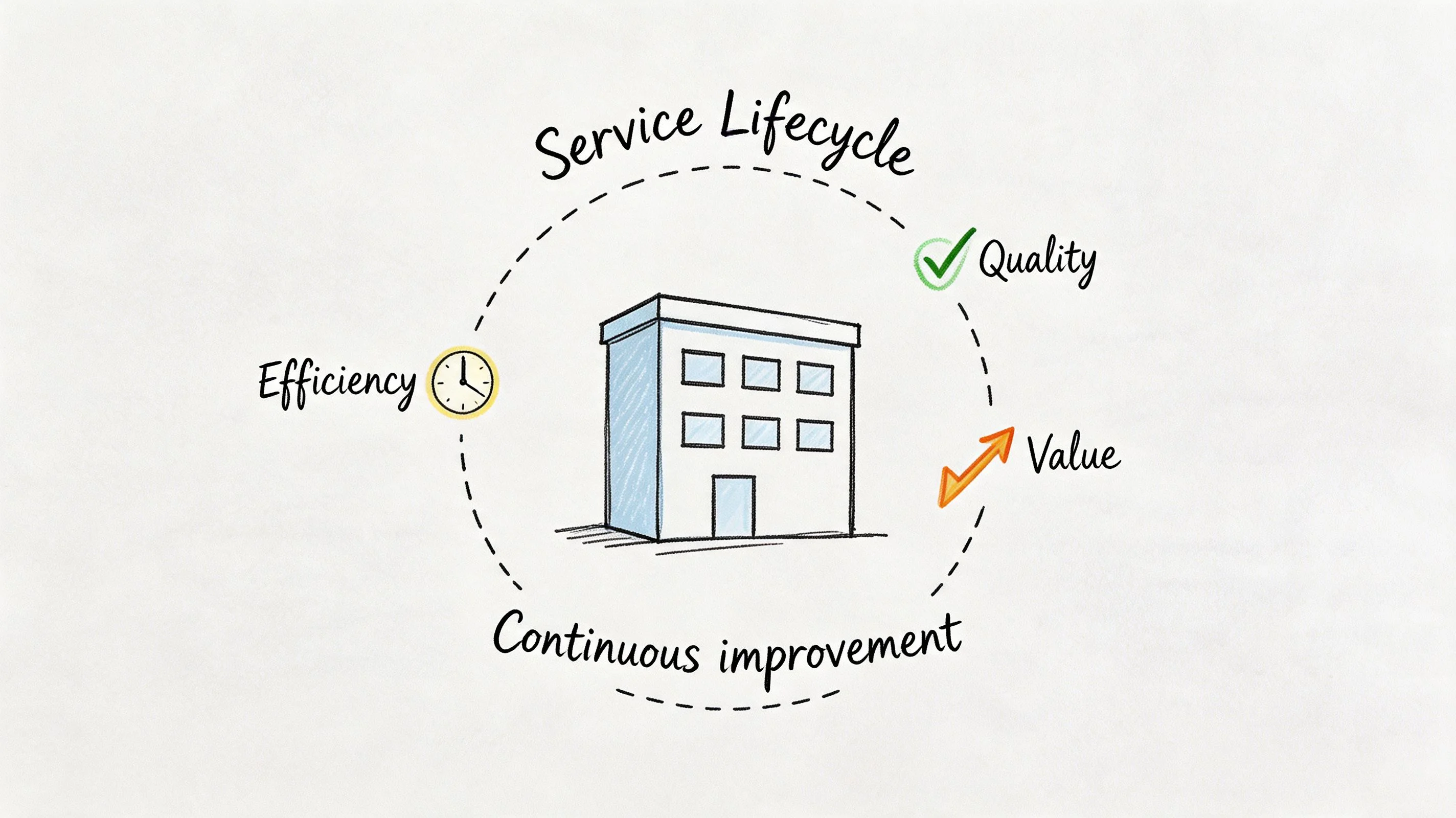
Full Service Lifecycle Management: ITSM looks at the entire life of a service. It's not just about the shiny launch day. It covers everything from the initial idea and design to the transition into the live environment, day-to-day operations, and—crucially—ongoing improvements until the service is eventually retired.
-
A Culture of Continuous Improvement: This isn't a one-and-done project. ITSM fosters an environment where everyone constantly looks for ways to make things better. Processes, services, and performance are always under review to find opportunities for more efficiency and better alignment with what the business needs now.
By focusing on the entire service lifecycle, organizations can avoid the common pitfall of launching new technologies without a long-term plan for support, maintenance, and value measurement. It ensures that investments deliver returns over their entire lifespan.
From Technical Tasks to Business Outcomes
When you adopt an ITSM strategy, your goals change. They stop being about technical metrics and start being about business performance. These objectives become the "why" behind every IT activity and the ultimate measure of success.
So, what are we trying to achieve? It boils down to a few key business-centric goals:
- Enhancing Service Quality: The aim is to provide IT services that are so consistent and reliable that users can depend on them without a second thought.
- Boosting Operational Efficiency: This is about streamlining how work gets done. By cutting out waste and automating routine tasks, you lower costs and free up your sharpest IT minds for more strategic work.
- Aligning IT with Business Needs: Every IT resource—people, technology, budget—should be laser-focused on pushing the company's strategic goals forward, whether that's growing revenue or entering a new market.
- Improving Governance and Reducing Risk: With clear processes for managing changes and handling incidents, you create a more stable and compliant environment. This directly reduces the risk of costly outages and security breaches.
Of course, having these strategic goals is one thing; achieving them is another. That's where you need a proven structure and a set of practical tools. Frameworks like ITIL provide the "how-to" for implementing the strategic "what" of ITSM. For professionals aiming to master the platforms that make this happen, having access to quality Servicenow certification study material is a fantastic place to start building those critical skills.
Understanding the ITIL Framework and Its Evolution
If ITSM defines the strategic "what," then the IT Infrastructure Library (ITIL) provides the practical "how." ITIL isn't a rigid standard you must follow to the letter. Think of it as a rich library of proven best practices, designed to give you a roadmap for your ITSM initiatives.
ITIL offers the detailed blueprints for actually implementing service management. While it provides a structured approach, its real strength lies in its flexibility. The framework encourages you to adopt and adapt its guidance to fit your company's unique culture, goals, and current maturity. You don’t implement everything at once; you pick and choose what solves your most pressing problems.
The Shift to ITIL 4 and the Service Value System
The conversation around ITSM and ITIL changed completely with the release of ITIL 4. Older versions were often criticized for being too focused on rigid processes, which felt clunky and out of step in modern, fast-paced IT departments. ITIL 4 tackled that criticism head-on by introducing a more holistic and flexible model: the Service Value System (SVS).
The SVS marks a significant move away from linear, siloed processes toward a dynamic system built around co-creating value with your business stakeholders. It illustrates how every part of an organization—from development to operations to support—can work together to generate value through IT-enabled services. Crucially, this model is designed to integrate with modern methodologies like Agile and DevOps, not compete with them.
The core principle of the ITIL 4 Service Value System is that value is always in motion. It's not a single delivery but a continuous exchange between the service provider and the consumer, driven by opportunities and demand.
Core Components of ITIL 4
The power of ITIL 4 comes from a handful of key components that help you look at service management from every important angle. Getting a handle on these is fundamental for anyone wanting to build a modern ITSM practice.
-
The Four Dimensions Model: This ensures you take a balanced approach to service management. It forces you to consider every service through four critical lenses: Organizations and People, Information and Technology, Partners and Suppliers, and Value Streams and Processes. If you ignore any one of these dimensions, your services are likely to fall short.
-
The ITIL Guiding Principles: These are the soul of ITIL 4. They act as simple, universal recommendations that guide an organization's decisions in any circumstance. The seven principles include "Focus on value," "Start where you are," and "Progress iteratively with feedback," forming the cultural bedrock of a successful service management organization.
These principles foster a practical, agile mindset. For instance, "Progress iteratively with feedback" is a direct nod to DevOps and Agile, steering you away from risky "big bang" projects. Instead, it encourages small, manageable improvements that deliver value quickly, making ITIL 4 a much more relevant framework for today's business world. Anyone preparing for certification will find that mastering these concepts is essential, and dedicated ITIL 4 Foundation resources for IT professionals can provide the structured learning you need to pass the exam.
By embracing the SVS, the Four Dimensions, and the Guiding Principles, organizations can stop seeing ITIL as a restrictive rulebook. It becomes a powerful toolkit, giving you the actionable framework needed to execute the broad strategic goals of ITSM and ensuring your IT operations are efficient, effective, and perfectly aligned with what the business needs to succeed.
It’s one thing to know the textbook definitions of ITSM and ITIL, but the real lightbulb moment comes when you see how they function together on the ground. Think of it this way: ITSM is the destination you plug into your GPS—the business objective—while ITIL is the detailed map that gives you the best routes to get there.
Let's unpack this with a couple of real-world scenarios. We'll see how organizations pair the strategic "what" of ITSM with the practical "how" of ITIL to tackle serious business challenges.
Scenario One: Rescuing an E-commerce Business from Downtime
Picture a fast-growing online retailer. Their big problem? The website crashes during peak shopping times, like holiday sales. Every minute of downtime means lost revenue and frustrated customers who might never come back. The business has a clear, urgent need that IT has to solve.
The leadership team sets a straightforward ITSM goal: “Achieve 99.9% website uptime to protect revenue and improve the customer experience.” Notice this isn’t just a technical metric; it’s a strategic objective tied directly to business health.
So, how do they achieve it? The IT team turns to the ITIL framework for a proven game plan. They choose to implement two specific ITIL practices:
- Incident Management: First, they establish a formal process to log, triage, and resolve outages the second they happen. This isn't just about fixing things; it’s about a coordinated, rapid response that gets the site back online immediately, minimizing the financial bleeding.
- Problem Management: At the same time, they spin up a Problem Management function. This team’s job is to be a detective, digging into the data from all those incidents to find the root cause. Instead of just patching the same leak every week, they find the faulty code or overloaded server and fix it for good.
By applying ITIL's structured approach, the company graduates from frantically putting out fires to methodically preventing them. This directly serves their ITSM strategy, resulting in a more stable platform and happier customers.
Scenario Two: Helping a Bank Innovate Faster
Now, let's look at a large bank. They're losing ground to nimble fintech startups that roll out new features constantly. The bank's old, bureaucratic processes for launching new digital services are just too slow to compete.
Their ITSM strategy is focused on a different business outcome: “Accelerate the delivery of new digital banking features to increase market competitiveness.” Here, the "what" is all about speed and innovation.
To get there, they look at ITIL 4, which was built to play nicely with modern, fast-paced development. They focus on the Change Enablement practice—a modern evolution from the rigid "change control" of the past.
Here’s what that looks like in action:
- They wire their Change Enablement process directly into their DevOps CI/CD pipeline.
- Standard, low-risk changes, like a minor text update on the app, are pre-approved and automated. They can be deployed in minutes without a single meeting.
- Major changes, like a new mobile deposit feature, still require a review, but the mindset is different. The goal is to assess and manage risk to enable the change, not to block it with red tape.
The infographic below shows how ITIL 4’s structure is built for this kind of flexibility.
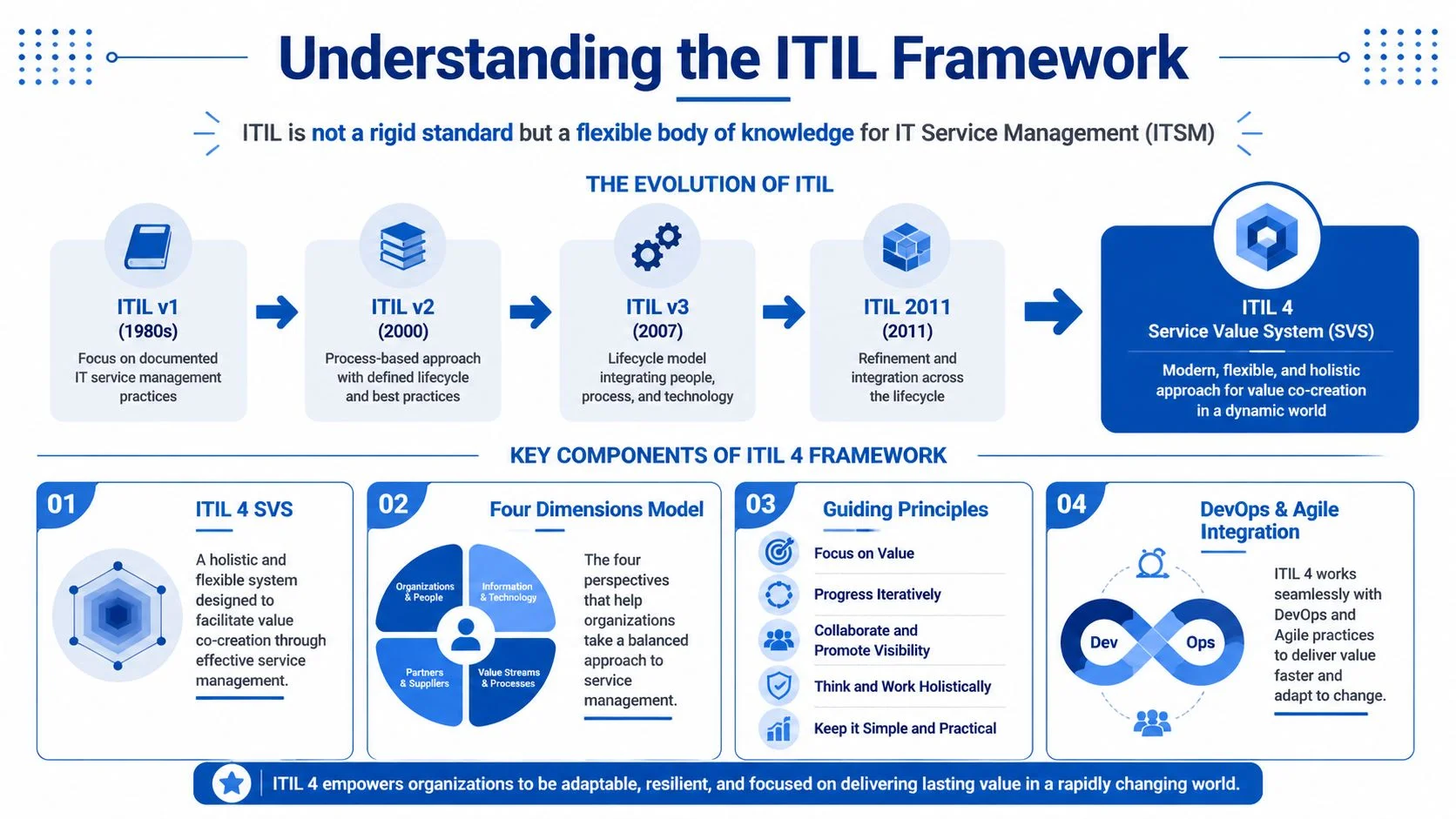
As you can see, the ITIL 4 Service Value System and its Guiding Principles, like "Progress Iteratively with Feedback," are designed to support Agile and DevOps. This allows the bank to manage risk responsibly without sacrificing the speed it needs to compete, perfectly aligning its tactical ITIL processes with its strategic ITSM goal of faster innovation.
Choosing the Right Certification and Career Path
All this talk about ITSM and ITIL naturally brings up a practical question: what's the best way to get certified and advance your career? It's a great question, but it starts with a common point of confusion I want to clear up immediately.
There's no such thing as an "ITSM certification." ITSM is a discipline, a way of thinking about delivering IT as a service. You can't get certified in a discipline in the same way you can't get certified in "management."
What you can do is get ITIL certified. And in the world of IT service management, that’s the gold standard. Earning an ITIL certification is the clearest way to show employers you have a firm grasp of the world's most popular ITSM framework and can apply its principles to deliver real business value.
The ITIL 4 Certification Scheme
The modern ITIL 4 certification path is far more flexible than its predecessors. It's built in a modular way, so you can focus on the skills and knowledge that directly apply to your current role and future ambitions.
For almost everyone, the journey starts with the ITIL 4 Foundation certification. Think of this as your passport to the world of modern service management. It covers the essential concepts, the Service Value System, and the Four Dimensions Model. It's the baseline knowledge needed to even participate in the conversation inside an ITIL-driven organization.
Passing the ITIL 4 Foundation exam isn't just about adding a line to your resume. It fundamentally changes how you view your role, connecting your daily tasks to the bigger picture of business value co-creation.
Once you've got the Foundation under your belt, the path splits into two advanced streams. This is where you really start tailoring your learning to your career. Many people pause here and ask, is ITIL certification beneficial for me personally? The answer almost always depends on which of these two paths you take next.
Mapping Certifications to Job Roles
The two advanced designations, Managing Professional and Strategic Leader, are built for very different career goals. One is for the hands-on practitioner, and the other is for the visionary leader.
ITIL 4 Managing Professional (MP)
This track is for the people on the ground—those who run IT projects, manage teams, and oversee the day-to-day delivery of services. The MP designation is earned by completing four specialist modules:
- Create, Deliver and Support: Perfect for those at the heart of service operations and support.
- Drive Stakeholder Value: All about mastering the customer journey and user experience.
- High-velocity IT: Digs into the agile and lean methods that power modern digital organizations.
- Direct, Plan and Improve: The one module shared with the SL stream, it teaches you how to build a culture of continuous improvement.
Who it's for:
- Service Desk Managers
- IT Project Leads
- Release Managers
- Business Analysts
ITIL 4 Strategic Leader (SL)
The SL stream is for the shot-callers. It's designed for current and future leaders who need to align IT with the overarching business strategy and drive digital transformation from the top down. It consists of two modules:
- Direct, Plan and Improve: This shared module provides the strategic tools for improvement that are crucial for leadership.
- Digital and IT Strategy: This module focuses on the high-level work of linking digital business goals directly to IT strategy.
Who it's for:
- Chief Information Officers (CIOs)
- Heads of IT
- IT Directors
- Senior Business Leaders
In the end, choosing a certification path isn't just about collecting credentials. It's a strategic move to build the career you want. By understanding the practical differences between the MP and SL tracks, you can create a personalized roadmap for a successful and rewarding career in IT Service Management.
Common Questions About ITSM and ITIL
Even with a solid grasp of the basics, a few practical questions always seem to pop up when people dig into the relationship between ITSM and ITIL. It's one thing to know the definitions, but it's another to figure out how they actually work in the real world. Let's clear up some of the most common points of confusion.
Can You Implement ITSM Without Using ITIL?
That’s a great question, and the short answer is yes. ITSM is a service-oriented discipline, not a single product you buy off the shelf. You can absolutely build a service-centric IT department using other frameworks or even by developing your own internal processes. The ultimate goal is to connect IT activities to business value, and ITIL is just one—albeit the most popular—path to get there.
But here’s the thing: choosing not to use ITIL often means you're signing up to reinvent the wheel. You’d be building your own incident, problem, and change management processes from the ground up. While it’s certainly possible, it's rarely the most efficient route when you could be adapting a framework that has been tested and refined by millions of professionals for decades.
Is ITIL Still Relevant with Agile and DevOps?
This is probably the most critical question in service management today. The answer is a definitive yes, but with a huge asterisk: we're talking about ITIL 4. The older versions of ITIL rightly earned a reputation for being bureaucratic and slow, often clashing with the fast-paced, iterative nature of Agile and DevOps.
ITIL 4 was a direct response to that criticism. It’s built around guiding principles that sound very familiar to anyone in the Agile world, like "Progress iteratively with feedback" and "Collaborate and promote visibility." Instead of seeing ITIL as a set of rigid rules, think of it as the guardrails that help Agile and DevOps teams deliver value quickly and safely. It provides the structure for things like Change Enablement, ensuring that speed doesn't accidentally introduce a ton of risk or instability.
ITIL 4 doesn't replace Agile or DevOps; it supports them. It provides the structured service management context that ensures speed doesn't come at the expense of stability and governance.
Which ITIL Certification Should I Start With?
For anyone just starting their journey, the answer is always the ITIL 4 Foundation certification. There's no debate on this one. It's the mandatory entry point to the entire ecosystem.
Think of it as learning the alphabet before you try to write a novel. The Foundation certificate teaches you the core language and concepts of the ITIL 4 Service Value System, and you can't move on to any of the more advanced certifications without it.
What Are Some Common Alternatives to ITIL?
While ITIL gets most of the spotlight, it's not the only option available. Several other models exist, each with its own specific strengths and focus. Depending on your organization's unique needs, one of these might be a better fit or a useful supplement:
-
COBIT (Control Objectives for Information and Related Technologies): If your world revolves around governance, security, risk management, and compliance, COBIT is for you. It's less about the "how-to" of daily service delivery and more about ensuring everything is controlled, measured, and aligned with enterprise governance.
-
VeriSM (Service Management for the Digital Age): This is a more flexible, high-level approach. VeriSM doesn't prescribe specific processes but instead provides a framework for meshing different practices—like ITIL, Agile, and DevOps—into a custom management model that fits your organization perfectly.
-
SIAM (Service Integration and Management): If you work in a complex environment with dozens of external vendors and suppliers, SIAM is your best friend. It's specifically designed to provide governance and coordination in a multi-supplier ecosystem.
The right choice really depends on what you're trying to solve. Are you focused on risk, managing vendors, or building a completely custom approach? Your answer will point you in the right direction.
Ready to master the concepts behind ITIL and other critical certifications? MindMesh Academy provides expert-curated study materials and evidence-based learning techniques to help you not just pass your exams, but truly understand the material. Start your learning journey and accelerate your career by taking an ITIL Foundation 4 Practice exam to test your familiarity with the concepts.

Written by
Alvin Varughese
Founder, MindMesh Academy
Alvin Varughese is the founder of MindMesh Academy and an enterprise architecture leader. An electrical engineer by training, he moved from factory automation in South Africa to cloud architecture at GE Appliances and Humana (Fortune 50), and holds 20 professional certifications including AWS Solutions Architect Professional, Azure DevOps Engineer Expert, and Microsoft Agentic AI Business Solutions Architect. He built MindMesh Academy after interviewing too many highly certified candidates who couldn't answer basic questions: the goal is prep that makes you better at the job, not just able to pass the exam.