ServiceNow System Administrator Certification Guide
Mastering ServiceNow: Your Expert Guide to the System Administrator (CSA) Certification
IT professionals who want to build a career using ServiceNow will find that the ServiceNow System Administrator (CSA) Certification is an essential first step. This certification proves you have the skills needed to manage, configure, and maintain the platform. It serves as the baseline requirement for technical roles in enterprise service management. By earning this certificate, you demonstrate a clear understanding of how to operate the software within a production environment and prepare for advanced ServiceNow specializations.
Why the ServiceNow System Administrator Certification Matters for Your Career
ServiceNow functions as the high-performance engine for modern IT services and business workflows. To ensure this engine runs reliably and at peak efficiency, an organization needs a skilled administrator who understands its internal mechanics. The ServiceNow System Administrator (CSA) certification provides official validation of these skills, confirming you are a qualified expert capable of maintaining the platform.
This credential is more than a resume entry. It is a globally recognized proof of your knowledge regarding the platform architecture and your ability to manage daily administration tasks. Much like an AWS Certified Solutions Architect or a PMP credential, the CSA demonstrates a commitment to foundational principles. It is a baseline requirement for nearly every professional role involving ServiceNow.
Who Should Earn the CSA Certification?
While the CSA is open to any student, it provides specific advantages for certain professional backgrounds. Those new to IT or those seeking to add a powerful specialization will find that this certification provides valuable opportunities.
- Aspiring ServiceNow Professionals: Individuals entering this field use the CSA to build the knowledge required for all other advanced certifications. It is the primary entry point into a professional community that values standardized training.
- Existing IT Professionals: Help desk technicians, network administrators, and ITIL practitioners use the CSA to pivot into specialized roles. It offers a direct path toward careers focused on service delivery and automated workflows.
- Career Changers: People moving from non-technical backgrounds into the technology sector find that this certification provides a structured and clear route. It offers a way to enter an industry characterized by consistent growth and technological change.
The Platform Operator's License Analogy
Compare this certification to a professional license for a complex machine. An organization would not allow someone to manage a critical financial system based only on a casual interest or self-study. They require a certified operator who has completed formal training and demonstrated the ability to manage the system safely.
The CSA certification is the operator's license for the ServiceNow platform. It signals to employers that you are a qualified professional capable of configuring its features and ensuring smooth operations for every stakeholder.
Establishing credibility to manage vital systems is difficult without this certification. Obtaining the CSA provides new professional opportunities and serves as the required starting point for higher-level credentials. You must earn it before pursuing the Certified Application Developer (CAD) or various Certified Implementation Specialist (CIS) certifications. These advanced paths allow you to specialize in specific areas of the platform as your career progresses.
Reflection Prompt: How might earning the CSA certification help you take on more impactful projects or leadership roles in your current or future IT position?
Deciphering the Blueprint: The ServiceNow CSA Exam Structure
To pass the ServiceNow System Administrator certification, a clear grasp of the exam blueprint is essential. This guide works as your study plan. It highlights the main topics so you can focus your effort where it will have the most impact. Success requires more than just memorizing facts. You must show that you have the practical skills to manage the platform in a professional environment. We will look at what happens on the day of the exam and how the questions are distributed across different functional areas.
Understanding the Exam Format and Logistics
The CSA exam is a timed, standardized test. Knowing the rules, including time limits and question formats, gives you a clear advantage before you start. You must finish the official ServiceNow Fundamentals training course before you can register for the exam. This course provides the base knowledge you need to navigate the software. Once you finish the course, you will typically receive a voucher that allows you to schedule the exam through a testing partner.
The test has approximately 60 multiple-choice questions. You have 90 minutes to complete the session. You need a score of at least 70% to pass. Many people find that studying hard and having three to six months of experience with the platform helps them feel ready. This experience can come from your daily job or from working in a Personal Developer Instance. You can find more details on the structure through official sources like Global Knowledge. Be sure to verify the current pricing and registration requirements on the ServiceNow site, as these can change.
The 5 Core Exam Domains You Must Master
The exam is organized around five main domains. Each one has a different weight. These percentages show what ServiceNow values most in a system administrator. They also tell you how many questions to expect for each specific topic. Use this breakdown to plan your study sessions and manage your time.
- Database Administration (30%): This is the largest part of the exam. It focuses on the platform’s underlying structure. You will need to manage tables and records, define various fields, and configure access control rules (ACLs). It also covers the Configuration Management Database (CMDB), which is a key part of ITIL frameworks. As a CSA, your job is to keep data accurate and secure across the entire system. You will deal with import sets to move data into the system and use the schema map to see how different tables relate to one another.
- User Interface & Navigation (20%): This domain covers the parts of the system that users see every day. You must know how to customize lists and forms to meet different business needs. You will also configure the application navigator and set up basic branding to match a company's visual style. Good navigation makes the system easier for everyone to use. This is similar to how a dashboard in Azure or AWS helps cloud administrators view their resources quickly. You should understand how to use filters and breadcrumbs to find information effectively.
- Collaboration (20%): This section tests how teams work together in ServiceNow. It includes task management and setting up assignment rules to route work to the right groups or individuals. You also need to know how to set up email notifications triggered by specific events. This keeps all stakeholders informed about the status of their requests. Effective collaboration is a major part of incident and change management. These concepts are similar to the principles found in PMP certification materials.
- Self-Service & Process Automation (20%): This area focuses on making business operations more efficient. You will learn to build and look after the Service Catalog, which allows users to order goods or services. You will also use Flow Designer to create basic automations that handle repetitive tasks. Managing the Knowledge Base is another key task here. These tools help users find answers on their own without contacting the help desk. This work follows ITIL goals by making IT services more effective. You will need to know how to create categories and items within the catalog.
- Introduction to Development (10%): You do not need to be a full developer to pass, but you must understand how to customize the system. This part of the exam covers client-side scripting, UI policies, and business rules. These tools change how the platform functions and how it responds to user input. Knowing these basics allows you to build simple solutions without calling in a professional developer. It is similar to an AWS administrator using Lambda functions for small automation tasks. You should know how to use an update set to move your changes between different instances.
View these domains as the interconnected systems of a complex enterprise application. Database Administration is the engine. It is the most powerful and important component. User Interface & Navigation acts as the dashboard that allows the user to control the engine. All parts must work together to create a functional service management platform. The following table gives a clear view of the domains and their weights. Use it as a checklist while you study.
ServiceNow CSA Exam Domain Breakdown
This table offers a high-level overview of the exam's focus areas. Utilize it as a checklist to structure your studies and ensure coverage of all components.
| Exam Domain | Weighting | Key Topics Covered |
|---|---|---|
| Database Administration | 30% | Table & record management, CMDB, import sets, access control rules (ACLs) |
| User Interface & Navigation | 20% | Application Navigator, branding, list and form configuration, dashboards |
| Collaboration | 20% | Task management, assignment rules, event and email notifications |
| Self-Service & Process Automation | 20% | Service Catalog, Flow Designer basics, Knowledge Base |
| Introduction to Development | 10% | Client scripts, UI policies, business rules, update sets |
Mastering these five domains is your direct route to earning the ServiceNow System Administrator certification. Keep this breakdown accessible throughout your preparation. It is the most effective way to study and be well-prepared for the current exam.
Your Step-By-Step Path to CSA Exam Day Success
Achieving your ServiceNow System Administrator certification is a major professional goal. You need a clear plan for the logistics of the process. While the steps might seem complicated, the path from training to test day is direct. You will move from foundational training to a period of focused study and practice before finally sitting for the exam.
The first requirement is the completion of the official ServiceNow Fundamentals training course. This course acts as your technical boot camp. It provides the essential knowledge and hands-on skills that form the base of the CSA exam. Trying to take the exam without this course is a mistake. The test expects you to understand how the platform works at a functional level, and this class provides that necessary context.
Once you finish the Fundamentals course, ServiceNow issues you an exam voucher. You need this code to register for the official test.
Registering for Your CSA Exam
With your voucher ready, go to the ServiceNow Webassessor portal. This platform is where you schedule exams and track your certifications. If you are a new user, you must create an account. Make sure you link this account to your Now Learning profile so your training history and voucher appear correctly.
After you log in and enter your voucher code, you must choose how to take the exam:
- Online Proctored Exam: This choice lets you take the test from your home or office. You will need a stable internet connection and a webcam. A remote proctor will watch you through the camera to ensure the exam remains secure and fair.
- In-Person Testing Center: If you prefer a quiet, formal environment, you can book a seat at a Kryterion testing center. These sites provide the hardware and a space free from interruptions, which helps some people focus better.
Choose the environment where you focus best. There is no single right choice; it depends on your personal testing style and your home office setup.
Expert Advice: Do not schedule your exam for the day after you finish the Fundamentals course. Give yourself at least a few weeks of study time. Use this period to explore your Personal Developer Instance (PDI). Practice creating records, modifying lists, and building workflows. This hands-on time makes the theoretical concepts much easier to remember during the test.
The exam covers five core domains that work together. You start with basic navigation and move toward more complex system tasks.
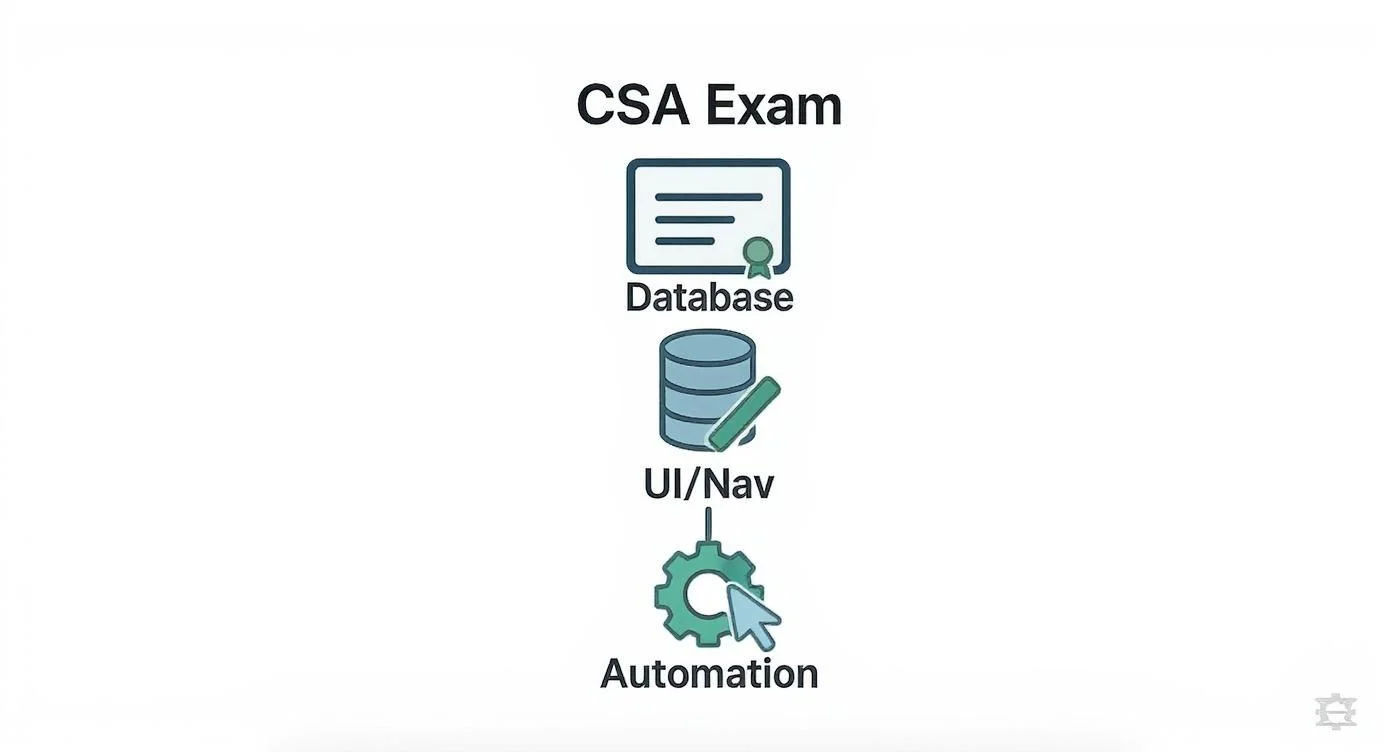
As the infographic shows, understanding the user interface and database administration is essential. Once you master how data is stored and displayed, you can handle automation and development. These topics build on each other, so do not skip the basics.
Final Preparations for Peak Performance
In the final weeks before your exam, shift your strategy. Stop trying to learn new topics and focus on confirming what you already know. Identify any weak areas and spend extra time reviewing those specific sections of the course material.
Practice tests are very helpful during this stage. They help you get used to the question formats and the pressure of the test. To check your readiness, try a ServiceNow Certified System Administrator practice exam. This allows you to benchmark your skills and find gaps in your knowledge before the big day.
On exam day, make sure you are well-rested. If you are testing online, check your computer and camera settings an hour early. If you are traveling to a center, confirm your route to avoid delays. Managing these small details ahead of time helps you stay calm and focused on your goal.
Reflection Prompt: What specific strategies will you employ in the final weeks before your exam to ensure you're mentally and logistically prepared?
Crafting Your Winning CSA Study Plan with MindMesh Academy
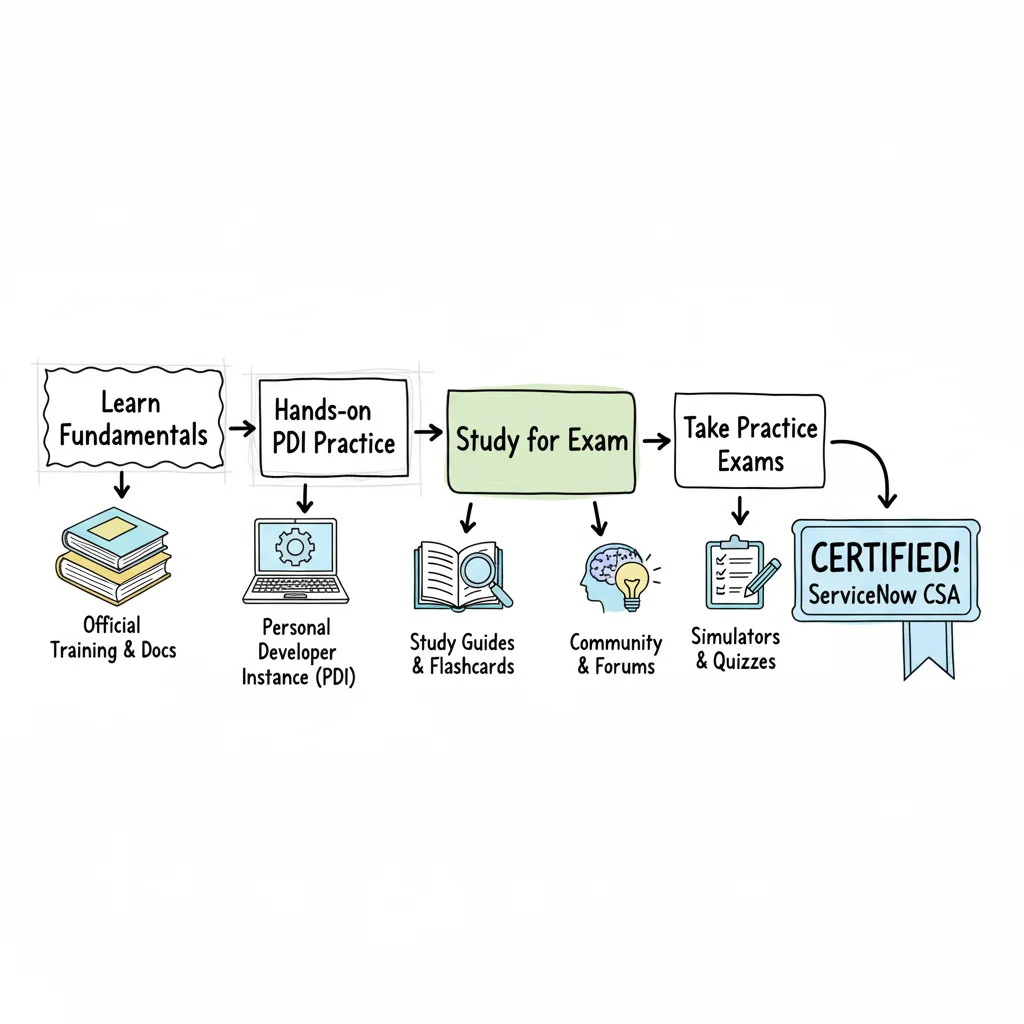
Preparing for the ServiceNow Certified System Administrator (CSA) exam is not about last-minute cramming. Success requires a practical, hands-on understanding of the platform, which calls for a strategic and well-structured study plan. An effective plan breaks this significant goal into manageable segments, ensuring you cover every exam topic thoroughly without feeling overwhelmed.
Compare this process to training for a professional certification like the PMP or an advanced Azure credential. You would not arrive on exam day hoping for the best. Instead, you would follow a specific schedule, build your knowledge in stages, use diverse study methods, and set aside time for rest and review. Your CSA preparation requires this same disciplined approach to help you reach the finish line with confidence.
Laying the Foundation: Essential Study Materials
Start by assembling your toolkit. The primary foundation of your study plan is the official ServiceNow Fundamentals course content. This serves as your main source of truth, directly aligning with the exam objectives and teaching you core concepts exactly as the vendor defines them. This course is usually available through the Now Learning portal, and you should ensure you are following the version that aligns with the current exam release.
Your resources should include more than just the course manual. Two other tools are vital for your success:
- ServiceNow Product Documentation: Treat this as the authoritative encyclopedia for the platform. When a topic within the course seems unclear, the official documentation provides the technical details required for full comprehension. It serves a similar function to official AWS whitepapers by providing deep architectural context.
- A Personal Developer Instance (PDI): This is your private, risk-free sandbox. Your PDI is a complimentary, fully functional ServiceNow instance where you can build, experiment, and break configurations. Crucially, it allows you to learn how to fix errors without impacting a production environment.
These three resources—the official course, the product documentation, and your PDI—work together to support your learning. The course outlines the specific topics you need to know, the documentation explains the logic behind why features function in a particular way, and your PDI is where you actively demonstrate how to implement and manage those features.
Structuring Your Study Schedule
A common mistake is attempting to learn every module at once. A more effective approach involves tackling the material one domain at a time. Dedicate a full week or more to each major exam domain, such as Data Management or Scripting, to ensure you master the underlying concepts.
As you build your schedule, looking at actionable learning plan samples can provide organizational ideas. A productive weekly rhythm might look like this:
- Monday & Tuesday: Spend these days focused on the ServiceNow Fundamentals modules and the related official documentation for the current week's domain. If you are studying Database Administration, focus on understanding the theoretical concepts of tables, fields, and records.
- Wednesday & Thursday: Move to hands-on practice in your PDI. Complete the labs and exercises that relate to your theoretical study. Actively build custom tables, configure Access Control Lists (ACLs) to manage security, or perform an import set simulation to bring data into the system. This is where theory translates into a practical skill set.
- Friday: Use this as a self-assessment day. Take a practice quiz or review flashcards focused on the topics covered during the week. This helps identify areas that need more attention and reinforces your ability to recall information under pressure.
- Weekend: Make rest and light review your priorities. Allowing your brain to process and consolidate new information is necessary for long-term retention. To understand the science behind this, examine some of the best study methods for exams.
This cyclical approach keeps you engaged with the material. This is a proven method for embedding information more deeply than passive reading.
The ultimate objective is not to memorize facts for the exam; it is to develop muscle memory and an intuitive understanding of the platform. When you have configured a UI Policy, created a Business Rule, or built a Catalog Item multiple times in your PDI, the exam questions become much easier to answer because you can visualize the interface and the steps involved.
The Power of Hands-On Practice in Your PDI
Theoretical knowledge has limits. The CSA exam tests your ability to apply what you know. This is why hands-on practice in your Personal Developer Instance is the most critical component of your study plan. Your PDI is where abstract theory transforms into tangible technical skill.
Do not just click through the menus without a goal. Instead, create small, focused projects that tie directly to the exam domains:
- Database Administration: Challenge yourself to build a new custom application containing three interconnected tables. Define the relationships between them, such as a reference field connecting a "Device" table to a "Location" table. Then, secure specific fields or records using granular ACL rules to ensure only the right roles can edit the data.
- User Interface & Navigation: Design a custom view for the Incident form that displays only five key fields relevant to a specific user role, like a Service Desk Analyst. After that, create a UI Policy to make the "Resolution Code" field mandatory only when an incident's state changes to "Resolved."
- Self-Service & Process Automation: Construct a simple catalog item for ordering a new peripheral, such as a computer mouse. Use Flow Designer to create an approval workflow. This workflow should send a request to a manager and then automatically generate a fulfillment task for the hardware team once the manager approves the request.
This active, problem-solving approach to learning is much more effective than passive consumption. It forces you to troubleshoot errors, analyze configurations, and understand how the different pieces of the ServiceNow platform integrate. This is the expertise required of a ServiceNow Administrator. By making the PDI the center of your study plan, you are not just preparing for a test; you are building the practical skills you will use every day on the job. Be sure to log into your PDI regularly, as these instances can be reclaimed by ServiceNow if they remain inactive for too long. Keeping your instance active ensures your practice data and custom configurations remain available throughout your study period.
How CSA Certification Boosts Your Career and Earning Potential
Earning the ServiceNow System Administrator certification is more than just passing a test. It is a smart move for your professional future. This credential acts as a key that provides access to roles that were previously out of reach. It shows hiring managers clearly that you have the verified skills required to manage one of the most powerful enterprise platforms available.
Once you earn the CSA credential, you become a strong candidate for several high-demand roles. It acts as the required starting point for positions including:
- ServiceNow Administrator: This is the most direct path. You will handle daily management, configuration, and the operation of the platform to ensure everything runs correctly. Administrators often act as the first line of support for users and troubleshoot issues within the system.
- Platform Consultant (Junior/Associate): In this role, you guide businesses as they improve how they use ServiceNow to meet specific goals. This is similar to a junior Azure consultant advising on cloud solutions.
- ServiceNow Developer (Junior): The CSA provides the base knowledge required before you move into building custom applications and writing scripts within the platform. You will use this knowledge to ensure your custom code aligns with the platform's standard configurations.
The Tangible Financial Impact on Your Earning Potential
The financial side is just as compelling. Earning the CSA credential usually leads to higher pay, making it a valuable addition to your resume. It separates you from general IT staff and marks you as a specialist.
The numbers back this up. One detailed study found that 69% of professionals with a ServiceNow certification saw positive changes in their careers. Nearly a third earned a promotion within one year, and 31% reported a salary increase. These numbers show that the CSA is a real driver for career growth.
This data shows that the cost of the CSA is an investment that provides high returns. The certification gives you the confidence and the evidence needed to ask for a higher salary and move into more senior roles.
When you are certified, you have more power during salary discussions. To get the pay you deserve, try using effective salary negotiation strategies. The CSA puts you in a group of highly valued experts. You can see how this certification compares to others in our guide to the top 10 high-paying IT certifications for 2025.
A Launching Pad for Advanced Specializations
The CSA is the start of your progress, not the end. It is the required first step for almost every advanced ServiceNow certification. It functions like the foundation of a house. You cannot build the walls or the roof until you have a solid base in place.
Once you are a Certified System Administrator, you can choose a path that fits your interests. This is like moving from an AWS Associate level to a Professional level.
Your next steps might include:
- Certified Application Developer (CAD): This path is for people who want to code and build custom applications on the ServiceNow platform.
- Certified Implementation Specialist (CIS): This category includes many certifications. Each one focuses on a specific ServiceNow product, such as IT Service Management (ITSM), Customer Service Management (CSM), or HR Service Delivery (HRSD). These specialized paths allow you to demonstrate your expertise in specific areas of the platform.
- Certified Technical Architect (CTA): This is the highest level of ServiceNow expertise. It is meant for experts who design complex, large-scale solutions for major companies. Reaching this level requires years of experience and a deep understanding of technical strategy.
Each advanced certification brings more job openings and higher pay. But every single one of these paths begins with the ServiceNow System Administrator certification. It provides the base of knowledge you will use throughout your career.
Key Resources and Tools for CSA Exam Success
Preparing for the ServiceNow System Administrator certification requires more than reading theory. You must assemble a specific set of tools and learning materials to be successful. Consider this a professional toolset; a technician cannot maintain a complex system with only a single instrument. To pass the CSA exam, you need to combine official study guides, intensive hands-on practice, and the collective knowledge found in the user community.
Your study plan centers on three mandatory elements: the official ServiceNow training materials, your Personal Developer Instance (PDI), and a set of reliable practice exams. These components are essential. Organizing these three areas of study correctly will help you establish a clear path toward passing the test.
Mastering the Official ServiceNow Resources
When you start your ServiceNow training, go directly to the primary source for your information. ServiceNow provides several resources that serve as the foundation of your study plan. Using these ensures your technical knowledge is accurate and matches the specific objectives found on the exam.
- ServiceNow Product Documentation: This serves as the primary manual for every feature on the ServiceNow platform. If a concept in the Fundamentals course seems unclear or requires more detail, such as the specifics of Access Control Lists (ACLs) or the organizational structure of the Configuration Management Database (CMDB), use the official documentation. It provides the technical specifics required for a complete understanding of platform behavior.
- ServiceNow Community Forums: You are not studying in isolation. The community forums act as a massive archive of shared knowledge. You can find solutions to specific technical problems, see how other administrators have resolved configuration challenges, and find tips from experienced professionals who have managed the platform for years.
Consistent use of these resources ensures that your knowledge is factually correct. It also ensures your approach aligns with the recommended best practices from ServiceNow. This alignment is vital when you face scenario-based questions on the actual exam.
Your Essential Training Ground: The PDI
Your Personal Developer Instance (PDI) is the most effective study tool available to you. It is a free, live ServiceNow instance that belongs entirely to you. Reading about how to create a service catalog item provides a basic understanding, but building that item yourself creates a different level of technical skill.
Your PDI is the environment where theoretical knowledge becomes a practical skill. It is a safe space for experimentation. Log in, build new configurations, and do not worry about making mistakes. Real learning happens when you have to troubleshoot and fix a configuration you broke. This type of work builds the muscle memory needed to navigate exam questions and perform administrative tasks in a professional environment.
Do not limit your activity to the labs provided in the Fundamentals course. Challenge yourself by starting small projects that you design yourself. For example, try to build a basic application to track internal office supplies or equipment loans. A project like this requires you to create custom tables, design user-friendly forms, set up approval workflows, and configure automated notifications. This single exercise covers several major exam domains in a practical, integrated way.
Validating Your Knowledge with Practice Exams
You need a way to determine when you are ready for the actual test. Practice exams are the best way to confirm your readiness. These tests help you become familiar with the format of the exam environment. You will practice answering multiple-choice and multiple-select questions while learning to manage your time within the 90-minute limit (verify current exam duration and details on the ServiceNow site).
Practice tests are more than just a way to practice time management. They function as diagnostic tools that show you exactly where your knowledge is weak. If you consistently miss questions regarding Database Administration, you know that specific domain requires more study time. These tests require you to actively recall facts rather than just recognizing them on a page. This method is much more effective for long-term memory. Use these tests as a strategic tool to adjust your study habits in the weeks before your test date. This preparation allows you to approach the exam with the readiness needed to earn your ServiceNow System Administrator certification.
Reflection Prompt: Beyond the official course, how will you actively integrate the ServiceNow Product Documentation and your PDI into your daily study routine to maximize practical skill development?
Got Questions? MindMesh Academy Has Answers
Preparing for the ServiceNow Certified System Administrator (CSA) certification often brings up specific questions. We have gathered common inquiries from candidates to help clarify the path to becoming a certified professional.
How Much Experience Do I Really Need to Pass the CSA?
ServiceNow documentation suggests having 3-6 months of hands-on experience before you sit for the exam (verify current requirements on the official site). However, the specific number of months matters less than how you use that time.
Your goal is to reach a level of comfort where you can handle daily operations without a manual. You should feel proficient performing routine user and data administration tasks. It is also vital to know how to use core applications like Incident, Problem, and Change Management without hesitation. If you have spent hours in a Personal Developer Instance (PDI) building configurations and solving problems, that practice counts as relevant experience. Active practice is often more effective than passive learning.
What Happens If I Fail the Exam on My First Attempt?
Do not be discouraged if you fail the exam on your first try. It is a common setback. ServiceNow maintains a clear retake policy for the CSA to help you try again without confusion.
You are allowed three attempts to pass. If you do not succeed initially, you must wait for a specific duration before you can register for another session. Note that every retake attempt requires the purchase of a completely new exam voucher. To improve your results, analyze the section-level feedback provided in your exam report. This data highlights exactly which topics need more attention during your review. Focus your study sessions on those specific weaknesses to pass with confidence when you schedule your next attempt.
The work you put into this certification offers a high return on investment. Earning the CSA credential can change your career path and increase your pay. At this time, the average salary for ServiceNow roles in the United States is around $82,495 (verify current salary data on major job boards). This certification acts as a signal to employers that you have the skills to manage an important enterprise technology. You can find more details about career options and pay in the full report at cxtoday.com.
We hope these answers clarify the process and help you stay motivated while you study.
The team at MindMesh Academy provides the specific tools IT professionals need for certification success. We offer study resources and practice exams designed to help you master core concepts. These materials prepare you for the current CSA exam and your future job duties. Review our study materials to pass with confidence by visiting ServiceNow CSA Practice Exams.
Ready to Get Certified?
Study using practice exams, study guides, and spaced repetition flashcards from MindMesh Academy to be well-prepared:

Written by
Alvin Varughese
Founder, MindMesh Academy
Alvin Varughese is the founder of MindMesh Academy and holds 20 professional certifications including Microsoft Agentic AI Business Solutions Architect, AWS Solutions Architect Professional, and Azure DevOps Engineer Expert. He's held senior engineering and architecture roles at Humana (Fortune 50) and GE Appliances. He built MindMesh Academy to share the study methods and first-principles approach that helped him pass each exam.