
7 Top Sources for Security Test Questions in 2026
7 Top Sources for Security Test Questions
You've spent weeks, maybe months, studying theory. You know the CIA triad, understand risk management frameworks, and can explain the difference between symmetric and asymmetric encryption. Yet one question keeps coming back: am I ready for the exam?
That gap between knowing the material and performing under pressure is exactly where strong security test questions help. They turn passive review into active recall, expose weak spots before the exam does, and train you to make fast decisions when several answers look plausible. For Security+, that pressure is real. The current CompTIA Security+ SY0-701 structure includes up to 90 questions in 90 minutes, with a passing score of 750 on a 100 to 900 scale.
The bigger shift is that modern practice isn't just about memorizing definitions. Large question banks now let you train by domain, retake fresh sets, and work through scenario-heavy items that look more like real exam decisions than old-school flashcard trivia. For example, some offerings advertise over a thousand practice questions and hundreds of flashcards aligned to SY0-701.
That's why the best sources for security test questions aren't all the same. Some are strongest for CompTIA. Some are better for ISC2. Some shine for AWS and cloud security paths. The list below sorts them by use case and shows you how to use them with more discipline, so you're not just taking quizzes. You're building exam judgment.
1. MindMesh Academy
You finish a practice set feeling confident, then miss a cluster of questions on identity, risk, or cloud shared responsibility. That usually means the problem is not effort. It is study design.
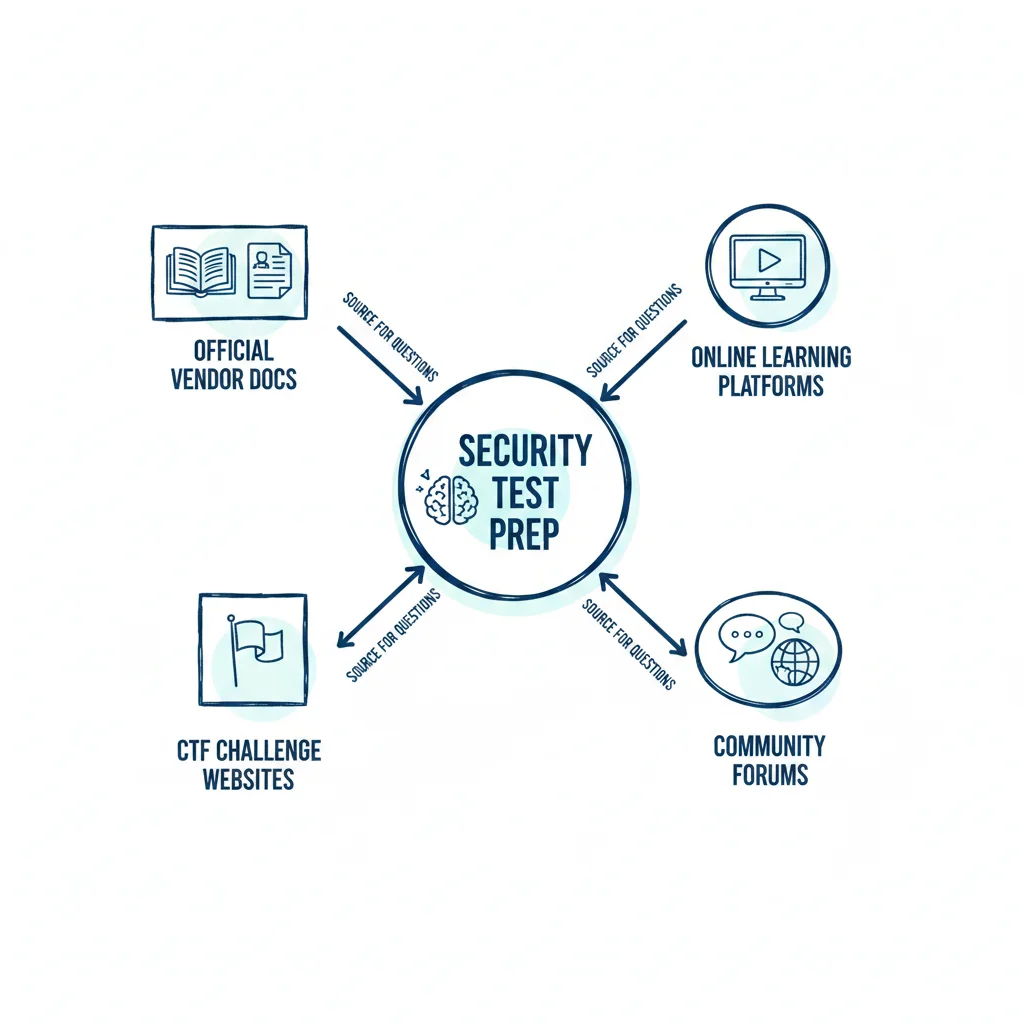
MindMesh Academy fits learners who want their question bank to act more like a training system. Instead of giving you isolated quizzes, it connects practice questions, flashcards, study guides, and progress tracking so you can see patterns in your mistakes and fix them on purpose.
That matters for certification prep because different exams test different kinds of judgment. CompTIA exams often reward broad coverage and quick elimination of distractors. ISC2 exams push you toward manager-level reasoning and best-answer thinking. Cloud security paths add architecture tradeoffs and service-specific details. A platform with mixed content across certifications is useful only if it also helps you separate weak recall from weak reasoning. MindMesh Academy does that better than many quiz-first tools.
Best fit by certification focus
MindMesh Academy is a good choice for learners whose plan goes beyond a single exam.
- CompTIA learners: Useful for Security+, CySA+, and related certifications where frequent retrieval practice helps lock in terms, controls, and scenario patterns.
- ISC2 candidates: Helpful for students who need to practice choosing the best answer, not just a technically correct one.
- Cloud-focused learners: Stronger than narrow security-only tools if your path includes AWS or Azure security topics alongside general security concepts.
- Career changers: A better fit than scattered PDFs and apps when you need one place to track progress across multiple subjects.
If you are planning more than one certification, this strategic IT security roadmap can help you choose a sequence that makes your practice time build on itself.
Why it works for exam prep
A good practice platform should do three jobs. It should test recall, expose weak domains, and tell you what to review next.
MindMesh Academy supports that loop well. The platform includes a large practice library, spaced-repetition flashcards, and explanations attached to answer choices. That combination matters because security students often stop at score checking. A better method is to review every miss, tag the domain behind it, then revisit the concept after a delay. Spaced repetition handles the timing piece. Weakness analysis handles the targeting piece.
The result is closer to how a strong instructor would coach you. First identify the pattern. Then revisit the concept. Then test it again under slightly different wording.
How to use MindMesh Academy effectively
Use the platform in cycles, not marathons.
Start with a timed mixed set to get a baseline. After that, sort your misses into two buckets: questions you missed because you forgot the fact, and questions you missed because the scenario confused you. Those are different problems, so they need different fixes. Flashcards help with fact gaps. Explanation review and domain drills help with judgment gaps.
A simple routine works well:
- Take a mixed quiz and record weak domains.
- Review explanations for both wrong answers and lucky guesses.
- Convert repeated misses into flashcard review.
- Retest the same domain a day or two later.
- Return to full-length mixed sets once your weak areas improve.
That approach is more reliable than taking fresh sets over and over and hoping your score rises.
What stands out
MindMesh Academy's main strength is visibility. You can see where your confidence is real and where it is inflated by familiarity.
The lower-friction entry point also helps. Free starter materials make it easier to test whether the platform matches your study style before you commit more time or money.
Pros
- Evidence-based review: Spaced repetition and adaptive practice support memory over time, not short-term cramming.
- Broad certification coverage: Useful if you are studying security topics across CompTIA, ISC2, and cloud paths.
- Targeted readiness tracking: Weakness views help you choose the next review step instead of guessing.
- Accessible starting point: Free materials make trial and comparison easier.
Cons
- Less hands-on than lab platforms: Better for exam prep than for building keyboard-based skills.
- Some buying details are limited: Pricing and feature depth are not always fully explained on the main pages.
- Breadth can dilute focus: If you want only one official vendor's style, a narrower tool may feel more direct.
2. CompTIA CertMaster Practice
For Security+ candidates who want the official route, CompTIA CertMaster Practice is the obvious choice.
Its main appeal is alignment. When you're studying for SY0-701, the official platform reduces uncertainty about scope because it's built around the same objectives students are expected to know on exam day. That's a big advantage if you've been overwhelmed by random online question banks that mix current material with outdated topics.
Best for CompTIA-first students
CertMaster Practice fits students who want a clean connection to the CompTIA ecosystem. If you're buying an exam voucher, considering bundles, or trying to keep all your prep under one vendor, the workflow is straightforward.
You also get multiple ways to study. Timed practice, study mode, and domain-based drills support both broad review and targeted cleanup. That's useful for a Security+ exam where pacing matters, because the official blueprint is broad even when the total exam length is tightly constrained.
How to use it well
Don't use CertMaster only for score chasing. Use it as a blueprint-checking tool.
- Use timed mode early: This tells you whether your issue is content knowledge, pacing, or both.
- Use domain drills after every full exam: Misses usually cluster. That's where the fastest improvement happens.
- Review by objective language: If a question keeps catching you off guard, compare it to the official objective wording and learn the exam's framing.
Coach's view: Treat official practice as your “scope control” resource. It tells you what CompTIA expects, even if you later use tougher third-party questions to stretch yourself.
Pros
- Official alignment: Strong choice if you want confidence that your practice maps to current objectives.
- Useful modes: Timed sessions, study mode, and analytics support structured prep.
- CompTIA ecosystem fit: Convenient if you're bundling training resources and vouchers.
Cons
- Often costs more than third-party options: Budget matters if you're already paying for the exam itself.
- May need supplementation: Some learners prefer harder practice questions after they've covered the official material.
3. ISC2 Official Practice Tests
If your target is CISSP, CCSP, or SSCP, ISC2 self-study resources are the most natural place to start. Official practice tests tied to the ISC2 ecosystem usually do one thing very well: they organize security test questions around domain thinking instead of isolated fact recall.
That matters more for ISC2 than many candidates expect. These exams often reward management judgment, prioritization, and best-answer logic. You can know the right technology and still miss the question if your reasoning isn't aligned with the role perspective the exam expects.
Best fit for CISSP and broad security reasoning
The Sybex and Wiley practice environment is useful when you need volume across multiple domains and want to create quizzes by topic. The print-plus-online model also suits learners who still like reading explanations in book form before switching to timed sets online.
The access model can feel a bit fragmented, though. Depending on what you buy, your experience may involve a book, an access code, an online bank, and sometimes an app. That isn't a deal-breaker, but it can be clunky compared with all-in-one platforms.
A good complement is to compare your ISC2 study habits with how you'd approach CompTIA Security Plus practice questions. The exams are different, but the discipline of reviewing explanations thoroughly carries over.
Where students often go wrong
Many ISC2 candidates overfocus on memorization. They build giant note sets, but they don't spend enough time defending an answer choice.
Coach's view: When two answers both seem reasonable, ask which one best fits the role, sequence, or risk-management lens of the exam. That's often where the point is hiding.
Pros
- Strong domain structure: Good for candidates who need broad coverage across ISC2 concepts.
- Official companion value: Fits naturally with recognized ISC2 study materials.
- Flexible quiz creation: Helpful for weakness-based review.
Cons
- Setup can feel messy: Access paths vary by product format.
- Platform transitions have caused some uncertainty: Some learners prefer simpler delivery systems.
4. Boson ExSim-Max

Some students don't need more comfort. They need harder questions. That's where Boson often enters the picture.
Boson ExSim-Max has a long-standing reputation among certification candidates for practice exams that feel tough, exam-realistic, and explanation-heavy. For Security+, that combination is valuable because hard practice can expose whether you really understand a concept or have just memorized familiar wording.
Why Boson is useful late in prep
Boson is especially effective after you've already covered the syllabus once. At that stage, your goal shifts from learning content to pressure-testing judgment. A challenging question bank can reveal hidden weaknesses in logic, not just memory.
Its detailed rationales are a valuable asset. Good rationales don't just say why the correct answer is right. They also teach why the tempting distractor is wrong in this scenario. That's the kind of review that makes your next timed exam feel easier.
Best fit by learner type
- Security+ candidates nearing exam day: Useful for realistic stress testing.
- Students who score well but still feel shaky: Boson often surfaces false confidence.
- Independent learners: Strong if you're comfortable diagnosing your own errors from written explanations.
One caution: vendor support can vary by exam and version, so always confirm that your exact certification track is covered before buying.
Pros
- Challenging practice style: Good for strengthening exam toughness.
- Thorough explanations: Helps with deeper correction, not just score reporting.
- Clear readiness pressure test: Strong fit for late-stage prep.
Cons
- Version coverage matters: Always verify your exam is supported.
- Not a full learning platform: It's strongest as an exam simulation and review tool, not an all-purpose curriculum.
5. MeasureUp Practice Tests

You are preparing for AZ-500 after a long week, and your weak spots are not basic definitions. They are judgment calls. Which control belongs in Azure Policy, which task belongs in Microsoft Defender, and which answer sounds plausible but breaks under a real cloud scenario. MeasureUp fits that stage of prep well because it is built around Microsoft-aligned exams and a more structured testing experience.
This section matters for a different reason than Boson. Boson is often used to make the exam feel harder. MeasureUp is often used to make Microsoft-style objectives feel clearer and more organized. If your certification path sits in the Microsoft and cloud security category, that distinction matters.
Strong fit for Microsoft security certifications
MeasureUp is a practical option for exams such as AZ-500 and SC-900, along with other Microsoft certification tracks. Its exam mode helps you rehearse pacing and question interpretation. Its study mode slows the process down so you can review one decision at a time, which is often the better choice early in the week when you are still repairing weak domains.
That combination supports a useful prep loop. First, take a timed set. Next, sort your misses by domain. Then review patterns, not just isolated wrong answers. If identity questions keep failing for the same reason, such as confusing authentication with authorization, you have found a real weakness instead of a one-off mistake.
How to use MeasureUp effectively
Treat MeasureUp like a diagnostic tool and a rehearsal tool.
A good method is to split your week into two types of sessions. Use short, untimed sessions to learn the logic behind missed questions. Then use one or two timed sessions to test whether that logic holds up under pressure. This works like practicing scales before performing a song. You need both accuracy and fluency.
For cloud-focused exams, pair question practice with direct product exposure whenever possible. If you miss an item about Conditional Access, role-based access control, logging, or segmentation, open the Microsoft environment or lab and trace where that setting lives. Practice questions tell you what you misunderstood. Hands-on work helps that answer stick.
If you are also studying for broader security management exams, this CISSP certification preparation guide can help you build stronger review habits for scenario-based questions.
Best fit by certification focus
MeasureUp makes the most sense in the cloud and Microsoft branch of your prep plan.
Use it if you are preparing for Microsoft security exams and want practice that mirrors vendor terminology, objective structure, and domain reporting. If your primary goal is Security+ or CISSP, other tools in this list may match those blueprints more closely, though MeasureUp can still help if your day job is centered on Azure.
Pros
- Strong Microsoft alignment: Good match for Azure and Microsoft security exam objectives.
- Useful study and exam modes: Supports both concept repair and timed rehearsal.
- Clear domain analytics: Helps you spot repeat weaknesses and plan the next review session.
Cons
- Best for specific certification tracks: It is more valuable for Microsoft-focused learners than for broad, vendor-neutral prep.
- Hands-on practice still matters: Cloud security questions are easier to answer correctly when you have seen the tools in action.
6. Pocket Prep
Pocket Prep solves a problem that derails a lot of exam plans: inconsistency.
You might have a full study setup at home, but most of your day happens elsewhere. Commutes, lunch breaks, waiting rooms, and the twenty quiet minutes before bed are often where real repetition happens. Pocket Prep is built for that reality. It's mobile-first, easy to open, and good for short bursts of security test questions across multiple cybersecurity certifications.
Best for daily reps and spaced recall
Pocket Prep shines when you use it as your “keep the material warm” tool. The app's short-session design supports habits such as a question of the day, weak-subject drills, and missed-question review. That makes it a natural fit for spaced repetition, even if you're using another platform for your deeper practice exams.
This is also where many learners finally become honest about weak areas. In long weekend sessions, you can hide from topics you dislike. In a daily app, your misses follow you around until you fix them.
A simple method that works
Use Pocket Prep for maintenance, not for your whole strategy.
- Morning block: Do a quick set from your weakest domain.
- Midday block: Review missed items only.
- Evening block: Answer a mixed set without notes.
- Weekly reset: Export or write down your repeat misses and turn them into flashcards or topic reviews.
Coach's view: A mobile app isn't “light” study if you review mistakes seriously. Ten disciplined minutes beats an hour of distracted scrolling through notes.
Pros
- Excellent convenience: Great for maintaining momentum every day.
- Broad certification coverage: Useful if you're balancing more than one exam path.
- Good weak-area drills: Helps keep review focused.
Cons
- Not an official vendor: Best used alongside a more primary resource.
- Bundle selection matters: Make sure you choose the correct exam package.
7. Tutorials Dojo Practice Exams

You finish an AWS practice question feeling confident, then the explanation shows why your answer would fail in a real environment. The issue was not memorization. It was judgment. That is the kind of gap Tutorials Dojo often exposes well for cloud security candidates.
For AWS-focused learners, Tutorials Dojo is a practical source of cloud security test questions because it stays close to the decisions AWS exams test. You are usually choosing between services, permission models, encryption options, logging approaches, and incident response actions under constraints. That makes it a different study tool from broad security platforms aimed at general certification coverage.
Best for AWS and cloud security paths
This resource fits the "Cloud" category in a security practice plan. If you are preparing for an AWS security certification, or for a cloud-heavy role where AWS services show up in scenario questions, the specialization helps. If your goal is CompTIA or ISC2, one of the earlier tools will usually map more directly to those objectives.
The value here is in the explanations. Tutorials Dojo questions often ask you to compare similar AWS services or policies and justify the better choice. That trains the skill many candidates struggle with: reading a scenario, spotting the actual requirement, and ruling out answers that are technically possible but operationally wrong.
How to use it well
Use Tutorials Dojo as your scenario-training layer, not just as a score tracker.
Start with timed sets to identify weak domains such as IAM, KMS, CloudTrail, GuardDuty, or secure architecture design. Then review every miss slowly. Write down why the correct answer fits the requirement and why the distractors fail. After that, revisit those weak areas two or three days later. That spaced review pattern is much more effective than repeating the same exam immediately and recognizing answer wording from memory.
If you use another platform for broader security foundations, Tutorials Dojo can act like the lab where you pressure-test your cloud reasoning.
Why that matters
Cloud security skills are becoming more central to security work. Analysts at Zion Market Research project the global security testing market at USD 11.58 billion in 2023 and USD 87.65 billion by 2032, with a 25.34% CAGR, according to its security testing market report: https://www.zionmarketresearch.com/report/security-testing-market. For exam prep, the takeaway is simple. Service selection, identity design, encryption choices, and monitoring logic are now common parts of security work, not edge topics.
Pros
- Strong AWS specialization: Good fit for learners on a cloud security certification path.
- Detailed answer explanations: Useful for improving service-choice and architecture reasoning.
- Good value for focused prep: Often a sensible option if AWS is your main target.
Cons
- Limited outside AWS-focused study: Less useful if you need broad coverage across multiple certification families.
- Needs hands-on reinforcement: Reading about IAM, KMS, and logging helps, but configuring them in AWS builds the judgment exams expect.
Top 7 Security Practice Exam Comparison
| Product | Implementation complexity | Resource requirements | Expected outcomes | Ideal use cases | Key advantages |
|---|---|---|---|---|---|
| MindMesh Academy | Low–Medium (web platform) | Free starter; paid subscriptions; device with web access | Long-term retention, data-driven exam readiness, topic mastery | IT professionals and career changers who want measured, mastery-based study | Spaced repetition + adaptive practice, large Q/flashcard library, mastery tracking |
| CompTIA CertMaster Practice | Low (official web/mobile app) | Paid 12‑month license; web/iOS/Android; may bundle with vouchers | Strong alignment to CompTIA exam objectives, targeted pass readiness | Candidates taking CompTIA exams who want official practice and ecosystem integration | Official item styles, domain analytics, integration with CompTIA offerings |
| ISC2 Official Practice Tests | Medium (book + access code or app) | Purchase book/ebook + online access/app; mobile/web | Broad ISC2 domain coverage, structured readiness for CISSP/CCSP/SSCP | Professionals preparing for ISC2 certifications seeking official companion materials | Official ISC2-aligned questions, comprehensive domain mapping |
| Boson ExSim‑Max | Low (downloadable/web) | One‑year paid subscription; device with web access | High exam realism and improved test‑taking endurance | Test‑takers seeking challenging, exam‑simulation practice | Reputation for exam‑realistic difficulty and detailed rationales |
| MeasureUp Practice Tests | Low–Medium (web/app) | Paid access; enterprise/team options; frequent content updates | Microsoft/Azure-aligned readiness with analytics and scores | Organizations and individuals focused on Microsoft/Azure certification upskilling | Microsoft-aligned content, readiness analytics, enterprise support |
| Pocket Prep | Very Low (mobile-first app) | Free basic; premium per‑exam subscriptions; iOS/Android/web sync | Improved spaced recall and short-session practice | On‑the‑go learners needing daily practice across multiple certs | Mobile convenience, large catalog, quick daily drills |
| Tutorials Dojo Practice Exams | Low (online portal) | Paid bundles, often cost‑effective; portal access | Challenging, instructive practice particularly for AWS exams | AWS certification candidates, especially Security Specialty | Strong AWS focus, realistic scenarios, competitive pricing |
Strategy and Next Steps: From Practice to Pass
Blasting through hundreds of questions isn't a strategy. It's a fast way to get tired and a slow way to improve. Security test questions only help when you turn each one into evidence about what you do and don't understand.
Start with deep review. Your score matters, but your explanation matters more. For every missed question, write down why the correct answer was best, why your selected answer was tempting, and what clue in the wording should have pushed you the right way. For every correct question you guessed on, review it as if you got it wrong. Guesses don't become knowledge unless you unpack them.
This is especially important on scenario-based exams. Training guidance discussed in a video on evidence-first reasoning for security and guard-style scenarios points to a common problem: many learners memorize lists but struggle to identify the best answer when several options seem plausible. That's exactly why your review notes should focus on evidence, sequence, and role-based judgment.
A simple two-phase study plan
Use your tools in stages instead of all at once.
- Weeks 1 to 2: Take one full baseline exam. Don't cram first. Let the score reveal your real weak domains. Then use custom quizzes, flashcards, and explanation review to repair those areas.
- Weeks 3 to 4: Shift into simulation mode. Take more timed exams, practice pacing, and keep a running error log of repeated mistakes.
- Final days: Do lighter mixed quizzes and explanation review. Don't try to relearn everything. Protect your confidence and sharpen recall.
How to analyze weaknesses correctly
Most students categorize misses too broadly. “Networking” or “cryptography” is often too vague to help. Be more specific.
- Concept gap: You didn't know the topic.
- Recognition gap: You knew it, but the scenario disguised it.
- Pacing gap: You ran out of time or rushed.
- Judgment gap: Two answers looked good, and you picked the less correct one.
Coach's view: The best study plan isn't the one with the most questions. It's the one that makes your next mistake less likely.
If you're juggling multiple certifications, organize your prep by focus. Use official or near-official tools to define exam scope. Use harder third-party tools to stress-test your reasoning. Use mobile tools to keep recall active every day. And if you can, connect practice questions with flashcards, notes, and mastery tracking so every study session builds on the last one.
Passing a security certification is more than a test-day win. It's proof that you can process technical information, make decisions under time pressure, and reason through real-world security scenarios. Pick the tool that matches your target exam, commit to a review method that's based on evidence rather than hope, and keep going until your weak spots stop repeating.
If you want one place to combine security test questions, spaced repetition, progress tracking, and scenario-based review, you can prepare for your CompTIA Security+ exam with MindMesh Academy. It's especially useful if you want a study system that helps you measure readiness, not just collect more practice questions.

Written by
Alvin Varughese
Founder, MindMesh Academy
Alvin Varughese is the founder of MindMesh Academy and an enterprise architecture leader. An electrical engineer by training, he moved from factory automation in South Africa to cloud architecture at GE Appliances and Humana (Fortune 50), and holds 20 professional certifications including AWS Solutions Architect Professional, Azure DevOps Engineer Expert, and Microsoft Agentic AI Business Solutions Architect. He built MindMesh Academy after interviewing too many highly certified candidates who couldn't answer basic questions: the goal is prep that makes you better at the job, not just able to pass the exam.