
Master the Exam: 8 In-Depth CISSP Sample Exam Questions for 2026
Passing the Certified Information Systems Security Professional (CISSP) exam validates your expertise as a cybersecurity leader. For IT professionals who want to move into senior management or security architect roles, the CISSP shows you can design, implement, and oversee the security posture of an organization. This exam evaluates your ability to think like a senior security manager. You must balance technical safeguards against strategic business objectives rather than just focusing on technical tools.
Questions on the current exam often present several choices that seem technically correct. Your task is to identify the most appropriate choice—the one that follows risk management principles and governance frameworks. Instead of looking for an isolated technical fix, you must find a solution that fits within a broad security strategy. You need a specific perspective to pass, and these questions help you build it.
This guide helps you develop that strategic and managerial perspective. We will analyze a set of eight CISSP sample exam questions, taking one high-quality example from each of the eight official domains. We provide more than just the answers. For every question, you will see a specific breakdown:
- Strategic Analysis: We explain the underlying logic and the reasons for the correct answer. This shows you exactly what (ISC)² looks for when testing candidates.
- Tactical Insights: We point out the critical keywords and core concepts you must recognize and use during the exam.
- Actionable Takeaways: We provide methods you can use to deconstruct scenarios, eliminate distractors, and choose the correct solution.
Use this as a training session to build your confidence and sharpen your analytical skills. By looking at these examples, you will learn to interpret vague scenarios and apply critical thinking while the clock is running. These skills help you on the exam and throughout your professional life. This method, along with tools like the spaced repetition and adaptive learning paths from MindMesh Academy, provides a clear way to pass with confidence and master the material.
Reflection Prompt: As an IT professional, how often do you find scenarios where multiple technical solutions exist, but only one truly fits the business goals? The CISSP focuses on this distinction.
1. Domain 1: Security and Risk Management - Risk Assessment Question
Risk assessment questions serve as the foundation of the CISSP exam. They evaluate your ability to identify, analyze, and prioritize security risks within an organizational context. A typical question presents a scenario, such as a company planning a large-scale migration to AWS or Azure or integrating a new IoT solution. You must then determine the correct next step in the risk management lifecycle. Success depends on understanding the relationship between valuable assets, potential threats, and existing vulnerabilities.
These concepts are practical requirements for security professionals. CISOs, security architects, and project managers—including those with PMP certification—use these principles daily. You must be able to apply qualitative analysis, such as ranking likelihood and impact as high, medium, or low. You also need to understand quantitative analysis, specifically Annualized Loss Expectancy (ALE), to provide clear, data-driven recommendations to leadership.
Strategic Breakdown: Thinking Like a Security Consultant
The current exam requires you to think like a security manager or advisor rather than a technical implementer. When you face a risk assessment question, deconstruct the scenario to find its core parts. Identify these elements:
- Asset: This is the resource requiring protection. It might be sensitive customer PII, proprietary intellectual property, critical operational technology, or the reputation of the brand itself.
- Vulnerability: This is a weakness that a threat can exploit. Examples include unpatched legacy software, a lack of employee cybersecurity awareness training, weak network segmentation, or insecure API endpoints.
- Threat: This is the potential danger that could exploit a vulnerability. This includes ransomware attacks, actions by a disgruntled insider, natural disasters, or a compromise within the supply chain.
By framing the problem this way, you can evaluate the choices logically. You can quickly eliminate options that fail to address the identified risk within the specific business context provided in the question.
Actionable Takeaways: Mastering Risk Concepts
To prepare for these CISSP sample exam questions, focus your study on these specific tactics:
- Memorize Risk Treatment Strategies: You must distinguish between Risk Acceptance (choosing to live with the risk), Avoidance (stopping the activity that creates the risk), Transference (moving the risk to another party via insurance or outsourcing), and Mitigation (applying controls to reduce the risk level).
- Framework Fluency: Learn the high-level objectives of major frameworks. Study the NIST Risk Management Framework (RMF) and ISO 27005. You do not need to memorize every line of these documents, but you should understand their process flow and purpose. This knowledge also applies to management certifications like the CISM.
- Practice Calculations: Work with quantitative formulas like Single Loss Expectancy (SLE) and Annualized Loss Expectancy (ALE). The test usually avoids complex arithmetic, but you must understand how these values are calculated to interpret questions about financial impact and risk prioritization.
To see how organizations manage threats systematically, read about the complete risk management process and how it supports business goals.
Key Insight: Risk management is a tool for making informed business decisions. It is not solely a technical exercise.
2. Domain 2: Asset Security - Data Classification and Handling
Questions regarding data classification and handling are a central part of the CISSP exam. These items test your skill in protecting an organization's most significant assets: its information. A standard question might describe a scenario where a company creates a new type of sensitive data—such as proprietary AI algorithms, customer payment card information (PCI), or protected health information (PHI). You must then choose the correct classification level and define the necessary handling rules. The logic is straightforward. Not all data carries the same weight. Its value, sensitivity, and any legal requirements must determine the security it receives from creation to destruction.
This knowledge is necessary to build a strong defense-in-depth strategy and maintain regulatory compliance with standards like GDPR, HIPAA, and PCI DSS. Establish a clear, usable data classification policy to direct every decision regarding how data is managed. This policy covers access control, encryption, secure storage, retention, and final disposal. By following these rules, an organization ensures its security budget and resources go where they are needed most.
Strategic Breakdown: Thinking Like a Data Steward
The CISSP exam asks you to adopt the mindset of a data owner or custodian. You are responsible for protecting information assets. When you see a data classification question, break the scenario down into its moving parts by identifying these specific elements:
- Data Owner: This individual is legally and financially accountable for the data. They define classification levels and set the requirements for protection. This role usually belongs to a senior manager or a business department head who understands the data's value to the company.
- Data Custodian: This person manages the technical side. They implement and maintain the security controls and the infrastructure used to store or process the data. This is often the IT department, a cloud provider, or a dedicated security team.
- Data Lifecycle Stage: Where is the data right now? Is it being created, stored, used, shared, archived, or destroyed? Security requirements and compliance needs change as data moves through these phases.
- Business Impact: What happens if this data is lost, stolen, or corrupted? Consider the financial costs, legal fines, reputational damage, or operational downtime. This potential impact is the primary factor that determines the classification level.
By focusing on these roles and the data lifecycle, you can filter through the exam choices. Pick the answer that best fits security best practices and business goals while meeting legal mandates.
Actionable Takeaways: Linking Policy to Practice
To succeed on these CISSP sample exam questions, focus your preparation on these specific areas:
- Memorize Common Classification Levels: You must know standard corporate tiers: Public, Internal/Confidential, and Restricted/Highly Confidential. You also need to know government labels: Unclassified, Confidential, Secret, and Top Secret. These labels dictate exactly which security controls apply to a file.
- Connect Controls to Classification: Security measures must scale up as data becomes more sensitive. For instance, "Confidential" data stored in an AWS S3 bucket might need server-side encryption with customer-managed keys (CMK), strict Identity and Access Management (IAM) policies, and access via VPC endpoints. "Public" data requires almost no restrictive controls.
- Master Secure Destruction: Review specific methods for sanitizing different types of media. CISSP candidates must understand and apply standards like NIST SP 800-88, the authoritative guide to secure data sanitization, to ensure data is irrecoverable. Methods include overwriting for hard drives, degaussing for magnetic media, and physical destruction like shredding or pulverizing.
Reflection Point: How does your organization's data classification policy (or lack thereof) impact your ability to apply consistent security controls?
3. Domain 3: Security Architecture and Engineering - Secure Design Principles
Domain 3 tests your ability to think like a security architect. You must apply established principles to build resilient systems from the initial design phase. A typical exam scenario might ask you to evaluate a proposed system, such as a microservices architecture on Kubernetes or a serverless application using Azure Functions. Identify which security principle best mitigates a specific risk. You must translate high-level business security requirements into technical blueprints. This requires a firm grasp of foundations like least privilege, defense in depth, and failing securely. Architecture is more than just writing code; it is about ensuring the structural integrity of the system.
Designing for security is a vital skill. Architectural flaws are often structural, meaning they cannot be patched easily like a simple software bug. These vulnerabilities are exponentially more expensive to fix once the system is in production. During the CISSP exam, you will justify architectural decisions by balancing security against performance, cost, scalability, and usability. This approach mirrors the security pillar within the AWS Well-Architected Framework. If you build a house on a weak foundation, the walls will crack regardless of the locks on the door. Secure design ensures the structure itself provides protection against threats.
Strategic Breakdown: Building Security Blueprints
When you see a secure design question, think like an architect. Focus on systemic resilience rather than isolated fixes. Analyze the scenario by identifying the system's purpose and the data it processes:
- Objective: Identify what the system achieves. It might process financial transactions, manage remote access, or host an e-commerce site. Understanding the mission of the application helps you determine the impact of a potential failure or data breach.
- Data Sensitivity: Determine the nature of the information involved, such as PII, financial records, or trade secrets. These details dictate protection levels and applicable compliance standards that the architecture must satisfy.
- Architectural Layers: Apply controls across the stack. This includes the network layer with VPCs, the operating system layer through hardening, and the application layer with secure coding. Encryption handles the data layer for protection at rest and in transit.
Actionable Takeaways: Principles into Practice
To succeed on CISSP sample exam questions, use these tactics to improve your architectural knowledge:
- Master Core Principles: Understand the CIA Triad (Confidentiality, Integrity, and Availability). Study least privilege, defense in depth, and fail securely. Be ready to explain how these prevent specific attacks. Placing a database in a private subnet is an application of least privilege because it restricts access. Also understand separation of duties and the economy of mechanism, which simplifies designs to reduce attack surfaces.
- Learn Modern Architectures: Study Zero Trust Architecture as defined in NIST SP 800-207. Understand how this differs from traditional perimeter models. In Zero Trust, the system assumes no implicit trust, even for users or devices inside the network boundary.
- Justify Your Choices: Practice explaining why one control is better than another. The exam often provides multiple plausible answers. Choose the most appropriate one based on efficiency and business impact. Consider why secure defaults are better than expecting users to change settings manually.
Key Insight: Secure architecture focuses on proactive prevention. Make systems naturally resistant to attack rather than adding security features after development is finished.
4. Domain 4: Communication and Network Security - Cryptographic Implementation
Cryptographic implementation questions represent a significant portion of Domain 4. These items test how you apply mathematical concepts to solve actual network security problems. You will likely face scenarios requiring you to choose the right algorithm, protocol, or management practice to satisfy specific security requirements such as confidentiality, integrity, or non-repudiation. The current exam evaluates your grasp of why specific tools are chosen over others, particularly the operational differences between symmetric and asymmetric encryption in various environments.
 Caption: A visual representation of symmetric and asymmetric encryption principles, illustrating key distribution and common protocols.
This topic is essential because cryptography serves as the foundation for modern secure communications. Security professionals must design and manage systems that defend data while it moves across networks and while it sits in storage. This involves using TLS for web traffic or IPsec for VPN tunnels to protect data in transit. For data at rest, you might implement AES for database encryption or apply full disk encryption to protect physical hardware.
Strategic Breakdown: Matching Crypto to Security Goals
To answer these questions correctly, think like a security architect. You must focus on the primary security objectives of the scenario. When you look at a cryptographic problem, break the requirements down into these core functions:
- Confidentiality: If the goal is to keep unauthorized parties from reading data, you need encryption. You must decide if symmetric encryption, such as AES-256 for high-speed bulk data processing, is appropriate. Alternatively, you might use asymmetric encryption, like RSA, for secure key exchanges or creating digital envelopes. Symmetric methods are fast but require a secure way to share keys, whereas asymmetric methods solve the key sharing problem but demand more processing power.
- Integrity: If you need to prove that data has not been changed or corrupted, focus on hashing algorithms like SHA-256. These create a unique, fixed-size fingerprint of the input data. You might also see Message Authentication Codes (MACs), which combine a hash with a shared secret key to provide both integrity and basic authentication.
- Authentication and Non-Repudiation: When you must verify a sender's identity and ensure they cannot deny sending a message later, you use digital signatures. This process involves hashing the message and encrypting that hash with the sender's private key. This relies on Public Key Infrastructure (PKI) to manage certificates and establish trust across a network.
Identifying the primary security goal allows you to eliminate incorrect answer choices quickly. If a question asks about integrity and the options include AES or RSA without hashing, you can likely dismiss them.
Actionable Takeaways: Practical Cryptography for IT Professionals
To succeed on CISSP sample exam questions related to this domain, focus your study on these specific tactics:
- Use-Case Association: Avoid just memorizing a list of algorithms. Instead, connect each one to its practical use. Link symmetric encryption (AES, 3DES) to high-speed operations, bulk data protection, and confidentiality. Link asymmetric encryption (RSA, ECC) to secure key exchange, digital signatures, and non-repudiation. Asymmetric methods are typically used for smaller data sets, like encrypting a symmetric key during the initial stages of a secure connection.
- Protocol Proficiency: You need to understand how common protocols function. Learn the details of the TLS handshake, including how certificates are validated and how cipher suites are negotiated to secure web traffic. For IPsec, understand the differences between Tunnel mode and Transport mode. Tunnel mode encrypts the entire original IP packet, while Transport mode only encrypts the payload, making it important for different VPN configurations.
- Key Management Lifecycle: Master the steps involved in managing cryptographic keys throughout their existence. This includes secure generation, distribution, and storage. You should know how Hardware Security Modules (HSMs) or cloud-based Key Management Services (KMS), such as AWS KMS or Azure Key Vault, protect these assets. Key rotation, revocation, and secure destruction are also critical. The current exam emphasizes that even the strongest algorithm fails if key management is weak.
Preparing for network architecture security requires a structured method for implementing controls. Reviewing cybersecurity frameworks helps organize these cryptographic concepts into a larger defense strategy.
Reflection Prompt: When would you prioritize AES over RSA in a real-world application, and why? Consider performance versus key exchange.
5. Domain 5: Identity and Access Management (IAM) - Authentication and Authorization Models
Identity and Access Management (IAM) is a core component of the CISSP exam. These questions measure your ability to build and oversee systems that ensure only the right people or devices access specific resources. You may encounter scenarios that ask you to select the most secure authentication method for a particular system or to design a Role-Based Access Control (RBAC) model for a global corporation using cloud-based assets. Success depends on understanding the difference between authentication, which verifies an identity, and authorization, which involves granting specific permissions to that identity.
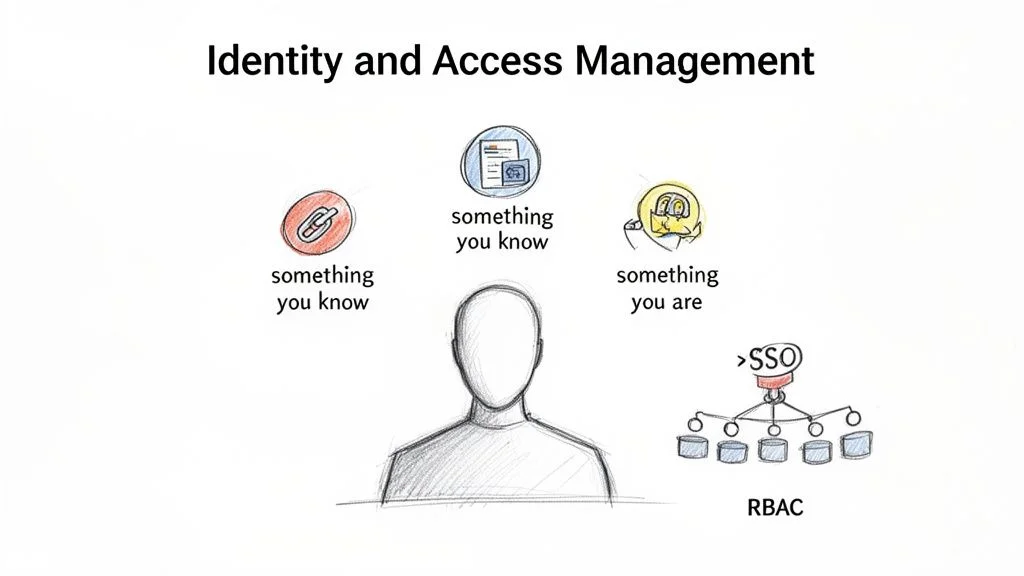 Caption: Core components of Identity and Access Management, including authentication, SSO, and various access control models.
Securing identities is the first step in preventing unauthorized access. This topic covers many technical areas. You should study protocols like Kerberos and SAML. You must also understand concepts like identity federation, multi-factor authentication (MFA), and just-in-time (JIT) privileged access management. These tools reduce the attack surface by ensuring that users only have the access they need exactly when they need it.
Strategic Breakdown: The IAM Workflow
CISSP IAM questions require you to adopt the mindset of a security architect. You must balance high security with practical business needs, such as operational speed and the user experience. When you face an IAM scenario on the test, analyze the problem by looking at the natural progression of access. Break the scenario down into these three elements:
- Identity: Determine who or what is asking for access. This might be a human user, a service account, an IoT sensor, a virtual machine, or an application workload.
- Authentication: Identify how the system verifies that identity. This involves three factors: knowledge (passwords), possession (tokens), or inherence (biometrics). Assess if the scenario calls for multi-factor authentication (MFA) and which delivery method, such as a TOTP app or a push notification, is most appropriate.
- Authorization: Decide what the entity can do after it is authenticated. Consider if the access is based on a specific job role (RBAC), user attributes (ABAC), an owner-defined list (DAC), or strict security labels (MAC). You should also look for environmental conditions like the time of day or whether the device meets compliance standards.
Organizing your thoughts this way makes it easier to evaluate the options provided in the multiple-choice questions. It helps you see if a problem is about proving identity or controlling permissions.
Actionable Takeaways: IAM in Cloud and Enterprise
To prepare for these CISSP sample exam questions, focus on these strategies:
- Distinguish Authentication vs. Authorization: Authentication occurs first to prove identity. Authorization occurs second to define permissions. Confusing these two terms is a frequent reason for incorrect answers on the current exam.
- Master Access Control Models: Learn the use cases for the four main models. RBAC is standard for corporate environments where jobs determine access. ABAC offers flexibility for dynamic cloud environments where you might restrict access based on IP address. MAC is used for label-based security, while DAC gives resource owners the power to manage access.
- Study Federation Protocols: Research how SAML, OAuth 2.0, and OpenID Connect (OIDC) provide Single Sign-On (SSO). These protocols manage identities across different systems and cloud providers, which is common in the modern enterprise.
If you work with cloud services like AWS or Microsoft Azure, you likely use these principles. You can see these theories in action by reviewing fundamental identity security concepts in Microsoft Azure. Reviewing how Azure AD handles conditional access policies can help you understand how abstract concepts work in a live environment.
Key Insight: Effective IAM is about more than just technology; it focuses on enabling secure productivity and maintaining regulatory compliance across the entire organization.
6. Domain 6: Security Assessment and Testing - Vulnerability Management
Questions from Domain 6 evaluate your ability to find, analyze, and fix security weaknesses throughout an organization's assets. The CISSP exam presents complex scenarios where you must interpret raw vulnerability scan data, prioritize remediation efforts based on risk, and understand the formal processes behind security testing methodologies. You might be asked to differentiate between a vulnerability assessment and a penetration test or decide the best course of action after a critical flaw is discovered in a live production system. This area is vital because it represents the proactive, technical side of cybersecurity that directly contributes to hardening defenses.
Understanding vulnerability management is a core competency for any security leader. The exam expects you to know more than just the tools; you must understand the entire lifecycle: discovery, reporting, prioritization, remediation, and verification. It is about implementing a continuous process that systematically improves security posture over time. These procedures ensure that security is maintained throughout the software development lifecycle and overall operations.
Strategic Breakdown: The Continuous Improvement Cycle
When you encounter these CISSP sample exam questions, approach them from a process-oriented management perspective. Do not just look at the technical flaw. Consider the broader business impact and the necessary steps to address the issue systematically. Dissect the scenario by identifying these key elements:
- Assessment Type: Determine what kind of assessment the organization is performing. Is it a vulnerability scan, which uses automated tools to find known potential flaws? Is it a penetration test, where a professional actively exploits flaws to demonstrate the impact of a breach? Or is it a code review involving static or dynamic analysis? Each has a different goal, scope, and final output.
- Vulnerability Details: Identify the specific weakness described in the prompt. Examples include SQL injection, cross-site scripting (XSS), outdated software with existing CVEs, or a misconfigured cloud security group. You must look at its severity, which is usually indicated by a CVSS (Common Vulnerability Scoring System) score. Think about how this score relates to the actual danger posed to the company.
- Business Context: Identify the system or data affected by the flaw. Is it a critical, customer-facing application that handles financial transactions and sensitive personal data? Or is it an internal development server that only contains non-sensitive information? This context dictates the urgency and priority of remediation.
By breaking the question down this way, you can evaluate the options using a structured, risk-based approach. The correct choice will align with established security assessment methodologies and prioritize actions that maintain business continuity while protecting critical assets.
Actionable Takeaways: Beyond the Scan Results
To answer questions on security assessment and testing, integrate these tactics into your study plan:
- Master the CVSS: Understand the components of the Common Vulnerability Scoring System (CVSS), particularly the Base Score metrics. These include Attack Vector, Attack Complexity, Privileges Required, User Interaction, Scope, and the impact on Confidentiality, Integrity, and Availability. You do not need to calculate these scores manually during the test, but you must understand what factors cause a vulnerability to be rated as critical.
- Know Testing Methodologies: Differentiate clearly between black-box (no prior knowledge), white-box (full knowledge), and gray-box (partial knowledge) testing. You should also be familiar with the standard phases of a penetration test: planning, reconnaissance, scanning, gaining access, maintaining access, and reporting/analysis. This helps you understand the scope and limitations of different tests in a scenario.
- Familiarize Yourself with Key Tool Purposes: You will not be tested on specific commands or configurations, but you must understand the purpose and capabilities of common security tools. Know that Nessus or Qualys are for vulnerability scanning, while Metasploit is an exploitation framework. Understand that Burp Suite is used for web application testing, and learn the differences between SAST and DAST tools.
Reflection Prompt: How do vulnerability assessments and penetration tests complement each other in a holistic security program?
7. Domain 7: Security Operations - Incident Response and Management
Domain 7 questions focus on incident response and management. They test your ability to react systematically and ethically when security events occur. A scenario might involve an analyst detecting anomalous outbound traffic from a database or a successful phishing attack. These questions ask for the most critical next step. The core of this domain is applying a repeatable process to contain damage, eradicate threats, restore services, and capture lessons learned from security incidents.
This operational skill mirrors ITIL incident management but emphasizes security requirements. You must move from detection and analysis to containment, eradication, and recovery. During these steps, you must preserve evidence, communicate with stakeholders, and limit business impact. These sample exam questions measure your readiness to lead and coordinate during a crisis. Managers must ensure the team follows protocols while maintaining technical oversight of the remediation process.
Strategic Breakdown: Managing the Incident Lifecycle
The current exam requires you to think with a manager's oversight and a responder's urgency. When you face an incident response question, dissect the scenario by identifying the current phase of the incident. Most questions follow a recognized framework like NIST SP 800-61:
- Preparation: Has the organization developed playbooks, trained staff, and established communication channels before an incident occurs? This phase is about readiness and tool deployment.
- Detection & Analysis: Is the incident just discovered? What are the initial Indicators of Compromise (IOCs)? Is the severity and scope known? This phase focuses on validating the event to confirm it is a true positive.
- Containment: Has the immediate threat been isolated to prevent further spread and damage? Examples include disconnecting an infected host from the network or blocking malicious IPs at the firewall. This is often the most critical immediate step in a scenario.
- Eradication & Recovery: Has the root cause been identified and removed? Are systems being restored from trusted backups and services brought back online securely? You must ensure the environment is clean before returning to normal operations.
- Post-Incident Activity: Has a "lessons learned" review been conducted? Are policies, procedures, and controls being updated to prevent recurrence? This phase ensures the organization improves its defense posture for the future.
This phased approach helps you prioritize actions correctly. For example, you must contain a ransomware outbreak before you attempt to recover systems. If you skip containment, the infection will simply spread again as soon as you restore the files.
Actionable Takeaways: From Theory to Tactical Response
To prepare for these questions, concentrate your study efforts on these key tactics:
- Memorize the Incident Response Lifecycle: Understand the six phases from NIST SP 800-61: Preparation, Detection & Analysis, Containment, Eradication & Recovery, and Post-Incident Activity. Be able to identify which actions belong to which phase.
- Chain of Custody: Understand the principles of evidence handling. Questions may test your knowledge of how to properly collect, document, and preserve digital evidence to ensure its integrity and admissibility in legal proceedings. This is vital for forensic investigations and potential prosecution.
- Practice Triage and Escalation: Be comfortable classifying incidents based on potential business impact, such as low, medium, or high criticality. Differentiate between a low-impact event like a minor malware detection and a critical breach involving data exfiltration that requires immediate escalation to senior management and legal teams. For a detailed review of practical approaches for managing and responding to security incidents, consult a guide on security incident response planning.
To build a solid foundation, it's crucial to understand how organizations formalize these steps. You can learn more about how a structured incident response plan is developed to ensure a coordinated and effective reaction in times of crisis.
Key Insight: A well-prepared incident response plan significantly reduces the impact and cost of a security breach.
8. Domain 8: Software Development Security - Secure Software Development Lifecycle
Questions on the Secure Software Development Lifecycle (SDLC) are a major part of Domain 8. These items test whether you can shift security left by making it a part of every phase of software creation. A common scenario might involve a company moving to a DevOps or DevSecOps model. You will likely need to find the best spot to add a specific security control, such as static analysis security testing (SAST), or decide how to manage open-source dependencies. The main idea is to make security a proactive part of the process. This starts with the first design and threat model and continues through deployment and upkeep. It should never be a reactive afterthought.
This topic matters because errors made during development are often hard to fix later. If a vulnerability reaches production, fixing it is frequently expensive and time-consuming. The CISSP exam requires you to show how to build security into the whole process. This creates software that is harder to attack and easier to defend. It also helps reduce technical debt and raises the quality of the final product.
Strategic Breakdown: Securing the Code Pipeline
To do well on these questions, you should think like a security engineer or a project manager. When you read a scenario, figure out which SDLC phase it describes. This helps you choose the right tool or process for that specific moment.
- Requirements/Design: Focus on the foundation of the system. This is where you use threat modeling, like the STRIDE method, to find risks. You look for spoofing, tampering, repudiation, information disclosure, denial of service, and elevation of privilege before writing any code. You must also set clear functional and non-functional security requirements for the project.
- Development/Coding: Focus on stopping flaws while writing code. This means using secure coding standards to prevent the OWASP Top 10 vulnerabilities. You also need to manage libraries from other sources using Software Composition Analysis (SCA) to check for known bugs and licensing risks.
- Testing/Verification: Focus on finding security holes before the release. You use different tools here. Static Application Security Testing (SAST) reviews the source code for errors. Dynamic Application Security Testing (DAST) tests the app while it runs to find configuration issues. Interactive Application Security Testing (IAST) combines these two styles and includes traditional penetration testing.
- Deployment/Operations: Focus on the live software environment. This part includes setting up secure configurations and keeping a close eye on the system. You must manage patches and make sure the application fits into the organization's incident response plan to handle potential breaches.
By placing each question into one of these phases, you can find the right answer. This is a key skill for solving CISSP sample exam questions.
Actionable Takeaways: Building Secure Software
Study these core areas to handle Domain 8 topics:
- Master Threat Modeling: Understand the purpose and practical use of methods like STRIDE. You should be able to spot threats in an architecture and rank them by risk. This process helps you choose the best ways to stop an attack before the first line of code is written.
- Know Your Testing Types: Learn the difference between SAST, DAST, and IAST. SAST is a white-box tool that scans source code for flaws early in the cycle. DAST is a black-box tool that finds bugs while the application is running. IAST acts as a hybrid, using elements of both to gain better visibility into the application logic. Know where they fit in a CI/CD pipeline.
- Embrace Secure Coding Principles: Study the OWASP Top 10 list, including injection, broken authentication, and sensitive data exposure. More importantly, learn how to prevent them. Use input validation, parameterized queries, and proper error handling to keep attackers out. Effective session management is also required to keep your data safe.
- Understand Software Supply Chain Security: Study the Software Bill of Materials (SBOM) and how to scan third-party libraries for vulnerabilities. These components often have hidden risks known as CVEs. Using the NIST Secure Software Development Framework (SSDF) provides a clear path for securing these external pieces throughout the cycle.
Reflection Prompt: How can "shifting security left" in the SDLC reduce costs and improve overall software quality in your current or future projects?
CISSP: 8-Domain Sample Questions Comparison
| Domain | Implementation complexity | Resource requirements | Expected outcomes | Ideal use cases | Key advantages |
|---|---|---|---|---|---|
| Security & Risk Management — Risk Assessment | Moderate–High effort using frameworks and calculations | Needs risk frameworks, asset data, stakeholder time, and analysis tools | Results in prioritized risks and a mitigation roadmap | Use cases cover cloud migrations, vendor risk, and enterprise programs | Improves investment decisions and stakeholder communication |
| Asset Security — Data Classification & Handling | Moderate effort focused on policy and processes | Needs classification policies, DLP, encryption, and retention tools | Maps controls to sensitivity and regulatory alignment | Best for PHI/PII protection, regulated data, and records retention | Provides systematic protection and cost-effective control allocation |
| Security Architecture & Engineering — Secure Design Principles | High effort due to design trade-offs | Needs architects, design reviews, and testing environments | Results in layered architectures with justified controls | Use cases cover cloud infrastructure, microservices, and API integrations | Provides proactive defenses and reduces post-deployment remediation |
| Communication & Network Security — Cryptographic Implementation | High effort involving mathematics and key management | Requires crypto libraries, PKI, HSMs, and specialist expertise | Ensures confidentiality, integrity, and authentication for data at rest or in transit | Used for TLS, database encryption, PKI deployments, and VPNs | Provides strong confidentiality, non-repudiation, and protocol standards |
| Identity & Access Management — Authentication & Authorization Models | Moderate–High effort for system integration | Requires IAM platforms, directories, MFA tokens, and governance processes | Results in controlled provisioning, scoped access, and audit trails | Best for SSO, federation, PAM, and RBAC or ABAC deployments | Reduces unauthorized access and improves provisioning or auditing |
| Security Assessment & Testing — Vulnerability Management | Moderate effort involving tools and processes | Requires scanners, pentest teams, metrics, and CI/CD integration | Delivers discovered vulnerabilities and prioritized remediation | Use cases include regular scanning, pre-release testing, and patch management | Allows early detection and prioritization of fixes |
| Security Operations — Incident Response & Management | High effort requiring coordination and forensics | Needs IR playbooks, SOC staff, and communication plans | Leads to faster detection, containment, recovery, and post-incident lessons | Best for ransomware, breaches, and supply-chain incidents | Minimizes impact and ensures legal or compliance handling |
| Software Development Security — Secure SDLC | Moderate–High effort requiring process and culture change | Needs SAST/DAST tools, threat modeling, developer training, and CI/CD integration | Results in fewer production vulnerabilities and integrated testing | Used for application development and CI/CD pipelines | Moves security left to reduce remediation costs and cycle time |
Your Action Plan for CISSP Success
You have examined eight sample questions covering each of the critical domains required for the current exam. This process involved more than simply finding the correct answers. It required you to adopt the specific perspective needed to pass the Certified Information Systems Security Professional (CISSP) exam. This exam does not just test your ability to memorize technical facts or definitions. It evaluates how you think as a security manager, a risk advisor, and a leader who can direct the security posture of an entire organization.
The explanations and logic provided for each question show the reasoning behind every correct choice. Understanding the "why" is the most important part of your preparation. Simply knowing that option A is correct and the others are wrong will not help you on the actual test. You must be able to explain why the distractors are less suitable within the specific context of the scenario. This shows you have a firm grasp of security principles and can apply them to real-world business problems.
Synthesizing Your Learning: From Analysis to Action
You must now turn these insights into a practical plan for your study sessions. Passing the CISSP requires a shift in how you view security problems. The sample questions you reviewed highlight several themes that appear throughout the eight domains. These domains include Security and Risk Management, Asset Security, Security Architecture and Engineering, Communication and Network Security, Identity and Access Management, Security Assessment and Testing, Security Operations, and Software Development Security.
Key Takeaways to Internalize for Every IT Professional:
- Managerial Mindset First: You must approach every problem from a high-level, business-oriented perspective. Your primary goal is to manage risk and protect the organization's assets. You are there to ensure security stays aligned with business objectives, not just to fix a technical issue. For example, if a server fails, a technician thinks about the hardware, but a manager thinks about the impact on business continuity and the recovery time objective. The questions on risk assessment and incident response require you to consider the effect on the entire enterprise.
- The "Most" or "Best" Trap: The exam frequently provides several options that are all technically correct. Your task is to find the most effective, most appropriate, or best solution for that specific situation. You must factor in efficiency, cost, and how the solution aligns with security best practices. This requires you to understand the underlying principles of a technology rather than just its name or basic function. You must evaluate if a control is proactive, detective, or corrective and choose the one that addresses the root cause described in the question.
- Process and Policy Over Products: The best answer often involves creating a policy, following a specific process, or using a structured framework like the Secure Software Development Life Cycle (SDLC). Technology is a tool, but it is not a solution on its own. Strong governance and repeatable processes are the foundation of a resilient security program. If you find an answer that suggests "implementing a firewall" and another that suggests "developing a risk-based firewall policy," the policy-based answer is often the management-level choice the exam looking for.
- Human Factor is Essential: Security is about people as much as it is about systems. The correct answer often involves training, awareness programs, or better communication with leadership and staff. Technical controls can be bypassed if the people using the system do not understand their role in security. The question regarding data classification showed that user responsibility is a major part of keeping data safe. Without clear roles and responsibilities, even the strongest encryption or most expensive biometric scanners will not protect the organization.
By focusing on these points, you will start to see the patterns in how questions are built. This allows you to break down complex scenarios and remove distractors with confidence. The goal is to change your thinking so the (ISC)² perspective becomes your natural way of solving problems. This will help you during the exam and in your daily work as a security professional.
Building Your Personalized Study Engine
Reading through sample questions is a good start, but it is not enough to pass an adaptive exam. You must move from reading to active practice. This helps you retain information and understand how different concepts interact across the eight domains.
Here are the next steps to take in your study process:
- Identify Your Weak Domains: Look at how you performed on the sample questions in this article. Which areas were the most difficult for you? Which domains did you have trouble explaining? Use this information to plan your study time. Spend more hours on the domains where you feel less confident and maintain your knowledge in the areas where you are already strong.
- Use Spaced Repetition: Do not try to learn everything at once through a single long session. Use a study system that tests you on concepts at set intervals. This method is proven to help with long-term memory. It forces you to remember information just as you are about to forget it, which makes the knowledge stick. This is particularly useful for the "mile wide" nature of the CISSP, where you must remember hundreds of different concepts.
- Choose Adaptive Learning Tools: Find practice platforms that change based on your performance. An adaptive system will show you more questions in your weak areas and harder questions as you improve. This makes your study time more efficient because you are not wasting time on things you already know. It ensures you are constantly challenged and prepared for the difficulty of the actual exam environment.
- Practice Explaining the Reasoning: For every practice question you answer, tell yourself exactly why the correct answer is the best choice. Then, explain why the other options are wrong or less effective. You can write this down or say it out loud. This active recall method is one of the fastest ways to build a true understanding of the material. If you can explain why a distractor is technically correct but not the "best" management choice, you are ready for the exam.
This structured method moves you past simple memorization. It builds the critical thinking skills you need to protect an organization against modern threats. Your success on the test depends on the quality and consistency of how you prepare. You are training to become a more effective and strategic security professional.
For a structured approach to your preparation, explore our CISSP Study Guide.
Ready to change your study plan from reading to active practice? MindMesh Academy uses modern learning science, including spaced repetition and adaptive learning paths, to help you master the domains efficiently. Stop guessing and start building competence with a platform designed to find your weaknesses and strengthen your skills.

Written by
Alvin Varughese
Founder, MindMesh Academy
Alvin Varughese is the founder of MindMesh Academy and holds 20 professional certifications including Microsoft Agentic AI Business Solutions Architect, AWS Solutions Architect Professional, and Azure DevOps Engineer Expert. He's held senior engineering and architecture roles at Humana (Fortune 50) and GE Appliances. He built MindMesh Academy to share the study methods and first-principles approach that helped him pass each exam.