
Certification Path for IT Security
A defined certification path for IT security serves as a strategic map for professionals advancing through their careers. This path starts with fundamental credentials like the CompTIA Security+, before moving into specialized technical roles and finishing with expert-level certifications like the CISSP. This structure does more than just validate skills. It sets clear milestones for professional development. You can track your progress from an entry-level analyst to a security architect using these recognized benchmarks.
MindMesh Academy provides high-quality educational resources to assist you. This guide offers clarity and direct advice on choosing the right exams for your specific goals. We focus on practical steps that help you build a career without the confusion often found in technical training. Use these stages to plan your next move and secure your professional future.
Why a Structured Certification Path Matters Now
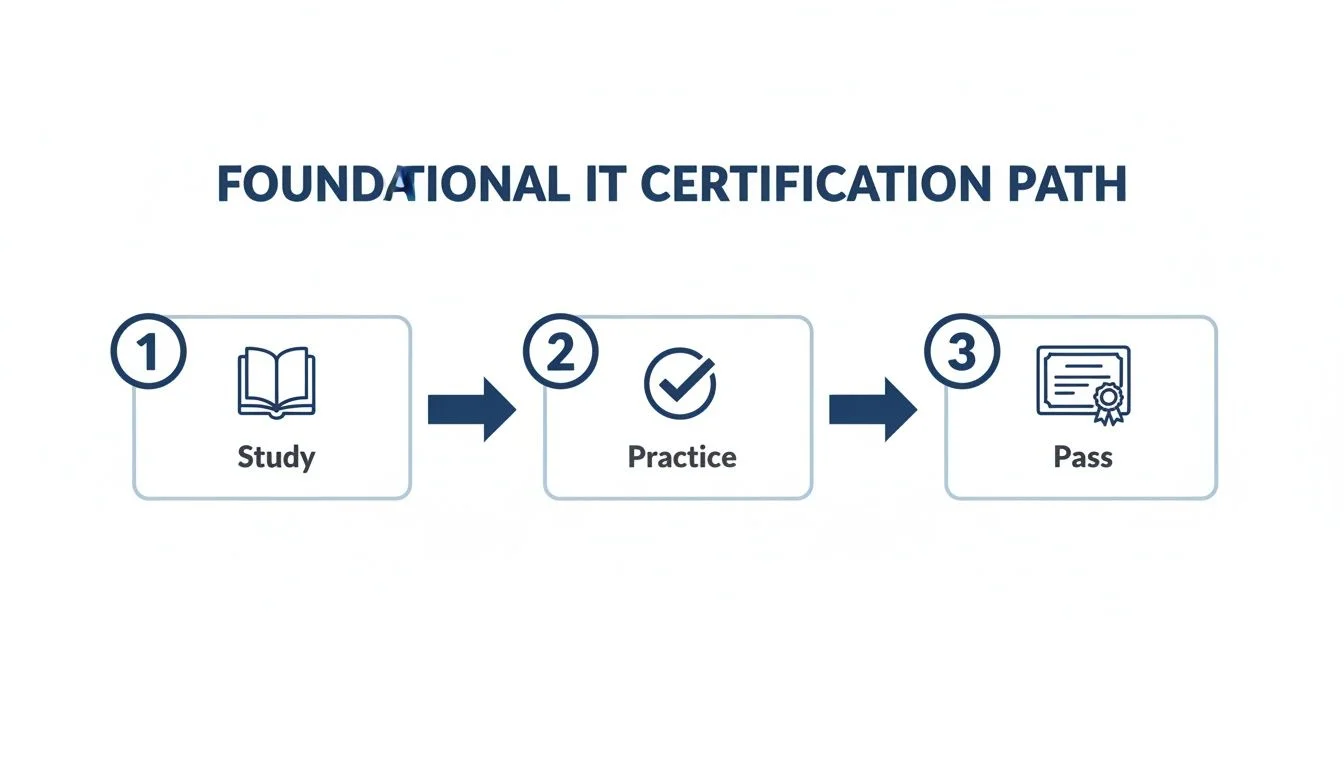 A visual representation of an IT security career and certification roadmap, highlighting progression from foundational skills to specialized areas like GRC and compliance.
Building a career in IT security without a plan often leads to wasted time. You might eventually find a role that fits your interests, but the process will be slower than necessary. A structured certification path for IT security acts as a guide. It changes vague professional goals into a clear sequence of steps. This is about more than just earning badges for your LinkedIn profile. It is about building a clear story of your skills and knowledge that hiring managers can quickly recognize and trust.
This organized approach ensures that your learning follows a logical order. You start by learning the core principles, such as network defense and threat management. Once you have a strong foundation, you can move into specific areas that match your career goals. This might include ethical hacking, cloud security with AWS or Azure, or governance and compliance roles centered on ITIL frameworks.
Charting Your Course for Career Growth
Committing to a defined path removes the uncertainty of what to study next. You follow a progression where each new skill builds on the one before it. In cybersecurity, advanced topics are often impossible to understand without a solid grasp of the basics. Trying to secure a complex network without understanding fundamental routing is like trying to manage a PMP project without knowing the basic stages of a project life cycle.
A well-planned path offers several advantages:
- Clear Career Progression: It shows employers that you have a deliberate strategy for your professional development. Your certifications should align with specific roles, ranging from junior security analyst to senior security engineer.
- Objective Skill Validation: Every certification you earn serves as third-party proof of your abilities. It provides evidence that you have the knowledge required to perform specific tasks effectively.
- Enhanced Earning Potential: Data consistently shows that IT professionals with recognized certifications earn higher salaries. These credentials provide access to better job opportunities and higher-tier roles within an organization.
Industry statistics support this approach. The market for cybersecurity certifications is projected to reach $4,251.8 million by 2025 (verify market data on industry research sites). This growth is caused by a global shortage of skilled workers. There are approximately 3.5 million unfilled jobs in the field worldwide. Because of this demand, earning the right certifications can increase your salary potential by 20-30% (verify current salary trends in your specific region).
A well-planned certification path is more than just a checklist; it represents a commitment to continuous learning that reflects the ever-changing nature of security threats. It signals to employers that you are prepared for modern challenges and can adapt to future technical shifts.
The following table shows how certifications are typically organized into tiers. This structure helps you understand how to progress from entry-level positions to expert roles.
IT Security Certification Tiers at a Glance
| Certification Tier | Focus Area | Example Certifications | Typical Experience Level |
|---|---|---|---|
| Foundational | Core concepts, terminology, basic security practices | CompTIA A+, Network+, Security+ | 0-2 years |
| Associate/Intermediate | Role-specific skills, vendor-specific technologies | Cisco CCNA, (ISC)² SSCP, GIAC GSEC | 2-5 years |
| Advanced/Professional | In-depth expertise, analysis, and management | (ISC)² CISSP, ISACA CISM, CompTIA CASP+ | 5-10+ years |
| Specialist/Expert | Niche domains, highly specialized technical skills | OSCP (Penetration Testing), AWS Security | 7-10+ years, often with prior advanced certs |
Each tier represents a major step in your career. You are building on the knowledge and technical skills you have already proven through previous exams and work experience.
In this field, tools like an AI learning path generator can help you create a personalized plan for your education. MindMesh Academy supports this by using study methods like spaced repetition. This ensures you do not just memorize facts for a test but actually remember the information for use in real-world security situations. Following a set path ensures you stay focused on the skills that matter most to your career.
Building Your Foundation with Core Certifications
A successful career in cybersecurity is built on a solid technical base. Before you pursue specialized roles like a penetration tester or a cloud security architect, you must master the principles that support the entire industry. Foundational certifications provide this necessary groundwork. The CompTIA Security+ remains the primary starting point for most professionals entering the field.
The Security+ acts as a common language for security experts worldwide. Because the certification is vendor-neutral, the skills you learn are not limited to one specific company or product. You will gain a broad understanding of core concepts such as threat analysis, risk management, network security, and cryptography. These principles apply to almost every technical environment. You will need this knowledge whether you are securing a physical data center or working with cloud providers like AWS or Microsoft Azure.
Why Security+ is the First Major Milestone
Earning a Security+ certification proves to hiring managers that you have the required technical knowledge. It demonstrates that you can identify threats, use basic security controls, and understand the logic behind security policies. For many entry-level roles, this certification is a requirement rather than an option. This is especially true for positions within the US Department of Defense and government contracting firms, where specific certifications are mandated by policy.
If you are following a certification path for it security, this credential serves as a primary entry point into the profession. It provides the technical context you need to succeed in advanced training later. Trying to learn a niche specialty like cloud security without this foundation is like trying to build a complex software application without knowing the basics of computer logic.
Foundational credentials like the CompTIA Security+ establish a global standard for the industry. Research suggests that human error contributes to 60-74% of security breaches (verify current statistics on the CompTIA or ISACA websites). This high percentage makes trained professionals a priority for organizations. The cloud security market alone is expected to grow at a 15.3% compound annual growth rate. This growth means a strong technical base is more important than ever before you choose a specialty. You can find further data on these trends through industry analysis firms like Mordor Intelligence.
Creating a Realistic Study Plan
Preparing for a major certification exam can feel difficult, but it is manageable when you break the work into smaller tasks. Most people who pass the Security+ exam spend between 80-120 hours on focused study. (Verify the current exam requirements on the CompTIA website).
Use this structure to organize your preparation:
- Study 8-10 hours per week. This schedule creates a 10 to 12-week timeline. This is a realistic goal even for those who work a full-time job.
- Focus on one domain at a time. CompTIA organizes the Security+ exam into specific domains, such as "Threats, Vulnerabilities & Mitigations" and "Security Operations." Make sure you understand one area before moving to the next.
- Use a variety of different study tools. Do not rely only on a textbook. Combine reading with video courses and hands-on labs to see how the concepts work in practice. Take practice exams to get used to the types of questions you will see on the test.
Consider a professional moving into IT from a different field who finds networking topics like subnetting or port numbers hard to memorize. Instead of reading the same page over and over, they could apply learning methods like spaced repetition. This technique involves reviewing difficult information at specific intervals to help the brain move data into long-term memory. This active recall method is useful for any exam, including the Security+, the AWS Certified Solutions Architect, or the ITIL Foundation certification.
The goal is to learn the material, not just pass the test. A strong grasp of these basics will help you every day in your career long after you receive your certificate.
Reflection Prompt: What IT skills do you have that relate to security? How can you document this experience to help with future certifications?
Actionable Tips for Exam Day Success
Success on the Security+ exam requires both technical knowledge and a clear strategy for the testing center. The exam includes multiple-choice questions and performance-based questions (PBQs). PBQs are simulations that test your ability to solve practical problems.
Follow these tips from people who have successfully passed the exam:
- Prioritize multiple-choice questions and save PBQs for last. PBQs can take a long time to complete. If you finish the multiple-choice section first, you will build confidence and ensure you earn points early. You can then use your remaining time to focus on the practical simulations.
- Employ the process of elimination to narrow your choices. For many multiple-choice questions, you can identify two answers that are clearly wrong. This improves your chances of picking the right answer from 50% instead of 25% if you have to make an educated guess.
- Read every single word in the question carefully. CompTIA often uses specific language. Look for keywords such as "MOST," "BEST," or "NOT." These small words can change the entire meaning of a question. Missing one word can lead to an incorrect answer even if you know the technical subject.
Earning this certification allows you to apply for several entry-level roles, including Security Administrator, IT Auditor, or Junior SOC Analyst. It is an effective way to turn your career goals into a reality. To see how the Security+ fits into the broader selection of IT roles, read our guide on entry-level IT certifications.
Choosing Your Specialization and Next-Level Certs
Once you have established a strong base with a credential like CompTIA Security+, you enter the most active phase of your career development. You have demonstrated a grasp of the fundamentals. Now, you have the chance to map out a specific career path. This is the stage where the certification path for IT security branches out. You can pursue specialized interests and build technical expertise in specific domains.
Think about which parts of security interest you most. Some people enjoy the challenge of defending networks against active threats by watching for intrusions. Others prefer to act like an attacker to find and fix vulnerabilities. The choice you make now will define your daily tasks and long-term career growth.
Whatever path you select, the process for success remains the same. You need to study the theory, use hands-on labs to gain experience, and prove your skills during the exam.
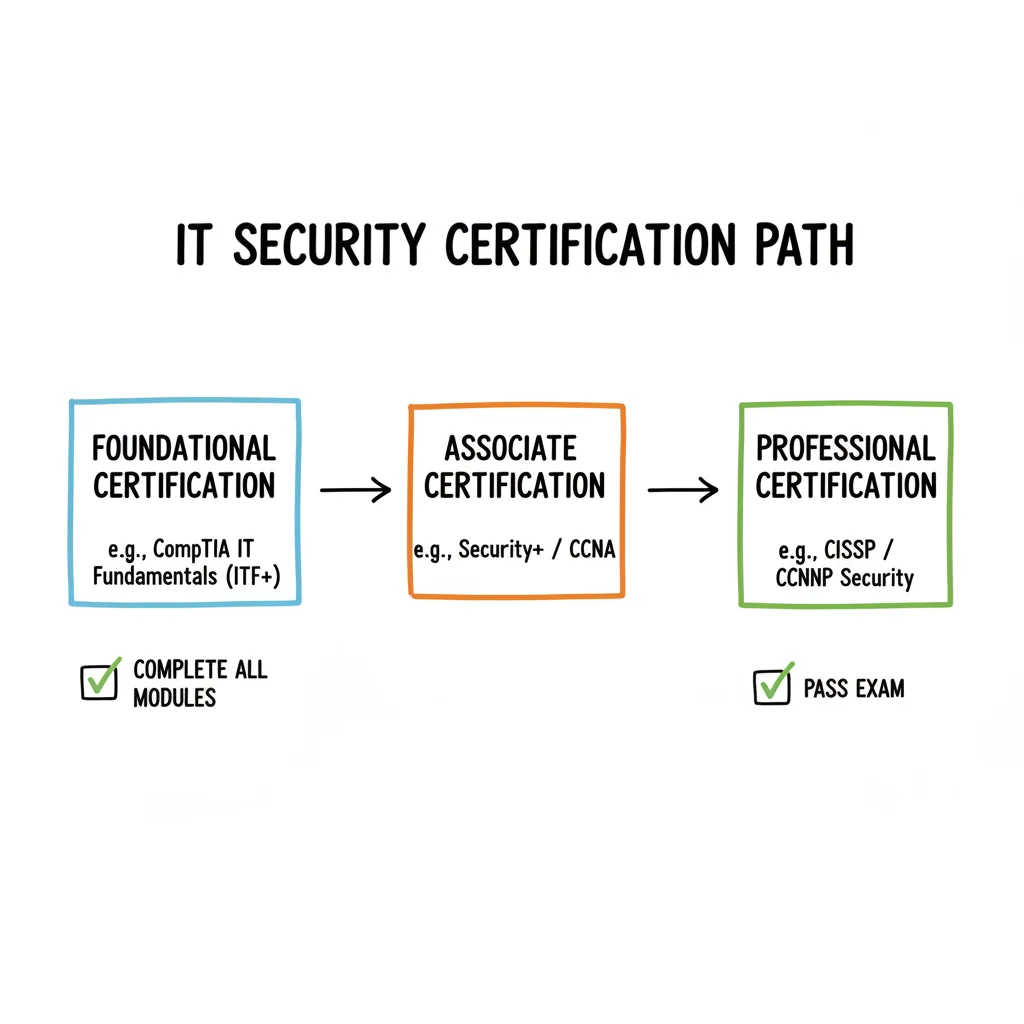 A three-step diagram depicting the core process for IT certification success: Study, Practice, Pass.
Let's examine four common specializations that can move your career forward.
The Defensive Path: Security Analyst
If you enjoy following a method and have a strong urge to protect assets, you might prefer working on a Blue Team as a Security Analyst. These professionals act as the primary defenders of an organization. They monitor systems constantly, watch for unauthorized access, and handle incident response when a security event occurs.
A Security Analyst spends much of their day looking at logs and analyzing alerts from tools like SIEM (Security Information and Event Management) systems. They look for patterns in data to find malicious activity. This role requires high attention to detail. You must stay calm and think clearly when a high-pressure security incident happens.
The CompTIA Cybersecurity Analyst (CySA+) is a logical next step for people on this track.
- What it Proves: The CySA+ certification confirms you can use behavioral analytics to find and stop advanced persistent threats (APTs) and modern malware. It shows you know how to look at data from a defensive perspective rather than just following a checklist.
- Core Skills: You will learn to manage threat intelligence, handle vulnerability management, and follow incident response procedures. These are the primary skills needed to work in a modern Security Operations Center (SOC).
- Career Outlook: Companies have a high demand for analysts who can interpret data. Entry-level salaries often start near $85,000 (verify current regional salary data with local recruiters). These figures rise as you gain experience or specialize in cloud platforms like Azure.
The Offensive Path: Penetration Tester
You might prefer the offensive side of security. If you enjoy a challenge that involves finding weaknesses, the Red Team is a better fit. As a Penetration Tester or Ethical Hacker, your goal is to think like a criminal. You try to find and exploit vulnerabilities before a real attacker does.
This field requires technical skill, creativity, and a focus on problem-solving. You will run authorized tests on systems, apps, and networks. You must document every weakness you find and work with the Blue Team to fix those holes. You are essentially testing the strength of a system by trying to break into it.
Common certifications for this path include the Certified Ethical Hacker (CEH) or the CompTIA PenTest+. If you want a more difficult, hands-on challenge that requires practical application, you might look at the Offensive Security Certified Professional (OSCP).
The choice between offensive and defensive security often depends on how you like to solve problems. Do you want to build a strong defense (Blue Team) or find a way to get past that defense (Red Team)?
Reflection Prompt: Based on your own problem-solving style, do you prefer the organized defense of an analyst or the creative testing of a penetration tester? Why does that style fit you better?
The In-Demand Path: Cloud Security Engineer
Most companies are moving their data and systems to the cloud. This has created a massive need for people who know how to keep those environments safe. Cloud Security Engineers focus on protecting data and infrastructure on platforms like AWS, Azure, and Google Cloud.
This role combines traditional security with cloud-specific tools. You will set up security controls, manage identity and access management (IAM), and configure network security groups. You also ensure that the cloud environment follows specific industry regulations. This often involves understanding the Shared Responsibility Model, which defines what the cloud provider protects and what you are responsible for securing.
The Certified Cloud Security Professional (CCSP) from (ISC)² is a top certification in this area.
- What it Proves: The CCSP shows you have the advanced skills to design and manage secure cloud environments. It covers cloud architecture, data security, and compliance issues specific to hosted environments.
- Prerequisites: You cannot usually get this as your first certification. It requires several years of IT experience, with a portion of that time spent in security and cloud roles.
- Salary Potential: Because these skills are rare and very important, Cloud Security Engineers often earn more than $120,000 (check current industry salary surveys for your specific city). Many senior engineers earn even more as they take on leadership roles.
The Strategic Path: GRC Analyst
Some vital security roles do not require writing code or using a command line every day. If you like strategy, communication, and working with policies, Governance, Risk, and Compliance (GRC) is a strong career choice.
A GRC Analyst connects the technical security team with the business leadership. Your job is to make sure security steps match the goals of the business and follow the law. You will perform risk assessments, write security policies, and help the company get through audits like ISO 27001 or SOC 2. Understanding ITIL frameworks can also help you succeed here by teaching you how IT services are managed.
The Certified in Risk and Information Systems Control (CRISC) from ISACA is a highly regarded certification for this path. It focuses on identifying and managing IT risk while ensuring that control systems are effective.
To see how these paths compare, look at the table below. It outlines what you can expect from each role.
IT Security Career Path and Certification Match
| Career Path | Recommended Intermediate Certification | Key Responsibilities | Skills Validated |
|---|---|---|---|
| Security Analyst | CompTIA CySA+ | Monitoring networks, incident response, threat hunting | Behavioral analytics, intrusion detection |
| Penetration Tester | CompTIA PenTest+ / CEH | Vulnerability scanning, exploiting weaknesses, reporting | Ethical hacking, exploit techniques, reporting |
| Cloud Security Engineer | (ISC)² CCSP | Securing cloud infrastructure, identity management | Cloud architecture, data security, compliance |
| GRC Analyst | ISACA CRISC | Risk assessments, policy development, audit support | Risk management frameworks, compliance controls |
Each of these specializations provides a different way to contribute to cybersecurity. By looking at your own strengths, you can choose a path that offers job security and keeps you interested in your work. To see how these roles fit into the entire industry, you can view our cyber security certification roadmap.
When choosing, consider the environment where you want to work. Security Analysts often work in SOCs with rotating shifts. Penetration Testers might work for consulting firms and move from project to project. Cloud Security Engineers usually work in-house for tech companies or large enterprises. GRC Analysts often work in corporate offices or for regulatory bodies. Each environment offers a different lifestyle and set of challenges.
As you progress, you will notice that these roles often overlap. A Cloud Security Engineer needs to understand the offensive tactics a Penetration Tester uses. A GRC Analyst needs to understand the logs that a Security Analyst monitors to ensure compliance. Starting with a clear specialization helps you build deep knowledge, but you will naturally learn about other areas as your career grows.
Make sure to keep your certifications active. Most of these organizations, like CompTIA and ISACA, require you to earn continuing education units or credits to maintain your status. This keeps your skills current as technology changes. Staying updated is a requirement for anyone who wants a long-term career in this field. If you stop learning, your certifications may expire, making it harder to move into higher-paying roles or new specializations later on.
Focus on one path at a time. Trying to learn penetration testing and GRC at the same moment can be difficult. Master the skills for one role, earn the relevant certification, and then look for ways to expand your knowledge. This step-by-step approach is the most effective way to build a career that lasts.
Reaching the Top with Advanced and Leadership Credentials
After you have established a solid technical base and developed skills within a specific area of interest, your certification path for IT security will naturally move toward leadership and management. This stage represents a shift in your daily responsibilities. You move away from hands-on technical tasks and begin focusing on strategic planning. At this level, you are no longer just fixing vulnerabilities; you are directing the security goals of an entire organization.
Advanced credentials provide a clear signal to the industry and executive boards. They show that you have the years of experience and the vision required to manage broad security programs. These roles involve building teams and ensuring that security protocols help the business reach its goals rather than acting as a barrier. For professionals ready to step into high-level management, two certifications are recognized globally as the gold standards: the Certified Information Systems Security Professional (CISSP) and the Certified Information Security Manager (CISM). Both certifications carry significant weight in the hiring process, but they support different career goals and management styles.
CISSP vs. CISM: Choosing Your Leadership Focus
Deciding whether to pursue the CISSP or the CISM is a major turning point in a career. Your choice depends on how you want to lead. Do you want to remain close to the technical side by designing security architecture and engineering systems? Or do you prefer to focus on the business side of security, dealing with governance, risk assessments, and policy?
The CISSP, which is issued by (ISC)², is known for its wide scope and technical rigor. It covers eight security domains that test your knowledge on everything from software development and network security to asset security and operations. This is the standard credential for people who want to become a Chief Information Security Officer (CISO) or a Security Architect. It is designed for those who must explain technical issues to executives while still understanding exactly how the underlying technology works.
The CISM, provided by ISACA, focuses strictly on the management of an information security program. It does not go as deep into technical details as the CISSP. Instead, it emphasizes your ability to build and oversee a security framework that protects the company while following regulations. This is the best option for those who want to focus on risk management and policy creation. A CISM holder ensures that every dollar spent on security provides clear value to the business.
We can look at the differences between the two this way:
- CISSP focuses on the "how." It proves that you can design and run the technical security operations of an organization.
- CISM focuses on the "why" and "what." It proves you can manage and govern a security program so that it fits the business strategy.
One way to distinguish them is to look at their roles in a project. A CISSP holder acts like an architect and lead engineer. They design a secure building and supervise the construction to ensure it meets high standards. A CISM holder acts like a general or a high-level strategist. They decide where the building should go, how much it should cost, and how the building's defense fits into the overall safety of the territory. They manage the risk of an attack rather than just the strength of the walls.
Navigating the Stringent Prerequisites
These are not entry-level exams. You cannot simply register and take them without proof of your professional background. Both certifications require years of documented work experience. This strict requirement is why the industry respects these credentials so much. They prove that you have spent years working in the field and have handled real-world security challenges.
To earn the CISSP, you must prove you have at least five years of full-time, paid work experience. This experience must cover at least two of the eight domains within the CISSP body of knowledge. To earn the CISM, you also need five years of experience in the security field. However, there is an extra requirement: at least three of those five years must be in a management role. This management experience must cover three or more of the CISM job practice areas.
While five years sounds like a long time, there are ways to shorten the requirement. If you have a four-year university degree in a relevant field, you can often waive one year of the experience requirement for the CISSP. Other certifications, like the CompTIA Advanced Security Practitioner (CASP+), can also count toward this waiver. It is important to keep a clear record of your work history. You will need to show how your previous jobs and projects align with the specific domains of the certification you want to earn.
As you move into these leadership roles, your ability to work with other people becomes just as important as your technical skill. Leaders must be able to improve business communication to explain risks to people who do not have a technical background. You will need to get support from executive teams and lead departments that might have competing interests.
Preparing For a Demanding Exam
Studying for the CISSP or CISM is a long process that requires discipline. Most people who pass these exams spend between 150 to 200 hours (verify current study recommendations on the provider websites) preparing over several months. These tests do not just ask you to repeat facts from a book. They ask you to solve problems. You will be given a situation and asked to choose the best response.
In many cases, you will see four answers that all seem technically correct. However, you must choose the one that a manager or a risk advisor would pick. You have to think about the business first. The goal is to find the solution that provides the most security with the least amount of disruption to the organization's goals.
The effort required to pass is reflected in the potential rewards. Recent data shows that 63% of security professionals find the complexity of modern threats to be a major source of stress. With 88% of organizations worldwide reporting a shortage of skilled workers, people with these certifications are in high demand to lead teams. Earning one of these credentials can lead to a salary increase of up to 25% (verify current local salary trends in your region). This is a strong investment in a market that is expected to be worth $7.5 billion by 2030. You can read more about these trends in the ISACA state of the industry report.
To prepare, you should use a variety of tools. This includes official textbooks, video lessons, and practice exams. Answering hundreds of practice questions is the best way to get used to the way the questions are phrased. It helps you adopt the mindset needed for the exam. You can look at some CISSP sample exam questions to see what the level of difficulty looks like before you start your full study plan.
Finishing one of these certifications is a major achievement in a security career. It allows you to move into senior roles where you can have a real impact on how an organization stays safe. These credentials mark you as a leader who understands both the technology and the business of security.
How to Optimize Your Study Strategy
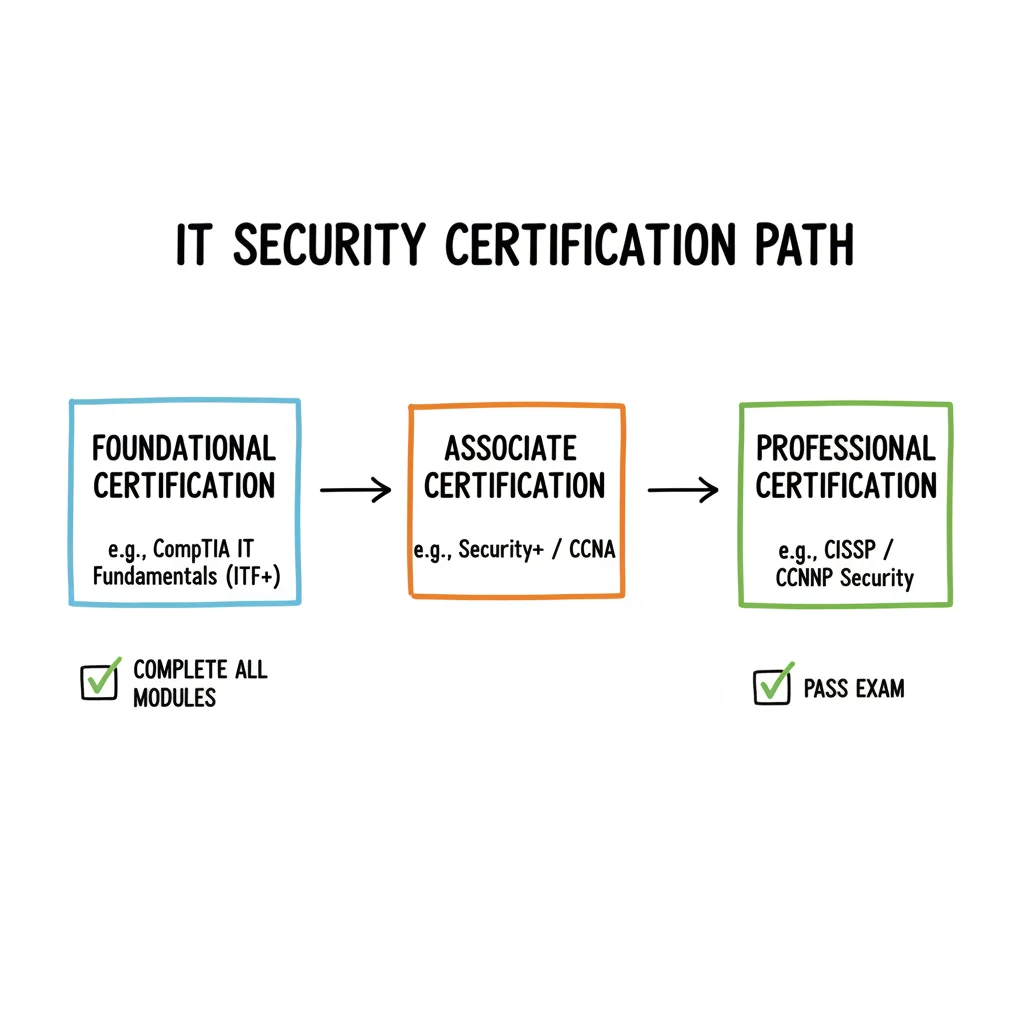 An illustration depicting effective study techniques, including practice exams, spaced repetition flashcards, time management, and a study checklist.
Selecting the right certifications is a vital first step, but your success depends on how you approach the material. If you rely on reading a textbook from cover to cover and hope the information stays with you, you will likely hit roadblocks. Reading is a passive activity. It rarely translates to the sharp problem-solving skills required for high-stakes security exams.
Modern IT security exams are technical and demand a deep understanding of concepts. Passive learning—like skim-reading or watching lectures without taking notes—fails to move information into long-term memory. You should adopt a smarter, more active study methodology to make knowledge stick. This goes beyond passing a test. You are building a base of knowledge that will support your entire career. A smart strategy saves time, prevents burnout, and increases the odds that you pass with confidence on your first attempt.
Stop Re-Reading, Start Recalling
Most students spend hours re-reading chapters until the material feels familiar. This familiarity is often a trap. You might recognize a term on a page, but that does not mean you can recall it during a high-pressure exam. Recognition and recall are two different cognitive processes, and the exam only cares about the latter.
The most effective way to build memory is through active recall. This process involves challenging your brain to find information without looking at your notes or prompts. When you force your brain to retrieve a fact, you strengthen the neural connections associated with that data. You can apply this through spaced repetition, a system where you review topics at specific intervals. You review difficult topics more often and easy topics less often. This prevents your brain from discarding information you haven't used in a few days.
- For Technical Details: Do not just make a card that says "DNS Port: 53." Instead, ask a question that requires more thought: "Which port and protocol does DNS use for zone transfers, and why does this differ from a standard query?" This forces you to remember that standard queries use UDP for speed, while zone transfers use TCP for reliability and data integrity.
- For Complex Concepts: When you study the OSI model, avoid simply listing the layers. Ask yourself: "A user clicks a link in a browser. What happens to that packet at each layer of the OSI model as it moves from the application to the physical hardware?" Describing the encapsulation process at each stage proves you understand how the layers interact.
Many learning platforms use these methods to show you concepts right before you are likely to forget them. This removes the guesswork and makes knowledge retention feel more natural.
Use Practice Exams as Your Compass, Not Your Finish Line
Many students wait until the week of the exam to take a practice test. They treat the practice exam like a final rehearsal. This is a waste of a powerful tool. Practice exams should serve as diagnostic instruments from the moment you finish your first review of the study material.
Take a full-length practice test early in the process. Do not worry about the score at this stage. You are looking for data points. Most professional exams provide a score report that breaks down your performance by domain, such as Identity and Access Management or Risk Management.
Your initial practice exam score is not a final grade; it is a map. It shows you exactly where your knowledge is thin. Use these results to prioritize your study time.
A data-driven approach removes the need to guess what to study next. Instead of wasting time on topics you already understand, you can focus on the areas where you struggled. If your score is high in network security but low in cryptography, you know to spend your next block of time on encryption algorithms and public key infrastructure. This targeted method ensures every hour you spend studying actually improves your final score.
Let Your Progress Shape Your Plan
A rigid study schedule often leads to frustration. If you spend a week on a topic you have already mastered, you lose time that could be spent on harder material. The most effective study plans are flexible and change as you gain mastery.
You can build a flexible framework using these steps:
- Establish Your Baseline: Use your first practice exam to find your current level of knowledge across every domain in the exam objectives.
- Aggressively Attack Your Weaknesses: Spend the next two weeks working only on your lowest-scoring areas. Use labs, technical documentation, and active recall drills to fix these specific gaps.
- Regularly Check In: Take a new full-length practice exam every two weeks to measure your progress objectively. As a weak area improves, move it to a maintenance phase and pick a new weak area to focus on.
- Transition to Final Review: In the last week before the exam, shift your focus to a broad review. Run through quick-hit quizzes to keep all the information fresh and ready to use.
This strategy ensures your effort goes where it matters most. Modern learning tools can help by providing progress dashboards that show your strengths and weaknesses in real-time. These tools can automatically tailor your certification path for IT security exam preparation, allowing you to focus on learning rather than managing a calendar. By following this data-backed method, you can approach your exam day with the certainty that you have covered every requirement.
Got Questions About the IT Security Certification Path?
Once you begin planning a certification roadmap, practical questions arise. It is one thing to look at a flowchart of credentials, but managing a career over years of technological change is a different challenge. We will address common questions IT professionals ask when following this path.
One of the first things newcomers realize is that certifications are not permanent achievements. Most credentials, including the CompTIA Security+ and the CISSP, come with an expiration date. You must renew them every three years (verify specific renewal terms with the certifying body).
This cycle is more than a fee collection system. The security field changes fast. Renewal requirements ensure that someone who certified in 2020 still has the knowledge to face current threats. Staying current means your skills remain applicable to the latest hardware, software, and attack methods. Without updates, a credential loses value to employers seeking current skills.
You renew by earning Continuing Professional Education (CPE) credits. You can collect these credits through activities you likely already do as a professional. This makes the renewal process manageable if you stay active in the community:
- Attending industry webinars, virtual conferences, and in-person events. These provide exposure to new tools.
- Enrolling in training courses to prepare for your next exam. This lets you stack progress toward higher tiers.
- Contributing to the field by writing technical blog posts, mentoring a junior colleague, or volunteering for a security-focused non-profit. These help the community while maintaining your status.
"How Do I Get Experience for the Big-Ticket Certs?"
Advanced certifications like the CISSP or CISM require years of verifiable work. This is a common hurdle for those just starting out. The best strategy is to document your experience starting today.
In every IT role, record the tasks and projects that involve security. If you helped patch a server to fix a vulnerability, that counts. If you configured a firewall rule or joined an incident response simulation, write it down. Log these activities with dates and technologies.
Later, you can map those responsibilities to the specific domains of the certification you want. You might find that your work in IT support, networking, or system administration counts as security experience. Many people are surprised by how much of their daily work fits the requirements when they look closely at the exam domains.
Do not wait for a specific "Security Analyst" job title to appear. Security is a team effort. You can find chances to gain experience in almost any technical role. Volunteer for projects that involve access controls, data protection, or audit preparation to build your background.
"Should I Collect a Bunch of Certs at the Same Level?"
This is a common habit. Many people struggle to choose between the CompTIA PenTest+ and the Certified Ethical Hacker (CEH). They decide to get both to cover all bases.
In most cases, this is not the best use of your time or money. Instead of collecting certifications horizontally at the same level, focus on advancing to higher certifications.
Check job descriptions for the roles you want to reach. Look at local job boards or major tech companies. If one certification appears more often than the other, prioritize that one. Earning two credentials that cover the same material usually results in diminishing returns. Employers rarely pay more for two versions of the same skill set. That time is better spent studying for a more advanced certification that proves you have increased your expertise and are ready for more responsibility.
Ready to stop guessing and start mastering your IT security career? MindMesh Academy uses proven methods like spaced repetition and adaptive learning to help you pass your next certification exam with confidence. You can see your progress and focus your efforts where they matter most. Start your path toward mastery today at CompTIA Security+ Practice Exams.

Written by
Alvin Varughese
Founder, MindMesh Academy
Alvin Varughese is the founder of MindMesh Academy and an enterprise architecture leader. An electrical engineer by training, he moved from factory automation in South Africa to cloud architecture at GE Appliances and Humana (Fortune 50), and holds 20 professional certifications including AWS Solutions Architect Professional, Azure DevOps Engineer Expert, and Microsoft Agentic AI Business Solutions Architect. He built MindMesh Academy after interviewing too many highly certified candidates who couldn't answer basic questions: the goal is prep that makes you better at the job, not just able to pass the exam.