Review Tests to Find Patterns in Your Wrong Answers
Review Tests to Find Patterns in Your Wrong Answers
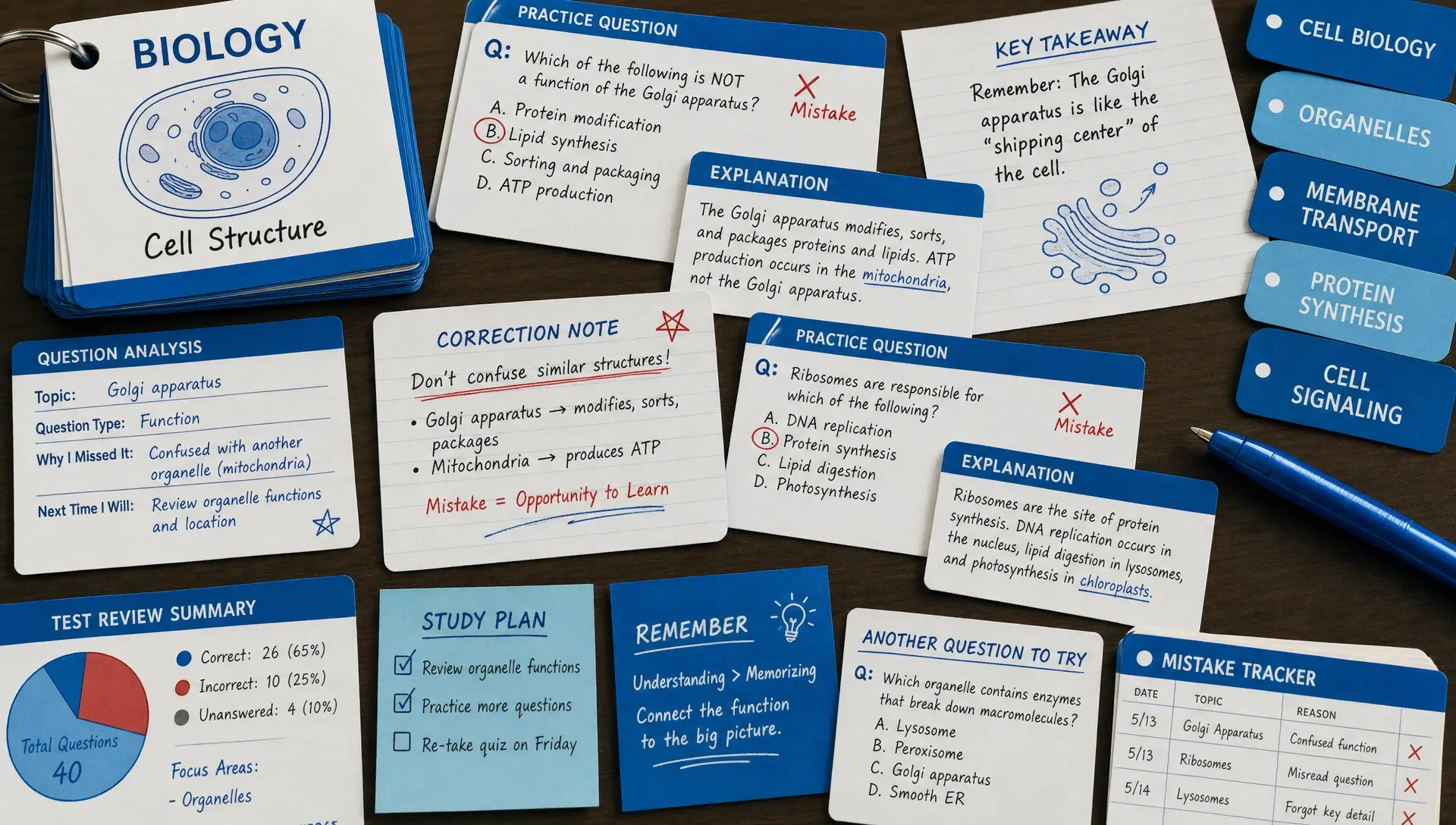
When you review practice tests, your goal isn't just to see which questions you missed. It's about finding the repeatable patterns behind those errors so your next study session fixes the real problem. Start with your last practice quiz or exam, mark every wrong answer, and then ask yourself three questions:
- What objective did this test?
- What clue did I miss?
- Why did my chosen answer seem right at the time?
That last question matters most. Many learners read an explanation, nod, and move on too quickly. Instead, treat each wrong answer as evidence. If the same type of error appears three or more times, you've found a study target, not just a random mistake.
How to Review Tests to Find Wrong Answer Patterns
A useful review starts before you read the explanation. If you look at the explanation first, it can make the correct answer feel obvious and hide the true reason you missed it. Write down your original reasoning while the question is still fresh in your mind, then compare it with the official explanation.
For a deeper, question-by-question routine, you can use this guide on how to review every answer better. The method we'll cover here focuses on the next layer: spotting trends across multiple missed questions.
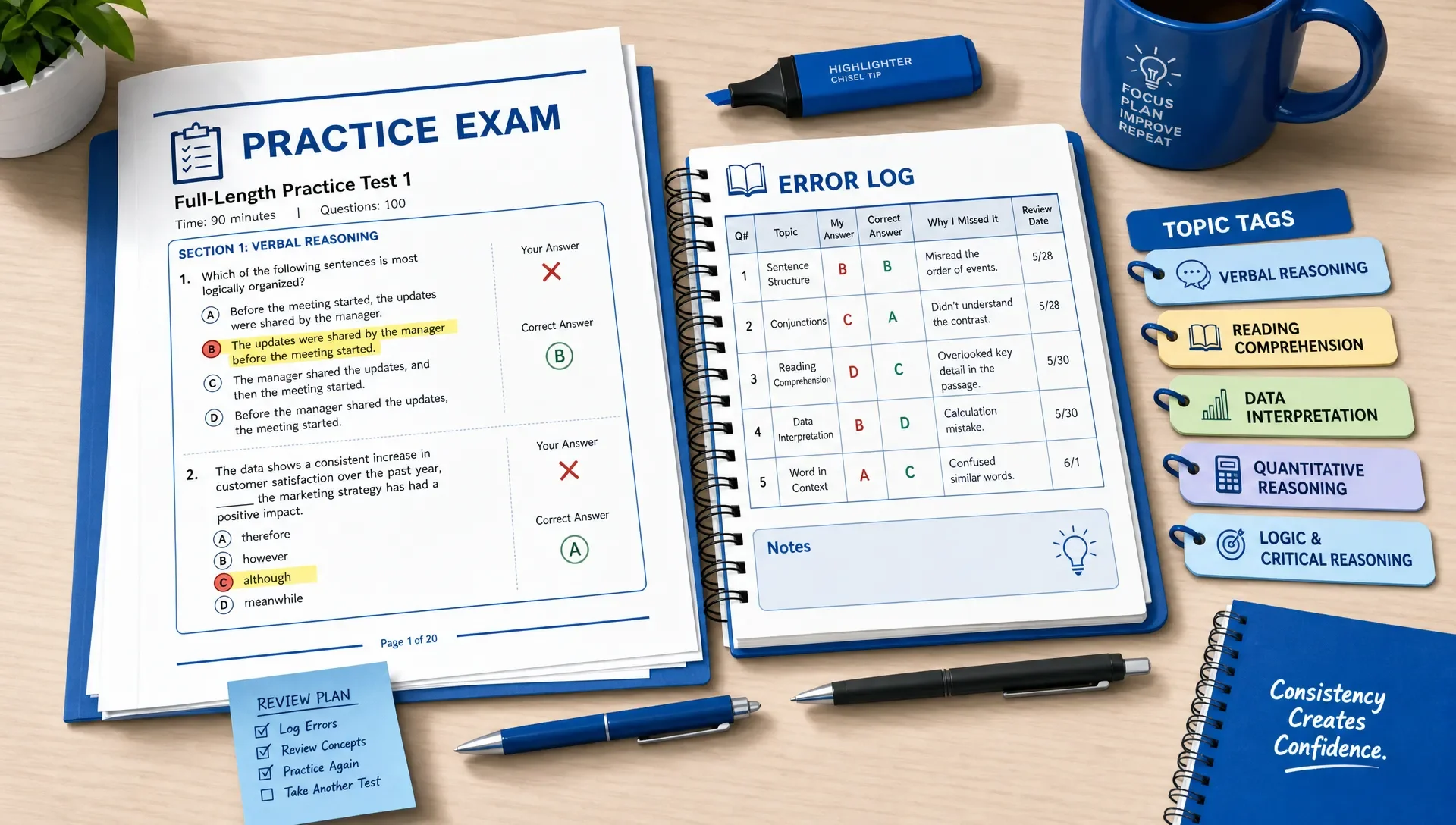
Build a wrong-answer log you can scan quickly
As you review tests over several sessions, keep your log simple enough that you'll actually use it. A spreadsheet, a physical notebook, or a study app note works well. The value comes from consistent tags, not from fancy formatting.
| Log column | What to record | Why it matters |
|---|---|---|
| Exam objective | The domain or topic tested | Shows which objectives need review |
| Question type | Scenario, definition, calculation, command, performance task | Reveals format-specific problems |
| Your confidence | Sure, leaning, guessing, or blank | Separates genuine knowledge from calibration issues |
| Error cause | Gap, misread, distractor, timing, or process | Points to the right fix |
| Fix action | Re-study, flashcards, drill, rework lab logic, or retake later | Converts review into actionable practice |
Don't write a paragraph for every miss. One clear sentence is usually enough: "I picked the cheaper storage answer because I ignored the durability requirement." That kind of specific note becomes very useful when you look for patterns later.
Common Wrong Answer Patterns That Lower Certification Scores
Wrong answers often cluster together. For instance, you might consistently miss identity questions across Azure, IAM questions across AWS, or risk response questions in PMP-style scenarios. Once you label these patterns, you can stop doing broad review and start targeted repair.
| Pattern in your misses | What it usually means | What to do next |
|---|---|---|
| Same objective missed repeatedly | You have a content gap | Re-read that objective section, then drill only that topic |
| Correct concept, wrong scenario choice | You know definitions but struggle with application | Practice scenario questions and explain the deciding clue |
| Two answers always look equally good | You're missing the vendor's priority rule | Compare why the best answer beats the second-best answer |
| You change right answers to wrong ones | Confidence is unstable | Require evidence from the question before changing answers |
| You miss long questions near the end | Timing or stamina is affecting your accuracy | Practice timed blocks and review your pacing |
| Performance-based tasks feel messy | You know facts but struggle with the workflow | Practice ordered steps and configuration logic |
If you're preparing for AWS, Azure, CompTIA, or Cisco exams, map the pattern back to the official exam objectives. For example, a learner using an AWS Certified Cloud Practitioner practice exam shouldn't just check the score. They should ask whether misses concentrate in billing, cloud concepts, security, or architecture.
Separate Knowledge Gaps From Test-Taking Errors
A low score can stem from very different causes. If you treat every miss as a content gap, you'll waste time re-reading topics you already understand. Conversely, if you treat every miss as a test-taking mistake, you'll under-study the areas that genuinely need more work.
When you review tests, sort each wrong answer into one of four buckets:
- A knowledge gap means you could not explain the topic without help.
- A clue error means the question gave you a deciding detail, but you skipped or misread it.
- A distractor error means you recognized a familiar term and picked it too fast.
- A process error means you knew the material but used the wrong sequence, calculation, or elimination method.
This distinction changes your study plan. Knowledge gaps need study guides and flashcards. Clue errors demand slower, more careful question reading. Distractor errors require thorough answer-choice comparison. Process errors need repeated practice under similar conditions.
For vendor exams, use the published exam objectives as your map. MindMesh Academy study guides are organized by exam objectives, making it simpler to connect a wrong-answer pattern to the exact content area you need to rebuild.
Use Confidence Ratings Before Reading Explanations
Confidence ratings are one of the fastest ways to uncover hidden risk. A wrong answer you guessed on isn't surprising. However, a wrong answer you felt sure about is far more dangerous because it points to a false rule, a misunderstood term, or memorized wording that isn't quite right.
Research on retrieval practice supports the value of testing as a learning tool. In a well-known experiment, Roediger and Karpicke found that repeated testing improved delayed recall compared with repeated studying. For certification prep, this only works if you use the test result to correct your mental model.
When you review tests with confidence tags, use four simple labels: sure, leaning, guessing, and blank. Then, prioritize high-confidence wrong answers first. These errors can keep repeating precisely because they feel correct in the moment.
A good review question is: "What rule was I applying, and when does that rule not apply?" This forces you to repair the thinking behind the answer, not just memorize the correct option.
Turn Wrong Answer Patterns Into a One-Week Fix Plan
Review is only useful if it changes what you do next. After a practice exam, choose your top two or three patterns. Don't try to fix every weak area in one sitting. Narrow, focused practice usually produces clearer progress than another broad quiz taken too soon.
| If your pattern is... | Your next study action | How to check progress |
|---|---|---|
| Repeated objective misses | Re-study that objective and make flashcards | Take a short topic quiz 24 to 48 hours later |
| High-confidence wrong answers | Write down the false rule and the corrected rule | Answer new questions that test the same trap |
| Missed scenario clues | Underline the requirement, constraint, and outcome before choosing | Review whether your answer used the key clue |
| Timing mistakes | Use shorter timed sets with a strict review afterward | Track accuracy in the final third of the set |
| Weak performance-based logic | Practice the workflow steps in order | Explain each step without looking at notes |
If you're studying security fundamentals, a CompTIA Security+ practice exam can help you connect practice questions to explanations and topic performance. The point isn't to rush into more questions; it's to choose the next set because it specifically matches your error pattern.
Retake Practice Questions Without Memorizing Answers
Retakes can help, but only if you avoid answer memorization. If you take the same quiz again right away, you might remember that option B was correct without truly understanding why. That creates a score that looks better than your actual readiness.
The safest way to review tests a second time is to delay the retake and change the task. Before selecting an answer, explain what the question is really testing. After selecting, explain why each wrong option is incorrect. If you can't explain the distractors, your "correct" answer may be simple recognition, not true mastery.
MindMesh Academy's flashcards with spaced repetition and adaptive weakness-based practice are built around this idea: practice should return to weaker areas over time instead of rewarding short-term memory. You can also use these quiz bank rules that prevent answer memorization if you're working through a large pool of questions.
Example: From Wrong Answers to a Better Study Decision
Imagine you score 74 percent on a cloud fundamentals practice test. A quick reaction would be to study everything again. A pattern-based review, however, might show something far more specific: most misses came from pricing, support plans, and shared responsibility scenarios.
After you review tests this way, your next move becomes obvious. You don't need another full-length exam tomorrow. Instead, you need a focused study block on billing and governance, a few flashcards for support plan boundaries, and scenario questions that force you to choose who is responsible for a specific security task.
The same process works for Microsoft fundamentals. If your misses cluster around identity, governance, and service selection, an AZ-900 Microsoft Azure Fundamentals study guide can give you an objective-based path instead of a vague instruction to "study more."
What To Do After You Fix a Pattern
Once you've studied a weak area, test it with fresh questions. Don't judge progress by whether you remember the old answer. Judge it by whether you can solve a new version of the same idea.
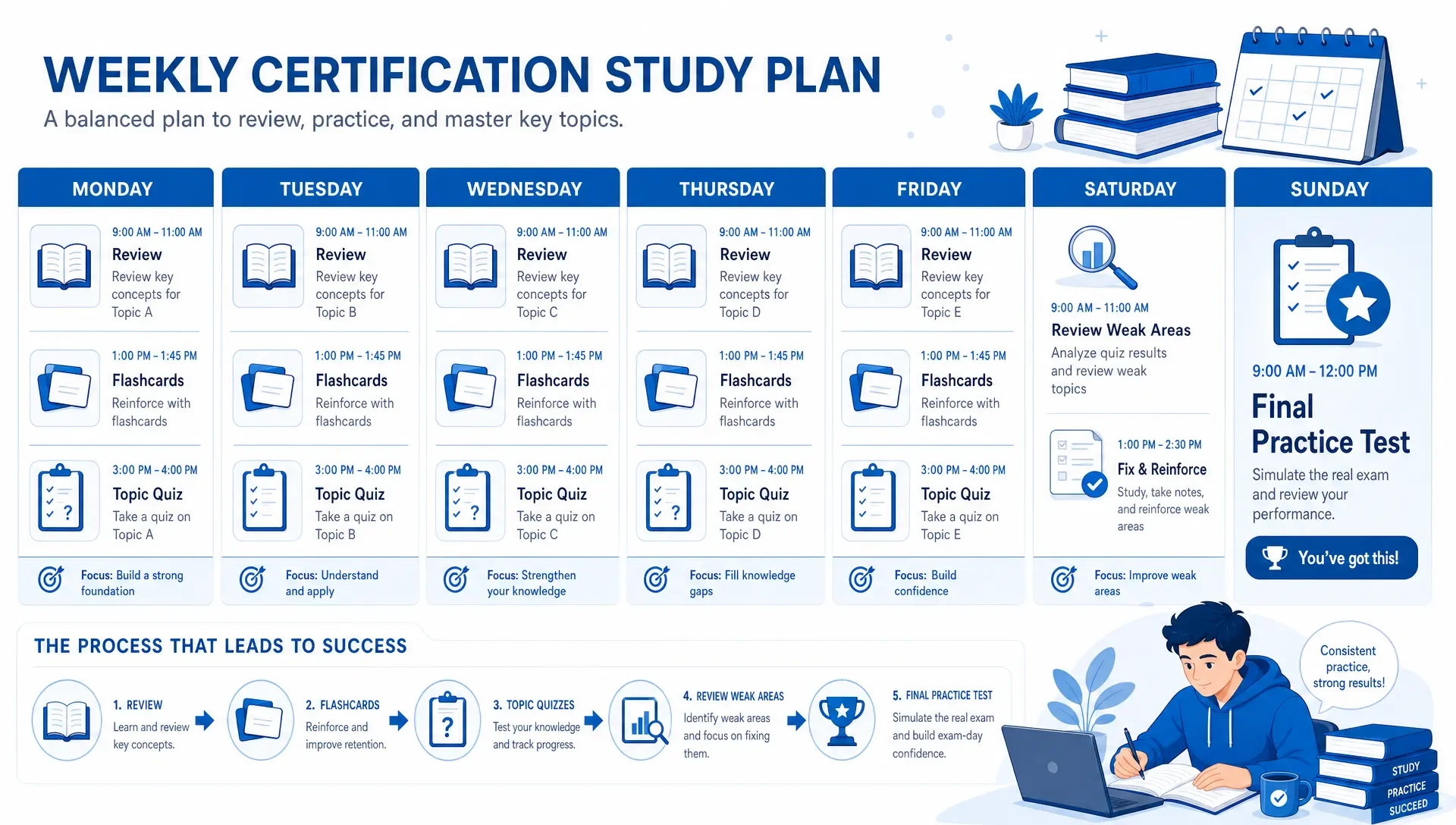
A good sequence looks like this: review the missed objective, make or revise flashcards, practice a small set of targeted questions, explain the missed distractors, wait at least a day, then try another mixed set. Mixed practice matters because real certification exams rarely group all questions from the same objective together.
When you review tests after that mixed set, compare the new log to the old one. If the same pattern dropped, your fix worked. If it stayed the same, the issue may be deeper than just content. You might need slower reading, more hands-on workflow practice, or a different way to distinguish similar services, commands, or project management terms.
Frequently Asked Questions
How often should I review tests during certification prep? Review every serious practice quiz or exam before taking another one. For short drills, a quick review is enough. For full practice exams, spend enough time to tag wrong answers by objective, confidence, and cause.
Should I review only the questions I got wrong? No. Wrong answers deserve the most attention, but review guessed correct answers too. A guessed correct answer can hide the same weakness that caused another missed question.
How many wrong answer patterns should I fix at once? Focus on two or three patterns at a time. If you try to fix ten things at once, your next study session becomes too broad, and you'll have trouble seeing what improved.
What if my wrong answers are spread across every topic? Start by checking your confidence and timing. If misses are scattered, the issue may be pacing, fatigue, or shallow recognition. Then, use a smaller topic quiz to see whether any objective-level pattern appears.
When should I retake a practice test? Retake after you've repaired the patterns from the first attempt and allowed time for forgetting. If you retake immediately, your score may reflect memory of the questions instead of true exam readiness.
Build Your Next Study Session From the Evidence
The fastest way to improve your certification scores is to stop treating a practice score as the final verdict. Instead, use it as a diagnostic report. Find the repeated wrong-answer patterns, choose the right fix, and test again with fresh or delayed questions.
MindMesh Academy provides the tools to put this diagnostic workflow into practice. Our platform offers practice questions with detailed explanations, adaptive weakness-based practice, and readiness tracking to help you target your study efforts. If you're ready to apply these review strategies and improve your score, take our AZ-900 Microsoft Azure Fundamentals practice exam and start building true exam confidence.

Written by
Alvin Varughese
Founder, MindMesh Academy
Alvin Varughese is the founder of MindMesh Academy and an enterprise architecture leader. An electrical engineer by training, he moved from factory automation in South Africa to cloud architecture at GE Appliances and Humana (Fortune 50), and holds 20 professional certifications including AWS Solutions Architect Professional, Azure DevOps Engineer Expert, and Microsoft Agentic AI Business Solutions Architect. He built MindMesh Academy after interviewing too many highly certified candidates who couldn't answer basic questions: the goal is prep that makes you better at the job, not just able to pass the exam.