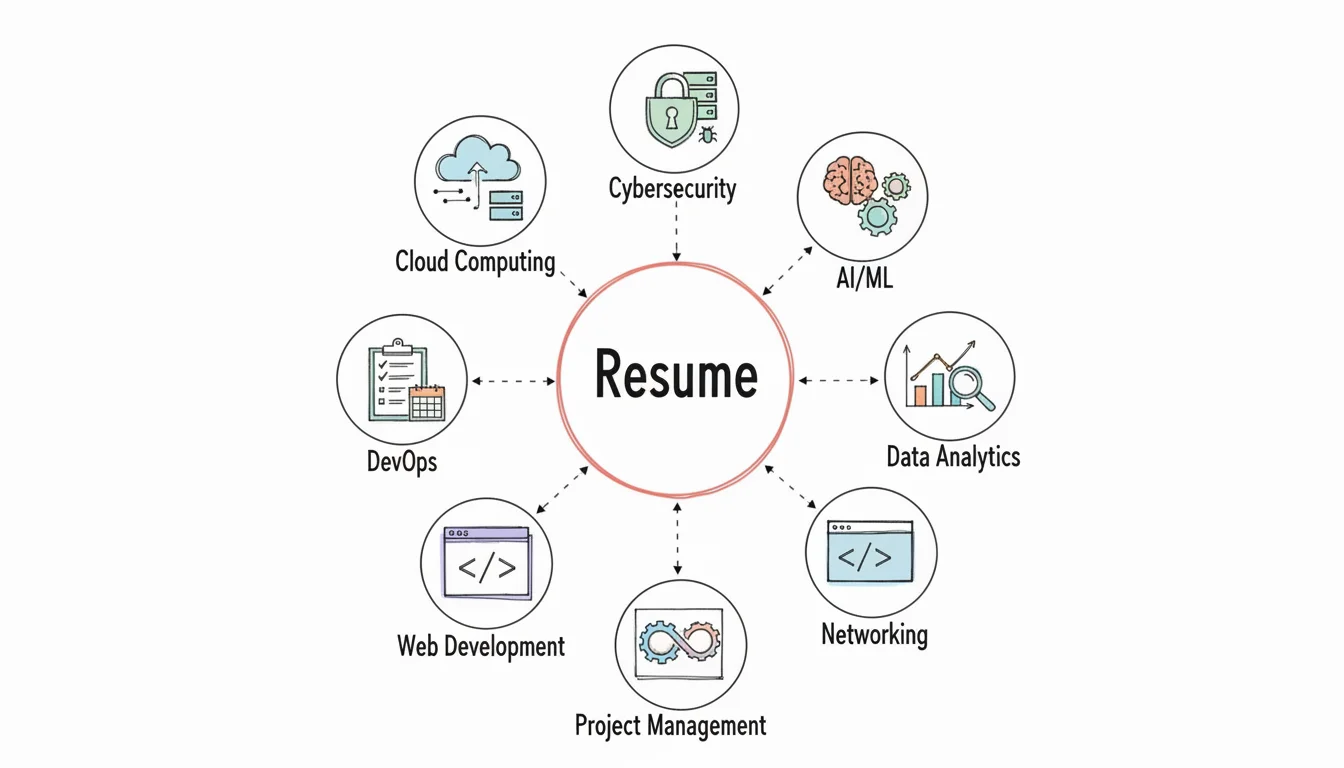
10 Essential Resume Skills IT Pros Need
10 Essential Resume Skills IT Pros Need: Your Guide to Certification Success
In the rapidly evolving IT landscape, a resume that truly stands out is your strategic asset for unlocking top-tier opportunities. It's no longer enough to merely list technologies; hiring managers, and indeed the industry, demand a sophisticated blend of high-demand technical expertise alongside critical soft skills that demonstrate real-world impact and drive business value.
This comprehensive guide, curated by the experts at MindMesh Academy, cuts through the noise to pinpoint the 10 essential resume skills IT professionals must master and effectively showcase. We'll explore not just why each skill is crucial in today's market, but how to articulate it on your resume with practical, certification-aligned examples, and what it truly takes to achieve mastery.
Beyond specific technical and interpersonal competencies, understanding the foundational elements of a compelling resume is paramount. For a deeper dive into crafting a structurally sound and attention-grabbing professional document, explore expert advice on what to include in a resume.
Whether your career aspirations lie in cloud architecture, DevOps engineering, cybersecurity, or data management, this curated list will equip you to build a resume that not only sails through Applicant Tracking Systems (ATS) but also captivates tech recruiters and hiring managers. Let's construct a resume that powerfully reflects your capabilities, ambitions, and commitment to continuous professional growth through validated expertise.
1. Cloud Computing (AWS, Azure, GCP)
Cloud computing has fundamentally reshaped how businesses design, deploy, and scale IT infrastructure, making proficiency in platforms like Amazon Web Services (AWS), Microsoft Azure, and Google Cloud Platform (GCP) one of the most in-demand resume skills IT professionals can possess. This crucial skill encompasses deploying, managing, and scaling applications and services on virtual, internet-based infrastructure rather than traditional on-premises data centers. It spans a spectrum of service models, from Infrastructure-as-a-Service (IaaS), where you manage virtual machines and networks, to Platform-as-a-Service (PaaS) and Software-as-a-Service (SaaS).
Organizations across all sectors are rapidly migrating to the cloud to achieve unparalleled scalability, enhance cost efficiency, and gain operational flexibility. Consider global giants like Netflix, which heavily leverages AWS for its massive content delivery network, or Spotify, which uses GCP for its sophisticated data analytics and recommendation engines. Showcasing your cloud proficiency proves you can help a company innovate, optimize operations, and maintain a competitive edge in the modern digital economy. For IT professionals seeking to validate their cloud expertise, a strong understanding of these platforms is directly testable in various certification exams.
How to Showcase Cloud Skills
- Certifications: Earn foundational certifications like the AWS Certified Cloud Practitioner or Azure Fundamentals (AZ-900) to validate your core knowledge. For more advanced roles, pursue associate-level certifications such as AWS Certified Solutions Architect - Associate or Azure Administrator Associate (AZ-104).
- Portfolio Projects: Utilize free-tier services offered by cloud providers to build and deploy a small application. Document your architectural choices, deployment process (perhaps using Infrastructure-as-Code), and the technologies employed on a personal blog or a well-structured GitHub repository.
- Infrastructure-as-Code (IaC): Demonstrate practical proficiency with IaC tools like Terraform or AWS CloudFormation. Mention specific projects where you automated the provisioning and management of cloud resources, directly impacting deployment speed and consistency.
- Hands-on Experience: Detail specific services you've worked with, e.g., "Managed EC2 instances and S3 buckets on AWS" or "Configured Azure Virtual Networks and App Services."
By highlighting hands-on experience and industry-recognized certifications, you provide concrete, verifiable evidence of your ability to manage and optimize complex cloud environments. If you are looking to get started on your cloud journey, you can find a comprehensive guide on how to learn cloud computing here.
Reflection Prompt: Consider a recent project or task you completed. How could you have leveraged cloud services (AWS, Azure, or GCP) to make it more scalable, cost-effective, or resilient? What specific cloud services would you have used?
2. Python Programming
Python has ascended to become a cornerstone of modern software development and data science, establishing itself as one of the most versatile and valuable resume skills IT professionals can acquire. Its intuitive, readable syntax and vast ecosystem of libraries make it an exceptionally powerful tool for a diverse range of applications—from web development and robust DevOps automation to advanced data science, machine learning, and artificial intelligence. Proficiency in Python signals that you possess the capability to build scalable applications, automate complex and repetitive tasks, and extract actionable insights from large datasets.

Leading tech companies extensively rely on Python for critical operations. For instance, Google utilizes Python for significant portions of its infrastructure automation and core services. Instagram’s backend services are largely built with its Django framework, and Spotify leverages Python for its sophisticated data analysis, recommendation algorithms, and backend services. Highlighting Python on your resume demonstrates a practical, in-demand skill that directly contributes to innovation and operational efficiency in virtually any modern tech-driven organization, often a prerequisite for roles that lead to specialized certifications in data or automation.
How to Showcase Python Skills
- Portfolio Projects: Develop and host 3-5 distinct projects on GitHub. Examples include a web application using Django or Flask, a data analysis project involving pandas and Jupyter notebooks, or an automation script for system administration tasks. Ensure projects have clear README files.
- Library Proficiency: Explicitly mention the core Python libraries you've mastered and applied in projects, such as
requestsfor API interaction,pandasandnumpyfor efficient data manipulation,matplotliborseabornfor data visualization, andscikit-learnfor machine learning. - Version Control: Demonstrate your collaborative workflow and code management skills by showcasing projects with a clean Git history, featuring clear, descriptive commit messages.
- Programming Paradigms: Mention your understanding and application of both functional and object-oriented programming (OOP) principles in your Python code, indicating a deeper grasp of software engineering best practices.
Reflection Prompt: Think of a repetitive manual task in your current or previous role. How could Python be used to automate this task? What specific libraries or modules would be beneficial for that automation?
3. Linux System Administration
Proficiency in Linux is arguably one of the most fundamental resume skills IT professionals can cultivate, serving as the bedrock of modern server infrastructure. This essential skill encompasses the management, configuration, and effective troubleshooting of Linux-based operating systems, which predominantly power server environments—from vast on-premises data centers to the vast majority of public cloud platforms. Expertise in this domain covers a wide array of competencies, including command-line interface (CLI) navigation, user and group permission management, process monitoring, file system management, and network configuration.
Given that nearly all public cloud instances (AWS EC2, Azure VMs, GCP Compute Engine) and the overwhelming majority of web servers run on Linux, expertise in this area is non-negotiable for roles in system administration, DevOps engineering, cloud architecture, and even cybersecurity. For example, the underlying containerization technology powering Docker and the orchestration capabilities of Kubernetes are deeply rooted in Linux kernel features. Demonstrating this skill on your resume signifies that you possess the foundational knowledge required to manage, secure, and automate the core infrastructure of almost any technology-driven company. Many advanced certifications, especially in cloud and DevOps, assume a strong Linux background.
How to Showcase Linux Skills
- Command-Line Proficiency: Mention specific commands and utilities you've mastered (e.g.,
grep,awk,sedfor text processing;chmod,chownfor permissions;systemctlfor service management;netstatfor networking) and how you've applied them for tasks like log analysis, performance monitoring, or intricate file manipulation. - Automation with Scripting: List projects where you utilized shell scripting (e.g., Bash, Zsh) to automate repetitive administrative tasks, such as server backups, routine system updates, user onboarding/offboarding, or deploying applications.
- Certifications: Pursue highly respected certifications like CompTIA Linux+ or the LPIC (Linux Professional Institute Certification). These provide formal, vendor-neutral validation of your expertise, which is highly valued by employers.
- Homelab Projects: Set up virtual machines (using VirtualBox or VMware) or a dedicated low-cost server (like a Raspberry Pi) running popular Linux distributions such as Ubuntu, CentOS, or Fedora. Use this environment to host a web server (Apache/Nginx), a database, or a containerized application, and meticulously document your setup and configurations on GitHub.
Reflection Prompt: Imagine a scenario where a production server is experiencing high CPU usage. What sequence of Linux commands and troubleshooting steps would you use to diagnose the root cause and potentially mitigate the issue?
4. Communication & Collaboration (Soft Skill)
While deep technical abilities form the bedrock of an IT career, effective communication and collaboration are the essential resume skills IT professionals need to translate their expertise into tangible business value and successful project outcomes. This critical soft skill involves more than just talking; it means articulating complex technical concepts clearly to diverse audiences (both technical and non-technical), actively listening, providing constructive feedback, working seamlessly within cross-functional teams, and fostering a shared understanding of project goals, timelines, and potential challenges. It acts as the vital bridge between technical execution and strategic business objectives.
Strong communication is a preventative measure against misunderstandings that frequently lead to project delays, scope creep, and costly mistakes. For example, a DevOps engineer must clearly document deployment procedures and runbooks for operations teams, while a support engineer needs to patiently explain technical issues and solutions to customers without resorting to impenetrable jargon. Similarly, a project manager relies heavily on clear communication to keep a team aligned with project management certifications like PMP emphasizing this. Showcasing this skill on your resume proves you are not merely a technician, but a valuable team player and leader who can drive projects forward, ensure alignment, and effectively integrate technology solutions with broader business needs.
How to Showcase Communication Skills
- Portfolio & Documentation: On your GitHub profile or personal website, ensure every project has a crystal-clear, concise README file. Explain the project's purpose, technical architecture, setup instructions, and the technologies used in simple, accessible terms. This demonstrates your ability to document effectively.
- Resume Bullet Points: Frame your accomplishments with a strong emphasis on collaborative efforts and communication outcomes. Instead of a generic "Developed a new feature," try: "Collaborated closely with product managers and UX designers to develop a new feature, presenting technical feasibility and progress updates, which resulted in a 15% increase in user engagement."
- Interview Performance: During interviews, practice explaining a complex technical project you worked on as if you were speaking to a non-technical senior manager or client. Actively listen to questions, ask clarifying questions yourself, and provide concise, articulate answers that avoid unnecessary jargon.
- Team Contributions: Mention instances where you facilitated team meetings, mentored junior colleagues, or led discussions on technical design choices.
Reflection Prompt: Describe a situation where you had to explain a complex technical concept to a non-technical stakeholder. How did you adapt your communication style? What was the outcome?
5. Docker & Container Technology
Containerization has profoundly transformed how applications are built, shipped, and run in modern IT environments, making Docker an unequivocally critical entry on any list of resume skills IT professionals must learn and master. This skill involves packaging an application and all its necessary dependencies (libraries, frameworks, configurations) into a standardized, isolated unit called a container. Containers provide lightweight, portable, and remarkably consistent environments, ensuring that software runs reliably and predictably across diverse stages of the software development lifecycle—from local development machines to testing environments and ultimately, production servers. This consistency is absolutely essential for modern DevOps practices and highly scalable microservices architectures.
Major technology companies globally rely heavily on containerization to maintain agility, enhance development velocity, and scale their operations efficiently. For example, Uber extensively uses Docker to deploy its myriad services across the globe, ensuring consistent performance, while Airbnb leverages it to create uniform development environments for its vast engineering teams. Listing Docker proficiency on your resume demonstrates your ability to streamline deployment pipelines, improve application portability, and support resilient, scalable application infrastructures. It's a foundational skill for anyone aiming for roles in DevOps, cloud engineering, or microservices development.
How to Showcase Docker Skills
- Portfolio Projects: Containerize one of your personal projects (e.g., a web application with its database) and host the Dockerfile and related configuration files on GitHub. This provides tangible, verifiable proof of your practical abilities.
- Multi-Container Applications: Demonstrate proficiency with Docker Compose by building and documenting an application that utilizes multiple interconnected services (e.g., a web server, a database, and a caching layer) all orchestrated through a
docker-compose.ymlfile. - Orchestration Knowledge: Even if not an expert, mention any foundational experience or understanding of container orchestrators like Kubernetes. This shows you grasp how containers are managed at scale in production environments.
- CI/CD Integration: Describe how you've integrated Docker into a CI/CD pipeline, perhaps building Docker images automatically upon code commits and pushing them to a container registry.
By highlighting practical, hands-on projects, you move beyond merely listing a technology and provide concrete evidence that you can apply Docker to solve real-world engineering and deployment challenges. To get hands-on experience, you can explore the official Docker Get Started tutorial.
Reflection Prompt: Imagine you're deploying a web application with a database. How does using Docker improve the deployment process compared to traditional methods? What specific problems does it solve?
6. Problem-Solving & Troubleshooting (Soft Skill)
At its very essence, IT is fundamentally about identifying and resolving issues. This makes problem-solving and troubleshooting one of the most critical resume skills IT professionals can develop, irrespective of their specialization. This soft skill represents the systematic, analytical process of identifying, analyzing, and efficiently resolving technical challenges. It requires a potent combination of logical reasoning, critical thinking, creativity, and persistent diligence to accurately diagnose the root cause of a problem, rather than merely addressing its symptoms.
This indispensable ability is fundamental to virtually every IT role. From help desk technicians meticulously isolating user-reported issues to Site Reliability Engineers (SREs) debugging complex production outages under immense pressure, effective troubleshooting minimizes downtime, significantly improves system reliability, and ultimately saves an organization invaluable time and money. Highlighting this skill on your resume powerfully demonstrates your value as someone who can maintain operational stability, ensure business continuity, and drive continuous improvement within technical environments. This skill is implicitly tested in almost every technical certification exam through scenario-based questions.
How to Showcase Problem-Solving Skills
- Document Your Process (STAR Method): In your resume's bullet points or during job interviews, use the STAR (Situation, Task, Action, Result) method to vividly describe a complex technical problem you encountered and successfully resolved. Detail the systematic steps you took to diagnose the issue, the tools you utilized, and the logic behind your chosen solution.
- Showcase Root Cause Analysis (RCA): Mention specific instances where you didn't just fix a problem, but conducted a thorough Root Cause Analysis (RCA) to understand why it occurred and implemented preventative measures to stop it from recurring. This demonstrates strategic thinking beyond reactive responses.
- Create a Knowledge Base: Maintain a personal or public log (e.g., a blog, a GitHub Gist, or a section on your portfolio site) of challenging problems you've solved, detailing the symptoms, diagnosis, and resolution steps. Sharing this demonstrates your methodology, commitment to learning, and willingness to help others.
- Certifications for Methodology: While not a direct problem-solving certification, a certification like ITIL 4 Foundation covers incident, problem, and change management processes, indirectly validating a structured approach to troubleshooting.
By framing your experience around a structured, methodical troubleshooting approach, you prove you are a reliable, resilient, and methodical thinker capable of effectively handling the inevitable challenges of a dynamic technical environment.
Reflection Prompt: Recall a time when you solved a particularly challenging technical problem. What was your process? What assumptions did you test, and what tools did you use? How did you ensure the problem wouldn't recur?
7. SQL & Database Management
Proficiency in SQL (Structured Query Language) is an enduring cornerstone of modern technology, making it one of the most fundamental and universally applicable resume skills IT professionals must cultivate. This skill involves querying, manipulating, and optimizing relational databases, which serve as the robust backbone for an enormous range of applications—from large-scale e-commerce platforms and financial transaction systems to complex enterprise resource planning (ERP) systems. Mastery of SQL is indispensable for backend developers, data analysts, DevOps engineers, and essentially anyone working with structured data.
Virtually every major tech company, across every industry, relies heavily on SQL. Financial institutions use it daily for secure, high-volume transaction processing; giants like Google and Amazon manage petabytes of critical customer and operational data using highly optimized relational databases. Highlighting this skill on your resume signals that you can directly interact with, manage, and extract value from an organization's most valuable asset: its data. While SQL remains paramount, an understanding of nonrelational databases (NoSQL) is also becoming increasingly crucial for handling diverse data structures and massive scale in modern applications, often complementing SQL skills.
How to Showcase SQL Skills
- Portfolio Projects: Analyze a publicly available dataset (e.g., from Kaggle or data.gov) and create a project that demonstrates complex SQL queries, involving joins, subqueries, aggregations, and window functions. Document your findings and the SQL scripts on GitHub.
- Performance Optimization: Mention specific, quantifiable examples where you optimized a slow-performing SQL query or database operation. Describe how you used tools like
EXPLAIN(or equivalent) to analyze and improve its execution plan, leading to performance gains. - Database Design: Showcase your understanding of database design principles, such as normalization (1NF, 2NF, 3NF), by including a database schema or an ERD (Entity-Relationship Diagram) you designed for a personal or academic project.
- CRUD Operations & Stored Procedures: Detail your experience with fundamental Create, Read, Update, Delete (CRUD) operations and, for more advanced users, your ability to write and manage stored procedures, functions, and triggers.
- Relevant Certifications: While specific SQL certifications exist (e.g., from Microsoft or Oracle), many data engineering and developer certifications (like Microsoft Certified: Azure Data Engineer Associate) include significant SQL components.
By detailing specific accomplishments and demonstrating a deep understanding, you prove your ability extends far beyond basic SELECT statements. You can find more information on advancing your database management skills here.
Reflection Prompt: Describe a scenario where a database query was performing poorly. How would you approach identifying the bottleneck, and what SQL optimization techniques would you apply to improve its speed?
8. CI/CD Pipeline & DevOps Tools (Jenkins, GitLab CI, GitHub Actions)
In today's relentlessly fast-paced software development world, the capability to build, test, and deploy code rapidly and reliably is no longer an advantage—it's a non-negotiable imperative. Expertise in Continuous Integration and Continuous Deployment (CI/CD) pipelines, leveraging industry-standard tools like Jenkins, GitLab CI, and GitHub Actions, is one of the most critical resume skills IT professionals, particularly those in DevOps or development, can possess. This skill involves automating the entire software delivery process, from the initial code commit by a developer right through to its deployment in production. The goal is to minimize manual errors, accelerate release cycles, and ensure consistent, high-quality software.
Companies that master CI/CD gain a profound competitive advantage. For instance, tech titans like Netflix and Google rely on highly sophisticated, automated pipelines to push thousands of code changes to production daily, enabling rapid innovation, quick bug fixes, and maintaining exceptional service stability. Demonstrating proficiency in designing, implementing, and managing these tools proves you can help an organization embrace a modern DevOps culture, resulting in faster feedback loops, improved collaboration, and significantly higher-quality software releases. This is a core domain for certifications like AWS Certified DevOps Engineer - Professional and Azure DevOps Engineer Expert.
How to Showcase CI/CD Skills
- Portfolio Projects: Create a public repository on GitHub or GitLab that includes a complete CI/CD pipeline. Use GitHub Actions, GitLab CI, or Jenkins to automatically build, test, and deploy a simple application (e.g., a web service) to a cloud service like AWS S3/EC2, Azure App Service, or Google Cloud Run.
- Tool-Specific Knowledge: Clearly mention specific tools you've mastered and your experience with them. For instance: "Designed and managed Jenkins pipelines for Java applications using Maven and SonarQube," or "Automated deployment workflows for microservices using GitHub Actions, Docker, and Terraform."
- Metrics and Outcomes: Whenever possible, quantify your impact. For example: "Reduced manual deployment time by 80% by implementing an automated CI/CD pipeline, increasing release frequency from monthly to weekly."
- Pipeline Stages: Detail your experience with different stages of a pipeline: source control integration, automated testing (unit, integration, end-to-end), artifact management, security scanning, and various deployment strategies (e.g., blue/green, canary).
Highlighting hands-on experience with these tools, especially when tied to measurable results, shows you deeply understand the mechanics of modern software delivery and can drive efficiency. For those preparing for advanced roles, a deeper understanding of these concepts is key, and you can learn more by exploring implementing CI/CD pipelines here.
Reflection Prompt: Describe a scenario where a manual deployment process caused issues or delays. How could a CI/CD pipeline have prevented these problems? What specific tools would you have integrated?
9. Leadership & Team Management (Soft Skill)
Beyond individual technical prowess, the ability to effectively lead, mentor, and manage teams is one of the most critical resume skills IT professionals can develop for significant career advancement. This skill set encompasses guiding projects to successful completion, making decisive technical judgments, fostering a positive and collaborative team environment, and empowering team members to perform at their best. It requires a sophisticated blend of emotional intelligence, strategic planning, effective delegation, and crystal-clear communication to unlock a team’s collective potential and achieve organizational goals.
Organizations, from agile startups to established enterprises and FAANG companies, rely heavily on strong technical leadership to navigate complex challenges, drive continuous innovation, and build high-performing engineering cultures. For example, engineering managers at Google are tasked with leading teams of 8-15 engineers, focusing on their growth and project delivery, while technical leads at Microsoft are expected to mentor junior developers, uphold rigorous code quality standards, and architect robust solutions. Showcasing this skill on your resume proves you are prepared for senior-level responsibilities that directly impact business outcomes, often a prerequisite for certifications like Project Management Professional (PMP) or Certified ScrumMaster (CSM).
How to Showcase Leadership Skills
- Seek and Document Opportunities: Actively volunteer to lead a small project, take ownership of a critical module, mentor a new hire, or facilitate technical discussions and team meetings. Document the project's scope, your specific actions as a leader, the challenges encountered, and the quantifiable results achieved.
- Formal Training & Certifications: Mention any management courses, leadership workshops, or professional development programs you have completed. Certifications such as a Certified ScrumMaster (CSM), Project Management Professional (PMP), or ITIL 4 Leader can formally demonstrate your ability to guide a team through agile methodologies or service management frameworks.
- Highlight Mentorship: On your resume, specifically describe instances where you have mentored junior colleagues, provided constructive technical feedback, conducted code reviews, and actively contributed to the professional growth and skill development of others on your team.
- Project Ownership & Strategic Impact: Detail projects where you took a leading role in defining technical direction, making critical architectural decisions, or successfully managed project dependencies and stakeholder expectations.
By framing your experience in terms of team success, project outcomes, and the growth of your colleagues, you powerfully demonstrate your capacity to transition from an individual contributor to an influential and impactful leader. To get started on this path, you might find valuable insights in books like Kim Scott’s Radical Candor, which emphasizes candid yet empathetic feedback.
Reflection Prompt: Recall a time you had to lead a small team or project. What leadership style did you adopt? How did you motivate your team, handle conflicts, and ensure project success?
10. Kubernetes & Container Orchestration
As companies increasingly embrace microservices architectures and cloud-native development, expertise in container orchestration has rapidly become a non-negotiable resume skills IT requirement for advanced DevOps, SRE, and cloud engineering roles. Kubernetes, the undisputed industry-standard platform, automates the deployment, scaling, and management of containerized applications with unparalleled efficiency. It empowers developers and operations teams to run complex, distributed systems with high availability, fault tolerance, and resilience by effectively managing application "containers" across clusters of machines (nodes).
This skill is absolutely crucial for building and maintaining modern, scalable infrastructure. For example, global platforms like Airbnb leverage Kubernetes to orchestrate their vast array of microservices at an enormous scale, ensuring consistent user experience, while Stripe relies on it for robust and reliable financial service deployments. Demonstrating Kubernetes proficiency shows you can navigate and manage the complex, dynamic environments that power today's leading technology companies, ensuring applications run smoothly, efficiently, and with minimal downtime. It’s a highly sought-after skill validated by prestigious certifications.
How to Showcase Kubernetes Skills
- Certifications: Earn a prestigious and highly valued certification like the Certified Kubernetes Administrator (CKA) or Certified Kubernetes Application Developer (CKAD) from The Linux Foundation. These hands-on exams formally validate your practical expertise.
- Local Clusters & Sandbox Environments: Mention projects built using local Kubernetes environments like Minikube, k3s, or Docker Desktop's built-in Kubernetes. This demonstrates hands-on experience without requiring expensive cloud costs for initial learning.
- Package Management with Helm: Highlight your experience using Helm charts to deploy, manage, and update complex applications on Kubernetes. Describe how you customized existing charts or even developed your own for specific deployments.
- YAML Manifests & Resource Management: Showcase your understanding by creating and sharing well-structured YAML manifest files for deploying multi-container applications, configuring services, persistent storage, and network policies on your GitHub profile.
- Cloud Provider Integration: Detail any experience deploying and managing Kubernetes clusters on major cloud platforms (e.g., Amazon EKS, Azure AKS, Google GKE), demonstrating real-world cloud-native implementation.
Mastering Kubernetes requires a solid foundation in Docker and Linux, but it provides an incredibly powerful way to manage and scale applications in a cloud-native world. You can explore a beginner's guide to get started with the basics of what Kubernetes is here.
Reflection Prompt: If you were to deploy a three-tier web application (web server, application server, database) on Kubernetes, what key Kubernetes resources (e.g., Deployments, Services, PersistentVolumes) would you need, and how would they interact?
Top 10 IT Resume Skills — Comparison
| Skill / Technology | Implementation complexity | Resource requirements | Expected outcomes | Ideal use cases | Key advantages |
|---|---|---|---|---|---|
| Cloud Computing (AWS, Azure, GCP) | Moderate → high; many services and vendor specifics | Cloud accounts, labs, IaC tools, certification costs | Scalable, cost-optimized deployments and flexible infra | Enterprise migration, scalable web/data workloads, serverless | High demand; vendor certs; multi-platform applicability |
| Python Programming | Low → moderate; easy to start, deep for advanced topics | Dev environment, libraries, datasets, learning resources | Rapid development, automation, ML/data solutions | Scripting, data science, web backends, automation | Versatile ecosystem; beginner-friendly; dominant in ML |
| Linux System Administration | Moderate → high; CLI and distro variance | Linux VMs/servers, hands-on practice, shell scripting | Stable server operations, system control, automation | Server management, DevOps foundation, container hosts | Industry standard; open-source; strong job security |
| Communication & Collaboration (Soft Skill) | Variable; continuous practice required | Mentoring, feedback loops, presentation practice | Clear stakeholder alignment, improved team outcomes | Cross-functional projects, stakeholder communication | Drives career growth; reduces errors; differentiator |
| Docker & Container Technology | Moderate; fundamentals quick, orchestration adds complexity | Docker engine, images, registries, CI/CD pipelines | Consistent, portable deployments and faster dev cycles | Microservices, CI/CD, dev/test environment parity | Simplifies deployments; quick to adopt; enables microservices |
| Problem-Solving & Troubleshooting (Soft Skill) | High to develop; experience-driven | Real incidents, practice scenarios, mentorship | Faster root-cause resolution and reduced downtime | SRE, support, incident response, operations | Broad applicability; improves reliability; interview focus |
| SQL & Database Management | Low → moderate; basics quick, tuning is complex | Database instances, datasets, monitoring and tooling | Reliable data access, optimized queries and schemas | Backend services, analytics, ETL and data engineering | Universal skill; high demand; foundational for data roles |
| CI/CD Pipeline & DevOps Tools (Jenkins, GitLab CI, GitHub Actions) | High; multiple integrations and concepts | CI/CD servers, test frameworks, IaC, artifact storage | Automated builds/tests/deploys and faster releases | Agile teams, frequent deployment workflows, automation | Reduces manual errors; accelerates delivery; core DevOps |
| Leadership & Team Management (Soft Skill) | High; requires experience, EQ and strategic thinking | Leadership training, mentoring time, real team exposure | Improved team performance, retention, and delivery | Engineering managers, tech leads, program leadership | Significant career and salary impact; organizational influence |
| Kubernetes & Container Orchestration | Very high; complex cluster and networking concepts | Cluster resources, strong Docker/Linux background, labs | Scalable, resilient microservice orchestration at scale | Large cloud-native apps, multi-service production systems | Industry standard; high salary premium; multi-cloud support |
From Skills to Success: Your Next Move
Crafting a truly standout IT resume in today's fiercely competitive landscape is much more than a mere listing of technical jargon; it's an exercise in strategic storytelling. As we've thoroughly explored, it's no longer sufficient to simply list technologies or frameworks you've encountered. The true power and impact of your resume lie in demonstrating a holistic skill set that expertly blends deep, hands-on technical expertise with the indispensable soft skills that collectively drive innovation, foster collaboration, and ensure project success. The most effective resumes showcase not just what you know, but crucially, how you apply that knowledge to solve real-world problems and deliver tangible business value.
The journey from a competent individual technician to an indispensable team asset and leader is paved with this dual mastery of both hard and soft skills. A professional who can expertly configure a Kubernetes cluster is undoubtedly valuable; however, one who can also clearly communicate its architectural benefits to non-technical stakeholders, troubleshoot critical deployment failures under immense pressure, and effectively lead a team through a complex cloud migration is a genuine game-changer. This essential balance and integration of skills form the core theme connecting all the critical resume skills for IT professionals we've discussed.
Synthesizing Your Technical and Soft Skills
The key takeaway for optimizing your resume is powerful integration. Your professional document should reflect how your diverse abilities work in concert, creating a synergistic impact. Instead of presenting isolated bullet points, aim to weave these skills together into a compelling narrative of achievement.
- Connect the Dots: Don't just list "Python" and "Problem-Solving" as separate items. Instead, frame it as: "Developed a Python script to automate server health checks, proactively identifying potential outages and reducing manual troubleshooting time by 90%."
- Show, Don't Just Tell: Rather than stating a generic "Strong Communication Skills," provide concrete, evidence-based examples: "Presented a technical deep-dive on our CI/CD pipeline implementation to a non-technical audience of 30+ stakeholders, successfully securing cross-departmental buy-in and project funding."
- Quantify Your Impact: Numbers speak louder than words and lend credibility to your accomplishments. Whether it's quantifiable cost savings, significant efficiency gains, improved system performance, or increased user engagement, adding metrics to your achievements powerfully validates the impact and value of your skills.
Your Action Plan for Career Advancement
Mastering these essential concepts is the first, and most crucial, step in your professional journey. The next, equally vital, step is to validate that mastery in a way that hiring managers and recruiters instantly recognize and trust. Industry-recognized certifications provide that invaluable third-party endorsement, transforming your claimed skills into proven, verifiable credentials. Think of certifications not just as badges, but as the official stamp that makes your expertise undeniable. They signal your profound commitment to your craft, your dedication to continuous learning, and your verified ability to perform complex technical tasks.
Ultimately, building a powerful collection of resume skills for IT is an ongoing, dynamic process of continuous learning, practical application, and strategic validation through certifications. By focusing on this meticulously curated blend of technical prowess in high-demand areas like cloud computing, containerization, and automation, and complementing it with indispensable soft skills such as leadership, problem-solving, and communication, you are not just preparing for your next job opportunity. You are actively building the robust foundation for a resilient, impactful, and profoundly rewarding career in technology. Your resume is far more than a simple document; it's the carefully crafted highlight reel of your professional story. Make it an exceptionally compelling one.
Ready to turn your skills into certified expertise and propel your career forward? MindMesh Academy offers expertly curated certification preparation materials designed to help you deeply master the concepts, not just memorize answers. Explore our evidence-based study methods and comprehensive resources at MindMesh Academy and take the next confident, validated step in your IT career.
Ready to Get Certified?
Prepare with expert-curated study guides, practice exams, and spaced repetition flashcards at MindMesh Academy:

Written by
Alvin Varughese
Founder, MindMesh Academy
Alvin Varughese is the founder of MindMesh Academy and holds 20 professional certifications including Microsoft Agentic AI Business Solutions Architect, AWS Solutions Architect Professional, and Azure DevOps Engineer Expert. He's held senior engineering and architecture roles at Humana (Fortune 50) and GE Appliances. He built MindMesh Academy to share the study methods and first-principles approach that helped him pass each exam.