
Neuroscience of Learning: Ace Exams Smarter
Neuroscience of Learning: Ace Exams Smarter
If you're studying for a certification while working full-time, you've been there.
It's late. You've read the same page twice. Your notes are full, your highlighter suggests productivity, yet if someone asked you to explain the topic aloud, you'd probably freeze. That moment rattles many. They often assume the problem is a lack of discipline, intelligence, or age.
But it's usually none of those.
The core issue is that traditional studying often asks your brain to perform under conditions that don't help learning stick. The science of how we learn offers a better explanation. Your brain doesn't learn best by passively staring at information. Instead, it learns by building, retrieving, connecting, and revisiting information over time.
For busy professionals preparing for high-stakes exams, this is good news. Better study results don't demand marathon sessions. They simply require a study process that works with your brain, not against it.
Why Traditional Studying Fails Your Brain
Many study patterns look productive on the surface. You open a course, reread your notes, highlight key terms, then spend an entire Saturday "catching up." By Sunday night, you might feel exhausted but oddly unsure. On Monday, much of what felt familiar has often faded.
That happens because familiarity isn't the same as learning.
When you reread material, your brain often recognizes it rather than reconstructs it. Recognition feels smooth; real recall demands effort. Exam success depends far more on that second type of work. If your preparation relies mostly on review instead of retrieval, you can spend hours studying yet still struggle when the test asks you to produce an answer from memory.
The trap of cramming
Cramming also creates a false sense of progress. You can push a lot of material into short-term awareness, especially while the topic is still visible. But without structured revisits, much of that effort won't convert into durable memory.
That's why professionals often say things like:
“I studied all week, but I couldn't remember it when I needed it.”
They did study. They just used methods that favored short-term exposure over long-term retention.
Why this should actually encourage you
A key shift in understanding how we learn was moving away from the old belief that the adult brain is fixed. A landmark report on neuroplasticity and lifelong learning noted that “the brain changes constantly as a result of learning, and remains ‘plastic' throughout life.” This insight changed how educators and learners think about improvement.
Neuroplasticity means your brain can keep forming and strengthening connections throughout adulthood. For certification candidates, this matters significantly. It means "I'm bad at studying" is usually the wrong conclusion. A more useful one is: "My current method isn't helping my brain hold onto this knowledge."
Here's the practical mindset shift:
- Stop judging yourself by one bad study session. One foggy evening says very little about your ability to learn.
- Treat studying like skill building. Good study habits are trainable.
- Expect effort to feel effortful. If recall feels hard, that often means the right mental work is happening.
You don't need a different brain. You need a better study protocol.
Your Brain's Learning Playbook Core Principles
Learning can feel mysterious until you simplify it. Effective exam preparation often comes down to a few brain-friendly principles, explaining why some habits work and others waste time.
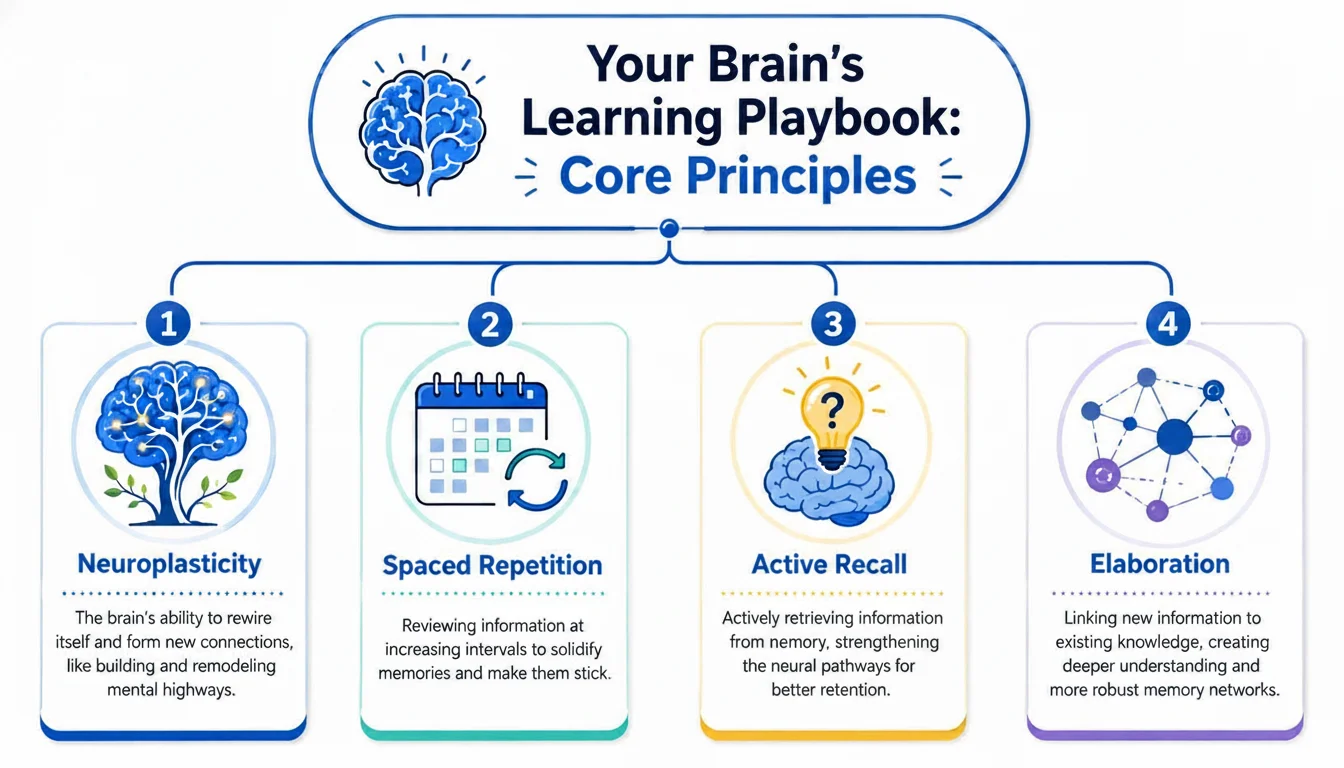
Neuroplasticity is your upgrade system
Consider neuroplasticity as your brain's remodeling ability. When you practice a concept, solve a problem, or explain an idea, you're not just "using memory." You're reinforcing the pathways involved in that skill.
That's why repetition matters, but not just any repetition. Passive exposure is weaker than active use. Reading a cloud security concept is one thing. Explaining when to apply it, comparing it to another model, or answering a practice question about it is what strengthens the route back to that knowledge.
Memory has a workbench and a storage room
Think of memory this way: your brain has a temporary workbench and a longer-term archive. The workbench holds what you're actively processing. The archive stores what you can retrieve later.
Busy learners often overload this workbench, attempting to learn too much in one sitting, across too many browser tabs, with too many interruptions. When this happens, the information doesn't settle well enough to be useful later.
Practical rule: If a study session leaves you feeling “busy” but unable to explain the material without looking, you probably filled the workbench without storing enough.
Pattern detection is one of your brain's superpowers
Your brain naturally seeks regularities. A review on statistical learning describes it as a pervasive mechanism involved in acquiring language and forming predictions about upcoming experiences. The review also notes that attention is automatically drawn to regularities.
This matters for exam preparation: disorganized studying makes everything feel like isolated trivia. Organized studying, however, helps your brain detect structure.
Use that principle by creating predictable study cycles:
- Group related concepts together. Study IAM, permissions, and policy evaluation as connected ideas, not random facts.
- Review in recurring rhythms. Repeated check-ins help the brain notice what returns and what matters.
- Look for templates and patterns. Many exam domains repeat the same logic in different wording.
For more tactical ideas on retrieval-heavy review, this guide on effective study techniques for recall proves useful, as it focuses on remembering under pressure, not just reading more.
Retrieval and elaboration make knowledge usable
Two habits transform information into exam-ready knowledge.
Active recall involves retrieving information from memory without looking first. This could mean using flashcards, creating blank-page summaries, or answering practice questions before consulting your notes.
Elaboration means linking new information to what you already know. If you're learning VPC peering, compare it to networking patterns you've seen at work. If you're learning project management terms, connect them to meetings, approvals, or handoffs you already manage.
When people say a topic finally "clicked," elaboration is often the reason.
From Science to Strategy: Evidence-Based Study Techniques
Effective study methods aren't random hacks. They're practical ways to apply learning science under real constraints like job deadlines, family life, and limited evening energy.
A busy adult usually doesn't need more content; they need a better sequence for using it.
Four techniques worth building around
Spaced repetition means revisiting material across multiple sessions instead of trying to lock it in at once. This works because memory strengthens when you return to information after some forgetting has started. The gap creates effort, and that effort helps.
Active recall is your exam simulator in miniature. The test won't ask if a concept looks familiar. It will ask if you can retrieve and apply it. So, your preparation should do the same.
Interleaving means mixing related topics instead of studying one area in a long, uninterrupted block. That sounds harder because it is harder. But this difficulty can improve discrimination. You learn not just what a concept is, but when it applies.
Elaboration deepens understanding by connecting ideas. Instead of memorizing a definition in isolation, you compare, contrast, classify, and explain.
For professionals studying at home, your environment also matters. If your sessions constantly dissolve into distraction, this guide on effective home study techniques can help optimize your study blocks.
What this looks like in practice
Here's a simple translation from principle to action.
| Learning Principle | Study Strategy in Action | MindMesh Academy Feature |
|---|---|---|
| Neuroplasticity | Practice consistently in shorter sessions; revisit concepts over time to strengthen them. | Spaced review scheduling |
| Pattern detection | Study by domain patterns, recurring question types, and linked concepts, rather than isolated facts. | Structured learning paths |
| Retrieval strengthens access | Use flashcards, self-quizzing, and practice questions before re-reading notes. | Practice questions and recall prompts |
| Deeper encoding through elaboration | Explain answers in your own words; connect topics to real work scenarios. | Guided explanations and concept mapping tools |
Many candidates make one mistake here: they treat these as separate tactics to rotate based on mood. Combining them within one session works better.
For example:
- Start with recall. Spend a few minutes answering from memory before opening materials.
- Study the weak point. Read or watch only what you missed.
- Elaborate immediately. Write a short comparison, teach it out loud, or relate it to a real task.
- Schedule the revisit. Don't leave the next review to chance.
That's the difference between "I covered the topic" and "I can use the topic."
For more domain-specific tactics, MindMesh Academy offers expert certification exam advice that helps translate general learning science into exam-day preparation.
Studying should feel like repeated retrieval with feedback, not repeated exposure with hope.
Your 4-Week Certification Study Blueprint
Many adults don't need motivation as much as they need structure. When a study plan is vague, guilt often rushes in. When it's concrete, you can start even on a busy Tuesday.
This four-week blueprint is designed for someone balancing work and exam preparation. Adjust the topic load, but keep the rhythm.
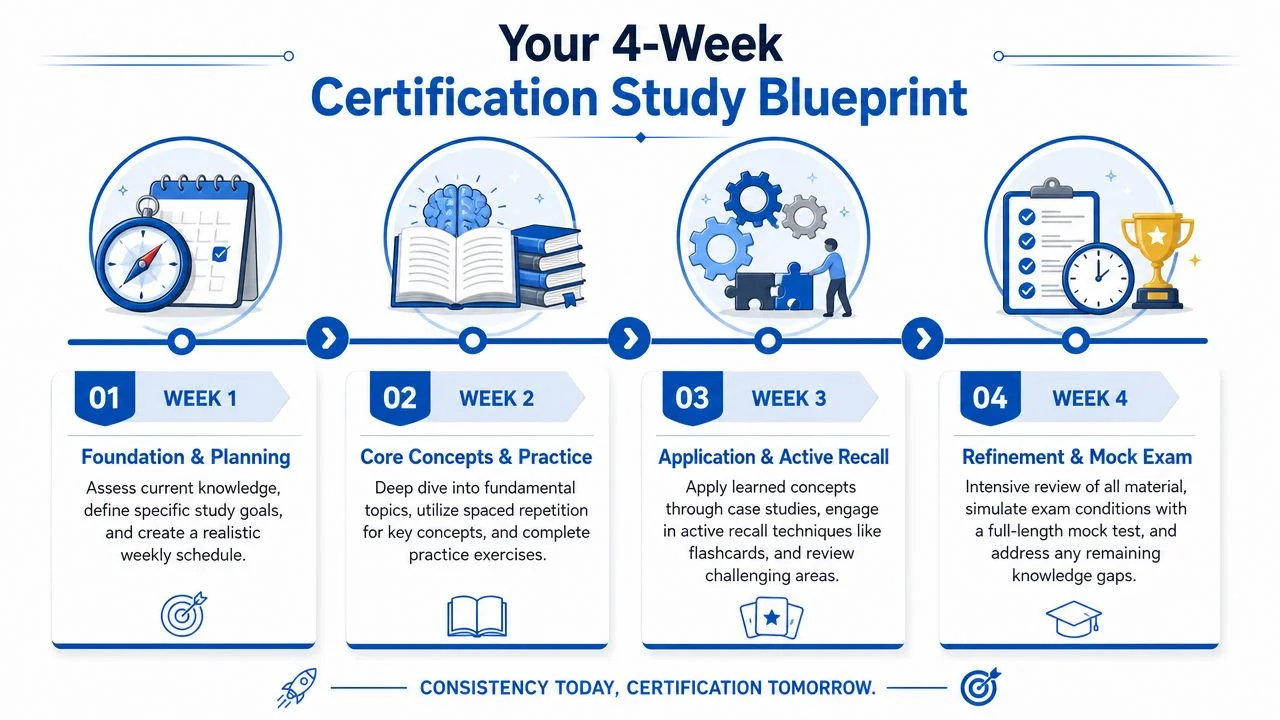
Week 1 builds the map
Your first job isn't memorization; it's orientation.
Break the exam into domains. Identify what feels familiar, what feels rusty, and what feels completely new. Then, create short study blocks across the week rather than waiting for a giant free day that might never come.
Focus on:
- Scope first. Know what the exam expects.
- Core vocabulary. Learn the language of the domain so later topics attach more easily.
- Simple summaries. End each session with a few lines written from memory.
A good rule for Week 1: stop while you still have mental energy. Early consistency beats heroic burnout.
Week 2 shifts from input to retrieval
Many learners improve quickly through this method: instead of mostly reading, start testing yourself every session.
Use flashcards, short-answer prompts, and mini quizzes. When you miss something, don't just mark it wrong. Ask why you confused it, what concept it resembles, and what cue should help you remember it next time.
Here's a quick visual overview of the rhythm you're building:
Week 3 adds mixing and application
By Week 3, avoid studying topics only in isolation. Mix related domains within the same session. If you're preparing for a cloud exam, combine architecture, security, and troubleshooting questions. If you're preparing for project or service management, mix planning, governance, and scenario judgment questions.
A strong sign of progress is not “I know this chapter.” It's “I can tell similar concepts apart under pressure.”
Do more scenario-based practice this week. Spend time explaining why one answer is better than another, not just which answer is correct.
Week 4 is for consolidation, not panic
Your final week should narrow focus, not expand it.
Review missed questions, weak domains, and recurring error patterns. Take at least one practice session under exam-like conditions. Then, use the results to guide targeted review instead of bouncing randomly across the syllabus.
Keep the final days clean:
- Protect sleep. Tired review is lower quality than rested recall.
- Trim new material. Don't flood yourself with fresh resources late.
- Review your own error log. Your mistakes are the most personalized study guide you have.
If you're still choosing a path or credential, browsing MindMesh Academy certifications can help align your study plan to a specific target.
Supercharge Your Plan with MindMesh Academy
A study plan is only as effective as your ability to follow it. This is where many learners slip. They know they should review older material, revisit weak topics, and track progress. But they often lack a system that makes those steps easy to repeat.
What a smart platform changes
A platform built around learning science reduces the number of decisions you need to make when you're tired.
Instead of asking yourself what to review next, you can follow a structured sequence. Instead of guessing if you're improving, you can view your performance by topic. Instead of treating all missed questions the same, you can spot patterns in what keeps breaking down.
That matters because high-stakes preparation isn't only about knowledge. It's also about metacognition, which means accurately judging what you know, what you merely recognize, and what still falls apart under recall.
Features that match the way people actually learn
The most effective study tools typically help with four key jobs:
- Scheduling review intelligently. Older material needs to come back before it disappears.
- Targeting weak areas. Learners improve faster when weak points are visible.
- Keeping progress visible. Momentum improves when you can see completed work and remaining gaps.
- Reducing friction. If review, questions, and tracking live in one place, you're more likely to stay consistent.
For a busy professional, convenience isn't a luxury; it's fundamental to learning design. A system that reduces setup time gives you more energy for the actual cognitive work.
Use tools to automate the routine parts of studying so you can spend your effort on thinking, recalling, and applying.
That's a key advantage of a platform approach: it turns good intentions into repeatable behavior.
Common Pitfalls and Dangerous Learning Myths
Some study habits feel effective because they're comfortable. That comfort, however, is precisely why they can be dangerous.
Myth one says passive review is enough
Rereading, rewatching, and highlighting can help you re-enter a topic. They aren't useless, but they often create an illusion of competence. The material looks familiar, so you assume it's learned. A practice question, however, can quickly expose that gap.
A better use for notes: close them first, try to recall the concept, then reopen them only to check and repair what's missing.
Myth two says you need a special learning style
Many people have preferences. Some like diagrams; others prefer listening, talking, or writing. Preferences are real. But the broad claim that people learn best only when instruction matches a fixed "style" is far weaker than popular study advice suggests.
Stronger guidance from educational neuroscience on learning myths and real supports points toward universal principles such as neuroplasticity, active retrieval, and the importance of sleep, nutrition, and exercise. In plain terms, how you engage with material matters more than a fixed label like 'visual' or 'auditory' learner.
Myth three says multitasking saves time
It usually steals quality. Switching between Slack, email, videos, and notes fragments attention. This fragmented attention weakens encoding, which then leads to shaky recall.
Try this instead:
- Use one task goal per session. Learn, quiz, or review. Don't blend everything at once.
- Remove obvious interruptions. Silence notifications and close unrelated tabs.
- Track recurring thought spirals. If worry keeps hijacking your session, resources on how to stop overthinking can help you regain focus.
For more tactical ways to improve retention in technical subjects, these effective memory aids for tech professionals are worth reviewing.
One more mistake deserves attention: people often assume that if studying feels difficult, something is wrong. In reality, the right kind of difficulty often signals that memory is being challenged productively. Struggle during recall is normal. Silent rereading, however, should make you suspicious.
Your Key Takeaways for Smarter Studying
If you remember only a few points from the science of learning, remember these.
- Your brain can still change. Neuroplasticity makes adult learning effective. Improvement isn't reserved for those with more time or younger brains.
- Passive review isn't enough. Rereading might feel smooth, but exams reward retrieval.
- Use spaced repetition. Revisit material purposefully over time, before you forget it completely.
- Practice active recall every session. Begin by answering from memory before checking notes.
- Organize study around patterns. Your brain learns regularities well, so connected topics and predictable review cycles are highly beneficial.
- Mix topics before the exam does it for you. Interleaving improves your ability to choose the correct concept in the right situation.
- Elaborate, don't just memorize. Explain ideas in your own words and connect them to real work scenarios.
- Protect your attention. Multitasking, constant notifications, and stress can wreck a short study session.
- Track errors carefully. Missed questions aren't failures; they're the clearest map of what to fix next.
- Build a repeatable system. Certification success often comes from steady cycles of learning, recall, feedback, and review.
Smart studying isn't about squeezing more suffering into your week. It's about making each session do the kind of work that leads to durable memory and calm performance on exam day.
If you're ready to apply these principles and build durable knowledge for your next certification, MindMesh Academy offers structured prep, progress tracking, and study tools designed for busy professionals. Get started with a CompTIA Network+ practice exam to test your readiness and apply what you've learned.

Written by
Alvin Varughese
Founder, MindMesh Academy
Alvin Varughese is the founder of MindMesh Academy and an enterprise architecture leader. An electrical engineer by training, he moved from factory automation in South Africa to cloud architecture at GE Appliances and Humana (Fortune 50), and holds 20 professional certifications including AWS Solutions Architect Professional, Azure DevOps Engineer Expert, and Microsoft Agentic AI Business Solutions Architect. He built MindMesh Academy after interviewing too many highly certified candidates who couldn't answer basic questions: the goal is prep that makes you better at the job, not just able to pass the exam.