What Is a Practice Exam and How Can It Secure Your Success
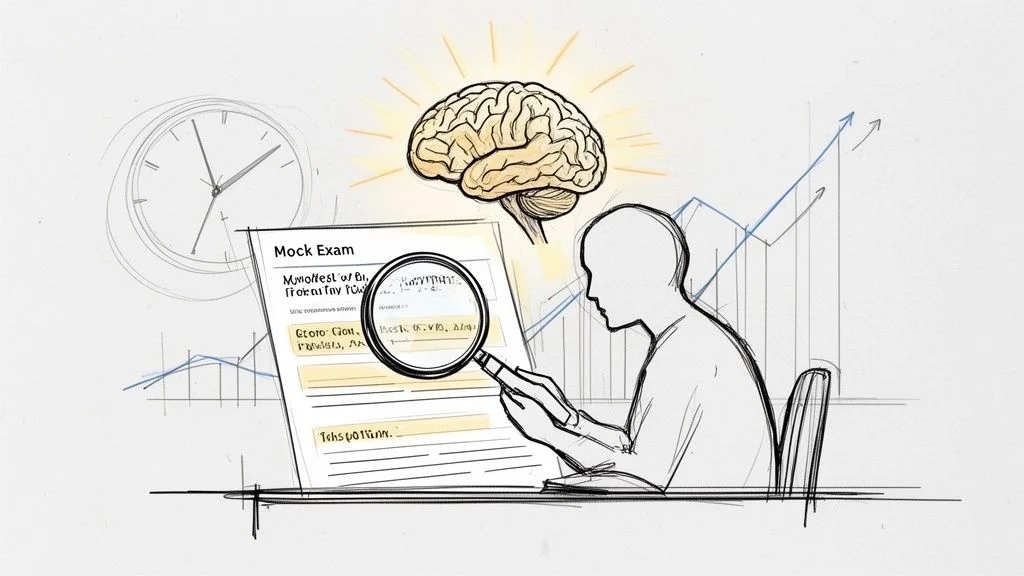
A practice exam serves as a dry run for testing your skills and knowledge in the IT world. It goes beyond a simple quiz by simulating the timing, format, and specific content of official tests from providers like AWS, Azure, PMP, or CompTIA. These assessments give you a chance to feel the pressure and pace of the actual testing environment. You can refine your strategy and identify gaps without the high stakes of the real exam. This preparation ensures you arrive ready.
What Is a Practice Exam, Really?
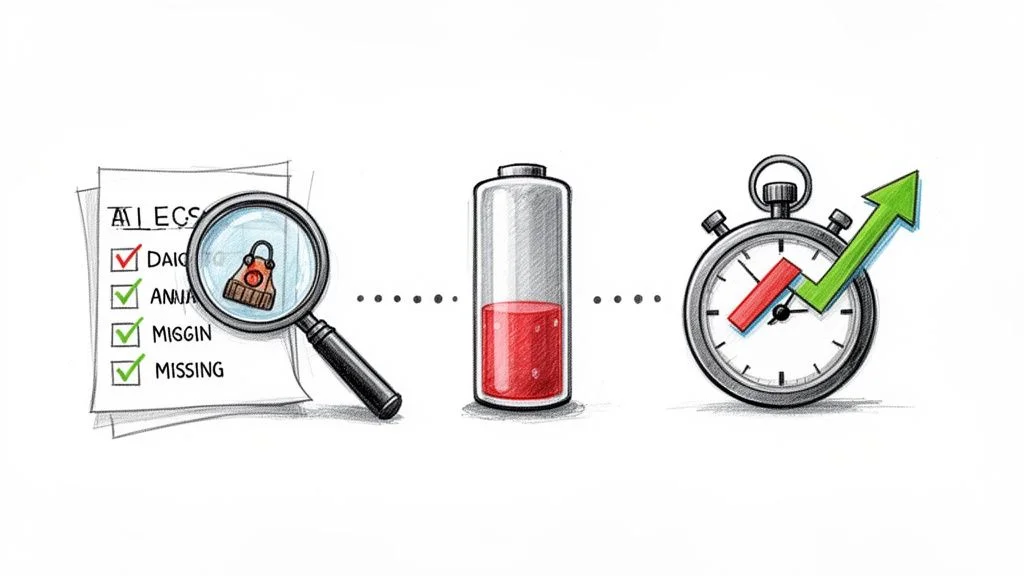
It is easy to misunderstand the function of practice exams, frequently viewing them as simple knowledge checks. Their true value lies in their role as a sophisticated diagnostic tool. Consider a pilot training in a flight simulator before their first actual flight. The simulator does more than check if they know where the buttons are. It forces them to handle realistic weather, mechanical failures, and the mental exhaustion that comes with a long flight.
A high-quality practice exam provides that same level of preparation for your certification. It goes beyond simple recall of facts to recreate the full test-taking experience. This full-scale simulation is critical for difficult exams like the Project Management Professional (PMP) or AWS Certified Solutions Architect – Professional. Success on these tests depends on your ability to apply complex logic while under pressure, rather than relying on rote memorization.
What a Practice Exam Truly Simulates
Authentic simulation is the primary feature that separates a genuine practice exam from other study materials. The goal is to replicate the exact conditions you will face on the day of your official exam.
Expect a quality practice exam to simulate these specific areas:
- Time Constraints: You must work against a strict clock. Answering a large volume of questions within a limited window is a skill that requires pacing and time management. For example, an Azure Administrator exam might require you to finish 40–60 questions in 120–150 minutes. Every second spent on a single difficult question is a second lost for the rest of the test.
- Question Format and Mix: The questions must reflect the style of the real exam. This includes multiple-choice, multiple-response, drag-and-drop, or scenario-based questions common in ITIL or CompTIA exams. These questions should follow the same topic weightings found in the official exam blueprint provided by the vendor.
- Mental Stamina: Taking a 2-, 3-, or 4-hour certification exam like the CISSP is a marathon of focus. A practice test builds your capacity to stay concentrated and helps you avoid the fatigue that often leads to mistakes. You learn how to stay sharp even when you have been sitting in the same chair for hours.
A well-designed practice exam acts as an honest and objective study partner. It provides a data-driven assessment of your current standing and shows you exactly where you need to focus your study time.
By using these simulations, you move from passive review to active application. You are no longer just trying to remember a list of terms; you are using that information to solve problems under stress. This is what professional certifications are designed to measure. This approach changes your study plan from a guessing game into a targeted training program.
Reflection Prompt: How might simulating time pressure on a practice exam help you specifically with a multi-part, scenario-based question often found in AWS advanced certifications?
Where Practice Exams Came From (And Where They're Going)
Modern practice exams use data-driven features that are a world away from their simple origins. The concept began with basic, photocopied question packets. In those days, study materials offered a surface-level look at test content but lacked real-time feedback or the immersive environmental simulation needed for effective preparation. These tools were static, providing only a small window into what the actual testing experience felt like.
The environment changed significantly when online learning gained traction. The early 2010s marked a significant shift that redefined the scope of these tools. Practice exams moved from passive documents to interactive, intelligent training systems that use technology to provide more effective preparation.
From Static Mocks to Smart Simulators
Digital transformation introduced features that older formats could not support. Modern online platforms now replicate the exact timing, user interface, and adaptive logic used in official certification exams. Candidates can feel the pressure of the clock and learn the quirks of the testing software before they arrive at the testing center.
This shift has been particularly useful for IT professionals pursuing credentials from providers like AWS, Azure, CompTIA, and PMP. The success of these sophisticated online tools has fueled the growth of the global test preparation market. This sector reached a value of US$126 billion (verify current market data via industry reports) and is expected to grow to US$177.9 billion by 2030. This growth shows the high value that professionals place on quality practice exams when they want to pass with confidence.
The modern practice exam functions as a personalized analytics engine. It breaks down your performance to show what you got wrong and explains the logic behind each error.
The Power of Data-Driven Insights
The real change in practice exams involves the use of advanced analytics. Instead of getting a raw score and nothing else, today's exams generate detailed reports on your performance.
- Topic Mastery Analysis: These reports identify which knowledge domains are your strengths—such as networking on an AWS Solutions Architect exam—and which areas, like security services, need more study time.
- Time Management Metrics: You can see exactly which question types or specific topics take the most time. This allows you to adjust your pacing strategy to improve your efficiency during the actual test.
- Performance Trending: Visual dashboards show your progress over several weeks. This turns abstract study hours into visible gains in proficiency.
Platforms like MindMesh Academy illustrate this shift. They offer adaptive questions that change based on your skill level and provide clear analytical insights. This ensures every session remains a focused learning opportunity. This data-driven method helps you study more effectively, making the practice exam an essential tool for any IT professional looking to advance their career through certification.
The Real-World Benefits of Using Practice Exams
View a practice exam as a dress rehearsal for your certification, rather than a simple pop quiz. Including these tests in your study plan provides a competitive advantage that is more than just measuring your current knowledge. Their greatest strength is the ability to pinpoint your weak spots with high accuracy. You no longer have to guess which topics need work.
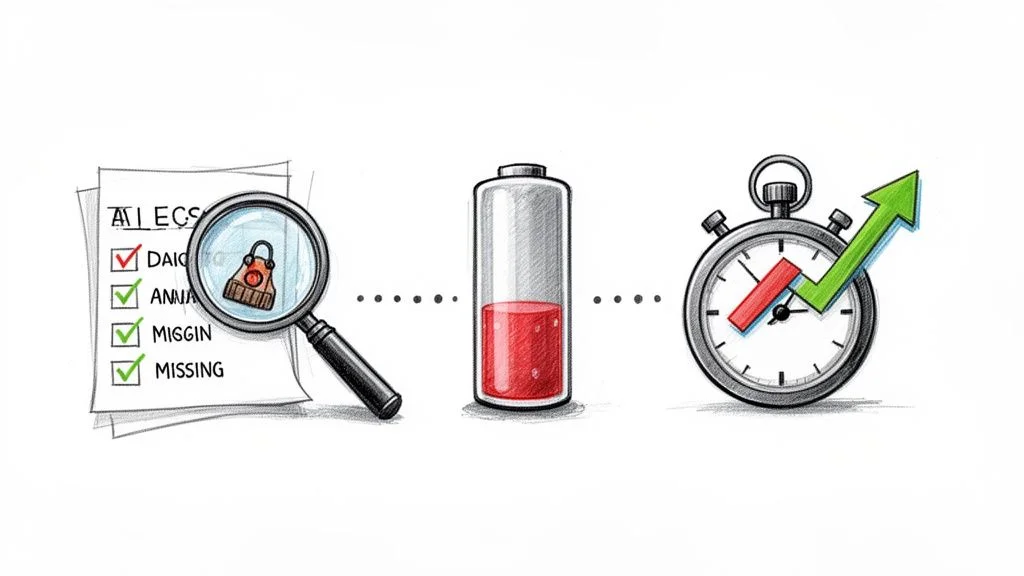
A reliable practice test provides a detailed score report that shows exactly where you lose points. This allows you to stop wasting time on concepts you already know. Instead, you can focus on the specific areas that offer the biggest score increases. Your study time becomes targeted and more effective. You can see your progress through actual data.
Building Mental Endurance and Confidence
Most IT certification exams are mental marathons. A three-hour test, like the AWS Certified Developer Associate or a Microsoft Azure certification, can drain your energy. This often leads to mistakes on questions you actually understand because your brain is tired. Practice exams act as a training ground to build this mental stamina.
When you take full-length simulations, you train your brain to stay sharp for long periods. This repetition builds endurance and creates a sense of confidence. You will walk into the testing center knowing you have the mental strength to handle the duration and the pressure. You have already handled these conditions before.
A practice exam turns the unknown into the familiar. Every simulation reduces test-day anxiety. You replace fear with confidence built on actual preparation and repeated exposure to the testing environment.
Familiarity offers a psychological advantage. When the question formats and the user interface feel routine, you can use 100% of your mental energy to solve complex problems. You avoid wasting effort on stress or uncertainty about how the exam works. You focus on the answers.
Key Takeaway: Consistent practice under exam conditions builds knowledge recall and psychological resilience for test day.
Mastering Time Management Under Pressure
Poor time management causes many candidates to fail, even when they know the material. A practice exam is the only tool that replicates the pressure of a ticking clock. It forces you to think under stress and create a pacing strategy. You learn how to move through the test without rushing or getting stuck.
A CompTIA Security+ candidate might realize they spend too much time on performance-based questions (PBQs). This leaves them rushing through the multiple-choice section. Analyzing timing data helps them distribute minutes more effectively. They might decide to skip the PBQs initially and return to them after securing the easier points. This shift in strategy can be the difference between a pass and a fail.
Developing this skill follows a repeatable cycle:
- Identify Bottlenecks: Find the question types or topics that slow you down. Look for patterns where time limits cause errors.
- Adjust Your Strategy: Try marking hard questions for later or setting time limits for specific sections.
- Practice Until Instinctive: Repeat simulations until your pacing is automatic. You want to reach a point where you move on without checking the clock constantly.
This deliberate practice ensures you finish the exam within the time limit. You stay calm and steady. To look closer at how to structure your learning, look at our guide on the best study methods for exams to improve your test-taking strategy.
A Strategic Framework for Using Practice Exams
Understanding that practice exams are useful is simple. Learning how to squeeze every bit of value from them is a separate skill. Many people make the mistake of just taking a test, checking their final score, and moving on. This is not enough. To succeed, you need a repeatable process that turns each simulation into a cycle of learning and constant improvement.
This approach goes beyond getting a passing mark. It is about mastering the concepts that the questions test. When you use practice tests with a deliberate structure, you turn a single score into a clear, actionable plan. Let’s look at the three steps to reach this level of mastery.
Step 1: Replicate Exam Day Perfectly
Treat every practice exam with the same seriousness as the real certification. Your goal is to simulate the testing environment as closely as possible. This builds the mental stamina you need and reduces test-day nerves by making the experience feel routine. If you have already sat through the same time pressure five times, the actual exam will feel like just another practice session.
To do this well, you must be strict with your self-discipline. There are no shortcuts. If you allow distractions now, you will struggle when the real pressure is on.
- Eliminate Distractions: Find a quiet, isolated space. You must turn your phone off completely. Do not leave it on vibrate, as a buzzing phone still breaks your concentration. Close all browser tabs that are not part of the exam. Tell everyone in your house or office that you are off-limits. You are training your brain to stay focused for several hours at a time, and every interruption resets that progress.
- Adhere to Strict Time Limits: This is a firm rule. If the official exam gives you 180 minutes, you must set a timer for exactly 180 minutes. Do not give yourself extra time to finish the last few questions. When the timer goes off, you stop. This teaches you how to pace yourself. You will learn when you are spending too much time on a difficult question and when you need to move on to ensure you see every item on the test.
- Utilize Only Allowed Resources: It is tempting to look up a term you forgot. You must resist that urge. If the real exam does not allow notes, books, or specific calculators, you must not use them during your practice sessions. Most professional IT certifications are very strict about external materials. Practicing without them ensures you can recall the information under pressure.
This discipline prepares your brain for the stress of the actual event. You are building endurance. For those preparing for AWS certifications, our guide on how to prepare for AWS certification provides exam-specific strategies that build on these rules.
Step 2: Analyze Your Performance Like a Detective
The real work begins after the timer stops. The review phase is where the actual learning happens. While a score of 85% might feel like a win, the most important data is hidden in the 15% of questions you missed. You should also look closely at the questions you got right. If you guessed correctly but were not 100% sure of the answer, that is still a knowledge gap that needs to be addressed.
Do not just look at the correct answer and move to the next page. You need to act like a detective. Look at every mistake and put it into a category. Was it a simple reading error? Did you misunderstand a technical concept? Or did you just run out of time?
The point of a practice exam is not to get a perfect score. It is to collect data. Every wrong answer is a gift. It is a signal telling you exactly where to spend your study time.
Look for patterns in your results. You might see that you always miss questions about storage on an Azure exam or struggle with network fundamentals on a CCNA exam. If you find that you frequently fail long, scenario-based questions, you know you need to work on your reading speed and comprehension of complex scenarios. This level of analysis stops you from just memorizing facts and helps you understand how different concepts work together. Learning how to use practice cases can also improve these problem-solving skills.
Step 3: Turn Insights Into Action
The final step is to close the learning loop. You take the patterns and gaps you found and build a study plan around them. Your analysis should dictate what you do for the next few days. If you found a weakness in Identity and Access Management (IAM) for an AWS exam, your next study sessions must focus on IAM. You should not waste time reviewing topics you already know perfectly.
If you struggled with time management, start doing timed drills on specific question types that slowed you down. This cycle of test, analyze, and remediate is the engine that drives your progress. It ensures every hour you spend studying is focused on the areas that will actually help you pass with confidence. This targeted effort is much more effective than reading a textbook from cover to cover and hoping for the best.
Common Mistakes That Undermine Your Practice
Practice exams are effective tools in your study kit, but they only work if you use them correctly. Rushing through test after test often wastes time and creates a false sense of confidence. To move the needle toward success, avoid the pitfalls that derail most candidates.
One major error is turning study sessions into a race to finish the highest number of exams possible. This "quantity over quality" mindset misses the point. Real learning does not happen while you click through multiple-choice bubbles. Instead, it happens during the deliberate and slow review process that follows each simulation. If you spend one hour taking a test, you should spend at least two hours reviewing why you got certain questions wrong and why you got others right.
Mistake 1: Memorizing Answers Instead of Concepts
It is a tempting shortcut. You see a wrong answer, check the correct one, and tell yourself you have mastered the topic. The problem is that you have only memorized a specific fact rather than the underlying principle. This might help you answer the exact same question during a second practice run, but it offers little help on the actual certification exam. Real test questions use different phrasing and contexts to see if you actually understand the core material.
Think of it this way: memorizing an answer is like learning one specific shell command without knowing how the operating system works. You can run that one command, but you cannot adapt, troubleshoot, or apply the logic to a different scenario. True mastery of a networking protocol or security framework allows you to handle various situations effectively because you understand the logic behind the solution. If the vendor changes the scenario slightly, the memorized answer fails, but the conceptual understanding remains valid.
Mistake 2: Treating a Low Score as a Failure
Seeing a low score on your screen feels like a setback, but viewing it as a failure is a major mistake. That score is not a final judgment on your intelligence or your potential; it is a diagnostic tool. It shows you exactly where your knowledge gaps are, pointing to the specific areas that require your attention. If you score 40%, you haven't failed; you have simply identified 60% of the material that needs a second look before the real exam day. This clarity helps you prioritize your remaining study hours.
A low score on a practice exam is not a defeat. It is a specific guide that shows you where more effort will result in the most significant improvement.
Get into the habit of viewing these results as data. They allow you to change your study plan from random guessing to a targeted strategy. When used as a diagnostic tool, research shows that practice exams can reduce certification failure rates by as much as 35%. This impact is why the professional test preparation market continues to grow as more students look for ways to pass with confidence. You can find more data on how these platforms are changing professional certification in this latest market report on practice test platforms.
The following graphic shows the ideal approach—a continuous cycle of refinement.
This three-step loop—Simulate, Review, Improve—is the engine that creates lasting progress. It turns every practice session into a cycle of effective learning that builds your skills over time. By sticking to this loop, you ensure that every hour spent studying actually translates into a higher score on your official test day.
Turning Practice into Performance on Exam Day
A practice exam is more than just a trial run before the real event. It is your most effective diagnostic tool for earning a professional certification. Success does not come from simply answering hundreds of questions; it requires extracting specific insights from every attempt and using that information to create a sharper, more focused study plan.
The best way to master the material is by following a three-part cycle: simulate, analyze, and integrate.
First, recreate the actual testing environment as closely as possible. This means removing distractions, sticking to the official time limit, and refusing to look up answers while the clock is running. To replicate the pressure of the live test, find platforms that provide a dedicated Exam Mode feature. This setting lets you work under realistic conditions, which helps build mental endurance and improves your pacing. If the real exam lasts three hours, you should sit for the full duration during your practice sessions to get used to the physical demands.
Next, review your performance results thoroughly. Avoid looking at mistakes as failures. Instead, treat every incorrect answer as a specific data point that shows exactly where you need to spend more study time. Look at the explanations for every question, even the ones you got right, to ensure you understood the logic behind the correct choice. Understanding why a distractor was wrong is often as helpful as knowing why the correct answer was right.
Your primary objective is not to attain a perfect score on a practice test. It is to strategically gather the critical intelligence required to achieve a stellar performance when it truly counts on exam day.
Finally, apply that feedback directly into your ongoing study routine. This is the stage where your preparation truly improves. Spend your time and energy on the specific topics where you struggled during the simulation. Methodically address those gaps until you understand the underlying concepts as well as your strongest subjects.
By repeating this cycle multiple times, you build genuine confidence and prepare yourself to pass with confidence.
If you are preparing for an ITIL certification, our detailed guide on how to ace ITIL practice exams offers specific strategies to help you succeed on the current exam.
Practice Exam FAQs: Your Questions Answered
Even with a well-structured study plan, questions often arise as you work through your certification preparation. These concerns are a natural part of the process for any IT professional. Addressing these common inquiries helps you stay focused on the material rather than the testing mechanics. Let’s look at the most frequent questions regarding the use of practice exams in a study routine.
How Many Practice Exams Should I Really Take?
There is no single rule for the exact number of tests you need. The quality and depth of your review process for each exam matters far more than the total number of tests you complete. However, if you want a reliable framework, aiming for three to five strategically timed, full-length exams is a solid approach for most technical certifications.
-
Your First Test (The Baseline): Take one at the very start of your study period. This initial attempt provides a clear, honest snapshot of your current knowledge and identifies skill gaps before you spend weeks on study materials. By revealing major weaknesses early, you can focus your energy on the topics that need the most work rather than reviewing things you already know.
-
Mid-Point Check-Ins (Tests 2-3): After several weeks of focused study, take another one or two practice exams. These act as your progress reports. They indicate whether your current study methods are actually working. If your scores are not improving, you can pivot your strategy. You might decide to spend more time on hands-on labs or seek out different technical documentation to grasp difficult concepts.
-
The Final Dress Rehearsal (The Last Test): Schedule your final full-length practice exam about one week before your official test date. Treat this session exactly like the real thing. Sit in a quiet room, remove all distractions, and stick to the official time limit. This is your chance to fix timing issues, manage pre-test anxiety, and build the confidence required to walk into the testing center feeling fully prepared.
Aren't Practice Exams and Mock Exams the Same Thing?
In most professional contexts, people use the terms "practice exam" and "mock exam" interchangeably. Both describe a full-length, simulated test designed to mimic the actual certification exam as closely as possible. You will see both terms used across different study platforms and official vendor documentation.
Occasionally, a "mock exam" might refer to a more formal simulation, perhaps one that is proctored or takes place in a specific testing environment. However, the underlying purpose is identical. The real distinction you need to understand is the difference between an exam and a quiz.
A quiz is a different type of assessment. It is usually short and focuses on a narrow set of concepts, such as a single domain or a specific technical task. Quizzes are designed for quick knowledge checks, not for measuring your overall exam readiness or mental stamina during a long testing session.
Consider this analogy: A quiz is like a quick drill to practice a specific coding syntax or command line argument. A practice exam is a full-scale, end-to-end system integration test with a simulated deployment and a strict deadline.
What if My Practice Exam Scores Are Terrible?
If you see a low score, take a deep breath. A low score on a practice exam is not a failure. It is useful data. This feedback is direct and personalized, telling you exactly where to focus next. A low score identifies the specific technical areas that require immediate attention and remediation.
A low score functions like a diagnostic report from a technician. It is not judging your abilities; it is pointing to the parts of your knowledge base that need repair. Instead of getting discouraged, use the results as a targeted study guide to optimize your remaining preparation time.
Review your results and ask yourself these questions:
- Are all my mistakes clustered within one or two specific topics, such as a particular domain in an ISACA CISM exam or specific services in an Azure Solutions Architect exam?
- Did I experience mental fatigue or run out of stamina, causing me to rush or make careless errors toward the end of the exam?
- Am I consistently misinterpreting how certain questions are phrased or what they are truly asking?
Use these answers to create a hyper-targeted remediation plan. A low score found early in your preparation is a benefit. It provides a clear roadmap to turn your weaknesses into strengths before you pay for the actual exam. If you find you are failing a specific domain, you can spend the next several days doing nothing but configuration labs for that topic.
Ready to pass your exam with confidence? MindMesh Academy offers data-driven practice exams and detailed analytics to help you master complex IT certification material. Explore our thorough courses at Explore IT Certification Practice Exams and begin the process of studying smarter instead of simply working longer hours.

Written by
Alvin Varughese
Founder, MindMesh Academy
Alvin Varughese is the founder of MindMesh Academy and holds 20 professional certifications including Microsoft Agentic AI Business Solutions Architect, AWS Solutions Architect Professional, and Azure DevOps Engineer Expert. He's held senior engineering and architecture roles at Humana (Fortune 50) and GE Appliances. He built MindMesh Academy to share the study methods and first-principles approach that helped him pass each exam.